Adductor Magnus Training: Seated Adductor Machine and Copenhagen Planks for Thigh Mass
Adductor magnus training explained: what research says on deep squats, the adductor machine and Copenhagen planks for thicker inner thighs and groin strength.
TL;DR. The short answer
- Adductor magnus training works best as a stack: deep, full-range squats or leg presses as the base, 2-3 sets on the adductor machine, and Copenhagen planks for groin resilience.
- In a 10-week MRI study of 17 young men, adductor muscle volume rose 6.2% after full squats versus 2.7% after half squats, so depth matters.
- No trial has directly tested the seated adductor machine for growth. It is a reasonable, low-fatigue way to add volume, but the proof is indirect.
- In football players, one 8-week Copenhagen programme raised eccentric adductor strength by about 36%, and another trial cut the odds of self-reported groin problems by 41%. Those are athletes, not bodybuilders.
- Groin pain, a recent strain or hip pain? Get it assessed by a physio or doctor before loading the adductors hard.
Part of our complete guide: Complete Lower-Body & Core Training Guide: Quads, Glutes, Hamstrings, Calves & Abs Science
Table of contents
Adductor magnus training is the missing piece for a lot of lifters who squat hard and still feel their legs look thin from the front. The short answer: squat deep, add 2-3 hard sets on the adductor machine, and use Copenhagen planks for groin strength. That stack covers size and resilience, though the evidence behind each piece is different, as we will see below. For the wider picture of leg training, see our complete guide to lower body and core training.
One thing first. You will see claims online that the adductor magnus is “the second largest muscle in the body.” I could not confirm that from the research, so I am not going to repeat it. You do not need the ranking to justify training it.
Why train adductors?
Most lifters skip them. Leg day becomes squats, leg press, curls and calves, and the inner thigh gets whatever is left over, which is usually nothing. Then they wonder why the leg looks narrow from the front.
The adductors sit on the inner thigh and pull the leg towards the midline. The adductor magnus is the biggest of the group, and part of it works like a hamstring, helping extend the hip.
That second job is why it gets hammered in squats and deadlifts. In an EMG-assisted modelling study of 15 injury-free people, the squat, step-up, deadlift and sumo deadlift all loaded the ischiocondylar part of the adductor magnus strongly (Collings et al., 2026). Hip-extension lifts, not just inner-thigh squeezes, are adductor lifts.
We cover the hip-angle mechanics in hip flexion depth and adductor magnus recruitment. Here the focus is practical training.
Do deep squats grow the adductors?
Yes, and depth seems to matter. In a randomized trial, 17 young men did either full or half squats twice a week for 10 weeks. MRI showed adductor volume rose 6.2% in the full squat group and 2.7% in the half squat group, a significant difference. Glute max followed the same pattern (6.7% versus 2.2%) (Kubo et al., 2019).
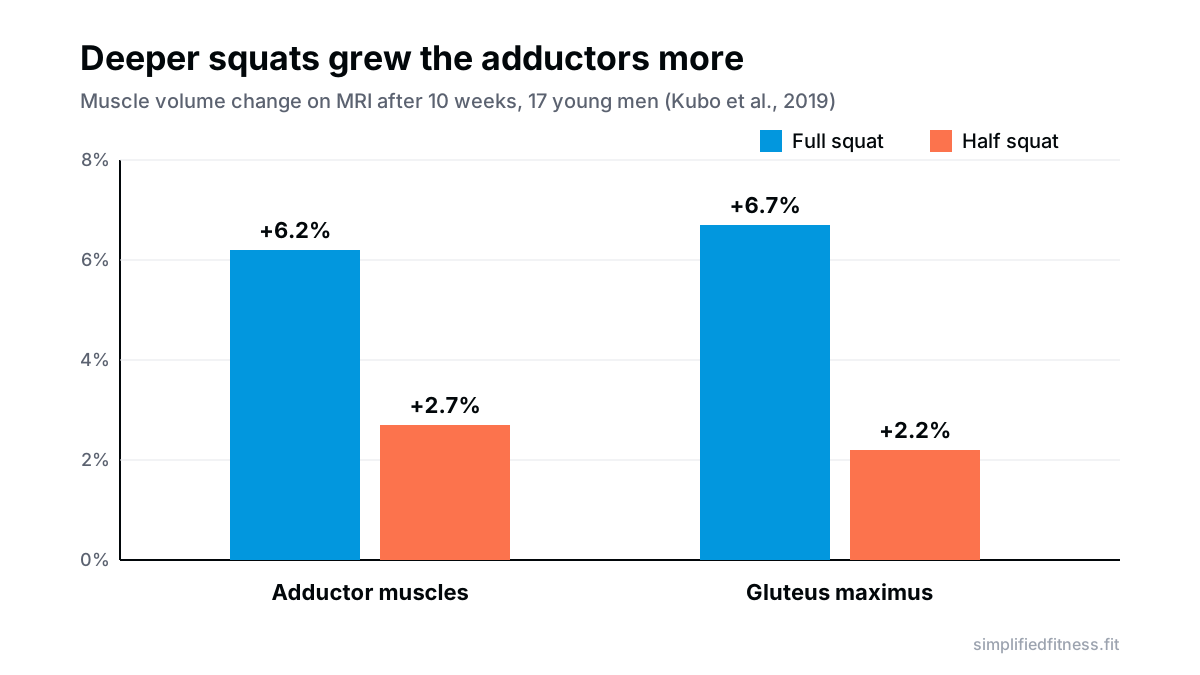
Caveats are real. It is only 17 people, all young men, and the groups were small (8 and 9). Still, a systematic review also concluded that full range of motion favours lower-body hypertrophy over partial range (Schoenfeld & Grgic, 2020). The practical read: if you only quarter-squat, you are leaving inner-thigh growth on the table. If depth bothers your knees or hips, our guide on squat depth for hypertrophy helps you pick a range you can own.
Does the seated adductor machine build thicker thighs?
Probably, with an honest asterisk: I found no trial that tested the adductor machine for muscle growth. The case is indirect. Hard sets taken close to failure through a decent range tend to grow muscle, and the machine makes that easy to do for the adductors without needing balance or skill.
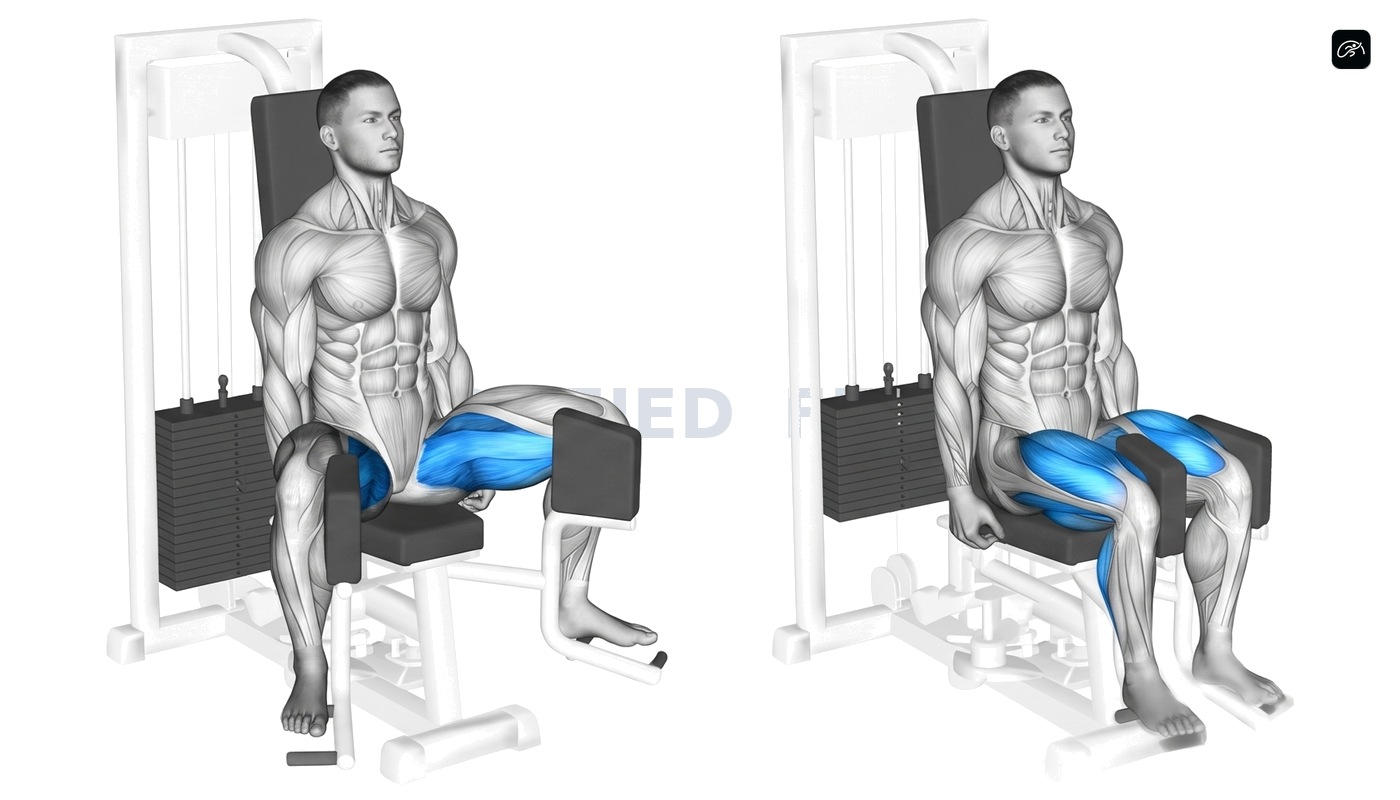
What the machine does well is isolate. Squats spread effort across quads, glutes and adductors. The machine lets you add adductor volume without adding more hip and spinal fatigue. That makes it a decent stimulus-to-fatigue choice after heavy legs.
What it probably does not do: replace deep squats. The modelling study above did not test the machine, and the machine positions the hips in a seated, flexed position, so it likely favours the pubofemoral and inner-thigh parts more than the hip-extension part. That is my reasoning, not a measured result.
How to run it
- Set the pads so your thighs start in a stretch you can control, not a painful one.
- Sit tall, back against the pad, and squeeze in over about 1-2 seconds.
- Pause briefly, then lower over 2-3 seconds. Do not let the stack slam.
- Do 2-3 sets of 10-15 reps, stopping 1-2 reps short of failure. Our RIR and RPE calculator helps you judge that.
- Add weight or a rep when you hit the top of the range for all sets.
What are Copenhagen planks good for?
A Copenhagen plank is a side plank with your top leg on a bench and your bottom leg off the floor. The top-side adductors hold your hips up.
In modelling, the long-lever version landed in the top force tier for every adductor muscle tested, which is why it sits at the hard end of the scale (Collings et al., 2026). In 40 elite football players, the Copenhagen adduction exercise and a banded hip adduction were the two dynamic high-intensity options, with adductor longus activity up to 108% of a maximal voluntary contraction in the top exercise (Serner et al., 2014).
Strength and injury results
Those results come from footballers, not bodybuilders, so keep that in mind.
- In 24 sub-elite U-19 players, 8 weeks of Copenhagen training raised eccentric hip adduction strength 35.7% versus no change in controls (Ishøi et al., 2016).
- In 45 elite U-19 players, swapping the Copenhagen exercise in for the Nordic hamstring exercise within the FIFA 11+ warm-up produced an 8.9% greater eccentric adduction strength gain than the standard programme (Harøy et al., 2017).
- In a cluster-randomised trial of 652 semiprofessional players, self-reported groin problems averaged 13.5% in the programme group versus 21.3% in controls, 41% lower odds of reporting groin problems (OR 0.59) (Harøy et al., 2019).
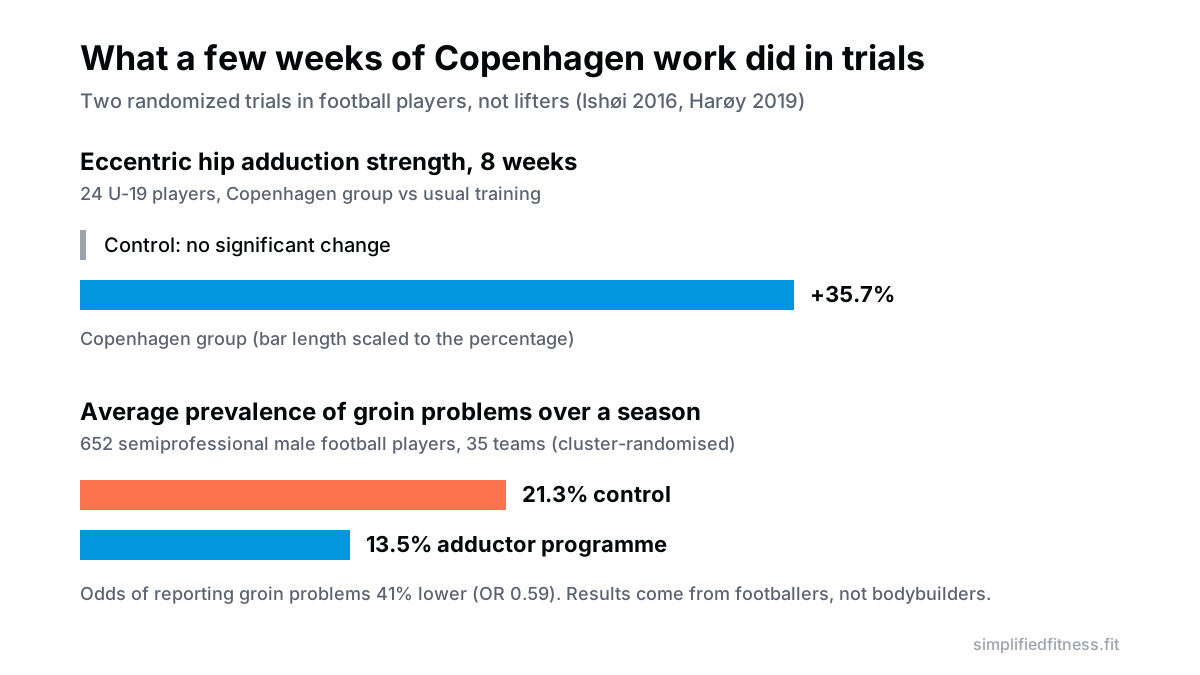
That last outcome was self-reported by questionnaire, and the trial could not blind players to the exercise. Keep the claim modest: it looks helpful for groin resilience in kicking and sprinting sports, and it is unlikely to hurt if you progress sensibly.
Can they add size?
Maybe. In 45 active adults, 8 weeks of Copenhagen training increased adductor muscle thickness on ultrasound by roughly 18%, but thickness went back to baseline after 4 weeks of detraining (Alonso-Fernandez et al., 2022). Ultrasound thickness is not MRI volume, and some of that swelling may be short-term. Use it as a strength tool that might also help size.
How do I put adductor magnus training into a week?
Think in three layers: a base, direct work, and resilience.
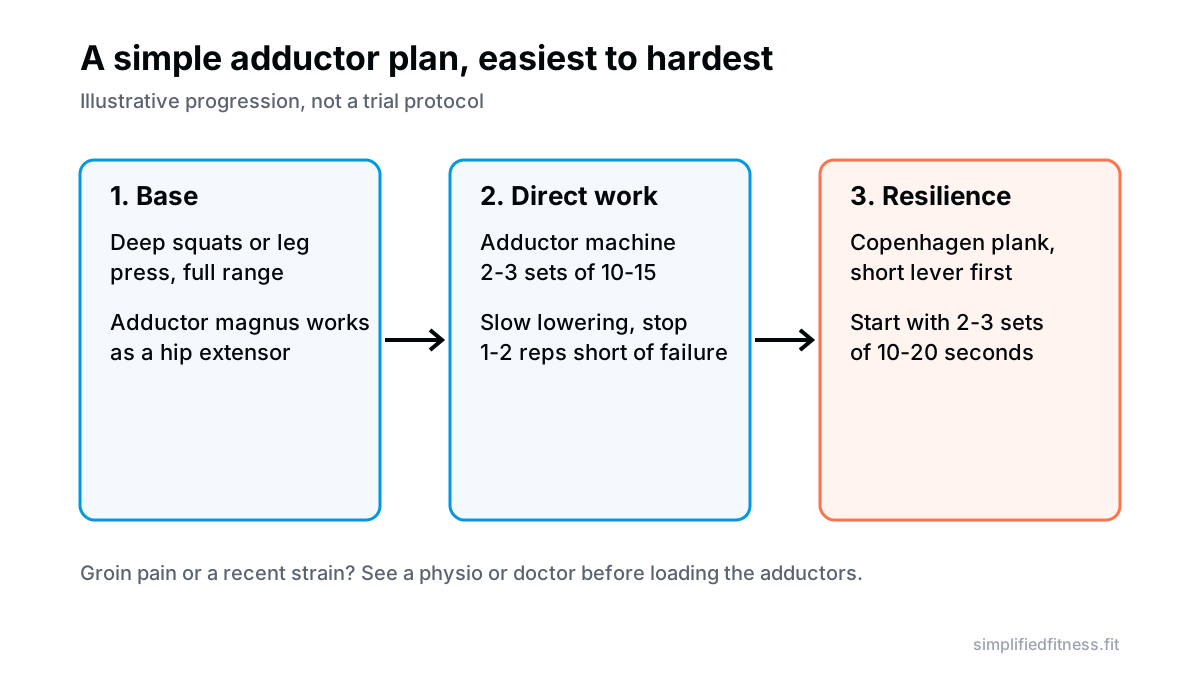
| Piece | What | Starting dose | Why |
|---|---|---|---|
| Base | Deep squat or leg press | Your normal leg days | Loads adductor magnus as a hip extender |
| Direct | Seated adductor machine | 2-3 sets of 10-15, twice a week | Easy extra volume, low fatigue |
| Resilience | Copenhagen plank (short lever first) | 2-3 sets of 10-20 seconds per side | Strength and groin protection in sport |
Drop the machine sets in at the end of a leg day. Do Copenhagen planks after your warm-up or on a second leg day, when you are fresh enough to hold good form. The leg plan on our free leg day workout shows where these fit, and programming a complete leg split covers weekly volume.
If you are on a home budget, a sofa-edge Copenhagen plank and deep goblet squats cost nothing. Banded adduction was also among the higher-intensity options in the EMG work, so a cheap loop band is a reasonable home option when you have no machine.
If you are short on time, here is the order of priority. Depth first, because it is free. Machine sets second, because they are cheap volume. Copenhagen planks third, because they need the most care and their evidence is mainly about strength and groin problems in sport.
When to be careful with the adductors
Groin strains are common in sprinting and kicking sports, and early return to heavy adductor work can aggravate them. See a physio or doctor if you have:
- sharp groin pain with squats, walking or running
- a recent pull or “pop” in the inner thigh
- deep hip pain or clicking that does not settle
- pain that wakes you at night or gets worse over weeks
Copenhagen planks are intense. Build the time over several weeks, and stop if you feel a sharp pull. Do not treat pain as a sign the exercise is “working.”
The bottom line
Adductors respond to being trained, and they get a lot of work in deep, full-range squats. Add a few sets on the adductor machine for extra volume and Copenhagen planks for groin strength, and be honest about what is known: the squat-depth data is solid for a small trial, the football data is good for injury and strength, and direct growth data for the machine is missing. Judge by your thigh measurements and your lifts over 8-12 weeks, not by hype. If your hamstrings also need attention, our piece on Nordic hamstring curls pairs well with this one.
Frequently Asked Questions
Why train adductors at all?
The adductors are a big muscle group on the inner thigh that helps pull the leg inward and the adductor magnus also helps extend the hip. In an MRI study, full squats grew adductor volume by 6.2% over 10 weeks, which shows they are working hard in big lifts. Train them directly if you want a fuller inner thigh or want to protect your groin in sport.
Is the adductor magnus really the second largest muscle in the body?
I could not confirm that claim from the research I reviewed, so treat it as gym folklore rather than fact. What is well supported is that the adductor group is a large part of thigh muscle mass and that adductor magnus has both a hip-adduction and a hip-extension role. The practical point stands without the ranking: it deserves training.
Does the adductor machine build muscle?
Probably, but it has not been tested directly in a hypertrophy trial. Muscles generally grow when trained hard through a good range of motion, and the machine lets you do that with little balance or technique demand. Use 2-3 sets of 10-15 slow reps close to failure and track the weight over weeks.
How many sets of adductor work do I need per week?
There is no adductor-specific volume study, so use general hypertrophy logic as a starting point. A reasonable start is 4-8 hard sets per week including the sets from squats and leg press. Start at the low end, and add sets only if your performance and recovery stay good.
What is a Copenhagen plank?
It is a side plank where your top leg is supported on a bench and your bottom leg hangs, so the top-side adductors hold your body up. In EMG-assisted modelling, the long-lever version ranked in the top force tier for every adductor muscle tested. Start with the short lever (knee on the bench) and hold for 10-20 seconds.
Do Copenhagen planks prevent groin injuries?
In one cluster-randomised trial of 652 male footballers, a Copenhagen-based programme cut self-reported groin problems by 41%. That result comes from a specific sport and a self-reported outcome, so it may not carry over to every lifter. It is still a sensible, cheap addition if you play running or kicking sports.
Can Copenhagen planks make my inner thighs bigger?
They may add some size, though the evidence is limited. In a 45-person trial, adductor muscle thickness on ultrasound rose about 18% after 8 weeks, then returned to baseline after 4 weeks of stopping. Treat them as a strength and resilience tool first and a size tool second.
Do squats already train the adductors enough?
For many lifters they cover a lot, especially deep squats, since the adductor magnus is heavily loaded as a hip extender. Modelling work found squats and deadlifts loaded the ischiocondylar part of the adductor magnus strongly. If your inner thighs lag or you want groin resilience, add a little direct work.
Do wide stance squats build more adductors?
Stance width may shift some load, but depth appears to matter more from the evidence we have. The MRI study that compared depths found full squats grew adductors more than half squats. Pick a stance you can squat deep in without pain and then judge by your results.
How often should I train adductors?
Twice a week is a practical default, because machine sets cause little fatigue and squats and deadlifts already hit the adductors on other days. Put the machine work at the end of a leg day, and Copenhagen planks on a second leg day or after warm-up. Skip direct work if your groin feels irritated.
Is the adductor machine bad for your hips or groin?
It is not inherently harmful, but a stack pushed too heavy, too deep or too fast can irritate the groin in some people. The risk is higher if you already have groin pain or a recent strain. Use a comfortable range, control the weight on the way out, and see a physio or doctor if pain persists.
Should women train adductors too?
Yes, the same logic applies for strength and joint resilience, though most of the research in this area is in men. The Kubo trial was in young men, so effects in women are not directly measured. Use the same progression and judge by your own response.
What can I do at home without a machine?
A Copenhagen plank on a sofa or sturdy chair, deep bodyweight or goblet squats, and a resistance band squeezed between the knees or ankles will all load the adductors. In EMG work in footballers, hip adduction with an elastic band was among the higher-intensity options. Build up the time or reps slowly over a few weeks.
Sources & References
Every claim above is checked against peer-reviewed research (PubMed, U.S. National Library of Medicine) or guidance from established health bodies. How we fact-check.
- Kubo K, et al. Effects of squat training with different depths on lower limb muscle volumes. Eur J Appl Physiol. 2019. PMID: 31230110
- Collings TJ, et al. Hip adductor muscle forces during strength training and rehabilitation exercises. Med Sci Sports Exerc. 2026. PMID: 41931009
- Harøy J, et al. The Adductor Strengthening Programme prevents groin problems among male football players: a cluster-randomised controlled trial. Br J Sports Med. 2019. PMID: 29891614
- Ishøi L, et al. Large eccentric strength increase using the Copenhagen Adduction exercise in football: a randomized controlled trial. Scand J Med Sci Sports. 2016. PMID: 26589483
- Alonso-Fernández D, et al. Effects of Copenhagen adduction exercise on muscle architecture and adductor flexibility. Int J Environ Res Public Health. 2022. PMID: 35682148
- Serner A, et al. EMG evaluation of hip adduction exercises for soccer players: implications for exercise selection in prevention and treatment of groin injuries. Br J Sports Med. 2014. PMID: 23511698
- Schoenfeld BJ, et al. Effects of range of motion on muscle development during resistance training interventions: a systematic review. SAGE Open Med. 2020. PMID: 32030125
- Harøy J, et al. Including the Copenhagen adduction exercise in the FIFA 11+ provides missing eccentric hip adduction strength effect in male soccer players: a randomized controlled trial. Am J Sports Med. 2017. PMID: 28806100

Umair Hazrami · Founder & Head Coach, Simplified Fitness
Umair Hazrami founded Simplified Fitness and the Simplified Lifter channel to cut through fitness noise. With 4+ years of consistent training and 10+ coaching clients, he writes every guide from the peer-reviewed research and links the sources so you can check them. Our editorial standards.
Educational content only, not medical advice. If you have a medical condition, are pregnant, or take medication, talk to a qualified doctor before changing your diet, supplements or training. Full disclaimer.
Keep reading
Exercise Technique
High Bar vs Low Bar Squat: Which Builds More Quad Muscle?
High bar vs low bar squat for hypertrophy: what torso lean, knee travel and EMG studies show, why high-bar leans quad, and when low-bar still makes sense.
8 min read
Exercise Technique
Calf Hypertrophy Science: Standing vs Seated Calf Raises (Gastrocnemius vs Soleus)
Calf hypertrophy explained: why calves seem stubborn, what the trials say on exercise choice, stretch and foot position, plus weekly sets, reps and frequency.
9 min read
Exercise Technique
Complete Leg Workout Programming: Quad Day vs Hamstring and Glute Day
Best leg workout routine science: split leg day into a quad session and a hamstring-glute session, with sets, order and a 5-week plan that avoids burnout.
9 min read
Exercise Technique
Foot Pronation, Knee Valgus, and Squat Mechanics: Flat Feet, Arches, and Lifting Shoes
Knees caving in on squats with flat feet? See what research says about pronation, short foot, hip strength and lifting shoes, and what to try first.
8 min read