Reps in Reserve, Rep Ranges and Rest Times: The Evidence-Based Guide to How Hard Every Set Should Be
A reps in reserve RIR guide from 15 studies: how close to failure to train, which rep ranges build muscle, how long to rest, and when tempo actually matters.
TL;DR. The short answer
- Stopping most hypertrophy sets 1-2 reps short of failure (RIR 1-2, RPE 8-9) builds about as much muscle as going to failure, with less fatigue, according to current meta-analyses and a 2024 trial in trained lifters.
- Sets of roughly 5-30 reps build similar muscle when taken close to failure. Heavier loads are still better for maximal strength.
- Rest at least about 90 seconds between sets. A 2024 meta-analysis found a small benefit to resting longer than 60 seconds and no clear extra growth beyond 90 seconds; 2-3 minutes is a practical default for big compound lifts.
- RIR guesses are least accurate on long, high-rep sets far from failure. On moderate-rep bench sets near failure, trained lifters were off by less than 1 rep on average.
- Rep tempo has little effect on growth across roughly 0.5-8 seconds per rep. Control the weight, skip the super-slow reps.
Table of contents
For most muscle-building sets, stop 1-2 reps short of failure, pick any load you can lift for roughly 5-30 reps, and rest about 2-3 minutes on big lifts (at least 90 seconds on everything else). That is the short answer this reps in reserve RIR guide defends, study by study. Failure is optional, rep ranges are flexible, and rest matters less than the Instagram crowd thinks, but more than “60 seconds, keep the pump” suggests.
Volume tells you how many sets to do. This guide is about the other half: how hard each of those sets should be. Load, reps, proximity to failure, rest and tempo decide whether a set actually counts. (For how many sets per week, see our training volume and frequency guide. For adding weight across weeks, see the progressive overload and deloads guide.)
Here is the framework first, then the evidence behind each piece.
| Variable | Practical default for muscle growth | How strong is the evidence? |
|---|---|---|
| Proximity to failure | 1-2 RIR on most sets, 0 RIR occasionally on safe exercises | Moderate: several meta-analyses plus trials in trained lifters |
| Rep range | About 5-30 reps; most work in 6-20 | Strong for hypertrophy across loads; heavier is better for 1RM strength |
| Rest between sets | 2-3 min on compounds, at least 90 s on isolations | Moderate: one 2024 meta-analysis of 9 studies, plus RCTs |
| Tempo | Controlled lowering, intentional lift; about 1-4 s per rep | Moderate: two meta-analyses show little effect across normal speeds |
| How you judge effort | RIR or RPE, calibrated with occasional failure sets | Moderate: accuracy studies in trained lifters |
What is reps in reserve (RIR), and how does the RPE scale work?
Reps in reserve is the number of good reps you had left when you racked the weight. Ended a set of 10 knowing you could have squeezed out two more? That was 2 RIR.
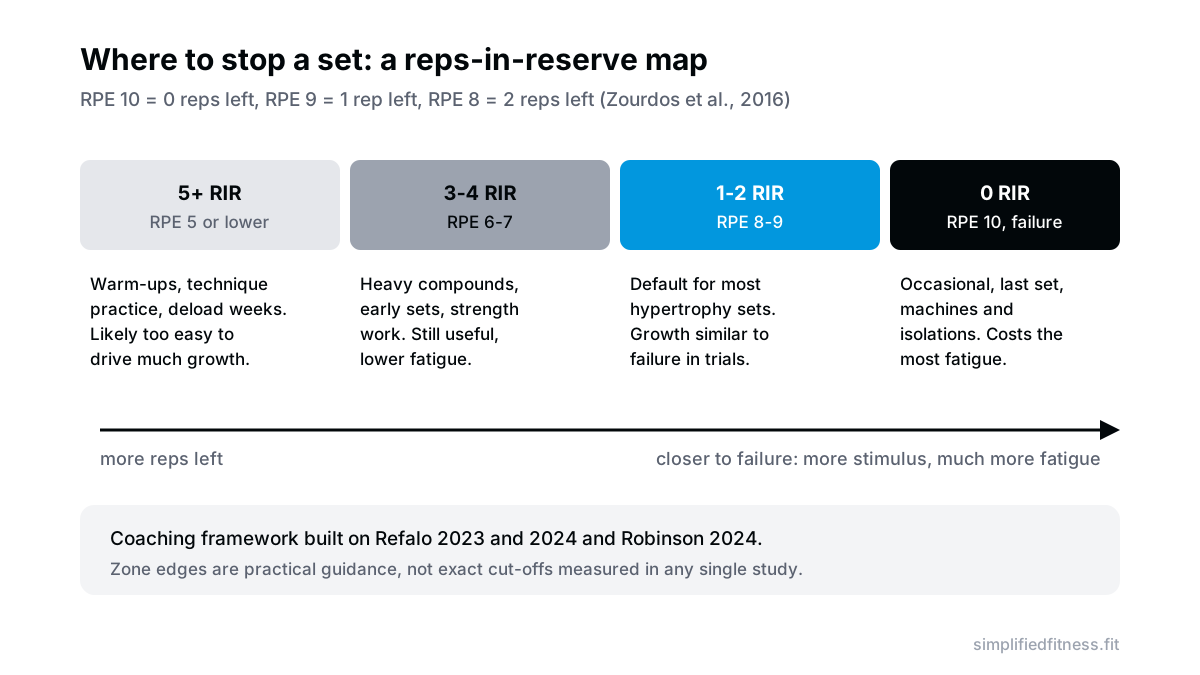
The idea got formalised for lifting in 2016, when researchers built a resistance-training RPE scale where each number maps to a rep count (Zourdos et al., 2016). RPE 10 means 0 reps left. RPE 9 means 1 left. RPE 8 means 2 left, and so on. In that study of 29 squatters, slower bar speed lined up strongly with higher RPE ratings in both experienced and novice lifters, which is what you would expect if the numbers reflected real effort. The experienced squatters also rated their true 1RM attempts higher than the novices did, a hint that judging effort is a skill that improves with time under the bar.
A companion paper laid out how coaches can use the scale to adjust loads set to set, so the weight on the bar matches how strong you are that day rather than how strong you were on test day (Helms et al., 2016).
| RPE | Reps in reserve | What it feels like |
|---|---|---|
| 10 | 0 | Could not do another clean rep |
| 9.5 | 0, maybe a little more weight | No more reps, but slightly heavier was possible |
| 9 | 1 | One more rep, definitely |
| 8 | 2 | Two more reps |
| 7 | 3 | Bar still moving fast-ish, three left |
| 6 or below | 4+ | Warm-up territory |
The RIR number matters because “I did 3 sets of 10” says almost nothing on its own. Ten reps with a weight you could lift 25 times is a warm-up. Ten reps with your 11-rep max is a hard set. If you want to turn RPE numbers into loads, our RIR and RPE calculator does the arithmetic. For a full walkthrough of the scale, see the dedicated RIR and RPE scale guide.
Training to failure vs RIR: what do the meta-analyses say?
This is where gym opinion splits hardest. One camp says a set does not count unless you fail. The other says failure just digs a recovery hole. The research sits in between.
Meta-analysis 1. A 2022 review of 15 studies in young adults found no significant difference between failure and non-failure training for hypertrophy (effect size 0.22, with a confidence interval that crossed zero) or for strength (Grgic et al., 2022). In the subgroup of resistance-trained participants, though, failure showed a small significant edge for growth (effect size 0.15). And when total volume was not matched between groups, non-failure training actually produced better strength gains.
Meta-analysis 2. A 2023 review, also pooling 15 studies, found a “trivial” advantage for set failure over non-failure when any definition of failure was counted (effect size 0.19, confidence interval 0.00 to 0.37) (Refalo et al., 2023). When the analysis was restricted to true momentary muscular failure versus non-failure, that advantage disappeared (effect size 0.12, not significant). The authors suggested the relationship between proximity to failure and growth may be non-linear: getting close matters, but the last grinding rep may add little.
Meta-analysis 3. A 2024 series of meta-regressions took a different approach and estimated the RIR of every training condition in the literature (Robinson et al., 2024). For hypertrophy, the slopes pointed one way: muscle growth increased as sets ended closer to failure. For strength, RIR barely mattered. The authors were careful to call this exploratory, because the RIR values had to be estimated from study descriptions rather than measured.
So do these conflict? Partly. The first two compare categories (failure versus “not failure”, which can mean anything from 1 to 6 reps left), while the third models a continuous slope. A reasonable reading that fits all three: sets that end far from failure probably leave growth on the table, sets that end 1-3 reps short capture most of it, and the final step to 0 RIR adds little or nothing on average.
The trial that tested 1-2 RIR head to head
Meta-analyses mix very different protocols, so a direct test in trained lifters is useful. In a 2024 study, 18 resistance-trained men and women trained one leg to momentary failure and the other leg to 2 RIR on the leg press and 1 RIR on the leg extension, twice a week for 8 weeks (Refalo et al., 2024).
Quadriceps thickness increased by 0.181 cm in the failure leg and 0.182 cm in the RIR leg. Practically identical. Training volume ended up similar too. The difference showed up in fatigue: the failure condition produced consistently greater losses in lifting velocity and reps from set to set.
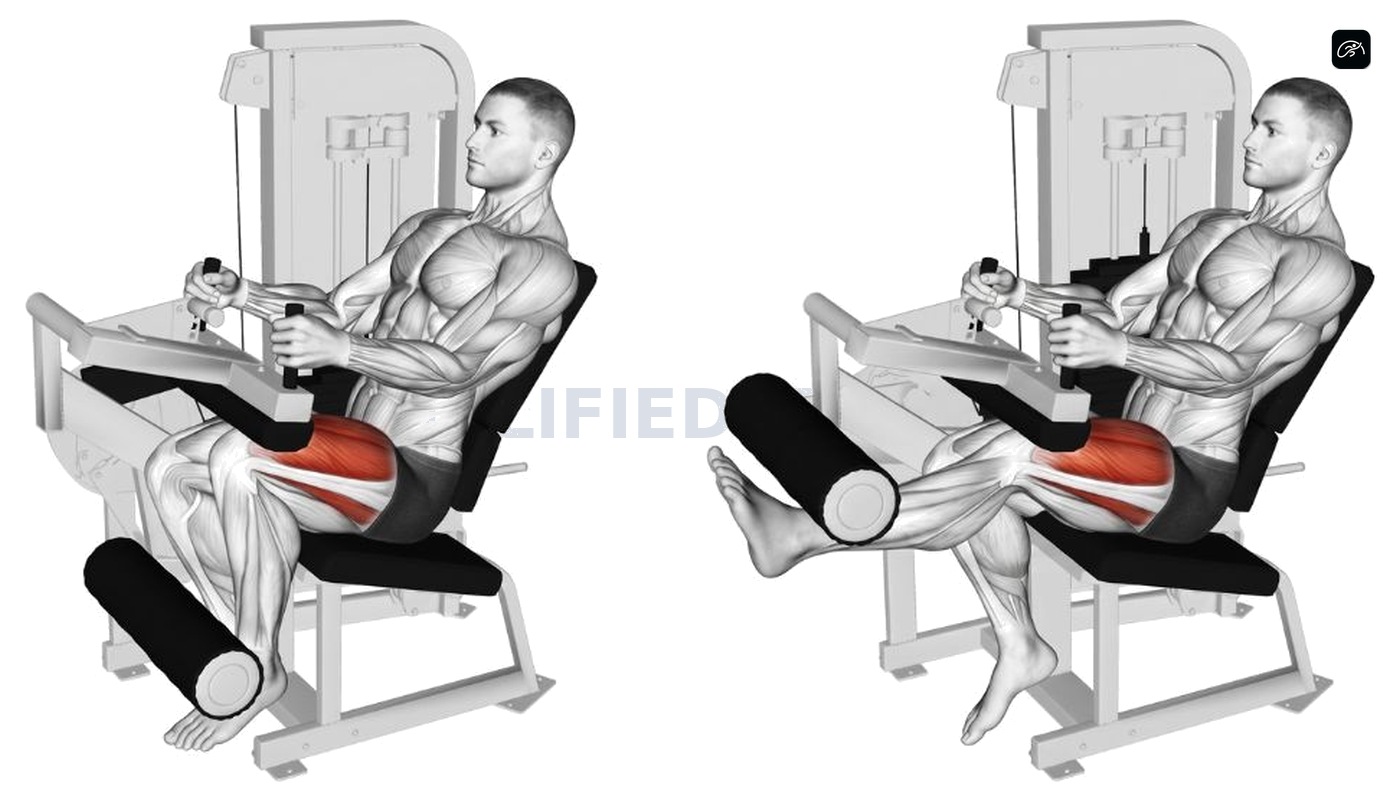
That is one trial, in one muscle group, over 8 weeks, so it does not settle the question for every exercise or every lifter. It does line up neatly with the meta-analyses. For the full breakdown, read our deep dive on training to failure vs RIR for hypertrophy.
How close to failure should each exercise go?
Not every exercise deserves the same RIR. The cost of a failed rep on a leg extension is a weight stack that clanks down. The cost of a failed rep on a heavy back squat is a lot higher.
A practical way to set it up:
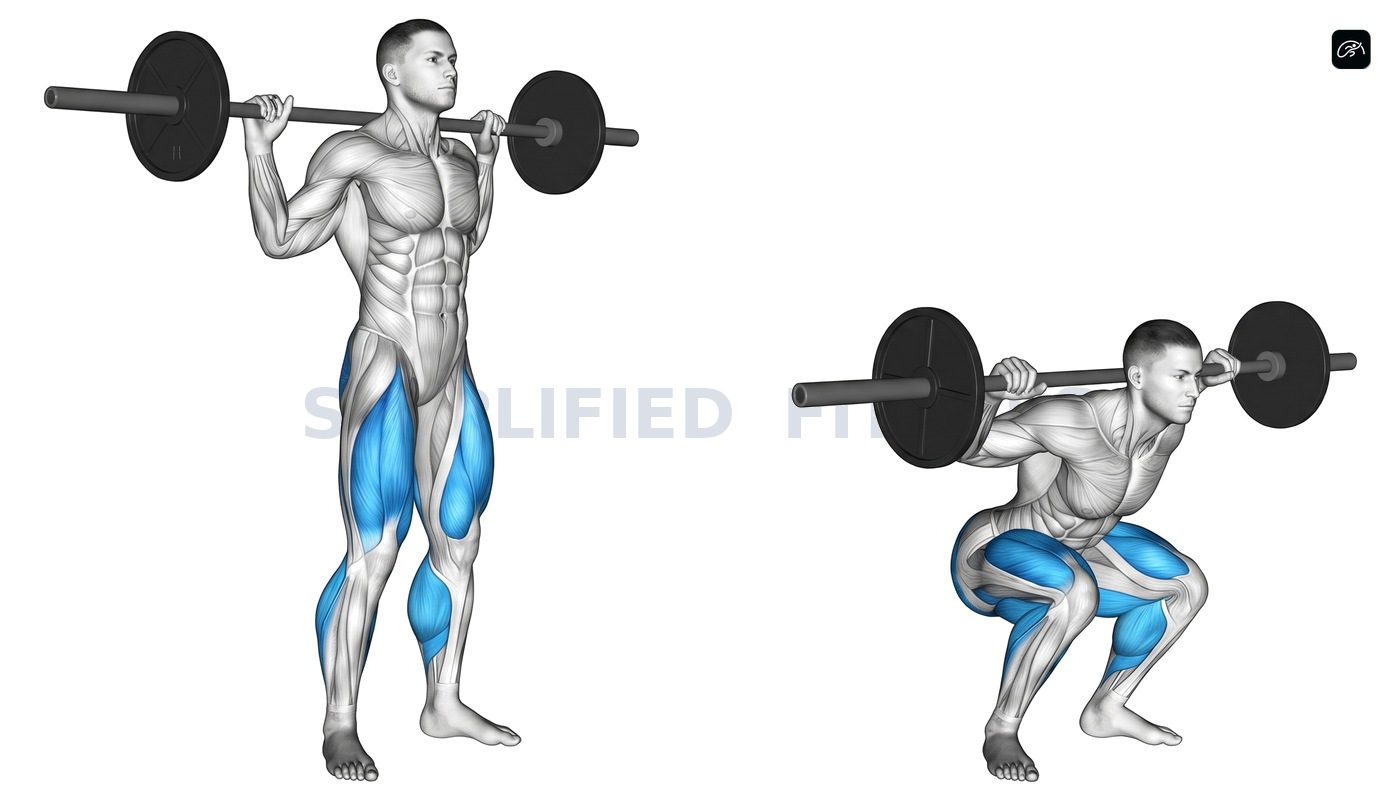
- Heavy barbell compounds (squat, deadlift, bench, overhead press): 1-3 RIR. Technique often breaks before the muscle truly fails, and the fatigue spills over into the rest of the session.
- Machine and cable compounds (leg press, chest press, rows, pulldowns): 1-2 RIR, with an occasional 0 RIR final set.
- Isolation exercises (curls, extensions, lateral raises, leg curls): 0-2 RIR. Low risk, low systemic fatigue, and you learn what failure really feels like.
- Early in a training block or after time off: 2-3 RIR, then creep closer as the weeks go on.
We expand on this split in proximity to failure on compounds vs isolations and on the safety side in failure on machines and cables vs free barbells.
There is also a central versus local fatigue question. Failure sets on big lifts leave you feeling flattened in a way that failure on a cable curl does not. The physiology there is more nuanced than “CNS fatigue”, and we cover it in CNS vs peripheral fatigue and proximity to failure.
How accurate is RIR? Can you really judge it?
Here is the uncomfortable part. Lifters often misjudge how many reps they have left, especially on long sets.
In a 2021 study, 25 trained men squatted 70% of their 1RM to failure (about 16 reps on average) and called out when they thought they were at 5, 3 and 1 RIR (Zourdos et al., 2021). The average error was about 5.2 reps at the “5 RIR” call, 3.7 reps at “3 RIR” and 2.1 reps at “1 RIR” (rounded from 5.15, 3.65 and 2.05). Being further from failure and doing more reps in the set both made predictions worse. Training age did not predict accuracy.
The picture looks better on shorter sets. In a 2024 study, 24 trained men and women benched 75% of 1RM to failure and called 1 and 3 RIR along the way (Refalo et al., 2024). Their average absolute error was just 0.65 reps, with a slight tendency to underpredict (thinking they had fewer reps left than they actually did). Accuracy was not related to sex, years of training or bench strength.
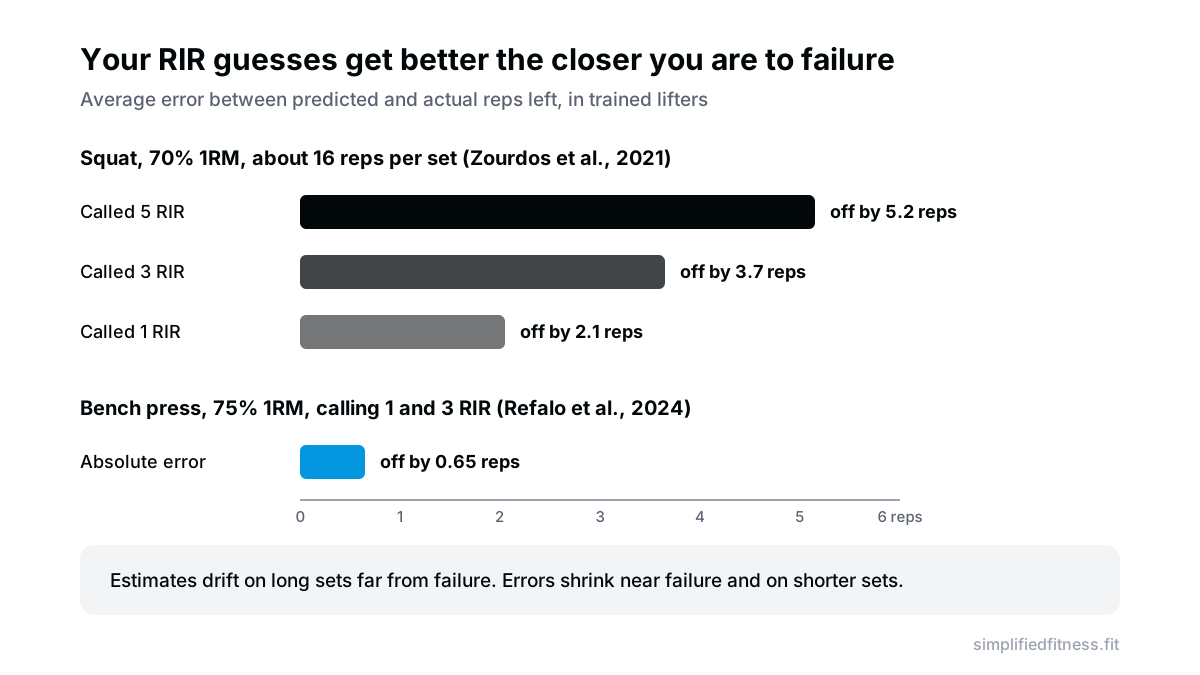
Two studies, two exercises, slightly different methods. They agree on the direction, though: you judge best when you are close to failure and when the set is not marathon-length. That has a practical consequence for rep ranges, which we come to next. To sharpen your own calls, use the drills in calibrating true RIR in the gym and the research summary on how accurately lifters gauge RIR.
What is the best rep range for hypertrophy? The 5-30 rep spectrum
The old textbook “repetition continuum” goes like this: 1-5 reps for strength, 8-12 for size, 15+ for endurance. Tidy. Mostly wrong for muscle growth.
A 2017 meta-analysis pooled 21 studies comparing light loads (60% of 1RM or less) with heavier loads, with every set taken to failure (Schoenfeld et al., 2017). Hypertrophy was similar. 1RM strength gains were clearly better with heavy loads.
A 2021 network meta-analysis went further, with 28 studies and 747 healthy adults, splitting loads into high (8 RM or less), moderate (9-15 RM) and low (over 15 RM), all to failure (Lopez et al., 2021). No significant hypertrophy differences between any of them. Strength was another story: both high and moderate loads beat low loads, with standardised mean differences of roughly 0.6 and 0.35.
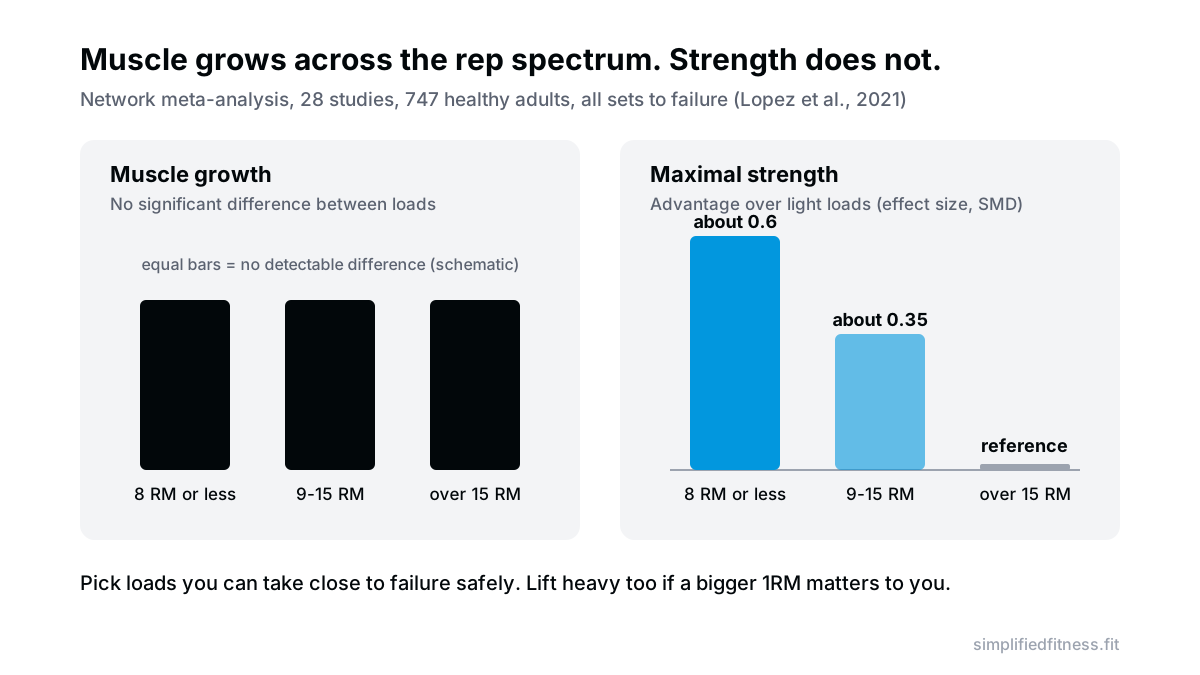
Those findings led the same research group to argue for a new model in which muscle can be built, and in some cases maximised, across a wide range of loading zones (Schoenfeld et al., 2021).
So why not do all your training with 30-rep sets? A few practical reasons:
- Effort is harder to judge. As we just saw, RIR estimates drift badly on long sets.
- Discomfort becomes the limiter. Burning lungs and lactic misery often end a 30-rep set before the target muscle is truly close to failure.
- Time. A set of 25 takes far longer than a set of 8.
- Strength still matters. Heavier work builds 1RM strength that lighter work does not.
- Joints and technique. Very heavy triples on every exercise beat up some lifters more than moderate loads do (we look at the evidence in rep ranges and joint wear).
- Low-load sets on big compounds are miserable. A 30-rep squat set is a cardio event.
A sensible split for most natural lifters: 5-10 reps on heavy compounds, 8-15 on machine compounds, 10-20 (occasionally up to 30) on isolations. The detailed version is in our hypertrophy rep spectrum guide, and the “why does light weight work” mechanism (motor unit recruitment as fatigue builds) is explained in low-load vs high-load training and motor unit recruitment.
If maximal strength is your main goal, the rules shift toward heavier loads and lower reps, and our maximal strength and powerlifting guide covers that end of the spectrum.
Optimal rest intervals for lifting: 1 minute vs 3 minutes
Short rest got popular because it “keeps the pump” and supposedly raises hormones. The longer-term muscle data tell a different story.
In a 2016 trial, 21 resistance-trained young men did the same full-body program (3 sessions a week, 3 sets of 8-12 RM on 7 exercises) for 8 weeks, with either 1-minute or 3-minute rests (Schoenfeld et al., 2016). The 3-minute group gained more squat and bench strength and more front-thigh muscle thickness, with a trend toward more triceps growth too.
A 2024 Bayesian meta-analysis pulled together 9 randomised studies on rest and muscle growth (Singer et al., 2024). Results across rest categories overlapped substantially. The authors concluded there is likely a small benefit to resting longer than 60 seconds, perhaps because short rest cuts the load you can lift on later sets, but they did not find appreciable differences once rest exceeded 90 seconds. Whether people trained to failure or stopped short did not meaningfully change that pattern.
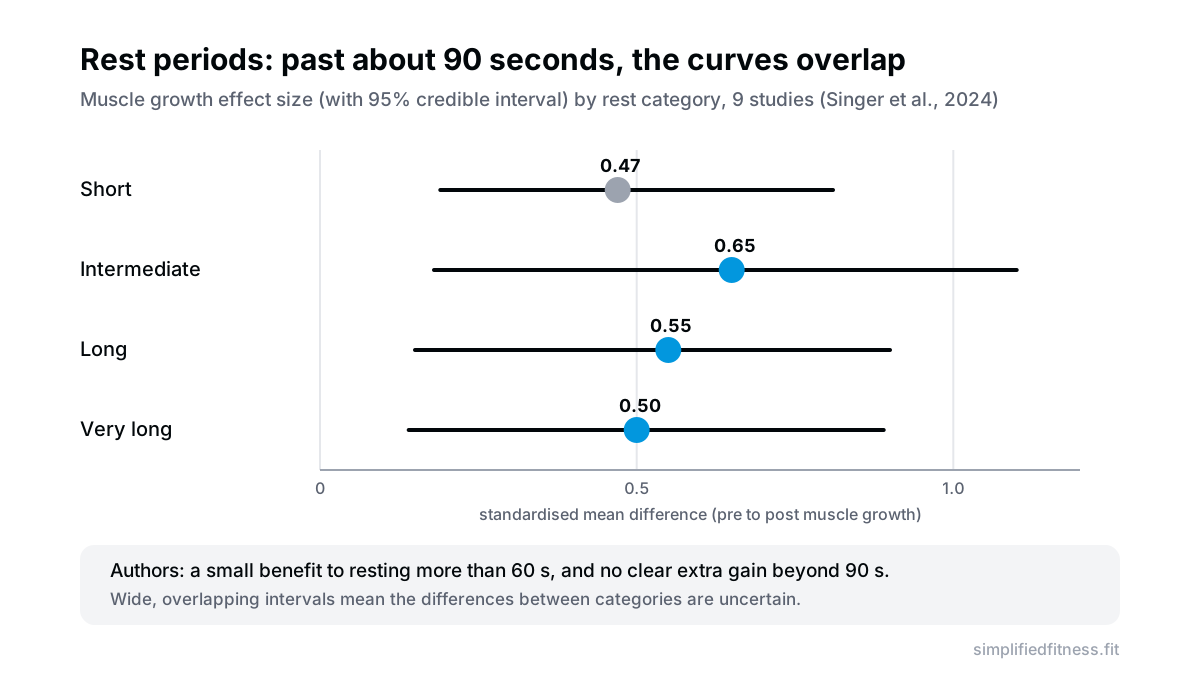
So 1 minute versus 3 minutes is not really “short is useless, long is magic”. It is closer to: very short rest makes your next sets worse, and past about 90 seconds you have most of the benefit. On a heavy squat or deadlift, 2-3 minutes (sometimes more) usually lets you repeat your reps. On a cable lateral raise, 90 seconds is often plenty.
There are legitimate uses for short rest: time-limited sessions, supersets of non-competing muscles, or isolation finishers. The trade-offs are covered in short rest intervals: penalties and uses, and the main recommendation in more depth in rest intervals for hypertrophy: 2-3 minutes vs short. If you want shorter sessions without shorter rest, set structures like rest-pause and myo-reps are an option (see rest-pause, myo-reps and cluster sets).
Does rep tempo matter for muscle growth?
Probably less than your gym’s tempo-obsessed coach claims.
A 2015 meta-analysis of 8 studies found similar hypertrophy with repetition durations ranging from 0.5 to 8 seconds, all with sets to failure (Schoenfeld et al., 2015). It also suggested that very slow reps (over 10 seconds) were worse, though the authors noted there were too few controlled studies for firm conclusions.
A 2025 meta-analysis of 14 studies revisited the question (Enes et al., 2025). Comparing faster reps (averaging about 1 second) with slower ones (averaging about 3.5 seconds), the difference in growth was trivial and, if anything, slightly favoured the faster tempo. The authors concluded tempo has minimal overall effect on hypertrophy, with possible differences under specific conditions.
That does not mean tempo is irrelevant. It means the useful version of tempo is simple: lower the weight under control so you are not bouncing out of the bottom, and lift with intent. Our guides on tempo training and repetition duration and intent to move explosively cover the details.
Putting it together: a set-by-set blueprint
Here is how the evidence translates to a normal training day.
- Warm up with ramp sets at 4+ RIR so the work sets start fresh (see warm-up protocols and ramping sets).
- First exercise, heavy compound: 5-8 reps, 2-3 RIR on the first set, 1-2 RIR on the last, 2-3 minutes rest.
- Second exercise, machine or dumbbell compound: 8-12 reps, 1-2 RIR, about 2 minutes rest.
- Isolation work: 10-20 reps, 0-2 RIR, 90 seconds to 2 minutes rest. Last set to failure is fine here.
- Tempo: controlled lowering (roughly 1-3 seconds), no bouncing, lift with intent.
- Log weight, reps and RIR. Next session, add a rep or a little weight at the same RIR.
- Calibrate with a failure set on a safe exercise every few weeks.
That last progression step is where this guide hands over to the progressive overload guide. How many of these sets you do per muscle per week belongs to the volume and frequency guide. If you want all of this already laid out, our free push, pull and legs plans apply these RIR and rest targets, and the 1RM calculator helps you pick starting loads.
Special cases worth knowing
Cutting. Effort is the signal that tells your body to keep muscle while you eat less. Keep sets close to failure, but fatigue builds faster on fewer calories, so fewer failure sets is a reasonable adjustment. Direct research is thin; our proximity to failure while cutting guide walks through the options.
Beginners. Novices gain from almost any reasonable stimulus, and their RIR calls are rougher. Keep big lifts at 2-3 RIR while technique settles, and learn failure on machines.
Advanced techniques. Lengthened partials past failure and blood flow restriction training are ways to extend sets or make light loads effective. They are tools, not foundations.
Rotating rep ranges. Some programs cycle heavy, moderate and light days within a week or across blocks. Whether that beats a steady mix for hypertrophy is covered in rep range periodisation: DUP vs block.
Health first. If a set to failure brings on chest pain, dizziness, unusual breathlessness or sharp joint pain, stop and get checked by a doctor before training hard again. People with high blood pressure, heart conditions or recent surgery should clear high-effort lifting with their doctor, since straining sets cause big temporary blood pressure spikes.
The bottom line
Most of the arguments about intensity come down to a few research-backed defaults. Stop most sets 1-2 reps short of failure; failure itself is optional and best saved for low-risk exercises. Use whatever rep range you can push hard in, roughly 5-30, and lift heavier if a bigger 1RM matters. Rest long enough to repeat your performance, which for most people means at least 90 seconds and 2-3 minutes on the big lifts. Keep tempo controlled but not slow-motion.
None of this replaces the boring work of adding a rep or a kilo over time, eating enough protein and sleeping. If you are new to the bigger picture, start with our muscle hypertrophy guide for natural lifters, and use the training volume calculator to check that your hard sets add up.
Go deeper: every guide in this topic
- Blood Flow Restriction (BFR) Practical Guide: Cuff Pressures, Rep Schemes, and Light Loads
- Calibrating True RIR: A Safe Gym Test for Technical vs Absolute Failure
- CNS Fatigue vs Peripheral Fatigue: How Failure Hits Squats and Curls Differently
- Failure on Machines and Cables vs Free Barbells: Managing Injury Risk and Axial Fatigue
- How Accurately Do Lifters Gauge RIR? Research on Subjective Failure vs Actual Failure
- The Hypertrophy Rep Spectrum: Why 5-30 Reps Build Similar Muscle When Sets Are Hard
- Intent to Move Explosively: Why Pushing the Bar Hard Matters Even When It Moves Slowly
- Lengthened Partials Beyond Failure: Mechanical Overload and Practical Execution
- Low-Load (30% 1RM) vs High-Load (80% 1RM) Training: Motor Unit Recruitment and Acidosis
- Proximity to Failure by Movement Type: Compound Squats vs Isolation Lateral Raises
- Proximity to Failure in a Caloric Deficit: How Hard to Push While Cutting
- Rep Range Periodization: Daily Undulating (DUP) vs Block Rep Distribution
- Rep Ranges and Joint Wear: Are Heavy Triples Worse for Your Joints Than Moderate Reps?
- Reps in Reserve (RIR) and RPE: What the Scale Means and How Accurate It Is
- Rest Intervals for Hypertrophy: Why 2-3+ Minutes Beats 60 Seconds on Hard Sets
- Rest-Pause, Myo-Reps, and Cluster Sets: Accumulating Effective Reps in Compressed Time
- Short Rest Intervals (30-60s): When Compressed Rests Are Useful and What They Cost Your Gains
- Tempo Training and Repetition Duration: Does Slowing Down the Eccentric Build More Muscle?
- Training to Failure vs Leaving 1-3 RIR: What the Hypertrophy Meta-Analysis Shows
- Warm-Up Sets for Lifting: How to Ramp Up Weight Without Wasting Energy
Frequently Asked Questions
What does RIR mean in lifting?
RIR stands for reps in reserve, the number of clean reps you could still have done when you ended a set. It was formalised in a resistance-training RPE scale where RPE 10 means 0 reps left and RPE 9 means 1 rep left. Write down your RIR after each working set so you can track effort, not just weight and reps.
What is the difference between RIR and RPE?
RIR and the lifting RPE scale describe the same thing from two directions: RPE 10 equals 0 RIR, RPE 9 equals 1 RIR, RPE 8 equals 2 RIR. The RIR-based RPE scale was built so that each RPE number maps to a specific count of reps left, which makes it more concrete than the older 'how hard did that feel' scales. Use whichever number is easier for you to think in, but be consistent.
How many reps in reserve should I leave for muscle growth?
For most hypertrophy sets, leaving about 1-2 reps in reserve is a sensible default. A 2024 trial in trained lifters found quadriceps growth was essentially identical when sets ended at 1-2 RIR versus at failure, while failure caused more fatigue. Go to 0 RIR occasionally on the last set of a machine or isolation exercise if you want, but it is not required.
Is training to failure necessary to build muscle?
No, training to failure is not necessary for muscle growth. Two meta-analyses (2022 and 2023) found no clear advantage for momentary failure over stopping short when other variables were similar, though one found a small benefit for failure in trained subgroups. Train most sets close to failure and save true failure for low-risk exercises.
Does training closer to failure build more muscle?
Probably yes, up to a point. A 2024 series of meta-regressions found muscle growth improved as estimated RIR dropped toward failure, but the authors called the analysis exploratory because RIR had to be estimated from study descriptions. Treat 0-3 RIR as the productive zone and avoid sets that end with 5 or more easy reps left.
Is 3 RIR enough for hypertrophy?
Sets at 3 RIR are likely still productive, especially for heavy compound lifts. Direct comparisons at exactly 3 RIR are limited, and the dose-response data suggest a little more growth as sets get closer to failure. Use 3 RIR on early sets of squats or deadlifts and push isolation work closer to 1 RIR.
What is the best rep range for hypertrophy?
There is no single best rep range: roughly 5-30 reps per set builds similar muscle when sets are taken close to failure. A network meta-analysis of 28 studies found no significant hypertrophy difference between heavy (8 RM or less), moderate (9-15 RM) and light (over 15 RM) loads. Most lifters do well with 6-12 reps on compounds and 10-20 on isolations.
Do light weights build as much muscle as heavy weights?
Yes, light weights can build similar muscle if each set is taken close to failure. A 2017 meta-analysis of 21 studies comparing loads at or below 60% of 1RM with heavier loads found similar hypertrophy, with all sets performed to failure. The catch is that light sets need more reps and more discomfort to reach the same effort, so keep them for exercises where that is practical.
Are heavy weights better for strength?
Yes, heavier loads produce bigger gains in maximal (1RM) strength. Meta-analyses show high-load training beats low-load training for 1RM strength, with moderate loads in between. If a stronger squat, bench or deadlift matters to you, include regular work in the 1-6 rep range.
How long should I rest between sets for hypertrophy?
Rest at least about 90 seconds between hypertrophy sets, and around 2-3 minutes on heavy compound lifts. A 2024 Bayesian meta-analysis found a small benefit to resting more than 60 seconds, likely because short rest reduces the load you can lift, but no clear extra benefit beyond 90 seconds. Rest until you can hit your target reps at the planned effort again.
Is 1 minute rest enough between sets?
One minute is usually a little short for building muscle with multi-joint exercises. In a 2016 trial of trained men, 3-minute rests produced more strength and more thigh muscle growth than 1-minute rests over 8 weeks with the same sets and reps. Use 60-second rests only when time is tight, on small isolation exercises, and accept you may need an extra set.
Do longer rest periods build more muscle?
Longer rest periods help up to a point, mainly by letting you lift more on later sets. The 2024 meta-analysis saw a small advantage beyond 60 seconds but no appreciable difference once rest went past 90 seconds. Resting 4-5 minutes on isolation work rarely adds anything except time in the gym.
How accurate is RIR?
RIR is reasonably accurate near failure and much less accurate far from it. In a 2021 squat study, lifters were off by about 2 reps when they called 1 RIR but about 5 reps when they called 5 RIR during sets of around 16 reps. On a 2024 bench press test at 75% of 1RM, trained lifters were off by about 0.65 reps on average, so keep most working sets moderate in reps if you rely on RIR.
How do I get better at estimating RIR?
Calibrate by occasionally taking a set to true failure and comparing it with your guess. Research shows estimates improve near failure and with moderate rep sets, so failure tests on safe exercises (machines, cables, dumbbell isolations) give you useful feedback. Do a calibration set every few weeks and note how far off you were.
Does RIR work for beginners?
RIR works for beginners but is less precise at first. In the original RIR-scale study, novice squatters still showed a clear relationship between bar speed and their RPE ratings, though experienced lifters rated maximal efforts more accurately. Beginners should push sets hard but technically clean and use occasional failure sets on machines to learn what 1-2 RIR feels like.
Does rep tempo matter for muscle growth?
Tempo matters much less than most people think. A 2025 meta-analysis of 14 studies found trivial differences in growth between faster (about 1 second) and slower (about 3.5 seconds) repetitions, and an older review found similar growth from 0.5 to 8 seconds per rep. Lower the weight under control, lift with intent, and do not deliberately crawl through reps.
Are super slow reps better for hypertrophy?
No, very slow reps do not appear to be better and may be worse. A 2015 meta-analysis suggested that extremely slow repetitions of more than 10 seconds were inferior for hypertrophy, although few controlled studies exist. Super slow reps force you to use a lighter load and fewer total reps, so most lifters get more from controlled, normal-speed reps.
Should every set go to failure?
No, taking every set to failure is unnecessary and usually costs more than it gives. A 2024 trial found failure training caused greater rep and velocity loss across sets than stopping at 1-2 RIR, while growth was the same. Reserve failure for the last set of an exercise, preferably on a machine or isolation movement.
Is it safe to train to failure on squats and deadlifts?
Failure on heavy barbell squats and deadlifts likely carries more risk than failure on a leg press or leg curl, because technique tends to break down before the muscle quits. Stopping at 1-3 RIR on these lifts keeps the stimulus high while limiting ugly, grinding reps. If you do push a squat or bench hard, use safety pins or a spotter.
How many sets should I do per exercise?
Sets per exercise depend on your weekly volume per muscle rather than a fixed number, and most programs use 2-4 hard sets per exercise. Effort and set count work together: a set only counts as a hard set if it ends close to failure. Work out your weekly sets with our training volume calculator and keep most of them at 0-3 RIR.
Should I use RIR or percentage of 1RM?
RIR adjusts to your daily readiness while a fixed percentage of 1RM does not, which is why many coaches prefer it for hypertrophy work. The RIR-based RPE scale was designed to auto-regulate load set by set, so a bad-sleep day automatically gets a slightly lighter weight. Combining both, with a percentage as a starting point and RIR as the stop rule, works well for strength-focused lifts.
Does training to failure cause more fatigue?
Yes, failure training produces more acute fatigue than stopping a rep or two short. In a 2024 trial in trained lifters, sets taken to failure showed consistently greater velocity and repetition loss than sets ended at 1-2 RIR. That extra fatigue can cut reps on later sets, so if you go to failure, do it on the final set of an exercise.
How should I use RIR during a fat loss phase?
Keep training effort high during a diet, because hard sets are the signal that helps you hold on to muscle. Stopping at 1-2 RIR rather than grinding to failure on every set may help manage the extra fatigue that comes with eating less, although direct research on this is limited. Keep loads as heavy as you can manage and reduce sets before you reduce effort.
Sources & References
Every claim above is checked against peer-reviewed research (PubMed, U.S. National Library of Medicine) or guidance from established health bodies. How we fact-check.
- Refalo MC, et al. Influence of Resistance Training Proximity-to-Failure on Skeletal Muscle Hypertrophy: A Systematic Review with Meta-analysis. Sports Med. 2023. PMID: 36334240
- Robinson ZP, et al. Exploring the Dose-Response Relationship Between Estimated Resistance Training Proximity to Failure, Strength Gain, and Muscle Hypertrophy: A Series of Meta-Regressions. Sports Med. 2024. PMID: 38970765
- Grgic J, et al. Effects of resistance training performed to repetition failure or non-failure on muscular strength and hypertrophy: A systematic review and meta-analysis. J Sport Health Sci. 2022. PMID: 33497853
- Refalo MC, et al. Similar muscle hypertrophy following eight weeks of resistance training to momentary muscular failure or with repetitions-in-reserve in resistance-trained individuals. J Sports Sci. 2024. PMID: 38393985
- Zourdos MC, et al. Novel Resistance Training-Specific Rating of Perceived Exertion Scale Measuring Repetitions in Reserve. J Strength Cond Res. 2016. PMID: 26049792
- Helms ER, et al. Application of the Repetitions in Reserve-Based Rating of Perceived Exertion Scale for Resistance Training. Strength Cond J. 2016. PMID: 27531969
- Zourdos MC, et al. Proximity to Failure and Total Repetitions Performed in a Set Influences Accuracy of Intraset Repetitions in Reserve-Based Rating of Perceived Exertion. J Strength Cond Res. 2021. PMID: 30747900
- Refalo MC, et al. Accuracy of Intraset Repetitions-in-Reserve Predictions During the Bench Press Exercise in Resistance-Trained Male and Female Subjects. J Strength Cond Res. 2024. PMID: 37967832
- Schoenfeld BJ, et al. Loading Recommendations for Muscle Strength, Hypertrophy, and Local Endurance: A Re-Examination of the Repetition Continuum. Sports (Basel). 2021. PMID: 33671664
- Schoenfeld BJ, et al. Strength and Hypertrophy Adaptations Between Low- vs. High-Load Resistance Training: A Systematic Review and Meta-analysis. J Strength Cond Res. 2017. PMID: 28834797
- Lopez P, et al. Resistance Training Load Effects on Muscle Hypertrophy and Strength Gain: Systematic Review and Network Meta-analysis. Med Sci Sports Exerc. 2021. PMID: 33433148
- Schoenfeld BJ, et al. Longer Interset Rest Periods Enhance Muscle Strength and Hypertrophy in Resistance-Trained Men. J Strength Cond Res. 2016. PMID: 26605807
- Singer A, et al. Give it a rest: a systematic review with Bayesian meta-analysis on the effect of inter-set rest interval duration on muscle hypertrophy. Front Sports Act Living. 2024. PMID: 39205815
- Enes A, et al. How Slow Should You Go? A Systematic Review With Meta-Analysis of the Effect of Resistance Training Repetition Tempo on Muscle Hypertrophy. J Strength Cond Res. 2025. PMID: 42709703
- Schoenfeld BJ, et al. Effect of repetition duration during resistance training on muscle hypertrophy: a systematic review and meta-analysis. Sports Med. 2015. PMID: 25601394

Umair Hazrami · Founder & Head Coach, Simplified Fitness
Umair Hazrami founded Simplified Fitness and the Simplified Lifter channel to cut through fitness noise. With 4+ years of consistent training and 10+ coaching clients, he writes every guide from the peer-reviewed research and links the sources so you can check them. Our editorial standards.
Educational content only, not medical advice. If you have a medical condition, are pregnant, or take medication, talk to a qualified doctor before changing your diet, supplements or training. Full disclaimer.
Keep reading

Programming
2-Day per Week Lifting Programs: Minimum Effective Dose for Busy Professionals
Can a 2 day a week workout routine hypertrophy goals support? Yes. Get a ready two-day full-body plan, the research behind it and how to run it in 60 minutes.
9 min read
Programming
30-Minute High-Density Hypertrophy Sessions: Micro-Workouts for Time-Constrained Lifters
Can a 30 minute workout for muscle growth work? See how paired sets, Myo-reps and machine setups fit 16 hard sets into half an hour, plus a 4-day plan.
10 min read
Programming
The 5 Modalities of Progressive Overload: A Checklist for When Weight Won't Go Up
5 ways to progressive overload: load, reps, range of motion, tempo and rest density. A practical checklist for compounds and isolations, with the research.
7 min read

Programming
The 7-Minute Dynamic Warm-Up: A Fast Routine to Prep Joints Before Lifting
A dynamic warm up for lifting takes about 7 minutes, not 25. See the 2-3-2 routine, what the research says about stretching and foam rolling, and what to skip.
9 min read