Hamstring-to-Quadriceps (H:Q) Ratio: What It Means for Your Knees
What is a good hamstring to quadriceps ratio? See the 0.6 rule, the functional 1.0 target, what studies say about ACL risk, and how to balance leg training.

TL;DR. The short answer
- The conventional hamstring to quadriceps (H:Q) ratio compares concentric strength and is classically given as about 0.6, meaning hamstrings produce roughly 60% of quad torque. The functional ratio compares eccentric hamstring strength with concentric quad strength and sits near 1.0 in fast knee extension.
- Lower H:Q ratios have been linked to ACL and hamstring injuries in some prospective studies, but a 2023 systematic review of 23 prospective studies found only very limited evidence that H:Q is an independent risk factor.
- No single H:Q number has been proven to prevent knee injury, so treat 0.6 and 1.0 as rough reference points, not pass-fail targets.
- In the gym, the practical fix is simple: do hamstring work at the hip and the knee, train the lowering phase, and keep left and right legs similar.
- Pain, swelling, or the knee giving way is a reason to see a doctor or physiotherapist rather than chase a ratio.
Part of our complete guide: Complete Lower-Body & Core Training Guide: Quads, Glutes, Hamstrings, Calves & Abs Science
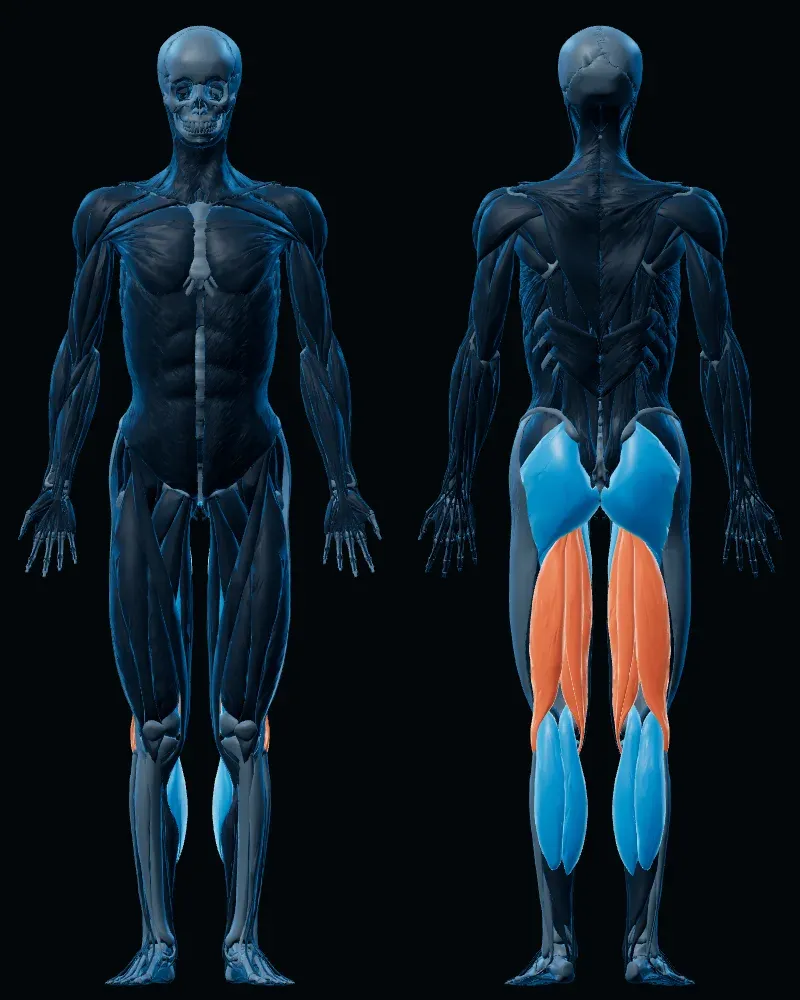
Muscles worked: hamstrings
Main movers: biceps femoris, semitendinosus and semimembranosus
Assisting: glutes, calves and adductor magnus
Table of contents
The hamstring to quadriceps ratio (H:Q) compares how strong the back of your thigh is against the front. The conventional version is usually quoted as about 0.6, and the functional version, which pits eccentric hamstring strength against concentric quad strength, sits close to 1.0 in fast knee extension. Lower ratios have been linked to knee and hamstring injuries in some athletes, but no exact number has been proven to protect you.
That matters if you squat, leg press and do leg extensions three times a week while curls get whatever energy is left. This article is part of our complete lower body and core training guide, and it covers what the numbers mean, what the research really shows, and how to balance your legs without turning it into maths homework.
What is the hamstring to quadriceps ratio?
H:Q is simply hamstring strength divided by quadriceps strength. In research it is measured on an isokinetic dynamometer, a machine that moves your shin at a fixed speed and records torque. In a normal gym there is no way to get the exact figure.
There are three versions you will see:
| Ratio type | What is compared | Rough reference |
|---|---|---|
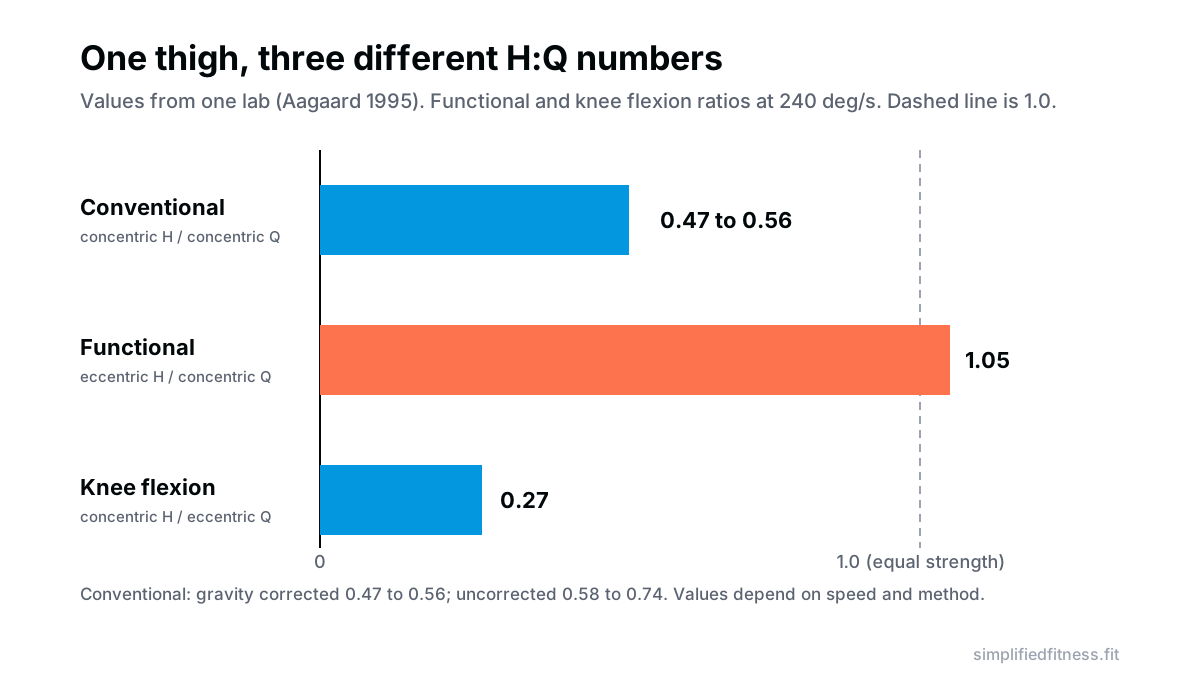
| Conventional | Concentric hamstring / concentric quad | About 0.6 (classic norm) |
| Functional | Eccentric hamstring / concentric quad | Near 1.0 in fast knee extension |
| Mixed | Eccentric hamstring at 30 deg/s / concentric quad at 240 deg/s | Used in some screening studies |
The 0.6 figure is the traditional norm. A 2002 review notes that it has been central to the debate for decades, while also pointing out that it ignores joint angle and type of muscle action (Coombs and Garbutt, 2002).
Why is there a 0.6 rule and a 1.0 rule?
Because the hamstrings do different jobs. When you kick a ball or extend your knee fast, the hamstrings work eccentrically (lengthening under tension) to brake the shin and protect the joint. That braking job is better described by the functional ratio than by comparing two concentric contractions.
One Danish lab measured both. After correcting for the weight of the leg, the conventional ratio stayed within about 0.47-0.56 across speeds and contraction modes, while the uncorrected concentric ratio climbed from 0.58 to 0.74 as speed increased. For fast knee extension at 240 degrees per second, the eccentric hamstring to concentric quad ratio was 1.05 at peak torque and 0.89 at a 50-degree knee angle (Aagaard et al., 1995). The authors read this as evidence that hamstrings have real capacity to stabilise the knee in fast movements.
Note what that is: a measurement in one group under one set of conditions, not a threshold above which injuries stop. Gravity correction alone moved the numbers a lot, which is a good reminder to be sceptical of any single cut-off.
Does a low H:Q ratio cause ACL tears or hamstring strains?
The honest answer is “it is associated, but it predicts poorly.” Here is what each side found.
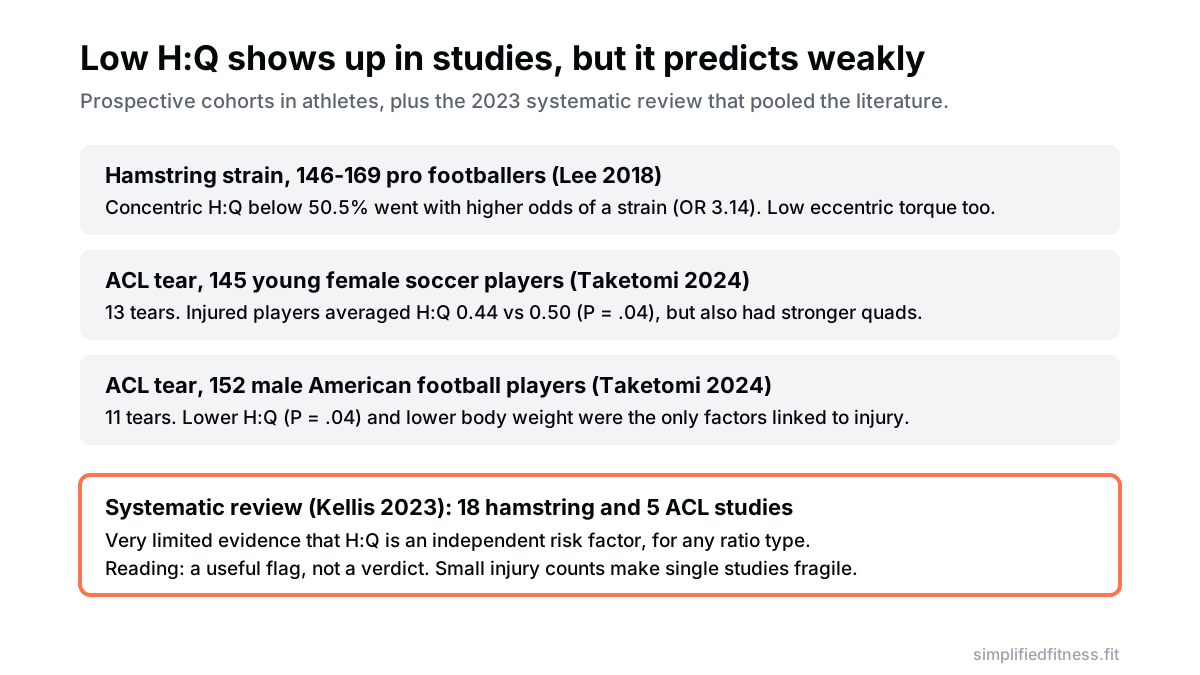
Studies that found a link. In a prospective study of professional footballers, those with a concentric H:Q below 50.5% had higher odds of a later hamstring strain (OR 3.14), alongside low eccentric hamstring torque and a previous strain (Lee et al., 2018). In 145 young female soccer players followed for a season, 13 tore their ACL, and those players had a lower H:Q (0.44 vs 0.50). They also had stronger quads, so the low ratio did not simply mean weak hamstrings (Taketomi et al., 2024). A cohort of 152 male American football players showed the same direction: 11 ACL tears, and a lower H:Q ratio was associated with them (Taketomi et al., 2024).
The pooled picture. A systematic review of prospective studies covered 18 studies with 585 hamstring injuries in 2,945 people, and 5 studies with 128 ACL injuries in 2,772 people. It concluded there is very limited evidence that H:Q is an independent risk factor for either injury, and the result did not differ between ratio types (Kellis et al., 2023).
Why they may disagree. ACL tears are rare, so single cohorts rest on 11 or 13 injuries, which makes results fragile. Studies use different tests, speeds and ratio definitions. And strength is only one of many risk factors, alongside sport, landing and cutting mechanics, previous injury, and plain bad luck. Interestingly, in a small study of female athletes, those with a past hamstring injury or ACL reconstruction had lower quad and hamstring strength than controls, yet the H:Q ratio itself did not differ significantly (Kellis et al., 2019). So the same ratio can hide very different legs: strong quads in one cohort, weaker legs overall in another.
Can lifting cause a hamstring-quad imbalance?
Yes, in the sense that programming can drift quad-dominant. The most common mistake is a leg day built from back squat, leg press, hack squat and leg extension, with one set of leg curls at the end when you are tired. Squats and presses do load the hamstrings, but they mostly work at the hip end and are not the same stimulus as bending the knee against resistance.
Two things worth knowing:
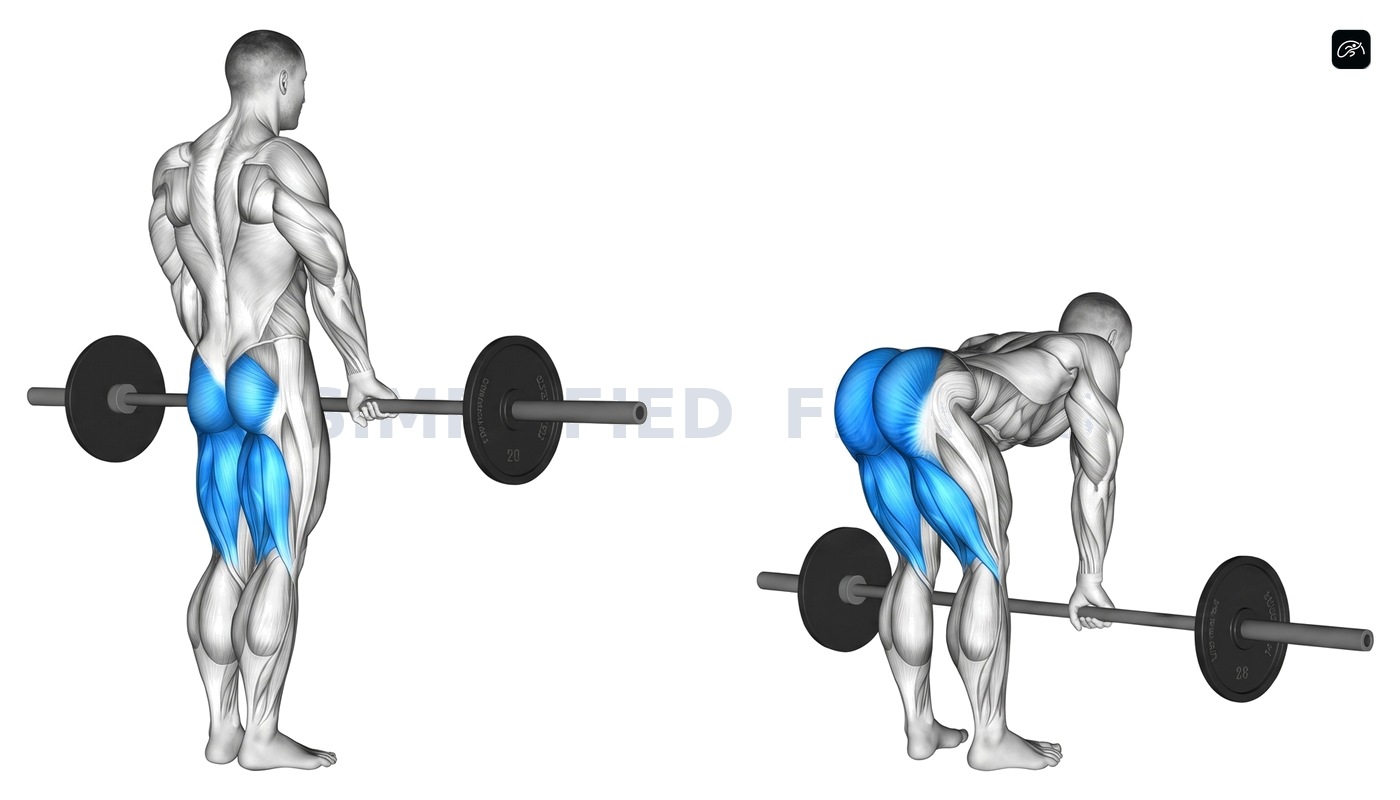
- Hip-dominant lifts like the Romanian deadlift train the hamstrings across the hip, as covered in our RDL guide.
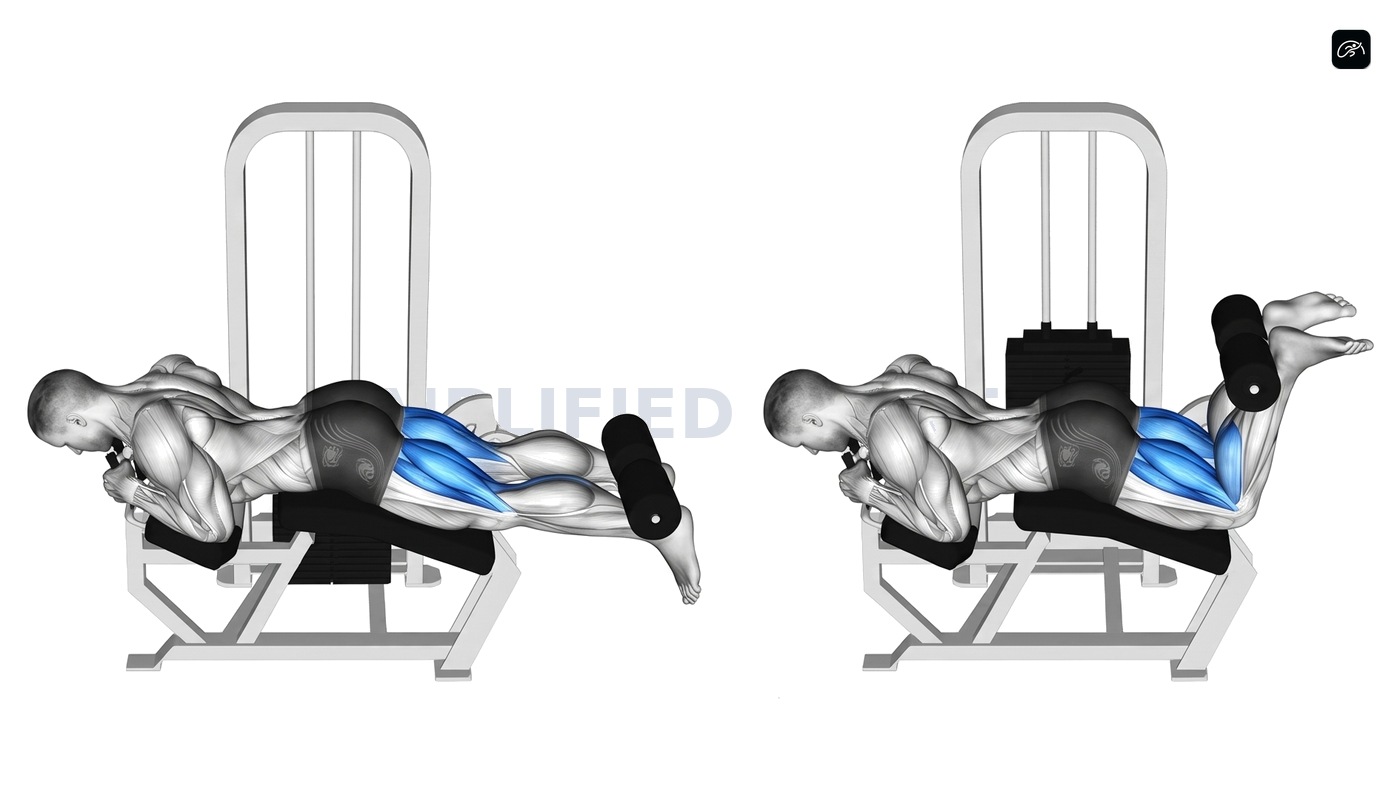
- Knee-flexion work (seated or lying curls) trains the knee end, which hinges alone miss. See seated vs lying leg curls for the differences.
Which hamstring muscles do what is in our hamstring anatomy article.
How to balance your hamstrings and quads
Since no ratio is proven, the sensible aim is balanced, progressive training. This is coaching judgement built on the evidence above, not a validated protocol.
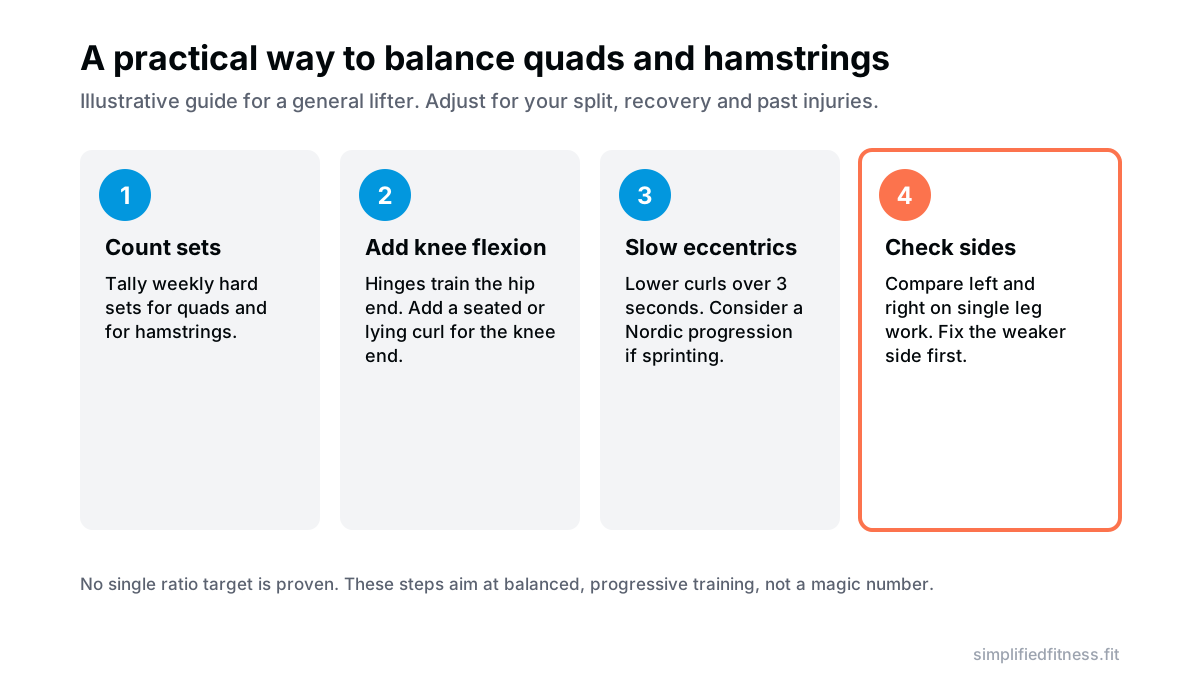
- Count your weekly hard sets. Use the training volume calculator or a notebook. If quads get 14 sets and hamstrings 4, the gap is obvious.
- Cover both jobs. One hip hinge (RDL or stiff-leg deadlift) plus one knee-flexion curl, trained twice a week where you can.
- Train the lowering phase. Take 3 seconds to lower the weight on curls. If you sprint or play field sports, a gradual Nordic progression is worth considering (details in our Nordic curl guide).
- Keep the two legs honest. Use single-leg work such as the split squat and single-leg curl, and bring the weaker leg up first. Our unilateral leg training guide covers the options.
Do Nordic hamstring curls improve the ratio?
Nordics build eccentric hamstring strength, which feeds the functional ratio, and the evidence on injuries is split. A 2019 meta-analysis of 15 studies in 8,459 athletes found programmes with Nordics had a risk ratio of 0.49 (95% CI 0.32-0.74) for hamstring injury, a reduction of up to about half (van Dyk et al., 2019). A later reanalysis argued only five of those studies truly randomised to Nordics. Using randomised trials only, the risk ratio was 0.56 (95% CI 0.20-1.52), an interval that includes no effect (Impellizzeri et al., 2021).
Why the gap? Mostly study selection: one analysis included non-randomised designs, the other did not. The cautious takeaway is that Nordics are a reasonable option for athletes, but the benefit is less certain than headlines suggest, and they are very hard, so progress slowly. Most recreational lifters can get plenty from curls and RDLs.
What about leg extensions and patellofemoral pain?
You may have heard that leg extensions are “bad for knees” and that strong hamstrings fix this. The studies above did not test that, so there is no evidence here either way. If leg extensions are comfortable, keep them and balance them with hamstring work. If they hurt, see a professional and read our leg extensions article.
Should I get my H:Q ratio tested?
For most lifters, no. Isokinetic testing is mainly used in sports clinics and rehab, and the 2023 review suggests the ratio alone is a weak predictor. It may help if you have returned from an ACL reconstruction or a hamstring tear and want to compare legs, and your physiotherapist can guide that.
When to see a doctor
Get assessed by a doctor or physiotherapist if you have knee swelling, locking, the knee giving way, a pop with sharp pain, or hamstring pain that does not settle within a couple of weeks. A strength ratio cannot diagnose any of these, and loading through an injury can make things worse.
The bottom line
The hamstring to quadriceps ratio is a useful idea with weaker proof than the gym internet suggests. Lower ratios show up in some injured athletes, yet a 2023 review found only very limited evidence that the ratio independently predicts ACL or hamstring injury. So aim for balance: a hinge and a curl each week, slow lowering, and two legs of similar strength.
Ready to put it into practice? Start with our leg day plan and make sure the hamstring slots are not an afterthought.
Frequently Asked Questions
What is a good hamstring to quadriceps ratio?
The classic reference for the conventional ratio is about 0.6, though one lab measuring gravity-corrected values found 0.47-0.56 across speeds. No ratio has been proven to guarantee injury protection. Use it as a rough guide and look at overall leg balance instead of one number.
How do you calculate the H:Q ratio?
Divide hamstring peak torque by quadriceps peak torque on an isokinetic dynamometer. The conventional version uses concentric strength for both, while the functional version divides eccentric hamstring strength by concentric quad strength. Without that machine, you can only estimate balance roughly, for example by comparing curl and leg extension loads over time.
Can I measure my H:Q ratio without an isokinetic machine?
Not accurately. Isokinetic testing controls speed and measures torque, which a gym leg curl and leg extension do not. A physiotherapist or sports lab can test it, and a rough home check is whether your hamstring work is improving at a similar pace to your quad work.
Does a low H:Q ratio cause ACL tears?
Not proven. Two Japanese cohorts found lower H:Q in athletes who later tore an ACL (145 female soccer players, 152 male American football players), but a 2023 systematic review found very limited evidence that H:Q independently predicts ACL injury. ACL risk also depends on landing mechanics, sport, and chance, so strengthen hamstrings as one part of the picture.
Do squats make my quads too strong for my hamstrings?
Squats do not automatically create an imbalance, but a program with heavy squats, leg press, and leg extensions and almost no hamstring work leans quad-dominant. Hamstrings assist in squats, but hinges load them far more directly at the hip, and curls at the knee. Add a hinge and a knee-flexion exercise each week to cover both jobs.
Should hamstring sets equal quad sets?
There is no research-proven set ratio, so this is a coaching judgement. Many lifters do fine with hamstring volume somewhere near their quad volume, with hinges and curls both counted. Track your weekly sets for a few weeks and add hamstring work if the gap is large.
Is the functional H:Q ratio of 1.0 a target I must reach?
No, it is a reference from one lab study, not a proven threshold. Aagaard and colleagues measured an eccentric hamstring to concentric quadriceps ratio of 1.05 at peak torque in fast knee extension, which shows hamstrings can match quads when braking the shin. Do not chase 1.0 on a leg curl, and focus on training the lowering phase.
Do Nordic hamstring curls fix a low H:Q ratio?
They train eccentric hamstring strength, and a 2019 meta-analysis found programmes with Nordics had about half the hamstring injury rate (risk ratio 0.49). A 2021 reanalysis of randomised trials only found a wide, inconclusive interval, so the benefit is debated. If you try them, build up gradually because they are very hard on the hamstrings.
Does the H:Q ratio matter for women?
It may, though the evidence is mixed. One cohort of young female soccer players linked lower H:Q (0.44 vs 0.50) with later ACL injury, yet a small study of female athletes with prior injuries found no significant ratio differences from controls. Strength training for both quads and hamstrings is sensible for everyone.
Can leg extensions hurt my knees if my hamstrings are weak?
There is no good evidence that leg extensions alone harm healthy knees because of a low H:Q ratio. The concern is mostly about programming that ignores the back of the leg altogether. Keep extensions if you tolerate them, and pair them with curls and hinges.
How long does it take to improve hamstring strength?
Strength on a new exercise usually climbs within a few weeks, partly because you get better at the movement itself. Visible muscle growth takes longer. Train hamstrings twice a week and add weight or reps gradually.
When should I see a doctor about knee or hamstring problems?
See a doctor or physiotherapist if you have knee swelling, locking, instability, a pop with sharp pain, or hamstring pain that lingers beyond a couple of weeks. A strength ratio cannot diagnose these problems. Stop heavy loading on that leg until it is assessed.
Sources & References
Every claim above is checked against peer-reviewed research (PubMed, U.S. National Library of Medicine) or guidance from established health bodies. How we fact-check.
- Kellis E, et al. Is hamstrings-to-quadriceps torque ratio useful for predicting anterior cruciate ligament and hamstring injuries? A systematic and critical review. J Sport Health Sci. 2023. PMID: 35065297
- Lee JWY, et al. Eccentric hamstring strength deficit and poor hamstring-to-quadriceps ratio are risk factors for hamstring strain injury in football: A prospective study of 146 professional players. J Sci Med Sport. 2018. PMID: 29233665
- Taketomi S, et al. Intrinsic Risk Factors for Noncontact Anterior Cruciate Ligament Injury in Young Female Soccer Players: A Prospective Cohort Study. Am J Sports Med. 2024. PMID: 39320411
- Taketomi S, et al. Lower hamstring to quadriceps muscle strength ratio and lower body weight as factors associated with noncontact anterior cruciate ligament injury in male American football players: A prospective cohort study. Asia Pac J Sports Med Arthrosc Rehabil Technol. 2024. PMID: 38187929
- Aagaard P, et al. Isokinetic hamstring/quadriceps strength ratio: influence from joint angular velocity, gravity correction and contraction mode. Acta Physiol Scand. 1995. PMID: 7484168
- Coombs R, et al. Developments in the use of the hamstring/quadriceps ratio for the assessment of muscle balance. J Sports Sci Med. 2002. PMID: 24701125
- Kellis E, et al. Hamstring-to-Quadriceps Ratio in Female Athletes with a Previous Hamstring Injury, Anterior Cruciate Ligament Reconstruction, and Controls. Sports (Basel). 2019. PMID: 31569442
- van Dyk N, et al. Including the Nordic hamstring exercise in injury prevention programmes halves the rate of hamstring injuries: a systematic review and meta-analysis of 8459 athletes. Br J Sports Med. 2019. PMID: 30808663
- Impellizzeri FM, et al. Why methods matter in a meta-analysis: a reappraisal showed inconclusive injury preventive effect of Nordic hamstring exercise. J Clin Epidemiol. 2021. PMID: 34520846

Umair Hazrami · Founder & Head Coach, Simplified Fitness
Umair Hazrami founded Simplified Fitness and the Simplified Lifter channel to cut through fitness noise. With 4+ years of consistent training and 10+ coaching clients, he writes every guide from the peer-reviewed research and links the sources so you can check them. Our editorial standards.
Educational content only, not medical advice. If you have a medical condition, are pregnant, or take medication, talk to a qualified doctor before changing your diet, supplements or training. Full disclaimer.
Keep reading

Exercise Technique
Adductor Magnus Training: Seated Adductor Machine and Copenhagen Planks for Thigh Mass
Adductor magnus training explained: what research says on deep squats, the adductor machine and Copenhagen planks for thicker inner thighs and groin strength.
7 min read
Exercise Technique
High Bar vs Low Bar Squat: Which Builds More Quad Muscle?
High bar vs low bar squat for hypertrophy: what torso lean, knee travel and EMG studies show, why high-bar leans quad, and when low-bar still makes sense.
8 min read
Exercise Technique
Calf Hypertrophy Science: Standing vs Seated Calf Raises (Gastrocnemius vs Soleus)
Calf hypertrophy explained: why calves seem stubborn, what the trials say on exercise choice, stretch and foot position, plus weekly sets, reps and frequency.
9 min read
Exercise Technique
Complete Leg Workout Programming: Quad Day vs Hamstring and Glute Day
Best leg workout routine science: split leg day into a quad session and a hamstring-glute session, with sets, order and a 5-week plan that avoids burnout.
9 min read