Complete Back Training Guide: Lats vs Upper Back, Best Exercises and a Hypertrophy Workout
Back workout hypertrophy, simplified: which rows and pulldowns hit lats vs upper back, how many sets to run, and how to keep your lower back out of it.

TL;DR. The short answer
- Your back is two main training targets: the lats pull the upper arm down and back toward the hip, while the upper back (mid traps, rhomboids, rear delts) pulls the shoulder blades together and the arms out wide.
- Elbow path decides the bias. Tucked elbows driving toward the hip lean on the lats; flared elbows with a hard shoulder blade squeeze lean on the upper back.
- Grip width on lat pulldowns matters less than people think: a 2014 study found similar lat activation across grips 1-2 times shoulder width, and the narrow and medium grips were slightly stronger.
- Volume drives growth with diminishing returns. Around 6-10 hard sets per week for lats and upper back is a sensible start for most natural lifters, split over two sessions.
- In a small lab study, the bent-over barbell row put the largest load on the lumbar spine of the three rows tested. Supported rows are the easier way to add back volume without your lower back becoming the limit.
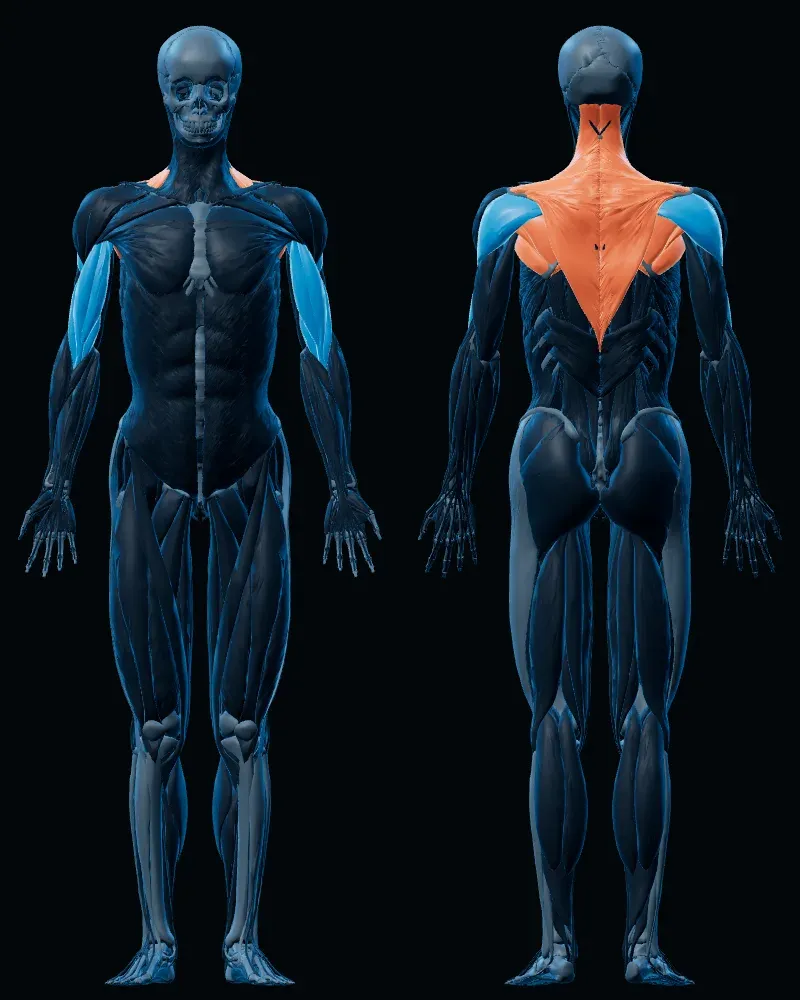
Muscles worked: upper back
Main movers: traps, rhomboids, teres major, infraspinatus and teres minor
Assisting: rear delts, biceps and brachialis
Table of contents
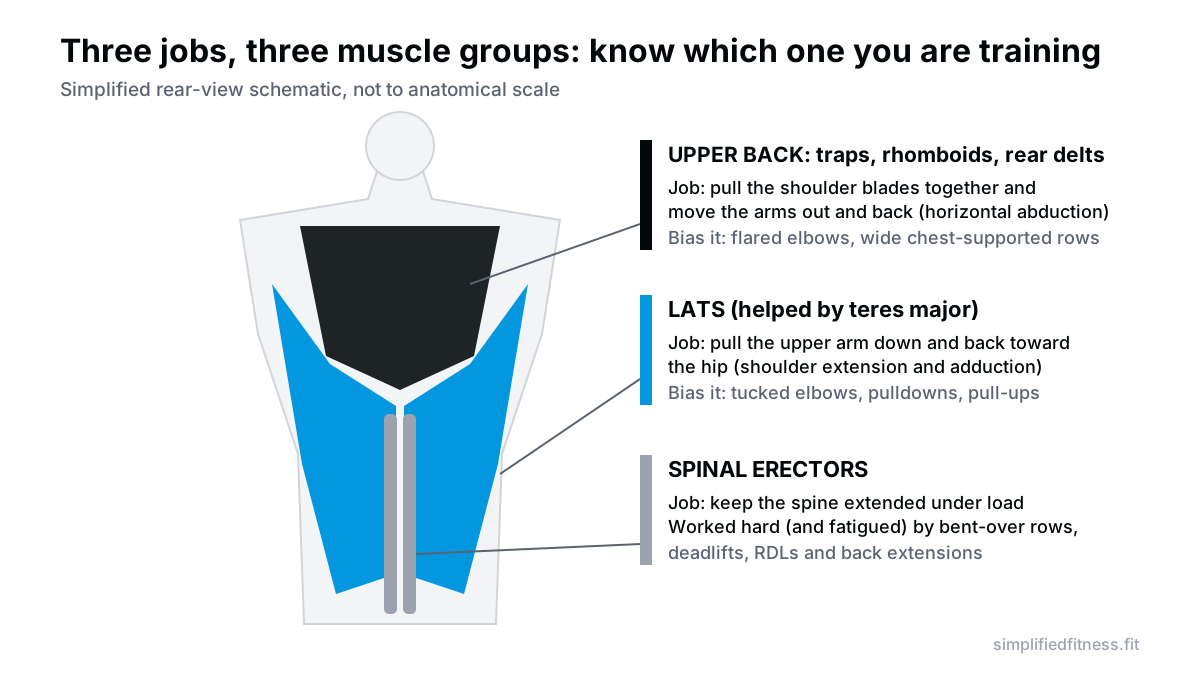
Most back training confusion comes from treating “back” as one muscle. It is not. For back workout hypertrophy you are really training two main targets: the lats, which pull your upper arm down and back toward your hip, and the upper back (mid and lower traps, rhomboids, rear delts), which pulls your shoulder blades together and your arms out wide. Your elbow path decides which one does most of the work.
Get that one idea right and exercise selection stops being a guessing game. Pulldowns, pull-ups and tucked-elbow rows lean lats. Flared-elbow, chest-supported rows and reverse flys lean upper back. Your spinal erectors sit underneath both and mostly act as the thing that gets tired first on bent-over rows and deadlifts.
This pillar guide covers the anatomy, the exercises, what the research does and does not show, and how to build a weekly plan. Each section links out to a deeper article if you want the full breakdown.
The back muscles you are actually training
Here is the short version of the anatomy. The full tour, including smaller muscles like the teres minor and infraspinatus, lives in our functional anatomy of the back muscles.
Lats: the width muscle
The latissimus dorsi is the biggest muscle on your back. It runs from the lower half of the spine, the thoracolumbar fascia, the back of the pelvis (iliac crest) and the lower ribs, and it inserts on the front of your upper arm bone. Its main jobs at the shoulder are extension, adduction and internal rotation (Di Fonza et al., 2026).
In plain gym language: any time your elbow travels from in front of you or above you down toward your hip, your lats are pulling.
A cadaver study of 12 lats found long fascicles (about 26 cm normalized) and a fairly small physiological cross-sectional area (about 5.6 cm²), which the authors read as a muscle built to produce moderate force over a very large range of lengths (Gerling and Brown, 2013). Their modelling also suggested that across shoulder movement the lat works mostly on the plateau and descending part of its force-length curve. That is consistent with what many lifters feel, and it is one reason to use long, full pulls with a real stretch at the top, though it has not been tested as a growth effect.
Because the fibers fan out from the upper back all the way to the pelvis, people talk about “upper” (thoracic) and “lower” (iliac) lat regions. You cannot isolate one, but you can bias the line of pull. We cover that properly in latissimus dorsi regional anatomy, and the lat’s small helper is covered in our piece on teres major and back width.
Upper back: the thickness muscles
The “upper back” is a group, not one muscle:
- Middle trapezius and rhomboids pull the shoulder blades together (retraction).
- Lower trapezius pulls the shoulder blades down and helps rotate them upward when your arms go overhead.
- Rear delts move the upper arm out and back when the elbow is away from your body (horizontal abduction).
- Upper trapezius shrugs and supports the shoulder girdle, and is involved in nearly every heavy pull.
These muscles give the back its dense, thick look between the shoulder blades. They are trained by rows where the elbows travel out wide and the shoulder blades actually move.
Spinal erectors: the support crew
The erector spinae run along both sides of your spine and keep it extended. On a back day they usually work isometrically: holding your torso still during bent-over rows, T-bar rows and deadlifts. They can be trained for growth with back extensions and RDLs, which we cover in spinal erector hypertrophy: back extensions vs RDLs, and in more detail on the leg side in our lower body and core training guide.
Lats vs upper back training: what changes the bias
This is the core of the whole guide. Two rows can look nearly identical from across the gym and train quite different muscles. The variable that matters most is where your elbow goes relative to your torso.
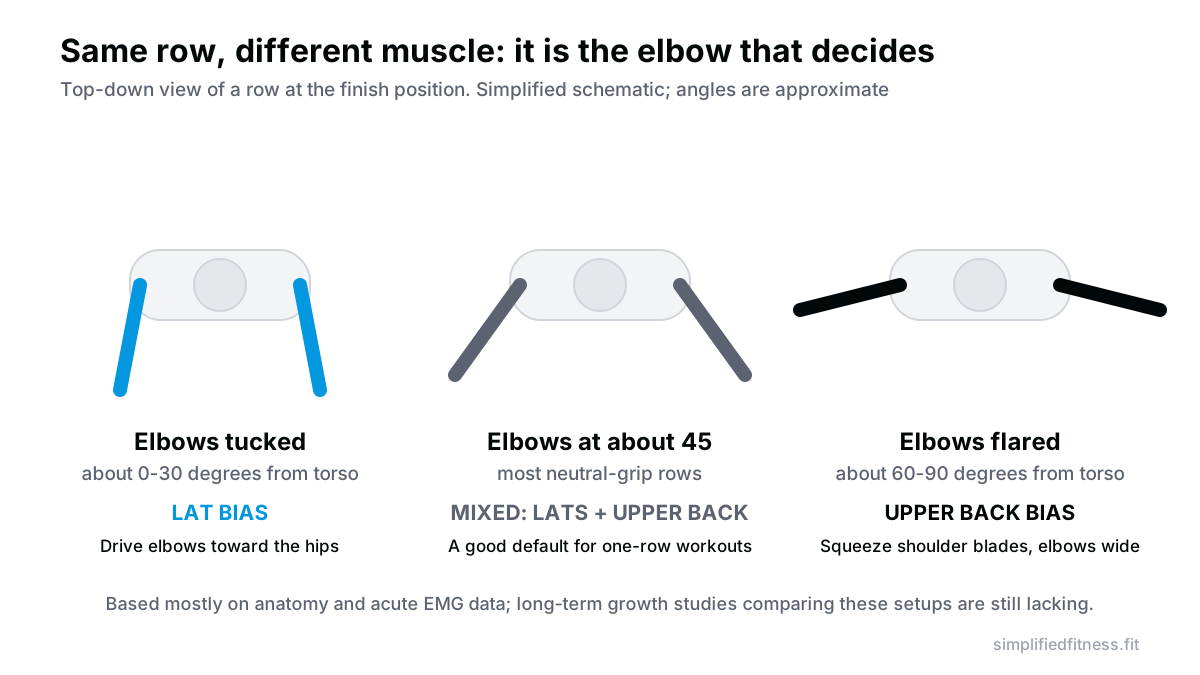
Elbows tucked, path toward the hip. The upper arm stays close to your side and travels down and back. That is shoulder extension and adduction, the lat’s job. Neutral-grip pulldowns, close-grip cable rows and single-arm dumbbell rows with an elbow-to-hip path all live here.
Elbows flared, path straight back. The upper arm sits roughly 60-90 degrees out from your torso and travels backward. That is horizontal abduction plus retraction, the upper back’s job. Wide-grip chest-supported rows, Meadows rows with a flared elbow and reverse pec deck flys live here.
Elbows around 45 degrees. Most neutral-grip rows. You get a meaningful hit on both. If you only have time for one row, this is the one.
The research mostly supports this logic, with a big caveat. A 2026 narrative review of 23 EMG studies on the lats concluded that in the seated row, a narrower grip and a lower shoulder-abduction angle were each linked with higher lat EMG amplitude, and that the humerus-to-trunk relationship may be a key factor in how load gets shared between muscles (Di Fonza et al., 2026). The authors were also clear that these are acute EMG findings, not long-term growth data, and should be treated as a starting point rather than a definitive prescription.
That caveat matters. EMG tells you how loudly a muscle is being signalled during a set; it does not prove that muscle grows more over 12 weeks. So treat elbow-path rules as good anatomy-based coaching, not settled hypertrophy science. The full mechanics are in lats vs upper back: arm path and elbow flare, and the cueing side in scapular retraction vs depression.
Best back exercises, grouped by job
There is no single best back exercise. There are good options for each job, and the best one is the one you can load, progress and feel in the target muscle.
| Exercise | Main target | Lower back demand | Notes |
|---|---|---|---|
| Lat pulldown (neutral or pronated) | Lats | Very low | Easiest vertical pull to progress in small steps |
| Pull-up / chin-up | Lats, biceps | Low to moderate | Bodyweight must be manageable; assisted versions work |
| Single-arm cable pulldown | Lower lats | Very low | Lets you pull the elbow right to the hip |
| Chest-supported row (elbows ~45) | Lats + upper back | Very low | Great default row |
| Chest-supported T-bar, wide grip | Upper back | Very low | Flared elbows, big shoulder blade squeeze |
| Seated cable row, close grip | Lats + mid back | Low | Thighs pinned, torso stays upright |
| Single-arm dumbbell row | Lats + upper back | Low | Bench support reduces trunk demand |
| Barbell bent-over row | Whole back | High | Heavy, but costly for the lower back |
| Reverse pec deck | Rear delts, mid traps | Very low | Simple isolation for upper back |
| Back extension (45 degree) | Erectors, glutes | Moderate (by design) | Direct erector work |
Lat pulldowns and grip width
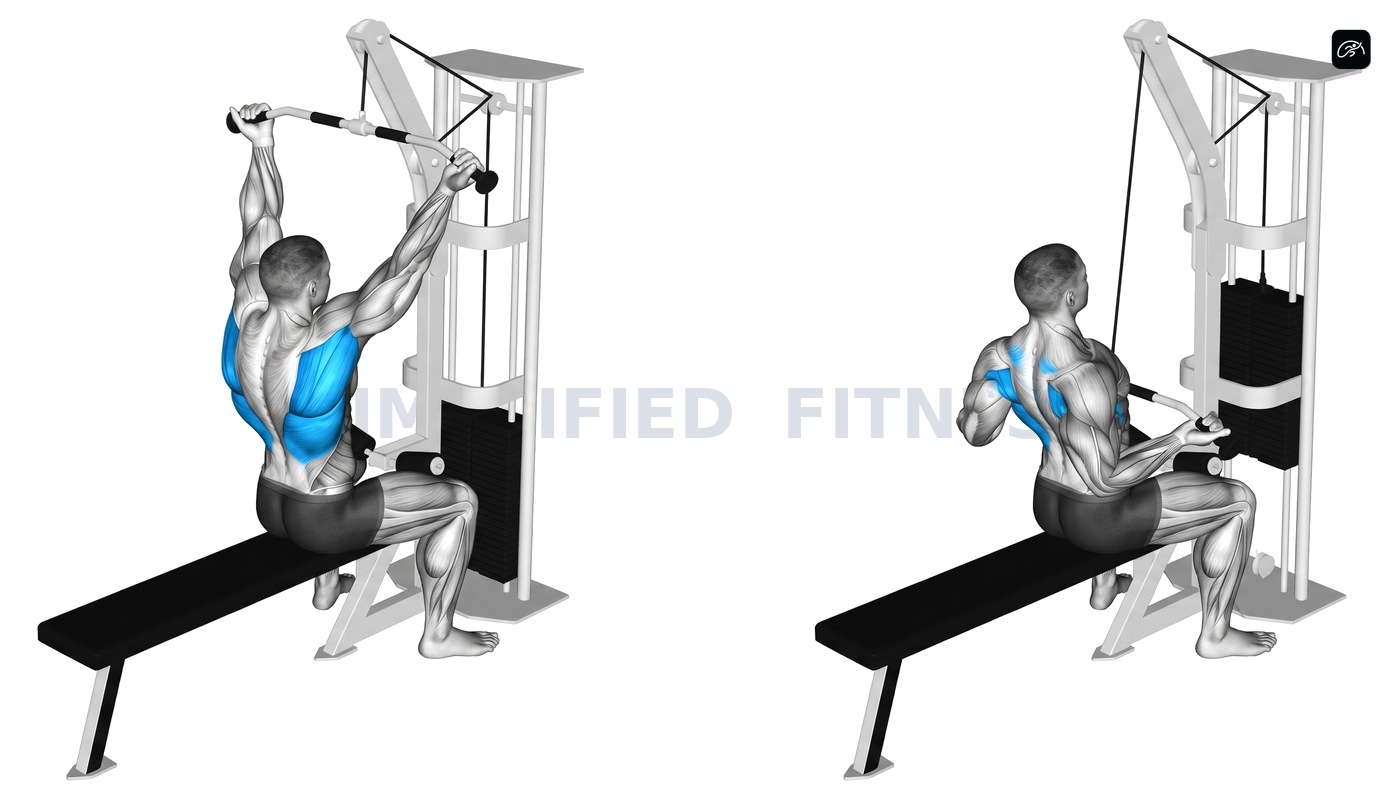
The lat pulldown is the backbone of most lat training because you can adjust the load by a few kilos at a time. The perennial question is grip width.
A 2014 study had 15 men do 6-rep maxes with narrow, medium and wide pronated grips (1, 1.5 and 2 times shoulder width). Lat, trapezius and infraspinatus activation were similar across grips over the full rep, and the narrow (80.3 kg) and medium (80.0 kg) grips were slightly stronger than the wide grip (77.3 kg) (Andersen et al., 2014). In the lowering phase only, the wide grip showed more lat activity than the narrow grip. The authors concluded that lifters can expect similar activation across 1-2 times shoulder width.
Forearm orientation may matter a little more. In 12 healthy men using 70% of their 1RM, an overhand grip produced more lat activity than an underhand grip, regardless of width (Lusk et al., 2010). The 2026 review added that pulling the bar to the front (not behind the neck) was the most consistently supported setup for lat EMG, while grip width effects were inconsistent (Di Fonza et al., 2026).
Pullups vs lat pulldown
Both are vertical pulls. Both train the lats hard. The differences are practical.
In 25 young adults, pull-ups and chin-ups produced high lat activity (117-130% of a maximal isometric contraction across the variations tested). Chin-ups drew more biceps and pec major activity, while pull-ups drew more lower trapezius activity (Youdas et al., 2010). In 19 strength-trained men, overhand, underhand, neutral and rope pull-ups were broadly similar for the shoulder and arm muscles measured, though the overhand grip activated the middle trapezius more than the neutral grip (Dickie et al., 2017).
So for lat growth, the choice comes down to logistics:
- Pull-ups are great if you can do at least 5-6 clean reps. They need no machine, which is handy if you train at home with a doorframe bar.
- Lat pulldowns are better if you cannot yet do clean pull-ups, if you are heavy, or if you want small, predictable load jumps.
- Many lifters do both: pull-ups early in one session, pulldowns in the other.
One interesting detail: in a spine-loading study of 14 men, chin-ups and pull-ups produced the highest spine compression among the pulling tasks tested, because they required the highest muscle activation, even though the body is hanging (McGill et al., 2014). That is not a reason to fear them. It is a reminder that “hanging” is not the same as “decompressing.” The biceps angle is covered in pull-ups vs chin-ups.
Rows: free-standing vs supported
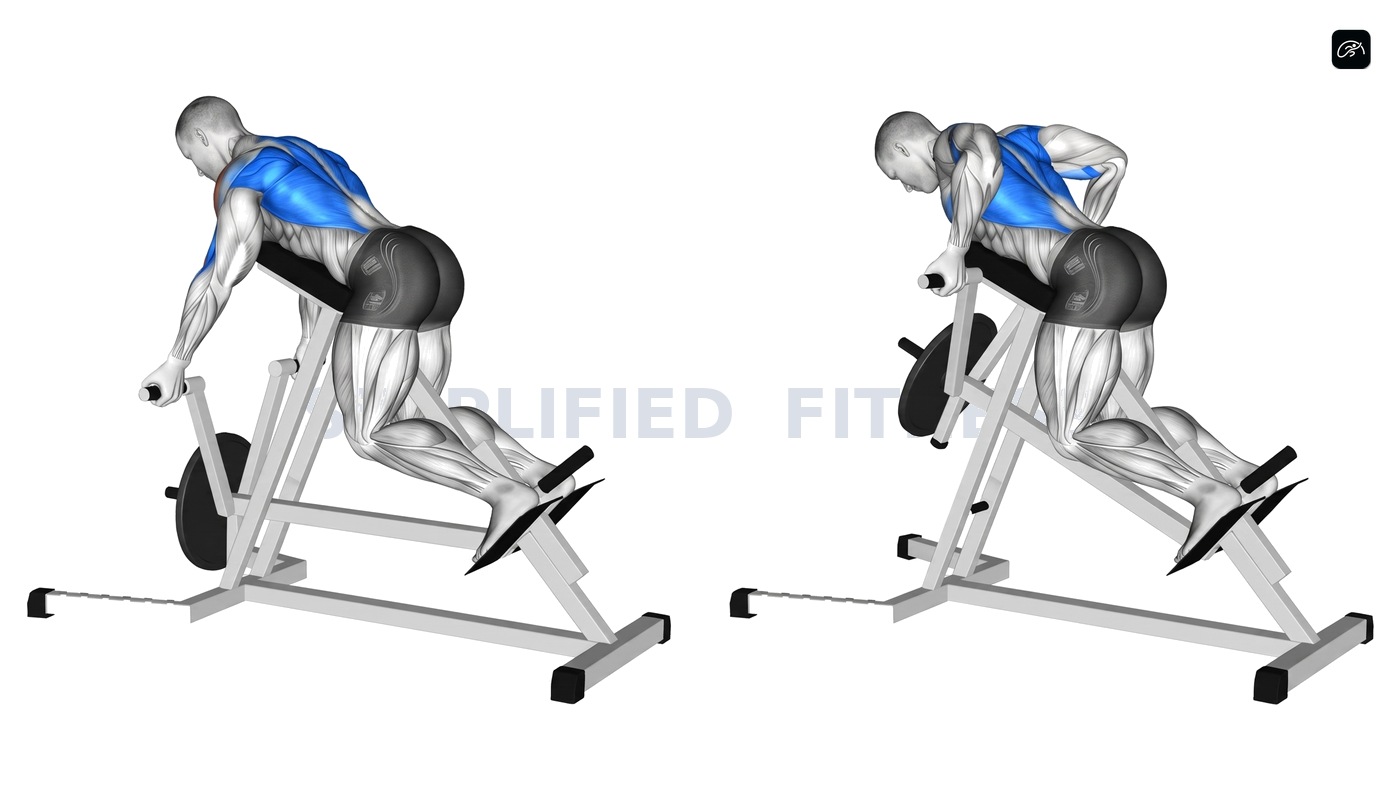
Rows are where lower back fatigue becomes a real programming issue.
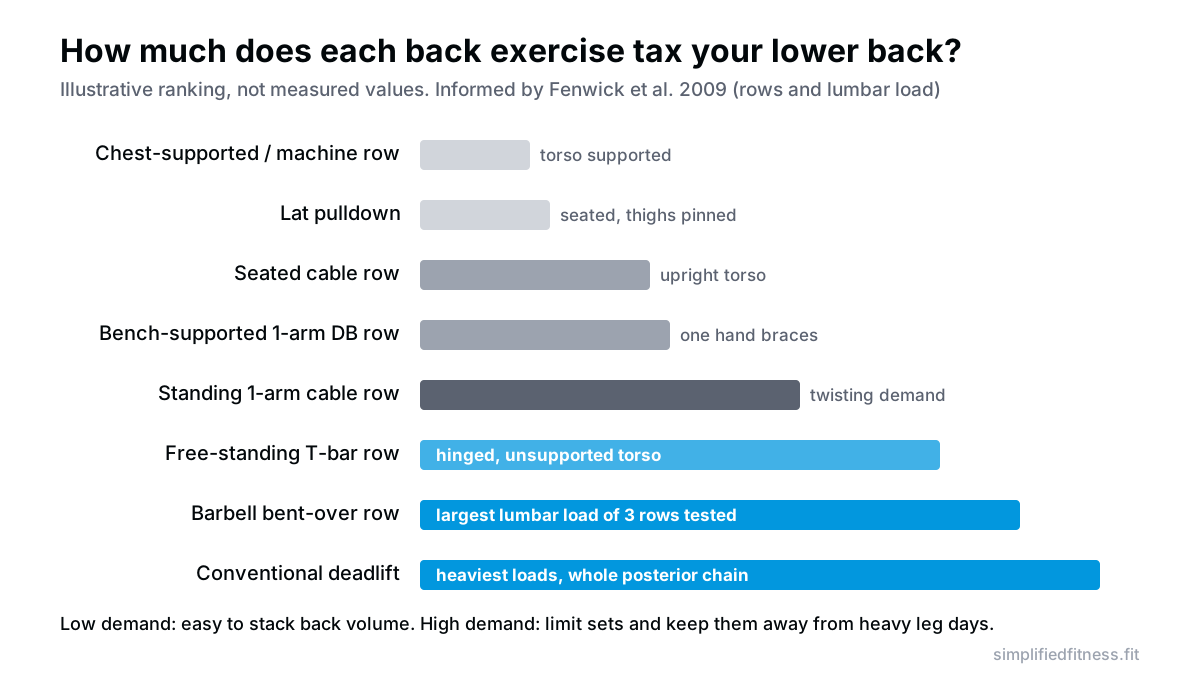
A lab study of 7 healthy men compared the inverted row, the standing bent-over row and the standing one-arm cable row (Fenwick et al., 2009). The inverted row produced the highest lat, upper back and hip extensor activation with the lowest spine load. The bent-over row produced large activation across the whole back but the largest lumbar spine load. The one-arm cable row challenged the trunk’s ability to resist twisting.
It is a small sample and it measured acute activation and load, not growth. Still, the takeaway is practical: an unsupported hinge costs your lower back something on every set.
Chest supported row biomechanics
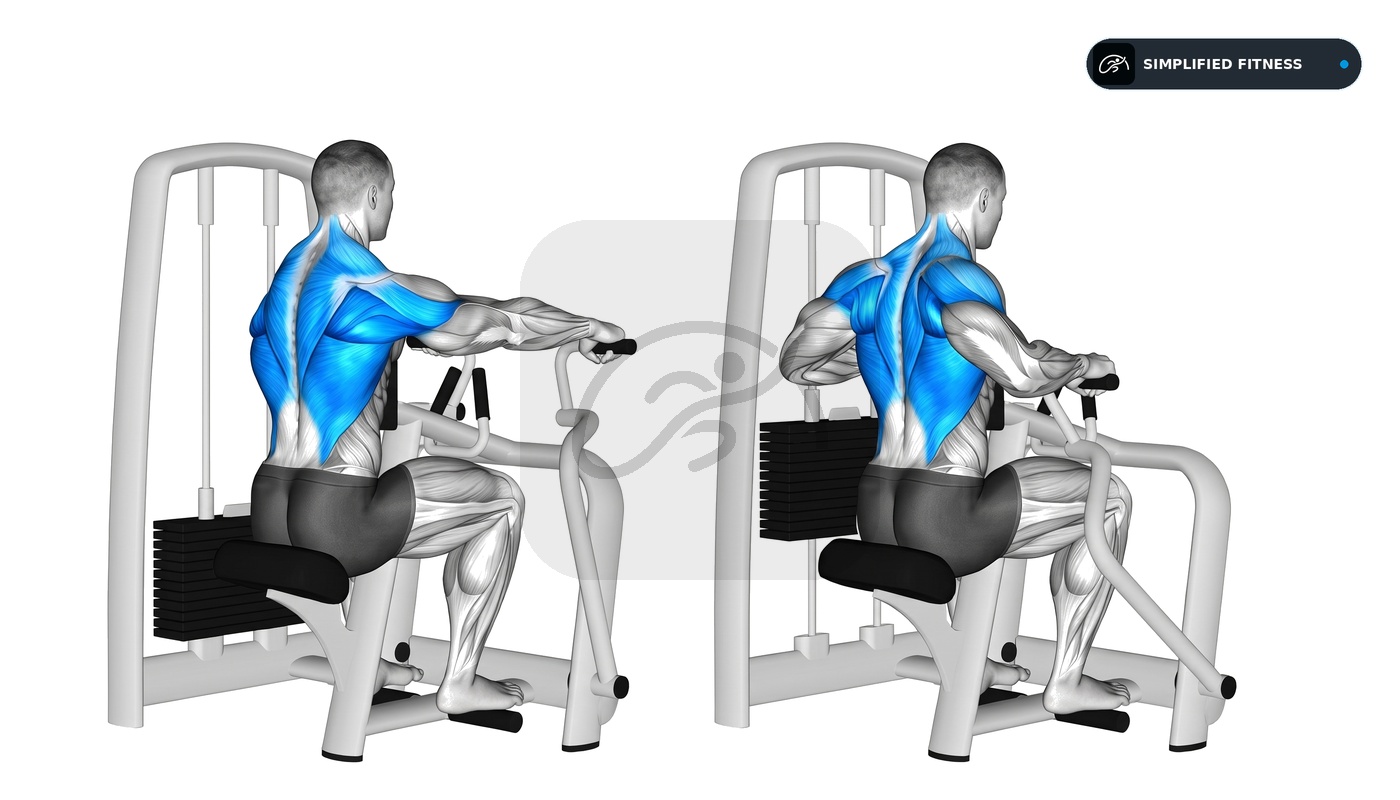
A chest-supported row moves the job of holding your torso from the erectors to a pad. That changes three things:
- Your lower back is no longer the limiting factor, so the set ends when your back muscles are tired, not when your erectors are.
- You cannot use body English to swing the weight up, so the range of motion stays honest.
- You can stack more weekly sets without the fatigue spilling into squats, RDLs or deadlifts.
The trade-off is that the pad can restrict breathing at heavy loads and some machines fit short or tall lifters badly. If a machine forces your shoulders to shrug up at the top, set the chest pad higher or switch to an incline-bench dumbbell row. The full analysis is in chest-supported rows for upper back hypertrophy, with T-bar specifics in T-bar rows: chest-supported vs standing.
Seated cable rows and single-arm rows
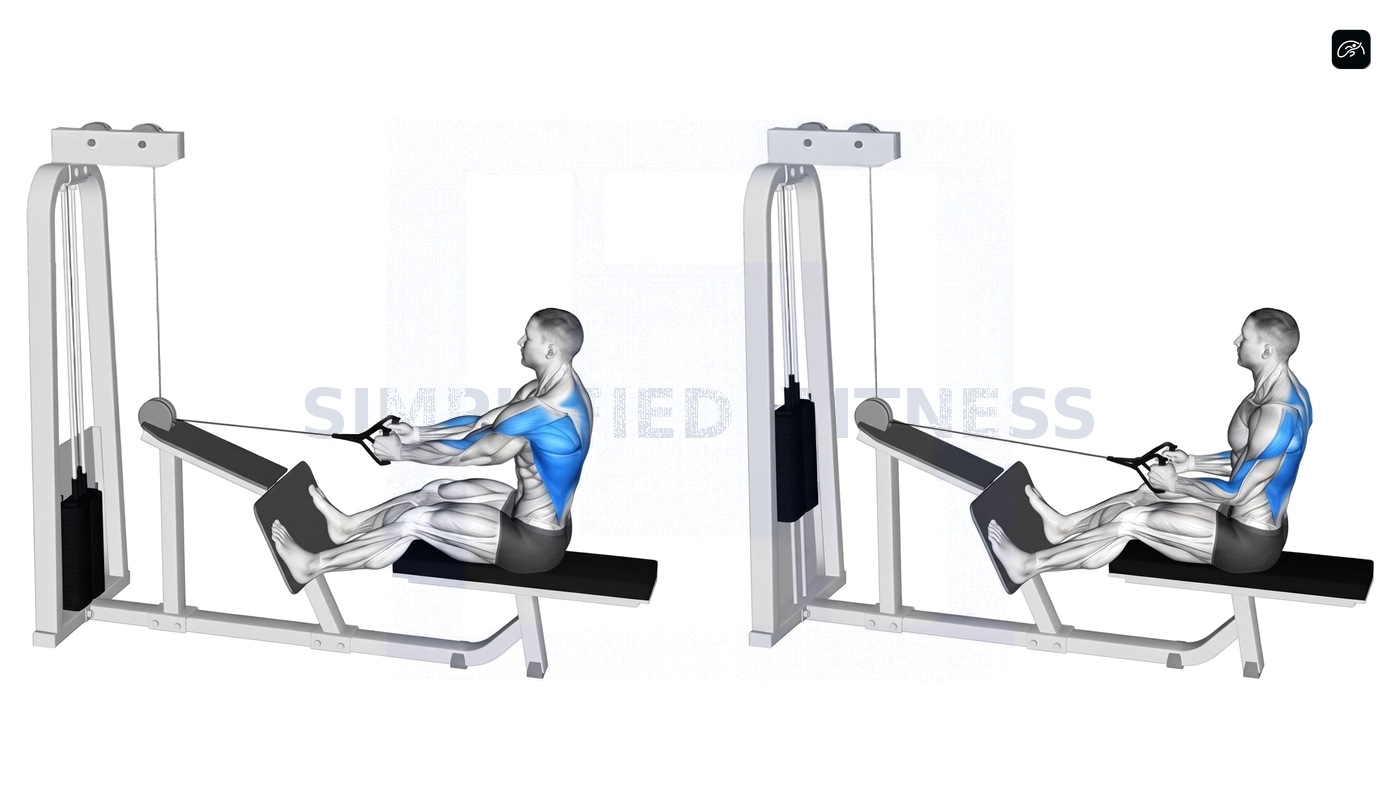
Seated cable rows sit in the middle: low lower back demand if you keep the torso mostly upright, and flexible attachments. The V-handle and close neutral grips lean lat; a wide bar leans upper back. Our breakdown of seated cable row attachments and elbow drive goes through each one.
Single-arm dumbbell rows let each side work through a long range and let you pull the elbow back toward the hip. Bench support versus a tripod stance mostly changes how much your trunk has to stabilize; see single-arm dumbbell rows: bench vs tripod. Landmine and Meadows rows are a fun upper back variation covered in Meadows rows and landmine rowing.
Range of motion on rows
Should you row through the full range or bias part of it? In 16 resistance-trained men doing prone barbell rows, the upper half of the range produced higher mean lat excitation than either full or lower-half reps, and the middle trapezius peaked lower in the upper-half condition (Fischer et al., 2025). The authors called the effects medium-sized and inconsistent, and concluded that range adjustments had limited impact on overall activation.
Translation: full-range rows with a controlled stretch remain a safe default. Partial reps are not a magic shortcut for back growth, and the evidence for them in back training is acute and limited.
Pullovers, deadlifts and the “do I need them?” list
Dumbbell pullovers feel like a lat exercise, but EMG work suggests they often lean on the chest. The 2026 review concluded that the pullover appeared to preferentially activate the pectoralis major rather than selectively target the lats (Di Fonza et al., 2026). Cable straight-arm pulldowns are the more lat-friendly cousin. The tension curve problem is explained in dumbbell pullover tension curve analysis.
Conventional deadlifts load the erectors, glutes and hamstrings heavily and give your upper back plenty of isometric work. They are not required for back size, and the fatigue cost is high. If you like them, keep them; if you are purely chasing back muscle, the case for them is weaker than gym folklore suggests. See conventional deadlifts for back hypertrophy.
Shrugs mostly hit the upper traps, which already get a lot of work from heavy rows, deadlifts and carries. Kelso shrugs (a shrug-plus-retraction done chest-down) shift more of the work toward the middle traps. If your upper traps are a visual priority, a few sets per week will cover it; if not, your rows are probably doing enough.
Managing lower back fatigue
This is the part most back programs ignore. Your spinal erectors are working on almost every heavy unsupported pull, and that work adds up across the week. If your week also includes squats, RDLs and deadlifts, the erectors become the bottleneck before your lats or upper back ever get enough work.
A few practical rules:
- Cap your heavy hinge-based back work. One free-standing row variation or one deadlift variation per week is plenty for most hypertrophy-focused lifters.
- Separate lower back heavy days. Do not put bent-over rows the day after heavy RDLs.
- Use supported rows for the bulk of your volume. Chest-supported, seated and machine rows let you add sets without the hidden lumbar cost.
- Do direct erector work deliberately. Two sets of 45-degree back extensions once a week trains them directly without a heavy axial load.
Coaching retraction also has a cost. In the McGill study, cueing shoulder blade “centration” through retraction increased spine loading while adding stiffness around the shoulder (McGill et al., 2014). That is fine for healthy lifters; it is one more reason not to stack endless heavy pulls.
When to see a doctor: soreness in the lower back muscles a day or two after rows is common. Pain that shoots down a leg, numbness, tingling, leg weakness, changes in bladder or bowel control, or back pain with fever or after a fall needs a prompt medical check. Pain that has not improved after two to three weeks of modified training is worth a visit to a physiotherapist or sports medicine doctor. Do not train through sharp pain hoping it goes away.
How to build a back workout: hypertrophy sets, frequency and effort
The anatomy tells you which exercises to pick. The dose tells you how much of them to do. This is where back workout hypertrophy is won or lost.
Volume
A 2017 meta-analysis of 15 studies (34 treatment groups) found a graded dose-response: each additional weekly set was associated with an extra 0.37% gain in muscle size on average, and higher-volume conditions beat lower-volume ones (Schoenfeld et al., 2017). A larger 2026 meta-regression of 67 studies and 2,058 participants confirmed that hypertrophy rises with weekly volume, but with diminishing returns (Pelland et al., 2026).
That second paper also counted indirect sets as partial (“fractional”) sets, and that model fit best. For back training this matters. Every pulldown hits the upper back a bit; every row hits the lats a bit. You do not need 10 sets per region plus 10 sets of rows to cover everything.
A practical starting point for most natural lifters is 6-10 hard sets per week for lats and 6-10 for upper back, counting a 45-degree row toward both. Lifters who recover well and have plateaued can push higher, a couple of sets at a time. Use our training volume calculator to count your weekly sets honestly. For more on dose-response and junk volume, see the training volume and frequency guide.
Frequency
Training back once or twice a week both work. A 2019 meta-analysis of 25 studies found no significant hypertrophy difference between frequencies when weekly volume was equated (Schoenfeld et al., 2019), and the 2026 meta-regression found frequency’s effect on hypertrophy was compatible with a negligible effect (Pelland et al., 2026).
Two sessions is still the easier way to run it. Ten hard back sets in one session means your last four sets are done with a tired grip, tired biceps and less focus. Split them and every set counts.
Effort
A 2023 meta-analysis found no evidence that training to momentary muscular failure beats stopping short of failure for hypertrophy (Refalo et al., 2023). For back work, sets taken to about 1-3 reps in reserve are a good default. Pushing the last set of a machine row or cable pulldown to failure is low risk. Grinding a barbell row to failure with a rounding lower back is not.
If you are unsure how close to failure you are, the RIR and RPE calculator gives you a simple way to rate and track effort.
Exercise order and progression
- Put your main lat pull or main row first, while you are fresh.
- Put lower back heavy work early in the session and early in the week, away from leg day.
- Finish with isolation: reverse flys, straight-arm pulldowns, or back extensions.
- Add reps first, then load. When you hit the top of your rep range on every set, add the smallest jump the machine allows.
The rules for when to add load, when to deload and how to break a stall are in our progressive overload, deloads and plateaus guide. The 1RM calculator helps you estimate working weights from a recent set.
A sample back training week
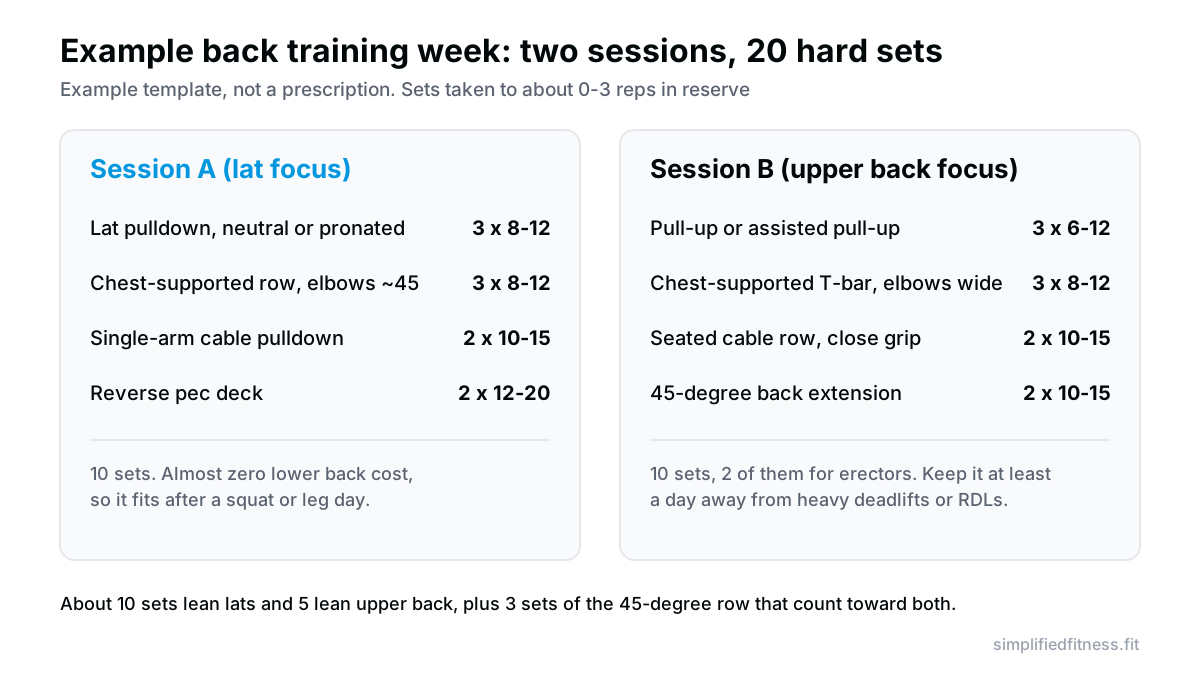
This example fits a push/pull/legs or upper/lower split. Session A is almost free for the lower back, so it can sit right after leg day. Session B contains pull-ups, a wide chest-supported row and two sets of back extensions, so keep it at least a day away from heavy deadlifts or RDLs.
If you are newer, cut each exercise by one set. If you have trained seriously for years and progress has stalled, add one set to the exercise you feel best and see how you respond over four to six weeks. Our complete back workout design guide builds this out into several versions, and the free pull day plan gives you a ready-made session.
Training at home or in a crowded gym where the one lat machine is always taken? A doorframe pull-up bar, a resistance band for assistance and a pair of dumbbells for rows cover the same structure. In hot, humid weather, sweaty hands give out on heavy rows long before the back does. Chalk, a towel, or straps help.
Grip, straps and mind-muscle connection
Straps. When grip fails first, the back gets less work. That is the logic behind straps on heavy rows, shrugs and RDLs. The direct evidence is thin, though. In 12 resistance-trained men doing lat pulldowns, straps did not change 1RM, reps at 70% of 1RM, or lat activation (Valério et al., 2021). A reasonable reading: straps are useful on your heaviest pulls or when your forearms are clearly the limiter, and unnecessary on moderate-load cable work. More in lifting straps for back hypertrophy.
Arms. Rows and pulldowns train your biceps too. In 29 untrained men over 10 weeks, a program of only lat pulldowns and bench presses grew the elbow flexors by 6.5%, versus 7.04% when direct arm exercises were added, with no significant difference between groups (Gentil et al., 2013). That was in beginners, so trained lifters may still benefit from curls, but it shows how much arm work your back training already covers. Plan arm volume with that in mind using our arm and forearm training guide.
Feeling your lats. Many people simply do not feel their lats working at first. Lead with the elbows, think of your hands as hooks, start each pulldown by pulling the shoulder blades down slightly, and pause for a second at the bottom. Practical cues are in lat flare and mind-muscle connection. Whether mind-muscle focus adds growth on its own is less clear than the cues make it sound, so use it to learn the movement, then focus on progression.
Choosing exercises that fit your body
Exercise selection is not one-size-fits-all. Long arms, a short torso, past shoulder injuries and the machines your gym actually has all change what works best. The exercise selection and biomechanics guide explains how to judge any movement by its resistance profile and how it loads the target muscle, so you can swap exercises without losing progress.
A simple test for any back exercise: can you feel the target muscle, control the stretch, and add reps or load over a few weeks? If yes, keep it. If your elbows, shoulders or lower back complain every session, change the variation before you change the plan.
The bottom line
A bigger back comes down to one anatomical idea and a few programming rules. Lats pull the arm toward the hip; the upper back pulls the shoulder blades together and the arms out wide. Pick at least one exercise for each, do roughly 6-10 hard sets per week per region across two sessions, and progress them patiently. Put most of your volume into supported rows and pulldowns, and treat bent-over rows and deadlifts as the expensive extras they are.
The research on back exercises is mostly short-term EMG work in small groups, so stay skeptical of anyone claiming one perfect grip or one secret row. Train the jobs, track your numbers, and let consistency do the work. If you want a structured starting point, grab the free workout plans and build your week from there.
Go deeper: every guide in this topic
- Barbell Bent-Over Rows: Spinal Load, Hamstring Fatigue and Lat Growth
- Chest-Supported Rows: Train Your Upper Back Without Lower Back Fatigue
- Complete Back Workout Design: Balancing Vertical Pulls, Horizontal Rows, and Lumbar Recovery
- Conventional Deadlifts for Back Hypertrophy: Stimulus-to-Fatigue Ratio Analysis
- Dumbbell Pullover Tension Curve: Why You Feel Triceps and Chest, Not Lats
- Functional Anatomy of the Back: Lats, Traps, Rhomboids, Teres and Erectors
- Lat Flare and Mind-Muscle Connection: How to Feel Your Lats Working
- Lat Pulldown Grip Comparison: Wide vs Close Neutral vs Underhand
- Latissimus Dorsi Regional Anatomy: Thoracic, Lumbar, and Iliac Fiber Recruitment
- Lats vs Upper Back: How Elbow Flare and Scapular Motion Decide Which Muscle Works
- Lifting Straps for Back Hypertrophy: Cheating or Smart? What the Research Says
- Meadows Rows and Landmine Rowing Variations: Biomechanics for Scapular Retraction
- Pull-Ups vs Chin-Ups: What the EMG Research Says About Lats and Biceps
- Scapular Retraction vs Depression: Feel Your Back in Every Pull
- Seated Cable Rows: V-Bar, Neutral Grip or Wide Bar? How to Choose and Drive the Elbows
- Single-Arm Dumbbell Rows: Knee on Bench vs Tripod Stance, Which Is Better?
- Single-Arm Iliac Lat Pulldowns: Cable Setup, Side Bend, and Driving the Elbow to the Hip
- Spinal Erector Hypertrophy: 45-Degree Back Extensions vs Romanian Deadlifts
- T-Bar Rows: Chest-Supported vs Free-Standing, and What Each Does to Your Lower Back
- Teres Major and Minor: Anatomy, Function and How to Train Back Width
Frequently Asked Questions
What is the best back workout for hypertrophy?
The best back workout for hypertrophy includes at least one vertical pull (pulldown or pull-up) and one row, done for roughly 6-10 hard sets per week per region, split over two sessions. Volume meta-analyses show more sets tend to produce more growth with diminishing returns, and frequency matters little once volume is equated. Start with a pulldown and a chest-supported row twice a week and add sets only when progress stalls.
What is the difference between training lats and upper back?
Lat training pulls the upper arm down and back toward the hip, while upper back training pulls the shoulder blades together and moves the arms out wide. The lats extend and adduct the shoulder, whereas the mid traps, rhomboids and rear delts retract the scapula and horizontally abduct the arm. Use tucked-elbow pulldowns and rows for lats, and flared-elbow, chest-supported rows plus reverse flys for the upper back.
Are pull-ups better than lat pulldowns for back growth?
Neither is clearly better for hypertrophy; both train the lats through the same basic movement. EMG work shows high lat activity in pull-ups, and the lat pulldown lets you load lighter or heavier than bodyweight and progress in small steps. Use whichever lets you do 6-15 clean reps close to failure, and many lifters do both across the week.
Does a wide grip build a wider back?
Not reliably. A 2014 study of 15 men found similar lat activation across grip widths of 1-2 times shoulder width on the lat pulldown, and the wide grip was slightly weaker for 6RM. Pick the grip that feels strongest and lets you pull through a full range, then focus on adding load and reps over time.
Is underhand or overhand grip better for lats?
An overhand (pronated) grip produced slightly more lat activity than an underhand grip on the lat pulldown in one study of 12 men. Chin-ups with an underhand grip raised biceps and pec activity compared with pull-ups, while lat activity stayed high in both. Use overhand or neutral grips as your main lat pull and treat chin-ups as a solid option if you also want more biceps work.
Do chest-supported rows build more muscle than bent-over rows?
There is no long-term study showing chest-supported rows build more back muscle, but they remove most of the lower back demand. A small lab study found the bent-over barbell row placed the largest load on the lumbar spine of the three rows tested, which limits how many sets you can recover from. For most people chasing back size, chest-supported rows make it easier to add hard sets without your lower back becoming the limiting factor.
How many sets for back per week for hypertrophy?
A practical starting point is about 6-10 hard sets per week each for lats and upper back, taken within 0-3 reps of failure. Meta-analyses show a graded dose-response where more weekly sets tend to give more growth, but the returns shrink as volume climbs. Begin at the lower end, track your pulldown and row numbers, and add a set or two only when progress stalls.
How many times a week should I train back?
Twice a week works well for most lifters. A 2019 meta-analysis found no significant difference in hypertrophy between training frequencies when weekly volume was equated, so frequency is mainly a tool for spreading volume. Splitting 12-20 back sets across two sessions keeps each workout short enough that your last sets are still high quality.
Should I train back to failure?
You do not need to take every set to failure for back growth. A 2023 meta-analysis found no clear hypertrophy advantage for training to momentary muscular failure compared with stopping short. Take most sets to 1-3 reps in reserve and push the final set of a machine or cable exercise closer to failure if you like.
Do I need deadlifts for a big back?
No, deadlifts are not required for back hypertrophy. They mainly load the spinal erectors, glutes and hamstrings, and they create a lot of fatigue that can cut into your rowing and leg training. If you enjoy them or compete in powerlifting keep them, but rows, pulldowns and back extensions can build a full back without them.
Do lifting straps help back growth?
Straps can help when grip fails before your back does, especially on heavy rows and RDLs. In a lab-based lat pulldown study of 12 trained men, straps did not change 1RM, reps at 70% of 1RM, or lat activation, which suggests grip is not always the limiter. Use straps on your heaviest pulls or late sets when your forearms are clearly giving out first.
Why do I feel rows in my arms instead of my back?
Your biceps and forearms always work in rows, so some arm feel is normal. Problems usually come from pulling with the hands instead of driving the elbows, cutting the range short, or using a load so heavy that you yank with the torso. Think of your hands as hooks, lead with the elbows, pause briefly at the finish, and reduce the weight until the stretch and squeeze are controlled.
How do I target my lower lats?
You cannot fully isolate the lower lats, but you can bias them by pulling the elbow down and back toward the hip with the arm close to your side. The lat attaches from the lower spine and iliac crest up to the upper arm, so lines of pull that end near the hip stretch and shorten those lower fibers. Single-arm cable pulldowns, half-kneeling pulldowns and dumbbell rows with an elbow-to-hip path are good options.
What exercises build the upper back?
Chest-supported rows with flared elbows, wide-grip cable rows, reverse pec deck flys and face-pull style movements are the most practical upper back builders. These exercises emphasize scapular retraction and horizontal abduction, which are the main jobs of the mid traps, rhomboids and rear delts. Pick one heavy row and one isolation movement and do 6-10 total sets per week.
Are shrugs needed for traps?
Shrugs mostly train the upper traps, which also get a fair amount of work from heavy rows, deadlifts and carries. Because heavy pulling already loads the upper traps, many lifters get enough trap growth without dedicated shrug work. Add 2-4 sets of shrugs or Kelso shrugs per week only if your upper traps are a visual priority.
Can I build a big back at home in India without machines?
Yes, a doorframe pull-up bar, a pair of adjustable dumbbells and resistance bands can cover most back training. Pull-ups or band-assisted pull-ups train the lats, and dumbbell rows on a sturdy bench or chair cover rows and upper back work. Progress by adding reps, pauses, slower lowering and eventually a backpack with weight.
Is it bad to round your back on rows?
Some upper back rounding at the stretch of a row is common and not automatically dangerous, but large lower back rounding under heavy load is a technique fault worth fixing. The bent-over row already places a high load on the lumbar spine, and losing your hinge position adds to it. Keep the lower back neutral and braced, let the shoulder blades move, and switch to chest-supported rows if your lower back fatigues first.
Why does my lower back hurt after back day?
Lower back soreness after back day usually comes from unsupported rows, deadlifts or RDLs that hold the spinal erectors in a long isometric contraction. Bent-over rows produced the highest lumbar spine load of the rows studied in one lab study. Move some rows to chest-supported or seated versions, and see a doctor or physiotherapist if pain is sharp, lasts more than a couple of weeks, or travels down your leg.
What is the best order for back exercises?
Put the exercise you most want to progress, usually a heavy pulldown, pull-up or row, first while you are fresh. Fatigue builds across a session, so lower back heavy movements are best done early and isolation work like reverse flys or pullovers late. A simple order is vertical pull, row, second pull or row, then an isolation movement.
Do dumbbell pullovers work the lats?
Pullovers do train the lats, but EMG research suggests they often load the chest at least as much. A 2026 narrative review of lat EMG studies concluded the pullover appeared to preferentially activate the pectoralis major rather than selectively target the lats. Use cable or machine pullovers with a straight-arm pull down toward the hips if you want a more lat-biased isolation movement.
Do back exercises also grow the biceps?
Yes, pulling movements train the elbow flexors too. In a 10-week study of 29 untrained men, doing only lat pulldowns and bench presses grew the elbow flexors about as much as adding direct curls and triceps work. Trained lifters may still benefit from direct arm work, so keep a few sets of curls if arm size is a goal.
How heavy should I go on back exercises?
Use loads you can control for roughly 6-15 reps with a full range of motion and a short pause at the finish. Hypertrophy research shows that a wide range of loads builds muscle when sets are taken close to failure, so the rep range matters less than effort and consistency. If you cannot hold the contracted position for a second, the weight is probably too heavy for the target muscle.
Should I see a doctor for back pain from lifting?
Most mild muscle soreness after rows or deadlifts settles within a few days, but some symptoms need a medical check. Pain that shoots down a leg, numbness, tingling, weakness, loss of bladder or bowel control, or pain after a fall or with fever should be assessed by a doctor promptly. For ongoing aches that do not improve within two to three weeks, a physiotherapist or sports medicine doctor can rule out injury and help you modify training.
Sources & References
Every claim above is checked against peer-reviewed research (PubMed, U.S. National Library of Medicine) or guidance from established health bodies. How we fact-check.
- Fenwick CM, et al. Comparison of different rowing exercises: trunk muscle activation and lumbar spine motion, load, and stiffness. J Strength Cond Res. 2009. PMID: 19620925
- Schoenfeld BJ, et al. Dose-response relationship between weekly resistance training volume and increases in muscle mass: A systematic review and meta-analysis. J Sports Sci. 2017. PMID: 27433992
- Pelland JC, et al. The Resistance Training Dose Response: Meta-Regressions Exploring the Effects of Weekly Volume and Frequency on Muscle Hypertrophy and Strength Gains. Sports Med. 2026. PMID: 41343037
- Schoenfeld BJ, et al. How many times per week should a muscle be trained to maximize muscle hypertrophy? A systematic review and meta-analysis. J Sports Sci. 2019. PMID: 30558493
- Refalo MC, et al. Influence of Resistance Training Proximity-to-Failure on Skeletal Muscle Hypertrophy: A Systematic Review with Meta-analysis. Sports Med. 2023. PMID: 36334240
- Lusk SJ, et al. Grip width and forearm orientation effects on muscle activity during the lat pull-down. J Strength Cond Res. 2010. PMID: 20543740
- Andersen V, et al. Effects of grip width on muscle strength and activation in the lat pull-down. J Strength Cond Res. 2014. PMID: 24662157
- Youdas JW, et al. Surface electromyographic activation patterns and elbow joint motion during a pull-up, chin-up, or perfect-pullup rotational exercise. J Strength Cond Res. 2010. PMID: 21068680
- Dickie JA, et al. Electromyographic analysis of muscle activation during pull-up variations. J Electromyogr Kinesiol. 2017. PMID: 28011412
- McGill SM, et al. Muscle activity and spine load during pulling exercises: influence of stable and labile contact surfaces and technique coaching. J Electromyogr Kinesiol. 2014. PMID: 25066518
- Gerling ME, et al. Architectural analysis and predicted functional capability of the human latissimus dorsi muscle. J Anat. 2013. PMID: 23758053
- Di Fonza D, et al. Electromyographic Analysis of Latissimus Dorsi Activation During Common Resistance Training Exercises: A Narrative Review. J Funct Morphol Kinesiol. 2026. PMID: 42647355
- Fischer J, et al. Impact of different ranges of motion in the prone barbell row on muscle excitation. J Electromyogr Kinesiol. 2025. PMID: 40513198
- Valerio DF, et al. The effects of lifting straps in maximum strength, number of repetitions and muscle activation during lat pull-down. Sports Biomech. 2021. PMID: 31198105
- Gentil P, et al. Effect of adding single-joint exercises to a multi-joint exercise resistance-training program on strength and hypertrophy in untrained subjects. Appl Physiol Nutr Metab. 2013. PMID: 23537028

Umair Hazrami · Founder & Head Coach, Simplified Fitness
Umair Hazrami founded Simplified Fitness and the Simplified Lifter channel to cut through fitness noise. With 4+ years of consistent training and 10+ coaching clients, he writes every guide from the peer-reviewed research and links the sources so you can check them. Our editorial standards.
Educational content only, not medical advice. If you have a medical condition, are pregnant, or take medication, talk to a qualified doctor before changing your diet, supplements or training. Full disclaimer.
Keep reading
Exercise Technique
3D Shoulder Protocol: Weekly Volume, Frequency (2-3x/Week) and Rep Ranges
How to build 3D shoulders: how many weekly sets, how often to train side and rear delts, and which rep ranges to use, with an 8-week plan and the research.
8 min read

Exercise Technique
Adductor Magnus Training: Seated Adductor Machine and Copenhagen Planks for Thigh Mass
Adductor magnus training explained: what research says on deep squats, the adductor machine and Copenhagen planks for thicker inner thighs and groin strength.
7 min read

Exercise Technique
Antagonist Arm Supersets: Biceps and Triceps Pairing for a Faster, Pumpier Arm Day
A biceps triceps superset workout can shorten arm day while keeping volume close to straight sets. See the research, pairing tips and a 20-minute routine.
9 min read

Exercise Technique
Are Front Raises Necessary? Why Bench Pressers Rarely Need Direct Front Delt Work
Are front raises necessary if you bench and overhead press? See what EMG and volume research says, when they can still help, and where to spend those sets.
8 min read