Best Workout Split for Muscle Growth: PPL vs Upper/Lower vs Full Body, What the Research Says
The best workout split is the one you can repeat. See what studies say about PPL, upper/lower and full body, plus supersets that cut sessions to 30 minutes.
TL;DR. The short answer
- No split is best for muscle growth on its own. A 2024 meta-analysis of 14 studies found split and full-body routines produced similar strength and size gains when weekly volume was matched.
- Weekly hard sets per muscle matter more than how you divide them. Training frequency, by itself, appears to have little effect on growth once sets are equal.
- Hitting each muscle at least twice a week is a sensible default, mostly because it makes higher weekly volume easier to spread out and recover from.
- Choose by schedule: 2-3 days suits full body, 4 days suits upper/lower, 5-6 days suits push pull legs.
- Antagonist supersets (for example bench press paired with rows) can cut session time a lot while keeping volume and long-term gains similar.
Table of contents
The best workout split is the one that fits the days you can actually train, every week, for months. When weekly sets per muscle are matched, full body, upper/lower and push pull legs produce very similar muscle and strength gains in controlled trials. So the split is a scheduling decision, not a secret growth lever.
That answer annoys people. It shouldn’t. It means you can stop hunting for the perfect program and pick one in five minutes.
This guide is the hub for everything on splits and session structure at Simplified Fitness. We compare the popular options head to head, look at what the frequency research really says, then get practical: exercise order, antagonist supersets, 30-minute express sessions and how long a workout should be. Each section links to a deeper article if you want the detail.
Is there a best workout split? What the research says
Short version: no split wins on its own merit.
The most direct evidence is a 2024 meta-analysis that pooled 14 studies with 392 people comparing split routines against full-body routines. Bench press gains, lower-body strength gains, arm muscle size, quad size and lean body mass all came out similar between the two approaches, and the authors concluded people can choose based on personal preference when volume is equated (Ramos-Campo et al., 2024).
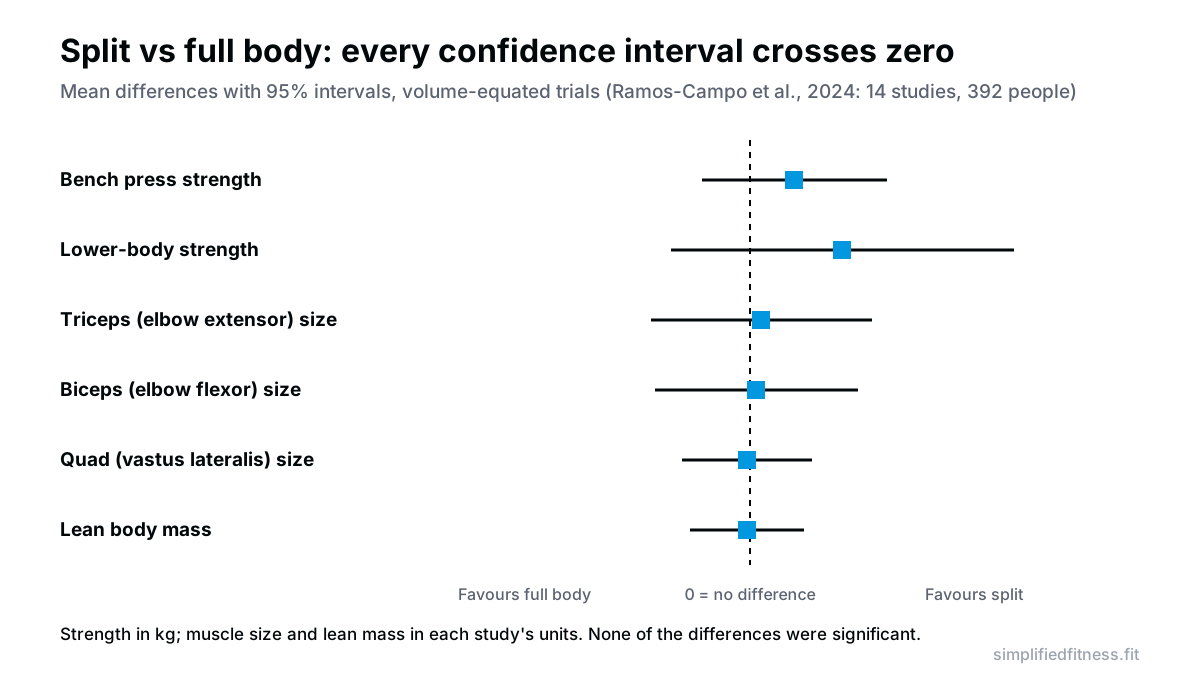
That fits the wider frequency literature. A 2019 meta-analysis of 25 studies found no significant difference in hypertrophy between higher and lower training frequencies when volume was equated, including in resistance-trained people and for both upper and lower body (Schoenfeld et al., 2019).
Individual trials in trained lifters point the same way:
- 3 vs 6 sessions a week: 27 trained men, 6 weeks, volume equated. Strength and muscle thickness changes were similar between groups (Saric et al., 2019).
- 3 vs 6 sessions, powerlifts: 28 trained men, 6 weeks, volume and intensity equated. Squat, bench, deadlift and fat-free mass gains showed no group differences (Colquhoun et al., 2018).
- 2 vs 4 hits per muscle: 67 untrained people, 8 weeks, equal weekly sets. Similar strength and muscle thickness (Evangelista et al., 2021).
Where the research is less tidy: once a week vs twice
Here is the honest conflict.
An earlier 2016 meta-analysis of 10 studies found that training a muscle twice a week produced larger hypertrophy effect sizes than once a week (0.49 vs 0.30), and the authors inferred major muscles should be trained at least twice weekly (Schoenfeld et al., 2016). Some trials in trained men also found better muscle thickness at certain sites when they trained everything more often instead of using a once-a-week split (Schoenfeld et al., 2015); (Zaroni et al., 2019). Those were small samples (20 and 18 men), and strength results did not differ.
So why did the 2019 and 2024 analyses find no difference? The likely explanation is volume. When the higher-frequency groups also ended up doing more total work, frequency got the credit. Once sets were matched, the gap mostly disappeared. The 2019 analysis did see a modest edge for higher frequency in studies that did not equate volume (Schoenfeld et al., 2019).
The newest dose-response analysis, 67 studies and 2,058 participants, found more volume kept increasing growth with diminishing returns, while the effect of frequency on hypertrophy was compatible with a negligible effect. Strength was different: strength gains did tend to rise with frequency, again with diminishing returns (Pelland et al., 2026).
The popular splits, compared
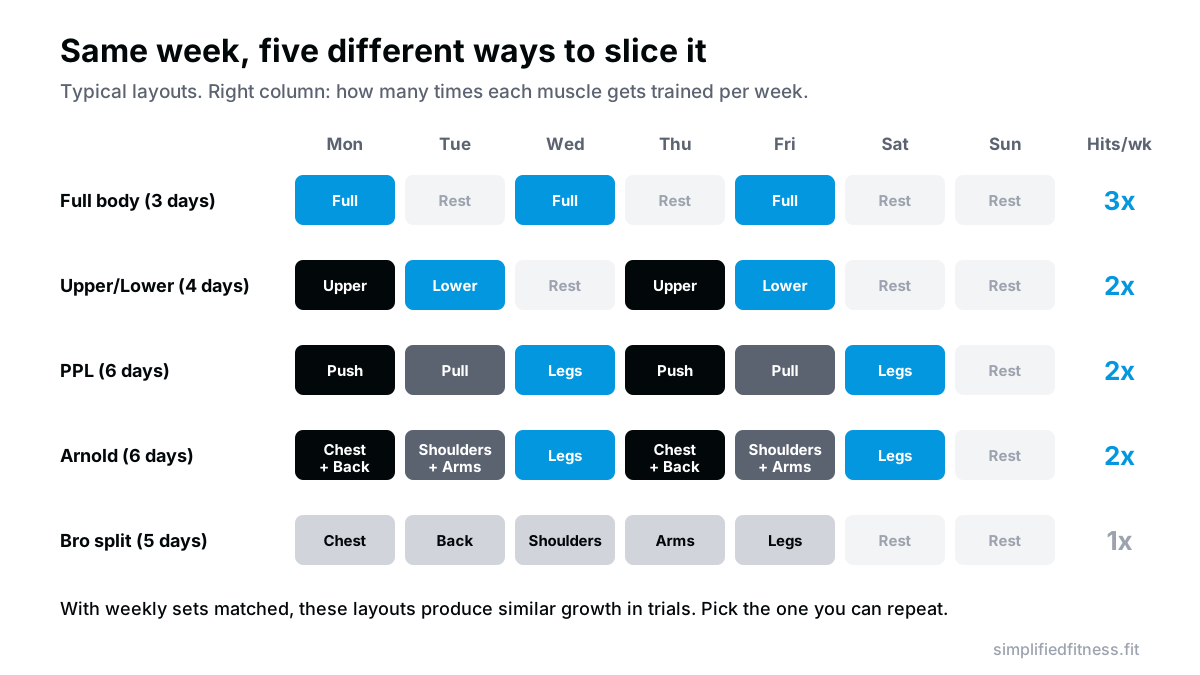
| Split | Days/week | Hits per muscle | Typical session | Best for | Main downside |
|---|---|---|---|---|---|
| Full body | 2-3 | 2-3x | 50-75 min | Beginners, busy people, shift workers | Long sessions if volume climbs |
| Upper/Lower | 4 | 2x | 50-75 min | Intermediates, most people with 4 days | Lower days are draining |
| Push Pull Legs | 3 or 6 | 1x or 2x | 45-70 min | People who like the gym 5-6 days | Six days is a big commitment |
| Arnold | 6 | 2x | 60-80 min | Experienced lifters with time | Shoulders get hit by pressing and direct work |
| Bro split | 5 | 1x | 60-75 min | Enjoyment, high volume per day | Late sets on each muscle get junky |
Full body, 3 days a week
Every session trains everything: a squat or leg press, a hinge, a push, a pull, plus one or two small exercises. Miss a day and nothing goes untrained that week. That forgiveness is the big selling point.
The catch shows up later. Once you need 12-15 sets per muscle a week, cramming them into three full-body sessions makes each workout long. We go deeper in full body 3 days a week for hypertrophy.
Upper/Lower, 4 days
Two upper days, two lower days, each muscle twice. It is the split we default to for most intermediates with four days because it balances volume per session and recovery between sessions. The upper/lower 4-day guide has the full layout.
Push pull legs: 3, 4, 5 or 6 days
Push (chest, shoulders, triceps), pull (back, biceps, rear delts), legs. Run once through (3 days) each muscle gets one session a week. Run twice through (6 days) it gets two. The five-day version rotates, so frequency lands somewhere in between. Our PPL variations guide covers all four, and you can grab the free sessions: push day, pull day and leg day.
Push pull legs vs upper lower is the comparison people search most. If both hit each muscle twice a week, the research gives you no reason to prefer one. The real differences are practical. PPL needs six days for twice-weekly frequency; upper/lower gets there in four. PPL sessions are shorter. Upper/lower leaves three rest days for life, sport or cardio. Our head-to-head comparison of full body, upper/lower and PPL runs the numbers week by week.
Arnold split
Chest and back, then shoulders and arms, then legs, repeated twice across six days. No trial has tested it as a named program. It sits comfortably inside the evidence because each muscle gets about two sessions a week, but six demanding days is a lot. Pairing chest and back in one session also makes it a natural fit for antagonist supersets. More in our Arnold split breakdown.
Bro split
One body part per day. The research case against it is not that it fails. It is that once-weekly frequency makes it harder to do enough high-quality sets, and the older 2016 data hinted twice weekly does a bit better. If you love it and train hard, it can still work. A sensible compromise is a 4-day push/pull plus legs split or adding a small second session for weak muscles.
How to choose a split from your real schedule
Start with the calendar. Not the ideal week. The bad week, with a deadline, a wedding in the family and a sick kid.
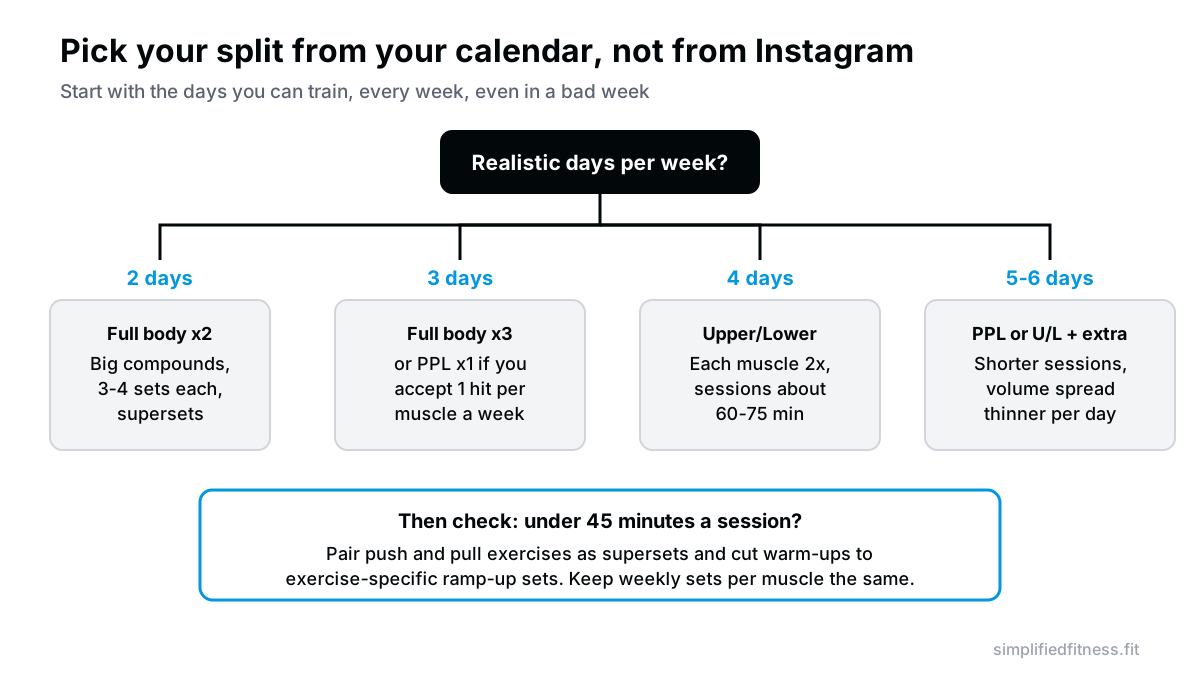
A few rules of thumb:
- 2 days: full body twice. You can still make progress, especially early on. See the 2-day routine for busy professionals and the weekend-only split.
- 3 days: full body. Or a 3-day PPL if you accept once-weekly frequency.
- 4 days: upper/lower.
- 5-6 days: PPL, or upper/lower plus an extra arms/weak-point day.
- Irregular shifts or travel: full body, because any session covers everything. Our splits for high-stress careers and shift work goes into rotating rosters.
Recovery capacity matters too. Poor sleep, a physically hard job, long commutes or a lot of running all eat into what you can recover from. In those cases fewer, slightly longer sessions often work better than six short ones. If you also run or play sport, read our hybrid scheduling guide before choosing.
Exercise order inside a session
Order matters for strength more than for size.
A 2021 meta-analysis of 11 studies found strength gains were largest for whichever exercise came first in the session: multi-joint lifts improved more when done first, single-joint lifts improved more when done first. For muscle growth, starting with compounds or with isolations made no significant difference (Nunes et al., 2021).
What that means in the gym:
- Put your priority lift first while you are freshest. For most people that is a squat, a press or a row.
- Heavy, technical, high-skill movements early. Machines and cables later.
- Want bigger side delts and they are lagging? It is fine to start with lateral raises sometimes. Growth does not seem to suffer from that order.
We dig into the reasoning in compounds before isolations and the more technical intra-session sequencing and neural demands.
Antagonist supersets: the best time saver in the gym
A superset is two exercises done back to back with little rest between them. An antagonist superset pairs opposing muscles: bench press with rows, curls with triceps pushdowns, leg extensions with leg curls. While one muscle group works, the other rests.
The evidence here is better than most “advanced techniques” get.
A 2025 meta-analysis of 19 studies (313 participants) found supersets allowed similar total reps and volume load to traditional sets with shorter session duration, and long-term gains in strength and hypertrophy were similar (Zhang et al., 2025). In the subgroup analysis, agonist-antagonist pairs let people complete more reps than traditional sets, while pairing two exercises for the same muscle reduced volume load.
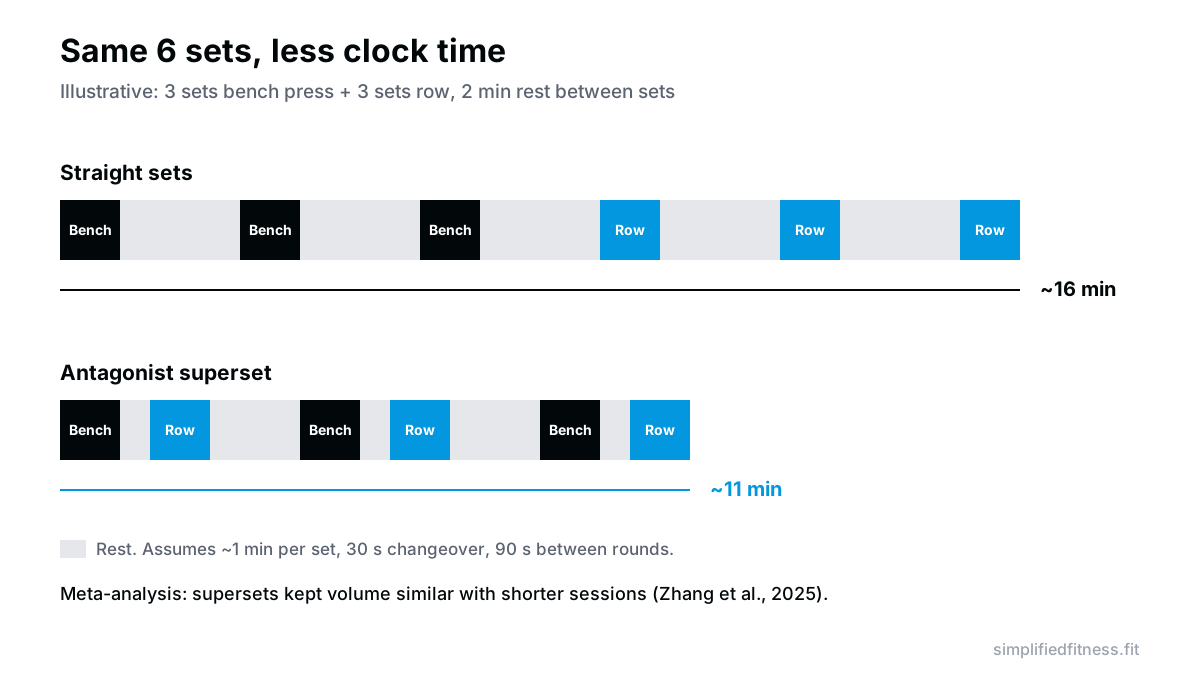
Older acute studies in trained men line up. Alternating bench pull and bench press at 4RM loads kept more volume load in the same 10-minute window than straight sets (Robbins et al., 2010). With 10RM loads, alternating bench press and seated rows produced more volume load in less time, but also higher fatigue indices (Paz et al., 2017).
There is a cost. The 2025 meta-analysis also reported higher perceived exertion, higher lactate and more signs of muscle damage with supersets. A small crossover study in 14 men found jump performance had returned to baseline 24 hours after traditional sets but was still possibly reduced after supersets and tri-sets (Weakley et al., 2017). Those are short-term markers, not proof of worse long-term results, but they suggest you may need a bit more recovery.
The full method, including pairings and rest timings, is in our guide to antagonist paired sets and supersets. If you are wondering how this differs from a sweaty circuit class, circuit training vs true hypertrophy lifting explains why load and effort still matter.
Time-efficient workouts for hypertrophy: the 30-minute session
Lack of time is one of the most common reasons people skip training. A 2021 review built around exactly that problem gave practical recommendations (Iversen et al., 2021):
- Prioritise bilateral, multi-joint exercises with full range of motion.
- Include at least one leg press or squat pattern, one upper-body pull and one upper-body push.
- Weekly volume matters more than frequency; aim for at least 4 weekly sets per muscle using 6-15 rep-max loads (or 15-40 reps if taken to failure).
- Supersets, drop sets and rest-pause roughly halve training time while maintaining volume, though they are probably better for size than for maximal strength, and long-term data are limited.
- Keep warm-ups exercise-specific and only prioritise stretching if flexibility is a goal.
A 30-minute upper session might look like this:
| Pair | Exercise A | Exercise B | Sets |
|---|---|---|---|
| A | Incline dumbbell press, 6-10 reps | Chest-supported row, 8-12 reps | 3 rounds |
| B | Dumbbell shoulder press, 8-12 reps | Lat pulldown, 8-12 reps | 3 rounds |
| C | Dumbbell lateral raise, 12-15 reps | Cable hammer curl, 10-12 reps | 2 rounds |
Run this upper session twice a week alongside two similar lower sessions and chest, back and shoulders each get at least 6 hard sets a week, above the 4-set minimum the review suggests. The full templates live in 30-minute high-density hypertrophy workouts, and if you train at home or in hotels see the home gym blueprint and hotel gym travel workouts.
How long should a workout be?
There is no evidence-based hard cutoff. The idea that you must leave within 45-60 minutes or “go catabolic” is gym folklore. Your hormones do not flip a switch at minute 61.
What does happen is practical: performance on the last exercises drops as fatigue builds, and long sessions are easier to skip. If your sessions run past about 75-90 minutes, check whether the extra time is coming from useful sets or from rest creep and filler exercises. Our article on managing workout duration and performance drop-off goes through it. Rest periods are covered in the load, reps, RIR and rest guide.
Some people split a long day into two short ones. That can work for advanced lifters with flexible schedules, and we cover the pros and cons in two-a-day lifting sessions.
Warm-ups: keep them short and specific
You do not need 20 minutes on the treadmill and a foam roller routine before every session. The time-efficiency review suggests exercise-specific warm-ups are enough for most lifters (Iversen et al., 2021).
In practice: 2-3 lighter ramp-up sets of your first exercise, building toward your working weight. If you feel stiff, or it is a cold morning, add a few minutes of easy movement. A quick routine is in our 7-minute dynamic warm-up.
Indian context: making any split work around real life
A few things come up often for lifters in India:
- Heat. Gyms without proper cooling in May and June feel brutal. Shorter sessions with supersets help, and so does keeping a bottle of water or buttermilk nearby. Training early morning or after sunset makes a difference.
- Crowded evening gyms. Supersets are harder when the bench and the cable station are 10 metres apart and both have a queue. Pick pairs you can do at one station, such as dumbbell press and one-arm dumbbell row on the same bench.
- Long commutes. If the gym is a 40-minute round trip, three full-body sessions usually beat six PPL sessions on time cost alone.
- Festivals, weddings and exams. Plan for missed weeks. Full body or upper/lower recovers from a missed day far better than a bro split.
- Food. No split builds muscle without enough protein. Dal, paneer, curd, soya chunks, eggs and chicken cover most needs on a normal budget. Work out your target with the protein calculator and see the Indian diet plan for meal ideas.
Putting it together: a simple weekly framework
- Pick days. The number you can hit in a bad week.
- Pick the split from the flowchart above.
- Set weekly volume. Start at roughly 8-12 hard sets per muscle and adjust. Use the training volume calculator to check your totals.
- Order sessions with your priority lifts first.
- Use antagonist supersets when time is short.
- Progress loads or reps every week or two, and track it.
- Run it for 8-12 weeks before judging it.
If you want a ready-made starting point, our free workout plans give you a full program with sessions laid out. For the bigger picture on growth itself, read the muscle hypertrophy guide for natural lifters.
When to talk to a doctor or physio
Lifting is safe for most healthy adults, but get checked before starting or ramping up if you have heart disease, high blood pressure that is not controlled, chest pain or dizziness during exercise, a recent surgery, or pregnancy. Joint pain that is sharp, gets worse week to week, or causes swelling is a reason to see a doctor or physiotherapist rather than switching splits. A new split will not fix an injury.
The bottom line
Full body, upper/lower and push pull legs all build muscle. The research is consistent on this once weekly sets are equal. What separates them is how they fit your week: how many days you have, how long each session can be, and how well you recover.
Pick the split that matches your bad week. Hit each muscle about twice with enough hard sets. Put your most important lift first. Use antagonist supersets when time is tight. Then stop shopping for programs and start adding weight to the bar.
Go deeper: every guide in this topic
- 2-Day per Week Lifting Programs: Minimum Effective Dose for Busy Professionals
- 30-Minute High-Density Hypertrophy Sessions: Micro-Workouts for Time-Constrained Lifters
- The 7-Minute Dynamic Warm-Up: A Fast Routine to Prep Joints Before Lifting
- Antagonist Paired Sets: Cut Workout Time by About 40% Without Losing Reps
- The Arnold Split (Chest/Back, Shoulders/Arms, Legs): Does It Work for Natural Lifters?
- Circuit Training vs True Hypertrophy Lifting: Do Circuits Compromise Muscle Tension?
- Exercise Order: Why Heavy Compounds Should Come Before Isolation Work
- Full-Body Workouts 3 Days a Week: The Hypertrophy Plan That Actually Works
- Home Gym Workout for Hypertrophy: A Dumbbell, Band and Pull-Up Bar Plan
- Hotel Gym Workout Routine: How to Keep Your Muscle on the Road
- Hybrid Training Scheduling: How to Pair 4 Days of Lifting with Running
- Exercise Order in Workout Science: What to Do First in the Gym and Why
- How Long Should a Workout Last? Set Quality Beyond 60-75 Minutes
- Push/Pull 4-Day Split With Legs: Where Quads and Hamstrings Go
- Push/Pull/Legs (PPL): Structuring 3-Day, 4-Day, 5-Day, and 6-Day PPL Routines
- Two-a-Day Lifting Sessions: Do Morning and Evening Splits Build More Muscle?
- Upper/Lower Split (4 Days/Week): Why It Remains the Gold Standard for Intermediates
- Weekend Warrior Lifting: Can You Make Solid Hypertrophy Gains Training Only on Sat/Sun?
- Workout Splits Compared: Full Body vs Upper/Lower vs PPL vs Bro Split
- Workout Split for Shift Workers and High-Stress Jobs: A Practical Guide
Frequently Asked Questions
What is the best workout split for muscle growth?
There is no single best workout split for muscle growth; full body, upper/lower and push pull legs all work when weekly volume is similar. A 2024 meta-analysis of 14 studies found no significant difference between split and full-body routines for strength or muscle size under volume-equated conditions. Pick the split that fits the number of days you can train every week and stick with it for at least 8-12 weeks.
Is push pull legs better than upper lower?
Neither is better by default; both train each muscle about twice a week when PPL is run six days or upper/lower is run four days. Frequency research shows that once weekly sets are matched, how you divide them has little effect on hypertrophy. Choose upper/lower if you have four days and PPL if you can reliably train five or six.
Is full body 3 days a week enough to build muscle?
Yes, full body three days a week is enough to build muscle for most beginners and many intermediates. It trains each muscle three times weekly, and trials in trained men found three weekly sessions matched six when volume was equal. Use 2-4 hard sets per muscle per session and add sets slowly as you adapt.
How many days a week should I work out to build muscle?
Three to four lifting days a week is enough for most people to build muscle well. Research suggests total weekly sets drive growth more than the number of sessions, so more days mainly helps you fit more volume in without marathon workouts. Start with the number of days you can do in your busiest realistic week.
Is the bro split bad?
A bro split is not useless, but training each muscle only once a week is probably not the most efficient choice. A 2016 meta-analysis found training muscles twice a week produced larger hypertrophy effect sizes than once a week, though later volume-equated analyses found frequency matters less than total sets. If you love a bro split, keep the weekly sets high and consider adding a second, smaller session for lagging muscles.
How many times a week should I train each muscle?
Training each muscle about twice a week is a sensible default for most lifters. A 2019 meta-analysis found no significant hypertrophy difference between higher and lower frequencies when volume was equated, so twice weekly is about spreading sets out, not magic. If a muscle needs more than about 10 hard sets a week, split them over two or three sessions.
Does training frequency matter if volume is the same?
For muscle growth, frequency appears to matter little when weekly volume is the same. Several meta-analyses, including a 2026 dose-response analysis of 67 studies, found the frequency effect on hypertrophy was compatible with a negligible effect, while strength gains did rise somewhat with higher frequency. Choose a frequency that lets you complete your planned sets with good effort.
What is the Arnold split?
The Arnold split is a six-day routine that rotates chest and back, shoulders and arms, then legs, so each muscle is trained twice a week. No study has tested it as a named program, but it lines up with frequency research showing two weekly sessions per muscle works well. Use it only if six training days fit your life and you recover well between sessions.
Can I build muscle training only 2 days a week?
Yes, you can build muscle on two days a week, especially as a beginner or when maintaining. A 2021 review on time-efficient training recommends at least 4 weekly sets per muscle as a minimum, which two full-body sessions can cover. Prioritise a squat or leg press, an upper-body push and an upper-body pull each session.
Are supersets good for building muscle?
Supersets appear about as effective as traditional sets for building muscle while saving time. A 2025 meta-analysis of 19 studies found similar long-term hypertrophy and strength, with shorter session duration and similar total volume. Use antagonist pairs like presses with rows rather than two exercises for the same muscle.
What are antagonist supersets?
Antagonist supersets pair two exercises that train opposing muscles, such as bench press with a seated row or biceps curls with triceps pushdowns. Short studies in trained men found paired sets kept more volume load in less time than straight sets. Rest about 90-120 seconds after each pair so both exercises stay heavy.
Do supersets make you more tired?
Yes, supersets usually feel harder and can cause more short-term fatigue than straight sets. The 2025 meta-analysis reported higher perceived exertion, higher lactate and more markers of muscle damage, and a 2017 crossover study found jump performance was still reduced 24 hours later. Use supersets mainly on upper-body and machine work, and keep heavy squats and deadlifts as straight sets.
Should compound exercises come before isolation exercises?
Usually yes, if you care about getting stronger on the compound lifts. A 2021 meta-analysis found strength gains were largest in whichever exercise was done first, while muscle growth was similar regardless of order. Put your priority lift first, which for most people is the squat, press or row.
Does exercise order matter for hypertrophy?
Exercise order appears to matter little for overall muscle growth. A meta-analysis of 11 studies found no significant hypertrophy difference between starting with multi-joint or single-joint exercises. Order your session around the exercise you most want to progress, because that is where strength gains concentrate.
How long should a workout be to build muscle?
Many well-built hypertrophy sessions take about 45-75 minutes, but no fixed time limit is backed by research. What matters is completing your planned hard sets with enough rest to keep performance up. If sessions keep running past 90 minutes, move some sets to another day or use supersets.
Can a 30 minute workout build muscle?
Yes, a well-built 30 minute workout can build muscle, especially when done three or more times a week. A 2021 review of time-efficient training concluded that supersets, drop sets and rest-pause can roughly halve training time while maintaining volume. Use 3-5 exercises, mostly compounds, pair them as supersets and skip long general warm-ups.
How long should I warm up before lifting?
A few ramp-up sets of your first exercise is enough for most lifters. A 2021 review on time-efficient training advised restricting warm-ups to exercise-specific sets and only prioritising stretching when flexibility is the goal. Do 2-3 lighter sets building toward your working weight, plus a few minutes of easy movement if you feel stiff.
Is PPL good for beginners?
A six-day PPL is usually more than a beginner needs, but a three-day PPL can work. Beginners grow well from modest volume, and studies show similar results across splits when weekly sets match, so simplicity and recovery matter more. Most beginners do better with full body three times a week for the first few months.
How do I switch from one workout split to another?
Keep your weekly sets per muscle roughly the same and just redistribute them across the new days. Meta-analyses show that volume, not the split itself, drives most of the response, so a clean switch should not cost you progress. Expect your first week of loads to need small adjustments as fatigue patterns change.
Which workout split is best for busy people or shift workers?
Full body is usually the most forgiving split for busy schedules because missing one session still leaves every muscle trained that week. Volume-equated trials show full body works as well as splits, so you lose nothing by choosing flexibility. Schedule two to three sessions and treat any extra day as a bonus.
Should I rest between supersets?
Yes, rest about 90-120 seconds after completing both exercises in a pair. Studies showing better volume with paired sets still used rest between rounds (2 minutes in one bench press and row study), so supersets are not meant to be done non-stop. If your reps drop sharply by the third round, lengthen the rest rather than cutting sets.
Is training 6 days a week too much?
Six days a week is not too much if total weekly volume is sensible and you sleep and eat well. Trials in trained men found six weekly sessions produced similar results to three when volume was equal, so the extra days spread work rather than add benefit. If you feel run down, have nagging joint pain or performance keeps sliding, drop to four or five days.
Can I combine running or sports with my lifting split?
Yes, and upper/lower or full body splits usually combine most easily with running or sport. Keep hard leg sessions and hard runs on separate days where you can, and give legs at least a day before key runs or matches. Our guide to hybrid scheduling covers how to arrange the week.
Sources & References
Every claim above is checked against peer-reviewed research (PubMed, U.S. National Library of Medicine) or guidance from established health bodies. How we fact-check.
- Ramos-Campo DJ, et al. Efficacy of Split Versus Full-Body Resistance Training on Strength and Muscle Growth: A Systematic Review With Meta-Analysis. J Strength Cond Res. 2024. PMID: 38595233
- Schoenfeld BJ, et al. How many times per week should a muscle be trained to maximize muscle hypertrophy? A systematic review and meta-analysis of studies examining the effects of resistance training frequency. J Sports Sci. 2019. PMID: 30558493
- Schoenfeld BJ, et al. Effects of Resistance Training Frequency on Measures of Muscle Hypertrophy: A Systematic Review and Meta-Analysis. Sports Med. 2016. PMID: 27102172
- Pelland JC, et al. The Resistance Training Dose Response: Meta-Regressions Exploring the Effects of Weekly Volume and Frequency on Muscle Hypertrophy and Strength Gains. Sports Med. 2026. PMID: 41343037
- Saric J, et al. Resistance Training Frequencies of 3 and 6 Times Per Week Produce Similar Muscular Adaptations in Resistance-Trained Men. J Strength Cond Res. 2019. PMID: 30363041
- Colquhoun RJ, et al. Training Volume, Not Frequency, Indicative of Maximal Strength Adaptations to Resistance Training. J Strength Cond Res. 2018. PMID: 29324578
- Evangelista AL, et al. Split or full-body workout routine: which is best to increase muscle strength and hypertrophy? Einstein (Sao Paulo). 2021. PMID: 34468591
- Zaroni RS, et al. High Resistance-Training Frequency Enhances Muscle Thickness in Resistance-Trained Men. J Strength Cond Res. 2019. PMID: 31260419
- Schoenfeld BJ, et al. Influence of Resistance Training Frequency on Muscular Adaptations in Well-Trained Men. J Strength Cond Res. 2015. PMID: 25932981
- Zhang X, et al. Superset Versus Traditional Resistance Training Prescriptions: A Systematic Review and Meta-analysis Exploring Acute and Chronic Effects on Mechanical, Metabolic, and Perceptual Variables. Sports Med. 2025. PMID: 39903375
- Iversen VM, et al. No Time to Lift? Designing Time-Efficient Training Programs for Strength and Hypertrophy: A Narrative Review. Sports Med. 2021. PMID: 34125411
- Robbins DW, et al. The effect of an upper-body agonist-antagonist resistance training protocol on volume load and efficiency. J Strength Cond Res. 2010. PMID: 20847705
- Paz GA, et al. Volume Load and Neuromuscular Fatigue During an Acute Bout of Agonist-Antagonist Paired-Set vs. Traditional-Set Training. J Strength Cond Res. 2017. PMID: 28933712
- Weakley JJS, et al. The effects of traditional, superset, and tri-set resistance training structures on perceived intensity and physiological responses. Eur J Appl Physiol. 2017. PMID: 28698987
- Nunes JP, et al. What influence does resistance exercise order have on muscular strength gains and muscle hypertrophy? A systematic review and meta-analysis. Eur J Sport Sci. 2021. PMID: 32077380

Umair Hazrami · Founder & Head Coach, Simplified Fitness
Umair Hazrami founded Simplified Fitness and the Simplified Lifter channel to cut through fitness noise. With 4+ years of consistent training and 10+ coaching clients, he writes every guide from the peer-reviewed research and links the sources so you can check them. Our editorial standards.
Educational content only, not medical advice. If you have a medical condition, are pregnant, or take medication, talk to a qualified doctor before changing your diet, supplements or training. Full disclaimer.
Keep reading

Programming
2-Day per Week Lifting Programs: Minimum Effective Dose for Busy Professionals
Can a 2 day a week workout routine hypertrophy goals support? Yes. Get a ready two-day full-body plan, the research behind it and how to run it in 60 minutes.
9 min read
Programming
30-Minute High-Density Hypertrophy Sessions: Micro-Workouts for Time-Constrained Lifters
Can a 30 minute workout for muscle growth work? See how paired sets, Myo-reps and machine setups fit 16 hard sets into half an hour, plus a 4-day plan.
10 min read
Programming
The 5 Modalities of Progressive Overload: A Checklist for When Weight Won't Go Up
5 ways to progressive overload: load, reps, range of motion, tempo and rest density. A practical checklist for compounds and isolations, with the research.
7 min read

Programming
The 7-Minute Dynamic Warm-Up: A Fast Routine to Prep Joints Before Lifting
A dynamic warm up for lifting takes about 7 minutes, not 25. See the 2-3-2 routine, what the research says about stretching and foam rolling, and what to skip.
9 min read