Complete Leg Workout Programming: Quad Day vs Hamstring and Glute Day
Best leg workout routine science: split leg day into a quad session and a hamstring-glute session, with sets, order and a 5-week plan that avoids burnout.
TL;DR. The short answer
- Splitting legs into two sessions (Leg Day A for quads and adductors, Leg Day B for hamstrings and glutes) lets you keep the same weekly volume without one 2-hour grind.
- Research links more weekly hard sets to more muscle growth, with diminishing returns. About 10-16 sets per muscle per week is a sensible working range, started at the low end.
- Hitting each muscle twice a week beat once a week in a 2016 meta-analysis when volume was equal, but split versus full-body routines did not differ in a 2024 meta-analysis. Pick what you can recover from.
- Pick exercises that load the muscle at long lengths: seated leg curl over prone, standing calf raise over seated for the gastrocnemius.
- Put one heavy spinal-loading lift (the Romanian deadlift) on Leg Day B only, and keep Leg Day A machine-based so your lower back is fresh.
Part of our complete guide: Complete Lower-Body & Core Training Guide: Quads, Glutes, Hamstrings, Calves & Abs Science
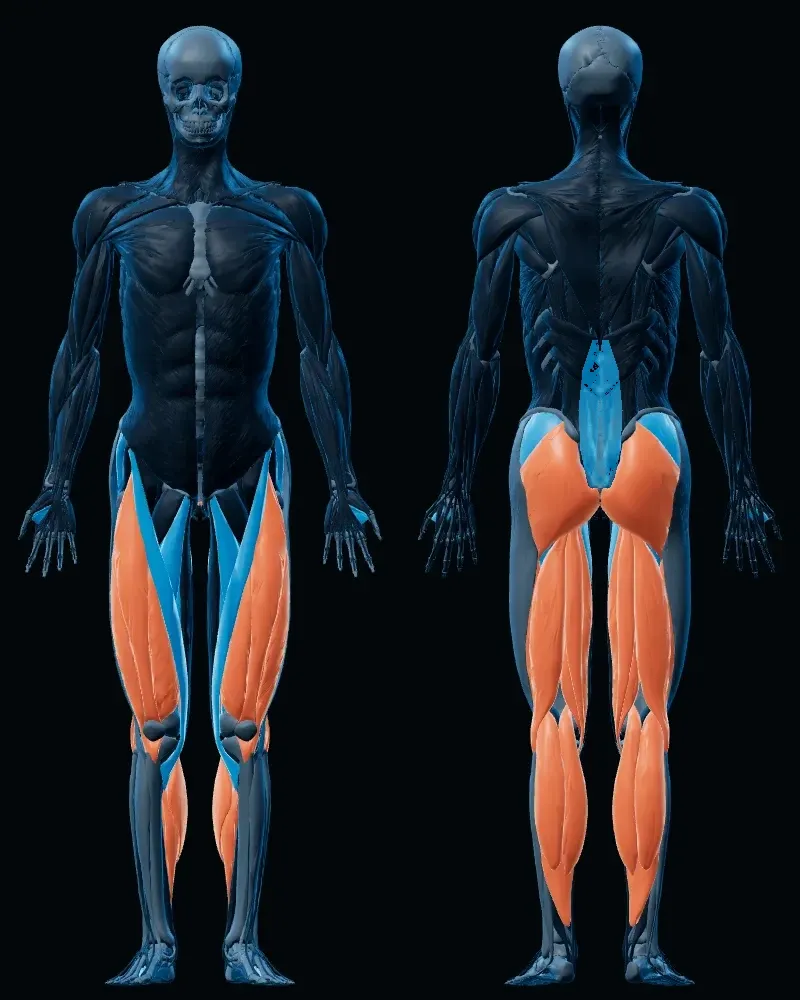
Muscles worked: leg day
Main movers: quads, glutes, hamstrings and calves
Assisting: lower back, adductors and gluteus medius
Table of contents
If one big leg session leaves you walking like a newborn deer and dreading the next one, the fix is probably not “toughen up”. The best leg workout routine science supports is one where you can recover and repeat it: weekly hard sets in a sensible range (about 10-16 per muscle), each muscle trained about twice a week, and exercises that stretch the muscle under load.
The easiest way to get there is to split legs into Leg Day A (quads and adductors) and Leg Day B (hamstrings and glutes). This article is the practical routine behind our complete lower-body and core training guide, with exercise order, set counts, axial-load management and a 5-week template you can start on Monday.
Why one giant leg day fails
Legs are the biggest muscles you train. Quads, hamstrings, glutes, adductors and calves, all in one session, means 20-plus sets, several heavy compound lifts and a lot of systemic fatigue. Late in a session like that, rep quality often slips: shallower depth, slower bar speed, more grinding.
Here is the reality. More sets only help if they are good sets. Pushing extra volume into a tired body adds soreness and fatigue faster than it adds useful stimulus.
Splitting the work fixes three things at once:
- Each session is shorter, so every working set gets a fresh lifter behind it.
- You can pair exercises that fit together instead of fighting each other (no heavy hinge before a heavy squat).
- Each muscle gets its own slot, so you can spend your best energy on it.
How many sets per week for legs?
Start with what the data says about volume. A 2017 meta-regression of 15 studies (34 treatment groups) found a graded dose-response relationship: each additional weekly set was associated with a larger gain in muscle size, about 0.37% more per set, and higher-volume groups gained about 3.9% more than lower-volume groups (Schoenfeld et al., 2017).
A larger 2026 meta-regression pooled 67 studies and 2,058 participants. It found that gains in muscle size increase as volume increases, but with diminishing returns, and that the pattern for strength flattened out even more (Pelland et al., 2026). It also suggested counting indirect sets (such as squats contributing to quads and glutes) at partial credit rather than ignoring them.
What does that mean at the gym?
- There is no cliff at 10 sets and no cliff at 16. The curve bends gradually.
- Beginners can usually grow on the lower end, and these studies were mostly in young adults (average age about 25 in the Pelland data), so older or very advanced lifters may respond differently.
- A practical range of about 10-16 hard sets per muscle per week is a sensible planning target, started at the low end.
Our weekly set volume dose-response guide goes deeper on the curve, and the training volume calculator can add up your week.
Quad day vs hamstring day: how the split works
Before the exercises, one rule of thumb: each leg day has a bias, not a monopoly. Leg Day A still touches the glutes through the hack squat. Leg Day B still hits the quads through Bulgarian split squats. That overlap is intentional, because it gets each muscle roughly two exposures a week.
Does hitting a muscle twice matter? A 2016 meta-analysis of ten studies found that, when volume was equated, training a muscle twice per week produced larger hypertrophy effect sizes than once per week (0.49 vs 0.30), while whether three times beats twice was unclear (Schoenfeld et al., 2016). The newer Pelland analysis found frequency’s effect on hypertrophy was compatible with negligible effects once volume was accounted for (Pelland et al., 2026).
Those findings do not fully agree. The older analysis favoured twice a week; the newer, larger one suggests that once weekly volume is counted, frequency adds little for size. The safe reading is that frequency is mostly a tool for distributing volume. And on the split-versus-full-body question, a 2024 meta-analysis of 14 studies (392 people) found similar strength and muscle growth when volume was equal, concluding that people can choose a routine by preference (Ramos-Campo et al., 2024).
So the practical takeaway: use the split because it makes your sessions better, not because it is superior on paper.
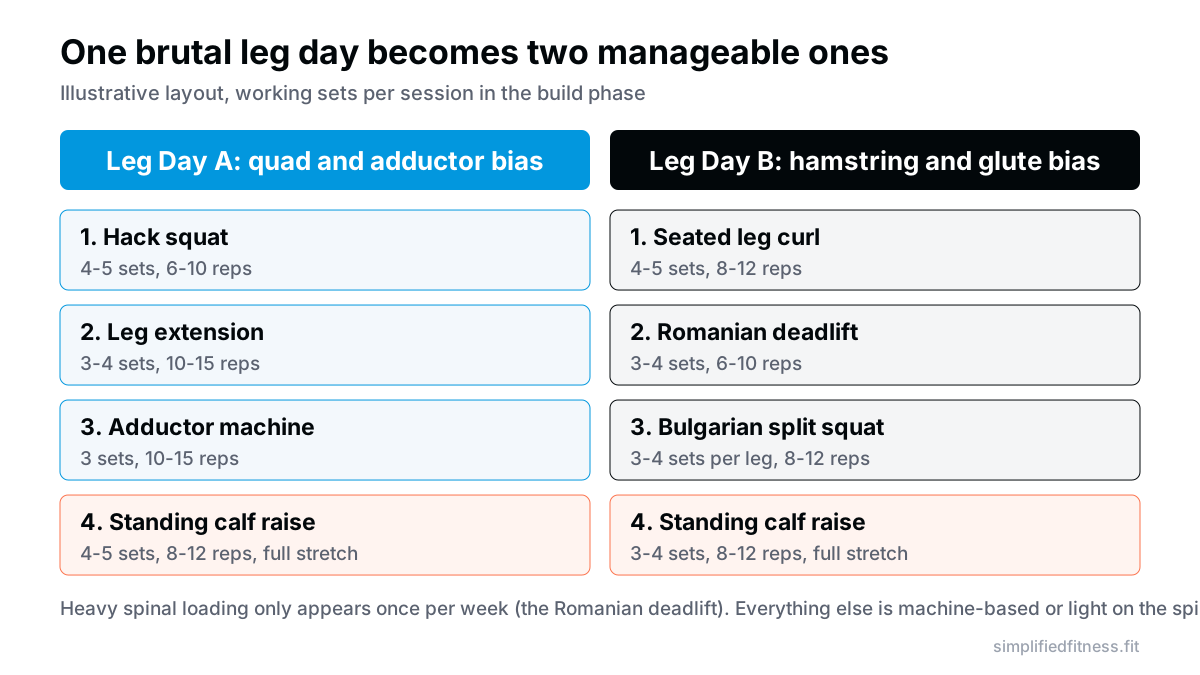
Leg Day A: the quad and adductor session
Run this one first in your week, ideally after a rest day.
- Hack squat (or leg press), 4-5 sets of 6-10 reps. Heavy, stable and light on the lower back. Go deep enough that your thighs drop below parallel if your knees and hips allow it comfortably. A 2020 systematic review of six studies concluded that full range of motion training favours lower-body hypertrophy over partial range (Schoenfeld and Grgic, 2020), though the combined sample was only 135 people, mostly men, so treat it as a lean rather than a law. Our hack squat stimulus-to-fatigue guide covers set-up.
- Leg extension, 3-4 sets of 10-15 reps. A low-fatigue way to add quad volume once your legs are already tired. See the leg extension and knee safety guide.
- Adductor machine, 3 sets of 10-15 reps. Inner-thigh work, covered more fully in adductor training.
- Standing calf raise, 4-5 sets of 8-12 reps. Calves recover fast, so they go last.
Sets of 6-10 on the first lift and 10-15 on the isolation lifts is not a rule from a single trial. It is a common-sense spread: heavier where fatigue is cheap, lighter where a joint or the lower back would otherwise be the limiter.
Leg Day B: the hamstring and glute session
Put at least one full rest day between A and B.
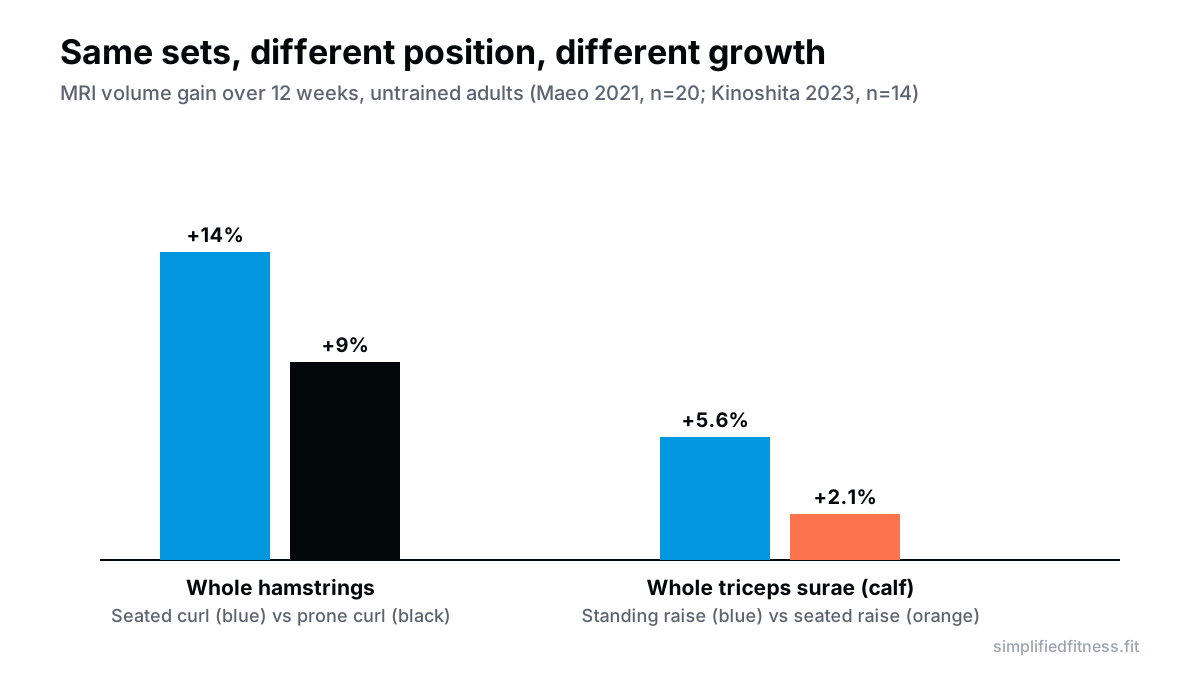
- Seated leg curl, 4-5 sets of 8-12 reps. The hamstrings first, while you are fresh. A 12-week MRI study of 20 untrained adults trained one leg with seated curls and the other with prone curls (5 sets, twice a week). Whole-hamstring muscle volume rose about 14% with the seated version versus 9% with the prone version, which the authors tie to training at longer muscle lengths (Maeo et al., 2021). That is untrained adults, one trial, so expect a smaller gap in experienced lifters. See seated vs lying leg curls.
- Romanian deadlift, 3-4 sets of 6-10 reps. The hip-hinge and the one real spinal-loading lift of your week. Stop a rep or two before form drifts. The RDL guide covers the hinge.
- Bulgarian split squat, 3-4 sets per leg of 8-12 reps. Quads, glutes and adductors with far less spinal load than a barbell squat. More in unilateral leg training.
- Standing calf raise, 3-4 sets of 8-12 reps. A second dose of calf work with a bit less volume.
Where do glutes fit in?
You may notice there is no dedicated hip thrust. That is a choice, not an omission. Glutes get work from the hack squat, the RDL and the Bulgarian split squat.
A 2023 trial of 34 untrained college-aged people (9 weeks, set-volume matched) found that hip thrusts and back squats produced similar gluteal growth, while squats produced more quad and adductor growth (Plotkin et al., 2023). The sample was untrained, so it may not generalise to advanced lifters. If glutes are your priority, add 2-3 sets of hip thrusts to the end of Leg Day B and drop a calf set.
Managing axial load and fatigue
Axial load is the weight pressing down through your spine. It is the main reason a heavy squat session and a heavy deadlift session do not share a day well.
Here is how this template handles it:
- Leg Day A: no barbell on the back. The hack squat and leg press are supported.
- Leg Day B: one hinge (RDL), placed after the curls. The curls get your freshest effort, and the pre-tired hamstrings mean the RDL does its job with less weight on your spine.
- Hamstring work is split across two types of movement, so you avoid cooking a single pattern.
Prefer free barbell squats? Put them first on Leg Day A in place of the hack squat, and swap Leg Day B’s RDL for an extra curl set if your lower back is complaining. Most people do not need both.
A 5-week sample mesocycle
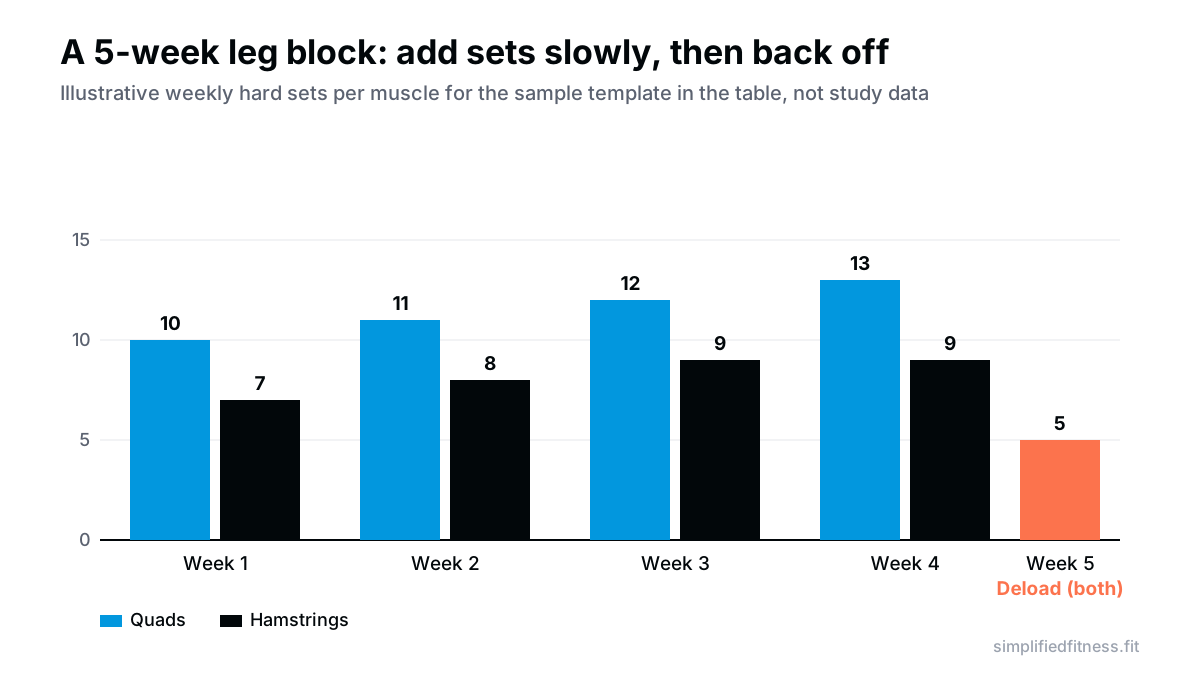
A mesocycle is a block of training with a plan. This one starts near the low end of the volume range, adds sets gradually and finishes with a lighter week.
| Week | Quads (sets) | Hamstrings (sets) | How to progress |
|---|---|---|---|
| 1 | 10 | 7 | Hack 4, extension 3, split squat 3. Curl 4, RDL 3. |
| 2 | 11 | 8 | Add one leg extension set and one curl set. |
| 3 | 12 | 9 | Add one hack squat set and one RDL set. |
| 4 | 13 | 9 | Add one split squat set. Hold hamstrings. |
| 5 | about 5 | about 5 | Deload: about half the sets, same exercises. |
Hamstrings start at 7 sets, below the 10-set mark, because the RDL and split squats also tax them and the glutes indirectly. Week 1 counts the Bulgarian split squat at full credit for quads, which is generous. The Pelland analysis favoured partial credit for indirect work, so treat these numbers as planning guides rather than lab-grade measurements.
Within a block, aim to add reps or weight when you hit the top of the rep range on all sets. If performance drops for two sessions in a row, trim a set before you add one. See volume landmarks for a framework on spotting your own limits, and our leg day plan if you want a ready-made routine.
Weekly schedule examples
- Four-day upper/lower: Monday upper, Tuesday Leg Day A, Thursday upper, Friday Leg Day B.
- Push, pull, legs plus: Leg Day A on your normal leg day, Leg Day B on the weekend or the day after your pull day, if you are fresh.
- Three-day full-body: Use the A exercises as the leg block in one session and the B exercises in another, with at least one rest day between them.
Heat and lifestyle matter. If you train in a hot gym in an Indian summer, or after a long commute, start with fewer sets and add them back as you adapt.
Food for leg days
Leg sessions burn through a lot of energy, so under-eating hurts them most. A rough Indian vegetarian day for a lifter: dal and roti or rice at lunch, curd with fruit, paneer or soya chunks at dinner, and a protein-rich snack before training. Match protein to your body weight with the protein calculator.
The bottom line
Pick the split that you can actually recover from. Run Leg Day A and Leg Day B on separate days, start near 10 hard sets per muscle per week, favour exercises that load muscles at long lengths, and keep spinal loading to one day. Add sets slowly, deload every 4-6 weeks, and track your numbers.
Persistent knee, hip or lower-back pain, numbness, or pain that wakes you at night is a reason to see a doctor or physiotherapist rather than programme around it. This article is general education, not a diagnosis.
Frequently Asked Questions
What is the best leg workout routine for muscle growth?
A twice-weekly split with one quad-biased day and one hamstring-and-glute-biased day is a practical option. Meta-analyses link more weekly hard sets to more growth, and splitting legs across two days mainly helps you recover and keep set quality high. Start with about 10 sets per muscle per week and add a set or two every week.
How many sets per week should I do for legs?
A working range of roughly 10-16 hard sets per muscle per week suits most lifters, though the research shows a gradual dose-response rather than one magic number. Larger volumes show diminishing returns, so more is not always better. Start near 10, track your performance, and only add sets while you are still recovering well.
Should I split leg day into two days?
It is a good idea if one session leaves you wrecked for days or runs past 90 minutes. A 2024 meta-analysis found split and full-body routines produce similar muscle growth when weekly volume is equal, so the split is a recovery and scheduling tool, not a growth hack. Try Leg Day A and Leg Day B on separate days, at least one rest day apart.
What should I train first on leg day?
Train the exercise you most want to progress first, while you are freshest. On Leg Day A that is a hack squat or leg press, on Leg Day B it is the seated leg curl. Small isolation lifts and calves go last.
Do I need barbell squats to build big legs?
No. A 9-week trial in untrained college-aged adults found hip thrust and back squat produced similar glute growth, with squats producing more thigh and adductor growth. Hack squats, leg presses and split squats can fill the quad slot with less spinal load. Choose the variation that you can load hard and repeat with good form.
Is the seated leg curl better than the lying leg curl?
In one 12-week MRI study of 20 untrained adults, seated leg curls grew the hamstrings more than prone curls (14% versus 9%). The seated position puts the biarticular hamstrings at a longer length. If your gym has a seated machine, use it as your main curl.
Are standing or seated calf raises better?
Standing raises grew the gastrocnemius far more than seated raises in a 12-week MRI trial of 14 untrained adults, while soleus growth was similar. The straight knee lengthens the gastrocnemius. Do standing raises with a full stretch at the bottom and add a seated set only if you want extra soleus work.
How long should a leg workout take?
Four to five exercises and about 14-18 hard sets usually fit in 60-75 minutes with 2-3 minutes of rest between heavy sets. Sets tacked onto the end of a long session are rarely your best ones. If you are going past 90 minutes, cut a set from the last exercise or move it to the other leg day.
How many rest days do I need between leg sessions?
At least one full day between Leg Day A and Leg Day B is a reasonable default, and two is easier early on. Soreness and fatigue clear at different speeds for different people, so base it on your performance. If your leg press or curl numbers drop two sessions in a row, add rest or trim sets.
Can I train legs twice a week without overtraining?
Yes, when the weekly total is sensible. For most people, two sessions of 7-8 sets per muscle are easier to recover from than one session of 15. Keep most sets 1-3 reps short of failure and take a lighter week every 4-6 weeks.
How do I fit calves and adductors into a leg routine?
Put adductor machine work on Leg Day A and standing calf raises on both days, since they are small muscles that recover quickly. Both are cheap in fatigue terms, so 3-5 sets each per session is manageable. Place them last so they do not tire you before the main lifts.
What if I only have time for one leg day a week?
Do one session with a quad lift, a hamstring lift and a calf raise, 3-4 sets each, and accept a lower weekly volume. A single weekly session is a valid minimum, though twice a week had the edge in the 2016 frequency meta-analysis. When you can spare another 45 minutes, add the second day.
Do vegetarians need anything special to build legs?
No special exercises, but total protein matters. Dal, paneer, curd, soya chunks (and eggs, if you eat them) can all cover the target if you plan portions. Check your number with our protein calculator and spread it across 3-4 meals.
Sources & References
Every claim above is checked against peer-reviewed research (PubMed, U.S. National Library of Medicine) or guidance from established health bodies. How we fact-check.
- Schoenfeld BJ, et al. Dose-response relationship between weekly resistance training volume and increases in muscle mass: A systematic review and meta-analysis. J Sports Sci. 2017. PMID: 27433992
- Pelland JC, et al. The Resistance Training Dose Response: Meta-Regressions Exploring the Effects of Weekly Volume and Frequency on Muscle Hypertrophy and Strength Gains. Sports Med. 2026. PMID: 41343037
- Schoenfeld BJ, et al. Effects of Resistance Training Frequency on Measures of Muscle Hypertrophy: A Systematic Review and Meta-Analysis. Sports Med. 2016. PMID: 27102172
- Ramos-Campo DJ, et al. Efficacy of Split Versus Full-Body Resistance Training on Strength and Muscle Growth: A Systematic Review With Meta-Analysis. J Strength Cond Res. 2024. PMID: 38595233
- Maeo S, et al. Greater Hamstrings Muscle Hypertrophy but Similar Damage Protection after Training at Long versus Short Muscle Lengths. Med Sci Sports Exerc. 2021. PMID: 33009197
- Kinoshita M, et al. Triceps surae muscle hypertrophy is greater after standing versus seated calf-raise training. Front Physiol. 2023. PMID: 38156065
- Plotkin DL, et al. Hip thrust and back squat training elicit similar gluteus muscle hypertrophy and transfer similarly to the deadlift. Front Physiol. 2023. PMID: 37877099
- Schoenfeld BJ, et al. Effects of range of motion on muscle development during resistance training interventions: A systematic review. SAGE Open Med. 2020. PMID: 32030125

Umair Hazrami · Founder & Head Coach, Simplified Fitness
Umair Hazrami founded Simplified Fitness and the Simplified Lifter channel to cut through fitness noise. With 4+ years of consistent training and 10+ coaching clients, he writes every guide from the peer-reviewed research and links the sources so you can check them. Our editorial standards.
Educational content only, not medical advice. If you have a medical condition, are pregnant, or take medication, talk to a qualified doctor before changing your diet, supplements or training. Full disclaimer.
Keep reading

Exercise Technique
Adductor Magnus Training: Seated Adductor Machine and Copenhagen Planks for Thigh Mass
Adductor magnus training explained: what research says on deep squats, the adductor machine and Copenhagen planks for thicker inner thighs and groin strength.
7 min read
Exercise Technique
High Bar vs Low Bar Squat: Which Builds More Quad Muscle?
High bar vs low bar squat for hypertrophy: what torso lean, knee travel and EMG studies show, why high-bar leans quad, and when low-bar still makes sense.
8 min read
Exercise Technique
Calf Hypertrophy Science: Standing vs Seated Calf Raises (Gastrocnemius vs Soleus)
Calf hypertrophy explained: why calves seem stubborn, what the trials say on exercise choice, stretch and foot position, plus weekly sets, reps and frequency.
9 min read
Exercise Technique
Foot Pronation, Knee Valgus, and Squat Mechanics: Flat Feet, Arches, and Lifting Shoes
Knees caving in on squats with flat feet? See what research says about pronation, short foot, hip strength and lifting shoes, and what to try first.
8 min read