Are Front Raises Necessary? Why Bench Pressers Rarely Need Direct Front Delt Work
Are front raises necessary if you bench and overhead press? See what EMG and volume research says, when they can still help, and where to spend those sets.

TL;DR. The short answer
- For most people who bench, incline press or overhead press every week, direct front raises are not necessary. The anterior deltoid already works on every pressing set, and no study shows front raises are needed to grow it.
- EMG studies show the anterior deltoid is active in bench variations and rises as the bench gets steeper (highest at 60 degrees in trained adults), so pressing already counts as front delt training.
- Meta-regression data suggest sets that only partly hit a muscle (indirect sets) still contribute to growth, which is why dropping front raises is unlikely to shrink your front delts.
- Freed-up sets are usually better spent on lateral raises and rear delt work, which pressing trains far less.
- Front raises are not dangerous or banned. If you press rarely, or you simply like them, a few light sets are fine. Persistent shoulder pain deserves a doctor or physio, not another exercise.
Part of our complete guide: Complete Shoulder, Delt & Neck Training Guide: 3D Deltoid Anatomy, Rotator Cuff & Traps
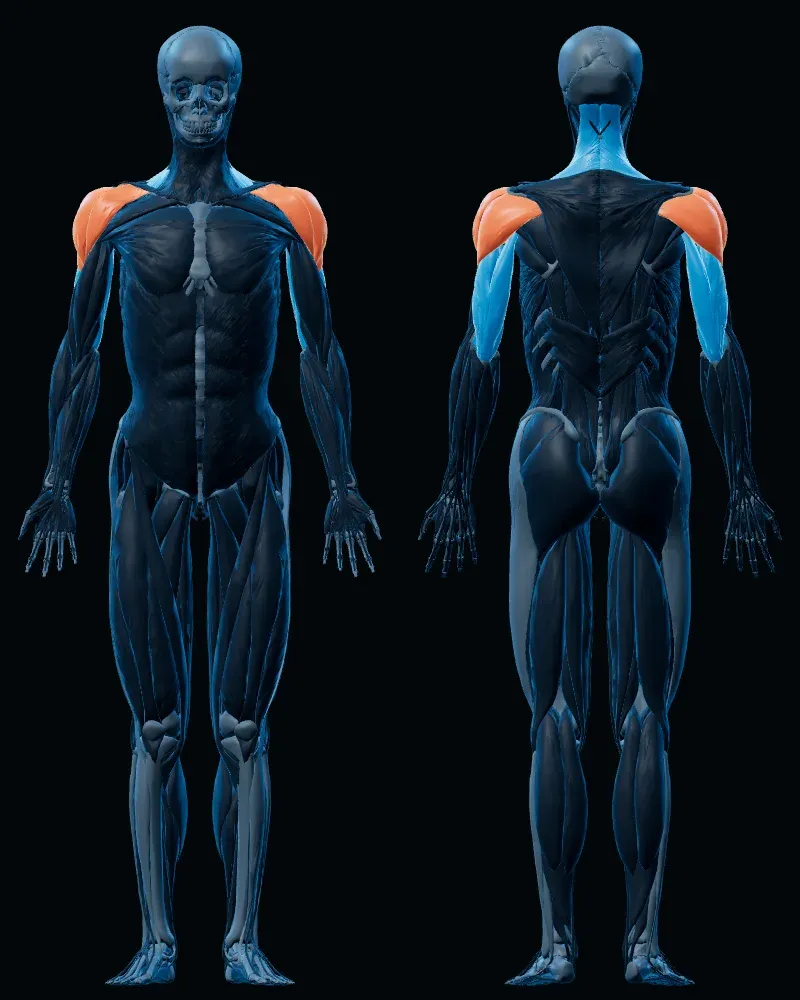
Muscles worked: shoulders
Main movers: all three heads of the deltoid
Assisting: supraspinatus, upper traps and triceps
Table of contents
Are front raises necessary? For most people who bench press, incline press or overhead press every week, no. Your front delts are already getting worked on every pressing set, and nothing in the research says you need an extra isolation move to grow them.
That is the short answer. The longer one is more interesting, because it explains why so many lifters have big, rounded front delts and flat, narrow shoulders from the side. If that sounds like you, this article is part of our complete shoulder and delt training guide, and the fix is mostly about where you spend your sets.
What do the front delts actually do?
The anterior deltoid is the front head of the shoulder. It raises the arm forward and takes a big share of the work in any pressing movement. If you want the full map of all three heads, our breakdown of deltoid anatomy for the anterior, lateral and posterior heads covers it.
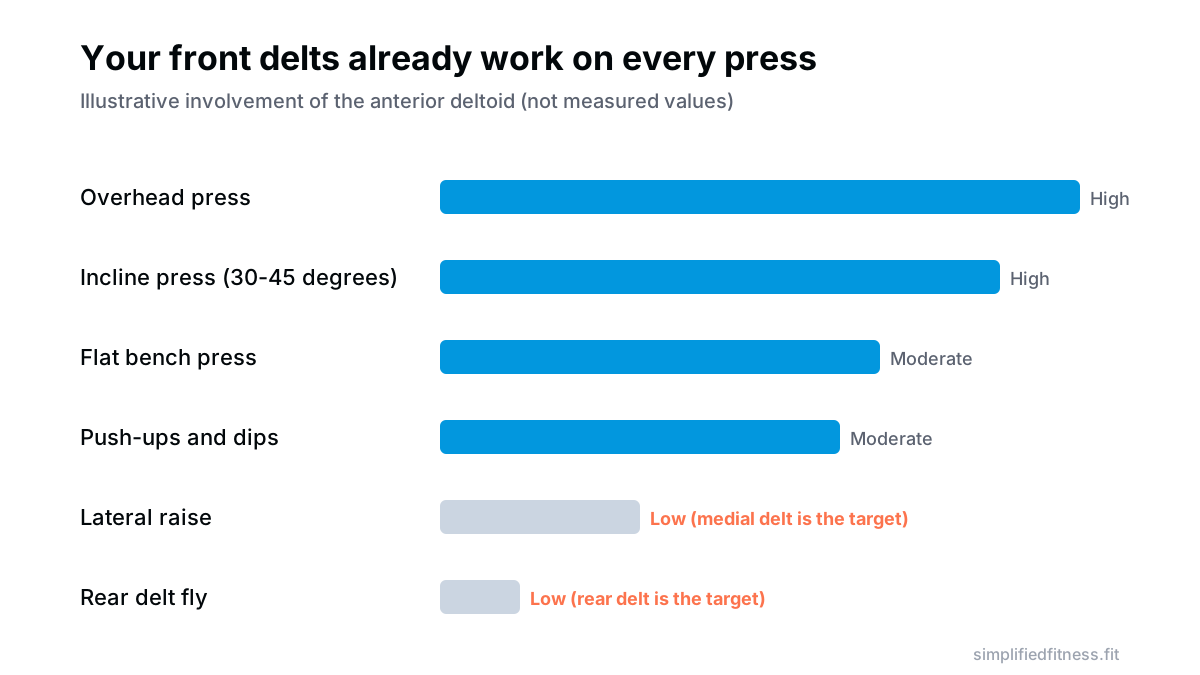
Here is the gym version. When you bench, the pecs and triceps move the bar, and the front delts help drive it off your chest. When you press overhead, they take an even bigger share. Push-ups, dips and incline presses all do the same.
So you are not neglecting them. You are hitting them three or four times a week without calling it shoulder day.
What does EMG research say about pressing and the front delts?
Electromyography (EMG) measures electrical activity in a muscle. It is a useful clue about which muscles are working, but it does not tell you how much a muscle will grow. Keep that caveat in mind for everything below.
A 2020 study had 30 trained adults bench press at 60% of their one-rep max across five bench angles (0, 15, 30, 45 and 60 degrees). Anterior deltoid activity was highest at 60 degrees, and the authors concluded the flat bench produced similar activity for the pecs and the anterior deltoid (Rodriguez-Ridao et al., 2020). Angles above 45 degrees increased the front delt contribution and reduced the pec contribution.
An older study of 15 healthy men found a similar direction. Anterior deltoid activation was significantly greater at 28, 44 and 56 degrees than on a flat bench (Trebs et al., 2010).
Overhead pressing is the same story. In eight competitive bodybuilders, different overhead press variations changed how much each part of the shoulder was excited, and the barbell versions excited the muscles more than a machine that guided the bar path (Coratella et al., 2022).
Do front raises work the front delts more than pressing?
Sort of, and that is where the confusion starts.
In a 2020 EMG study of 10 competitive bodybuilders, the front raise produced greater anterior deltoid activity than the lateral raise variations, and also higher pectoralis major activity (Coratella et al., 2020). So yes, it does hit the front delt. Nobody is claiming otherwise.
The catch is the comparison. The study compared raise variations with each other, not a front raise with a bench press. A dumbbell front raise also tops out at a weight most people can lift with straight arms, which is a fraction of what you handle on a press.
Higher activation in one exercise does not equal a better growth exercise. If you already press heavy, a front raise mostly adds more of the same work to a muscle that is not short of it.
Can indirect pressing volume really grow the front delts?
This is the question that decides the whole debate. Does a bench set count as a front delt set, even though the pecs are the main target?
Research on training volume is starting to treat it that way, with a discount. A 2026 meta-regression of 67 studies and 2,058 participants classified sets as direct or indirect, and the model that counted indirect sets as a fraction of a direct set fit the data best (Pelland et al., 2026). Muscle gain rose with volume, with diminishing returns. The authors concluded that separating direct from indirect sets matters for predicting results.
Here is what that means in the gym. Your bench sets are not a full front delt set each, but they are not zero either. In the paper, the best-fitting method counted an indirect set as half a set. Applied to your week (our extrapolation, not something the study tested on front delts), 12 hard pressing sets would count as roughly 6 front delt sets without a single raise.
An earlier meta-analysis of 15 studies found that weekly sets and muscle growth followed a graded dose-response, with each extra set linked to a small gain (Schoenfeld et al., 2017). Note that those studies looked at the muscles being directly trained, so they do not tell us the exact value of one bench set for one front delt.
Why are my front delts bigger than my side and rear delts?
A few things stack up. Here is the usual picture:
- Pressing dominates the program. Chest day, shoulder day and triceps day all include pressing, so the front delts get most of the weekly work.
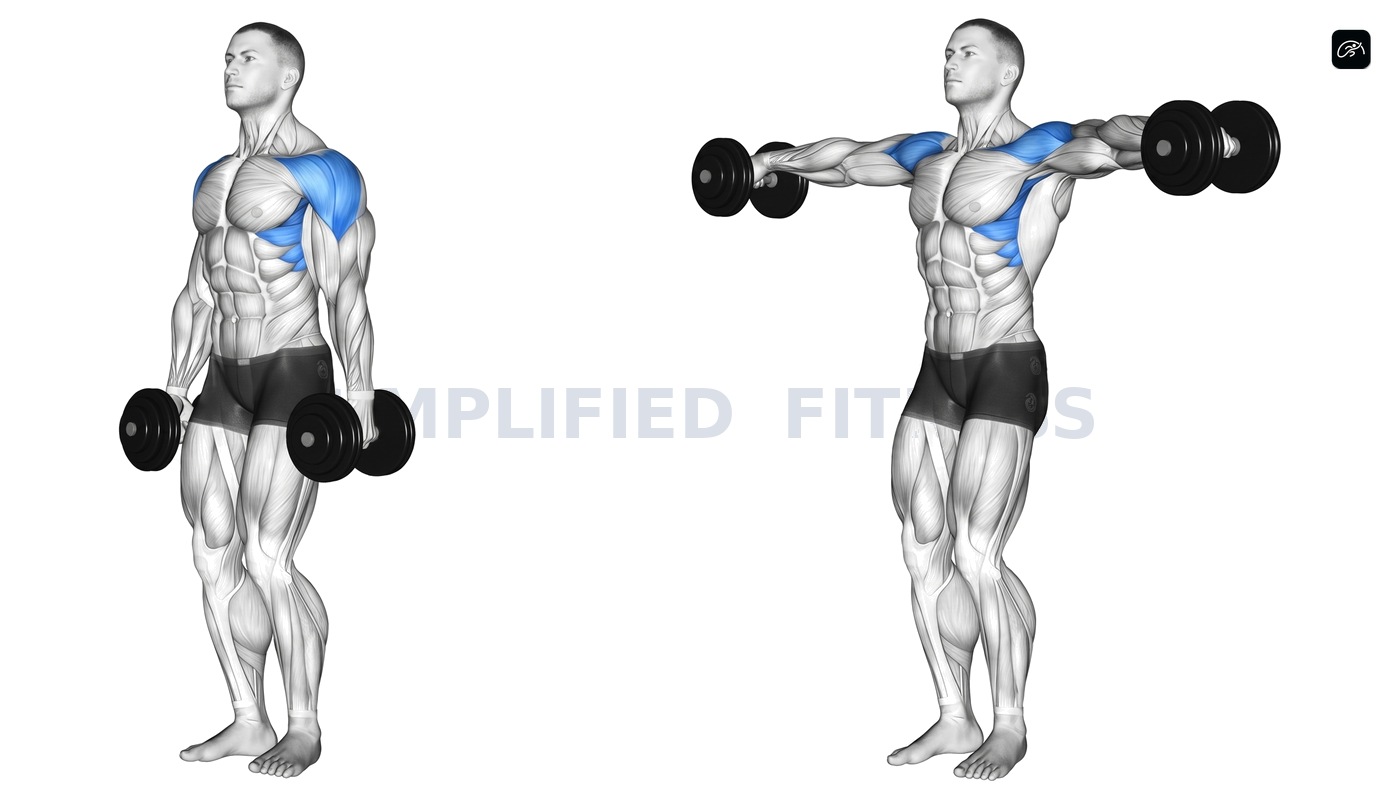
- Lateral and rear delts get scraps. The lateral raise and rear delt fly are the main ways to hit those heads, and many programs include few sets or none.
- Genetics. Muscle shape and how a head fills out from the side vary from person to person, so some people will always look front-heavy.
- Posture. Rounded shoulders can make the front delts look bigger and the rear look flatter, though that is a visual effect, not a measured growth difference.
The most common mistake here is treating “shoulder day” as three presses and a front raise, then wondering why the side view never improves. For the lateral head, our guide to lateral delt exercises with dumbbells, cables and machines goes deeper. The rear delts get their own treatment in reverse pec deck vs cables vs face pulls.
Where should you spend the sets instead?
If you drop 3-6 weekly front raise sets, you do not need to remove them from your total. Move them.
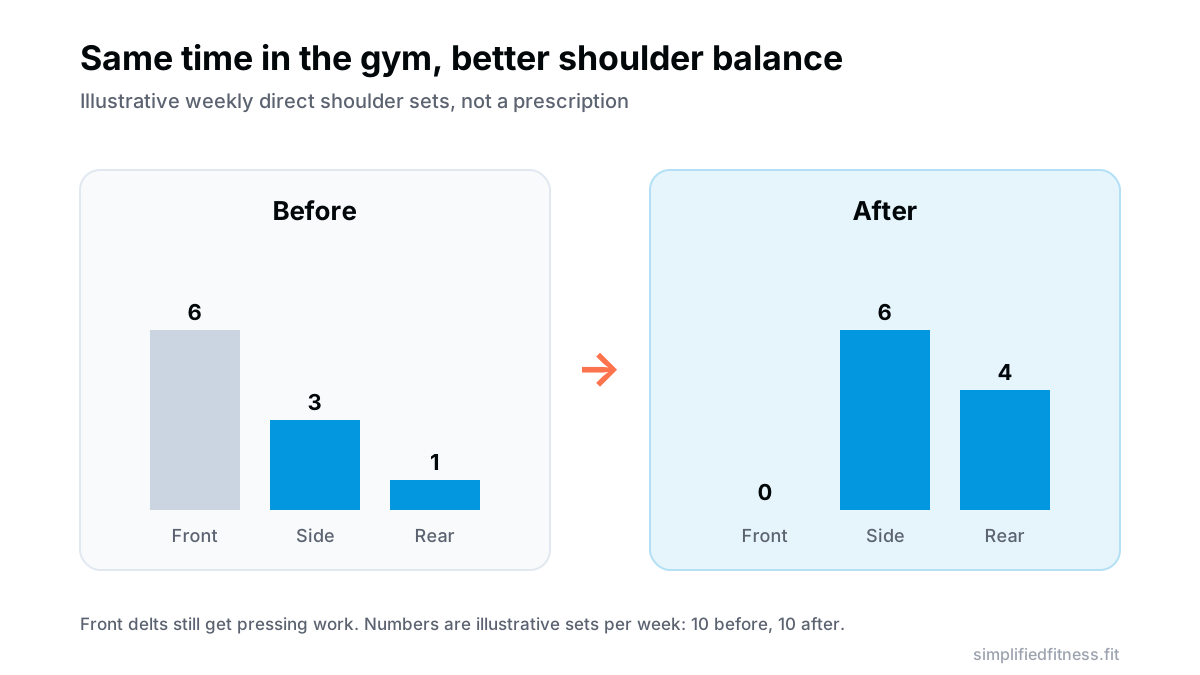
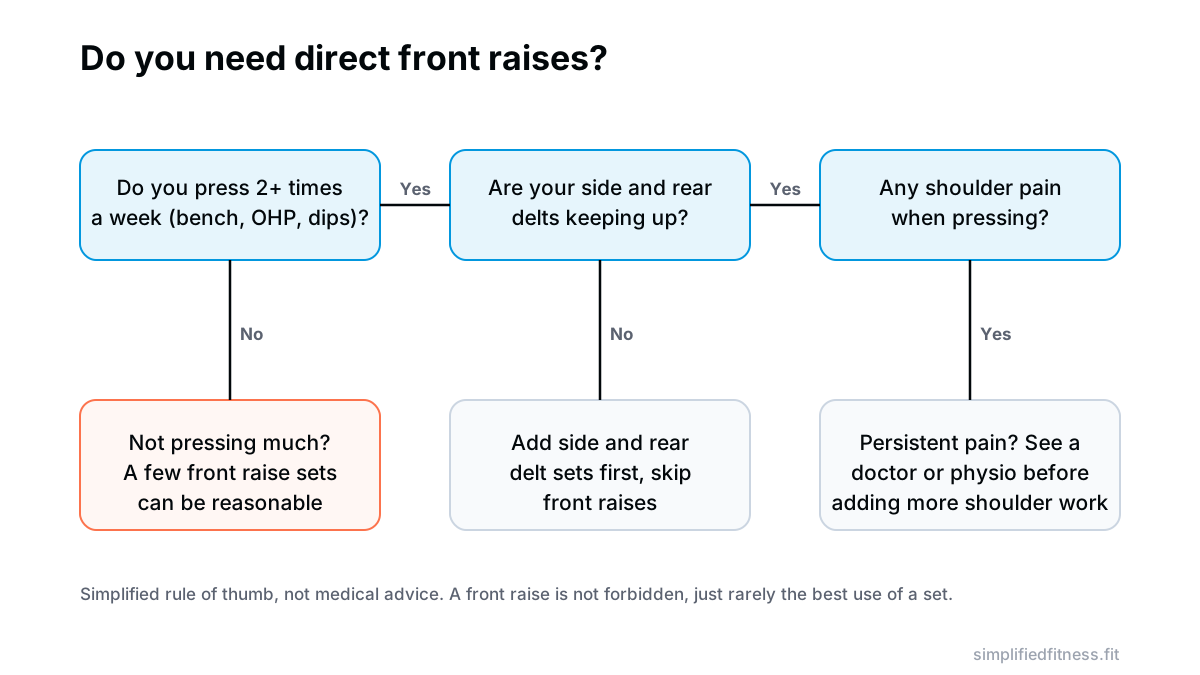
A simple version for someone who presses twice or more a week:
- Keep your main presses (bench, incline, overhead).
- Do 6-8 hard sets a week of lateral raises, split over two sessions.
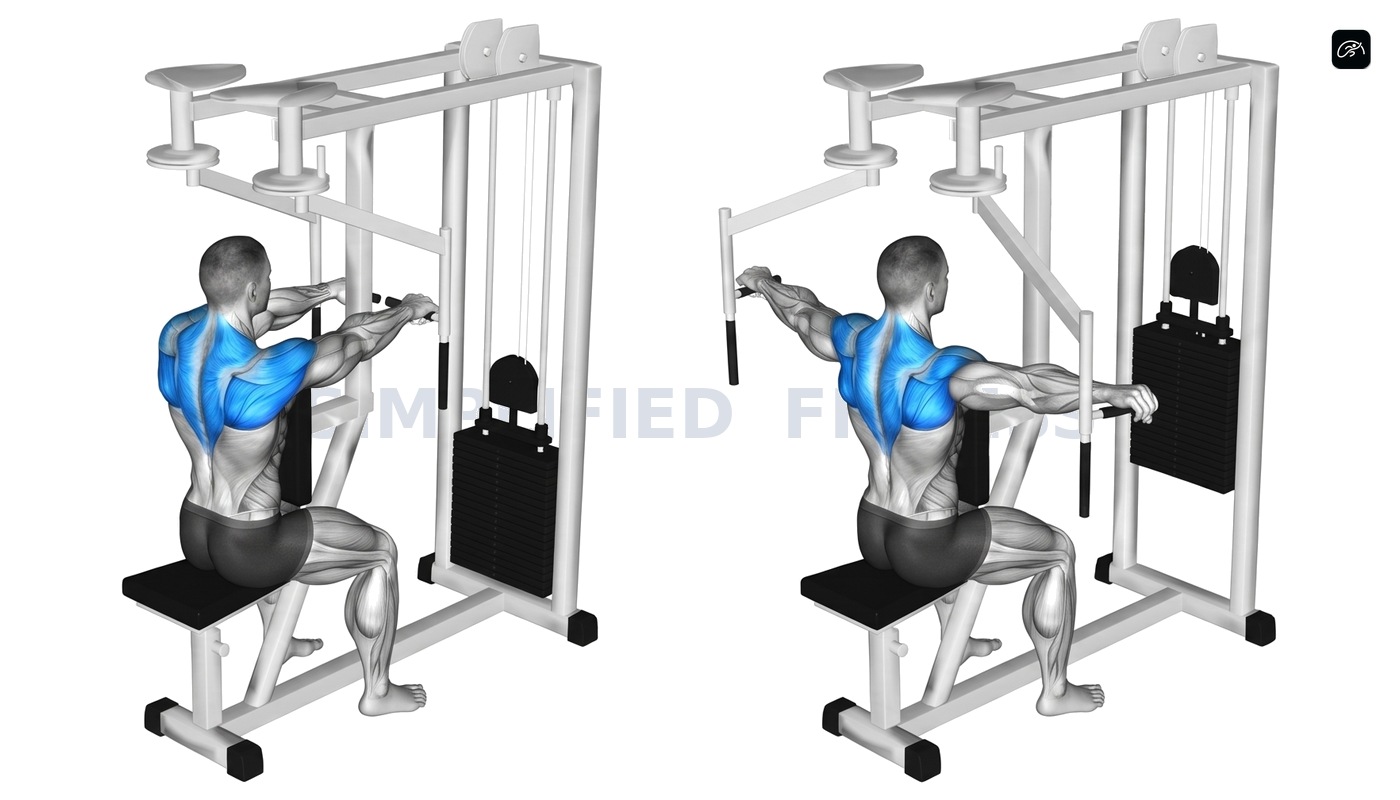
- Do 4-8 hard sets a week of rear delt work.
- Skip direct front raises, or keep 2 light sets at the end if you enjoy them.
These numbers are practical starting points, not research-proven optimums. Adjust based on how your shoulders look and feel after 6-8 weeks. You can check your weekly totals with the free training volume calculator.
Are front raises necessary for shoulder health?
Short answer: no, and the idea that big front delts directly cause shoulder problems is overstated.
A review of impingement rehab recommends a programme that addresses pain, scapular dysfunction and rotator cuff weakness, with objective testing of range of motion, strength and muscle balance (Ellenbecker and Cools, 2010). A separate review found altered scapular movement in people with impingement, including reduced serratus anterior and increased upper trapezius activation (Ludewig and Reynolds, 2009).
Notice what is not in either abstract: a finding that big front delts cause impingement. A press-heavy program with very little pulling and rotator cuff work may add to the problem, but that is a reasonable hypothesis, not a proven cause.
Do I need a front raise if I rarely press?
Maybe. The argument against front raises depends on you pressing regularly.
If your program has no bench, no overhead press and no dips, the front delts are getting much less work, and a few sets of front raises or a press variation can make sense. The same goes if you have a particular reason to train them, like a sport that demands it.
Also, enjoyment counts. If you like front raises and your lateral and rear delts are already getting their sets, a few light sets will not hurt. The point is priority, not prohibition.
What about the bench itself?
If your front delts take over on the bench, it is worth looking at how you set up and which variation you use. A steeper incline shifts more work to the front delts, as the EMG data above shows, so a lower incline or a flat bench may keep the pecs in front. Our article on flat barbell bench press limitations for hypertrophy covers the trade-offs, and the free push day plan shows how we structure pressing and lateral work together.
The practical takeaway
Press regularly, train side and rear delts directly, and treat front raises as optional. If your front delts are your strong point, there is no case for giving them more. Check your shoulders in the mirror every 6-8 weeks, and adjust where the sets go.
If you have pain, numbness or a shoulder that feels unstable, see a doctor. No exercise swap replaces a proper assessment.
Frequently Asked Questions
Are front raises necessary for big shoulders?
No, for most lifters who press regularly they are not necessary. The anterior deltoid is heavily involved in bench press, incline press and overhead press, and EMG work shows it stays active across bench angles. Put your direct shoulder sets into lateral and rear delt exercises instead.
Do front raises work the front delts more than bench press?
In a small EMG study of 10 competitive bodybuilders, the front raise gave the highest anterior deltoid activation of the raise variations tested. That does not mean it beats pressing for growth, because EMG amplitude is not the same as muscle gain and pressing allows far heavier loads. If you already press, the extra benefit of front raises is likely small.
Why are my front delts bigger than my side and rear delts?
Pressing hits the anterior deltoid hard while the medial and posterior heads get much less direct work. Add in genetics and muscle insertions, and many pressers end up front-dominant. A practical starting point is 6-8 hard sets a week of lateral raises and 4-8 of rear delt work, with direct front raises cut.
Can I skip front raises if I only train chest and triceps?
Yes, if your chest day includes pressing, your front delts are already being trained. Studies of bench angles show anterior deltoid activation across flat and inclined presses. Spend your direct shoulder time on side and rear delts.
Do overdeveloped front delts cause shoulder impingement?
There is no good evidence that large front delts alone cause impingement. Reviews link impingement to altered scapular movement and recommend rehab that targets scapular control and rotator cuff weakness. A pressing-heavy program with little pulling may play a part, but that has not been proven. If you have pain, see a doctor or physio rather than guessing.
How many sets of front raises per week is too many?
There is no research-defined limit for front raises specifically. Most lifters who press 2 or more times per week already collect plenty of front delt volume, so direct sets are usually surplus. If you want to keep them, 2-3 light sets is plenty and should come after your lateral and rear delt work.
Are front raises bad for your shoulders?
No, front raises are not inherently harmful. Problems usually come from adding more pressing-pattern volume on top of an already heavy load, swinging heavy weights, or ignoring pain. Use a light weight, controlled reps, and stop if the front of the shoulder hurts.
Does the incline bench work the front delts more than flat bench?
Yes, in EMG studies anterior deltoid activity generally rises as the bench gets steeper. A 2020 study of 30 trained adults found the highest anterior deltoid activity at 60 degrees, and a 2010 study found greater activity at 28, 44 and 56 degrees than flat. A 30 degree incline is a common compromise for upper chest without leaning too heavily on the front delts.
Do dumbbell front raises help the upper chest?
The front raise activates the pectoralis major as well as the anterior deltoid in bodybuilders, but it is a poor way to train the chest. Incline presses and flyes allow far more load and range. Use incline work for the upper chest.
What can I replace front raises with?
Replace them with lateral raises for the medial deltoid and a reverse pec deck or rear delt fly for the posterior deltoid. These heads get much less work from pressing. Move your front raise sets into those two exercises, keeping total weekly volume about the same.
Is overhead press better than front raises for front delts?
For most people yes, because the overhead press loads the anterior deltoid with far heavier weights. In one EMG study of bodybuilders, barbell overhead presses excited the shoulder muscles more than a machine press. Press overhead once or twice a week and skip front raises.
Should powerlifters or strongman athletes do front raises?
Usually not, since their pressing already provides the stimulus and their shoulders need recovery for heavy bench and overhead work. Evidence in these specific groups is limited. If you compete, follow your coach's plan and use your spare energy on pulling and rear delt work.
Sources & References
Every claim above is checked against peer-reviewed research (PubMed, U.S. National Library of Medicine) or guidance from established health bodies. How we fact-check.
- Coratella G, et al. An Electromyographic Analysis of Lateral Raise Variations and Frontal Raise in Competitive Bodybuilders. Int J Environ Res Public Health. 2020. PMID: 32824894
- Rodriguez-Ridao D, et al. Effect of Five Bench Inclinations on the Electromyographic Activity of the Pectoralis Major, Anterior Deltoid, and Triceps Brachii during the Bench Press Exercise. Int J Environ Res Public Health. 2020. PMID: 33049982
- Trebs AA, et al. An electromyography analysis of 3 muscles surrounding the shoulder joint during the performance of a chest press exercise at several angles. J Strength Cond Res. 2010. PMID: 20512064
- Coratella G, et al. Front vs Back and Barbell vs Machine Overhead Press: An Electromyographic Analysis and Implications For Resistance Training. Front Physiol. 2022. PMID: 35936912
- Pelland JC, et al. The Resistance Training Dose Response: Meta-Regressions Exploring the Effects of Weekly Volume and Frequency on Muscle Hypertrophy and Strength Gains. Sports Med. 2026. PMID: 41343037
- Schoenfeld BJ, et al. Dose-response relationship between weekly resistance training volume and increases in muscle mass: A systematic review and meta-analysis. J Sports Sci. 2017. PMID: 27433992
- Ellenbecker TS, et al. Rehabilitation of shoulder impingement syndrome and rotator cuff injuries: an evidence-based review. Br J Sports Med. 2010. PMID: 20371557
- Ludewig PM, et al. The association of scapular kinematics and glenohumeral joint pathologies. J Orthop Sports Phys Ther. 2009. PMID: 19194022

Umair Hazrami · Founder & Head Coach, Simplified Fitness
Umair Hazrami founded Simplified Fitness and the Simplified Lifter channel to cut through fitness noise. With 4+ years of consistent training and 10+ coaching clients, he writes every guide from the peer-reviewed research and links the sources so you can check them. Our editorial standards.
Educational content only, not medical advice. If you have a medical condition, are pregnant, or take medication, talk to a qualified doctor before changing your diet, supplements or training. Full disclaimer.
Keep reading

Exercise Technique
3D Shoulder Protocol: Weekly Volume, Frequency (2-3x/Week) and Rep Ranges
How to build 3D shoulders: how many weekly sets, how often to train side and rear delts, and which rep ranges to use, with an 8-week plan and the research.
8 min read

Exercise Technique
Behind-the-Neck Press: Shoulder Mobility, Neck Safety and Muscle Bias
Behind the neck press safety explained: who has the shoulder mobility for it, what EMG studies show for delts, and which swaps work if you do not.
10 min read

Exercise Technique
Cable Lateral Raises: Behind-the-Back vs Cross-Body Setup, Which Is Better?
Cable lateral raise behind the back vs in front: what the research says, which setup suits most lifters, and a step-by-step guide to pulley height and cuffs.
9 min read

Exercise Technique
Converging Machine Shoulder Press: Why It Feels Easier on Your AC Joint
Why does a converging shoulder press machine feel smoother than a barbell press? Setup, grip, depth and failure rules for sore AC joints, with studies linked.
8 min read