Leg Press Foot Placement: Quads vs Glutes, Depth and Lower Back Safety
Leg press foot placement: does high or low change quads vs glutes? What research shows, how deep to go, and how to stop your lower back rounding off the pad.
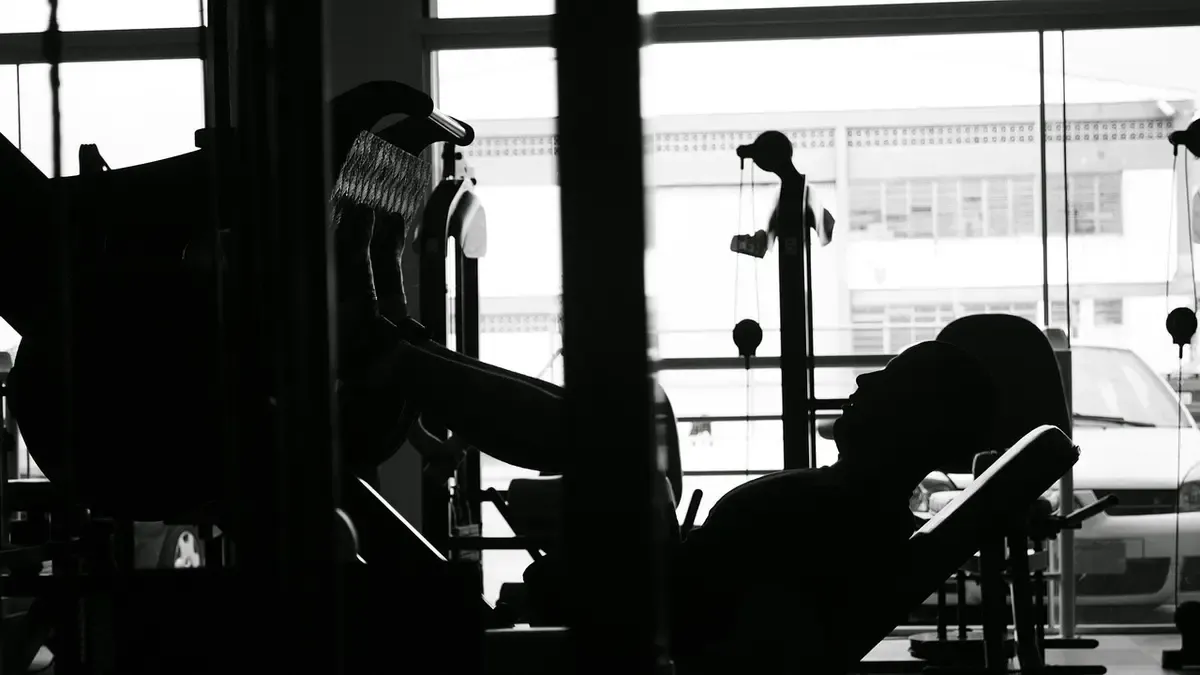
TL;DR. The short answer
- Leg press foot placement changes hip and knee angles, but the few studies that measured muscle activity found little or no difference in quad activity between wide, narrow or turned-out stances.
- Feet lower on the plate means more knee bend and a more upright shin; feet higher means more hip bend. The 'low for quads, high for glutes' rule is a reasonable theory, not a proven effect.
- In a 2025 trial of trained lifters, a fixed range of about 5-100 degrees of knee flexion and a maximum range grew the quads about equally over 8 weeks.
- The risky part is depth, not foot height. If your hips lift and your lower back rounds off the pad at the bottom, you have gone past your usable range.
- Set the safety stops, keep your glutes and back on the seat, and stop short of locking your knees. Pain that persists is a reason to see a physio or doctor.
Part of our complete guide: Complete Lower-Body & Core Training Guide: Quads, Glutes, Hamstrings, Calves & Abs Science
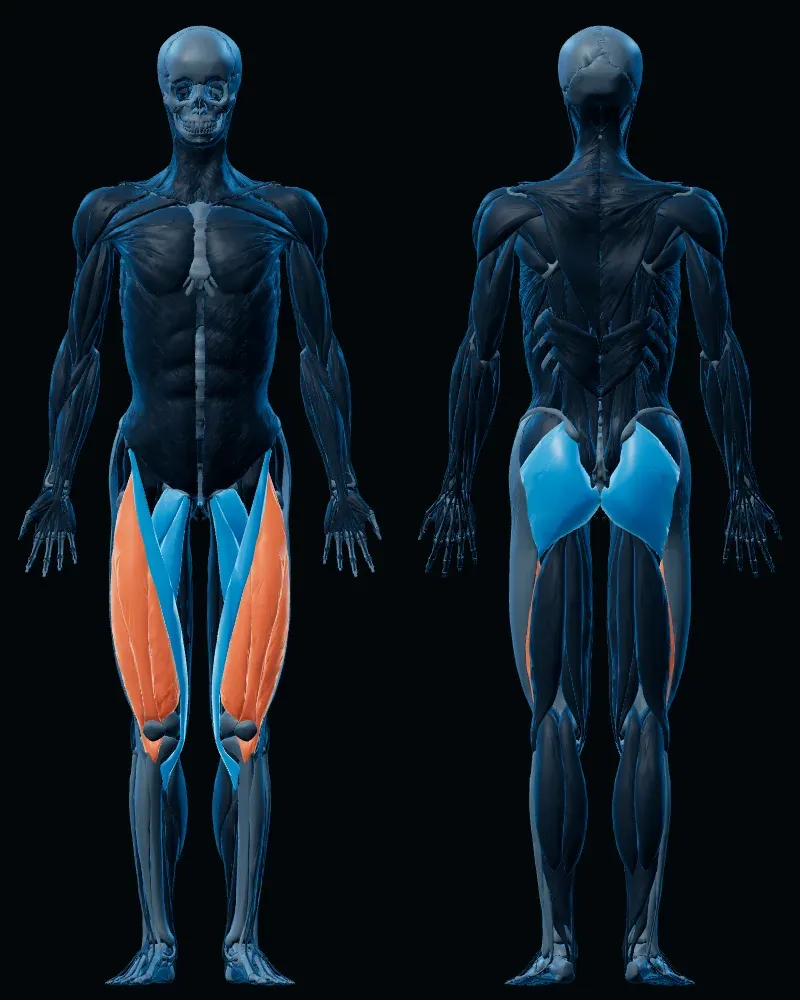
Muscles worked: quads
Main movers: rectus femoris and the three vasti
Assisting: adductors, sartorius and glutes
Table of contents
Leg press foot placement changes your hip and knee angles, but it probably matters less than the internet claims. Feet low on the plate bend the knees more; feet high bend the hips more. The studies that measured muscle activity found small or no differences between stances, so the safer question is how deep you can go before your lower back leaves the pad.
This is the machine tutorial for the leg press inside our complete lower body and core training guide. We will cover what foot position really changes, how deep to go, how to avoid rounding your lower back, and how to set the safety stops. For the wider stance question across squats too, see stance width and foot placement for squats and leg press.
Does leg press foot placement change quads vs glutes?
Here is the gym version. Feet low = quads. Feet high = glutes and hamstrings. Feet wide = adductors. Toes out = inner quad.
The logic is not crazy. Lower feet let your knees travel further forward over your toes, so your knees bend more. Higher feet shift the work toward hip bending. More hip flexion, more hip extensor demand. That is the biomechanical theory.
The measurements are less tidy. In a 2001 lab study, ten experienced male lifters did the squat plus a high-foot and a low-foot leg press, with wide and narrow stances and two foot angles. Foot angle made no difference to muscle activity or knee forces. The wide, high-foot leg press produced more hamstring activity than the narrow, high-foot version, and there were no knee force differences between high and low foot positions (Escamilla et al., 2001).
More recent work agrees on the quad side. A 2022 study on the inclined leg press compared stance widths of 100% and 150% of hip width and feet turned out 0 or 45 degrees. Muscle activation did not differ between conditions, and the vastus medialis was the most active muscle throughout (Martin-Fuentes et al., 2022). A smaller study of ten trained young women found the same pattern (Martin-Fuentes et al., 2020).
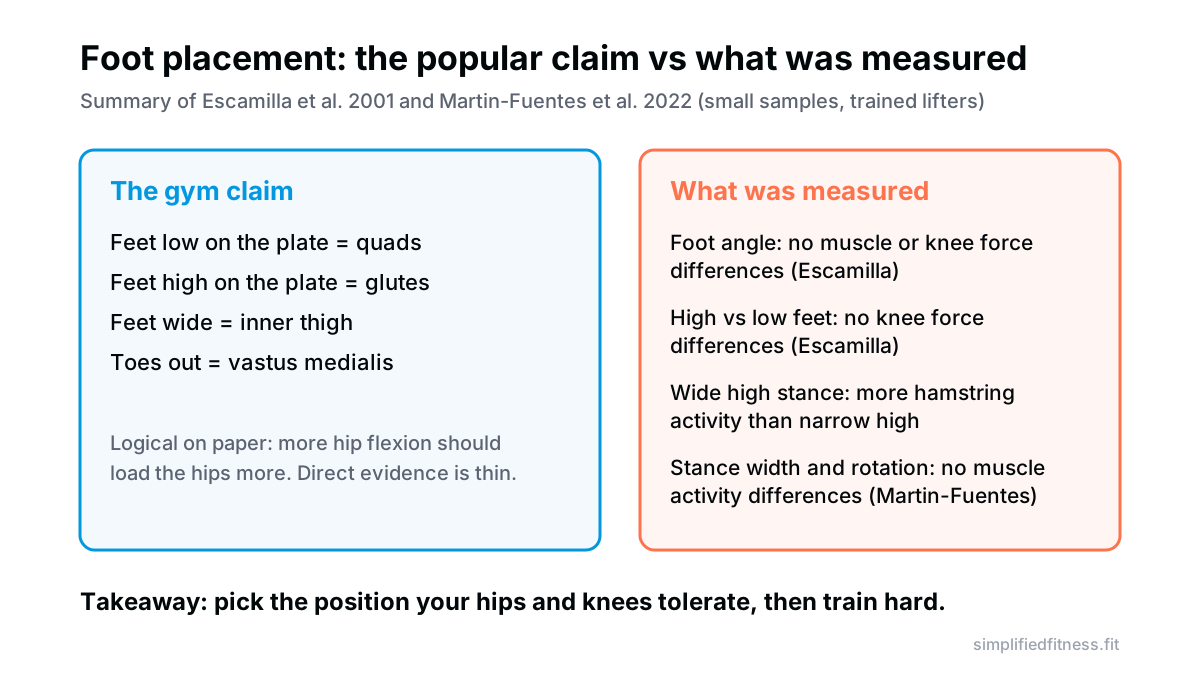
Be honest about the limits. These were small, short lab studies using surface EMG, which is a rough guide to long-term growth. Nobody has run a long hypertrophy trial comparing high vs low feet on the leg press that we could confirm. So treat foot height as a minor tweak, not a switch.
Where to put your feet: a practical starting point
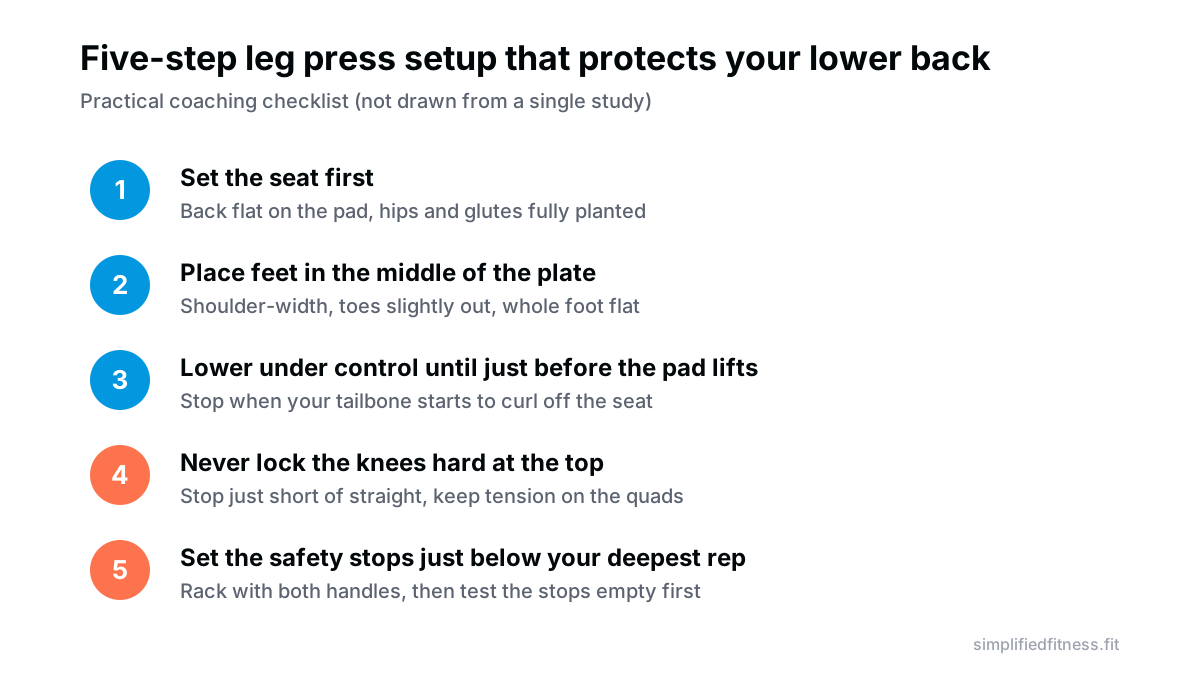
Start in the middle of the plate. Feet about shoulder-width, toes turned out slightly (10-20 degrees is common), whole foot flat. Then adjust one thing at a time.
| Your goal or problem | Try this | Why |
|---|---|---|
| More knee bend, quad focus | Feet slightly lower, shoulder-width | Knees travel further forward |
| Hips feel pinched at the bottom | Feet a bit higher | Less hip flexion at the same depth |
| Knees feel cranky at depth | Feet a bit higher, shorter range | Less knee flexion |
| Heels lifting off the plate | Feet slightly higher | You ran out of ankle room |
| Lower back rounds early | Feet higher or narrower range | Gives your pelvis room to stay planted |
Most people have a “sweet spot” an inch or two either side of centre. Hip structure, femur length and ankle mobility vary, so a position that feels perfect for a friend can feel awful to you. If you want more on this, read adapting range of motion to femur length and anthropometry.
How low should you go on the leg press?
Many lifters assume the deepest range is the best range. The best available leg press trial says otherwise.
In 2025, twenty-three resistance-trained participants (average training age about 7 years) trained one leg with a fixed knee flexion range of about 5-100 degrees and the other with their own maximum range, which averaged about 154 degrees. They did four sets to failure twice a week for 8 weeks. Quad muscle thickness, measured by ultrasound, rose by roughly 1-2 mm in both legs, and the Bayesian analysis found moderate to extreme evidence for no difference between the two ranges (Larsen et al., 2025).
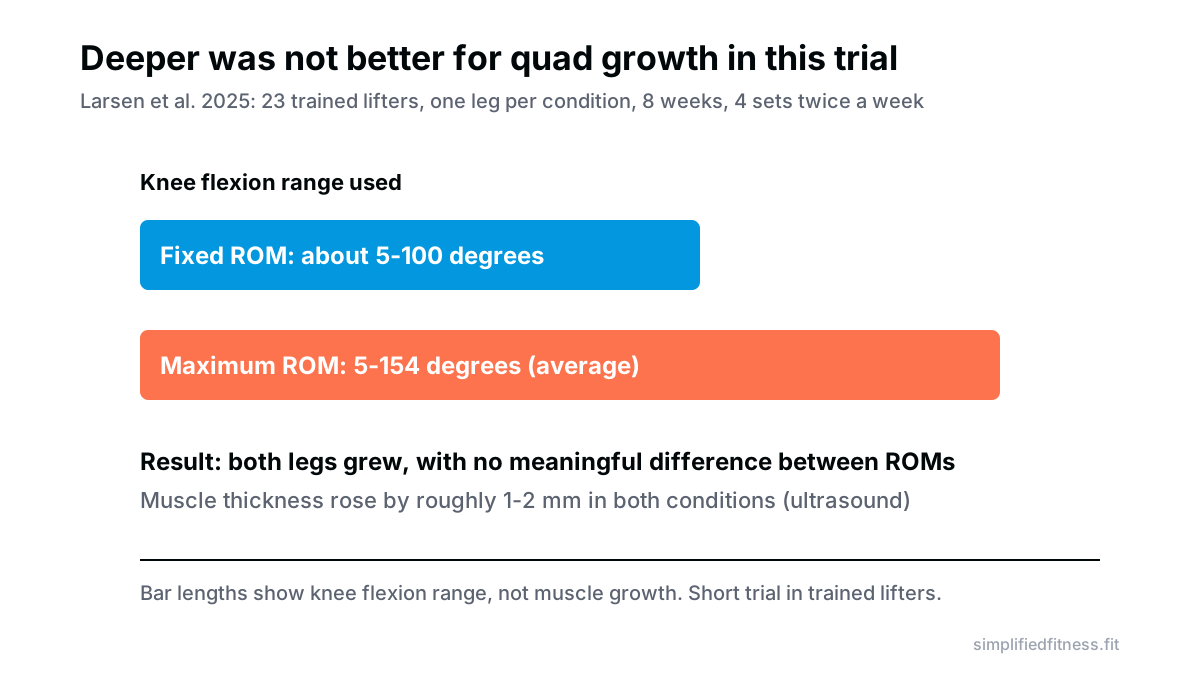
So is range of motion irrelevant? Not quite. A 2020 systematic review of six studies concluded that full range of motion looked better than partial range for lower-body hypertrophy, but it rested on only six studies (four on the lower body) and 135 participants (Schoenfeld and Grgic, 2020). And a 12-week, 15-site trial with 297 people compared full range with lengthened partials and found only small differences in thigh muscle area, which the authors described as practically equivalent, although their strict statistical threshold for formal equivalence was not met (Gschneidner et al., 2025).
Why might these differ? The review pooled a handful of small studies, while the newer trials were larger and compared a decent range against a deeper one. The cautious reading is that a solid, controlled range works, extremely shallow reps probably leave something on the table, and chasing the last 50 degrees of knee bend is not required. We go deeper on this in full vs partial range of motion for hypertrophy.
Avoiding lower back rounding on the leg press
Now the part most worth worrying about: the “butt wink,” or posterior pelvic tilt, at the bottom of the rep.
On the leg press, your hips bend as the sled comes toward you. At some depth your hamstrings and hips run out of room. Then your pelvis tucks under, your tailbone lifts off the seat and your lower back goes from flat to rounded. In the gym it looks like your hips rolling up off the pad at the bottom of each rep, often with the heaviest plates on.
Here is the honest evidence. We found no study measuring disc loading on the leg press specifically. The closest data comes from squats. In 13 young adults doing high-load Smith machine squats (80% of 1RM, 8 reps, 5 sets), parallel squats caused a drop in a disc water movement marker at L4/5 and L5/S1, more than half squats at L5/S1. Lumbar lordosis and anterior pelvic tilt were smaller at the bottom of the parallel squat, which the authors linked to greater mechanical stress on the lower discs (Yanagisawa et al., 2021).
That is an acute MRI finding in healthy young people, not proof of injury. A broader review argues deep squats do not raise injury risk to passive tissue when technique is good and loads progress sensibly (Hartmann et al., 2013). So the two sources do not contradict as much as they seem: depth is not dangerous in itself; heavy load plus a rounding lumbar spine is the combination to avoid.
Applying this to the leg press is an inference, but a sensible one. The leg press can pin your pelvis between the pad and the sled, so a rounded bottom position under heavy plates is exactly where you would not want to be.
How to prevent it:
- Set the seat so your hips are planted and your knees are not crushed against your chest.
- Stop the descent just before your tailbone curls.
- Move feet slightly higher or a touch narrower if rounding starts early.
- Do not let the weight bounce at the bottom.
- Keep a bit of warm-up work on hip and ankle mobility, since tight hips and calves limit range.
Safety pins, lockout and the setup that keeps you safe
The leg press feels safe because you are sitting down. People then load it like it cannot hurt them. It can.
Set the safety stops so the sled stops just below your deepest controlled rep, not at your absolute limit. If you miss a rep, the sled lands on the stops instead of on you. Test them with an empty sled before loading plates.
Do not slam the lockout. At the top, the weight rests on your skeleton rather than your muscles. Stop just short of straight and keep the quads working. Hard locking out heavy loads on the knee is simply not worth it.
Keep your hands on the handles, not on your knees. Pressing on your thighs to force a rep is a sign the weight is too heavy for your range.
Do not rest in the bottom. Reset in the top position with the stops engaged.
Why the leg press is great for quads
Why do lifters like it? It lets you load your legs hard without the demands of balance, bracing a bar on your back, or tolerating spinal compression. When your lower back or technique is the limiting factor, the leg press lets your quads work harder.
The tradeoff is real. In the 2001 study the squat produced greater quad and hamstring activity than the leg press, and knee compressive forces were generally greater in the squat too (Escamilla et al., 2001). That suggests the squat may be more effective for muscle development, but it also loads the knee more. For glutes, a 2025 meta-analysis concluded leg press machines can facilitate glute growth, while it highlighted barbell hip thrusts and parallel or full squats as stronger glute options (Krause Neto et al., 2025). Our guide to hip thrusts vs squats for glute growth covers that in more detail.
If you like machines for quads, our guide to hack squats and their stimulus-to-fatigue ratio is the natural next read.
Practical leg press programming
- Sets and reps: 2-4 hard sets of 8-15 reps, finishing a rep or two before form breaks.
- Tempo: about 2 seconds down, a firm push up. No bouncing.
- Load: adding weight is fine, but only if the range stays the same. Cutting depth to move more plates is not progress.
- Frequency: once or twice a week is enough for most people.
- Indian gym reality: plate-loaded machines vary a lot in angle and seat design. A 45-degree sled and a horizontal one feel completely different, so reset your foot position when you change machines.
Slot it into the leg day plan after your main compound lift, or use it as your primary quad movement on days your lower back is tired. If you are managing knee pain, see our leg workout modifications for knee pain, and for a sore back, our lower back friendly leg and back workout.
When to see a doctor
Sharp pain, pain that travels down your leg, numbness or tingling, or back pain that does not settle after a few days needs professional assessment. So does knee pain that persists at the same range every session. Do not train through it. A physiotherapist or doctor can assess it properly; we cannot diagnose it from an article.
The bottom line
Leg press foot placement is a comfort and angle adjustment, not a muscle-targeting switch. The studies we have show small or no differences in muscle activity between stances. Range of motion matters, but a controlled range of roughly 100 degrees of knee bend grew quads as well as the maximum range in trained lifters over 8 weeks. The real risk is rounding your lower back off the pad under heavy load, so stop where your pelvis stays planted, set your stops, and avoid slamming the lockout.
Start in the middle of the plate, find the depth where your back stays flat, and make the weight go up gradually. That beats chasing a precise foot position every time.
Frequently Asked Questions
Where should I place my feet on the leg press for quads?
Mid to low on the plate, about shoulder-width, is the usual starting point for quad focus because it lets your knees travel further forward. Research on muscle activity shows only small differences between stances, so comfort matters more than a precise spot. Pick the position where your knees track over your toes and your lower back stays flat, then push hard.
Where should I place my feet on the leg press for glutes?
Higher on the plate increases how much your hips bend, which in theory loads the glutes and hamstrings more. Direct evidence is limited, though a 2001 study found a wide, high stance produced more hamstring activity than a narrow, high one. If you use a high stance, only go as deep as your pelvis stays on the pad, and keep hip thrusts or RDLs in the plan for glute work.
Does foot position on the leg press really matter?
It changes the joint angles, but muscle activity differences between stances look modest in the studies we have. Lab studies in trained people found no differences in muscle activity with foot rotation, and inclined leg press studies found none with stance width either. Choose a position you can repeat safely and spend your effort on load, reps and effort.
How low should you go on the leg press?
Go as deep as you can while your lower back and hips stay on the pad. A 2025 trial found that about 5-100 degrees of knee flexion grew the quads as much as a maximum range of about 154 degrees. So you do not need to chase the deepest possible depth to build muscle.
Is it bad if my butt comes off the seat on the leg press?
Yes, it is a sign you have run out of usable range. When the hips lift, the pelvis tucks under and the lower back rounds, which puts your spine under load in a flexed position. Shorten the range so your glutes stay planted, and work on hip mobility separately.
Can the leg press hurt your lower back?
It can when you go too deep with heavy weight and your lower back rounds off the pad. In a squat study, deeper depth with a loaded bar reduced lumbar curve and reduced disc water movement at the lowest levels, which suggests more spinal stress. Keep your back flat on the seat and ease the load if your back is sore afterwards.
Should I lock my knees at the top of the leg press?
Do not slam into lockout. At the top the weight sits on your joints instead of your muscles, and a sudden extension with heavy plates is a bad place to get hurt. Stop just short of straight and keep the quads working.
How do I set the safety pins on a leg press?
Set them so the sled stops just below your deepest controlled rep, not at your absolute limit. This gives you a backstop if you fail a rep without forcing you to cut your range. Test them with an empty sled before you load plates, and always rack with both handles.
Is the leg press easier on the knees than the squat?
In a 2001 lab study of ten experienced lifters, knee compressive forces were generally lower on the leg press than the squat, and neither exercise produced ACL forces in the model. This does not make it risk-free for everyone, especially with kneecap pain at deep angles. If knees hurt, shorten your range and see our knee-friendly leg workout modifications.
Is the leg press as good as the squat for building legs?
It is a very effective quad builder, but the same 2001 study found the squat produced more quad and hamstring activity. The leg press lets you train your legs hard without balancing a bar or fatiguing your lower back. Use both if you can, or lean on the leg press when your back is the limiting factor.
Does the leg press build glutes?
A 2025 meta-analysis of glute growth concluded leg press machines can also facilitate glute hypertrophy, while it singled out the barbell hip thrust and parallel or full back squats as stronger glute options. Results depend on depth and load. Pair the leg press with a dedicated hip extension movement if glutes are a priority.
Do narrow or wide stances change leg press results?
Research on inclined leg press found no muscle activity differences between stance widths of 100% and 150% of hip width. Individual comfort, hip anatomy and knee tracking vary a lot. Use the width where your knees and hips feel natural and change it only if something feels pinched.
How many sets and reps should I do on the leg press?
A reasonable starting point is 2-4 hard sets of 8-15 reps, stopping a rep or two before form breaks. Muscle growth responds to training close to failure across a wide rep range, so pick weights you can control through your full usable range. Add reps or weight gradually week to week.
Sources & References
Every claim above is checked against peer-reviewed research (PubMed, U.S. National Library of Medicine) or guidance from established health bodies. How we fact-check.
- Larsen S, et al. Knee flexion range of motion does not influence muscle hypertrophy of the quadriceps femoris during leg press training in resistance-trained individuals. J Sports Sci. 2025. PMID: 40113586
- Escamilla RF, et al. Effects of technique variations on knee biomechanics during the squat and leg press. Med Sci Sports Exerc. 2001. PMID: 11528346
- Schoenfeld BJ, et al. Effects of range of motion on muscle development during resistance training interventions: a systematic review. SAGE Open Med. 2020. PMID: 32030125
- Gschneidner D, et al. The effects of lengthened-partial range of motion resistance training of the limbs on arm and thigh muscle area: a multi-site randomised trial. J Sports Sci. 2025. PMID: 41055237
- Martin-Fuentes I, et al. Influence of feet position and execution velocity on muscle activation and kinematic parameters during the inclined leg press exercise. Sports Health. 2022. PMID: 34085847
- Martin-Fuentes I, et al. Muscle activation and kinematic analysis during the inclined leg press exercise in young females. Int J Environ Res Public Health. 2020. PMID: 33238589
- Yanagisawa O, et al. Acute effects of varying squat depths on lumbar intervertebral disks during high-load barbell back squat exercise. Scand J Med Sci Sports. 2021. PMID: 33038028
- Hartmann H, et al. Analysis of the load on the knee joint and vertebral column with changes in squatting depth and weight load. Sports Med. 2013. PMID: 23821469
- Krause Neto W, et al. The impact of resistance training on gluteus maximus hypertrophy: a systematic review and meta-analysis. Front Physiol. 2025. PMID: 40276368

Umair Hazrami · Founder & Head Coach, Simplified Fitness
Umair Hazrami founded Simplified Fitness and the Simplified Lifter channel to cut through fitness noise. With 4+ years of consistent training and 10+ coaching clients, he writes every guide from the peer-reviewed research and links the sources so you can check them. Our editorial standards.
Educational content only, not medical advice. If you have a medical condition, are pregnant, or take medication, talk to a qualified doctor before changing your diet, supplements or training. Full disclaimer.
Keep reading
Exercise Technique
Adductor Magnus Training: Seated Adductor Machine and Copenhagen Planks for Thigh Mass
Adductor magnus training explained: what research says on deep squats, the adductor machine and Copenhagen planks for thicker inner thighs and groin strength.
7 min read
Exercise Technique
High Bar vs Low Bar Squat: Which Builds More Quad Muscle?
High bar vs low bar squat for hypertrophy: what torso lean, knee travel and EMG studies show, why high-bar leans quad, and when low-bar still makes sense.
8 min read
Exercise Technique
Calf Hypertrophy Science: Standing vs Seated Calf Raises (Gastrocnemius vs Soleus)
Calf hypertrophy explained: why calves seem stubborn, what the trials say on exercise choice, stretch and foot position, plus weekly sets, reps and frequency.
9 min read
Exercise Technique
Complete Leg Workout Programming: Quad Day vs Hamstring and Glute Day
Best leg workout routine science: split leg day into a quad session and a hamstring-glute session, with sets, order and a 5-week plan that avoids burnout.
9 min read