The Complete Chest Workout Guide: Pec Anatomy, Bench Angles, Flys and Shoulder-Safe Pressing
A science-based chest workout guide: how the three pec regions work, the bench angle for upper chest, presses vs flys, and setup cues that spare your shoulders.
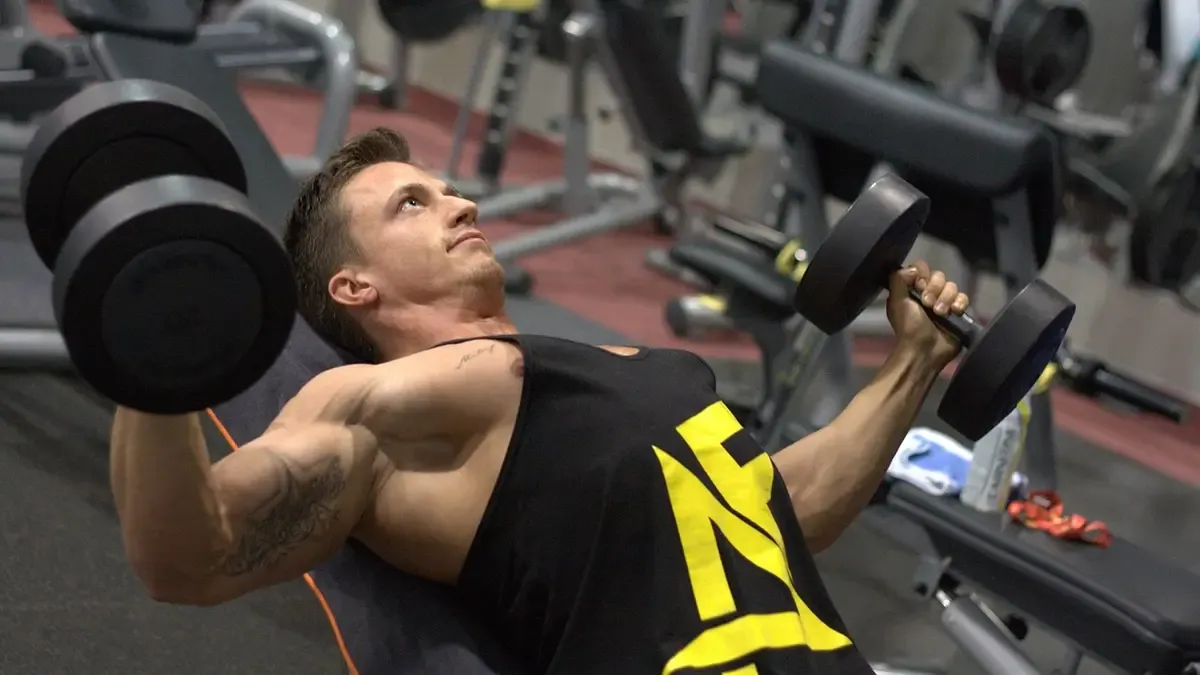
TL;DR. The short answer
- The pectoralis major has a clavicular (upper) head and a larger sternocostal head whose lowest fibers come off the ribs. Each region lines up best with a different pressing direction.
- A moderate incline of roughly 30-45 degrees shifts work toward the upper chest; steeper angles mostly add front delt. Long-term growth data on this comes mainly from untrained men.
- Barbell, dumbbell and machine presses build similar amounts of muscle on average. Pick the ones you can load progressively without shoulder pain.
- A good chest week covers a flat or slight-decline press, an incline press and a fly, taken close to failure through a full, controlled range.
- A grip under about 1.5 times shoulder width and pinned-back shoulder blades reduced modelled shoulder loads in a 2024 bench press study.
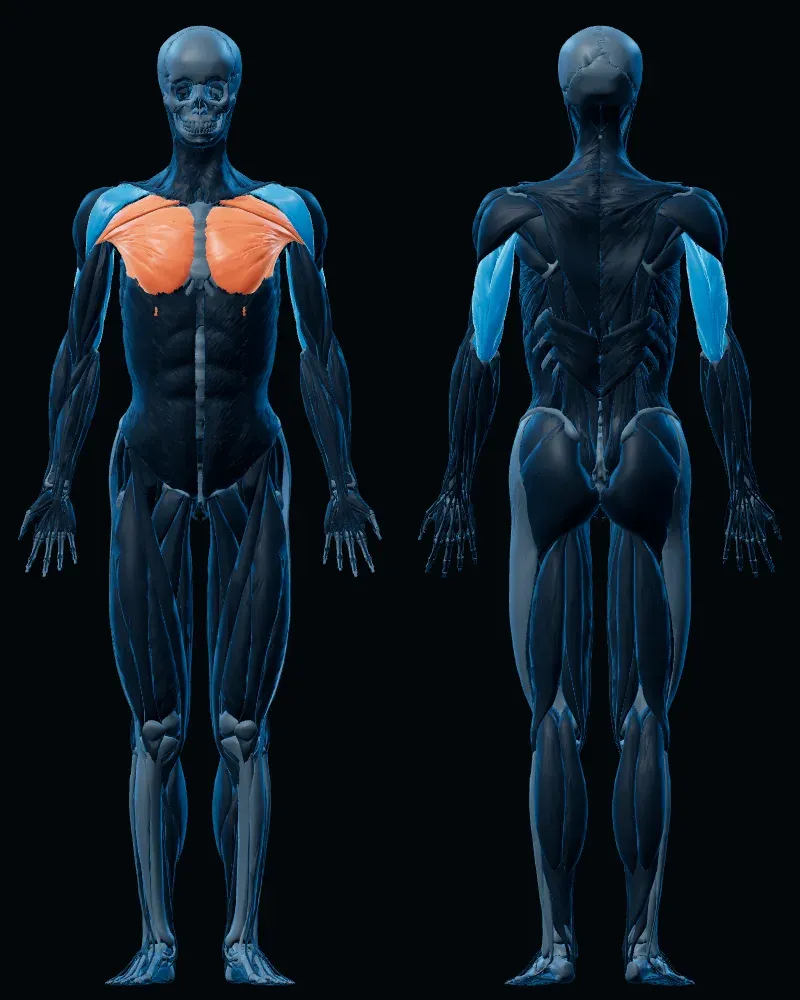
Muscles worked: chest
Main movers: pectoralis major
Assisting: front delts and triceps
Table of contents
A good chest workout is simpler than most programs make it look. Cover three pressing directions (flat, incline and a slight decline or dip), add one fly, take your sets close to failure through a full range, and do it twice a week. That is the core of this chest workout guide, and everything below explains why, with the research linked so you can check it.
The reason the angles matter is anatomy. Your pec is not one flat slab. It is a fan of fibers that run in different directions, and the direction you press decides which fibers do most of the work.
We will go from anatomy to exercise choice to shoulder safety, then put it together into a week you can run. If you want the deep version of any single topic, each section links to a dedicated article.
How the chest is built: the pec major heads
The pectoralis major has two recognised heads.
- Clavicular head (the “upper chest”): starts on the inner half of your collarbone and runs down and out to the upper arm.
- Sternocostal head (the mid and lower chest): starts on the sternum and the cartilage of the upper ribs, and runs roughly horizontally to the same arm tendon. Its lowest fibers, sometimes called the costal or abdominal portion, come up from the lower ribs and the sheath of the abs.
A 3D cadaver study mapped this in detail. The clavicular head was architecturally uniform, while the sternal head was split into 6-7 distinct segments, with the lowest segment folding forward to cradle the one above it. The clavicular head also had a steeper average pennation angle (about 29 degrees vs 21 degrees for the sternal head) (Fung et al., 2009). Translation: the sternal head behaves less like one muscle and more like a stack of slightly different ones. That is why “upper”, “mid” and “lower” chest are not gym myths, even if the inner chest is (more on that later).
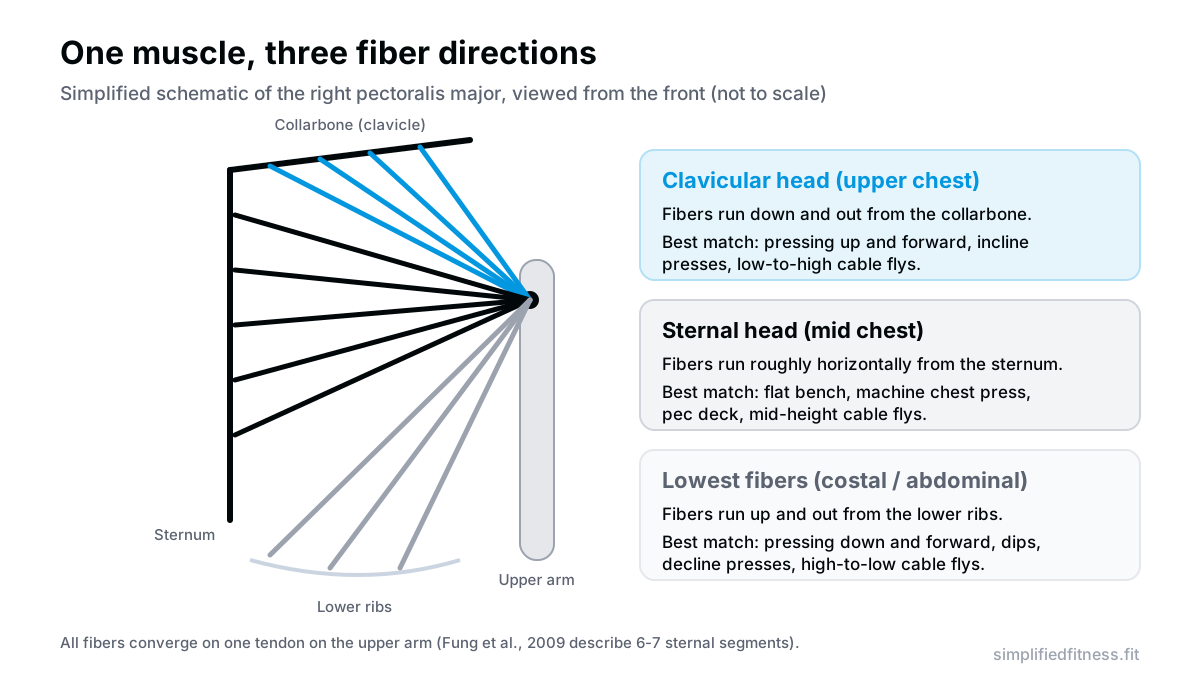
All of those fibers converge on one tendon on the upper arm. So the whole pec horizontally adducts the arm (brings it across the body). The upper fibers also help raise the arm forward, and the lower fibers help pull a raised arm down and forward, like the bottom half of a dip.
Underneath sits the pectoralis minor, a small muscle that tilts the shoulder blade forward. Off to the side, the serratus anterior wraps around the ribs and holds the shoulder blade against your torso when you press. You do not need to train pec minor directly. Serratus is worth a few sets, and we will get to why.
For the full anatomy breakdown, including how fiber length differs from top to bottom, see our guide to pectoralis major anatomy and its heads.
The four movement patterns that cover your whole chest
You do not need 12 chest exercises. You need these four patterns, each done well.
| Pattern | Main emphasis | Examples | Why include it |
|---|---|---|---|
| Horizontal press | Sternocostal head, triceps | Flat barbell or dumbbell bench, machine chest press, push-ups | Heaviest loads, easiest to progress |
| Incline press | Clavicular head, front delt | Incline dumbbell or barbell press, incline machine | Fills in the upper chest |
| Decline press or dip | Lowest sternocostal fibers, triceps | Bar dips with forward lean, decline press, high-to-low cable fly | Lower chest line, less front delt |
| Fly | Whole pec with little triceps | Cable fly, pec deck, dumbbell fly | Chest volume without extra elbow and triceps fatigue |
Most well-built chests come from a horizontal press, an incline press and a fly. The decline or dip slot is optional, especially if your flat press already sits low on the chest.
Bench press vs dumbbell press: which is better for chest?
This is the argument that never ends in the gym. The data says it matters less than people think.
A 2023 meta-analysis pooled 13 studies (1,016 participants) that directly compared free-weight and machine training for at least six weeks. Only five of those studies measured muscle size, and for hypertrophy there was no difference between modalities. Strength gains leaned specific: free-weight training improved free-weight tests more, and machine training tended to improve machine tests more (Haugen et al., 2023). That is free weights vs machines rather than barbell vs dumbbell, but it tells you something useful. Your chest grows from hard sets with progressive tension, not from a specific piece of steel.
So choose on practical grounds:
- Barbell bench: easiest to load in small jumps and track. Range of motion stops where the bar hits your chest. Rack position matters, and you want a spotter or safety arms when you push close to failure.
- Dumbbell press: lets your hands travel lower and closer together at the top, and lets each arm find its own path. That freedom is often kinder to cranky shoulders. Loading jumps are bigger (often 2.5 kg per hand), so progressing can be clunky.
- Machine press: you can grind safely to failure without a spotter. Great for the last press of the day.
Does the deeper stretch from dumbbells build more muscle? Maybe. A systematic review on range of motion found clear benefits for full range in the lower body, but concluded that upper-limb evidence was limited and conflicting (Schoenfeld and Grgic, 2020). Going deep is a reasonable bet as long as your shoulders tolerate it. It is not a proven must. Our range of motion and stretch-mediated hypertrophy guide covers the newer lengthened-partials research.
What the barbell bench does well, and where it falls short for pure chest growth, is unpacked in flat barbell bench press: hypertrophy strengths and limitations. If you want to see how your bench compares across rep ranges, plug a recent set into the 1RM calculator.
How to build your upper chest: the incline angle question
A lagging upper chest is a common complaint among lifters who only flat bench, and the research here is better than you might expect. It also has a genuine disagreement worth understanding.
What the EMG studies show
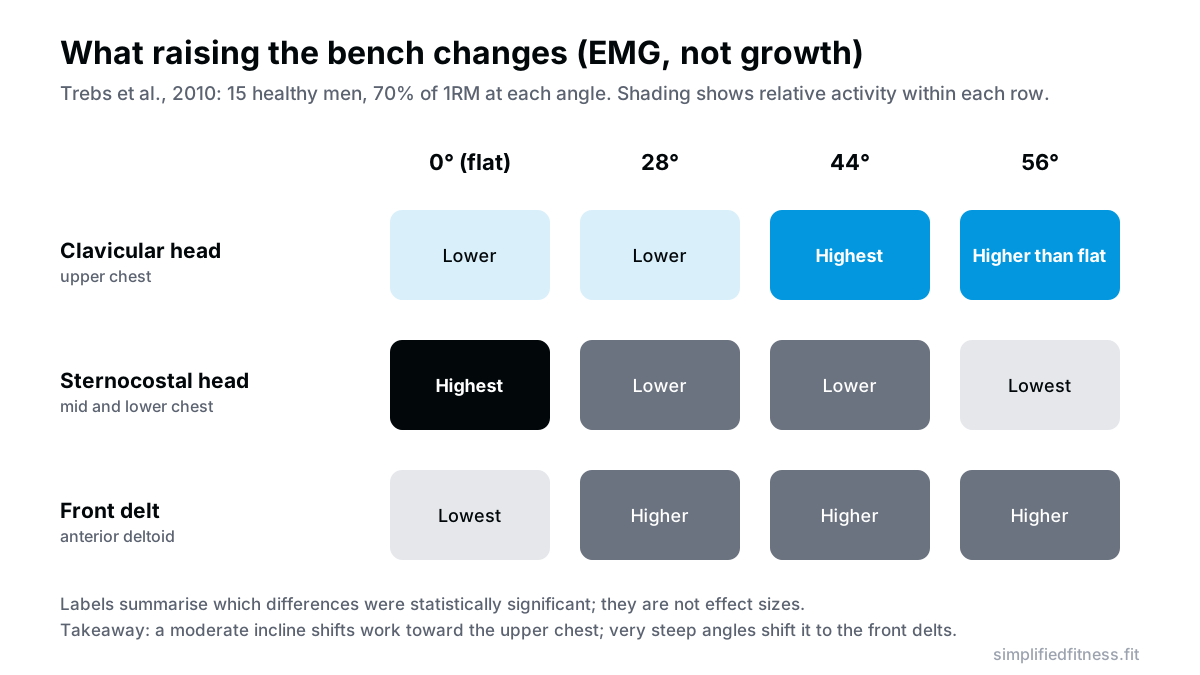
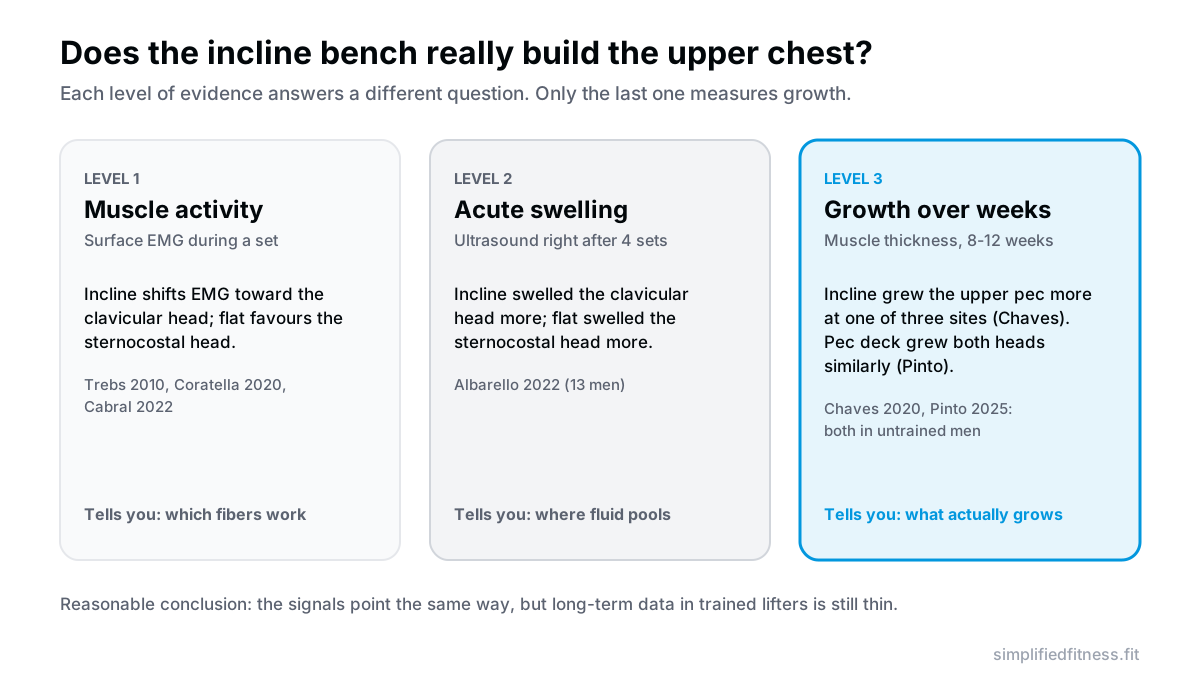
The classic study tested 15 men at 0, 28, 44 and 56 degrees, all at 70% of 1RM. Clavicular head activity was significantly higher at 44 and 56 degrees than flat, and higher at 44 than 28. Sternocostal activity was highest on the flat bench and dropped as the bench rose. Front delt activity was higher at every incline than flat (Trebs et al., 2010).
A study in 10 competitive bodybuilders lined up with this. A 45-degree incline excited the clavicular head more than flat, decline or a chest press machine, while the sternocostal head was similar between flat and decline and lower on the incline (Coratella et al., 2020).
Where the research disagrees
Not every study agrees. In 12 national and international level bench press athletes doing 6RM sets, there were no significant differences in pec activity between flat, incline and decline positions. Only biceps and triceps activity changed (Saeterbakken et al., 2017).
Why the mismatch? Two plausible reasons. First, that study reported the pectoralis major as one muscle rather than splitting it into heads, so a shift from one region to another could cancel out. Second, ordinary surface EMG is noisy. A team using high-density EMG (15 recording sites along the muscle) argued that these non-physiological sources likely explain earlier contradictions, and found that the “centre” of pec activity clearly moved toward the clavicular region when the bench went from flat to 45 degrees (Cabral et al., 2022). We think the region-by-region data is more convincing, but it is still activity, not growth.
Does it translate to growth?
Here is where it gets interesting. A follow-up study in 13 men measured muscle size with ultrasound right after four sets. The incline bench swelled the clavicular head more; the flat bench swelled the sternocostal head more (Albarello et al., 2022). That is acute swelling, not long-term growth.
For long-term growth, the best data is an 8-week trial in 47 untrained men split into flat, incline or combined groups with equal sets. Strength gains were similar. Muscle thickness changes differed at only one of three sites: at the upper pec (second intercostal space), the incline group grew about 0.6 cm more than the flat group (Chaves et al., 2020).
But a 2025 study complicates the picture. Untrained men did 12 weeks of the pec deck only, and both heads grew by similar amounts, 17-18% for the clavicular and 21% for the sternocostal head. The authors concluded their results did not support regional hypertrophy with the pec deck (Pinto et al., 2025). The pec deck is a horizontal movement with no incline, though, so it does not really test the incline question. And beginners tend to grow everywhere from almost anything.
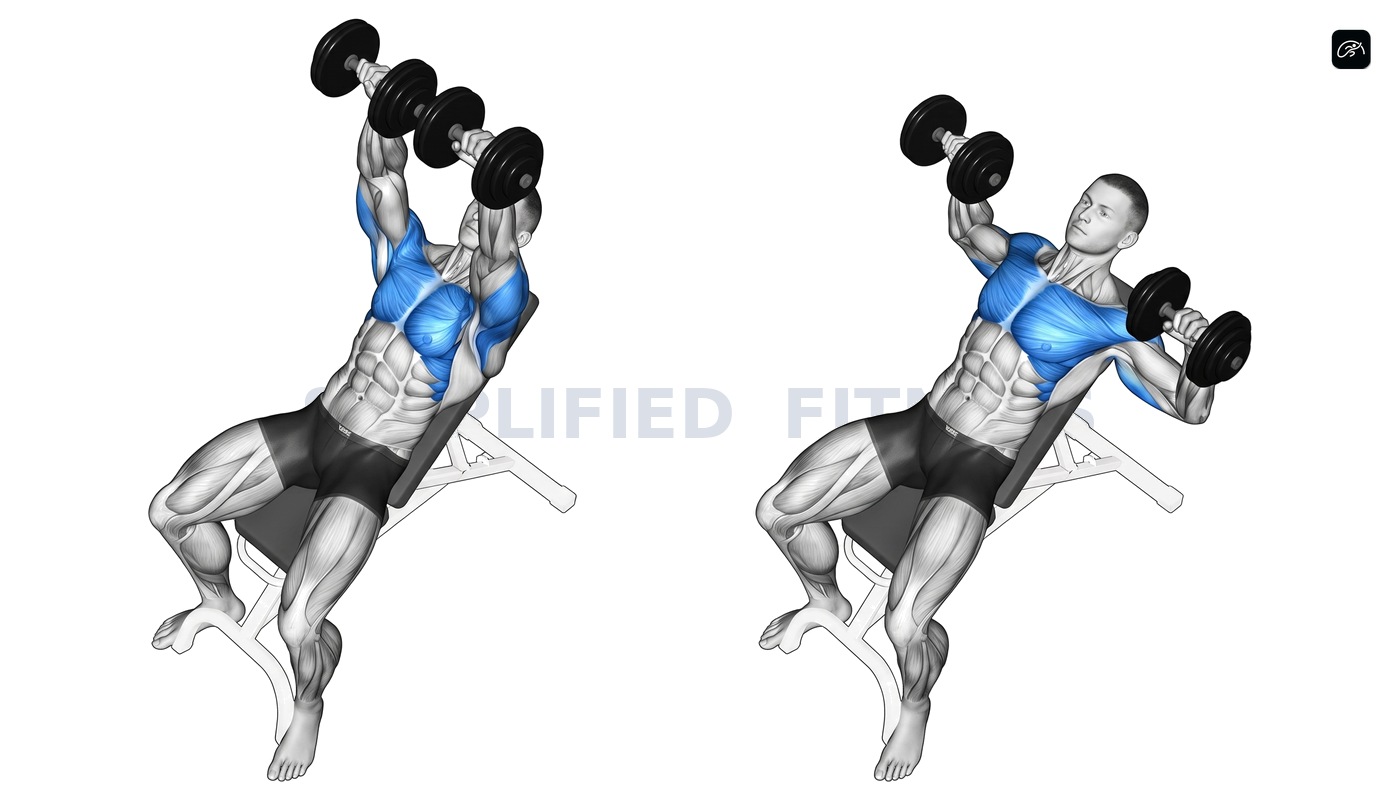
In practice, most adjustable benches give you roughly 15, 30, 45 and 60 degree notches. Start on the second or third notch. If you mainly feel it in your front delts, drop one notch. The full angle-by-angle comparison is in incline dumbbell bench press: angle comparison, and the wider programming picture is in our upper chest training guide.
Lower chest: decline presses and dips
The lowest fibers run upward from the lower ribs, so pressing down and forward lines up with them. You have three good tools: dips, the decline press and high-to-low cable flys.
In bodybuilders, the decline bench produced sternocostal activity similar to the flat bench, with lower front delt involvement than every other press tested (Coratella et al., 2020). So a decline press is less about a special “lower chest” effect and more about a shoulder-friendlier way to press heavy.
Dips are the other option. An EMG study in 13 experienced men compared bench, bar and ring dips. The bench dip mostly hit triceps but needed more shoulder extension. Bar and ring dips produced higher peak muscle activity, with the ring dip pushing some muscles higher still (McKenzie et al., 2022). The authors flagged the results as relevant for people with a history of shoulder pain, which matches what you see in the gym: dips are excellent for some shoulders and miserable for others.
Cues that help:
- Lean your torso forward and let your elbows drift slightly out to bias chest over triceps.
- Lower until your upper arm is about parallel to the floor, then stop. Sinking deeper adds stretch at the front of the shoulder with little extra benefit for most people.
- Control the bottom. No bouncing.
If dips hurt the front of your shoulder even with a shorter range, swap them. More on this in chest dips: forward lean and shoulder safety and the full lower chest biomechanics guide.
Chest flys: dumbbells vs cables vs pec deck
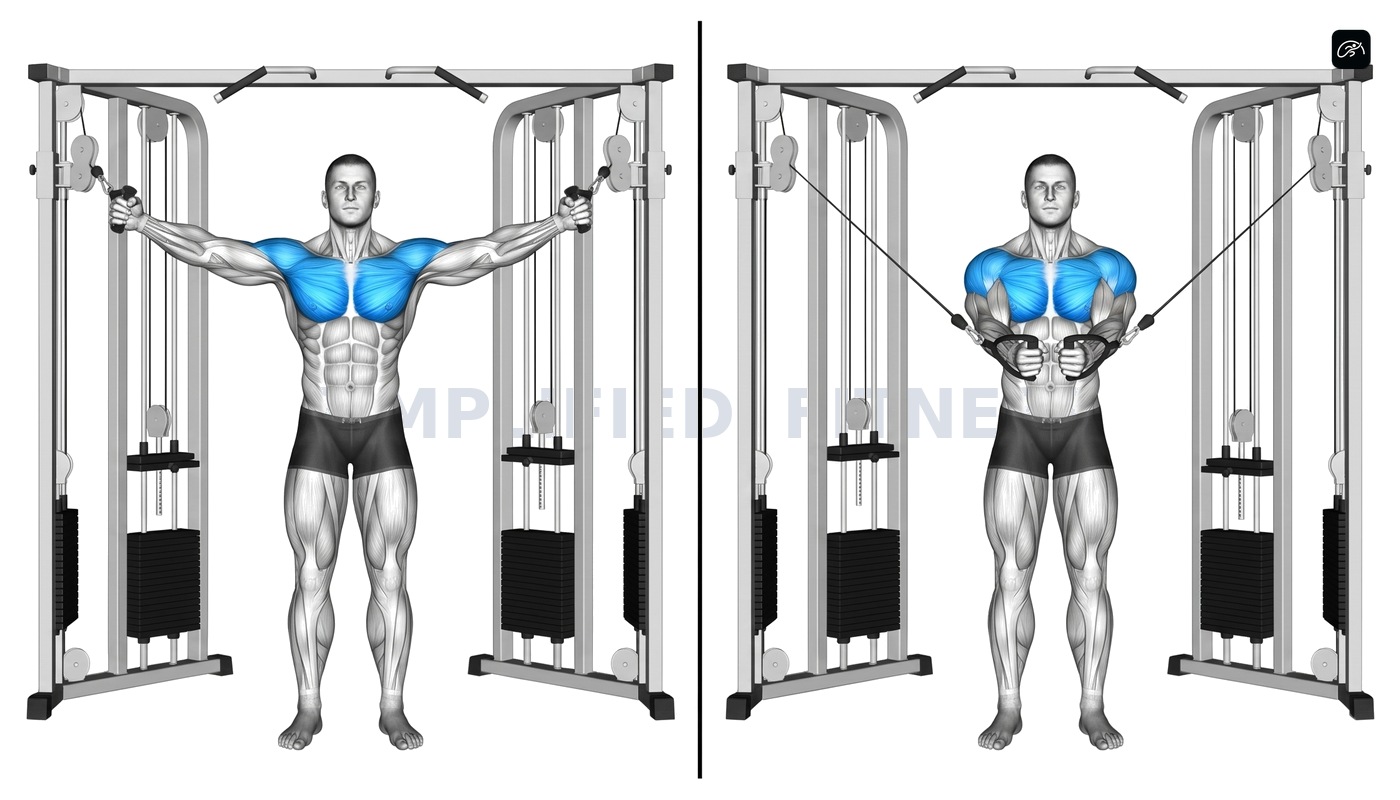
Flys train the pec through its main job, bringing the arm across the body, without your triceps giving out first. They should supplement presses, not replace them.
A study in 17 resistance-trained men compared the barbell bench and the dumbbell fly at 6RM loads. Pec, front delt and triceps EMG were higher on the bench through most of the movement (Solstad et al., 2020). Presses stay the foundation. Flys are where you add extra chest volume cheaply.
The real difference between fly types is the resistance profile: where in the rep the movement is hardest.
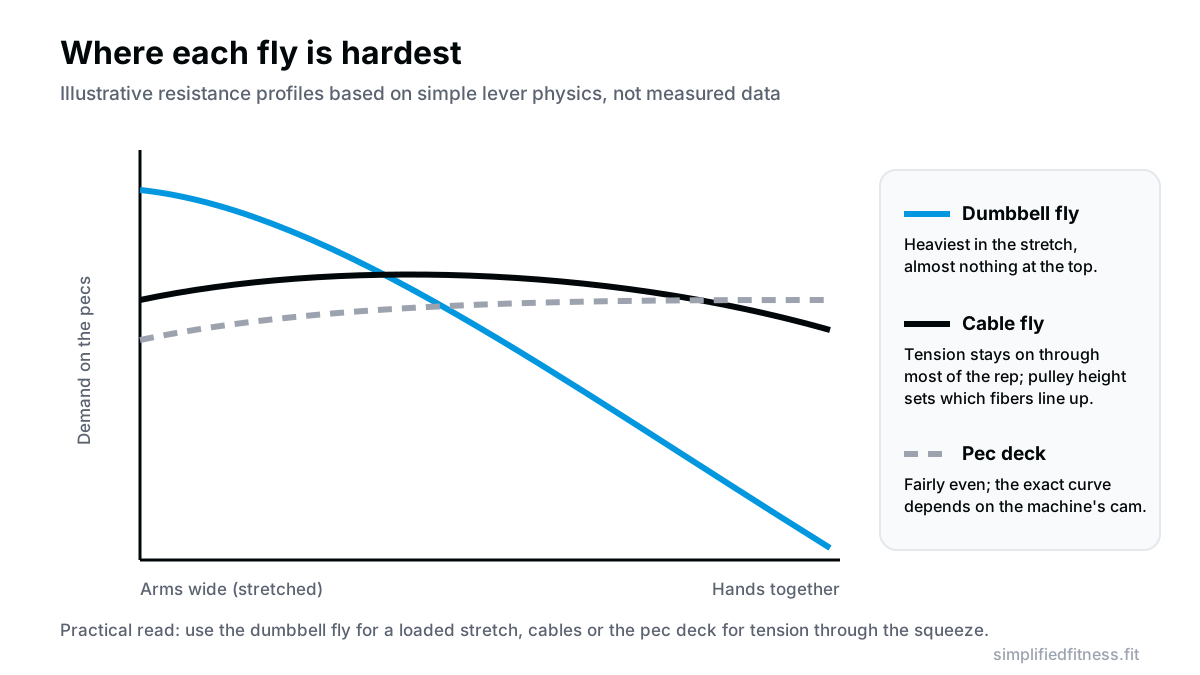
- Dumbbell fly: gravity pulls straight down, so the lever arm is longest when your arms are wide. Heaviest in the stretch, almost nothing at the top. Good for a loaded stretch; easy to overload the shoulder if you go too deep with heavy weights.
- Cable fly: the cable pulls along its own line, so tension stays on for more of the rep. Pulley height sets the angle. Low-to-high biases the upper chest; high-to-low biases the lower fibers.
- Pec deck: a fixed path and fairly even tension, though the exact curve depends on the machine’s cam. Very easy to take to failure safely.
That pec deck study from earlier also showed that untrained men grew both pec heads by 17-21% from the pec deck alone, with 1 set or 3 sets (Pinto et al., 2025). In beginners, the humble machine fly is not just a finisher.
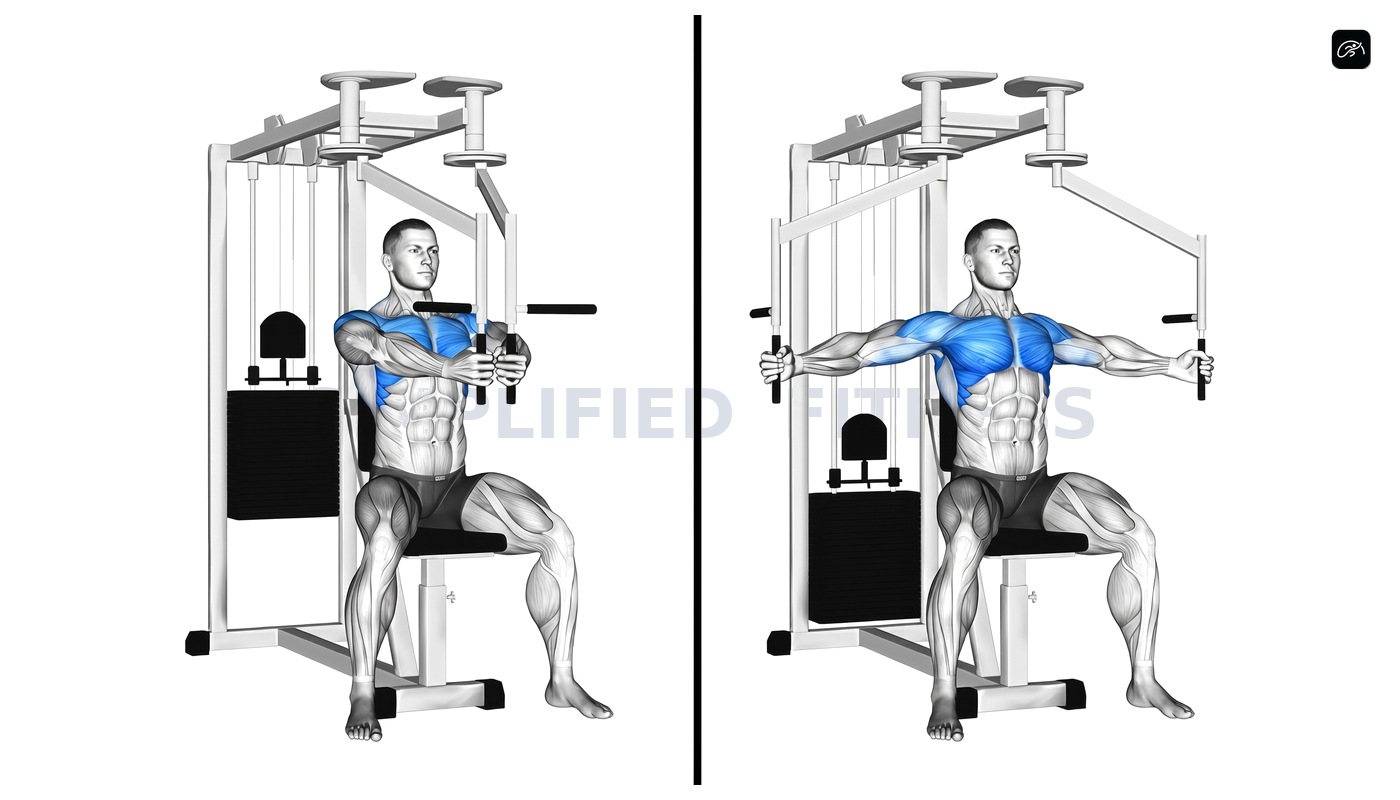
Full comparisons live in chest flyes: dumbbells vs cables vs pec deck, with setup details in cable crossover vectors and angles and pec deck setup and cues.
Chest press machines: are they as good as free weights?
For growth, yes, as far as current evidence shows. The 2023 meta-analysis above found no hypertrophy difference between machine and free-weight training (Haugen et al., 2023).
One detail from the bodybuilder EMG study: the machine chest press produced sternocostal activity similar to the flat bench but lower clavicular activity than the free-weight presses, and less triceps and side delt activity because the machine removes the balancing demand (Coratella et al., 2020). So a flat machine press is a mid-chest movement. If you want upper chest from a machine, use an incline version.
Converging machines, where the handles move toward each other as you press, add a bit of horizontal adduction at the top. Whether that grows more muscle has not been tested directly. We cover the mechanics in converging chest press machines and the plate vs stack debate in plate-loaded vs pin-loaded chest machines.
Push-ups: a real chest exercise, not a warm-up
Push-ups get dismissed once people join a gym. They should not be.
An 8-week trial took 18 young men and had half bench press at 40% of 1RM while the other half did push-ups adjusted (for example, kneeling) to match that load, twice a week. Both groups grew their pecs and triceps by similar amounts and improved bench 1RM similarly (Kikuchi and Nakazato, 2017). It was a small study in 9 young men per group at a light load, so it does not show push-ups match heavy benching in experienced lifters. It does show the movement itself is a legitimate chest builder.
That matters if you train at home, travel a lot, or your gym’s only flat bench has a queue every Monday. A simple progression:
- Incline push-ups (hands on a table or kitchen counter)
- Standard push-ups
- Deficit push-ups (hands on books or handles for a deeper stretch)
- Feet-elevated push-ups (biases the upper chest)
- Backpack or weighted-vest push-ups (a school bag with a few kg of rice or dal packets works)
- Ring or suspension push-ups
Move up a level once you can do about 20-30 controlled reps. See push-up progressions for chest hypertrophy for sets, reps and tempo, and floor press for hypertrophy and shoulder rehab for another short-range option.
Serratus anterior: the forgotten piece of pressing
The serratus anterior pulls your shoulder blade forward and around the rib cage, and keeps it flat against your back. When it is weak, the shoulder blade can “wing” and the upper traps tend to take over.
A meta-analysis of 19 studies (356 participants) found the standard push-up plus, a push-up where you push your shoulder blades apart at the top, produced high serratus activity. Serratus activity was higher and upper trap activity lower when it was done on a stable surface, with elbows fully straight, hands shoulder-width apart and the shoulders flexed to 110-120 degrees. Doing it on an unstable surface raised upper trap activity (Kang et al., 2019).
So skip the wobble board. Two or three sets of push-up plus on the floor, at the end of chest day, is enough for most people. More in our serratus anterior anatomy and exercise guide.
Shoulder-safe bench pressing: setup cues backed by data
Shoulder pain is the main reason lifters stop benching. The bench press itself is not the villain, but a few setup details change how much load your shoulder joints take.
A 2024 study had 10 experienced strength athletes perform 21 variations of the bench press and used a musculoskeletal computer model to estimate shoulder loads. Grips narrower than about 1.5 times shoulder width reduced compression at the AC joint (where collarbone meets shoulder blade). Retracting the shoulder blades, along with that narrower grip, reduced the backward shear force on the shoulder joint and the demand on the rotator cuff. How hard each lifter pushed the bar outward or inward also changed shoulder loads a lot, and it varied widely between people (Noteboom et al., 2024).
This is a modelling study in a small group, not an injury trial, so read it as “lower estimated stress”, not “proven to prevent injury”. It does line up with what tends to help in practice.
Grip width itself does not change pec activity much. In competitive bench athletes, narrow, medium and wide grips produced no significant pec EMG differences, while medium and wide grips allowed 5.8-11.1% heavier 6RM loads than a narrow grip (Saeterbakken et al., 2017). A medium grip gets you most of the load with less shoulder stress.
Your setup checklist:
- Grip: start a little inside 1.5 times shoulder width and move in further if your shoulders complain. Note that the knurl rings on an Olympic bar sit wider than this for most people, so do not use them as your default mark.
- Shoulder blades: pull them back and down before you unrack, and keep them pinned.
- Arch: a moderate arch keeps your shoulders set. A maximal powerlifting arch is a strength tool; see bench press arch: powerlifting vs bodybuilding.
- Bar path: touch around the lower chest or sternum, not the neck.
- Elbows: slightly tucked rather than flared straight out to the sides.
- Depth: controlled touch, no bounce.
For pain that already exists, read shoulder pain on bench press: biomechanical fixes and the grip details in bench press grip width. Our broader joint-friendly lifting guide covers the rest of the body.
When to see a doctor
Pec tears are uncommon, but in lifters they are often linked to heavy pressing, when the muscle is stretched under load. See a doctor promptly if you feel a pop or tearing sensation during a press, followed by bruising on the chest or upper arm, sudden weakness pushing, or a change in the shape of the fold at the front of your armpit. Some of these injuries need surgery, and timing matters. The same goes for shoulder pain that wakes you at night, numbness or tingling down the arm, or pain that has not improved after two to three weeks of modified training. This article cannot diagnose anything.
How to program chest: sets, frequency and exercise order
The movement choices above matter less than doing hard sets consistently. A practical starting point:
- Volume: around 6-10 hard sets per week for chest to start, counted across presses, flys and dips. Volume research shows a graded dose-response, but beginners can grow on surprisingly little. In the pec deck study, 1 set grew the pecs as much as 3 sets over 12 weeks in 15 untrained men (Pinto et al., 2025). Add 2-3 sets when progress stalls, up to roughly 20 for advanced lifters. Our training volume and frequency guide covers the dose-response research, and the training volume calculator will total your weekly sets.
- Frequency: twice a week works well for most people.
- Effort: finish most sets with 0-3 reps in reserve.
- Order: heaviest compound press first, fly last.
Here is a sample week that fits into an upper-lower or push-pull-legs split:
| Day | Exercise | Sets x reps |
|---|---|---|
| Chest day A | Flat barbell bench press | 3 x 5-8 |
| Incline dumbbell press (30-45 degrees) | 3 x 8-12 | |
| Cable fly, mid height | 2 x 12-15 | |
| Chest day B | Incline machine or Smith press | 3 x 8-12 |
| Dips (forward lean) or decline press | 2 x 8-12 | |
| Pec deck | 2 x 12-15 | |
| Push-up plus | 2 x 10-15 |
That is 15 sets of chest work plus serratus, which is plenty for most intermediates. Beginners can drop one exercise from each day. If you want a ready-made plan, the free push day workout uses this structure, and the complete chest workout architecture guide explains how to adjust it. For where chest fits into your week, see workout splits and session architecture.
Front delts get a lot of work from all this pressing, especially inclines. Factor that in before adding front raises; the shoulder and delt training guide explains how. And if you want the principles behind choosing any exercise by its resistance profile and line of pull, read our exercise selection and biomechanics guide.
Two chest myths to drop
“You can train the inner chest.” You cannot isolate the inner edge of the pec. Each fiber runs from the sternum or collarbone to the arm tendon and shortens along its whole length. A fuller-looking inner chest comes from growing the whole muscle and, for many people, losing some fat. Squeezing your hands together harder does not change which part of a fiber contracts. We break this down in the inner chest myth.
“An uneven chest means you are doing something wrong.” Small left-right differences are normal. Rib cage shape, handedness and posture all play a role. Unilateral dumbbell and cable work can help balance effort. A sudden change in shape, especially after a pop, needs a doctor, not more curls. See uneven chest asymmetry fixes.
The most common chest training mistakes
- Only flat benching. It is a great lift, but the upper chest gets less work. Add one incline press.
- Treating EMG as proof of growth. “This exercise activates 40% more chest” is a statement about electrical signals, not muscle size.
- Ego-loading flys. Heavy dumbbell flys with bent elbows turn into a sloppy press and stress the front of the shoulder. Go lighter and own the stretch.
- Bouncing the bar. You lose the stretch tension and add shoulder stress.
- Piling on sets. Twenty-five sets on Monday is unlikely to beat 10-15 hard, well-spread sets across two days, and the last sets of a marathon session are usually junk.
- Ignoring food. Chest growth runs on the same rules as every other muscle. Enough protein (paneer, curd, dal, soya, eggs or chicken) and enough total calories matter more than any angle. Our muscle hypertrophy guide for natural lifters covers the rest.
The bottom line
The pec is a fan of fibers, and the direction you press decides which part works hardest. A moderate incline biases the upper chest; flat and decline pressing bias the mid and lower fibers; flys add volume with less triceps fatigue. Barbell, dumbbell and machine presses all build muscle. Set up with your shoulder blades back and a medium grip, keep the reps controlled, and train chest twice a week close to failure.
The research on regional growth is promising but still mostly from beginners. So keep the plan simple, track your numbers, and let consistent progressive overload do the work.
Go deeper: every guide in this topic
- Arching on the Bench Press: Powerlifting Spine Arch vs Bodybuilding Setup
- Bench Press Grip Width: Pec Activation, Triceps and Shoulder Clearance
- Cable Crossover Angles: High-to-Low vs Low-to-High vs Horizontal Fly
- Chest Dips: Forward Lean Angle, Scapular Position, and Shoulder Safety
- Dumbbell vs Cable vs Pec Deck Fly: Which Chest Fly Is Best?
- Complete Chest Workout Architecture: Weekly Set Volume, Exercise Pairings, and Progression
- Converging Chest Press Machines: Why the Pump Feels So Good and What Science Says
- Flat Barbell Bench Press for Hypertrophy: Setup, Muscle Activation, and Pec Limitations
- Floor Press: Triceps Overload, Reduced Shoulder Extension, and Pec Activation
- Incline Dumbbell Bench Press Angle: 15° vs 30° vs 45° Compared
- The Inner Chest Myth: Why You Cannot Isolate the Midline and What Builds Cleavage
- Lower Chest Workout: Do You Need Decline Bench or Are Dips and Cable Flys Enough?
- Pec Deck Machine Setup: Seat Height, Elbow Position and Safe Range
- Functional Anatomy of Pectoralis Major: Clavicular, Sternocostal, and Abdominal Heads
- Plate-Loaded vs Pin-Loaded Chest Machines: Which Actually Builds More Muscle?
- Push Ups for Chest Hypertrophy: Deficits, Weighted Vests and Elevation
- Serratus Anterior Exercises: Anatomy, Scapular Upward Rotation and the Boxer's Muscle
- Shoulder Pain During Bench Pressing: Biomechanical Root Causes and Grip Adjustments
- Uneven Chest Fix: Unilateral Dumbbell and Single-Arm Cable Pressing
- Upper Chest Workout: Best Bench Angle, Elbow Path and Exercises for the Clavicular Pec
Frequently Asked Questions
What is the best chest workout for muscle growth?
The best chest workout for growth combines a horizontal press, an incline press and a fly, each taken close to failure over a full range of motion. Research shows flat and incline pressing bias different regions of the pectoralis major, while flys add tension in the stretched position with less triceps involvement. Start with 2-3 hard sets of each per week and add sets only when progress stalls.
How many heads does the chest have?
The pectoralis major has two recognised heads: a clavicular head attached to the collarbone and a larger sternocostal head attached to the sternum and ribs. Cadaver work by Fung and colleagues found the sternal head is made of 6-7 segments, with the lowest segment folding forward under its neighbour. In practice, train the upper chest with incline work and the mid and lower chest with flat, decline or dip-style pressing.
What angle should an incline bench be for upper chest?
A moderate incline of roughly 30-45 degrees is a sensible default for the upper chest. In an EMG study by Trebs and colleagues, clavicular head activity was higher at 44 and 56 degrees than flat, but front delt activity also rose at every incline and sternal activity fell. Set the bench at the lowest angle where you feel the upper chest working, which for most people is the second or third notch.
Is the bench press or dumbbell press better for chest?
Neither is clearly better for chest growth; both work well when trained hard. A 2023 meta-analysis found no difference in hypertrophy between free-weight and machine training, and dumbbells and barbells differ mainly in range of motion, stability and how easy they are to load in small jumps. Use the barbell if you want simple progression and the dumbbells if they let you press deeper without shoulder pain.
Do push-ups build chest muscle?
Yes, push-ups can build chest muscle when they are hard enough. In an 8-week study of 18 young men, push-ups adjusted to match 40% of bench press 1RM produced the same pec thickness and strength gains as bench pressing at that load. Once you can do more than about 30 clean reps, make them harder with a weighted vest, deficit handles or slower lowering.
Can you build your upper chest with flat bench only?
Flat bench does train the upper chest, but less than an incline press does. EMG and ultrasound studies show the flat bench concentrates activity in the sternocostal head, and one 8-week trial found the incline group grew more at the upper pec site. If upper chest size is a priority, include at least one incline press each week.
Is there such a thing as inner chest?
There is no separate inner chest muscle you can isolate. Each fiber of the pectoralis major runs from the sternum or collarbone to one tendon on the upper arm, so the whole length of a fiber contracts together. A fuller inner chest comes from growing the whole muscle and, for many people, dropping body fat.
Are chest flys necessary for growth?
Chest flys are not strictly necessary, but they are a useful addition to pressing. A 2020 study in trained men found the barbell bench press produced higher pec EMG than dumbbell flys, so presses should stay the foundation. Add 2-4 sets of flys per week for extra chest volume with less triceps and elbow fatigue.
Cable fly or dumbbell fly: which is better?
Both work, and they load the chest differently. A dumbbell fly is hardest when the arms are wide and almost weightless at the top, while a cable fly keeps tension on through more of the rep, and pulley height changes which fibers line up with the pull. Use dumbbells for a loaded stretch and cables when you want tension through the squeeze.
Are dips good for chest?
Dips can be a strong chest exercise, especially for the lower fibers, when done with a forward lean and controlled depth. An EMG study of experienced men found bar and ring dips produced higher peak muscle activity than bench dips, while bench dips required more shoulder extension. If dips cause pain at the front of the shoulder, shorten the bottom range or switch to a decline press.
How many sets per week for chest?
Most lifters grow well starting at roughly 6-10 hard sets per week for chest, counted across presses, flys and dips, with advanced lifters sometimes needing more. Volume research shows a graded dose-response, but a 12-week pec deck study in untrained men found 1 set and 3 sets produced similar growth, so beginners need less than they think. Start in that range, track performance and add 2-3 sets only when progress stalls.
How often should I train chest?
Training chest twice per week is a practical default for most lifters. Splitting weekly volume over two sessions keeps each workout shorter and the quality of the later sets higher. A push-pull-legs or upper-lower split naturally gives you two chest exposures a week.
Why do I feel bench press in my shoulders more than my chest?
Feeling the bench mostly in your shoulders often comes from flared elbows, a wide grip, or shoulders rolling forward off the bench. A 2024 modelling study found that pinning the shoulder blades back and keeping grip width under about 1.5 times shoulder width reduced loads on the shoulder joint. Set your shoulder blades before unracking, tuck the elbows slightly and touch the bar lower on the chest.
What grip width is best for bench press?
A medium grip, roughly 1-1.5 times your shoulder width, suits most lifters. In competitive bench athletes, medium and wide grips allowed 5.8-11.1% heavier 6RM loads than a narrow grip with no significant difference in pec activity, while a separate study found grips under 1.5 times shoulder width reduced compression at the AC joint. Start a little inside 1.5 times shoulder width and move in a finger or two if the front of your shoulder complains.
Should I arch on bench press for chest growth?
A moderate arch with the shoulder blades pulled back is fine and helps keep the shoulders in a stable position. A big powerlifting arch shortens the range of motion, which helps you lift more weight but may reduce the stretch on the pecs. For hypertrophy, use enough arch to keep your shoulders set and your lower back comfortable, not the maximum you can manage.
Is the decline bench press worth doing?
The decline press is optional rather than essential. In competitive bodybuilders, sternocostal head activity was similar between flat and decline pressing, while the decline press reduced front delt involvement. Use it if it feels better on your shoulders than the flat bench, or swap in dips for the same lower-chest direction.
Are chest press machines as good as free weights?
Yes, for muscle growth chest press machines appear to be about as effective as free weights. A 2023 meta-analysis found no difference in hypertrophy between free-weight and machine training, although only five of its 13 studies measured muscle size, and strength gains tended to favour whichever equipment people trained on. Machines are a great choice when you want to push close to failure safely without a spotter.
What does the serratus anterior have to do with chest training?
The serratus anterior holds your shoulder blade against the rib cage and helps it move smoothly when you press. A meta-analysis of 19 push-up plus studies found the standard push-up plus produced high serratus activity, highest on a stable surface with the elbows straight and hands shoulder-width apart. Add 2-3 sets of push-up plus or protracted wall slides on chest days if your shoulder blades wing or your shoulders feel unstable.
Why is one side of my chest bigger than the other?
Small differences between the left and right pec are normal and often reflect handedness, posture or rib cage shape. Barbell pressing lets the stronger side do more of the work, so unilateral dumbbell or cable work can help even out effort. See a doctor if the asymmetry appeared suddenly, came with a pop, bruising or a visible change in the armpit fold.
How do I know if I tore my pec?
You cannot diagnose a pec tear yourself, but a sudden pop or tearing feeling during a heavy press, followed by bruising, weakness and a change in the shape of the armpit fold, are warning signs. In lifters these injuries are often linked to heavy pressing, when the muscle is stretched under load. Stop training that side and see a doctor or orthopaedic specialist quickly, because some ruptures need surgical repair.
Can I train chest at home with no equipment?
Yes, you can build a meaningful amount of chest muscle at home with push-up variations. An 8-week study found load-matched push-ups produced similar pec growth to bench pressing at the same relative load in young men. Progress from incline push-ups to standard, then deficit, feet-elevated and backpack-loaded push-ups as you get stronger.
How long does it take to see chest growth?
Measurable chest growth usually shows up on ultrasound within 8-12 weeks of consistent training in beginners. In a 12-week pec deck study, untrained men increased pec thickness by about 17-21% in both heads. Visible change takes longer in trained lifters, so track your pressing numbers and measurements monthly rather than looking in the mirror daily.
Sources & References
Every claim above is checked against peer-reviewed research (PubMed, U.S. National Library of Medicine) or guidance from established health bodies. How we fact-check.
- Fung L, et al. Three-dimensional study of pectoralis major muscle and tendon architecture. Clin Anat. 2009. PMID: 19291757
- Trebs AA, et al. An electromyography analysis of 3 muscles surrounding the shoulder joint during the performance of a chest press exercise at several angles. J Strength Cond Res. 2010. PMID: 20512064
- Cabral HV, et al. Non-uniform excitation of the pectoralis major muscle during flat and inclined bench press exercises. Scand J Med Sci Sports. 2022. PMID: 34644424
- Albarello JCDS, et al. Non-uniform excitation of pectoralis major induced by changes in bench press inclination leads to uneven variations in the cross-sectional area measured by panoramic ultrasonography. J Electromyogr Kinesiol. 2022. PMID: 36334406
- Chaves SFN, et al. Effects of Horizontal and Incline Bench Press on Neuromuscular Adaptations in Untrained Young Men. Int J Exerc Sci. 2020. PMID: 32922646
- Coratella G, et al. Specific prime movers' excitation during free-weight bench press variations and chest press machine in competitive bodybuilders. Eur J Sport Sci. 2020. PMID: 31397215
- Saeterbakken AH, et al. The Effects of Bench Press Variations in Competitive Athletes on Muscle Activity and Performance. J Hum Kinet. 2017. PMID: 28713459
- Pinto MD, et al. Pectoralis Clavicular and Sternocostal Thicknesses Increase Similarly in Response to One and Three Sets of Pec Deck Resistance Training in Untrained Young Men. J Strength Cond Res. 2025. PMID: 40266636
- Solstad TE, et al. A Comparison of Muscle Activation between Barbell Bench Press and Dumbbell Flyes in Resistance-Trained Males. J Sports Sci Med. 2020. PMID: 33239937
- Haugen ME, et al. Effect of free-weight vs. machine-based strength training on maximal strength, hypertrophy and jump performance: a systematic review and meta-analysis. BMC Sports Sci Med Rehabil. 2023. PMID: 37582807
- Kikuchi N, et al. Low-load bench press and push-up induce similar muscle hypertrophy and strength gain. J Exerc Sci Fit. 2017. PMID: 29541130
- McKenzie A, et al. Bench, Bar, and Ring Dips: Do Kinematics and Muscle Activity Differ? Int J Environ Res Public Health. 2022. PMID: 36293792
- Kang FJ, et al. Serratus Anterior and Upper Trapezius Electromyographic Analysis of the Push-Up Plus Exercise: A Systematic Review and Meta-Analysis. J Athl Train. 2019. PMID: 31584855
- Noteboom L, et al. Effects of bench press technique variations on musculoskeletal shoulder loads and potential injury risk. Front Physiol. 2024. PMID: 38974522
- Schoenfeld BJ, et al. Effects of range of motion on muscle development during resistance training interventions: A systematic review. SAGE Open Med. 2020. PMID: 32030125

Umair Hazrami · Founder & Head Coach, Simplified Fitness
Umair Hazrami founded Simplified Fitness and the Simplified Lifter channel to cut through fitness noise. With 4+ years of consistent training and 10+ coaching clients, he writes every guide from the peer-reviewed research and links the sources so you can check them. Our editorial standards.
Educational content only, not medical advice. If you have a medical condition, are pregnant, or take medication, talk to a qualified doctor before changing your diet, supplements or training. Full disclaimer.
Keep reading
Exercise Technique
3D Shoulder Protocol: Weekly Volume, Frequency (2-3x/Week) and Rep Ranges
How to build 3D shoulders: how many weekly sets, how often to train side and rear delts, and which rep ranges to use, with an 8-week plan and the research.
8 min read
Exercise Technique
Adductor Magnus Training: Seated Adductor Machine and Copenhagen Planks for Thigh Mass
Adductor magnus training explained: what research says on deep squats, the adductor machine and Copenhagen planks for thicker inner thighs and groin strength.
7 min read

Exercise Technique
Antagonist Arm Supersets: Biceps and Triceps Pairing for a Faster, Pumpier Arm Day
A biceps triceps superset workout can shorten arm day while keeping volume close to straight sets. See the research, pairing tips and a 20-minute routine.
9 min read

Exercise Technique
Are Front Raises Necessary? Why Bench Pressers Rarely Need Direct Front Delt Work
Are front raises necessary if you bench and overhead press? See what EMG and volume research says, when they can still help, and where to spend those sets.
8 min read