Serratus Anterior Exercises: Anatomy, Scapular Upward Rotation and the Boxer's Muscle
Serratus anterior exercises explained: what the boxer's muscle does, which moves light it up in the research, and how to train it for healthier shoulders.
TL;DR. The short answer
- The serratus anterior pulls the shoulder blade around the ribcage (protraction), helps rotate it upward when your arm goes overhead, and keeps its inner edge flat against the ribs.
- The push-up plus (a push-up with an extra push at the top) is the best-supported serratus exercise: a 2019 meta-analysis of 19 studies found it gives high serratus activity, especially on a stable surface with arms fully straight.
- Overhead movements that need a lot of upward rotation, like raising the arm in the scapular plane above 120 degrees, also fire the serratus strongly in the lab.
- Visible serratus 'fingers' along the ribs depend mostly on how lean you are, so training builds the muscle but leanness reveals it.
- Shoulder pain that lingers, or a shoulder blade that visibly lifts off the back, deserves a physio or doctor, not just more push-ups.
Part of our complete guide: The Complete Chest Workout Guide: Pec Anatomy, Bench Angles, Flys and Shoulder-Safe Pressing
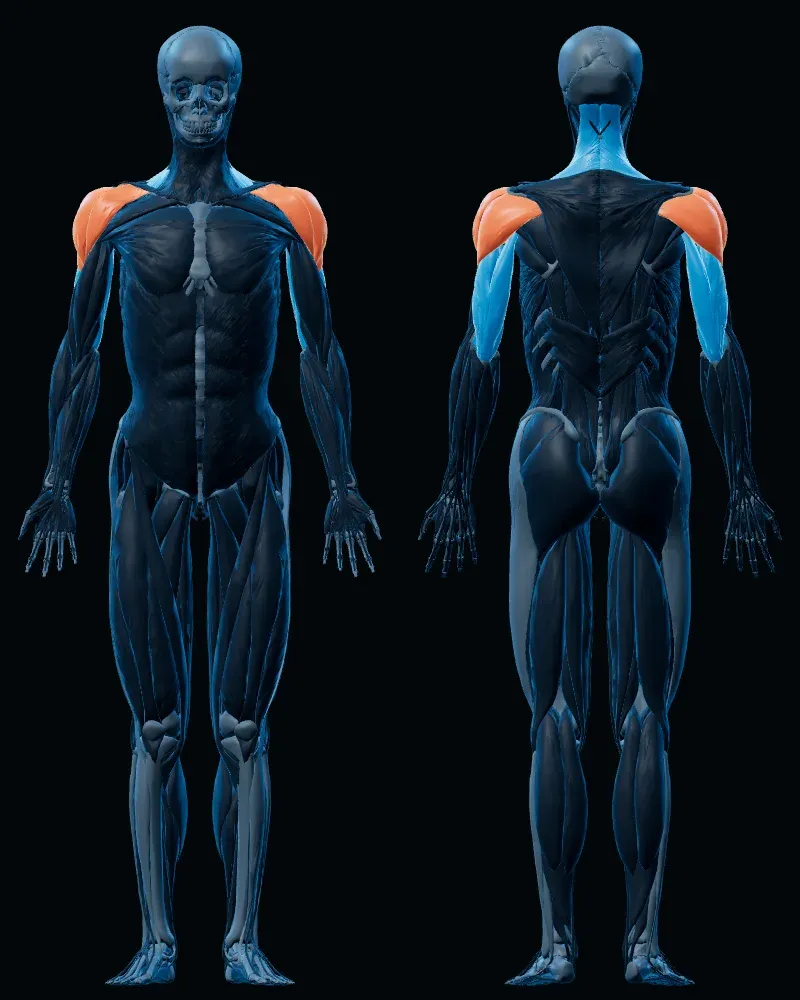
Muscles worked: shoulders
Main movers: all three heads of the deltoid
Assisting: supraspinatus, upper traps and triceps
Table of contents
The best serratus anterior exercises are the push-up plus and overhead movements that make your shoulder blade rotate upward, like raising your arm in the scapular plane above about 120 degrees. The serratus is the “boxer’s muscle” along the side of your ribs, and it matters more for shoulder health than for looks. Our complete chest training guide covers the pecs in depth.
Most chest training ignores the serratus completely. This article covers the muscle that moves and stabilises the shoulder blade underneath the pecs, so that your pressing has a stable base.
What does the serratus anterior actually do?
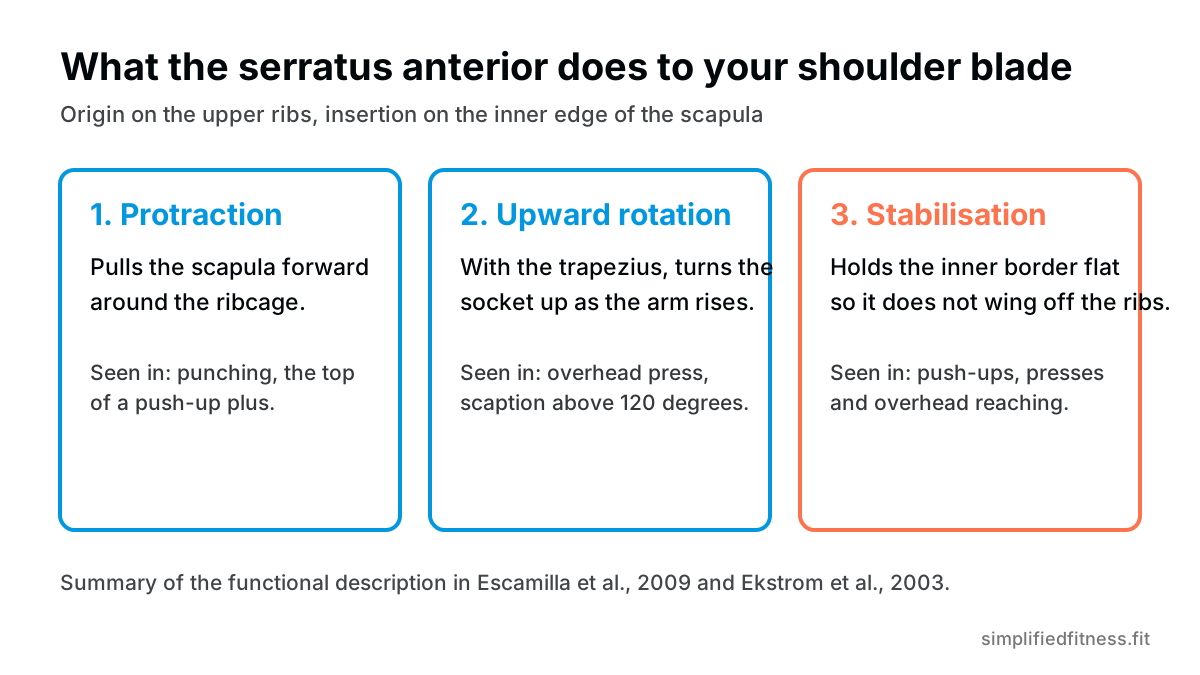
The serratus anterior starts on the outer surface of the upper eight or nine ribs and wraps around your ribcage to attach on the inner edge of the shoulder blade. Think of it as the muscle that glues the blade to your ribs while still letting it glide.
A 2009 review in Sports Medicine describes three jobs. It contributes to scapular upward rotation, posterior tilt and external rotation when the arm goes overhead. It also helps stabilise the medial border and lower tip of the scapula, preventing the internal rotation and forward tilt known as winging (Escamilla et al., 2009). The same review notes that if normal scapular movement is disrupted by weakness, fatigue or injury, the shoulder works less efficiently and injury risk goes up.
Scapular upward rotation in plain gym language
When you raise your arm overhead, your arm bone cannot do it alone. The shoulder blade has to rotate so the socket tilts upward and creates room. The 2003 Ekstrom study notes that the trapezius and serratus anterior are considered the only upward rotators of the scapula (Ekstrom et al., 2003).
If that rotation is poor, overhead presses feel pinchy and lateral raises get stuck around shoulder height. It is one reason the serratus shows up in any shoulder impingement solutions for lifters discussion.
What are the best serratus anterior exercises?
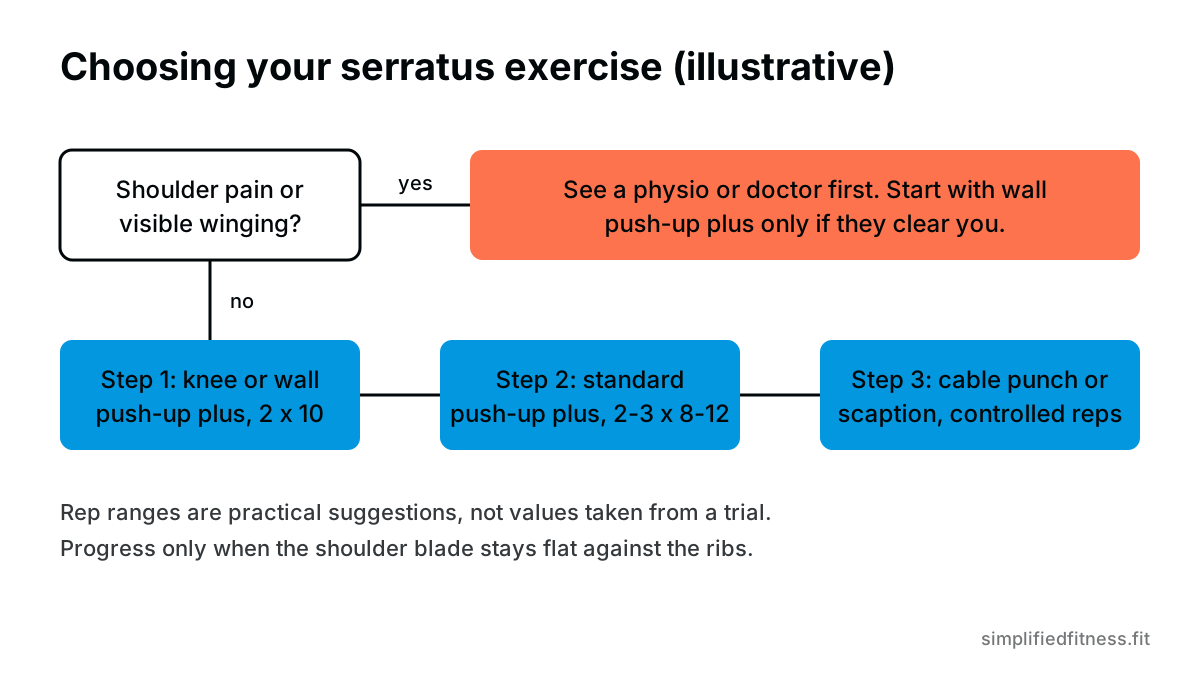
The best-supported exercise is the push-up plus. You do a normal push-up, then at the top keep pushing the floor away until your upper back rounds slightly and your shoulder blades spread apart.
A 2019 systematic review and meta-analysis of 19 studies (356 participants) concluded that the standard push-up plus elicits high serratus activity. Serratus activity was higher, and upper trapezius activity lower, on a stable surface with full elbow extension, hands shoulder-width apart, shoulder flexion of 110 or 120 degrees and the same-side leg lifted. An unstable surface increased upper trapezius activity by about 2.7% (Kang et al., 2019).
Overhead movements also work. In 30 healthy people, the serratus was maximally activated by exercises with a lot of scapular upward rotation: shoulder abduction in the plane of the scapula above 120 degrees, and a diagonal pattern combining flexion, horizontal flexion and external rotation (Ekstrom et al., 2003).
| Exercise | What the research says | Best for |
|---|---|---|
| Wall push-up plus | Lowest serratus activity of three push-up plus variations in a 2014 study | Beginners, rehab (with clinician approval) |
| Knee push-up plus | Middle of the three | Building control |
| Standard push-up plus | Highest serratus activity of the three | Most healthy lifters |
| Scaption above 120 degrees | Among maximal serratus activation in a 30-person study | Overhead strength and control |
| Forward punch, scapular “hug” | Listed with high scapular muscle activity in a 2009 review | Accessory work |
How hard is each push-up plus?
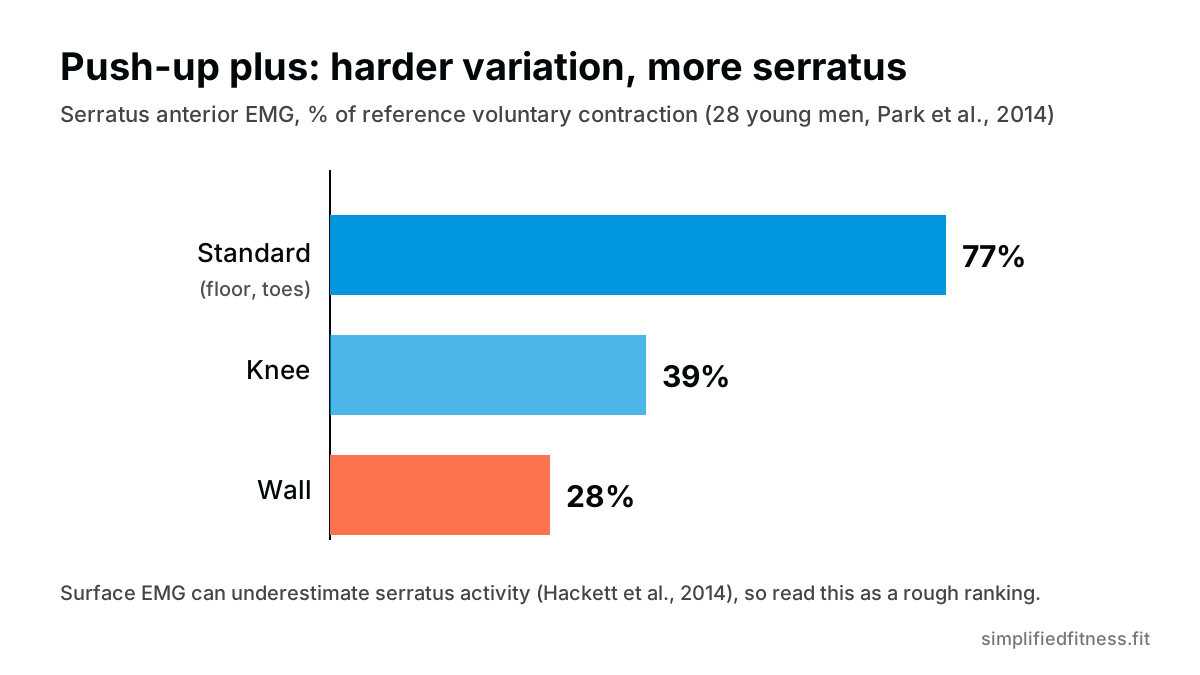
In a 2014 study of 28 men, serratus activity fell in this order across push-up plus variations: standard (about 77% of reference voluntary contraction), knee (about 39%) and wall (about 28%) (Park et al., 2014). That is a small sample of young men, and the values depend on the electrode caveat above.
How do you do serratus punches and overhead cable work?
A forward scapular punch appears alongside the push-up and the “dynamic hug” in the 2009 review as an exercise with high to very high activity from the rotator cuff, deltoids and scapular muscles (Escamilla et al., 2009). That supports cable or band serratus punches as a reasonable accessory. I could not find a trial that directly compares them with push-up plus for serratus growth, so do not expect them to beat it.
How to set one up:
- Stand side-on or facing away from a low-to-mid cable, handle in the hand nearest the stack.
- Brace your ribs down so your lower back does not arch.
- Punch forward and slightly up, and finish by reaching a little further with the shoulder blade, not by leaning.
- Return slowly until the blade is back, then repeat for 10-15 controlled reps.
The common mistake is turning it into a torso lean. If your hips or ribs are moving, the weight is too heavy.
Where do pullovers fit in?
A dumbbell or cable pullover finishes with the arms overhead, which in theory asks for scapular upward rotation. I could not confirm serratus activation for pullovers from EMG research, so treat that as a plausible bonus, not a proven benefit. Use them for what they are good at, covered in our dumbbell pullover tension curve analysis, and rely on push-up plus for deliberate serratus work.
Does the serratus matter for shoulder health?
It probably does, though the evidence is more about mechanisms than long-term injury prevention. A 2021 lab study of 30 participants fatigued the serratus and found reduced posterior scapular tilt during arm elevation, plus more internal rotation of the scapula at higher angles. These patterns are consistent with those seen in shoulder pain, and the authors suggest that serratus endurance may help delay these changes (Harrison et al., 2021). That was a short, immediate-effect study in a lab, not a trial of injury rates.
Here is a conflicting finding worth knowing. A randomized trial of 64 people with chronic shoulder pain compared scapular movement training with standard exercises for 8 weeks. Both groups improved pain and disability, and the scapular approach was not superior (Kamonseki et al., 2023). The authors concluded that clinicians should consider factors other than scapular movement.
Why might the studies differ? One shows that fatigue changes how the blade moves, the other shows that fixing blade movement is not the only route to feeling better. A cautious takeaway: train the serratus as one part of a balanced shoulder plan, alongside the rotator cuff and shoulder health work, not as a cure for shoulder pain.
Why do I have a winged scapula?
Winging means the inner edge of the shoulder blade lifts off the ribcage. A weak or poorly timed serratus is one possible cause. In a 2014 study, men with scapular winging had lower serratus activity and higher pectoralis major activity than controls (about 40% versus 56% for the serratus, and about 79% versus 40% for the pec) during push-up plus exercises (Park et al., 2014). In that group, the standard push-up plus gave the best serratus-to-pec balance.
That is a small study of 13 men with winging, and it does not tell us how to fix it. Winging can also come from injury to the long thoracic nerve, which supplies the serratus and needs medical assessment rather than more exercise.
Can I get visible serratus muscles?
Partly. Training makes the muscle bigger and more active, but whether you can see “fingers” along your ribs depends mostly on body fat and genetics. You cannot burn fat from your ribs by training them.
If your goal is aesthetics, build the muscle with 2-3 sessions a week of the exercises above, eat enough protein (dal, paneer, curd, eggs, soya or chicken all work), and get lean with a steady, modest deficit. Our body fat calculator gives a rough estimate to track against. For the full picture of how leanness changes the look of the torso, see our guide to optimal body fat ranges.
A simple serratus routine you can add to push day
Add it at the end of a pressing session or on a pull day when your shoulders are warm. A basic template:
- Push-up plus: 2-3 sets of 8-12 slow reps (use knees or a wall if you cannot keep the blades moving).
- Scaption or cable overhead reach: 2 sets of 10-12 with a light load, going only as high as you can without shrugging.
- Serratus punch (cable or band): 2 sets of 10-15 per side.
These rep ranges are practical suggestions rather than values from a serratus trial. Run it twice a week, and slot it into your push day as a finisher. If you already train push-ups, our push-up progression guide shows how to make them harder without losing form.
The bottom line
The serratus anterior is a small muscle with a big job: it moves your shoulder blade and keeps it steady. The push-up plus is the best-supported way to train it, and overhead movements that demand upward rotation add to the picture.
The research here is mostly short lab EMG studies in healthy, fairly young participants, and surface EMG can underestimate this particular muscle. So hold the details lightly, train the basics consistently, and let leanness do the work of making it visible. Two weekly sessions of push-up plus is a sensible place to start.
Frequently Asked Questions
What are the best serratus anterior exercises?
The push-up plus is the most researched option, followed by overhead movements that demand scapular upward rotation, such as scaption above about 120 degrees. A 2019 meta-analysis of 19 studies found the standard push-up plus produces high serratus activity, and Ekstrom's 2003 study found scaption above 120 degrees among the highest. Start with push-up plus for 2-3 sets of 8-12 and add a controlled overhead movement once the basics feel smooth.
What does the serratus anterior do?
It pulls the shoulder blade forward around the ribcage (protraction), helps rotate it upward as the arm rises, and holds the inner edge of the blade against the ribs. A 2009 review in Sports Medicine describes it as contributing to scapular upward rotation, posterior tilt and external rotation, and preventing winging. In the gym, that matters most for push-ups, overhead work and punching-type movements.
Why is it called the boxer's muscle?
Because throwing a straight punch ends with the shoulder blade sliding forward around the ribs, which is protraction, the serratus anterior's main job. The nickname is common in coaching rather than a formal anatomical term. The same action happens at the top of a push-up plus, so you can train it without gloves.
How do I get visible serratus muscles?
Build the muscle with push-up plus and overhead work, then get lean enough for it to show. Visibility depends heavily on body fat and individual genetics, and there is no spot-reduction route along your ribs. Use the body fat calculator for a rough estimate and focus on a modest, steady calorie deficit if you are cutting.
Are serratus punches effective?
A forward scapular punch is listed among exercises with high activity from the rotator cuff, deltoids and scapular muscles in a 2009 review, so it is a reasonable choice. I could not find a trial that directly ranks cable punches against push-up plus for serratus size. Treat them as a useful accessory and keep the shoulder blade moving, not the torso.
What is scapular upward rotation?
It is the shoulder blade turning so the socket faces more upward, which gives your arm room to go overhead. Ekstrom and colleagues describe the trapezius and serratus anterior as the main upward rotators. If this motion is limited, overhead pressing tends to feel pinchy or stuck.
What causes a winged scapula?
Causes range from a weak or poorly controlled serratus anterior to injury of the long thoracic nerve that supplies it. The serratus normally prevents the inner border from lifting off the ribs, per the 2009 Sports Medicine review. If a blade visibly lifts, especially after an injury, see a doctor or physiotherapist rather than self-diagnosing.
Can pullovers train the serratus anterior?
Possibly, but I did not find EMG research that confirms it for pullovers specifically. Mechanically, a pullover ends with the arm overhead, which asks for scapular upward rotation. Use pullovers for your lats and chest, and rely on push-up plus for deliberate serratus work.
How many times a week should I train serratus anterior?
There is no trial-based serratus-specific dose, so use general training logic: 2-3 sessions a week of a few controlled sets fits easily around push and pull days. Fatigue matters here: a 2021 study found that fatiguing it changed shoulder blade movement. Keep sets crisp and stop when the blade starts to wing or sag.
Do push-ups work the serratus anterior?
A regular push-up uses it, but the 'plus' at the end, pushing the upper back away from the floor, is what emphasises it. In a 2014 study of 28 men, serratus activity was highest in the standard push-up plus compared with knee and wall versions. Finish every rep by pushing the floor away until your shoulder blades spread.
Can I do serratus work if my shoulder hurts?
Pain changes the question. Gentle exercises like wall push-up plus are often used in rehab, but only a clinician can tell you whether they suit your problem. If pain is sharp, worsening, or comes with weakness or numbness, get assessed before training through it.
Is the serratus anterior the same as abs?
No. The serratus anterior sits on the side of the ribcage and attaches to the shoulder blade, while the abdominals run down the front of the torso. They sit next to each other visually, which is why a lean midsection can show both. They are trained very differently.
Do I need serratus-specific exercises if I already bench and press?
Many lifters get decent serratus work from pressing and pull-ups, but it is hard to know how much. In a 2007 EMG study of 45 healthy people, none of 12 common scapular exercises met the authors' criteria for a low upper trapezius to serratus ratio, so general shoulder work does not reliably target it. Adding two or three sets of push-up plus is cheap insurance if your shoulder blades feel unstable.
Sources & References
Every claim above is checked against peer-reviewed research (PubMed, U.S. National Library of Medicine) or guidance from established health bodies. How we fact-check.
- Escamilla RF, et al. Shoulder muscle activity and function in common shoulder rehabilitation exercises. Sports Med. 2009. PMID: 19769415
- Ekstrom RA, et al. Surface electromyographic analysis of exercises for the trapezius and serratus anterior muscles. J Orthop Sports Phys Ther. 2003. PMID: 12774999
- Kang FJ, et al. Serratus anterior and upper trapezius electromyographic analysis of the push-up plus exercise: a systematic review and meta-analysis. J Athl Train. 2019. PMID: 31584855
- Park KM, et al. Comparison of pectoralis major and serratus anterior muscle activities during different push-up plus exercises in subjects with and without scapular winging. J Strength Cond Res. 2014. PMID: 24618724
- Hackett L, et al. Assessing the validity of surface electromyography for recording muscle activation patterns from serratus anterior. J Electromyogr Kinesiol. 2014. PMID: 24534053
- Harrison N, et al. Serratus anterior fatigue reduces scapular posterior tilt and external rotation during arm elevation. J Sport Rehabil. 2021. PMID: 34294607
- Cools AM, et al. Rehabilitation of scapular muscle balance: which exercises to prescribe? Am J Sports Med. 2007. PMID: 17606671
- Kamonseki DH, et al. Scapular movement training is not superior to standardized exercises in the treatment of individuals with chronic shoulder pain and scapular dyskinesis: randomized controlled trial. Disabil Rehabil. 2023. PMID: 36000960

Umair Hazrami · Founder & Head Coach, Simplified Fitness
Umair Hazrami founded Simplified Fitness and the Simplified Lifter channel to cut through fitness noise. With 4+ years of consistent training and 10+ coaching clients, he writes every guide from the peer-reviewed research and links the sources so you can check them. Our editorial standards.
Educational content only, not medical advice. If you have a medical condition, are pregnant, or take medication, talk to a qualified doctor before changing your diet, supplements or training. Full disclaimer.
Keep reading
Exercise Technique
Arching on the Bench Press: Powerlifting Spine Arch vs Bodybuilding Setup
Is a bench press arch cheating or dangerous for your back? Learn the difference between a powerlifting arch and a natural upper back setup, with study data.
8 min read
Exercise Technique
Bench Press Grip Width: Pec Activation, Triceps and Shoulder Clearance
Bench press grip width changes triceps load, shoulder stress and little else for your pecs. See what EMG and joint-load studies show and how to pick your grip.
7 min read
Exercise Technique
Cable Crossover Angles: High-to-Low vs Low-to-High vs Horizontal Fly
Cable crossover angles explained: what high-to-low, low-to-high and horizontal flys likely train, what the research really says, and how to set each one up.
9 min read
Exercise Technique
Chest Dips: Forward Lean Angle, Scapular Position, and Shoulder Safety
Chest dips can build your chest if you lean, set your shoulders and stop at a depth that suits you. See what the research says and how to dip safely.
8 min read