Joint-Friendly Lifting & Fitness Myths: A Guide for Over-40s, Teens and Sore Backs
Lifting after 40, joint friendly: how to train around back, knee and shoulder pain, keep teens safe, and which fitness myths the research really busts.
TL;DR. The short answer
- Lifting after 40 is not hard on your joints by default. A Cochrane review of 121 trials (6,700 older adults) found progressive resistance training improves strength and function, and no serious adverse events were directly linked to the exercise itself.
- For lower back pain, staying active beats resting. A Cochrane review of 249 trials found exercise reduces chronic low back pain more than no treatment, and a 2021 meta-analysis favoured 12-16 weeks of posterior-chain strength work over general exercise.
- Supervised, well-coached resistance training is considered safe and worthwhile for children and teenagers by pediatric and strength-and-conditioning bodies. The fear that lifting stunts growth is not supported by that literature.
- Spot reduction is mostly a myth. MRI data from a 104-person arm-training study showed generalised fat loss, though one small 2023 trial in men hints at a modest local effect.
- Light weights do not 'tone' and heavy weights do not 'bulk'. In trained men, lifting 20-25 reps or 8-12 reps to failure gave similar muscle growth over 12 weeks.
Table of contents
Lifting after 40 does not have to be hard on your joints. Research on older adults shows that progressive resistance training improves strength and function, and that serious problems directly caused by the exercise are rare. The trick is choosing exercises, loads and ranges your body tolerates today, then building from there.
That same logic applies to sore backs, cranky knees, teenagers who want to start training and the myths that scare people away from the gym. This guide is the one place to cover all of it: how to train joint friendly at any age, what the evidence says about back pain and youth lifting, and which classic bro-science beliefs fall apart when you read the studies. If you want to pair it with the mechanics of picking movements, see our exercise selection and biomechanics guide.
A quick note before we start. I am not a doctor, and this is not a diagnosis. Where pain is involved, I will tell you when to get it checked.
Is lifting after 40 safe for your joints?
Yes, for most people, with sensible progression. The strongest evidence comes from a Cochrane review of 121 trials with 6,700 participants. Progressive resistance training had a large effect on muscle strength (SMD 0.84) and a moderate to large effect on getting out of a chair (SMD -0.94), plus a small improvement in gait speed of 0.08 m/s (Liu & Latham, 2009).
Two honest caveats. First, adverse events were poorly recorded, and the reviewers urged caution when applying results to clinical groups. Second, musculoskeletal complaints such as joint pain and muscle soreness were reported in many of the studies that tracked them. Serious events were rare, though, and none were directly attributed to the exercise program.
Those participants were older adults, mostly well past 40, so treat it as supporting evidence, not a perfect match for a 42-year-old with a desk job. The message holds: lifting is not the threat. Doing too much, too soon, with sloppy technique is.
What changes after 40
Here is what I would actually plan around:
- Recovery takes a bit longer. You can still train hard, but two heavy lower-body days back to back may sting more than they used to.
- Warm-ups earn their keep. Five to ten minutes of easy movement and two ramp-up sets before your first working set is cheap insurance.
- Joint-friendly loads still work. More on that below.
- Old injuries matter. A shoulder that was fine at 25 may need a neutral-grip press at 45.
Do you need to lift heavy?
Not necessarily. A meta-analysis of 15 studies (448 older adults, mean age 67.8) found that heavier loads (around 80% of 1RM) tended to produce somewhat larger strength gains than light to moderate loads (around 45% of 1RM), though the overall difference was not statistically significant, and only marginally larger gains in muscle size. When training was matched for mechanical work, the difference shrank. The authors concluded that, provided enough repetitions are performed, lighter-than-traditional loads may be enough to build substantial strength in older groups (Csapo & Alegre, 2016).
That is a study in people with a mean age near 68, so it does not map neatly onto 42-year-olds. Still, it fits what we see in younger trained lifters (more on that in the toning section). If heavy sets bother your joints, 10-20 controlled reps taken close to hard effort is a legitimate alternative. Our load, rep ranges and RIR guide explains how to judge effort, and the RIR and RPE calculator helps you translate a set into a number.
Bones and the other upside
A 2022 meta-analysis of 14 randomized trials in adults aged 65 and over found that progressive resistance training increased muscle strength and femur or hip bone mineral density (about 2.77% on average), but not lumbar spine density. Certainty was higher for strength than for bone, and heterogeneity was high (O’Bryan et al., 2022). So lifting is a good bet for your skeleton, but do not treat it as an osteoporosis treatment. If you have osteopenia or osteoporosis, ask your doctor which spinal loading is appropriate before going heavy.
For a full age-based breakdown, read our guide to resistance training over 40, 50 and 60.
How do you train around joint pain?
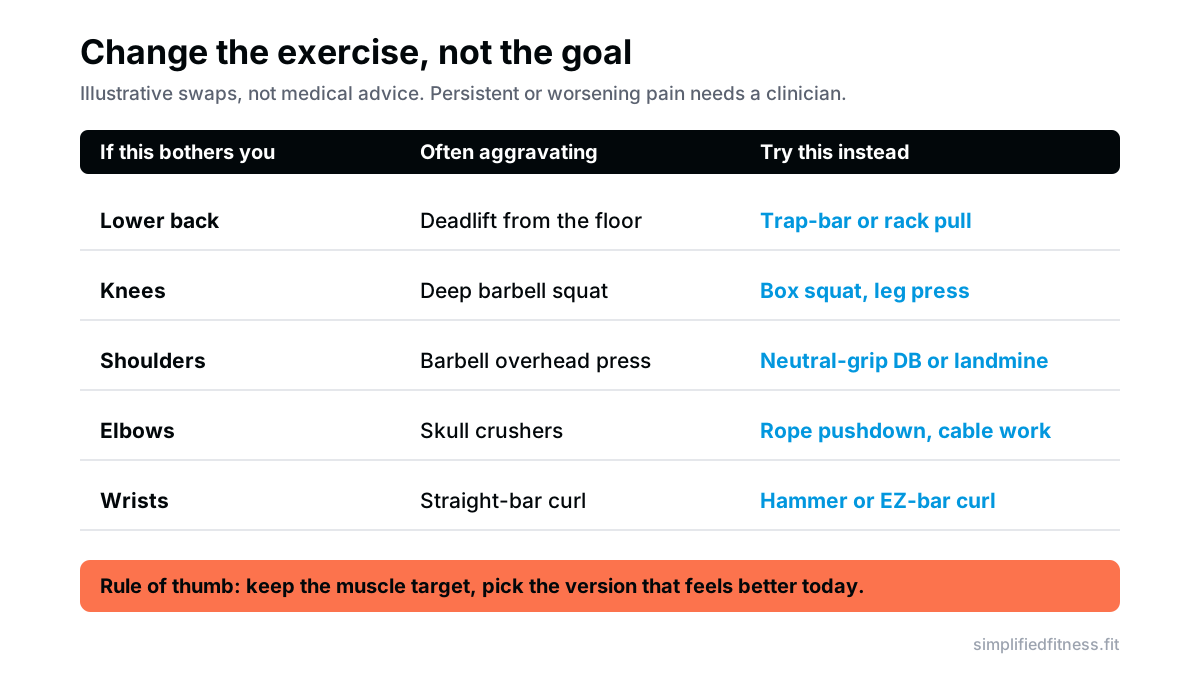
Here is the framework I use. It is not a research protocol, just practical coaching logic: keep the muscle target, change the variable that irritates the joint.
- Change the load. Drop to a weight you can control for 10-15 reps.
- Change the range. Stop short of the position that pinches. Many people find a box squat, a landmine press or a partial range comfortable even when the full version is not.
- Change the angle or grip. A neutral-grip dumbbell press often feels better on the shoulder than a straight-bar press.
- Change the exercise. Same muscle, different tool.
- Change the tempo. Slow the lowering phase and kill momentum.
We go deeper on each joint in separate guides: knee pain leg workout modifications, shoulder pain bench press alternatives, elbow tendinopathy and lifting and our joint-friendly hypertrophy overview. If you are coming back after an injury, the return-to-gym traffic-light model lays out a gradual way back, and the idea that tendons adapt on a different clock than muscle is covered in connective tissue adaptation.
Are squats bad for your knees?
Squats load the knee. That is the point. The question is whether that load is harmful. A 2022 systematic review of 37 studies concluded that all squat variations can create tension overload around the knee and may cause or worsen kneecap pain, particularly with knee flexion between 60 and 90 degrees. It listed forward knee travel past the toes and imbalance between thigh muscles as the main factors tied to patellofemoral pain syndrome (PFPS), but noted that studies used different measures and mostly involved sports populations (Pereira et al., 2022).
Read that carefully. It mainly tells you where stress concentrates and what tends to aggravate an already irritated knee. It is not proof that sensible squatting wrecks healthy knees. Our deeper take is in are squats bad for your knees.
Practical translation: if a deep barbell squat bothers you, try a box squat, a leg press with a comfortable range, or step-ups, and check the leg day plan for knee-aware options. Persistent pain at the front of the knee for more than a couple of weeks deserves a physio assessment.
Shoulders and elbows
Same logic. If a barbell overhead press pinches, try a neutral-grip dumbbell or landmine press before assuming overhead pressing is off the table (we cover this in the overhead press and shoulder impingement myth). For elbows, swap skull crushers for rope pushdowns and straight-bar curls for hammer curls.
What helps lower back pain when lifting?
Low back pain is the leading cause of disability worldwide, according to the Cochrane review below, and a common reason people give up on the gym, so it deserves the longest section. Start with the big picture.
A Cochrane review of 249 trials found moderate-certainty evidence that exercise treatment reduced pain in chronic non-specific low back pain compared with no treatment, usual care or placebo (mean difference -15.2 points on a 0-100 scale, a clinically important change). The effect on function was smaller, and compared with other conservative treatments the advantage was small. Exercise looked better than education alone, but no different from manual therapy. Adverse effects were mostly minor, such as muscle soreness (Hayden et al., 2021).
So moving is generally better than resting and waiting. The next question is what kind of exercise.
Posterior-chain strength work
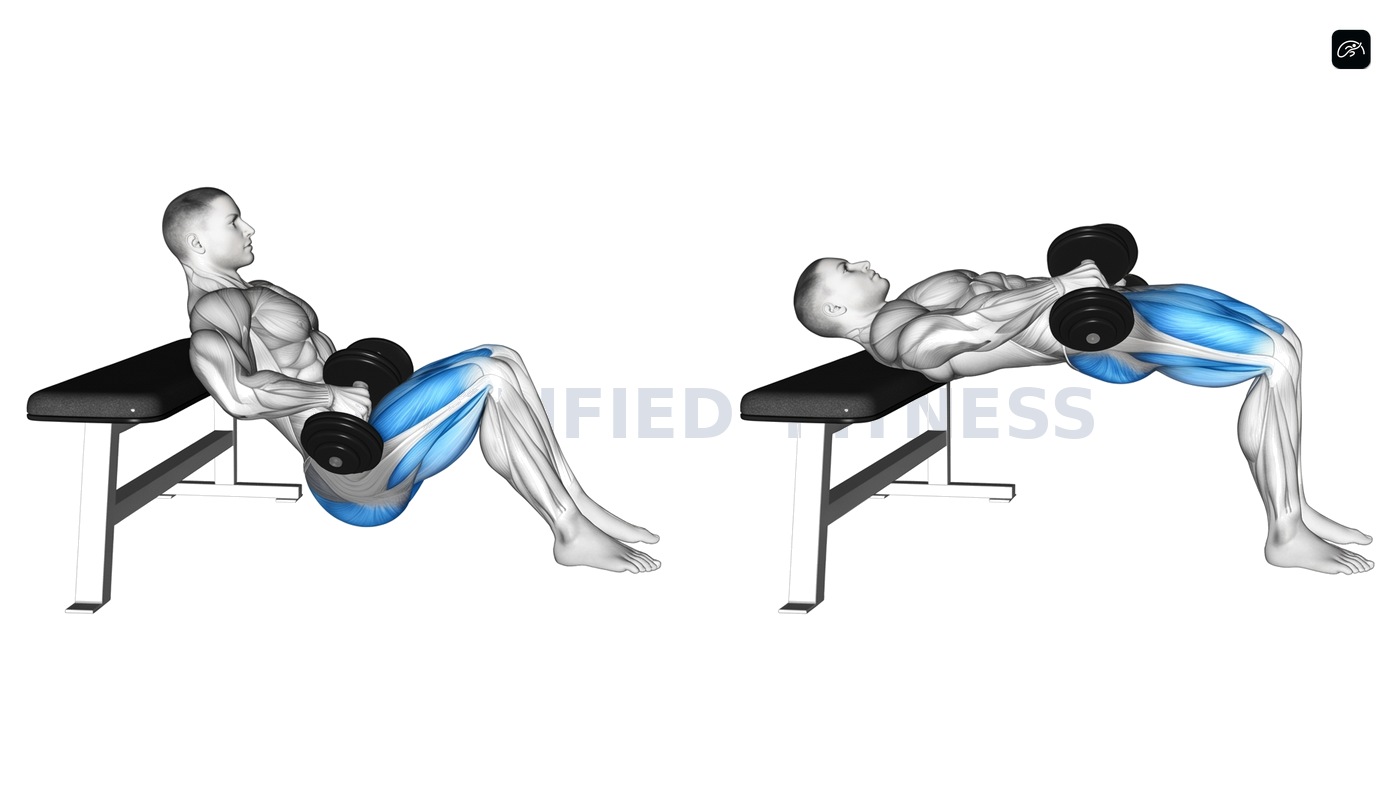
A 2021 meta-analysis of 8 trials (408 people with chronic low back pain) compared posterior-chain resistance training (thoracic, lumbar and hip extensor work) with general exercise. After 12-16 weeks, the strength-focused programs gave a greater reduction in disability (SMD -0.53), a greater increase in strength (SMD 0.67) and a borderline greater reduction in pain (SMD -0.61, 95% CI -1.21 to 0.00, p = 0.05). Adverse events did not differ (Tataryn et al., 2021). Heterogeneity was high for pain and the confidence interval touches zero, so I read this as promising, not settled.
This is why “deadlifts are bad for your back” is more nuanced than the gym rumor. Our piece on whether deadlifts are bad for your lower back goes through it, and a lower-back-friendly leg and back workout shows how to build a session around it.
Which exercise type wins?
A 2022 network meta-analysis of 118 trials (9,710 participants) in adults aged 18-65 found that most exercise types improved pain and disability compared with control (the exceptions were stretching for pain and the McKenzie method for disability). Pilates ranked highest, with mind-body and core-based exercise also among the most effective for pain, and Pilates, strength and core-based exercise among the best for disability (Fernandez-Rodriguez et al., 2022).
My cautious takeaway: the best program is the one you will do consistently, and a mix of strength work and core control looks like a safe bet. No single protocol has been proven superior.
What about the McGill Big 3?
The “Big 3” are the curl-up, the side plank and the bird dog, popularised by spine researcher Stuart McGill. They are low-risk ways to train trunk control without bending the spine under load.
Here is what the evidence does and does not say. A meta-analysis of five trials (414 patients) found core stability exercise was better than general exercise for chronic low back pain in the short term (pain mean difference -1.29, disability mean difference -7.14), but there was no significant difference in pain at 6 months (Wang et al., 2012). The pooled trials did not test the Big 3 as a set, and the authors noted the benefit was short-term.
So use them as a warm-up or a supplement alongside rowing, hip hinging and carrying, not as a magic fix.
A simple, back-friendly week
- Two full-body days with a hinge (Romanian deadlift or trap-bar), a row, a press and a leg press or split squat.
- Daily walking. In a hot Indian summer, early morning or evening works.
- Big 3 as a warm-up, 2 rounds, short holds.
- Stop sets with 2-3 reps in reserve, especially on hinges.
When back pain needs a doctor
Do not self-manage red flags. See a doctor promptly if back pain follows a fall or accident, comes with numbness in the groin or legs, leg weakness, loss of bladder or bowel control, fever, or unexplained weight loss, or if it wakes you at night and keeps worsening. Those are not signs to train through.
Desk-bound? Our desk worker workout plan for pelvic tilt and posture covers the long-sitting problem.
Is lifting safe for teenagers, and does it stunt growth?
This myth refuses to die, so here is the cleaner version.
The National Strength and Conditioning Association’s updated position statement notes that research increasingly indicates resistance training can offer unique benefits for children and adolescents when appropriately prescribed and supervised, and that qualified acceptance of youth resistance training by medical, fitness and sport organisations is becoming universal (Faigenbaum et al., 2009).
A review in the British Journal of Sports Medicine reached a similar conclusion. Injuries have occurred in young lifters, but most were classed as accidental, and the likely culprits were poor instruction, bad technique and inappropriate loads. Under qualified supervision, resistance training can be safe, effective and worthwhile for children and adolescents. A multifaceted program that includes movement instruction may even reduce sports-related injury risk (Faigenbaum & Myer, 2010).
How a teenager should start
- Coach first. Qualified supervision is the safety factor the evidence above stresses most.
- Technique before load. Bodyweight squats, push-ups, rows and hip hinges come before heavy barbells.
- Skip max-effort singles until technique is excellent and a coach agrees.
- Sleep and food are the real growth levers. In India that often means getting enough dal, curd, paneer, eggs or soya alongside school and tuition, not buying powders.
- Keep the fun in it. Two or three sessions a week beats a punishing six.
Does spot reduction work?
Almost everyone has asked it: if I train abs, will my belly fat go first? The honest answer is “mostly no, with an asterisk.”
The classic evidence
In a 2007 study, 104 people (45 men, 59 women) trained their non-dominant arm for 12 weeks. Skinfold measurements showed less fat in the trained arm in men but not women. MRI, which measures along the whole upper arm, found generalised fat loss that did not differ between trained and untrained arms, supporting the idea that spot reduction does not happen with resistance training (Kostek et al., 2007). The authors noted that results varied by sex and measurement method.
The newer wrinkle
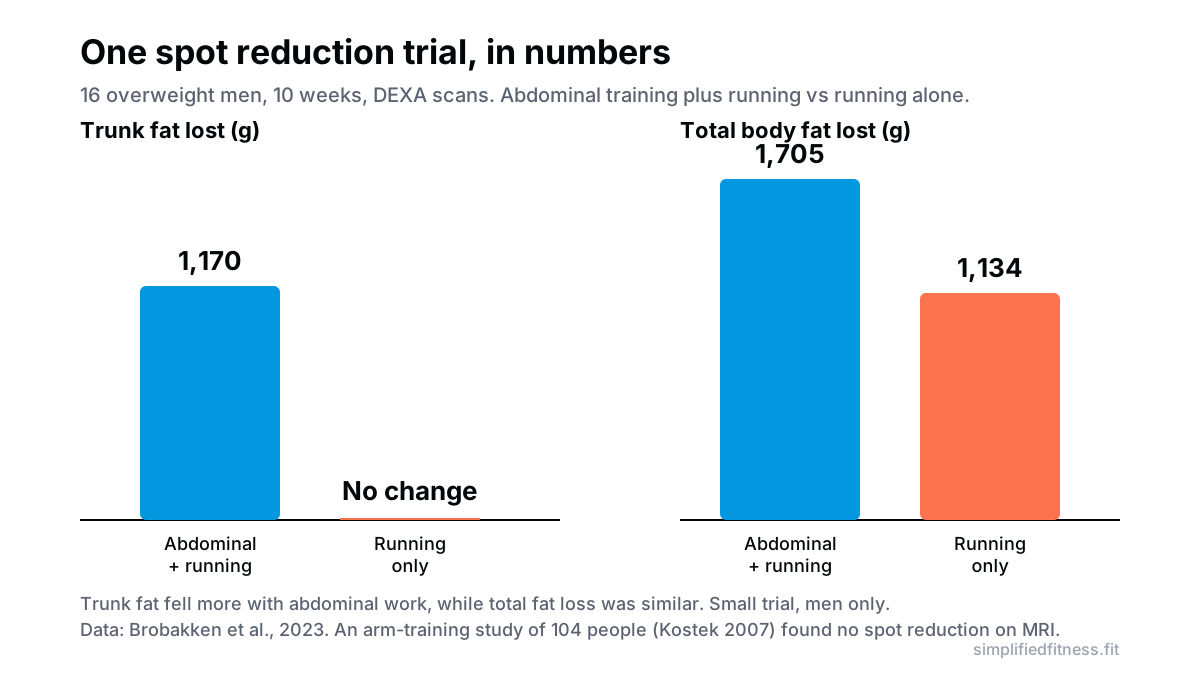
Then, in 2023, a randomized trial in 16 overweight men (mean age 43) compared abdominal endurance work plus running against running alone, matched for energy expenditure, over 10 weeks with DEXA scans. Trunk fat fell more in the abdominal group (1,170 g, about 7%) than in the running-only group (no change), while total fat and body weight fell similarly. The authors concluded spot reduction exists in adult males (Brobakken et al., 2023).
How to reconcile them
Why might these studies differ? The 2007 study trained one arm with resistance work, while the 2023 study used high-volume abdominal endurance exercise on top of running. They looked at different tissues, populations, protocols and measurement tools. The 2023 trial was also very small (16 men) and used a comparison that was not a no-exercise control.
My cautious read: a small local effect might exist under some conditions, but the evidence is thin and nobody has shown that it makes a visible difference to belly fat. For practical purposes, fat comes off from across your body when you hold an energy deficit. Train abs because they make you stronger, then handle fat loss with food, steps and sleep. Our energy balance and fat loss guide shows how.
Toning vs building muscle: are they different?
No. “Toning” is a marketing word for having visible muscle with less body fat on top. That requires two things: build some muscle, and lose some fat. There is no separate “toning” mechanism.
The related belief is that light weights and high reps tone while heavy weights bulk. The data do not support that split. In a 12-week trial, 49 resistance-trained men did whole-body training with either 20-25 reps at roughly 30-50% of 1RM or 8-12 reps at roughly 75-90% of 1RM, all sets to failure. Lean mass and fibre cross-sectional area increased in both groups with no significant differences between them, although bench press strength rose more in the heavier group (14 kg vs 9 kg) (Morton et al., 2016).
A 2025 within-subject trial in 14 trained men and women trained one leg with 3-5 reps and the other with 20-25 reps, to failure, for 9 weeks. Muscle thickness rose similarly with both, though heavy training was better for single-joint strength (Cumming et al., 2025). These are small trials in younger, trained people, but the pattern is consistent: effort near failure matters more than the load on the bar.
For joint-friendly lifters, this is good news. If heavy sets bother your knees, a lighter, harder set can still build muscle. Our muscle toning myth explainer goes through it, and will lifting heavy make women bulky covers the second half of the fear.
Does the menstrual cycle change how you should lift?
Many women hear that they should train hard in the first half of the cycle and back off later. The evidence is not that tidy. A 2023 umbrella review of meta-analyses and systematic reviews found highly variable results on how cycle phase affects strength, performance and hypertrophy, and flagged poor and inconsistent methods across the literature. The authors considered it premature to conclude that short-term hormonal fluctuations appreciably influence acute performance or long-term strength or hypertrophy adaptations (Colenso-Semple et al., 2023).
Practical takeaway: you do not need a phase-by-phase program. Some people feel noticeably worse on certain days, and that is real for them, so adjust load or volume on those days instead of skipping the week. If cycles are very painful, absent or irregular, or you feel dizzy, see a doctor.
The 10 classic fitness myths, scored
Here is the quick scorecard. Some are covered above; the rest have their own articles.
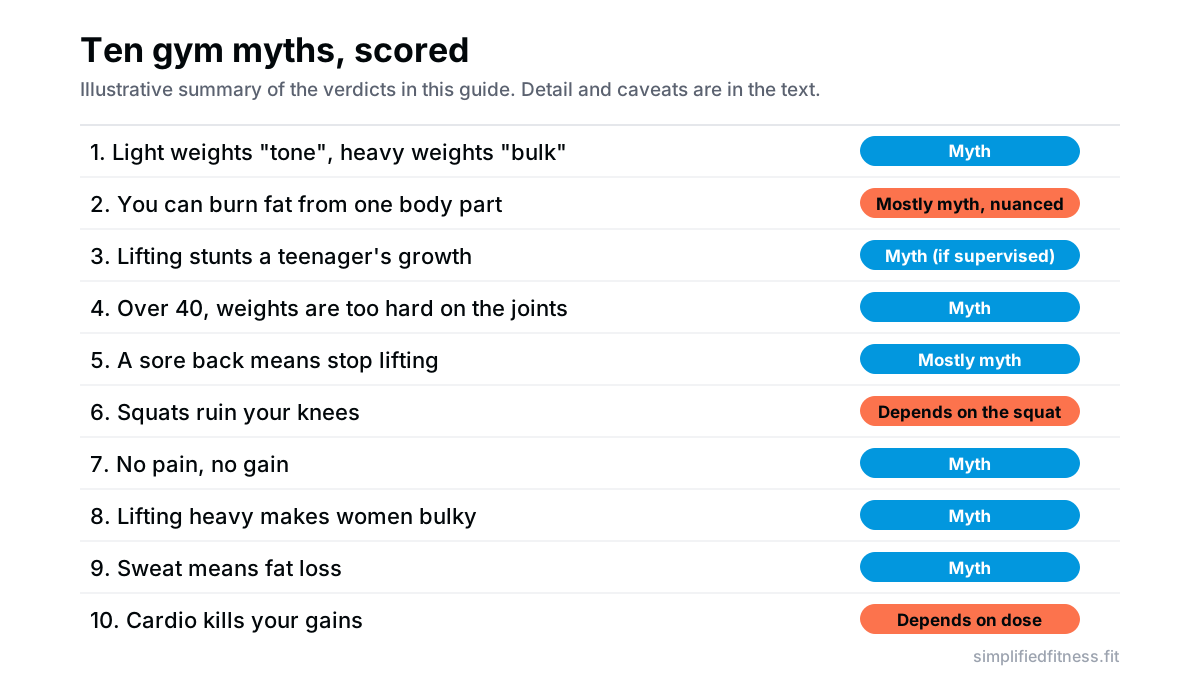
| Myth | Verdict | What to do instead |
|---|---|---|
| Light weights tone, heavy weights bulk | Myth | Pick a load you can control and train near failure |
| You can burn fat from one body part | Mostly myth | Aim for an overall energy deficit |
| Lifting stunts teen growth | Myth when supervised | Coach, technique, moderate loads |
| Over 40, weights are too hard on joints | Myth | Start light, progress slowly |
| A sore back means stop lifting | Mostly myth | Modify, keep moving, see a doctor for red flags |
| Squats ruin your knees | Depends on the squat | Adjust depth, load and stance |
| No pain, no gain | Myth | Effort is not injury |
| Lifting heavy makes women bulky | Myth | Women can get strong without getting “huge” |
| Sweat means fat loss | Myth | Sweat is water, not fat |
| Cardio kills gains | Depends on dose | Keep cardio moderate and schedule it sensibly |
A few of these deserve a line or two.
No pain, no gain. Muscle soreness and effort are normal. Sharp or worsening joint pain is not a training signal. In the exercise trials above, adverse events were mostly minor, like soreness. Our good pain vs bad pain article shows how to tell the difference.
Sweat equals fat loss. Sweat is your body cooling itself. In an Indian summer you can drip through a light walk, and none of that is body fat. See does sweat equal fat loss.
Muscle confusion. Switching exercises constantly does not make muscles grow. Gradual progression does. We explain this in muscle confusion vs progressive overload.
Cardio kills gains. Too much high-intensity running on top of heavy leg training can interfere with some adaptations, but moderate cardio does not erase muscle. The details, including how to schedule it, are in does cardio kill gains and the wider cardio and concurrent training guide.
Putting it together: a joint-friendly template
This is an example, not a prescription. Adjust it to how you feel and what your doctor says.
- Mon: full body A. Leg press, chest-supported row, neutral-grip dumbbell press, Romanian deadlift (light), side plank.
- Wed: full body B. Goblet or box squat, lat pulldown, cable fly, hip thrust, bird dog.
- Fri: full body C or optional. Split squat, seated row, lateral raise, curl and pushdown.
- Other days: walk, easy cycling or stretch.
Keep reps at 8-15 with 2-3 reps in reserve most of the time, and progress by adding a rep before adding weight. For comparing movement options by resistance profile, our lower-body and core guide is a good companion. And if you want the philosophy behind staying in the game for decades, read the Simplified Lifter manifesto.
The bottom line
Lifting after 40, with a sore back or as a teenager, is mostly a question of picking the right version of the right exercise. The research backs resistance training for older adults, exercise for chronic low back pain, and supervised lifting for youth. It does not back toning routines, spot reduction as a strategy or the idea that you must go heavy to grow.
Be patient, adjust the variable that hurts, and get unexplained or persistent pain checked. The lifter who is still training at 60 usually beat everyone else by simply not quitting.
Go deeper: every guide in this topic
- Are Deadlifts Bad for Your Lower Back? What Spinal Loading Research Shows
- Are Squats Bad for Your Knees? What the Research Actually Says
- Why Tendons Adapt Slower Than Muscles: Connective Tissue Timelines for Lifters
- Desk Worker Workout Routine: Fix Pelvic Tilt, Weak Glutes and a Rounded Upper Back
- Does Cardio Kill Gains? The Real Science of the Interference Effect
- Does Lifting Weights Stunt Growth in Teens? What the Research Says
- Does Sweating Burn Fat? Sweat Suits, Saunas and the Dehydration Illusion
- Golfer's Elbow and Tennis Elbow in Lifters: Why It Happens and How to Train Through It
- Joint-Friendly Hypertrophy: How to Build Muscle Without Joint Pain
- How to Train Legs With Bad Knees: Swaps, Angles and Tendon Protocols
- Lower Back Friendly Leg and Back Workout: Train Hard During a Flare-up
- The Muscle Confusion Myth: Why Switching Exercises Every Workout Stalls Progress
- The Muscle Toning Myth: Why Light Weights and High Reps Don't Tone
- Is 'No Pain, No Gain' True? Muscle Burn vs Joint Pain in the Gym
- Is Overhead Press Bad for Shoulders? The Impingement Myth Explained
- Resistance Training for Masters Lifters: Building Muscle at 40, 50 and 60+
- Returning to the Gym After an Injury: The Traffic Light Pain Model and Gradual Reloading
- Chest Workouts for Bad Shoulders: Bench Press Alternatives That Hurt Less
- The Simplified Lifter Manifesto: Minimal Effective Dose, The Joy of Strength and Lifelong Fitness
- Will Lifting Heavy Make Women Bulky? What Hormones Actually Say
Frequently Asked Questions
Is lifting weights bad for your joints after 40?
No, not by default. A Cochrane review of 121 trials in older adults found resistance training improved strength and physical function, and serious adverse events were rare and not directly linked to the exercise. Start with machines or dumbbells, control the lowering phase, and build load slowly.
How should I start lifting after 40 if I have never trained?
Begin with two or three full-body sessions a week using simple movements like leg press, rows, presses and hip hinges. Strength gains come mostly from consistency, and trials in older adults show benefits with two to three sessions per week. Pick weights you can lift for 10-15 clean reps and add small amounts when it feels easy.
Do I need heavy weights to build muscle over 40?
Not necessarily. A meta-analysis of 15 studies (448 older adults) found heavier loads tended to give somewhat larger strength gains, but concluded lighter loads may still be enough if you perform enough repetitions. Use a load you can control for 10-20 reps and take sets close to hard effort.
What is the best exercise for lower back pain?
There is no single best exercise. A 2022 network meta-analysis of 118 trials found Pilates, strength and core-based programs ranked among the most effective for chronic low back pain. Choose a program you can do consistently and have a clinician check you if the pain is severe or spreading.
Should I stop lifting if my lower back hurts?
Usually you adjust rather than stop. A Cochrane review of 249 trials found exercise reduced chronic non-specific low back pain compared with no treatment, usual care or placebo. Swap aggravating lifts for lower-load options, keep moving, and see a doctor if pain follows a fall or comes with numbness, weakness or bladder or bowel changes.
Are the McGill Big 3 exercises worth doing?
They are reasonable, low-risk core drills, but the evidence does not show they beat other exercise. A meta-analysis of five trials (414 people) found core stability exercise beat general exercise for chronic low back pain in the short term, with no clear difference at six months. Use the curl-up, side plank and bird dog as a warm-up or add-on, not a cure.
Are deadlifts bad for your back?
Not inherently. A 2021 meta-analysis of eight trials (408 people with chronic low back pain) found posterior-chain strength training for 12-16 weeks reduced disability more than general exercise, with a borderline benefit for pain and no difference in adverse events. Start light, brace well, and use a trap bar or rack pulls if the floor pull aggravates you.
Are squats bad for your knees?
Squats load the knee, but loading is not the same as damage. A 2022 systematic review concluded squats can overload the patellofemoral joint, especially around 60-90 degrees of knee bend, and may aggravate existing kneecap pain, but most studies were in sports populations and none show squats wreck healthy knees. If squats hurt, reduce depth or load, try box squats or leg press, and have persistent pain assessed.
Is lifting weights safe for teenagers?
Yes, when it is supervised and age-appropriate. The National Strength and Conditioning Association position statement and a 2010 review in the British Journal of Sports Medicine both describe resistance training as safe and worthwhile for youth under qualified instruction. Focus on technique, moderate loads and a coach, not on max lifts.
Does lifting weights stunt your growth?
There is no good evidence that it does. Pediatric and strength-and-conditioning reviews describe properly supervised resistance training as safe for children and adolescents, and injuries that occurred were mostly accidental and linked to poor instruction or excessive loads. Height is mostly set by genetics, with sleep and nutrition playing supporting roles, so keep technique tight and sleep enough.
What age can kids start lifting weights?
There is no single minimum age. The NSCA statement says youth can benefit when programs are age-specific and supervised, and children who can follow instructions and control a movement can begin with bodyweight and light loads. Keep it playful, technique-first and well supervised.
Can you lose fat from just one body part?
Mostly no. A 12-week arm-training study of 104 people found MRI showed generalised fat loss rather than loss only in the trained arm. A 2023 trial in 16 men did find extra trunk fat loss with abdominal training, so a small local effect is possible, but it is not a practical fat-loss strategy. Create an overall energy deficit and train the abs for strength.
Do crunches burn belly fat?
Not meaningfully on their own. Crunches use little energy, and fat comes off from across the body when you are in an energy deficit. A small 2023 trial found abdominal endurance work plus running lost more trunk fat than running alone, but total fat loss was similar. Do abs for strength and handle fat loss with food and overall activity.
What is the difference between toning and building muscle?
They are the same process. 'Toning' describes having more visible muscle with less body fat, which comes from building muscle and losing fat. Train with progressive overload, eat enough protein and manage calories, and stop chasing 'toning' routines.
Do light weights tone and heavy weights bulk you up?
No. A 12-week trial in 49 resistance-trained men found similar muscle growth with 20-25 reps at 30-50% of 1RM versus 8-12 reps at 75-90%, when sets were taken to failure. What matters is effort close to failure and enough weekly sets. Pick the load that feels good on your joints and push the set hard.
Does the menstrual cycle affect how I should lift?
Current evidence does not show that cycle phase meaningfully changes strength or muscle gains. A 2023 umbrella review called it premature to conclude that hormonal fluctuations appreciably affect performance or adaptation, noting poor methods in many studies. Track how you feel and adjust load or volume on rough days rather than following a rigid phase plan.
Can resistance training help my bones?
It can help. A 2022 meta-analysis of 14 trials in adults aged 65 and older found progressive resistance training increased hip and femur bone density by about 2.8% on average, but not lumbar spine density, with high heterogeneity. Keep lifting regularly and talk to your doctor if you have osteoporosis before doing heavy spinal loading.
How much pain is okay when lifting?
Mild muscle soreness and effort are normal, but sharp, pinching or worsening joint pain is a signal to change something. Adverse events in exercise trials were mostly minor, like muscle soreness. Reduce load or range of motion, and see a clinician if pain lingers beyond a few days or is getting worse.
Is it okay to train through joint pain?
Sometimes mild, steady discomfort that settles within a day can be managed, but sharp or increasing pain should not be pushed through. Exercise therapy helps chronic pain in trials, but that does not mean ignoring warning signs. Modify the exercise, lower the load and get unexplained or persistent pain checked.
Do I need to warm up more as I get older?
A slightly longer warm-up is a sensible habit for most people, though the evidence on exact protocols is limited. Raising your body temperature and rehearsing the movement with light sets prepares the joints and your technique. Do 5-10 minutes of easy movement and two or three ramp-up sets before your first working set.
Can I build muscle without heavy joint stress?
Yes. A 2025 trial in trained people found low-load training (20-25 reps) produced similar muscle thickness gains to heavy training (3-5 reps) over 9 weeks, which suggests joint-friendly loads can still grow muscle. Use machines, cables and controlled tempo, and train hard without grinding heavy singles.
When should I see a doctor about pain from lifting?
See a doctor if pain follows an injury, wakes you at night, spreads down a limb, or comes with numbness, weakness, fever or unexplained weight loss. These signs can point to something other than a simple strain. Stop the aggravating exercise and get assessed before returning to training.
Sources & References
Every claim above is checked against peer-reviewed research (PubMed, U.S. National Library of Medicine) or guidance from established health bodies. How we fact-check.
- Liu CJ, et al. Progressive resistance strength training for improving physical function in older adults. Cochrane Database Syst Rev. 2009. PMID: 19588334
- O'Bryan SJ, et al. Progressive resistance training for concomitant increases in muscle strength and bone mineral density in older adults: a systematic review and meta-analysis. Sports Med. 2022. PMID: 35608815
- Csapo R, et al. Effects of resistance training with moderate vs heavy loads on muscle mass and strength in the elderly: a meta-analysis. Scand J Med Sci Sports. 2016. PMID: 26302881
- Hayden JA, et al. Exercise therapy for chronic low back pain. Cochrane Database Syst Rev. 2021. PMID: 34580864
- Tataryn N, et al. Posterior-chain resistance training compared to general exercise and walking programmes for the treatment of chronic low back pain in the general population: a systematic review and meta-analysis. Sports Med Open. 2021. PMID: 33683497
- Fernandez-Rodriguez R, et al. Best exercise options for reducing pain and disability in adults with chronic low back pain: Pilates, strength, core-based, and mind-body. A network meta-analysis. J Orthop Sports Phys Ther. 2022. PMID: 35722759
- Wang XQ, et al. A meta-analysis of core stability exercise versus general exercise for chronic low back pain. PLoS One. 2012. PMID: 23284879
- Faigenbaum AD, et al. Youth resistance training: updated position statement paper from the National Strength and Conditioning Association. J Strength Cond Res. 2009. PMID: 19620931
- Faigenbaum AD, Myer GD. Resistance training among young athletes: safety, efficacy and injury prevention effects. Br J Sports Med. 2010. PMID: 19945973
- Kostek MA, et al. Subcutaneous fat alterations resulting from an upper-body resistance training program. Med Sci Sports Exerc. 2007. PMID: 17596787
- Brobakken MF, et al. Abdominal aerobic endurance exercise reveals spot reduction exists: a randomized controlled trial. Physiol Rep. 2023. PMID: 38010201
- Morton RW, et al. Neither load nor systemic hormones determine resistance training-mediated hypertrophy or strength gains in resistance-trained young men. J Appl Physiol. 2016. PMID: 27174923
- Cumming KT, et al. Divergent strength gains but similar hypertrophy after low-load and high-load resistance exercise training in trained individuals: many roads lead to Rome. J Appl Physiol. 2025. PMID: 40827709
- Colenso-Semple LM, et al. Current evidence shows no influence of women's menstrual cycle phase on acute strength performance or adaptations to resistance exercise training. Front Sports Act Living. 2023. PMID: 37033884
- Pereira PM, et al. Patellofemoral pain syndrome risk associated with squats: a systematic review. Int J Environ Res Public Health. 2022. PMID: 35954598

Umair Hazrami · Founder & Head Coach, Simplified Fitness
Umair Hazrami founded Simplified Fitness and the Simplified Lifter channel to cut through fitness noise. With 4+ years of consistent training and 10+ coaching clients, he writes every guide from the peer-reviewed research and links the sources so you can check them. Our editorial standards.
Educational content only, not medical advice. If you have a medical condition, are pregnant, or take medication, talk to a qualified doctor before changing your diet, supplements or training. Full disclaimer.
Keep reading

Health & Longevity
Overcoming the All-or-Nothing Mindset: How Perfectionism Wrecks Long-Term Fitness
The all-or-nothing mindset in fitness turns one missed workout into a lost month. Here is the research, the never-miss-twice rule and a 20-minute fallback plan.
10 min read
Health & Longevity
Are Deadlifts Bad for Your Lower Back? What Spinal Loading Research Shows
Are deadlifts bad for lower back health? The research shows spinal loads are high but tolerable, and trials use loaded lifting for back pain. How to hinge.
9 min read

Health & Longevity
Are Squats Bad for Your Knees? What the Research Actually Says
Are squats bad for your knees? Research on deep squats, kneecap stress and the knees-over-toes rule shows where the myth came from and how to squat safely.
9 min read
Health & Longevity
How to Build a Gym Habit: The Behavioral Science of Sticking With It
How to build a gym habit using habit science: how long it takes, why cues and low friction beat willpower, and what identity can and cannot do for consistency.
8 min read