Arching on the Bench Press: Powerlifting Spine Arch vs Bodybuilding Setup
Is a bench press arch cheating or dangerous for your back? Learn the difference between a powerlifting arch and a natural upper back setup, with study data.

TL;DR. The short answer
- A modest bench press arch, created mostly by pinching the shoulder blades and lifting the chest, is not cheating. It is a standard setup that has been linked in a small lab study to lower shoulder joint loads.
- An extreme powerlifting arch shortens the bar path. In studies of competitive lifters it raised 1RM by about 4 kg in one study (a borderline result) and made no difference in another, so the benefit is small and varies.
- No study here showed that arch height predicts low back pain, but the evidence is thin. Back pain on the bench is a reason to reduce the arch and see a clinician.
- If your goal is chest size rather than a competition max, aim for a natural arch with the glutes and head on the bench and a full range of motion.
Part of our complete guide: The Complete Chest Workout Guide: Pec Anatomy, Bench Angles, Flys and Shoulder-Safe Pressing
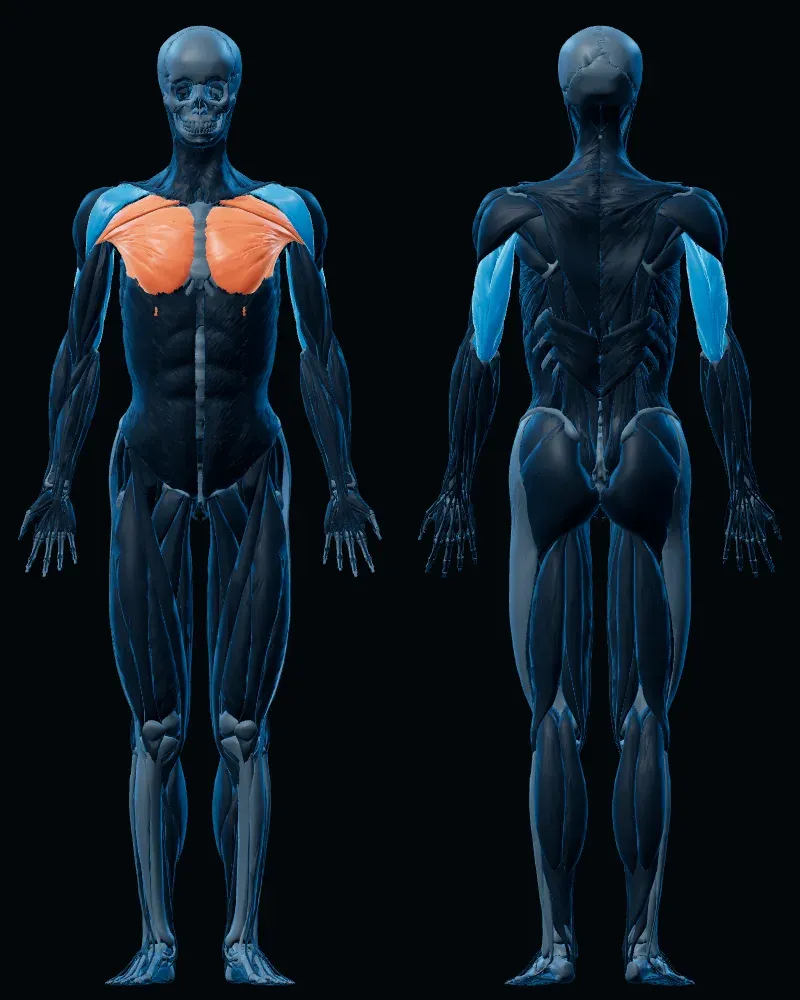
Muscles worked: chest
Main movers: pectoralis major
Assisting: front delts and triceps
Table of contents
A modest bench press arch is not cheating, and for most lifters it is the better setup. The extreme version used in powerlifting is a different thing: it mainly shortens the bar path, and the research shows its benefit is small and inconsistent. If you are training for chest size and healthy shoulders, you want the first kind, not the second.
This article is a focused look at the arch debate. For the full picture of chest training, start with our complete chest training guide. Here we separate two things that social media lumps together: the shoulder blade position that protects you, and the spinal bridge that moves maximum weight.
Is a bench press arch cheating or good?
Cheating means breaking the rules of the movement to make the weight feel lighter than it is. A bench press arch does not break the movement. Your glutes, upper back and head stay on the bench, the bar touches your chest, and it goes back up. The rules are intact.
What changes is geometry. Arching raises the chest toward the bar, so the bar has less distance to travel. That is a legitimate way to set up, and a moderate arch is common in competition. The International Powerlifting Federation did recently change its regulations to disallow an accentuated dorsal arch, according to the introduction of one 2024 study (Bartolomei et al., 2024), so the extreme version is now regulated, not the idea of arching itself.
The better question is not “is it cheating?” but “which arch do I actually need?”
Natural arch vs powerlifting arch: what is the difference?
Think of it as a spectrum.
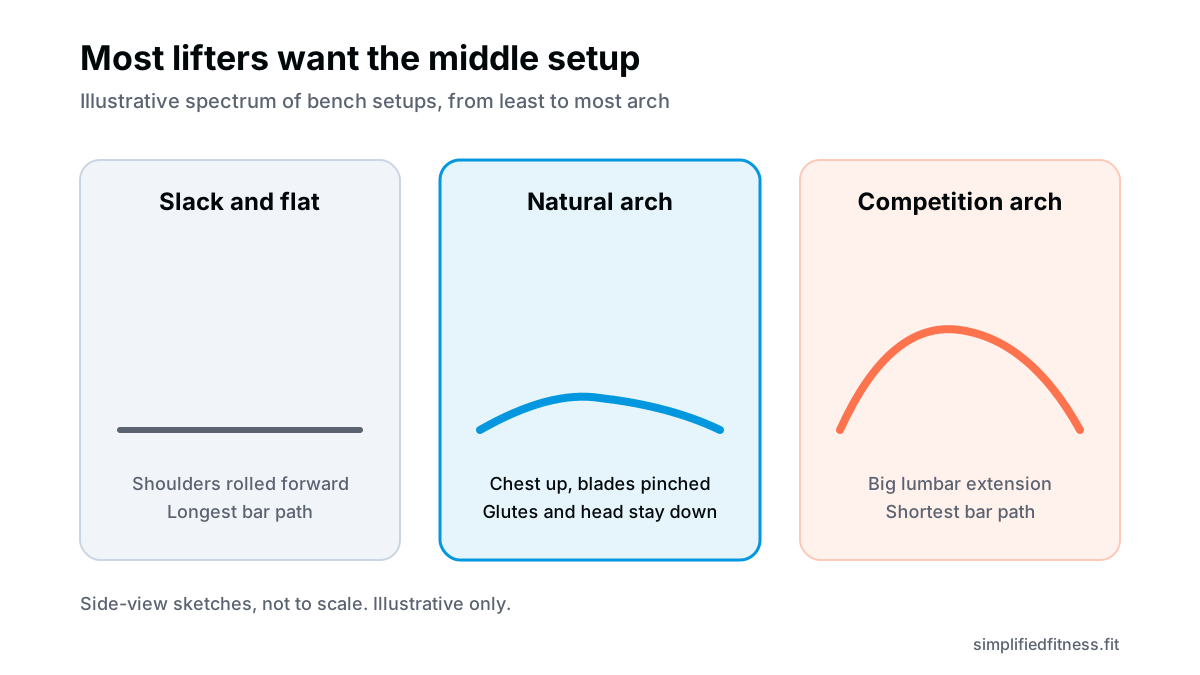
Natural arch. You pull your shoulder blades back and down, lift your chest, and keep a gentle curve in your lower back. Most of the shape comes from your upper back (thoracic spine), not your lumbar spine. Your feet are planted and your glutes stay on the bench.
Powerlifting arch. The lifter pushes hips and chest as high as the rules allow, creating a big lumbar bridge. The only purpose is to cut the distance the bar travels and keep the shoulders stable under maximal loads.
In one study, 11 competitive powerlifters were tested with a flat bench (natural lumbar arch and moderate scapular retraction) and an arched bench (pronounced lumbar arch and scapular retraction) (García-Ramos et al., 2021). Note that both conditions included scapular retraction. The difference was the size of the lumbar bridge.
Does the arch actually make you stronger?
Only slightly, and not always.
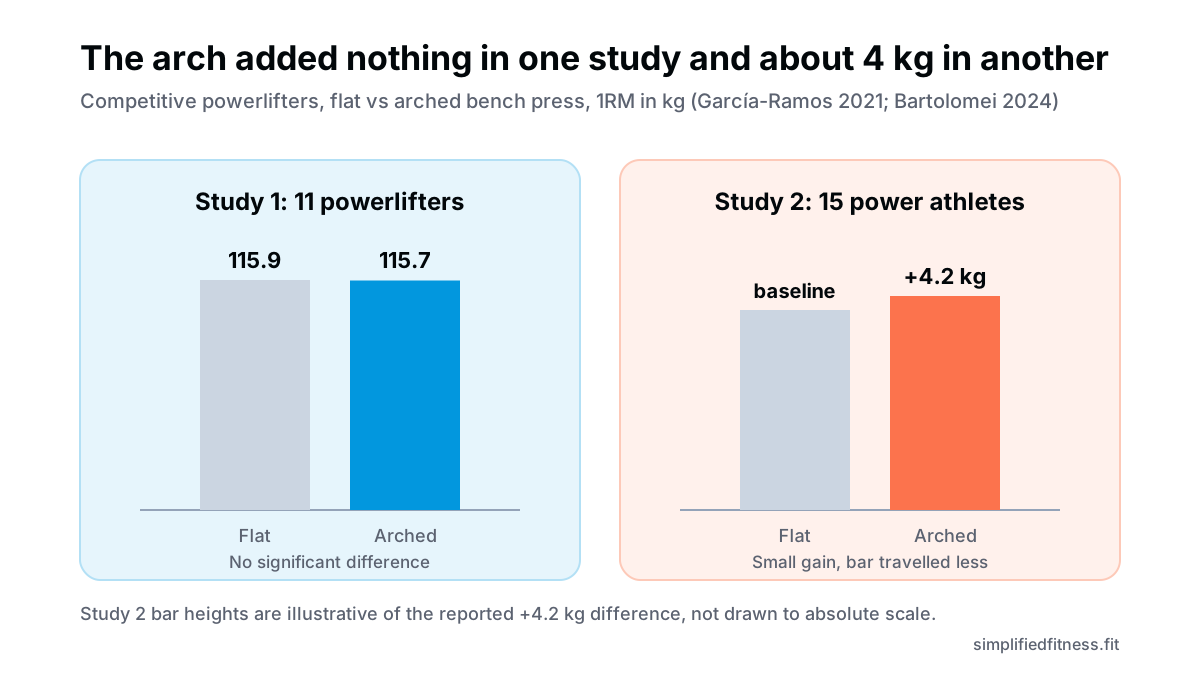
The 2021 study above found no significant difference in 1RM between flat (115.9 kg) and arched (115.7 kg) benching, and no velocity differences either. The authors concluded that powerlifters do not necessarily lift more with the arched version.
A 2024 study of 15 highly trained lifters came out slightly differently. The 1RM was greater with the arch by 4.2 kg (effect size 0.22, with a confidence interval starting at zero, so the result is borderline), and barbell displacement was greater with the flat-back version for all loads. The flat version had higher mean and peak bar speed, and power did not differ (Bartolomei et al., 2024).
Why might they differ? Sample size, lifter experience and how extreme each lifter’s arch was could all play a part. Both samples were small, so neither settles it. A third study in Paralympic powerlifters, 20 beginners and 23 experienced, found no significant difference in load, bar trajectory or mean velocity between arched and flat techniques (Ribeiro Neto et al., 2022). That group has its own physical characteristics, so do not assume it applies to everyone.
The practical takeaway: the arch is a small lever for a max attempt, not a magic strength switch. If you are not competing, a few kilos of 1RM is rarely the point. Use our 1RM calculator to track strength progress without chasing one-rep maxes.
Why a natural arch protects the shoulders
This is the part most people miss, and it is where the “arch” advice is strongest.
Shoulder injuries on the bench are commonly reported, but the authors of a 2024 study noted there was no biomechanical evidence on how to lower that risk. Their lab study put ten experienced strength athletes through 21 bench press variations and modelled shoulder joint forces. Scapular retraction, as well as a grip width under 1.5 times shoulder width, decreased glenohumeral posterior shear and rotator cuff activity, which the authors suggest may lower the risk of instability and rotator cuff injuries (Noteboom et al., 2024). Narrower grips also reduced acromioclavicular compression.
Caveats matter here. It was ten experienced strength athletes, it was a computer model of forces rather than an injury study, and it cannot prove that any setup prevents injury. Still, it supports a cue coaches have used for years: pin your shoulder blades back and down before you unrack.
In plain gym language, think of your shoulder blades as the bench under the bar. If they slide forward and up as you press, your shoulder joint is doing the job of a stable base and a mover at once. For more on grip and elbow placement, see bench press grip width, and if you already have a niggle, our guide to shoulder pain during bench pressing walks through the fixes.
Is arching the bench press bad for your spine?
Honest answer: the direct evidence is thin.
The popular worry is that a big lumbar arch compresses the small joints at the back of the spine and irritates the lower back. That is a plausible mechanism, but none of the studies reviewed for this article measured spinal loading during a bench press arch, so I will not quote numbers for it.
What exists is limited. One small study measured arch height in 18 male powerlifters during the bench press and compared those with a history of low back pain to those without. It found no significant difference in arch height between the two groups and concluded that the size of the arch may not be a determining factor in low back pain (Marotta et al., 2024). Eighteen people with a history-based grouping cannot tell us about cause and effect, so treat it as reassuring but not conclusive.
A narrative review of powerlifting injuries notes that pain and injuries are common in all three lifts, and that it has been suggested they may relate to heavy loads, large ranges of motion, short rest between sessions and faulty technique (Bengtsson et al., 2018). It does not single out the arch as the culprit.
Reasonable position: a moderate arch in a healthy lifter is unlikely to be a problem for most people, and an extreme arch under maximal loads deserves more respect. The best guide is your own body. If benching makes your lower back ache, that is feedback.
Arch and chest growth: is shortening the range a problem?
If you lift for size, range of motion matters. A 2021 meta-analysis of 16 studies found that full range of motion training produced greater adaptations than partial range on muscle strength (ES = 0.56) and lower-limb hypertrophy (ES = 0.88), with no clear difference in muscle thickness overall (Pallarés et al., 2021). That review was not about the bench press, so it cannot tell us how much an arch costs the chest.
An arch shortens the bar path by raising the chest, but you can still touch the bar to your chest and reach a deep stretch. For a related look at this trade-off, see our article on full vs partial range of motion for hypertrophy.
Muscle activity does not seem to change much either. In 15 powerlifters, the excitation of the upper and lower pectoralis was similar between flat and arched benching, with an overall trend towards more triceps activation when arched (Bartolomei et al., 2024). So the idea that arching “takes the chest out” is not supported by this study, though it is a small sample and EMG is a rough tool.
A small acute study in ten resistance-trained men using a pad that elevated the upper back (assisting thoracic extension and scapular retraction) reported higher pec activation and barbell speed than a flat bench (Kidwell et al., 2026). It was a single session with a novel device, so treat it as a hint, not a verdict.
How to set a safe bench press arch
- Lie down and plant your feet first, flat on the floor, under or slightly behind your knees.
- Grab the bar and pull your shoulder blades together and down, as if tucking them into your back pockets.
- Lift your chest toward the ceiling. This builds the upper back arch.
- Keep your glutes and head on the bench. Do not lift your hips.
- Unrack, lower to the lower chest, press, and keep your shoulder blades pinned throughout.
In a crowded commercial gym, pick a stable, full-length flat bench so you can brace your whole upper back against it. A short or wobbly bench makes the setup harder to hold.
Who should keep the arch small
Keep it modest if you are a beginner still learning the movement, if you have a history of back pain, if you feel the setup in your lower back, or if you train for size and want maximum stretch. Those are coaching judgements rather than study results. If you are working on a broader chest plan, our chest day plan pairs well with a clean setup.
When to see a doctor
Ordinary muscle soreness fades in a few days. See a doctor or physiotherapist if you have sharp or persistent back pain, pain that spreads into your legs, numbness or tingling, or weakness. This article cannot diagnose anything, and if pain started on the bench, reduce the arch and the load until someone examines you.
Summary
Arching is a spectrum. The upper back arch with pinched shoulder blades is the useful part, and a modest version is a sensible default for most lifters. The extreme powerlifting arch is a small performance tool whose benefit is inconsistent across studies and whose long-term risk is not well studied. Set your shoulder blades, keep your glutes down, and let your lower back tell you if you have gone too far.
Frequently Asked Questions
Is arching your back on the bench press cheating?
Not if the glutes, shoulders and head stay in contact with the bench and the bar touches the chest. An arch changes the setup, not the rules of the lift. A moderate arch is standard in powerlifting, although the International Powerlifting Federation has restricted an accentuated one, and for hypertrophy a modest arch simply gives your shoulders a stable platform.
Is a bench press arch bad for your lower back?
There is no good evidence that a moderate arch harms a healthy back. One small study of 18 powerlifters found arch height was not associated with low back pain risk, though the sample was tiny. If your lower back hurts during or after benching, flatten the setup and have it checked.
Does arching make you bench more?
Sometimes, by a small amount. One study of 11 competitive powerlifters found almost identical 1RMs flat and arched, while another of 15 power athletes found the arch added about 4.2 kg. The arch mainly shortens the distance the bar travels, which helps most when you are going for a max.
What is a natural arch on the bench press?
It is the upper back extension you get from pulling your shoulder blades together and down and lifting your chest toward the bar. Your lower back keeps a gentle curve rather than a big bridge. Set it before you unrack and hold it for the whole set.
Should bodybuilders arch the bench press?
Yes, modestly. Scapular retraction is linked to lower glenohumeral shear in a lab study of experienced lifters, and a stable upper back lets you load the chest hard. Skip the extreme version, because shortening the range by a lot may reduce the stretch on the pecs.
Does arching shift the work away from the chest?
Not clearly. In 15 powerlifters, upper and lower pec excitation was similar flat and arched, with a trend toward more triceps activity when arched. The evidence is from a small sample and one load pattern, so treat it as a rough guide.
Do I need to keep my butt on the bench?
Yes, for safety and for competition rules. Lifting your hips adds to the arch in a way that turns the bench into a bridge and strains your back. Keep your glutes down and push the floor away with your feet.
How do I arch the bench press without hurting my back?
Build the arch with your upper back first, not by cranking your lumbar spine. Plant your feet, pull your shoulder blades back and down, then lift your sternum. Warm up with light sets and stop if you feel pinching in the lower back.
Does scapular retraction protect the shoulders?
It appears to help. In ten experienced lifters, retracting the scapulae lowered posterior shear in the shoulder joint and rotator cuff activity in a musculoskeletal model. It was a modelling study in strength athletes, so it supports the cue rather than proving injury prevention.
Is a flat back bench press better for chest growth?
There is no direct evidence that one beats the other for muscle growth. A flat back increases bar travel, and full range of motion training has favoured strength gains and lower body hypertrophy in a meta-analysis. For chest size, pick the version you can control through a full range.
Can beginners use a bench press arch?
Yes, but keep it small and learn the shoulder blade position first. In Paralympic powerlifters, beginners and experienced lifters showed no significant performance difference between arched and flat techniques. Master a tight upper back before you chase a bigger arch.
When should I see a doctor about bench press back pain?
See a doctor if the pain is sharp, lingers for days, spreads into the legs, or comes with numbness or weakness. These could signal something beyond ordinary muscle soreness. Until then, drop the arch and the load.
Sources & References
Every claim above is checked against peer-reviewed research (PubMed, U.S. National Library of Medicine) or guidance from established health bodies. How we fact-check.
- García-Ramos A, et al. Differences in the one-repetition maximum and load-velocity profile between the flat and arched bench press in competitive powerlifters. Sports Biomech. 2021. PMID: 30526366
- Bartolomei S, et al. Flat-Back vs. Arched-Back Bench Press: Examining the Different Techniques Performed by Power Athletes. J Strength Cond Res. 2024. PMID: 38551927
- Ribeiro Neto F, et al. Performance Differences Between the Arched and Flat Bench Press in Beginner and Experienced Paralympic Powerlifters. J Strength Cond Res. 2022. PMID: 32740285
- Noteboom L, et al. Effects of bench press technique variations on musculoskeletal shoulder loads and potential injury risk. Front Physiol. 2024. PMID: 38974522
- Marotta N, et al. Role of the Flexion Relaxation Phenomenon in the Analysis of Low Back Pain Risk in the Powerlifter: A Proof-of-Principle Study. J Sport Rehabil. 2024. PMID: 38734422
- Pallarés JG, et al. Effects of range of motion on resistance training adaptations: A systematic review and meta-analysis. Scand J Med Sci Sports. 2021. PMID: 34170576
- Bengtsson V, et al. Narrative review of injuries in powerlifting with special reference to their association to the squat, bench press and deadlift. BMJ Open Sport Exerc Med. 2018. PMID: 30057777
- Motlagh JG, et al. The Contribution of Muscular Fatigue and Shoulder Biomechanics to Shoulder Injury Incidence During the Bench Press Exercise: A Narrative Review. J Strength Cond Res. 2024. PMID: 39808810
- Kidwell JA, et al. Acute Effects of Thoracic-Spinal Elevation via a Novel Bench Press Pad on sEMG and Barbell Kinetics in Resistance-Trained Males. Int J Exerc Sci. 2026. PMID: 42003891

Umair Hazrami · Founder & Head Coach, Simplified Fitness
Umair Hazrami founded Simplified Fitness and the Simplified Lifter channel to cut through fitness noise. With 4+ years of consistent training and 10+ coaching clients, he writes every guide from the peer-reviewed research and links the sources so you can check them. Our editorial standards.
Educational content only, not medical advice. If you have a medical condition, are pregnant, or take medication, talk to a qualified doctor before changing your diet, supplements or training. Full disclaimer.
Keep reading
Exercise Technique
Bench Press Grip Width: Pec Activation, Triceps and Shoulder Clearance
Bench press grip width changes triceps load, shoulder stress and little else for your pecs. See what EMG and joint-load studies show and how to pick your grip.
7 min read
Exercise Technique
Cable Crossover Angles: High-to-Low vs Low-to-High vs Horizontal Fly
Cable crossover angles explained: what high-to-low, low-to-high and horizontal flys likely train, what the research really says, and how to set each one up.
9 min read
Exercise Technique
Chest Dips: Forward Lean Angle, Scapular Position, and Shoulder Safety
Chest dips can build your chest if you lean, set your shoulders and stop at a depth that suits you. See what the research says and how to dip safely.
8 min read
Exercise Technique
Dumbbell vs Cable vs Pec Deck Fly: Which Chest Fly Is Best?
Dumbbell vs cable vs pec deck fly: how each resistance curve loads your chest, what research does and does not show, and which fly to pick for growth.
8 min read