Incline Dumbbell Bench Press Angle: 15° vs 30° vs 45° Compared
Which incline dumbbell bench press angle builds the upper chest best? See what EMG studies show for 15, 30 and 45 degrees, plus a safe setup and form guide.
TL;DR. The short answer
- For most lifters, a 30 degree incline dumbbell bench press angle is the best starting point. In a 30-person trained sample, upper chest EMG peaked at 30 degrees.
- Going to 45 degrees or higher shifts work to the front delts. One study found front delt activity highest at 60 degrees and a drop in chest performance above 45.
- The studies do not fully agree on the exact number. One found the upper chest higher at 44 than 28 degrees, so 30 to 40 degrees is a sensible range to test.
- Surface EMG shows muscle activation, not growth. The one training trial we have (untrained men, 8 weeks) found similar strength gains from flat and incline, with a site-specific thickness edge for incline.
- Setup matters as much as angle: shoulder blades back and down, elbows tucked about 45 to 60 degrees, and a controlled stretch at the bottom.
Part of our complete guide: The Complete Chest Workout Guide: Pec Anatomy, Bench Angles, Flys and Shoulder-Safe Pressing
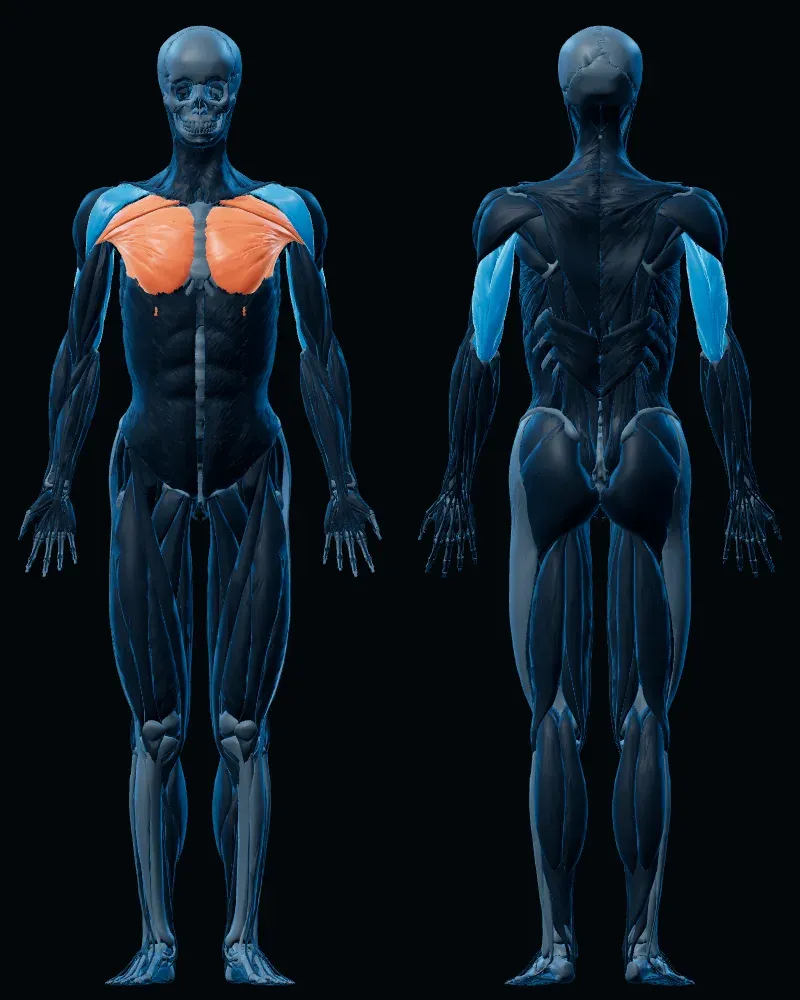
Muscles worked: chest
Main movers: pectoralis major
Assisting: front delts and triceps
Table of contents
The best incline dumbbell bench press angle for most lifters is about 30 degrees. That is where upper chest activation peaked in a study of 30 trained adults, and it keeps the front delts from taking over.
Go steeper and the shoulders do more of the work. This guide covers what 15, 30 and 45 degrees actually do, where the research disagrees, and how to set up the dumbbells so the angle you pick is worth something. It sits inside our complete chest training guide, so read that for the bigger picture of weekly chest programming.
Which incline dumbbell bench press angle is best?
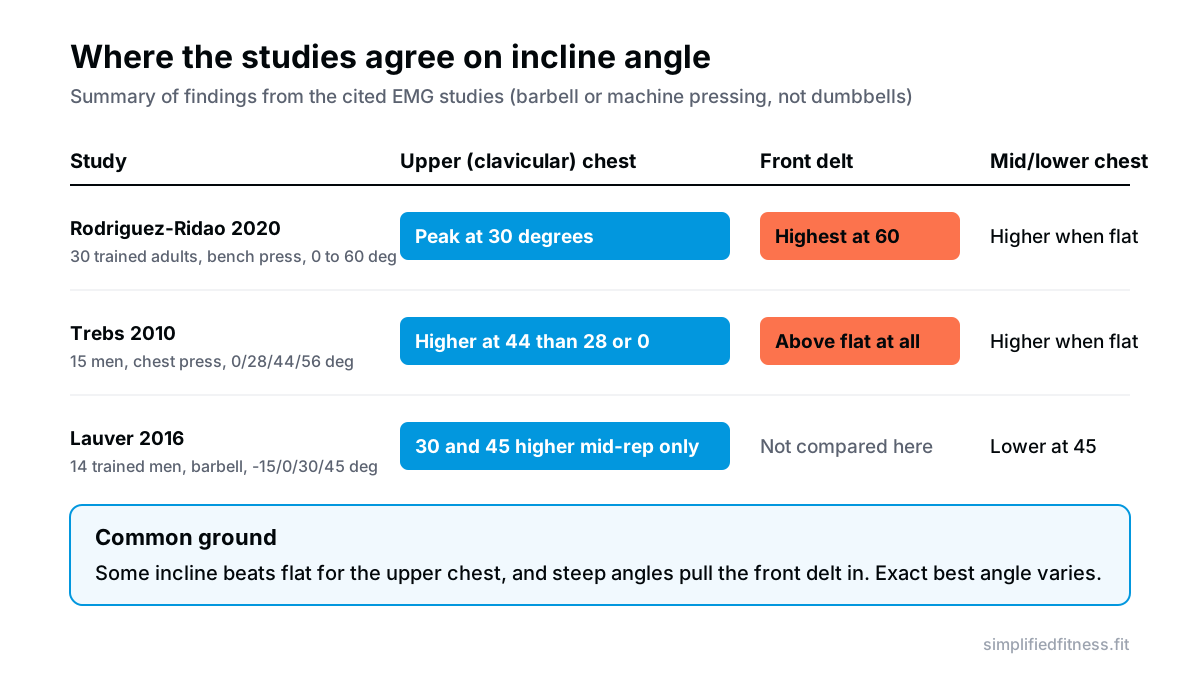
Here is the cleanest evidence we have. Researchers tested 30 trained adults on the bench press at 0, 15, 30, 45 and 60 degrees, using 60% of one-rep max, and measured muscle activity with EMG. The upper portion of the pectoralis major peaked at 30 degrees. The middle and lower chest were higher on the flat bench. The front delt peaked at 60 degrees, and angles above 45 reduced chest activation (Rodriguez-Ridao et al., 2020).
So 30 degrees is the sweet spot on that data. Fine.
But one study is not a verdict. Let’s look at the others.
What do the studies disagree on?
Quite a bit, and it is worth being honest about it.
A 2010 study of 15 men tested 0, 28, 44 and 56 degrees at 70% of 1RM. Clavicular head (upper chest) activity was higher at 44 degrees than at 28 or 0. The sternocostal head (mid chest) was highest on the flat bench, and the front delt was higher at every incline than flat (Trebs et al., 2010).
That does not match the 30 degree peak above. A third study of 14 trained men compared -15, 0, 30 and 45 degrees. Over the full concentric phase, upper chest activity did not differ between angles. Differences only appeared in the middle of the lift, where 30 and 45 degrees beat flat. Lower chest activity was lower at 45 degrees (Lauver et al., 2016).
Why the mismatch? Different loads, different bench angles (28 vs 30, 44 vs 45), different electrode placement, and different ways of normalizing the signal. EMG is also noisy. Small differences between angles can come from the method, not only the muscle.
The cautious takeaway is a range, not a number. Somewhere from 30 to about 40 degrees looks reasonable for upper chest, and there is no strong evidence that going beyond that helps.
15 vs 30 vs 45 degrees: what each one does
| Angle | What the evidence suggests | Practical note |
|---|---|---|
| 15 degrees | Tested in one study; upper chest peaked at 30, mid and lower chest favored flat | Feels close to flat on many benches. Fine if your shoulders dislike steeper angles |
| 30 degrees | Upper chest EMG peaked here in 30 trained adults | Best default for most lifters |
| 45 degrees | Mixed upper chest results; lower chest lower in one study; front delt higher | Works if you stay chest-focused, but shoulders take more load |
| 56-60 degrees | Front delt highest at 60; chest performance decreased above 45 | Closer to a shoulder press than a chest exercise |
Treat 15 degrees as the one with the least direct support. A low incline can still be useful as a middle ground between flat and 30, but the data do not single it out.
Does EMG mean the upper chest will actually grow?
Not automatically. EMG tells you which muscle region is more electrically active during a rep. It does not tell you how much it will grow over months.
There is some bridging evidence. In a 2022 study, 13 men did four sets of flat and 45 degree incline bench press. EMG was greater for the clavicular head on incline and for the sternocostal head on flat. Ultrasound taken right after exercise showed acute cross-sectional area increases that matched: larger in the clavicular head after incline, and larger in the sternocostal head after flat (Albarello et al., 2022). That is an acute response, though, not long-term growth.
The one training study we found compared horizontal, incline and combined bench press in 47 untrained young men for 8 weeks, with sets equalized. Strength gains were similar across groups. Muscle thickness differed at only one of three sites: the second intercostal space, where the incline group gained more (Chaves et al., 2020). That is short, small, once-a-week training in untrained men, so it hints at regional effects without proving them.
Practically: if you want a well-rounded chest, include both flat and incline pressing rather than choosing one. For more on how the upper chest fits into the bigger picture, see our guide to upper chest training and the clavicular pec. For the head-to-head with the barbell version, read incline vs flat bench press for upper chest angles.
How does the dumbbell version change things?
Dumbbells let each arm find its own path. They also let your hands drop lower than a bar, because the bar hits your chest and dumbbells do not.
Research on dumbbells specifically is thin. One study of 24 women (12 trained, 12 novice) compared dumbbell bench, incline and shoulder presses. Front delt activation was greatest in the shoulder press, then incline, then flat bench, with no differences between trained and novice women. Clavicular pec activity during the lowering phase was higher in the incline press than the other two, but during the lifting phase the flat dumbbell press actually beat the incline for the clavicular pec (Luczak et al., 2013).
So even with dumbbells, the upper chest picture is mixed. The flat press is not a write-off for the upper pec, and the incline’s edge showed up mainly on the way down. That is one more reason to control the descent rather than drop into the bottom. For the barbell versus dumbbell question in full, see dumbbell vs barbell pressing and pec recruitment.
How to set up the incline dumbbell press
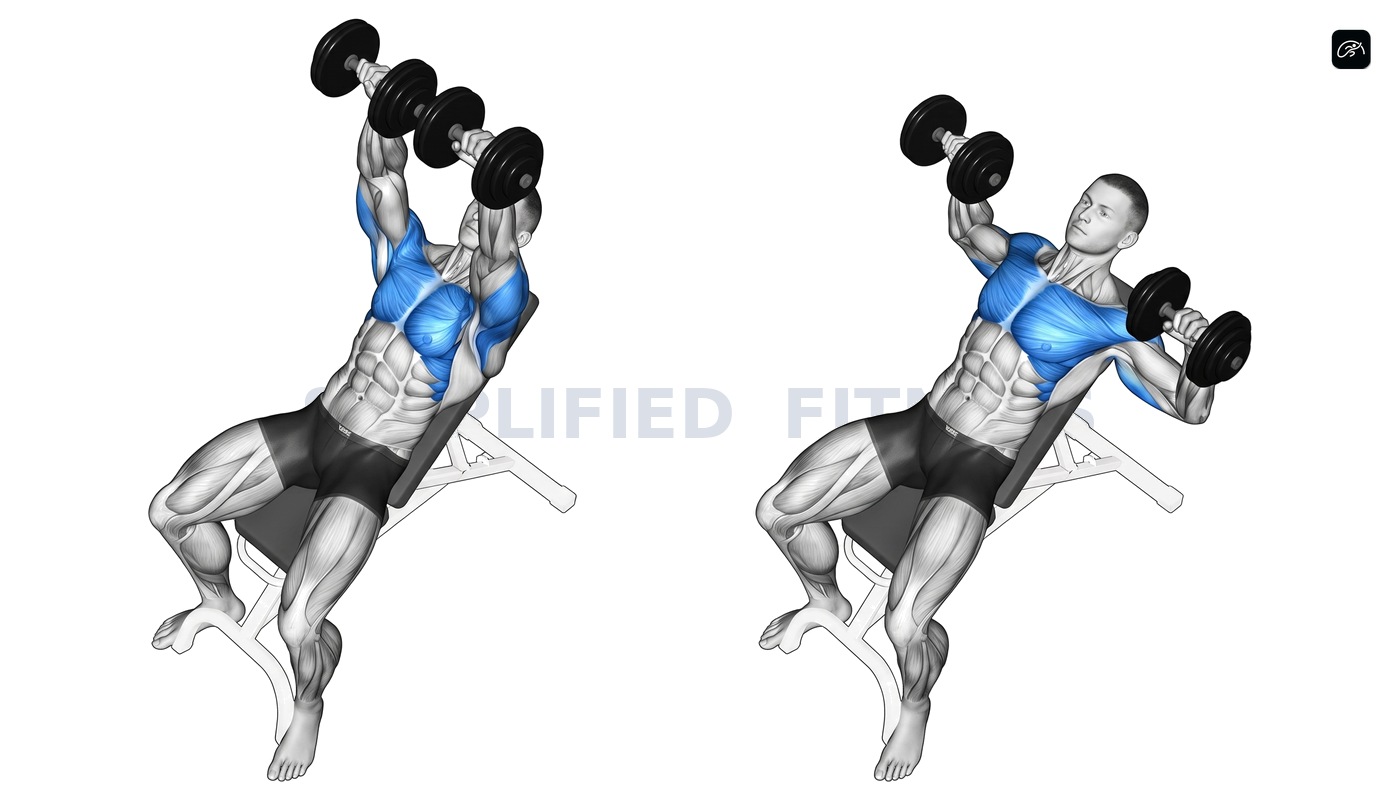
Much of the shoulder grumbling on this lift is a setup problem, not an angle problem. Work through it in order.
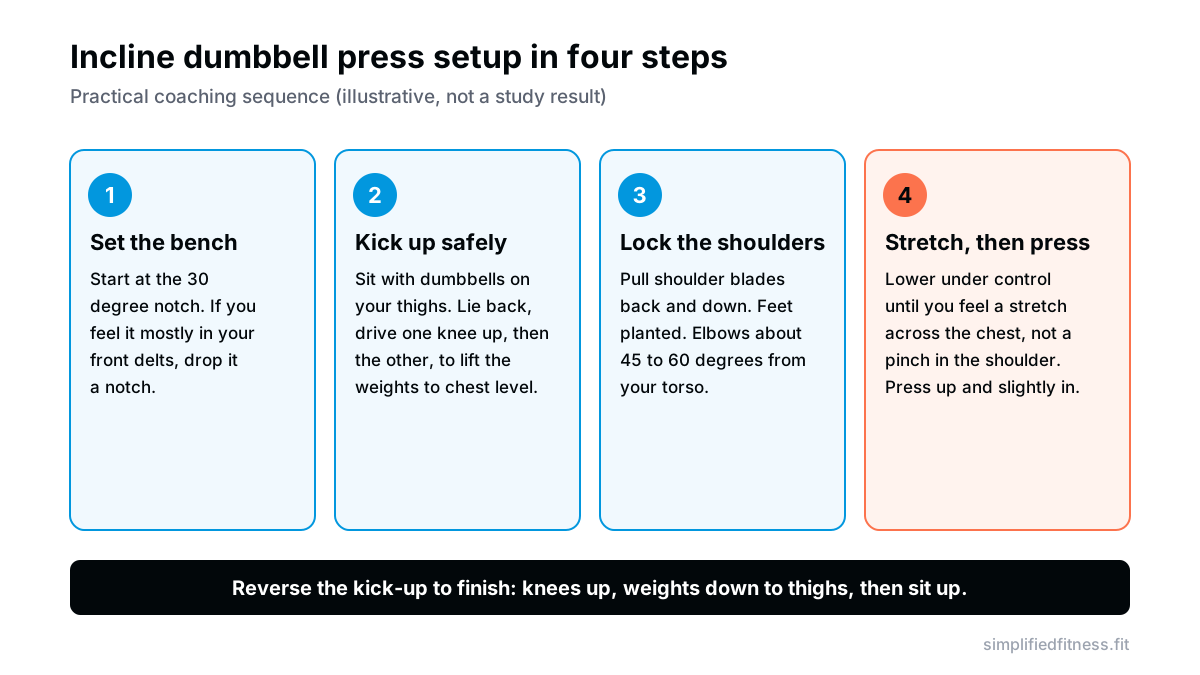
1. Set the bench. Start at about 30 degrees. If your gym’s bench has no numbers, the second notch up from flat is often close, but check by eye.
2. Kick up with your knees. Sit with the dumbbells resting on your thighs. Lie back and drive one knee up, then the other, to lift the dumbbells to chest level. Do not swing them up from the floor with your arms. Doing this with heavy dumbbells is where lifters tweak shoulders before the first rep.
3. Set your shoulder blades. Pull them back and slightly down, and keep your feet planted. This gives the chest a stable base to push from.
4. Choose a wrist and elbow position. Keep your wrists stacked over your elbows with forearms roughly vertical. A palms-forward grip, or a slight turn-in, are both common. There is no trial evidence for one correct wrist angle, so choose the one that feels strongest and pain-free. Elbows at roughly 45 to 60 degrees from your torso tend to be easier on the shoulders than flaring straight out to the sides. That is coaching practice, not a measured threshold.
5. Lower into the stretch. Take two to three seconds on the way down. Stop when you feel a stretch across the chest and the dumbbells are near chest level, not when your shoulders start to pinch.
6. Press up and slightly in. Drive the weights up along a gentle arc until your arms are nearly straight. Do not clank the dumbbells together at the top.
7. Rack safely. Bring the weights back to your thighs, then sit up. Never drop them behind you.
How deep should you go for the stretch?
Many lifters hear that a deep stretch is a must for chest growth. The evidence is less tidy than the gym advice.
A 2020 systematic review of six studies concluded full range of motion helped lower body hypertrophy more than partial range of motion. For the upper body, it said research was limited and conflicting, which stopped it drawing strong conclusions (Schoenfeld et al., 2020). A 2021 meta-analysis of 16 studies found full range of motion was better for strength and lower-limb hypertrophy, but no significant difference in muscle thickness, pennation angle or fascicle length (Pallares et al., 2021).
So there is no proof that deeper always builds more chest. There is also no good reason to bounce half reps. A sensible middle path: go as deep as you can control with a clear chest stretch and no shoulder pinch. For more on this, see range of motion and stretch-mediated hypertrophy.
What if incline press bothers your shoulders?
Lower the angle first. Steeper benches raise front delt involvement, so a notch down is the cheapest fix. Next try tucking the elbows a little and shortening the range slightly.
If it still hurts, our guide to fixing shoulder pain on bench press walks through the options. And if you have sharp pain, pain that lingers for days, numbness, or pain that shoots down the arm, see a doctor or physiotherapist rather than training through it. We cannot diagnose anything from an article.
How to program it
A reasonable starting point:
- Angle: about 30 degrees, adjusted by feel.
- Sets: 2 to 4 hard sets per session, as part of your weekly chest volume.
- Reps: about 6 to 12, finishing 1 to 3 reps short of failure. Our RIR and RPE calculator helps judge that.
- Frequency: once or twice a week, alongside a flat or machine press.
- Progression: add reps first, then a small jump in dumbbell weight.
On a budget? Adjustable benches and dumbbells are the whole kit. No cables or machines needed. If you want it slotted into a full session, our free push day plan includes pressing work around it.
Frequently Asked Questions
What is the best incline angle for dumbbell bench press?
For most people the best starting angle is about 30 degrees. In a study of 30 trained adults, upper pec EMG peaked at a 30 degree bench setting, while front delt activity rose at steeper angles. Try 30 degrees for your first few weeks, then adjust a notch up or down based on where you feel it.
Is a 45 degree incline too steep for upper chest?
Not necessarily, but it brings in more shoulder. A 2010 study found upper chest activity higher at 44 than 28 degrees, while another study found it peaked at 30 and that front delt activity climbs on steeper benches. If your shoulders do most of the work at 45 degrees, move the bench down a notch.
Is 15 degrees enough to hit the upper chest?
A low incline can work, but there is less direct evidence for it than for 30 degrees. The key EMG study tested 15 degrees and found upper chest activity peaked at 30, with mid and lower chest favoring the flat bench. If your gym's lowest incline notch feels like a flat press, you can still use it, and adjust based on feel.
Do dumbbells work the upper chest better than a barbell on incline?
There is no clear proof that dumbbells beat a barbell for upper chest growth. Dumbbells do let your hands travel lower and move more freely, which some lifters find easier on the shoulders and better for the stretch. Choose whichever you can load progressively and perform with a comfortable range of motion.
How should I hold the dumbbells on incline press?
Most lifters do best with a palms-forward or slightly turned-in grip, with wrists stacked over elbows. There is no strong trial evidence for one exact wrist angle, so this is coaching practice rather than a proven rule. Pick the grip that keeps your forearms vertical and your shoulders pain-free.
How do I get the dumbbells into position safely?
Rest the dumbbells on your thighs, sit back on the bench, then lie back while using your knees to help kick each weight up to chest level. This lets your legs do the heavy lifting before the weights ever reach your shoulders. To finish a set, reverse it: bring the weights back to your thighs, then sit up.
How low should I go on incline dumbbell press?
Lower until you feel a clear stretch across your chest without shoulder pinching, usually with the dumbbells near chest level. A 2020 review found full range of motion was supported for lower body hypertrophy, but upper body evidence was limited and conflicting. Use the deepest range you can control comfortably, and keep your shoulder blades set.
How many reps and sets should I do on incline dumbbell press?
Most lifters do well with 2 to 4 hard sets of about 6 to 12 reps, stopping 1 to 3 reps shy of failure, as part of their weekly chest volume. This range is a common hypertrophy recommendation rather than something specific to incline. Use our RIR calculator to judge how close to failure you are going.
Should I do flat bench or incline dumbbell press for chest growth?
Both have a place, because different chest regions respond to different angles. A 2022 study found the clavicular head was more excited and showed greater acute size change after incline, while the sternocostal head did after flat. A simple split is one flat or machine press and one incline press per week.
Why do my front delts burn more than my chest on incline press?
Usually the bench is too steep or your shoulder blades are not set. EMG data show front delt activity rises with incline, and a study of dumbbell presses found shoulder press activation greater than incline, which was greater than flat. Lower the bench a notch, tuck your elbows slightly, and keep your shoulder blades pinned back and down.
Can women use the same incline angle as men?
Yes, there is no sign that women need a different angle. A study of 24 women found incline dumbbell press raised front delt activity more than the flat bench, with similar patterns in novice and trained women. Start around 30 degrees and adjust based on feel.
My shoulders hurt on incline press. What should I change?
Lower the bench angle, tuck your elbows a bit, and shorten the range of motion if you feel a pinch. Steeper angles load the front delts more, and shoulder pain is individual, so there is no single fix. If pain persists, sharp, or travels down your arm, see a doctor or physiotherapist.
Sources & References
Every claim above is checked against peer-reviewed research (PubMed, U.S. National Library of Medicine) or guidance from established health bodies. How we fact-check.
- Rodriguez-Ridao D, et al. Effect of five bench inclinations on the electromyographic activity of the pectoralis major, anterior deltoid, and triceps brachii during the bench press exercise. Int J Environ Res Public Health. 2020. PMID: 33049982
- Trebs AA, et al. An electromyography analysis of 3 muscles surrounding the shoulder joint during the performance of a chest press exercise at several angles. J Strength Cond Res. 2010. PMID: 20512064
- Lauver JD, et al. Influence of bench angle on upper extremity muscular activation during bench press exercise. Eur J Sport Sci. 2016. PMID: 25799093
- Luczak J, et al. Shoulder muscle activation of novice and resistance trained women during variations of dumbbell press exercises. J Sports Med. 2013. PMID: 26464884
- Albarello JCDS, et al. Non-uniform excitation of pectoralis major induced by changes in bench press inclination leads to uneven variations in the cross-sectional area measured by panoramic ultrasonography. J Electromyogr Kinesiol. 2022. PMID: 36334406
- Chaves SFN, et al. Effects of horizontal and incline bench press on neuromuscular adaptations in untrained young men. Int J Exerc Sci. 2020. PMID: 32922646
- Schoenfeld BJ, et al. Effects of range of motion on muscle development during resistance training interventions: a systematic review. SAGE Open Med. 2020. PMID: 32030125
- Pallares JG, et al. Effects of range of motion on resistance training adaptations: a systematic review and meta-analysis. Scand J Med Sci Sports. 2021. PMID: 34170576

Umair Hazrami · Founder & Head Coach, Simplified Fitness
Umair Hazrami founded Simplified Fitness and the Simplified Lifter channel to cut through fitness noise. With 4+ years of consistent training and 10+ coaching clients, he writes every guide from the peer-reviewed research and links the sources so you can check them. Our editorial standards.
Educational content only, not medical advice. If you have a medical condition, are pregnant, or take medication, talk to a qualified doctor before changing your diet, supplements or training. Full disclaimer.
Keep reading
Exercise Technique
Arching on the Bench Press: Powerlifting Spine Arch vs Bodybuilding Setup
Is a bench press arch cheating or dangerous for your back? Learn the difference between a powerlifting arch and a natural upper back setup, with study data.
8 min read
Exercise Technique
Bench Press Grip Width: Pec Activation, Triceps and Shoulder Clearance
Bench press grip width changes triceps load, shoulder stress and little else for your pecs. See what EMG and joint-load studies show and how to pick your grip.
7 min read
Exercise Technique
Cable Crossover Angles: High-to-Low vs Low-to-High vs Horizontal Fly
Cable crossover angles explained: what high-to-low, low-to-high and horizontal flys likely train, what the research really says, and how to set each one up.
9 min read
Exercise Technique
Chest Dips: Forward Lean Angle, Scapular Position, and Shoulder Safety
Chest dips can build your chest if you lean, set your shoulders and stop at a depth that suits you. See what the research says and how to dip safely.
8 min read