Shoulder Pain During Bench Pressing: Biomechanical Root Causes and Grip Adjustments
Shoulder pain bench press fix: the four technique errors behind front shoulder pain, plus grip, elbow, and setup changes to try and when to see a doctor.
TL;DR. The short answer
- Four technique factors are worth auditing first when the front of your shoulder hurts on the bench: flared elbows, loose shoulder blades, a bar touch point too high on the chest, and a very wide grip. These are coaching patterns, not a diagnosis.
- In a 2024 lab study of 10 experienced lifters, pulling the shoulder blades back and using a grip narrower than 1.5 times shoulder-bone width lowered estimated stress on the shoulder joints.
- Try a 45-60 degree elbow tuck, a retracted setup, a lower-chest touch point and a moderate grip first. Swap to neutral-grip dumbbells or a floor press while it settles.
- Strengthening and scapular exercises have moderate-quality evidence for shoulder pain in general. They are not a promise that pain will vanish.
- Sudden pain with a pop, bruising, arm weakness, numbness or night pain needs a clinician, not a form tweak.
Part of our complete guide: The Complete Chest Workout Guide: Pec Anatomy, Bench Angles, Flys and Shoulder-Safe Pressing
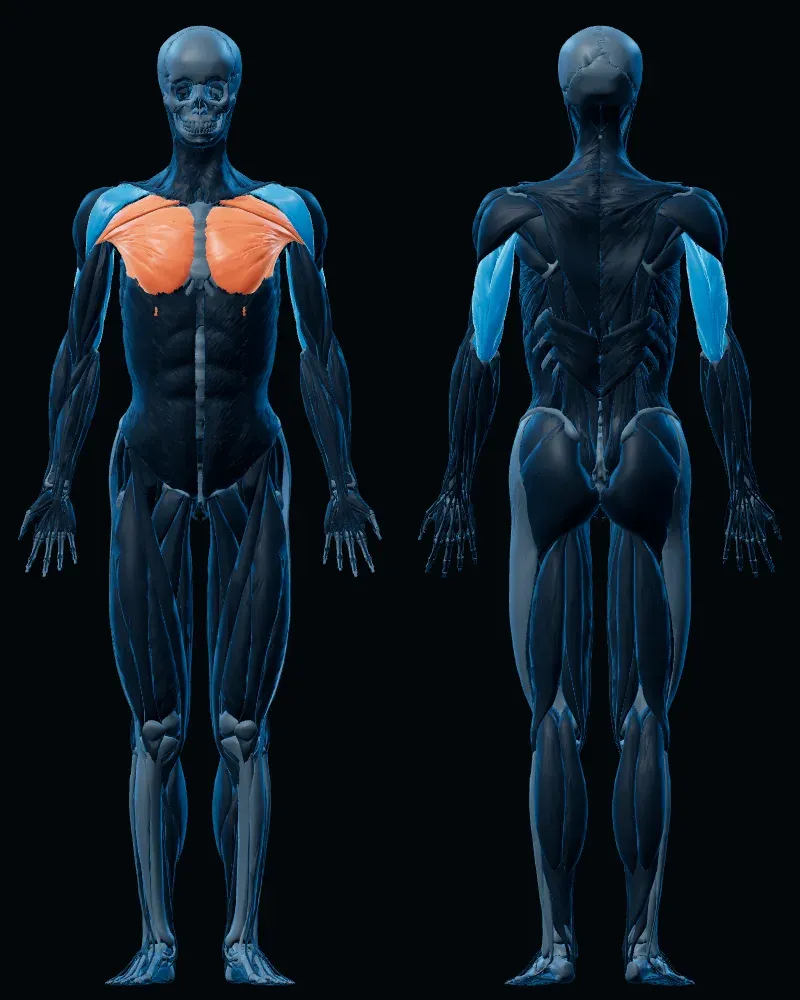
Muscles worked: chest
Main movers: pectoralis major
Assisting: front delts and triceps
Table of contents
Front shoulder pain on the bench is usually a setup problem before it is a body problem. The four things I would check first are your elbow flare, your shoulder blade position, where the bar touches your chest, and how wide your grip is. This article is part of our complete chest training guide, and it is about the shoulder pain bench press fix that most lifters actually need: small, specific changes you can test next session.
One honest caveat up front. I cannot diagnose your shoulder from a screen, and the research here is thinner than the gym folklore suggests. Treat everything below as a set of reasonable experiments, not guaranteed cures.
Why does my front shoulder hurt when I bench press?
The bench press loads the shoulder at its most vulnerable moment: the bottom, where the upper arm is stretched back and the bar wants to pull your joint forward. A 2024 narrative review describes a high risk of shoulder injury with this lift in powerlifters, but notes that the injury findings often say little about what the shoulder joint is actually doing during the press (Motlagh and Lipps, 2024).
So we work with what the biomechanics studies do tell us. A 2024 lab study put 10 experienced strength athletes through 21 bench press variations (different grip widths, elbow angles and shoulder blade positions) and used a musculoskeletal model to estimate forces inside the shoulder (Noteboom et al., 2024). Two findings matter for you. Grips narrower than 1.5 times the width between your shoulder bones lowered compression at the acromioclavicular joint. And pulling the shoulder blades back (as did the narrower grips) lowered posterior shear force at the main shoulder joint and rotator cuff activity. The team also found that how hard each lifter pushed the bar outward or inward varied a lot between people and strongly affected shoulder forces.
That is a model estimate in ten experienced lifters, not a trial in people with pain. Useful direction, not proof.
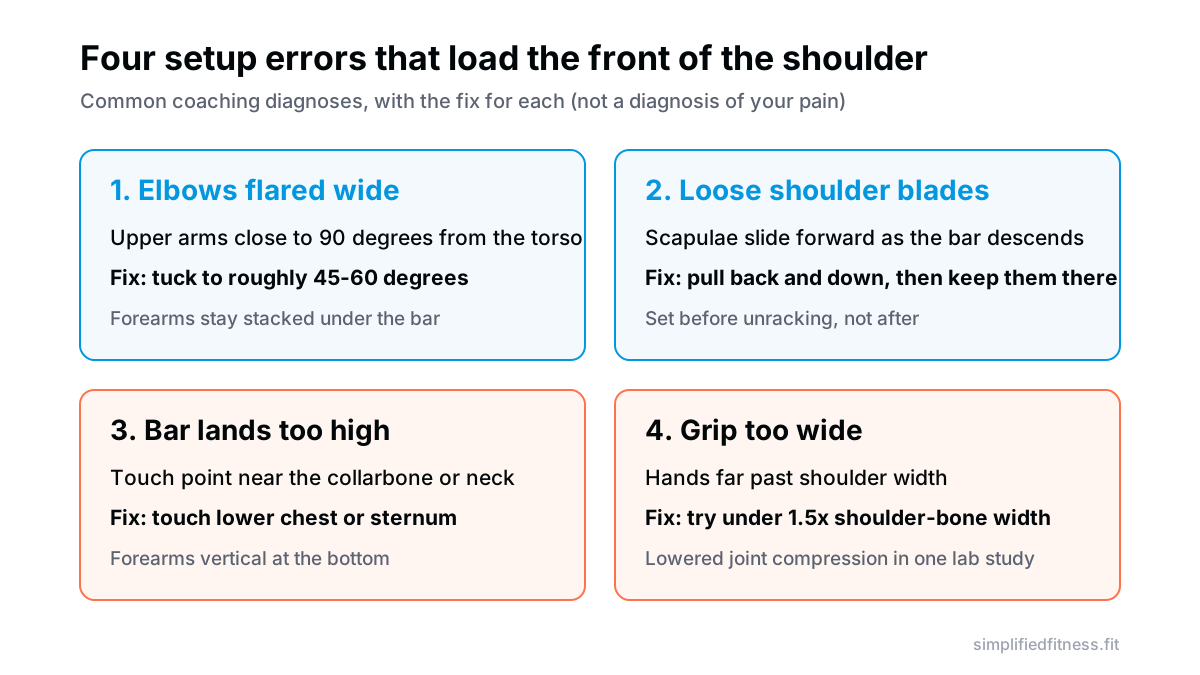
Cause 1: Flared elbows
Flaring means your upper arms sit close to 90 degrees from your torso, so your body and arms form a “T”. It feels strong because the chest is stretched, but it also puts the shoulder in a tight, exposed position at the bottom.
The usual coaching fix is to tuck the elbows to roughly 45-60 degrees, forearms close to vertical under the bar. A fair warning: Noteboom’s team tested abduction angles of 45, 70 and 90 degrees, but their published summary reports results for grip width and shoulder blade position, not a clear effect of elbow angle. So the study does not prove the tuck. It is a sensible starting point based on joint position, not a studied threshold.
In the gym, this looks like elbows shooting out the moment the bar gets heavy. Drop the weight, take a slower descent, and think about bending the bar rather than pulling it apart.
Cause 2: Loose shoulder blades
If your shoulder blades slide forward as the bar comes down, your upper back stops supporting the press and the front of the shoulder takes more of the work. This is the factor with the most direct support here: retraction lowered estimated posterior shear force and rotator cuff activity in the 2024 model (Noteboom et al., 2024).
The fix is simple, though not always easy:
- Lie down and pull your shoulder blades back and down, like squeezing a pencil between them.
- Keep your chest up and your upper back pressed into the bench.
- Do this before you unrack the bar. Not during the rep. Before.
A bench with a lot of padding can make it harder to hold the position. A firm flat bench helps most people.
Cause 3: A touch point too high on the chest
When the bar lands near your collarbone or neck, your elbows almost have to flare to get there. The shoulder ends up in a position that many lifters find irritating.
Aim for your lower chest or sternum, roughly in line with the bottom of the pecs, with the forearms vertical when the bar touches. Film a set from the side. If your forearms lean toward your feet or toward your head at the bottom, the touch point is off.
I am not aware of a trial that tests touch point against pain, so this one comes from coaching logic and joint position, not a study.
Cause 4: A very wide grip
Wide grips are popular because they shorten the bar path and can raise your one-rep max. In a study of 14 bench-trained men, the wide and medium grips produced the greatest horizontal shoulder moments compared with the narrow grip, and the authors suggested a wide or medium grip could help lifting as much as possible in a 1-RM (Larsen et al., 2020). That is a performance finding. It tells us why lifters drift wide, not that wide is safe for a sore joint.
For shoulder comfort, the modeling study points the other way: grips under 1.5 times biacromial width were linked to lower acromioclavicular compression, which the authors say may reduce the risk of distal clavicular osteolysis (Noteboom et al., 2024). If your hands sit beyond your shoulder width plus a lot, test pulling them in a hand-width or two. For more on grip and pec versus triceps emphasis, see our bench press grip width breakdown.
What about arching?
A moderate arch is common in powerlifting and often gets criticized online. In a 2022 study of 20 experienced male lifters, the arch technique raised latissimus dorsi activation, while the standard technique produced integrated shoulder moments that were 8% larger (Cudlip et al., 2022). The lifts were done at 25%, 50% and 75% of their self-reported 1RM, so this does not cover maximal loads, and the study did not test people with shoulder pain.
So a small, comfortable arch with your chest up and blades pinned looks reasonable. An extreme arch is a skill, not a shoulder fix. For the full comparison, see bench press arch: powerlifting versus bodybuilding.
The setup sequence that ties it together
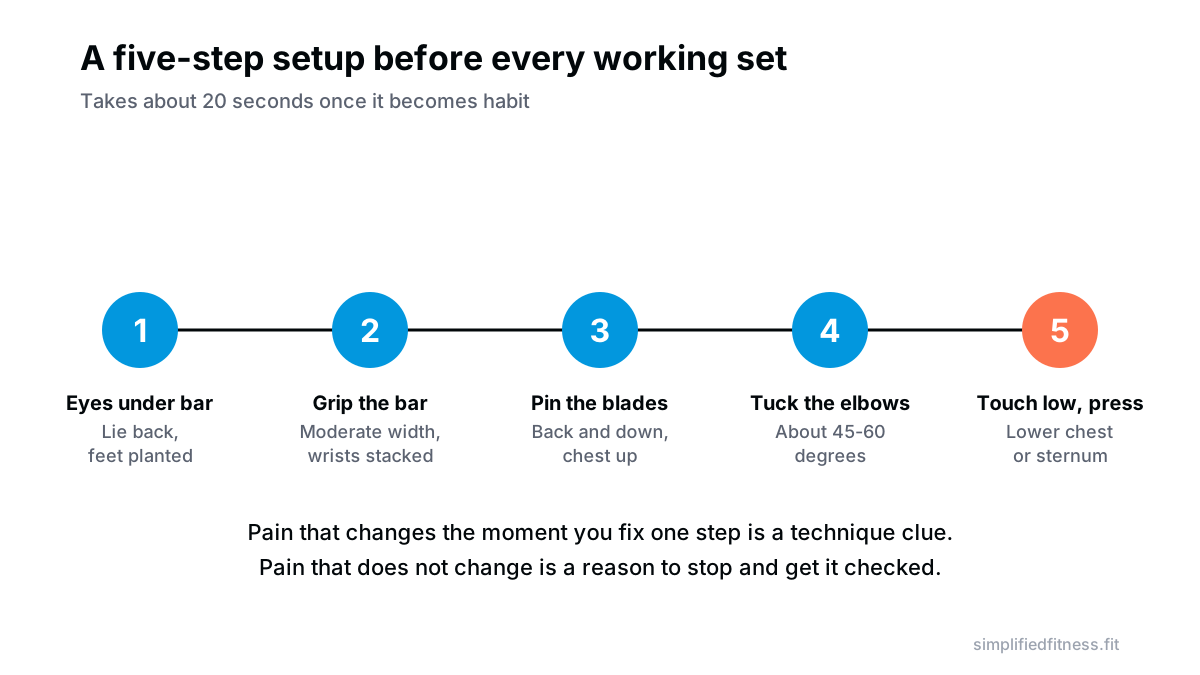
Run through it on every working set, including your first light one. Habit beats cleverness here.
Swap options while it settles
You do not have to stop training chest. You may just need a different tool for a few weeks. This is the short version; our guide to training around shoulder pain goes through each swap in depth.
- Neutral-grip dumbbell press. Palms facing each other lets the elbows tuck naturally. Many lifters find it kinder, though I know of no trial proving it heals pain. See the incline dumbbell press angle comparison.
- Floor press. The floor limits how far back the elbows travel, which is why people use it during shoulder issues. Read more in our floor press guide.
- Machine presses. Fixed paths let you control the load and range. A cable or machine can be a useful backup, though a 2022 motion-capture study noted that cable pulley exercises produced larger shoulder moments than bench press at the loads tested, so “easier on the joint” is not automatic (Schütz et al., 2022).
Cut the load by roughly 10-20% and use a rep range you can finish with clean reps and 2-3 reps in reserve. The RIR/RPE calculator can help you pick loads. A narrative review also suggests autoregulation methods (RPE, velocity) over grinding to failure for lowering overexertion risk in experienced powerlifters (Motlagh and Lipps, 2024).
Does strengthening the shoulder help?
Possibly. For people with subacromial pain syndrome, a 2024 meta-analysis of 8 randomized trials with 387 participants found scapular stabilization exercises gave greater improvements in pain (visual analog scale) and function than conventional physical therapy, but no better range of motion; the authors rate the evidence as moderately supportive and call for better trials (Zhong et al., 2024).
A 2025 network meta-analysis of 15-16 trials found concentric strengthening ranked best for pain and function in rotator cuff-related shoulder pain. For function, it and other strengthening types beat motor control and scapula-focused training, though most head-to-head comparisons for pain were not statistically significant (Zhang et al., 2025). That conflicts a little with the first review. The likely reason is different comparison groups: one pitted scapular exercises against usual physio, the other ranked seven exercise types against each other. Either way, exercise looks useful, and the specific best type remains unsettled.
A Danish sports physiotherapy statement paper found a rehabilitation programme that included strengthening had a large effect on pain and disability versus no treatment in athletes with subacromial impingement, but graded the evidence as very low to moderate quality (Liaghat et al., 2023). Translation: exercise is worth doing, ideally guided by someone who has examined your shoulder.
Add rows and face pulls into your week, which also fits well with a balanced push and pull plan. See our free workout plans for a structure with enough back work.
A short warm-up that is worth the 3 minutes
I do not know of strong evidence that a particular warm-up prevents bench press shoulder pain, so think of this as cheap preparation:
- 1-2 minutes of light band pull-aparts or external rotations.
- 5-10 slow reps with the empty bar, practicing the blade position.
- 2-4 ramp-up sets, each a bit heavier, with the same setup every time.
When to stop and see a doctor
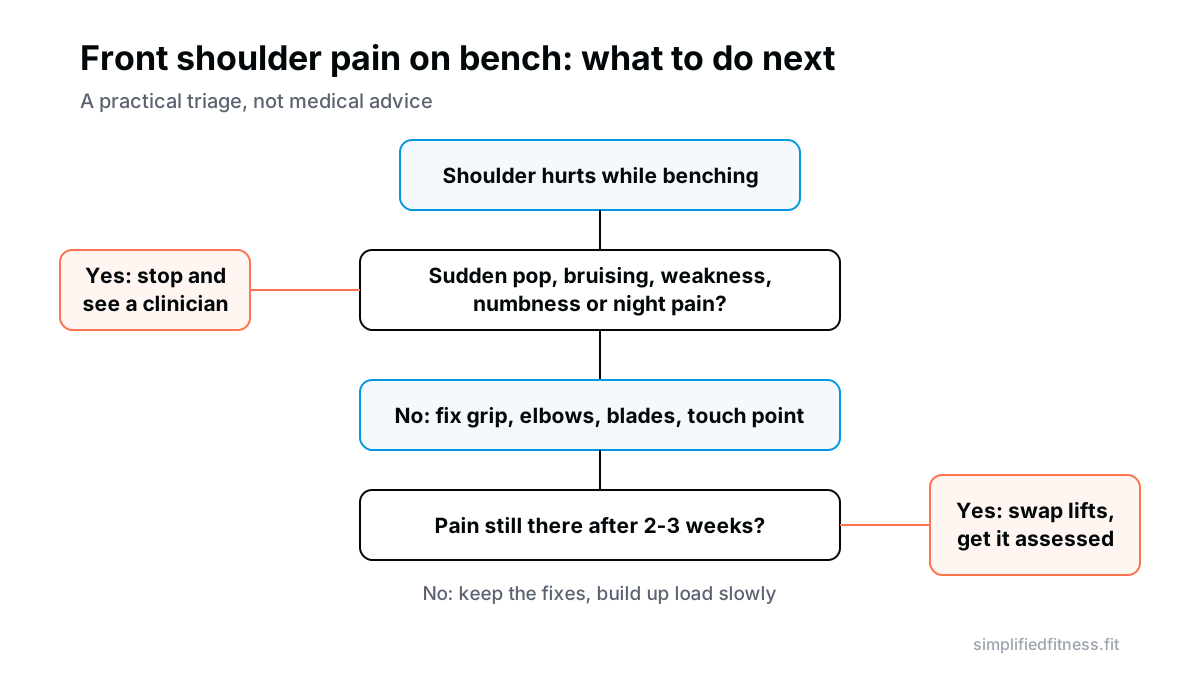
Do not push through pain that:
- started with a sudden pop or tearing sensation
- comes with bruising, visible deformity or arm weakness
- includes numbness, tingling or pain down the arm
- wakes you at night
- is not improving after 2-3 weeks of reduced load and cleaner technique
Chest muscle injuries and other structural problems can look like “just a sore shoulder” at first. A physiotherapist or sports doctor can examine the joint, which no article can do. If you want help programming around an injury, check our training volume calculator for a sensible weekly load while you recover, and use the parent chest training guide to rebuild your session structure.
The bottom line
Start with the shoulder blades, then the touch point, then the elbow tuck, then the grip. Keep the weight lighter for a couple of weeks, use dumbbells or a floor press if the barbell still bites, and add pulling and rotator cuff work. Related reading: serratus anterior and shoulder health and flat barbell bench limitations.
If the pain does not respond, or any red flag shows up, stop and get it examined. Pushing through it is how a two-week annoyance becomes a six-month problem.
Frequently Asked Questions
Why does my front shoulder hurt when I bench press?
The most common technique-related reasons are flared elbows, shoulder blades that are not pulled back, a bar that touches too high on the chest, and a grip that is too wide. Each one pushes more load through the front of the shoulder joint at the bottom of the rep. Fix the setup first, drop the load by 10-20%, and see a clinician if pain persists.
How do I fix shoulder pain from bench pressing?
Start with the setup: pull your shoulder blades back and down, tuck your elbows to roughly 45-60 degrees, touch the bar to your lower chest and use a moderate grip. A 2024 biomechanics study found that retracting the scapulae and using a narrower grip lowered estimated joint forces. Keep the weight lighter for two weeks and rebuild gradually.
Is bench press subacromial impingement real?
Subacromial pain syndrome (often called impingement) is a real and common diagnosis, but the label covers several different problems and only a clinician can tell which one you have. Systematic reviews of exercise therapy for it exist, though the quality of evidence is mixed. If your pain has lasted more than a couple of weeks, get it assessed rather than self-diagnosing.
What elbow angle is best for bench press?
A tuck of roughly 45-60 degrees from the torso is the usual coaching range, with the forearms staying close to vertical under the bar. The 2024 shoulder-load study tested 45, 70 and 90 degrees of abduction, but its published summary reports no clear result for elbow angle, so treat the number as a practical starting point. Adjust by feel and by whether the pain drops.
Does a wide grip cause shoulder pain on bench press?
A very wide grip is a plausible contributor, not a proven cause. In a lab study of 10 experienced lifters, grips narrower than 1.5 times biacromial width lowered acromioclavicular compression and some glenohumeral shear forces. Try a grip where your forearms are vertical at the bottom and see if the pain eases.
Where should the bar touch on the bench press?
For most people the lower chest or sternum is the safer target, because it keeps the forearms vertical and the elbows tucked. Touching near the collarbone or neck tends to force the elbows wide. Film a set from the side and check that the bar path and forearms look like the setup diagram above.
Should I arch my back to protect my shoulders on the bench?
A moderate arch, with the chest up and the shoulder blades pinned, is a reasonable option. In a 2022 study of 20 experienced male lifters, the arch technique produced integrated shoulder moments about 8% smaller than the standard technique at the loads tested. Keep it comfortable and do not copy a powerlifter's extreme arch.
Are dumbbells better than a barbell for shoulder pain?
Dumbbells let your hands and elbows find a path that feels comfortable, which many people with pain prefer, but I am not aware of trial evidence that they heal shoulder pain. A neutral grip (palms facing each other) often feels better on the front of the shoulder. Use them as a temporary swap while you fix the barbell setup.
Can I keep training chest with shoulder pain?
Often yes, if the movement is tolerable and the pain does not climb during the session or linger the next day. Swapping to a floor press, neutral-grip dumbbells or machines, and lowering the load, keeps training going. If pain is sharp, worsening or comes with weakness, stop and get assessed.
What exercises help shoulder pain from benching?
Scapular stabilization and progressive rotator cuff strengthening are the most studied options. A 2024 meta-analysis of 8 randomized trials (387 people) found scapular stabilization exercises reduced pain and disability more than conventional physical therapy, though not range of motion. Ask a physiotherapist for a program that fits your diagnosis.
How long does bench press shoulder pain take to go away?
There is no reliable timeline, because it depends on what is actually irritated and how much you keep provoking it. Technique-related irritation often settles within a few weeks of reduced load and better setup, but that is a coaching expectation, not a guarantee. If nothing has changed after 2-3 weeks, see a doctor or physiotherapist.
Should I warm up differently if my shoulder hurts when I bench?
A short warm-up that includes light band work for the back of the shoulder and a few ramp-up sets is a sensible habit. I do not know of strong evidence that a specific warm-up prevents pain, so see it as low-cost preparation. Do 2-4 gradually heavier sets before your first working set.
When should I see a doctor about shoulder pain from bench press?
See a clinician if you felt a sudden pop, have bruising, arm weakness, numbness or tingling, pain at night, or pain that is not improving after a few weeks. These can signal an injury that needs a proper exam. Stop pressing heavy until you have been assessed.
Sources & References
Every claim above is checked against peer-reviewed research (PubMed, U.S. National Library of Medicine) or guidance from established health bodies. How we fact-check.
- Noteboom L, et al. Effects of bench press technique variations on musculoskeletal shoulder loads and potential injury risk. Front Physiol. 2024. PMID: 38974522
- Motlagh JG, et al. The Contribution of Muscular Fatigue and Shoulder Biomechanics to Shoulder Injury Incidence During the Bench Press Exercise: A Narrative Review. J Strength Cond Res. 2024. PMID: 39808810
- Cudlip AC, et al. Upper extremity muscle activity and joint loading changes between the standard and powerlifting bench press techniques. J Sports Sci. 2022. PMID: 35236248
- Larsen S, et al. A Biomechanical Analysis of Wide, Medium, and Narrow Grip Width Effects on Kinematics, Horizontal Kinetics, and Muscle Activity on the Sticking Region in Recreationally Trained Males During 1-RM Bench Pressing. Front Sports Act Living. 2020. PMID: 33554113
- Zhong Z, et al. Effect of scapular stabilization exercises on subacromial pain (impingement) syndrome: a systematic review and meta-analysis of randomized controlled trials. Front Neurol. 2024. PMID: 38497039
- Zhang W, et al. Effects of seven types of exercise in the treatment of rotator cuff-related shoulder pain (RCRSP): a systematic review and Bayesian network meta-analysis. J Orthop Surg Res. 2025. PMID: 41276811
- Liaghat B, et al. Diagnosis, prevention and treatment of common shoulder injuries in sport: grading the evidence. Br J Sports Med. 2023. PMID: 36261251
- Schütz P, et al. Chest Exercises: Movement and Loading of Shoulder, Elbow and Wrist Joints. Sports (Basel). 2022. PMID: 35202059

Umair Hazrami · Founder & Head Coach, Simplified Fitness
Umair Hazrami founded Simplified Fitness and the Simplified Lifter channel to cut through fitness noise. With 4+ years of consistent training and 10+ coaching clients, he writes every guide from the peer-reviewed research and links the sources so you can check them. Our editorial standards.
Educational content only, not medical advice. If you have a medical condition, are pregnant, or take medication, talk to a qualified doctor before changing your diet, supplements or training. Full disclaimer.
Keep reading

Exercise Technique
Arching on the Bench Press: Powerlifting Spine Arch vs Bodybuilding Setup
Is a bench press arch cheating or dangerous for your back? Learn the difference between a powerlifting arch and a natural upper back setup, with study data.
8 min read
Exercise Technique
Bench Press Grip Width: Pec Activation, Triceps and Shoulder Clearance
Bench press grip width changes triceps load, shoulder stress and little else for your pecs. See what EMG and joint-load studies show and how to pick your grip.
7 min read
Exercise Technique
Cable Crossover Angles: High-to-Low vs Low-to-High vs Horizontal Fly
Cable crossover angles explained: what high-to-low, low-to-high and horizontal flys likely train, what the research really says, and how to set each one up.
9 min read
Exercise Technique
Chest Dips: Forward Lean Angle, Scapular Position, and Shoulder Safety
Chest dips can build your chest if you lean, set your shoulders and stop at a depth that suits you. See what the research says and how to dip safely.
8 min read