Functional Anatomy of Pectoralis Major: Clavicular, Sternocostal, and Abdominal Heads
Pectoralis major anatomy explained: where the clavicular, sternocostal and abdominal heads start, what each does, and what EMG studies say about training them.

TL;DR. The short answer
- Pectoralis major is one fan-shaped muscle with three commonly described regions: clavicular (upper), sternocostal (mid, the largest) and abdominal (lower) fibres, all attaching to the same spot on the upper arm bone.
- Its main jobs are horizontal adduction (arm across the body), shoulder internal rotation and, for the upper fibres, shoulder flexion. Lower fibres pull the arm down and in.
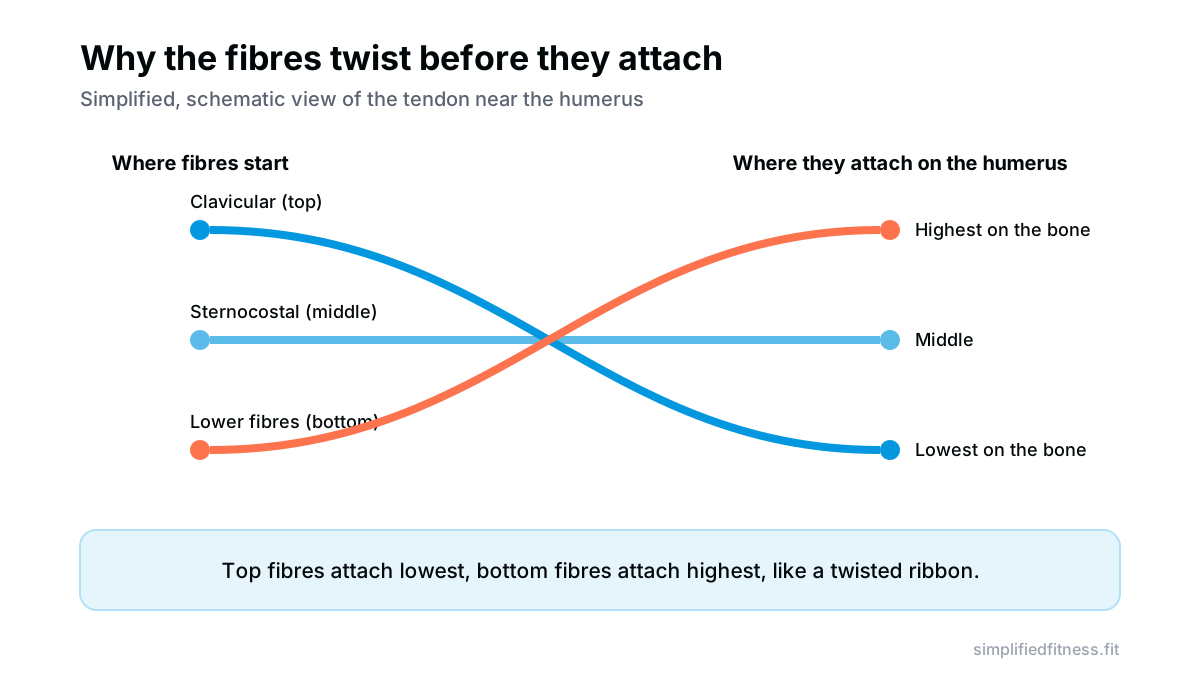
- The fibres twist before they attach, so the top fibres end up attaching lowest and the bottom fibres highest.
- Small EMG studies, mostly in men, show the clavicular head works relatively harder on a 45-degree incline and the sternocostal head on a flat bench, but both heads work in both lifts.
- Regional EMG differences do not prove regional growth. One 12-week trial in untrained men found similar growth in upper and mid chest.
Part of our complete guide: The Complete Chest Workout Guide: Pec Anatomy, Bench Angles, Flys and Shoulder-Safe Pressing
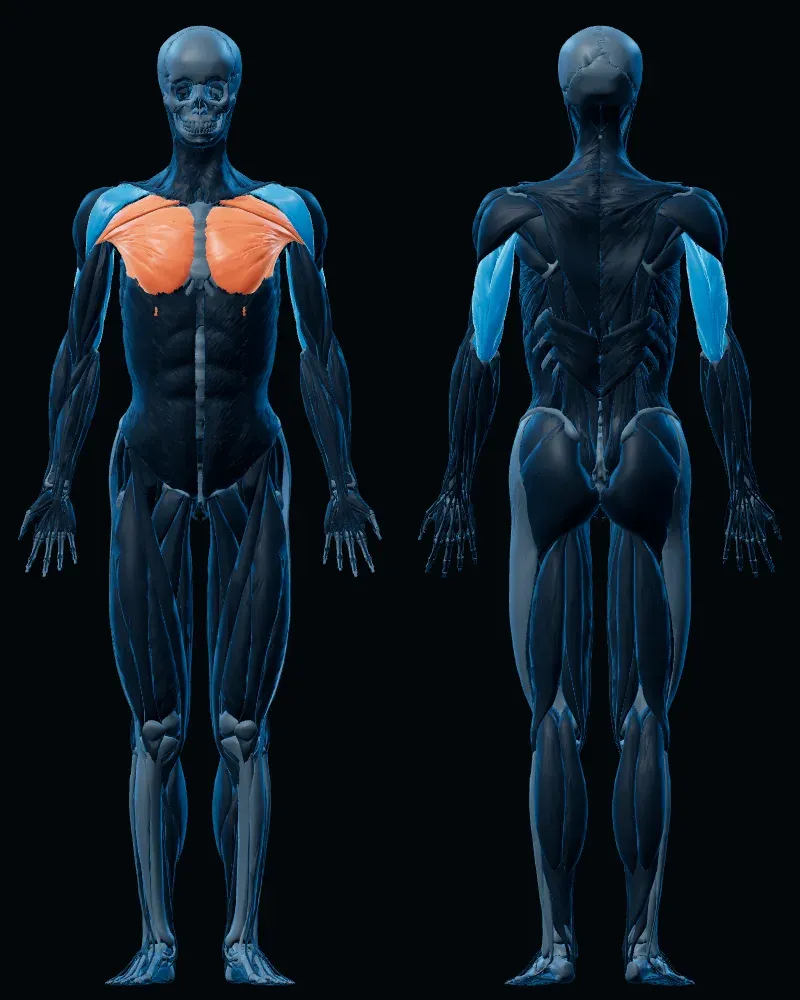
Muscles worked: chest
Main movers: pectoralis major
Assisting: front delts and triceps
Table of contents
Pectoralis major anatomy is simpler than gym lore makes it sound. It is one fan-shaped muscle, usually split into three regions: a clavicular (upper) head, a sternocostal (middle) head and an abdominal (lower) set of fibres. All three feed into one tendon on the upper arm bone, and together they pull your arm across your body and rotate it inward.
This is the anatomy map behind everything in our complete chest training guide. If you know where the fibres start and which way they run, exercise selection stops being guesswork. We will also look at what EMG and ultrasound studies say about “upper, mid and lower chest”, because that is where the myths live.
What is pectoralis major, and where does it sit?
Pectoralis major is the big superficial muscle on the front of your chest. Under it sits a smaller muscle, pectoralis minor, and over the ribs sits the serratus anterior (covered in our serratus anterior anatomy guide).
The muscle spans from your midline out to your arm. Its job is to move the humerus (upper arm bone) relative to your torso. When your torso is fixed, as in a bench press, it moves the arm. When your arm is fixed, as in a pull-up or dip, it can move the torso.
Three things define the anatomy: where the fibres start (origin), where they end (insertion) and the direction they run between the two. Direction matters most, because a muscle pulls along its fibres.
The three heads: origin, fibre direction and function
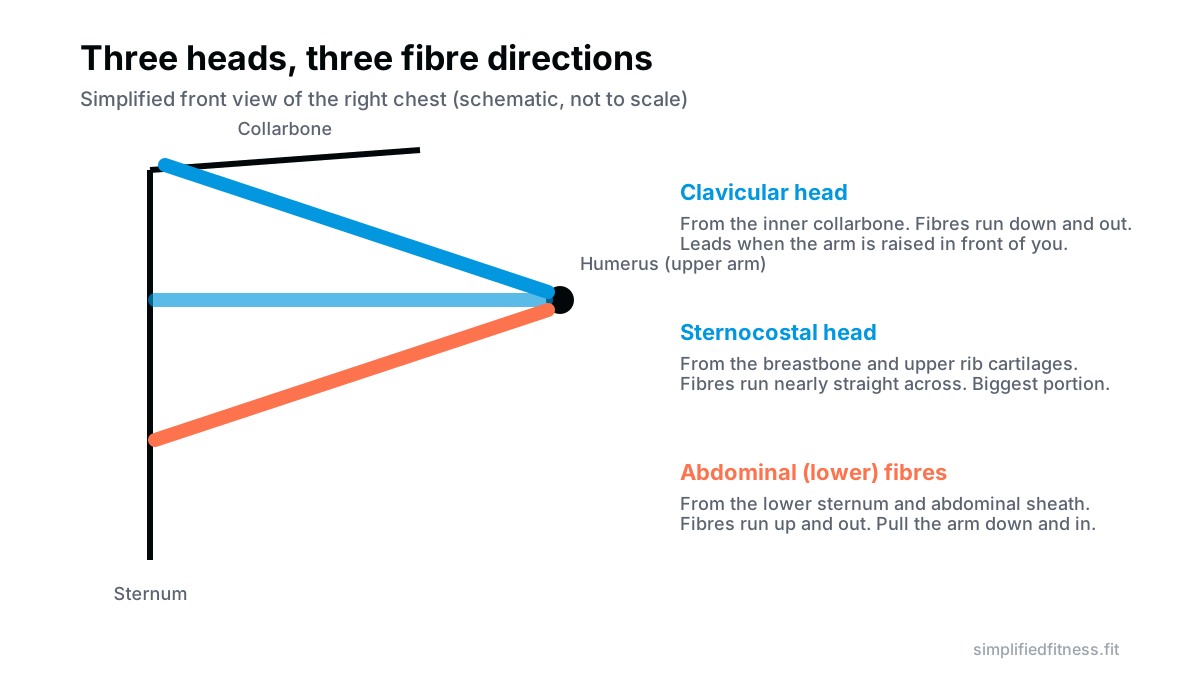
| Region | Starts on | Fibre direction | Where it works hardest |
|---|---|---|---|
| Clavicular (upper) | Inner half of the collarbone | Down and outward | Arm moving up and forward, incline presses |
| Sternocostal (middle) | Breastbone and upper rib cartilages | Mostly straight across | Flat presses, flyes, push-ups |
| Abdominal (lower) | Lower sternum and the sheath over the abdominal muscles | Up and outward | Arm moving down and in, dips, high-to-low flyes |
Anatomy texts differ slightly on exactly which structures the lowest fibres start from, and some sources fold the abdominal fibres into the sternocostal head. That is fine. The practical point is the same: the lowest fibres run uphill from the ribs and abdomen to the arm, the middle fibres run across, and the top fibres run downhill from the collarbone.
Clavicular head: the upper chest
The clavicular head is the smaller, upper portion. Because its fibres angle downward toward the arm, it is best aligned when the upper arm travels upward and forward. It also helps flex the shoulder (lifting the arm in front of you).
Many lifters call it the “upper chest” and chase it with incline work. That has some support, which we will get to below. If you want the training side, see our upper chest training guide.
Sternocostal head: the bulk of your chest
This is the largest region. Its fibres run mostly horizontally, so it is the main driver of horizontal adduction, the “hug a tree” motion. On a flat bench press, this is the head doing the lion’s share.
If your chest is going to grow from just one kind of work, this region is the reason pressing and flyes work at all.
Abdominal fibres: the lower chest
The lowest fibres run up and outward from the lower sternum and abdominal sheath. They pull the arm down and in toward your opposite hip. Dips with a forward lean and high-to-low cable flyes line up with this direction.
Here is the honest part. “Lower chest” is not a separate muscle you can switch on. It is the lowest slice of the same muscle, and the evidence for isolating it is thin. Our lower chest biomechanics article goes deeper.
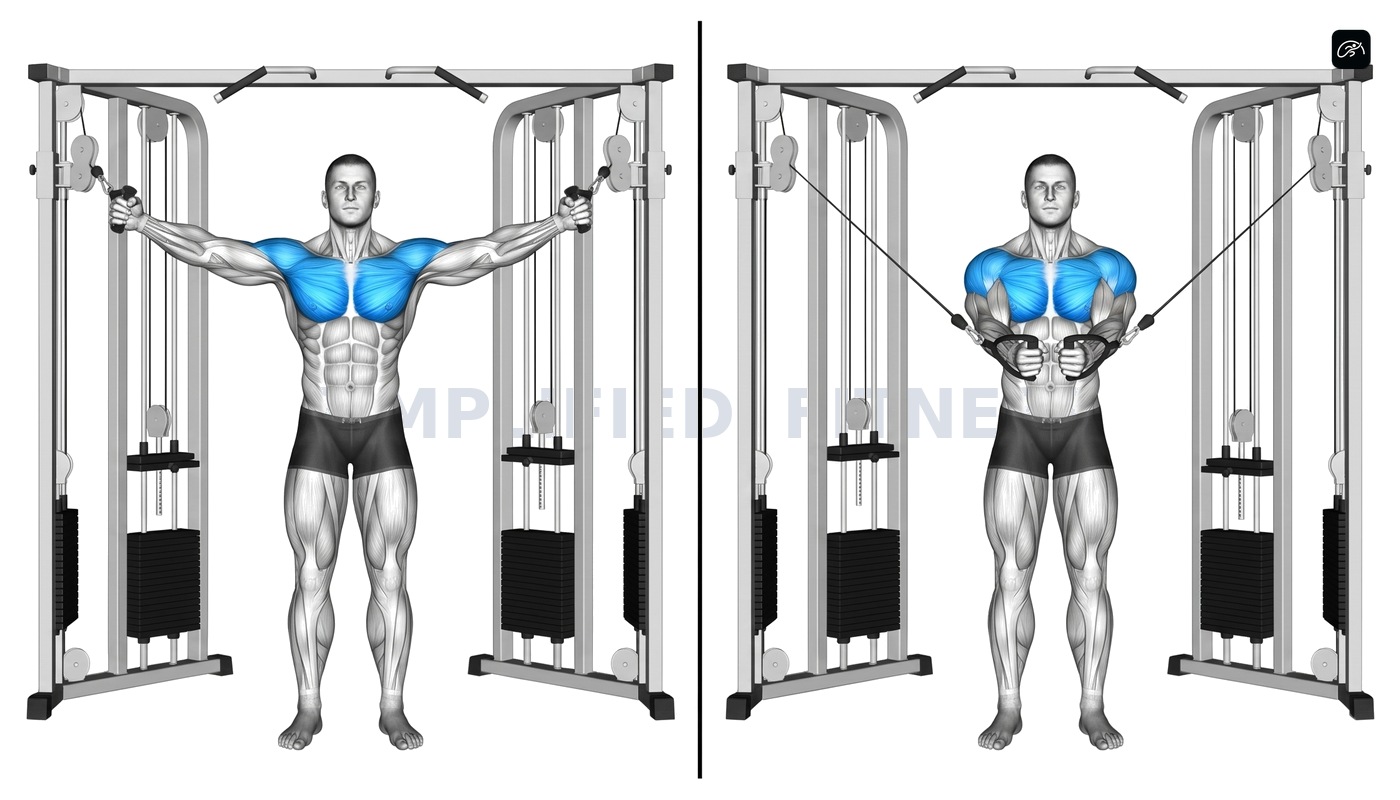
What does pectoralis major actually do?
Combine all three regions and you get four main actions at the shoulder:
- Horizontal adduction: the arm moves across the chest. Flyes, presses and push-ups all rely on this.
- Internal rotation: the upper arm rotates inward, thumb turning toward your body.
- Flexion: the upper fibres help lift the arm forward and up from the side.
- Extension from a raised position: the lower fibres help bring a raised arm back down, which is part of a pull-down or a dip.
Because the arm moves in three dimensions, the “best” exercise depends on where the hand travels. A press that moves the hands forward and slightly up leans on the upper fibres. A press or dip that moves them forward and down leans on the lower ones.
Why do the pec fibres twist before they attach?
Here is the odd part of the anatomy. The three regions do not simply run straight to the arm and attach in the same order they start.
Near the humerus, the tendon is folded so that fibres cross over each other. The top fibres end up attaching lowest on the bone, and the bottom fibres end up attaching highest, like a ribbon given a half twist. Surgical reviews of pectoralis major ruptures describe the muscle-tendon anatomy in detail because it affects how a torn tendon has to be reattached (Butt et al., 2015). Exact descriptions of the degree of twist vary between sources, so treat “about half a turn” as a teaching simplification.
Why does this matter to you in the gym?
- It explains why the muscle can generate force across a wide arc of arm positions.
- It explains why tears usually occur near the attachment, where force from all three regions concentrates.
- It is a reminder that “separate heads” is a teaching device. The muscle works as one unit with shifting emphasis.
Which head works harder on flat versus incline?
This is where anatomy meets training. Several studies have measured the electrical activity (EMG) of each region during bench pressing.
A 2022 study used high-density surface EMG, with 15 recording sites along the chest, on 8 volunteers performing flat and 45-degree incline bench presses. The centre of activity shifted toward the clavicular region on the incline, while the highest amplitudes were concentrated at the sternocostal region on the flat bench (Cabral et al., 2022).
A 2010 study of 15 healthy men tested bench angles of 0, 28, 44 and 56 degrees at 70% of 1RM. Clavicular head activity was higher at 44 and 56 degrees than at 0, while sternocostal activity was highest on the flat bench. The authors suggested using both flat and incline presses to recruit the muscle fully (Trebs et al., 2010).
Competitive bodybuilders showed a similar pattern. In 10 bodybuilders, the clavicular head was more excited on a 45-degree incline and less excited on a chest press machine, while the sternocostal head was excited more on the flat and declined presses than on the incline (Coratella et al., 2020).
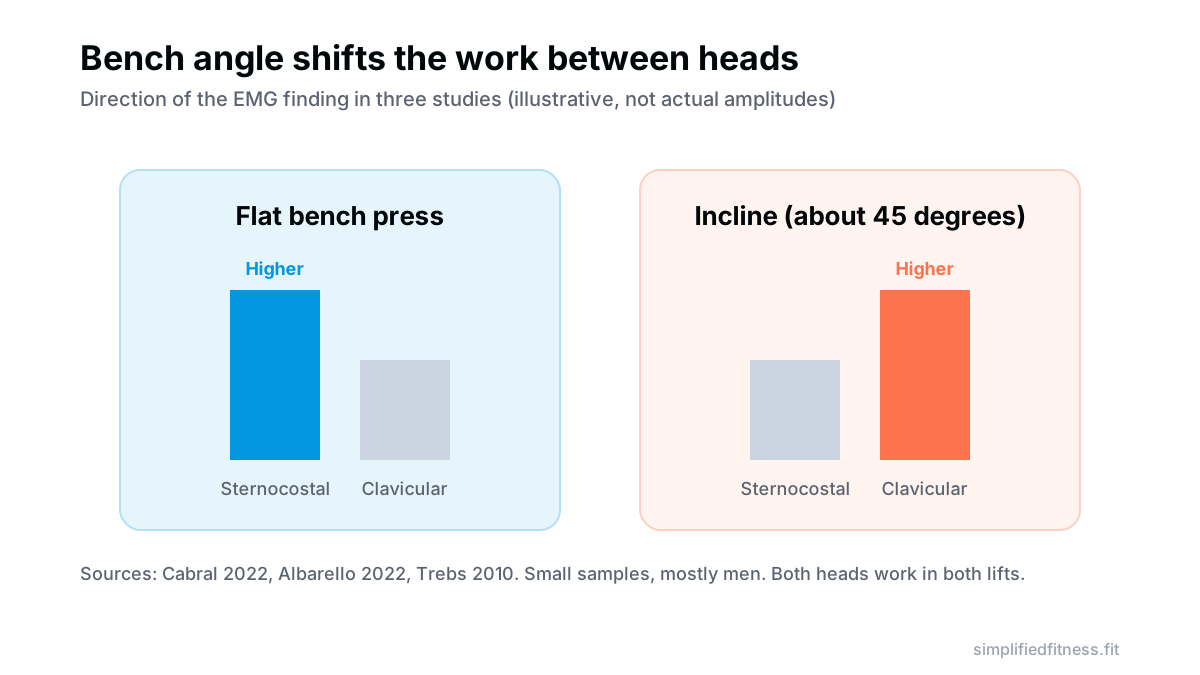
Notice the consistent direction across three independent groups. Notice also the limits: all samples are small, most participants were men, and EMG amplitude is a signal of activity, not a direct measure of growth.
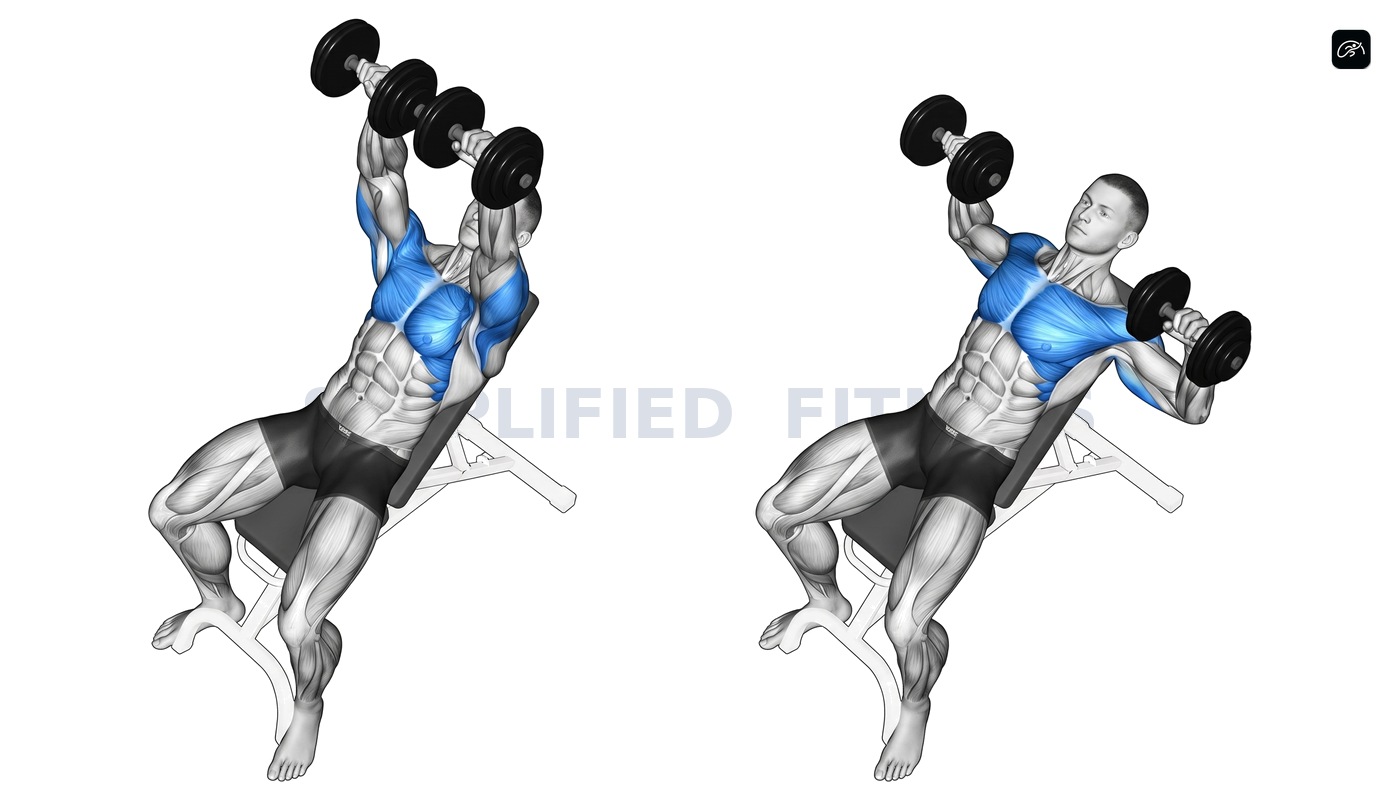
If you want to compare angles in practice, our incline dumbbell bench angle comparison covers it, and the flat barbell bench article covers what flat pressing does and does not do well.
Do these regional differences mean regional growth?
Not necessarily. This is the conflicting part of the evidence.
What the EMG and ultrasound studies show: different regions are active to different degrees depending on joint angle. What a longer training study shows: a 2025 trial put 15 untrained young men through 12 weeks of pec deck training, comparing 1 set against 3 sets per session in a within-subject design. Upper (clavicular) thickness rose about 17-18% and mid (sternocostal) thickness about 21%, regardless of volume, and the authors said the results did not support regional hypertrophy after pec deck training in untrained men (Pinto et al., 2025).
Why might they differ? The pec deck moves the arms mostly through horizontal adduction, which suits all regions. Beginners also grow almost anywhere they are loaded. The incline and flat studies measured acute responses, not months of training. And none of these trials used experienced lifters over long periods.
So here is a cautious takeaway. Using a mix of angles is reasonable, cheap insurance for even development, but nobody has shown that you can sculpt one region while ignoring the rest. Your total chest volume, effort near failure and progression still matter more than the angle label.
What nerve supplies pectoralis major?
It is mainly supplied by the lateral pectoral nerve, with help from the medial pectoral nerve. A dissection study of 30 specimens from 15 embalmed adult cadavers found the upper and proximal part of the muscle was consistently supplied through the lateral pectoral nerve, while the lower distal part got extra branches from the medial pectoral nerve or a connecting loop (Beheiry, 2012).
For you as a lifter, this just means the whole muscle is wired to fire together. For surgeons, it explains why the upper segment, which has its own nerve branch, can be transferred as a working flap.
How to use this anatomy in your training
Put it to work with a few practical rules.
- Pick at least two pressing angles each week. A flat or slight-incline press plus a 30-45 degree incline press covers the sternocostal and clavicular fibres.
- Add one fly or cable movement. Flyes put the muscle through a long stretch and horizontal adduction. A pec deck or cable fly works well, especially if your shoulders dislike heavy pressing.
- Let your elbows travel across your torso. If your hands move but your elbows stay glued to your sides, you are using more triceps and less chest.
- Use a range you can control. Descend until you feel a stretch across the chest without your shoulders rolling forward, then drive the hands up and in.
- Do not sacrifice shoulder comfort for angle. If a steep incline hurts, a lower angle works almost as well for most people.
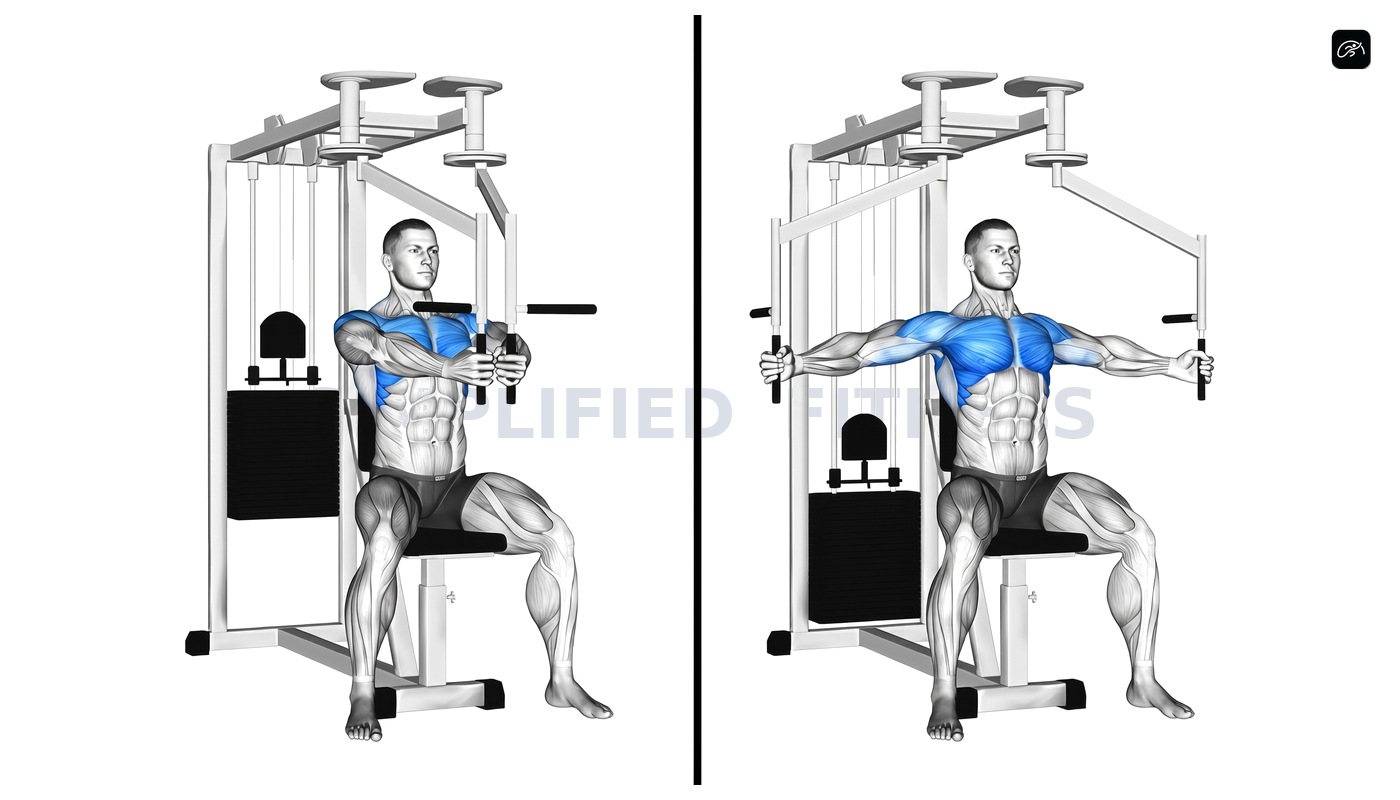
The most common mistake here is treating head names like separate buttons. A lifter does 6 sets of cable crossovers aimed at “inner chest” and skips heavy pressing. Pressing and flyes both load the same muscle, so you need both, plus enough weekly volume. Not sure how many sets? Check the training volume calculator and slot sessions into our push day plan.
At home with no equipment, the same logic works. Push-ups with feet raised on a chair mimic an incline-type angle that points the work higher up the chest, and hands raised on a bench make them easier and a bit lower in emphasis. This is based on mechanics, so use it as a rough guide rather than a rule.
Pec injuries: what to know about the attachment
The tendon where all three regions meet is also the weak point under extreme load. Reviews describe pectoralis major ruptures as becoming more common, mainly in active young men aged 20 to 40, with weight training and anabolic steroid use named as contributing factors (Thompson et al., 2020). Diagnosis relies on clinical features and often MRI, and early surgery is generally preferred for complete tears, although good results are possible later (Butt et al., 2015).
Reasonable prevention is unglamorous: warm up with progressive sets, control the lowering phase, avoid bouncing the bar off the chest and do not ego-load a deep stretch you have not trained.
The bottom line
Pectoralis major is one muscle with three fibre directions. Upper fibres run downhill from the collarbone, middle fibres run across from the breastbone and lower fibres run uphill from the abdomen, and they all end in a twisted tendon on the upper arm. Small EMG studies suggest incline pressing leans on the upper fibres and flat pressing on the middle ones, but one trial in beginners did not find region-specific growth.
Use the anatomy as a map for choosing angles, not as a promise of selective growth. Train two or three pressing and fly angles, push each set close to failure with control and progress the load. For how this fits into a full week of chest work, return to the complete chest training guide.
Frequently Asked Questions
What are the three heads of pectoralis major?
The clavicular head comes from the collarbone, the sternocostal head from the breastbone and upper rib cartilages, and the abdominal head from the lower sternum and the sheath over the abdominal muscles. Textbooks and gym coaches describe them as separate regions, but they form one muscle that shares a single tendon on the humerus. In practice, think of them as upper, middle and lower fibres with slightly different lines of pull.
What is the main function of pectoralis major?
Its main actions are horizontal adduction of the arm (bringing the upper arm across the chest), internal rotation of the shoulder and, with the upper fibres, shoulder flexion. These actions are why presses, flyes and push-ups all train it. Pick exercises where your elbows travel across your torso under load.
What muscle is the upper chest?
The upper chest is the clavicular head of pectoralis major, the fibres that start on the inner half of the collarbone. Its fibres run down and outward, so it works well when the arm moves up and forward, as in an incline press. Add an incline press or a low-to-high fly if you want to bias that region.
Is there really a lower chest muscle?
The lower chest is the lowest sternocostal and abdominal fibres of the same pectoralis major, not a separate muscle. These fibres run up and outward and pull the arm down and in, as in a dip or a high-to-low cable fly. Whether you can grow them selectively is not well proven, so cover the full range of motion with a mix of pressing angles.
Why do pec fibres twist at the humerus?
The tendon is folded so that the lower fibres attach highest on the bone and the upper fibres attach lowest, which means the fibres cross over each other near the insertion. This arrangement is described in anatomy and rupture reviews and affects how the muscle is repaired surgically. It also means the whole muscle can pull the arm across the body smoothly from many angles.
Where does pectoralis major attach?
It attaches proximally to the collarbone, sternum, upper rib cartilages and abdominal sheath, and distally to the upper front of the humerus near the bicipital groove. Because one tendon receives all three regions, any head can contribute to a given movement. Warm up the shoulder with light presses before heavy sets because this attachment takes high loads.
Do incline presses really hit the upper chest more?
In small EMG studies, mostly of men, the clavicular head showed relatively higher activity at around 44 to 45 degrees of incline, while the sternocostal head led on the flat bench. Ultrasound after incline sets also showed bigger acute swelling in the clavicular head. Use a 30-45 degree incline for part of your chest volume, but do not drop the flat press.
Can you grow the upper, middle and lower chest separately?
Not convincingly. EMG shows regional emphasis, but a 12-week trial using the pec deck in untrained men found upper and mid chest thickness rose by similar amounts. Evidence in trained lifters is limited. Train a few different angles and judge your chest by your total results, not by one region.
What nerve supplies pectoralis major?
A cadaver study of 15 bodies found the muscle is mainly supplied by the lateral pectoral nerve, with help from the medial pectoral nerve. Surgeons care about this because the upper segment can be moved on its own nerve. For lifters, it simply means the whole muscle is wired to work together during pressing.
Does pectoralis major help shoulder flexion?
Yes, mostly the clavicular fibres. When your arm is by your side, they help lift it forward and up. That is why incline presses feel closer to a front raise-type movement than flat presses do.
How common are pec tears in lifters?
Reviews describe pectoralis major tendon ruptures as increasing, mostly in young men between 20 and 40, with heavy weight training and anabolic steroid use named as contributors. They usually happen near the attachment on the humerus. If you feel a sudden tearing pain, bruising or a visible change in chest shape, stop and see an orthopaedic doctor promptly.
Why does my chest not look full even though I bench a lot?
Chest shape depends partly on muscle insertions and rib cage structure, which training cannot change, and partly on how well you load the muscle through a full range. Heavy benching with a short range and sore shoulders often under-trains the pecs. Add a stretch-focused fly or cable movement and track your chest with photos every four weeks.
Can push-ups train all three heads?
Push-ups train the whole pectoralis major, and raising your feet shifts emphasis toward the upper fibres while raising your hands shifts it toward the lower ones, though this is based on mechanics rather than strong research. They are a practical option at home. Pick a variation you can do for 8-20 hard reps near failure.
Sources & References
Every claim above is checked against peer-reviewed research (PubMed, U.S. National Library of Medicine) or guidance from established health bodies. How we fact-check.
- Cabral HV, et al. Non-uniform excitation of the pectoralis major muscle during flat and inclined bench press exercises. Scand J Med Sci Sports. 2022. PMID: 34644424
- Albarello JCDS, et al. Non-uniform excitation of pectoralis major induced by changes in bench press inclination leads to uneven variations in the cross-sectional area measured by panoramic ultrasonography. J Electromyogr Kinesiol. 2022. PMID: 36334406
- Trebs AA, et al. An electromyography analysis of 3 muscles surrounding the shoulder joint during the performance of a chest press exercise at several angles. J Strength Cond Res. 2010. PMID: 20512064
- Coratella G, et al. Specific prime movers' excitation during free-weight bench press variations and chest press machine in competitive bodybuilders. Eur J Sport Sci. 2020. PMID: 31397215
- Pinto MD, et al. Pectoralis clavicular and sternocostal thicknesses increase similarly in response to one and three sets of pec deck resistance training in untrained young men. J Strength Cond Res. 2025. PMID: 40266636
- Beheiry EE. Innervation of the pectoralis major muscle: anatomical study. Ann Plast Surg. 2012. PMID: 21587039
- Butt U, et al. Pectoralis major ruptures: a review of current management. J Shoulder Elbow Surg. 2015. PMID: 25556808
- Thompson K, et al. Everything pectoralis major: from repair to transfer. Phys Sportsmed. 2020. PMID: 31246519

Umair Hazrami · Founder & Head Coach, Simplified Fitness
Umair Hazrami founded Simplified Fitness and the Simplified Lifter channel to cut through fitness noise. With 4+ years of consistent training and 10+ coaching clients, he writes every guide from the peer-reviewed research and links the sources so you can check them. Our editorial standards.
Educational content only, not medical advice. If you have a medical condition, are pregnant, or take medication, talk to a qualified doctor before changing your diet, supplements or training. Full disclaimer.
Keep reading

Exercise Technique
Arching on the Bench Press: Powerlifting Spine Arch vs Bodybuilding Setup
Is a bench press arch cheating or dangerous for your back? Learn the difference between a powerlifting arch and a natural upper back setup, with study data.
8 min read
Exercise Technique
Bench Press Grip Width: Pec Activation, Triceps and Shoulder Clearance
Bench press grip width changes triceps load, shoulder stress and little else for your pecs. See what EMG and joint-load studies show and how to pick your grip.
7 min read
Exercise Technique
Cable Crossover Angles: High-to-Low vs Low-to-High vs Horizontal Fly
Cable crossover angles explained: what high-to-low, low-to-high and horizontal flys likely train, what the research really says, and how to set each one up.
9 min read
Exercise Technique
Chest Dips: Forward Lean Angle, Scapular Position, and Shoulder Safety
Chest dips can build your chest if you lean, set your shoulders and stop at a depth that suits you. See what the research says and how to dip safely.
8 min read