Lower Chest Workout: Do You Need Decline Bench or Are Dips and Cable Flys Enough?
A lower chest workout does not need a decline bench. See what EMG studies show about sternocostal pecs, plus how dips and high-to-low flys fit in.
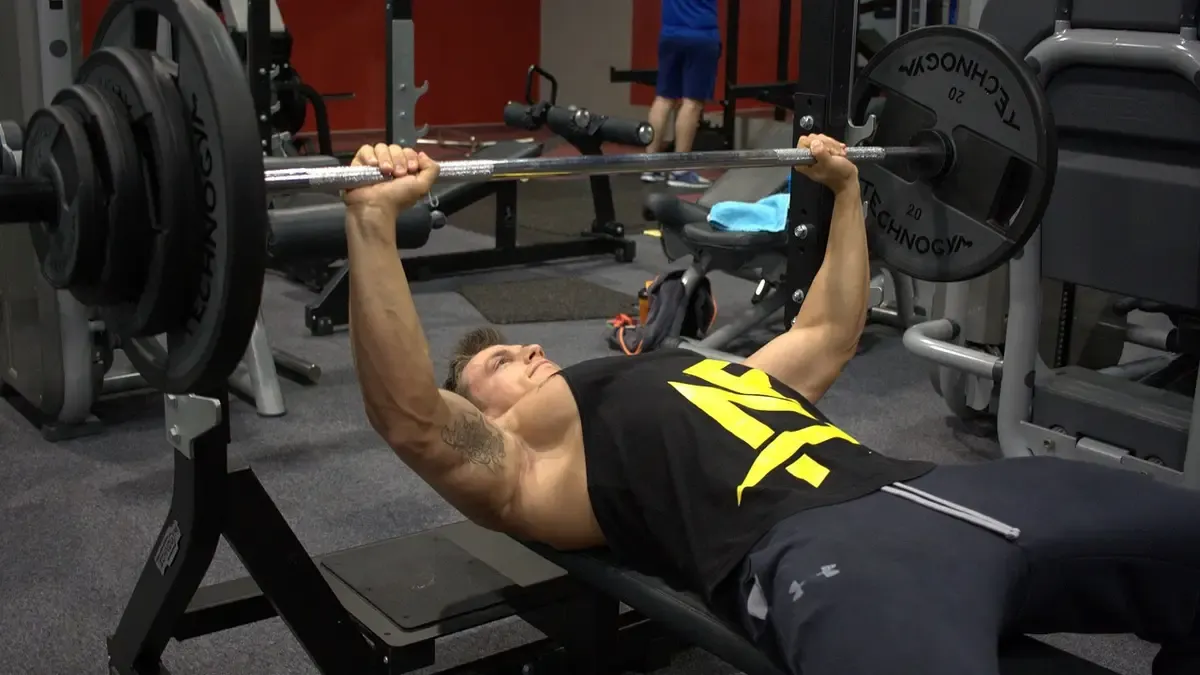
TL;DR. The short answer
- You do not have to buy into the decline bench. In bodybuilders, EMG of the sternocostal head (the large mid and lower part of the pec) was similar on decline and flat bench press, so decline is not clearly a different stimulus.
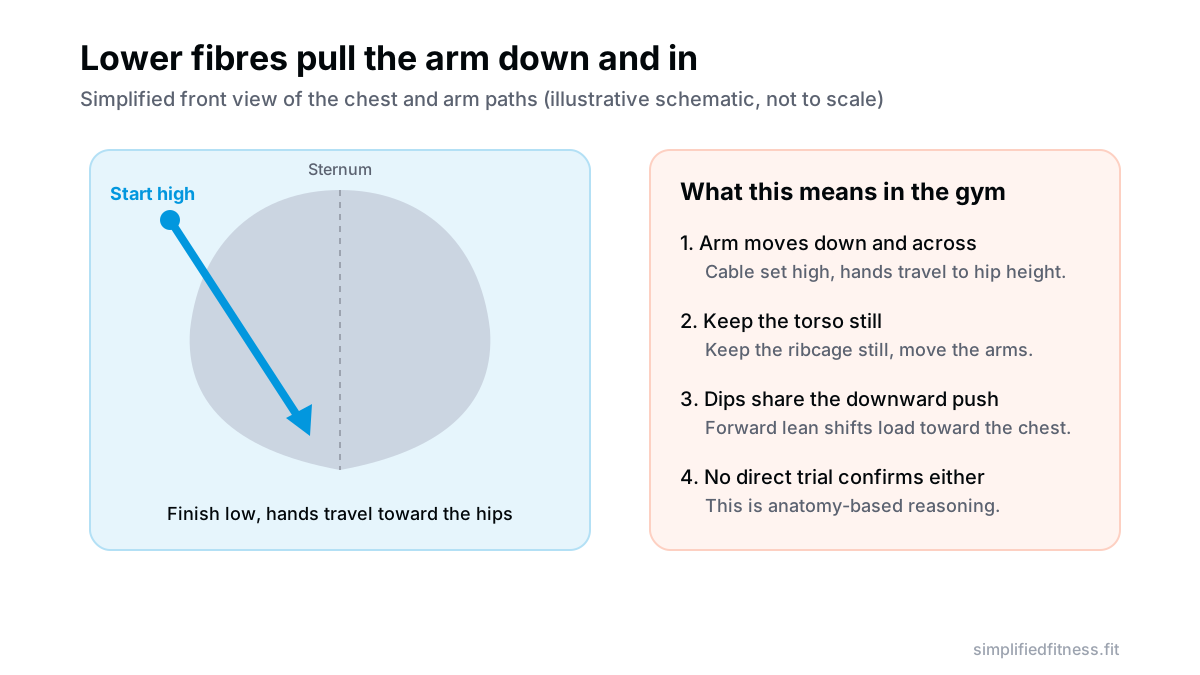
- The 'lower chest' is the lower sternocostal fibres plus the small abdominal portion of pectoralis major. Their line of pull runs with the arm moving down and across the body.
- High-to-low cable flys and forward-leaning dips match that arm path. Direct trials comparing them with decline bench for growth do not exist, so treat this as anatomy-based reasoning.
- Regional EMG differences do not guarantee regional growth. A 12-week trial in untrained men found similar upper and mid chest growth after pec deck training.
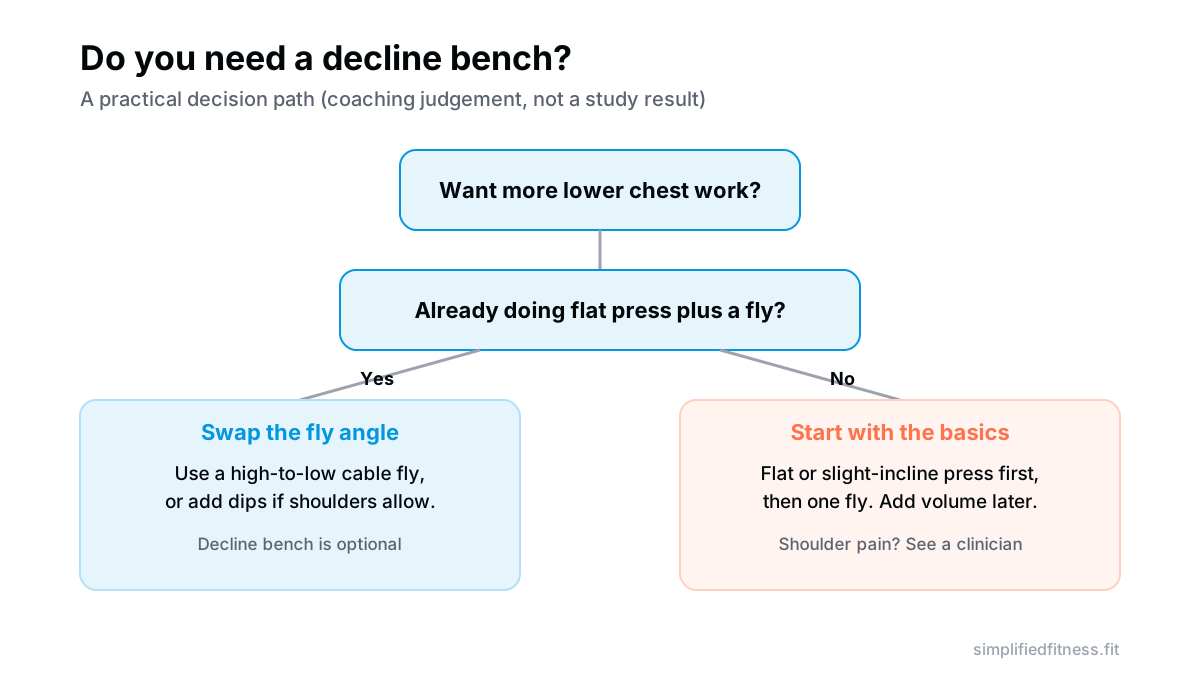
- A flat bench press, one downward-angled fly and (if shoulders tolerate it) dips cover the lower chest for most lifters.
Part of our complete guide: The Complete Chest Workout Guide: Pec Anatomy, Bench Angles, Flys and Shoulder-Safe Pressing
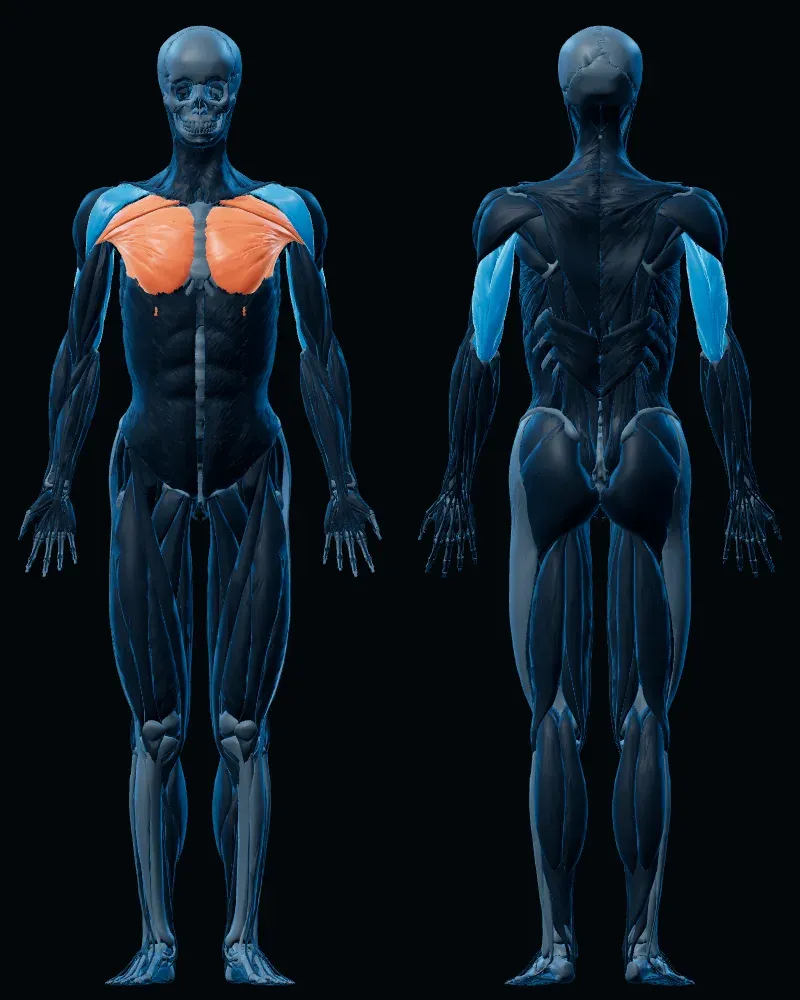
Muscles worked: chest
Main movers: pectoralis major
Assisting: front delts and triceps
Table of contents
You do not need a decline bench to build a lower chest workout that works. Dips and high-to-low cable flys cover the same lower fibres, and the best direct evidence we have suggests decline pressing is not a clearly different stimulus from flat pressing.
That runs against gym tradition. Decline bench has been sold as “the lower chest exercise” for decades. Here is what the research actually shows, and what to do instead. This article sits inside our complete chest training guide, so if you want the full picture of how to organise a chest week, start there.
What is the “lower chest,” anatomically?
Pectoralis major is one fan-shaped muscle. It is usually described in regions: the clavicular head (upper), the sternocostal head (the big middle and lower portion, from the breastbone and upper rib cartilages) and a smaller abdominal portion near the bottom. All of them gather into one tendon on the upper arm bone. We cover the full map in our pectoralis major anatomy breakdown.
So the “lower chest” in lifter language is mostly the lower sternocostal fibres, with a little help from the abdominal part. Not a separate muscle. Not a switch.
The key idea is the line of pull. Fibres shorten along their own direction, so the lower ones are best placed when your arm moves down and across your body, like pulling something from shoulder height toward your opposite hip. Pressing straight out from the chest, or overhead, shifts the emphasis elsewhere.
Is decline bench press the best lower chest exercise?
Probably not. Let’s go through what has been measured.
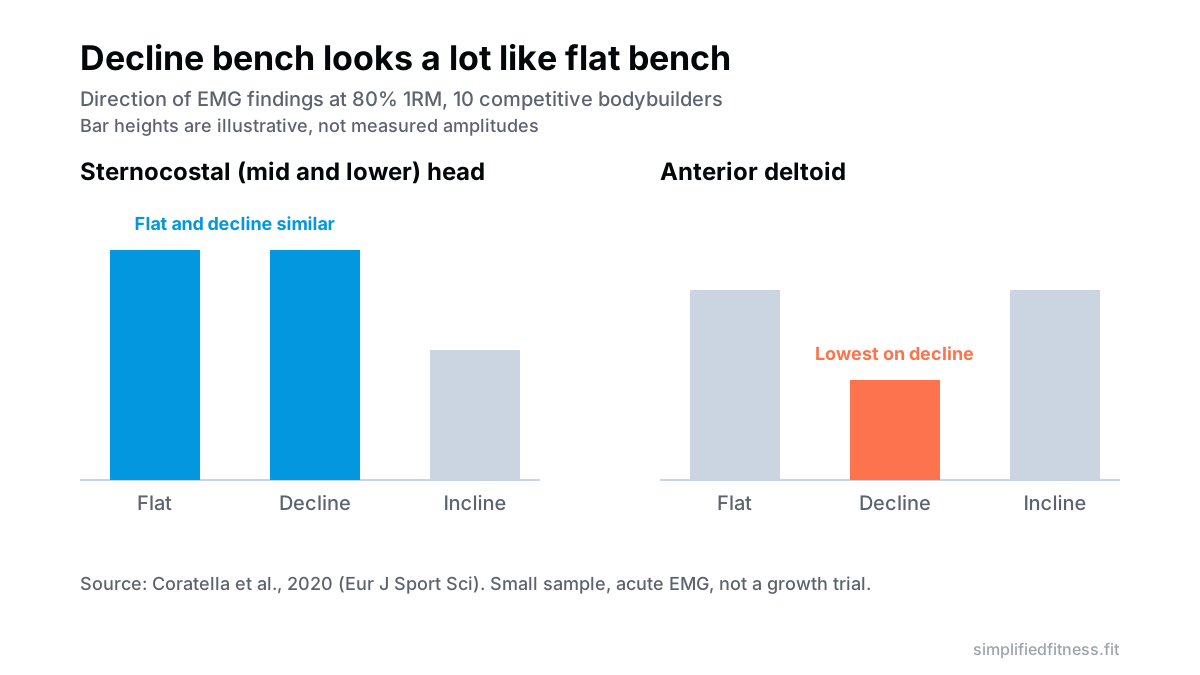
Coratella and colleagues recorded muscle activity (EMG) in 10 competitive bodybuilders using 80% of their one-rep max on flat, 45-degree incline, -15-degree decline and chest press machine variations. The sternocostal head was similarly excited in decline and flat bench press, and more excited than on incline (Coratella et al., 2020). Anterior deltoid activity was lower on decline than on the other exercises, and triceps activity was greater on flat and decline than on the others.
That last part is interesting. Decline takes some work off the front delts. It may feel “chesty” for that reason, not because it reaches a different set of pec fibres.
A second study of 20 trained lifters compared decline, flat and incline pressing with barbells and dumbbells. Pectoralis major activation was lower on incline dumbbell than on decline dumbbell, but the authors also noted they could not separate pec regions with their sensor placement, which limits what we can say about the lower fibres (Christian et al., 2023).
A third study put 12 national and international level bench press athletes through a 6-rep max on flat, incline and decline positions. Pectoralis major activation did not differ significantly between the three positions (Saeterbakken et al., 2017). The 6RM loads were 18.5-21.5% lower on incline than on flat and decline, so in that group decline loads sat in the same range as flat rather than below it.
What are the real drawbacks of decline bench?
Some of this is practical rather than scientific, so treat it as coaching judgement.
- Short range of motion. On a decline, the bar touches lower on the chest and the bar travels a shorter distance. Less range is not automatically worse (more on that below), but it does mean less stretch on the pec.
- Awkward setup. Many decline benches need you to hook your feet in, lower yourself back and unrack with your head below your hips.
- Scary rerack. If you fail a rep on a heavy set without a spotter, you cannot easily bail out. A rack with safeties is the fix, but not every gym has one.
- Head-down position. Some people dislike the pressure and dizziness. Anyone with high blood pressure, glaucoma or similar conditions should check with their doctor before training head-down.
On range of motion, the evidence is nuanced. A systematic review found that for the upper limbs, research on full versus partial range of motion is limited and conflicting (Schoenfeld and Grgic, 2020). A later meta-analysis of 16 studies found full range of motion was better for strength and for lower-limb hypertrophy, but no significant difference for changes in muscle architecture such as muscle thickness (Pallares et al., 2021). So I would not claim decline “fails” because of range of motion. I would just say it gives you less reason to pick it over flat.
What is the best lower chest workout without decline bench?
Use the arm path. Three options match the lower fibres’ line of pull.
High-to-low cable fly
Set both pulleys above shoulder height. Step forward, lean slightly, and bring your hands down and together toward hip level, with a soft bend at the elbows.
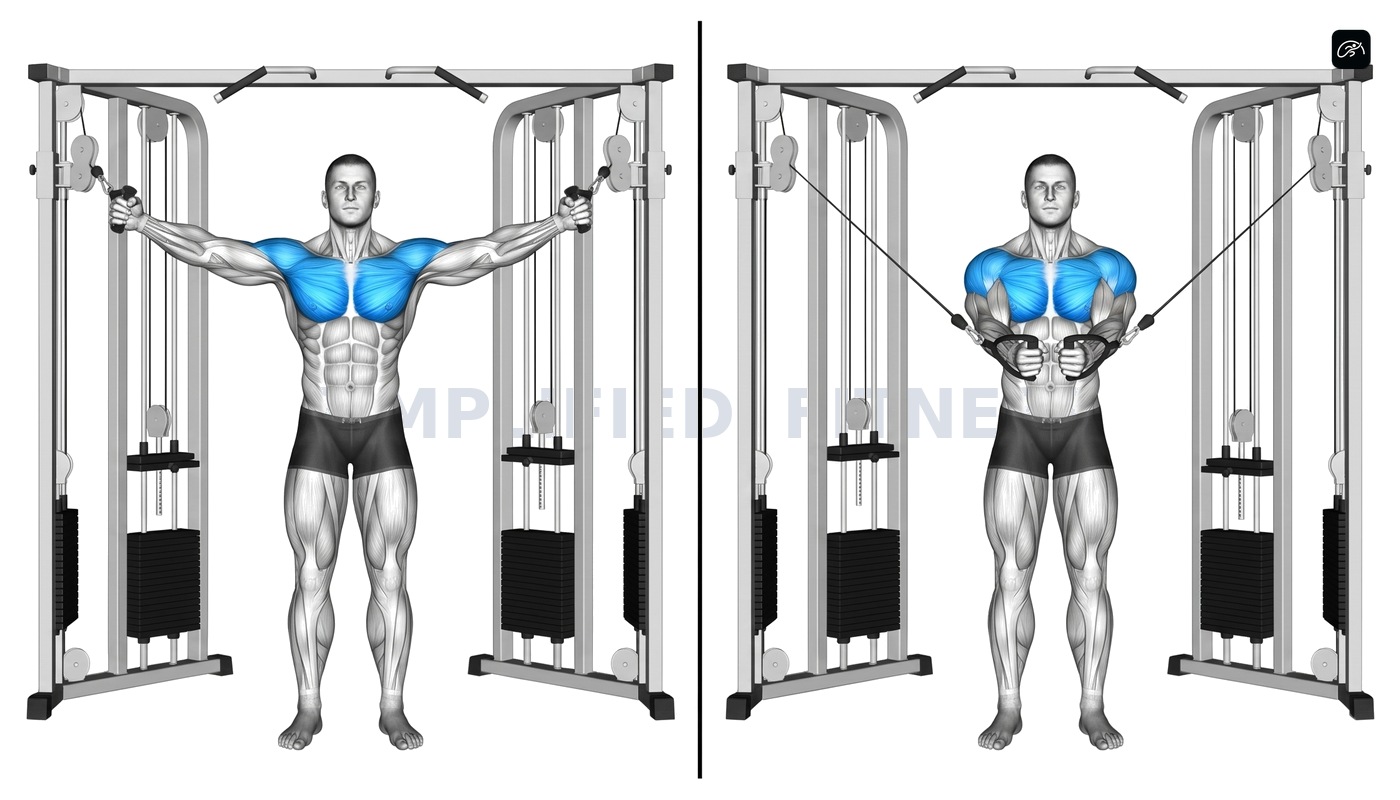
It keeps constant tension, it is easy to load in small steps, and there is no rerack risk. The weak spot is that no trial has isolated this exact exercise for lower pec growth. The reasoning comes from fibre direction, so I would call it “likely well-suited,” not “proven.” For setup details, our guide to cable pulley heights and angles and the breakdown of cable crossover vectors for chest growth go deeper.
Dips with a forward lean
Dips push your body down and forward between parallel bars. Leaning the torso forward and flaring the elbows slightly shifts the demand toward the chest and away from the triceps. They allow a deep stretch and heavy loading with a dip belt.
I could not find a study that measured pec regional activation during dips versus decline bench, so the claim that dips hit the lower chest is based on mechanics. It is plausible, not confirmed. Dips also load the front of the shoulder heavily at the bottom. If you have any shoulder history, read our guide to chest dips, forward lean and shoulder safety before you add them.
Flat press with a downward drive
A flat barbell or dumbbell press already works the sternocostal head hard, as the EMG studies above suggest. Think of driving the bar up and slightly back toward the rack, with elbows tucked at about 45-60 degrees. Our write-up on flat bench limitations covers what flat pressing does and does not do well.
Can you grow just the lower chest?
This is where the “lower chest line myth” comes from.
The line you see under the pec is the lower border of the muscle, set by where it attaches on your breastbone and ribs. You cannot move that attachment. A lean, thick pec shows a clearer edge, but no exercise will lower or sharpen the attachment itself.
On whether regions grow selectively, the evidence is thin and mixed. In a within-subject trial, 15 untrained young men trained the pec deck for 12 weeks, one set versus three sets, and thickness of both the clavicular (about 17-18%) and sternocostal (about 21%) regions rose by similar amounts. The authors concluded their results did not support regional hypertrophy from that exercise (Pinto et al., 2025).
On the other side, an acute study of 13 men found flat bench press raised sternocostal cross-sectional area more than clavicular, while 45-degree incline did the reverse (Albarello et al., 2022). That is a short-term swelling response, not long-term growth, but it suggests exercise angle shifts where the work lands.
Why might these differ? One is an acute measure and the other is a 12-week training outcome, and one used angled presses while the other used a pec deck. A pooled analysis of 12 studies also found that training at longer versus shorter muscle lengths produced similar regional hypertrophy across muscles in general (not the chest specifically), though the authors cautioned that the length differences between conditions were small (Varovic et al., 2025).
My cautious read: angle probably nudges emphasis, but whole-pec growth is the main event. You do not need a special exercise to “unlock” the bottom.
How to build a lower chest workout into your week
Here is a simple structure that fits inside a normal chest day. Adjust volume to your recovery.
| Slot | Exercise | Why it is there |
|---|---|---|
| 1 | Flat barbell or dumbbell press | Heavy compound work for the sternocostal head |
| 2 | Dips with forward lean (or machine press) | Downward, deep-stretch pressing |
| 3 | High-to-low cable fly | Constant tension along the lower fibre path |
Three exercises is plenty. A fourth only helps if you are recovering well and still progressing. If you want to see where your total weekly chest sets land, our training volume calculator makes it easy, and the push day plan gives a ready layout.
A few practical notes for Indian gyms. Many commercial gyms have a crowded decline bench with no safety rack, which is one more reason to skip it. If cables are busy at peak evening hours, a dip station or a flat dumbbell press is a reasonable fallback that needs very little equipment.
Don’t overdo it either. If chest day already feels like too much, overlapping movements are a known problem, and exercise redundancy explains how to trim them.
When to see a doctor
Chest-region pain that comes on during exercise, spreads to the arm or jaw, or comes with breathlessness needs urgent medical attention, not an exercise tweak. Sharp shoulder pain, a pop at the front of the shoulder or arm during a press, or bruising across the chest and upper arm after a lift are reasons to stop and get assessed. The same applies if you have high blood pressure or eye conditions and are considering head-down training. This article is general education, not a diagnosis.
The bottom line
A decline bench is optional. In trained lifters, decline pressing looks a lot like flat pressing for the sternocostal head, and the extra drawbacks (setup, rerack, short range) are real. High-to-low cable flys and forward-leaning dips fit the lower fibres’ line of pull, though neither has been tested head to head against decline for growth.
So press flat, add a downward-angled fly, add dips if your shoulders like them, and keep progressing. Do that for months and the lower chest takes care of itself.
Frequently Asked Questions
Do you need decline bench press for lower chest?
No, not for most lifters. In 10 competitive bodybuilders, sternocostal head EMG was similar on decline and flat bench press, so decline does not appear to hit a clearly different region. Build the lower chest with a flat press, a high-to-low cable fly and, if your shoulders are fine with it, dips.
What muscle is the lower chest?
The lower chest is the lower fibres of the sternocostal head of pectoralis major, plus the smaller abdominal portion that starts near the lower sternum and the abdominal sheath. They are part of one muscle with a shared tendon on the upper arm bone. Think of them as the fibres that pull the arm down and across your body.
Are dips better than decline bench for lower chest?
Nobody has compared them head to head for lower chest growth, so no one can honestly say dips are better. Dips push your body down and forward in a path that suits the lower fibres, and they allow a deep stretch, which many lifters prefer. Try dips with a slight forward lean for a few weeks and keep them only if your shoulders feel good.
Does high-to-low cable fly work the lower chest?
It likely loads the lower fibres well because the arms travel down and across the body, which matches their line of pull. Direct measurements of this exact exercise are scarce, so the claim rests on anatomy rather than a trial. Set the pulleys above shoulder height, finish with hands near hip level and pause briefly at the bottom.
Is there really a lower chest line, or is it a myth?
The visible line is mostly the lower edge of the whole pec, set by your bone structure and muscle attachments, not a separate muscle you can switch on. Training makes the pec thicker and can make the edge look sharper, but you cannot move where it attaches. Focus on getting the whole chest bigger and leaner rather than chasing one line.
Can you grow just the lower chest?
There is little evidence that you can selectively grow one region on demand. In a 12-week trial in untrained men, pec deck training raised upper and mid chest thickness by similar amounts (17-18% and 21%). Pick exercises you can progress and the whole pec tends to grow.
Is decline bench press bad for you?
It is not inherently dangerous, but it is awkward for many lifters. Getting set up, unracking and re-racking the bar while lying head-down can feel unstable, and pressure in the head is uncomfortable for some people. If you have high blood pressure, eye problems or shoulder pain, ask your doctor before using a decline bench.
How many sets for the lower chest per week?
There is no specific lower chest number backed by research. Your pressing and flys already train the lower fibres, so count them in your total chest volume instead. Most lifters do well with a modest weekly total spread over two sessions, and you can check yours with our training volume calculator.
Is a decline dumbbell press useful?
It can be a fine option if you like it, but it is not necessary. One study found pectoralis major activation was higher on a decline dumbbell press than on an incline dumbbell press, although the authors noted limits in how they measured it. Use it as a variation, not as a requirement.
What is the best lower chest exercise at home or in a crowded gym?
Dips on parallel bars or a stable bench, and push-ups with your feet elevated or hands set on a bench, are simple options. Cables are ideal when free, but a flat dumbbell press with a slight downward drive also works. Pick whichever you can load progressively with steady form.
How should I train lower chest if I have shoulder pain on dips?
Drop dips and use a high-to-low cable fly or a machine press instead, since these let you control the depth. Deep dips put the shoulder in a stretched, loaded position that some people do not tolerate. Persistent or sharp shoulder pain needs a clinician or physiotherapist, not a new exercise.
Should I do lower chest exercises on push day?
Yes, they fit naturally into push day with your other chest work. Start with a heavy press while you are fresh, then add a fly or dip variation later in the session. See our push day plan for a ready-made layout.
How often should I train lower chest?
Treat it as part of the whole chest and train the chest about twice a week if recovery allows. Splitting the same total volume across two days is easier to recover from than one marathon session. Track your reps and loads so each week you do a little more or a little better.
Sources & References
Every claim above is checked against peer-reviewed research (PubMed, U.S. National Library of Medicine) or guidance from established health bodies. How we fact-check.
- Coratella G, et al. Specific prime movers' excitation during free-weight bench press variations and chest press machine in competitive bodybuilders. Eur J Sport Sci. 2020. PMID: 31397215
- Christian JR, et al. Analysis of the activation of upper-extremity muscles during various chest press modalities. J Strength Cond Res. 2023. PMID: 36026487
- Saeterbakken AH, et al. The effects of bench press variations in competitive athletes on muscle activity and performance. J Hum Kinet. 2017. PMID: 28713459
- Albarello JCDS, et al. Non-uniform excitation of pectoralis major induced by changes in bench press inclination leads to uneven variations in the cross-sectional area measured by panoramic ultrasonography. J Electromyogr Kinesiol. 2022. PMID: 36334406
- Pinto MD, et al. Pectoralis clavicular and sternocostal thicknesses increase similarly in response to one and three sets of pec deck resistance training in untrained young men. J Strength Cond Res. 2025. PMID: 40266636
- Schoenfeld BJ, Grgic J. Effects of range of motion on muscle development during resistance training interventions: a systematic review. SAGE Open Med. 2020. PMID: 32030125
- Pallares JG, et al. Effects of range of motion on resistance training adaptations: a systematic review and meta-analysis. Scand J Med Sci Sports. 2021. PMID: 34170576
- Varovic D, et al. Does muscle length influence regional hypertrophy? A systematic review and meta-analysis. Int J Sports Med. 2025. PMID: 40570881

Umair Hazrami · Founder & Head Coach, Simplified Fitness
Umair Hazrami founded Simplified Fitness and the Simplified Lifter channel to cut through fitness noise. With 4+ years of consistent training and 10+ coaching clients, he writes every guide from the peer-reviewed research and links the sources so you can check them. Our editorial standards.
Educational content only, not medical advice. If you have a medical condition, are pregnant, or take medication, talk to a qualified doctor before changing your diet, supplements or training. Full disclaimer.
Keep reading
Exercise Technique
Arching on the Bench Press: Powerlifting Spine Arch vs Bodybuilding Setup
Is a bench press arch cheating or dangerous for your back? Learn the difference between a powerlifting arch and a natural upper back setup, with study data.
8 min read
Exercise Technique
Bench Press Grip Width: Pec Activation, Triceps and Shoulder Clearance
Bench press grip width changes triceps load, shoulder stress and little else for your pecs. See what EMG and joint-load studies show and how to pick your grip.
7 min read
Exercise Technique
Cable Crossover Angles: High-to-Low vs Low-to-High vs Horizontal Fly
Cable crossover angles explained: what high-to-low, low-to-high and horizontal flys likely train, what the research really says, and how to set each one up.
9 min read
Exercise Technique
Chest Dips: Forward Lean Angle, Scapular Position, and Shoulder Safety
Chest dips can build your chest if you lean, set your shoulders and stop at a depth that suits you. See what the research says and how to dip safely.
8 min read