Flat Barbell Bench Press for Hypertrophy: Setup, Muscle Activation, and Pec Limitations
Is the flat barbell bench press good for chest growth? See what EMG research shows, how to set up for your pecs, and where dumbbells or machines fill the gaps.
TL;DR. The short answer
- The flat barbell bench press is a good chest builder because it lets you load the pecs heavily and stably, but it is not magic and it is not the only tool. Evidence on how it compares with other presses for muscle growth is limited.
- Muscle activation studies show only small differences between grips, bench angles and press variations, so choose the version you can load heavily, control, and do without pain.
- For bodybuilding, retract your shoulder blades, use a moderate arch, grip about 1.5 times shoulder width and lower under control to the lower chest.
- A straight bar fixes your hands in place, so it gives less freedom for the arms to travel toward the midline and for the shoulders to move naturally. Add dumbbell presses, flies or a converging machine to fill that gap.
- Shoulder pain on bench is a signal to change grip, arm angle or exercise, not to push through it. See a doctor or physio if pain persists or follows an injury.
Part of our complete guide: The Complete Chest Workout Guide: Pec Anatomy, Bench Angles, Flys and Shoulder-Safe Pressing
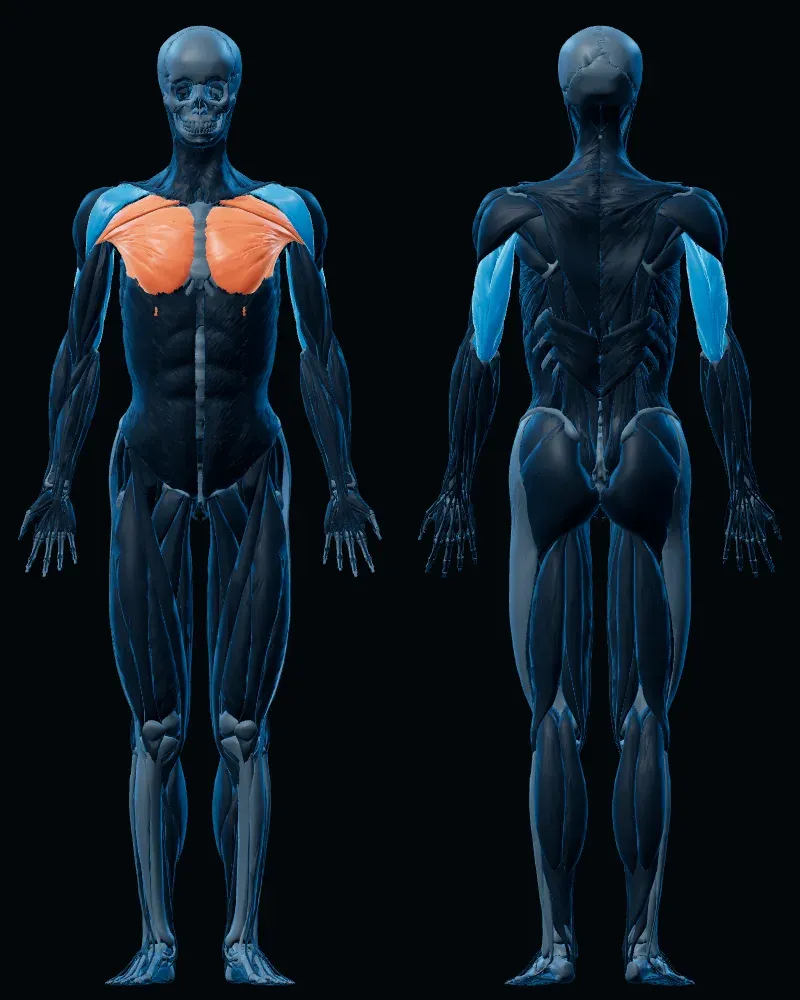
Muscles worked: chest
Main movers: pectoralis major
Assisting: front delts and triceps
Table of contents
The flat barbell bench press is a good chest builder, but it is not the whole job. It lets you load your pecs heavily and stably, which supports progressive overload, yet a fixed straight bar limits how your arms travel and how far your pecs stretch. Used well and paired with a couple of other presses or flies, it earns its place. Used as your only chest exercise, it may leave some growth on the table, though no trial has tested that directly.
This article looks at flat barbell bench press for hypertrophy as a pure chest builder. For the full picture of anatomy, exercise selection and weekly structure, start with our complete chest training guide.
Is the flat barbell bench press good for chest growth?
Short answer: yes, with caveats about what the evidence can and cannot tell us.
Bench press lets you progress load in small jumps, hold a stable body position and train close to your limit. Those are the practical reasons it works. What we do not have is a long-term trial that compares barbell bench against every alternative in trained lifters and tracks chest size. So when someone calls bench “the king of chest builders” or “overrated,” both are going beyond the data.
What the research does show is more modest and more useful. In a trial of 47 untrained young men, horizontal bench, incline bench and a mix of both were used once a week for eight weeks with equal sets. Strength gains were similar, and chest muscle thickness changed differently in only one of three measurement sites, with the incline group gaining more there (Chaves et al., 2020). The takeaway is not “incline wins.” It is that the pecs respond to several press angles, and small regional differences may exist.
What muscles does the flat bench press work?
Bench is a compound press, so the work is shared. Your pecs, front delts and triceps all contribute, and the balance shifts with bench angle and grip.
In ten competitive bodybuilders pressing at 80% of 1RM, the sternocostal (mid and lower) head of the pec was excited more on flat bench than on a 45 degree incline, while the clavicular (upper) head was excited more on the incline. Triceps excitation was greater on flat and decline bench than on the other variations (Coratella et al., 2020). So flat bench is a reasonable base for the bulk of the pec, and an incline press covers the upper fibres. Our deeper pieces on incline vs flat bench angles and on barbell versus dumbbell pec recruitment take this further.
A word of caution about EMG. It measures electrical activity at the skin surface. It does not tell you how much muscle you will grow, and it can vary with electrode placement and body composition. Use it to compare exercises roughly, not to rank them.
How to set up the flat bench press for your chest
Most people set up to lift the most weight. For hypertrophy, set up so the pecs do the work and the shoulders stay healthy.
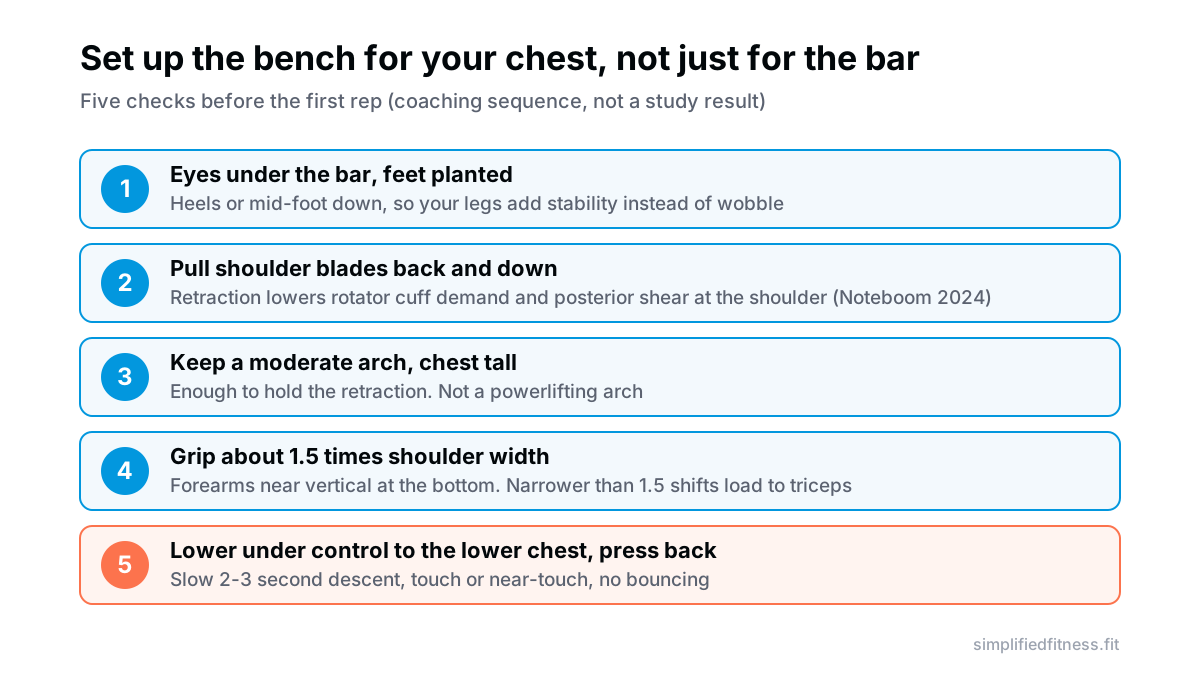
Scapular retraction. Pull your shoulder blades back and down, as if tucking them into your back pockets, and keep them there. In a biomechanical study of ten experienced strength athletes performing 21 bench variations, scapular retraction decreased posterior shear force at the glenohumeral joint and lowered rotator cuff activity (Noteboom et al., 2024). The authors modelled joint loads rather than measuring injuries, so it is a reasonable reason to retract, not proof it prevents pain. It also gives your chest a stable platform to press from.
Moderate arch. Keep your chest tall enough to hold the retraction and keep your glutes on the bench. This is a bodybuilding setup, not a meet setup, so it should not shorten the range much. If you want the contrast with powerlifting style, see bench press arch for powerlifting vs bodybuilding.
Grip width. A common bodybuilding starting point is about 1.5 times shoulder (biacromial) width, with your forearms close to vertical at the bottom. In the same shoulder study, grips narrower than 1.5 biacromial widths lowered acromioclavicular compression (Noteboom et al., 2024), so very wide grips are not obviously better for the shoulder. More on this in our grip width guide.
Lower under control. Take 2 to 3 seconds to bring the bar to the lower chest, press back up without bouncing it off your ribs. A controlled descent keeps tension on the pecs and makes your reps comparable week to week.
Does grip width change how much chest you use?
Less than the gym myth says. In 12 men holding isometric bench presses, moving from a wide to a narrower grip raised triceps activity and lowered activity in the sternoclavicular portion of the pec, but the author noted the changes were small (Lehman, 2005). Another study of 12 national and international level bench press athletes found largely non-significant activation differences between grip widths and bench angles, with differences mainly in biceps and triceps. Their 6RM loads were 5.8-11.1% higher with medium and wide grips than narrow (Saeterbakken et al., 2017). They recommended a wide grip on a flat bench for high-load hypertrophy work in bench press athletes.
Those are different groups using different methods, but the message agrees: grip changes things at the edges. The chest is working in all of them. Pick the width that lets you lift heavy with a stable shoulder.
Barbell bench press limitations for the pecs
This is where the barbell earns its criticism. None of these is a reason to drop it. They are reasons to add to it.
1. A fixed path with a fixed hand position. The bar is straight and your hands cannot move. Dumbbells, cables and many machines let your hands travel in a path that suits your shoulders and bring your arms closer together at the top. The pec’s job includes pulling the upper arm across the body, and a straight bar gives that action little room. This is a mechanical argument, not a result from a direct comparison.
2. A limited stretch at the bottom. Your chest stops the bar, so you often cannot get as deep a stretch as with dumbbells. The range-of-motion evidence for the upper body is thin. A systematic review of six studies concluded that full range of motion benefits lower-body growth, while upper-limb research is limited and conflicting (Schoenfeld and Grgic, 2020). A meta-analysis of 16 studies found full range of motion was better for strength and lower-limb hypertrophy, with no significant superiority for muscle thickness overall (Pallares et al., 2021). So do not panic about a stretch deficit. Just do not assume the bar gives you the best stretch available.
3. Wrist and shoulder stress. A straight bar fixes your wrist angle, and it is common to see lifters with the bar sitting too far back in the palm, bending the wrist under load. Shoulders can also complain when elbows flare or the shoulder blades drift forward. In the study above, bench technique changed shoulder joint loads noticeably, and the barbell force direction varied a lot between athletes (Noteboom et al., 2024). If pain persists, see our guide to bench press shoulder pain fixes and consider a doctor or physio.
4. Triceps and front delts can end the set first. Narrower grips push more work to the triceps, as shown above. If your triceps give out before your chest feels worked, a chest-dominant movement afterwards makes up for it.
When to use dumbbells, machines or cables instead
Do not abandon the bench. Slot it in as a heavy, simple anchor and add something that fixes its gaps.
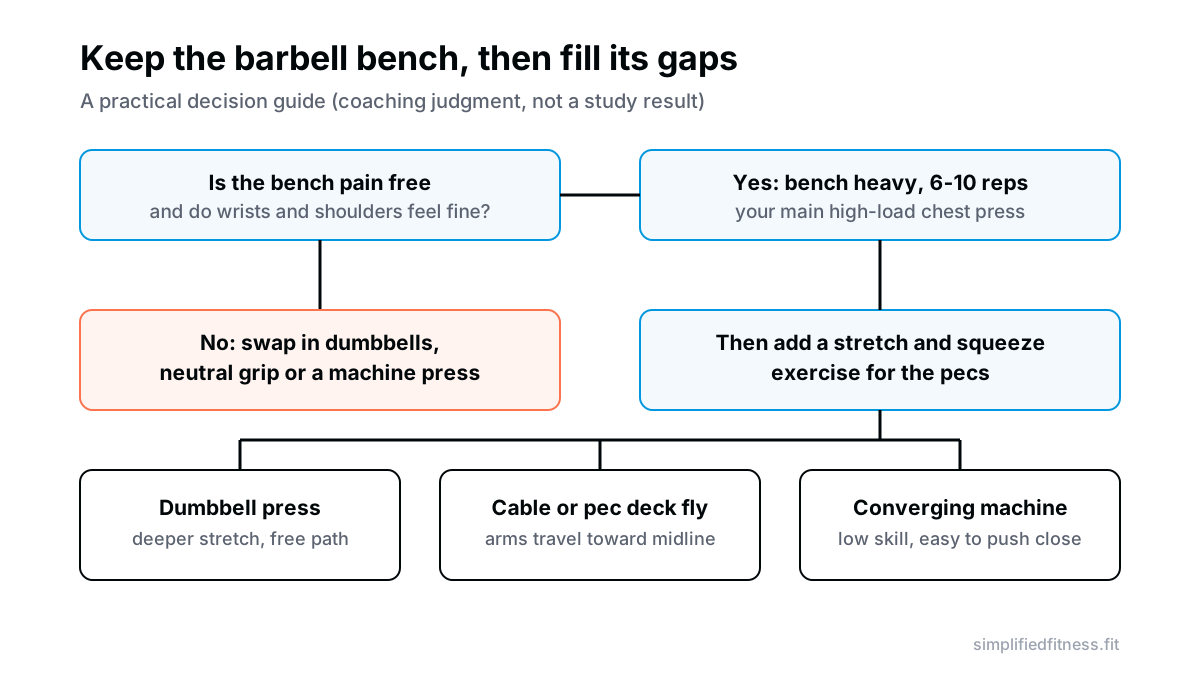
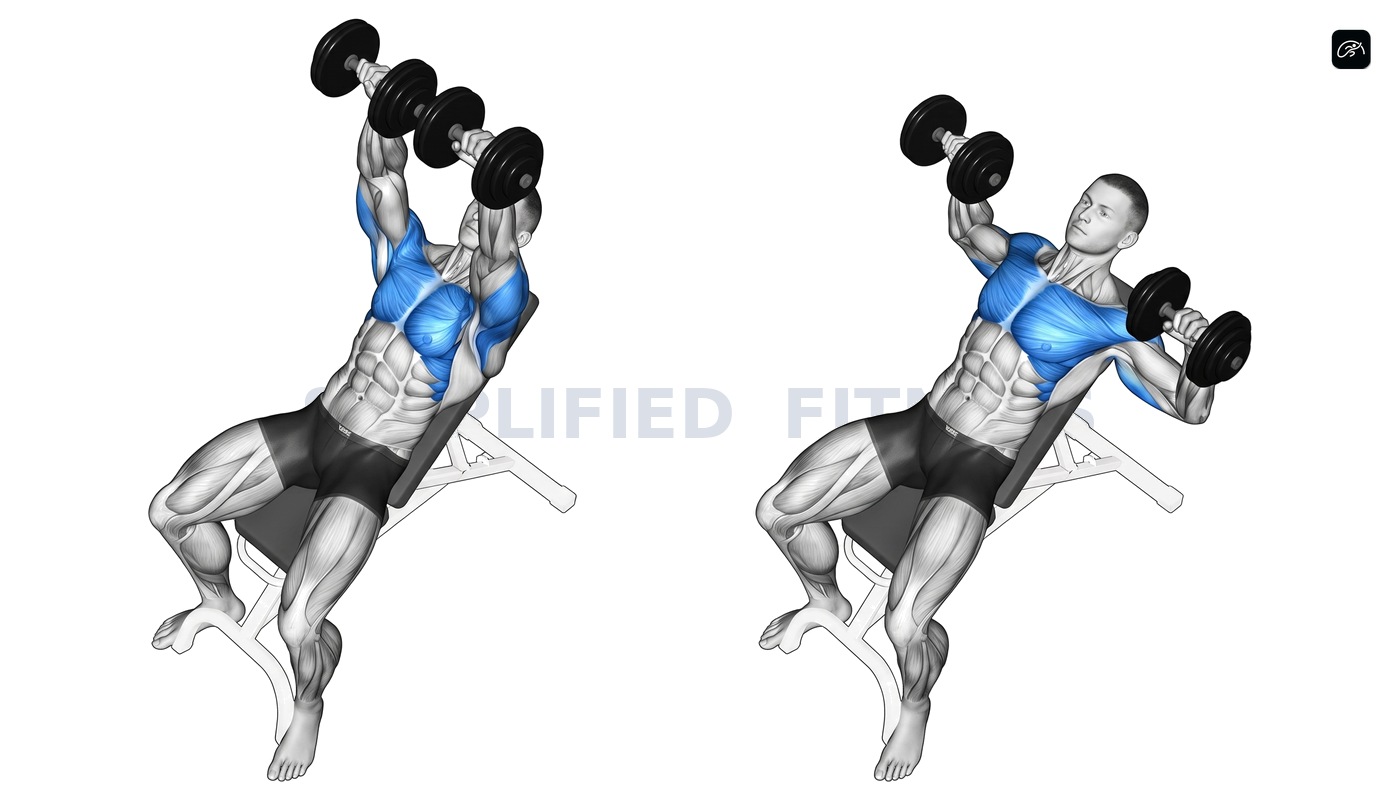
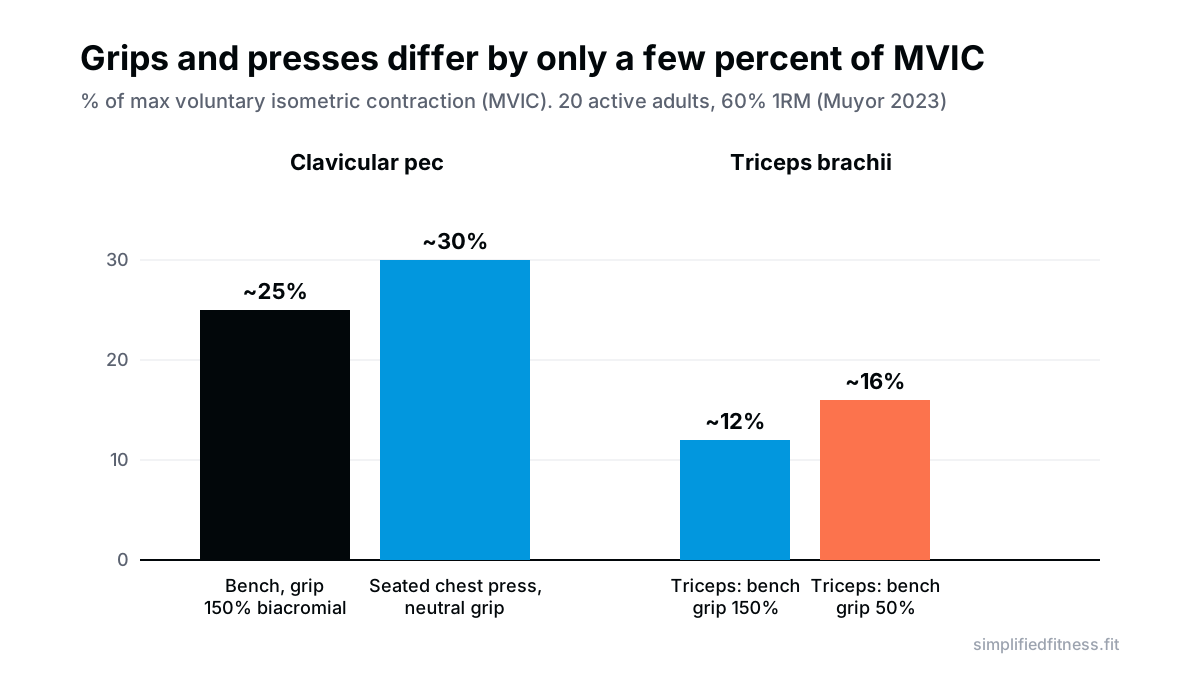
Dumbbells let each arm choose its path and often allow a deeper stretch. Machines are another option: one study of 20 active adults found the clavicular pec had higher activity on a seated chest press machine with a neutral grip (about 30% of MVIC) than on the barbell bench with a 150% biacromial grip (about 25%), while anterior delt activity did not differ (Muyor et al., 2023). The authors concluded that exercise choice should rest on load capacity, technique and context, not on activation alone. A bodybuilder-only comparison found that chest press machines excited the clavicular head less than free-weight versions and also gave less triceps and lateral delt excitation (Coratella et al., 2020). Different studies, different exercise settings, different results. The sensible reading is that every option loads the pecs, so use variety.
Practical options:
- Dumbbell press (flat or incline) for a freer path and deeper stretch. See incline dumbbell press angles.
- Cable or pec deck flyes for a finish where the arms move toward the midline. Compare options in chest flyes: dumbbells vs cables vs pec deck.
- Converging machine press when you want a lower-skill, joint-friendlier press you can push close to failure. See converging chest press machines.
How to program the barbell bench for hypertrophy
Keep this simple.
Sets. For most lifters, 3 to 4 hard sets of bench in a session, within roughly 8 to 12 hard chest sets across the week, is a reasonable starting range to adjust to your recovery. Track it with the training volume calculator.
Reps and load. Moderate to heavy loads with sets taken close to failure are the usual bodybuilding approach. Use roughly 6 to 10 reps on the barbell, then 10 to 15 on dumbbells and machines.
Effort. Stay 1 to 2 reps short of failure on the barbell unless you have a spotter or safety arms. Go closer on machines and flyes, where a failed rep is low risk.
Order. If the bench is your priority, do it first when you are fresh. Our push day plan shows one way to arrange it.
Who should be careful
If bench causes sharp shoulder pain, pain that lingers for days, numbness, or follows a pop or injury, stop and get it checked by a doctor or physiotherapist. Do not train through it hoping it clears. Many people also find that a trained shoulder is happier with a slightly narrower grip, tucked elbows and retracted blades, but individual anatomy varies, so adjust to what your body tells you.
The bottom line
Flat barbell bench press for hypertrophy works. It is heavy, simple and easy to track. Its limits come from the fixed bar: less freedom for the arms and shoulders, a stretch that is often capped by your chest, and the wrist and shoulder stress that comes with poor technique. Fix those with a good setup, then add dumbbells, flyes or a converging machine so the pecs get loaded in more than one way.
If you want a ready-made layout, try our push day plan and use the training volume calculator to keep weekly chest sets in a sensible range.
Frequently Asked Questions
Is the flat barbell bench press good for chest growth?
Yes, it is a solid chest builder for most people. It lets you use heavy, stable loads and progress in small steps, which are the practical drivers of muscle growth. It works best as one of several chest exercises rather than the only one.
Is the bench press enough to build a big chest?
For beginners, often yes for a while. Over time, adding a deeper-stretch press like dumbbells and a fly or machine movement gives you more variety in how the pecs are loaded. There is no direct trial proving that bench alone fails, so treat this as a sensible hedge, not a rule.
Does bench press work the upper or lower chest more?
On a flat bench, EMG in bodybuilders showed the sternocostal (mid and lower) head of the pec was excited more than on a 45 degree incline, while the clavicular (upper) head was excited more on the incline. The flat bench loads both heads. Add an incline press if your upper chest lags.
What grip width is best for chest on bench press?
Around 1.5 times shoulder width works well for most lifters. Research on muscle activity shows small differences between grips, and narrower grips shift more work to the triceps. Pick the width where your forearms stay near vertical at the bottom and your shoulders feel fine.
Should I retract my shoulder blades on the bench press?
Yes, for most people. A 2024 biomechanical study found scapular retraction reduced posterior shear force at the shoulder and rotator cuff activity. Squeeze your shoulder blades back and down before you unrack and hold them there for the set.
How much should I arch on bench press for muscle growth?
A moderate arch is enough, one that keeps your chest tall and shoulder blades pinned without lifting your hips off the bench. A big competition arch shortens the range of motion, which is useful for lifting more weight but less relevant for chest growth. Our guide on the [bench press arch for powerlifting vs bodybuilding](/blog/bench-press-arch-powerlifting-vs-bodybuilding) goes deeper.
Is barbell bench better than dumbbell bench for chest?
Neither has been shown to be clearly better for muscle growth. Barbells allow heavier loads and easier progression, while dumbbells give a freer path and a deeper stretch. Using both across the week is a reasonable plan, as covered in [dumbbell vs barbell pressing](/blog/dumbbell-vs-barbell-pressing-pec-recruitment).
Does the bench press stretch the pecs enough?
It can, but the bar usually touches your chest before your arms can sink much lower, so the stretch is often limited compared with dumbbells. Range of motion research suggests the upper-body evidence is mixed. Lower the bar to the chest under control and add a deeper-stretch exercise elsewhere in the week.
Why do my triceps and shoulders tire before my chest on bench?
Bench is a multi-joint press, so triceps and front delts share the work, and narrower grips raise triceps activity. Your set may end when they fail, not your pecs. Retract your shoulder blades, avoid a very narrow grip, and add chest-focused work like flies after pressing.
Why do my wrists hurt on the bench press?
A straight bar locks your hands in one position, and if the bar sits too far back toward your fingers, your wrists bend backward under load. Stack the bar over your forearm bones and keep your wrist straight. Wrist wraps can help, but persistent pain needs a doctor or physio.
How many sets of bench press per week for chest growth?
Many lifters grow well on roughly 8 to 12 hard chest sets a week across all exercises, though this is a starting point rather than a proven number. Higher volumes can help if you recover well, and fewer sets can still work. Use our [training volume calculator](/tools/training-volume-calculator) to track it.
How many reps should I do on bench press for hypertrophy?
Most lifters do well with roughly 6 to 12 reps on bench, saving higher reps for dumbbell and machine work. Leave 1 to 3 reps in reserve on compound sets.
Should I train to failure on bench press?
Usually not on the barbell. Failing on bench without a spotter or safeties is risky, and a grinding last rep often involves technique breakdown. Stop 1 to 2 reps short on barbell sets and go closer to failure on machines or dumbbells.
Sources & References
Every claim above is checked against peer-reviewed research (PubMed, U.S. National Library of Medicine) or guidance from established health bodies. How we fact-check.
- Coratella G, et al. Specific prime movers' excitation during free-weight bench press variations and chest press machine in competitive bodybuilders. Eur J Sport Sci. 2020. PMID: 31397215
- Saeterbakken AH, et al. The Effects of Bench Press Variations in Competitive Athletes on Muscle Activity and Performance. J Hum Kinet. 2017. PMID: 28713459
- Muyor JM, et al. Comparison of Muscle Activity between the Horizontal Bench Press and the Seated Chest Press Exercises Using Several Grips. J Hum Kinet. 2023. PMID: 37229415
- Lehman GJ. The influence of grip width and forearm pronation/supination on upper-body myoelectric activity during the flat bench press. J Strength Cond Res. 2005. PMID: 16095407
- Noteboom L, et al. Effects of bench press technique variations on musculoskeletal shoulder loads and potential injury risk. Front Physiol. 2024. PMID: 38974522
- Chaves SFN, et al. Effects of Horizontal and Incline Bench Press on Neuromuscular Adaptations in Untrained Young Men. Int J Exerc Sci. 2020. PMID: 32922646
- Schoenfeld BJ, Grgic J. Effects of range of motion on muscle development during resistance training interventions: A systematic review. SAGE Open Med. 2020. PMID: 32030125
- Pallares JG, et al. Effects of range of motion on resistance training adaptations: A systematic review and meta-analysis. Scand J Med Sci Sports. 2021. PMID: 34170576

Umair Hazrami · Founder & Head Coach, Simplified Fitness
Umair Hazrami founded Simplified Fitness and the Simplified Lifter channel to cut through fitness noise. With 4+ years of consistent training and 10+ coaching clients, he writes every guide from the peer-reviewed research and links the sources so you can check them. Our editorial standards.
Educational content only, not medical advice. If you have a medical condition, are pregnant, or take medication, talk to a qualified doctor before changing your diet, supplements or training. Full disclaimer.
Keep reading
Exercise Technique
Arching on the Bench Press: Powerlifting Spine Arch vs Bodybuilding Setup
Is a bench press arch cheating or dangerous for your back? Learn the difference between a powerlifting arch and a natural upper back setup, with study data.
8 min read
Exercise Technique
Bench Press Grip Width: Pec Activation, Triceps and Shoulder Clearance
Bench press grip width changes triceps load, shoulder stress and little else for your pecs. See what EMG and joint-load studies show and how to pick your grip.
7 min read
Exercise Technique
Cable Crossover Angles: High-to-Low vs Low-to-High vs Horizontal Fly
Cable crossover angles explained: what high-to-low, low-to-high and horizontal flys likely train, what the research really says, and how to set each one up.
9 min read
Exercise Technique
Chest Dips: Forward Lean Angle, Scapular Position, and Shoulder Safety
Chest dips can build your chest if you lean, set your shoulders and stop at a depth that suits you. See what the research says and how to dip safely.
8 min read