Upper Chest Workout: Best Bench Angle, Elbow Path and Exercises for the Clavicular Pec
Upper chest workout guide: the incline angle EMG studies favour (about 30 degrees), what changes past 45, the best exercises and setup cues, studies linked.
TL;DR. The short answer
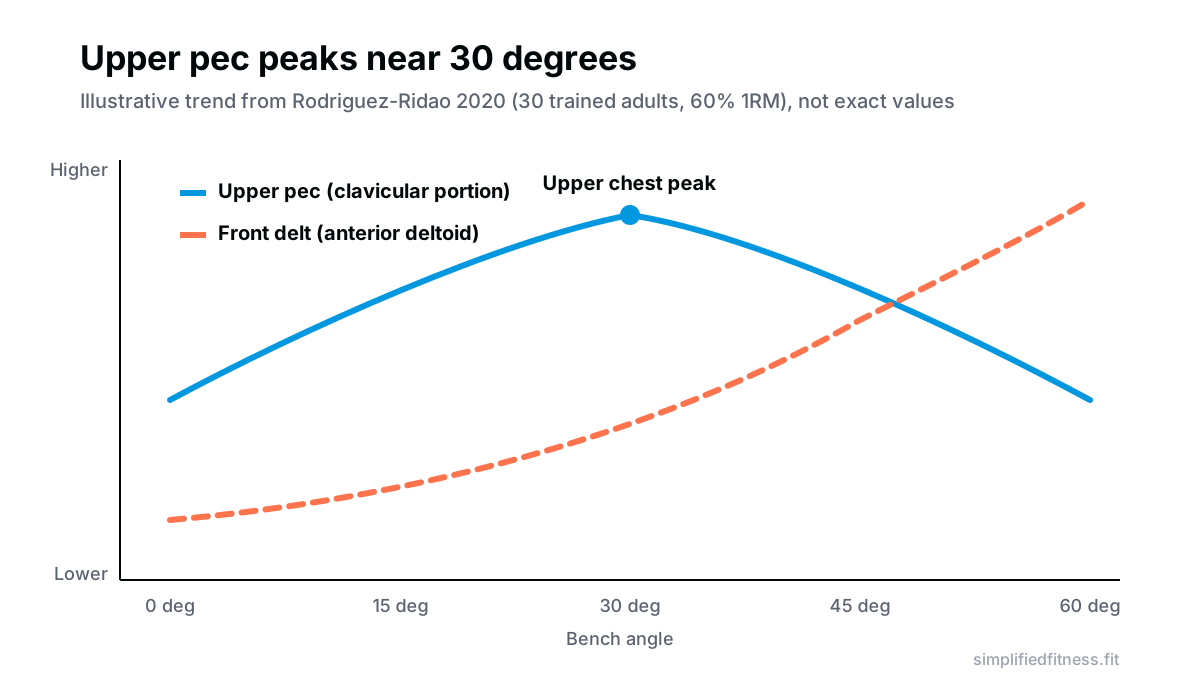
- For an upper chest workout, a bench incline of roughly 30 degrees is the best-supported starting point. In 30 trained adults the upper pec portion peaked at 30 degrees, and past 45 degrees the front delts took over.
- Incline pressing shifts muscle activity toward the clavicular (upper) pec, but flat pressing still works the middle and lower chest harder. You need both, not either/or.
- Whether that shift turns into lasting upper chest growth is not proven yet. Most evidence is acute EMG and ultrasound, and one 12-week trial found both pec regions grew similarly.
- Press up and slightly in toward your collarbone line with your shoulder blades set. The elbow tuck number you hear online (45-60 degrees) is a coaching convention, not a measured result.
- Pain at the front of the shoulder, or a numb or weak arm, is a reason to see a doctor or physio instead of changing angles.
Part of our complete guide: The Complete Chest Workout Guide: Pec Anatomy, Bench Angles, Flys and Shoulder-Safe Pressing
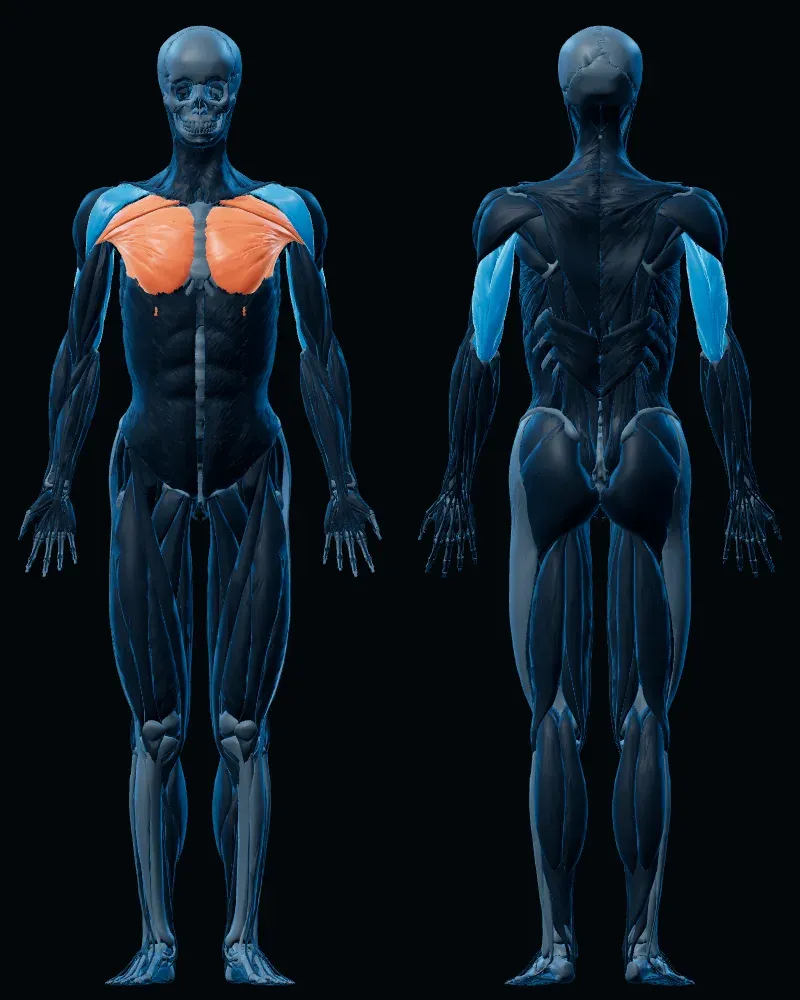
Muscles worked: chest
Main movers: pectoralis major
Assisting: front delts and triceps
Table of contents
If you want a better upper chest workout, the best-supported move is simple: press on a bench set to roughly 30 degrees, keep your shoulder blades set, and drive the weight up toward your collarbone line. That angle is where upper pec activity peaked in trained lifters, and going much steeper tends to hand the work to your front delts.
That is the practical answer. The honest follow-up is that “upper chest” is a muscle region, not a separate muscle, so you shift emphasis rather than isolate it. This page sits inside our complete chest training guide and focuses on the upper portion: what the studies show, where they disagree, and how to turn that into exercises you can do this week.
What are the clavicular pecs, and can you train them separately?
Your pectoralis major is one fan-shaped muscle with two main parts. The clavicular head attaches to the collarbone and sits high on the chest. The sternocostal head attaches along the breastbone and ribs and makes up the bulk of the mid and lower chest. (For the anatomy in depth, see pectoralis major functional anatomy.)
The nervous system does not treat the muscle as one block. An older EMG study of eight men found that different segments of the pectoralis major were controlled somewhat independently, with shoulder flexion movements using the superior segments and shoulder extension from a flexed position using the most inferior ones (Paton et al., 1994). That is a small isometric study, so it is a hint, not a recipe.
It does explain why the angle of your press matters. Raise the bench and your arms move more like shoulder flexion, which leans on the upper fibres.
What is the best incline angle for upper chest?
Here the research is fairly consistent about direction and a little messy about the exact number.
In a 2020 study of 30 trained adults, researchers measured three portions of the pec at 0, 15, 30, 45 and 60 degrees at 60% of 1RM. The upper portion’s EMG peaked at 30 degrees, the middle and lower portions were higher on the flat bench, front delt activity was highest at 60 degrees, and angles above 45 degrees reduced pec drive (Rodriguez-Ridao et al., 2020).
Other studies nudge the number around:
- Higher angle favoured. In 15 men pressing at 0, 28, 44 and 56 degrees, clavicular head activation was greater at 44 degrees than at 28 or 0, and the front delt was more active at every incline than flat (Trebs et al., 2010).
- Mixed by timing. In 14 resistance-trained men pressing at -15, 0, 30 and 45 degrees, upper pec EMG did not differ across the whole concentric phase, but 30 and 45 degrees were higher in the 26-50% window of the rep (Lauver et al., 2016).
- Bodybuilders. In ten competitive bodybuilders, the clavicular head was more excited on a 45 degree incline, and the sternocostal head more on flat or decline (Coratella et al., 2020).
Why do the numbers differ? Different loads, different EMG methods, different sample sizes, and surface EMG is sensitive to electrode placement. A 2022 group using high-density EMG across 15 regions of the muscle found the peak activity moved toward the clavicular region when bench press went from flat to 45 degrees (Cabral et al., 2022), which supports the direction of the shift even if it cannot pick a single best degree.
My practical read: start at 30 degrees, then try a slightly flatter or steeper notch only if your front delts take over or you cannot feel your upper chest. If you want the deeper angle-by-angle breakdown, read incline vs flat bench for upper chest and incline dumbbell press angle comparison.
Does incline pressing actually grow the upper chest?
This is the part most articles skip. Electrical activity is not growth.
One short-term study used ultrasound as well as EMG. Thirteen men did four sets of flat and 45 degree incline bench press. After the incline session the cross-sectional area of the clavicular head increased more than the sternocostal head, and after the flat session the sternocostal head increased more (Albarello et al., 2022). That is an acute swelling response, measured right after exercise, so it tells you which region was worked, not how much it will grow over months.
Longer-term evidence is thinner. A 2025 trial had 15 untrained men do 12 weeks of pec deck training (1 set versus 3 sets) and found the clavicular and sternocostal portions grew by similar amounts, with no support for regional growth from that exercise (Pinto et al., 2025). It used a pec deck, not an incline press, and untrained men, so it does not settle the incline question. It does warn against assuming every chest exercise grows the upper chest.
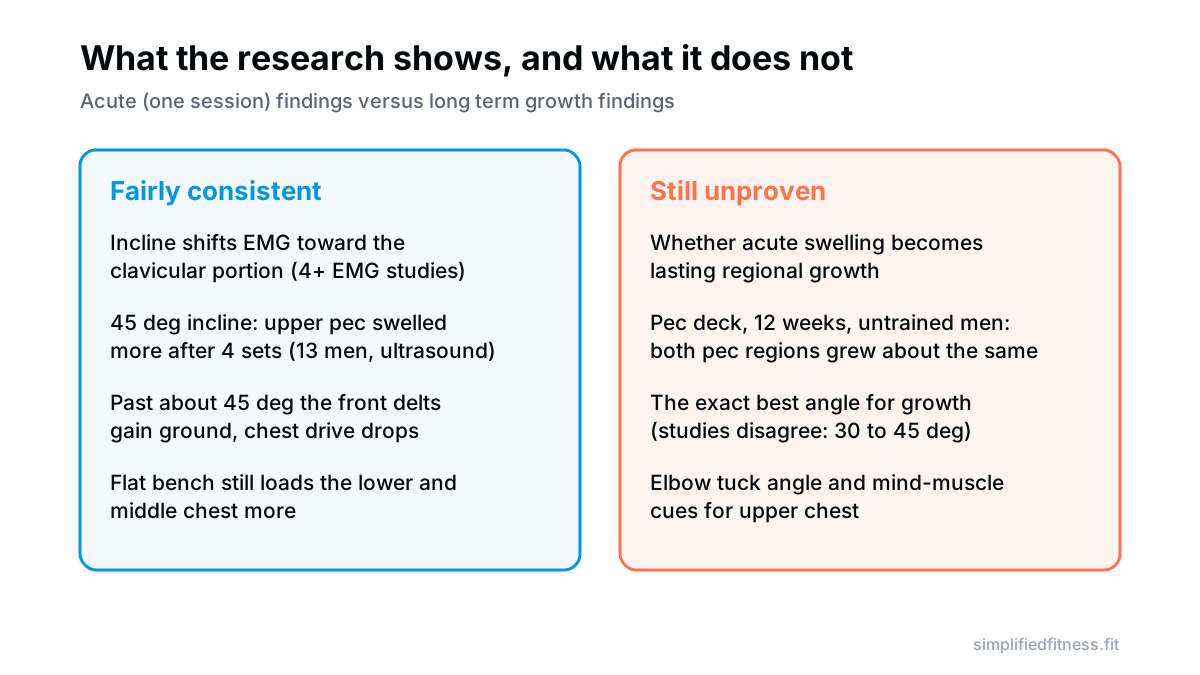
So here is a cautious takeaway. Incline pressing is a reasonable way to load the upper fibres more, and it costs you nothing. But it is not a guaranteed fix for a flat upper chest, and total hard sets, progression and consistency still do most of the work.
Upper chest exercises worth using
Pick two or three, not seven. Here is how I would rank them.
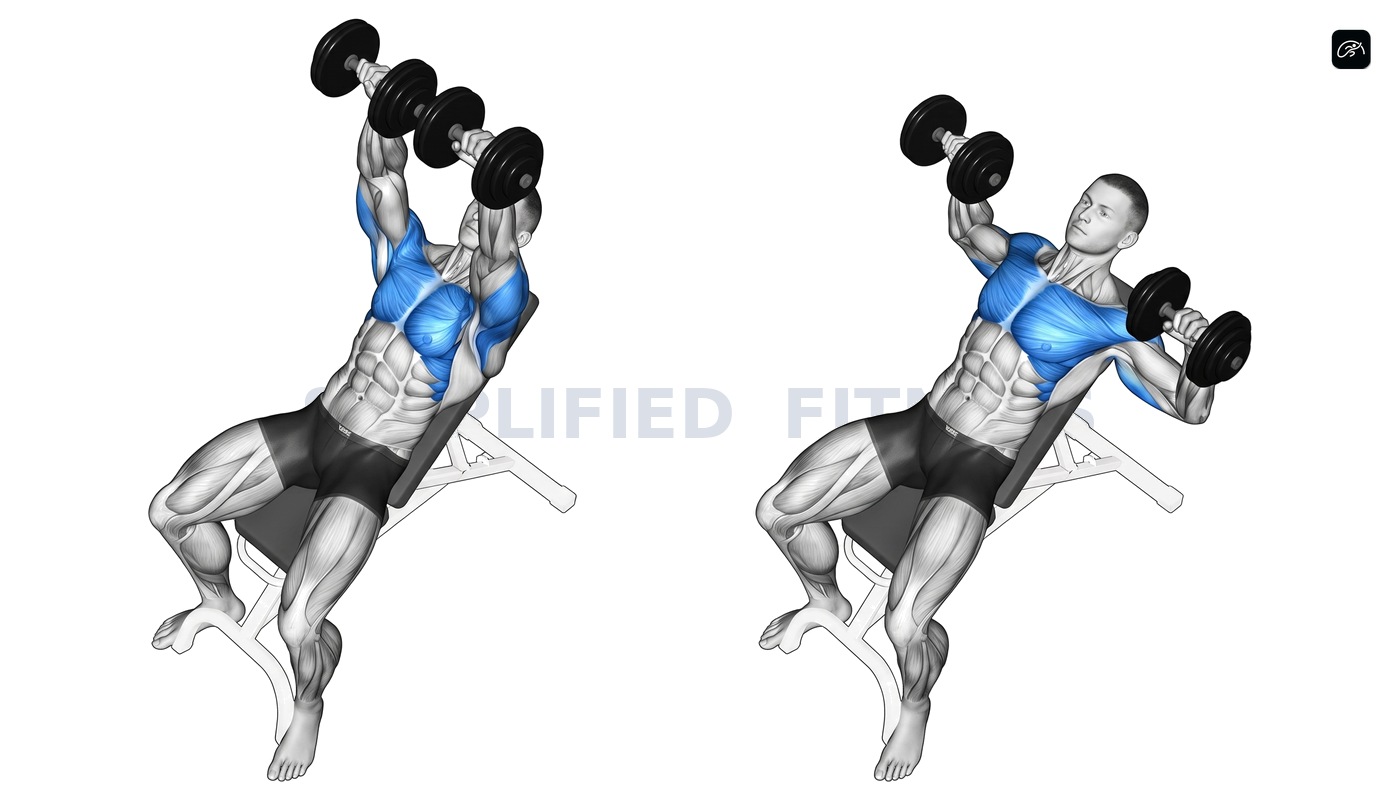
1. Incline dumbbell press (about 30 degrees). The default choice. Dumbbells let your hands travel on a natural arc and let you reach a deep stretch at the bottom. Lower under control, then press up and slightly inward.
2. Incline barbell or Smith machine press. Good if you want to load heavy and track numbers easily. The fixed bar path can bother some shoulders, so stop if you feel pinching at the front of the joint.
3. Low-to-high cable fly. The hands travel up toward the face, similar to shoulder flexion, which the Paton data hints favours the upper segments. I did not find a trial testing this exercise directly, so use it as an accessory with a light load and a squeeze at the top, not as a proven upper chest builder.
4. Flat or machine press. Do not drop these. The studies above show the sternocostal head works harder on flat work, and a balanced chest needs both.
Reverse grip bench. It is popular online as an upper chest trick. I did not find controlled evidence that it beats a normal incline press for growth, and it changes your wrist and elbow mechanics, so I would treat it as optional.
Compare flye options in dumbbell vs cable vs pec deck flyes and see cable crossover angles for how the cable height changes the line of pull.
| Exercise | Why it helps upper chest | Evidence quality |
|---|---|---|
| Incline DB press (~30 degrees) | EMG shift toward clavicular head on an incline | Several acute EMG studies |
| Incline barbell press | Same angle effect, heavier loading | Acute EMG studies |
| Low-to-high cable fly | Upward arm path resembles shoulder flexion | Indirect only |
| Flat or machine press | Covers sternocostal head | Acute EMG studies |
| Reverse grip bench | Popular claim | No direct evidence found |
How to set up the press: bench, shoulders, elbows and path
Angle is only one variable. Here is a checklist you can run in about ten seconds.
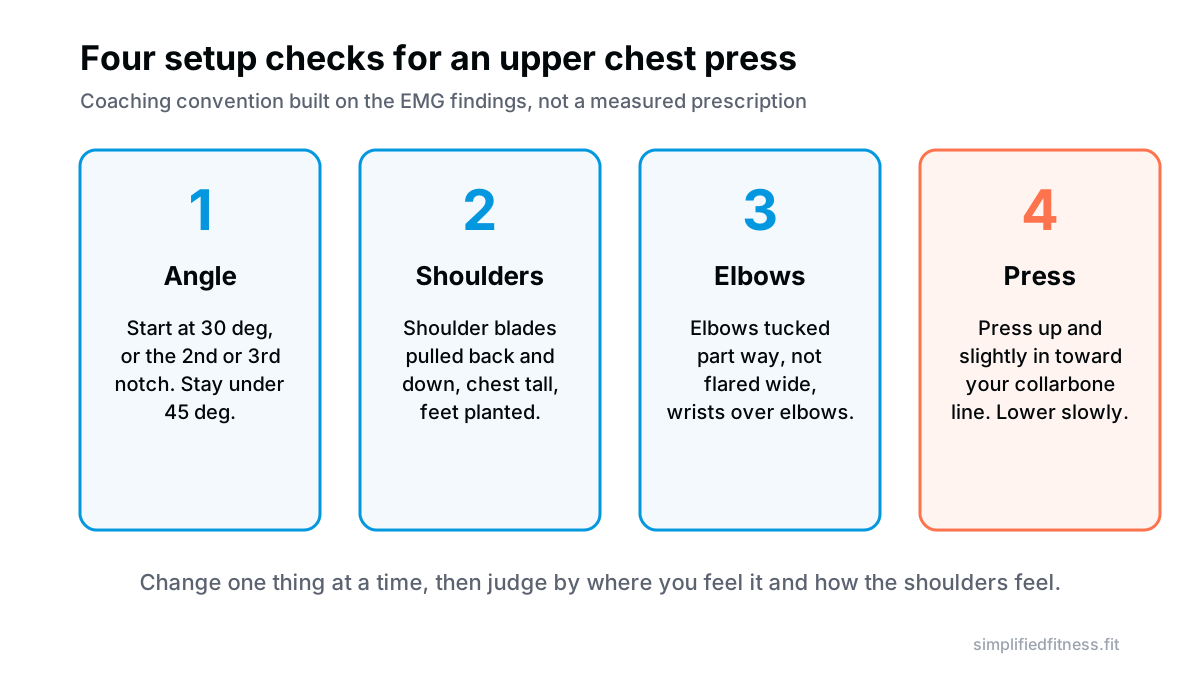
- Angle. About 30 degrees (often the second or third notch).
- Shoulder blades. Pull them back and down so the chest stays tall and the front of the shoulder is not doing the reaching.
- Elbows. A moderate tuck, not pinned and not flared to 90 degrees. You will often hear 45-60 degrees quoted. That is a coaching convention, and I did not find a study that proves it for upper chest growth. Use it as a starting point and adjust to what your shoulders tolerate.
- Path. Press up and slightly in toward your collarbone line, then lower slowly to a comfortable stretch.
In the gym, the most common mistake here is letting the shoulders roll forward as the weight gets heavy. The set looks fine on video, but all the tension has moved to the front delts.
If your shoulders hurt on pressing, read shoulder pain on bench press and the fixes before you add volume.
Is mind-muscle connection real for the upper chest?
Maybe, and it is still being studied. Some lifters find that focusing on the target muscle helps them feel it, mostly at lighter loads. I did not find upper-chest-specific trials, so keep it simple.
A workable cue is to imagine bringing your biceps toward your collarbone as you press. If it helps, keep it. If you find yourself slowing down and losing load because you are over-thinking it, drop the cue and go back to pushing hard.
How to build an upper chest workout (a sample week)
You do not need a special routine. Add upper chest emphasis into a normal chest plan.
- Day A: incline dumbbell press 3-4 sets of 6-10, flat or machine press 2-3 sets of 8-12, low-to-high cable fly 2 sets of 12-15.
- Day B: flat press 3 sets of 6-10, incline machine or Smith press 3 sets of 8-12, pec deck 2 sets of 12-15.
That gives roughly 4-8 hard sets of upper-chest-biased work per week inside your total chest volume. That range is a practical starting point, not a number from a regional-growth study. If you eat mostly vegetarian, getting enough protein from dal, paneer, curd, soya and eggs (if you eat them) matters more than any angle tweak. Our protein calculator and training volume calculator can help you set targets, and our push day plan has a ready version. To see how this fits with the rest of the week, see complete chest workout architecture.
Progress is the real engine. Add a rep or a small amount of weight over time, keep most sets 1-3 reps from failure, and give the chest a day or two to recover between sessions.
When to see a doctor
Muscle soreness at the front of the shoulder that settles in a day or two is normal. Sharp pain, pain that persists or wakes you at night, a pop with sudden weakness, or numbness or tingling in your arm or hand is not. Stop pressing and see a doctor or physiotherapist, and do not try to train through it by changing the bench angle.
The bottom line
Start near 30 degrees, set your shoulder blades, press up and slightly in toward your collarbone line, and keep a flat or machine press in the week. The angle shifts emphasis toward the clavicular head, but long-term regional growth from angle alone is not proven, so judge your plan by progress in reps, load and how your shoulders feel over 8-12 weeks.
Frequently Asked Questions
What is the best incline angle for upper chest?
About 30 degrees is the best-supported starting point. In a 2020 study of 30 trained adults, upper pec activity peaked at 30 degrees, while angles above 45 degrees raised front delt activity and reduced pec drive. Set your bench to 30 degrees (often the second or third notch) and adjust by feel.
Is 45 degrees too steep for an incline press?
For many people it is a little steep, but the research is mixed. One study found upper pec activity higher at 44 degrees than at 28 or 0, while another found a peak at 30 degrees and more front delt takeover past 45. Start near 30 degrees and only go steeper if your shoulders feel fine and you feel your upper chest working.
Can you really isolate the upper chest?
No, you can only shift emphasis. Studies show the clavicular portion is more active on an incline and the sternocostal portion on a flat bench, but both heads work in both lifts. Use a mix of incline and flat pressing rather than hunting for pure isolation.
How do I build an upper chest if mine is flat?
Add one or two incline pressing or fly variations at about 30 degrees, train chest two times a week, and push your sets close to failure with a full range of motion. Evidence that angle alone creates regional growth is limited, so total hard sets and progression matter more. Track your reps and weights and add load slowly.
Are incline dumbbell presses better than incline barbell?
Neither has clear superiority for the upper chest in current research. Dumbbells allow a freer path and a deeper stretch, while a barbell lets you load heavier. Pick whichever you can control and progress on; rotating between them across blocks is reasonable.
Do low-to-high cable flies work the upper chest?
They are a logical choice, because the arm travels upward as in shoulder flexion, which tends to use the upper pec segments. I could not find a trial that tests low-to-high cable flies directly, so treat it as a sensible accessory, not a proven winner. Use a light load, a smooth path and a squeeze at the top.
Does reverse grip bench press hit the upper chest?
It may feel like it does, but I did not find controlled evidence that it grows the upper chest more than a standard incline. It also changes the wrist and elbow position, which some lifters find uncomfortable. Stick with a proven incline and only experiment with reverse grip if it feels good and your wrists and shoulders stay happy.
How wide should my elbows flare on incline press?
A moderate tuck is a safe default, with the elbows not pinned to your ribs and not flared out at 90 degrees. The popular 45-60 degree figure is a coaching convention and I did not find a study that proves it for the upper chest. Pick the angle where your shoulders feel smooth and your wrists stack over your elbows.
How many sets for upper chest per week?
A reasonable starting point is about 4-8 hard sets of upper-chest-biased work per week, inside your total chest volume. That is a practical range, not a figure from a regional study. Add sets only when your reps and weights stop progressing and you are recovering well.
Why do my front delts take over on incline press?
As the bench gets steeper, the movement looks more like a shoulder press, so the anterior deltoid does more. One study found front delt activity highest at 60 degrees. Lower the bench, tuck the elbows slightly and set your shoulder blades back and down before you press.
Is mind-muscle connection useful for upper chest?
It may help some lifters feel the target muscle, but the evidence is limited and mostly from other muscles. Try focusing on pressing up toward your collarbone line and squeezing your upper chest at the top. If it does not help, do not worry about it: load, effort and range matter more.
Can I train upper chest with a pec deck?
You can train the chest with a pec deck, but it does not favour the upper portion. In a 2025 study of 15 untrained men, 12 weeks of pec deck training grew the clavicular and sternocostal portions by similar amounts. It is a good chest finisher, not an upper chest specialist.
How often should I train upper chest?
Two sessions a week is a sensible default, for example an incline press on one day and a flat or machine press with an incline fly on another. This spreads your volume and lets you progress each lift. Leave at least a day between chest sessions and cut volume if your shoulders feel sore.
Sources & References
Every claim above is checked against peer-reviewed research (PubMed, U.S. National Library of Medicine) or guidance from established health bodies. How we fact-check.
- Rodriguez-Ridao D, et al. Effect of five bench inclinations on the electromyographic activity of the pectoralis major, anterior deltoid, and triceps brachii during the bench press exercise. Int J Environ Res Public Health. 2020. PMID: 33049982
- Cabral HV, et al. Non-uniform excitation of the pectoralis major muscle during flat and inclined bench press exercises. Scand J Med Sci Sports. 2022. PMID: 34644424
- Albarello JCDS, et al. Non-uniform excitation of pectoralis major induced by changes in bench press inclination leads to uneven variations in the cross-sectional area measured by panoramic ultrasonography. J Electromyogr Kinesiol. 2022. PMID: 36334406
- Trebs AA, et al. An electromyography analysis of 3 muscles surrounding the shoulder joint during the performance of a chest press exercise at several angles. J Strength Cond Res. 2010. PMID: 20512064
- Coratella G, et al. Specific prime movers' excitation during free-weight bench press variations and chest press machine in competitive bodybuilders. Eur J Sport Sci. 2020. PMID: 31397215
- Lauver JD, et al. Influence of bench angle on upper extremity muscular activation during bench press exercise. Eur J Sport Sci. 2016. PMID: 25799093
- Pinto MD, et al. Pectoralis clavicular and sternocostal thicknesses increase similarly in response to one and three sets of pec deck resistance training in untrained young men. J Strength Cond Res. 2025. PMID: 40266636
- Paton ME, et al. An electromyographic analysis of functional differentiation in human pectoralis major muscle. J Electromyogr Kinesiol. 1994. PMID: 20870556

Umair Hazrami · Founder & Head Coach, Simplified Fitness
Umair Hazrami founded Simplified Fitness and the Simplified Lifter channel to cut through fitness noise. With 4+ years of consistent training and 10+ coaching clients, he writes every guide from the peer-reviewed research and links the sources so you can check them. Our editorial standards.
Educational content only, not medical advice. If you have a medical condition, are pregnant, or take medication, talk to a qualified doctor before changing your diet, supplements or training. Full disclaimer.
Keep reading
Exercise Technique
Arching on the Bench Press: Powerlifting Spine Arch vs Bodybuilding Setup
Is a bench press arch cheating or dangerous for your back? Learn the difference between a powerlifting arch and a natural upper back setup, with study data.
8 min read
Exercise Technique
Bench Press Grip Width: Pec Activation, Triceps and Shoulder Clearance
Bench press grip width changes triceps load, shoulder stress and little else for your pecs. See what EMG and joint-load studies show and how to pick your grip.
7 min read
Exercise Technique
Cable Crossover Angles: High-to-Low vs Low-to-High vs Horizontal Fly
Cable crossover angles explained: what high-to-low, low-to-high and horizontal flys likely train, what the research really says, and how to set each one up.
9 min read
Exercise Technique
Chest Dips: Forward Lean Angle, Scapular Position, and Shoulder Safety
Chest dips can build your chest if you lean, set your shoulders and stop at a depth that suits you. See what the research says and how to dip safely.
8 min read