The Inner Chest Myth: Why You Cannot Isolate the Midline and What Builds Cleavage
How to build inner chest: you cannot isolate it, but you can fill the gap. See what the pec research says and the plan that actually builds chest cleavage.
TL;DR. The short answer
- You cannot isolate the inner chest. Each pec fibre runs from the sternum or collarbone to the upper arm, so a fibre contracts along its whole length, not just near the midline.
- In a 12-week trial of untrained men, the pec deck thickened the upper and mid/lower pec by similar amounts (17-18% vs 21%), which did not support regional growth from a fly-style exercise.
- Bench angle does shift emphasis between the clavicular (upper) and sternocostal (mid/lower) heads, so a mix of flat and inclined pressing covers the whole muscle.
- How full the middle of your chest looks depends on overall pec size, how lean you are, and bone and tendon structure you cannot change.
- Flys and crossovers are useful for the pec, but treat them as a way to add hard sets, not as a special inner chest exercise.
Part of our complete guide: The Complete Chest Workout Guide: Pec Anatomy, Bench Angles, Flys and Shoulder-Safe Pressing
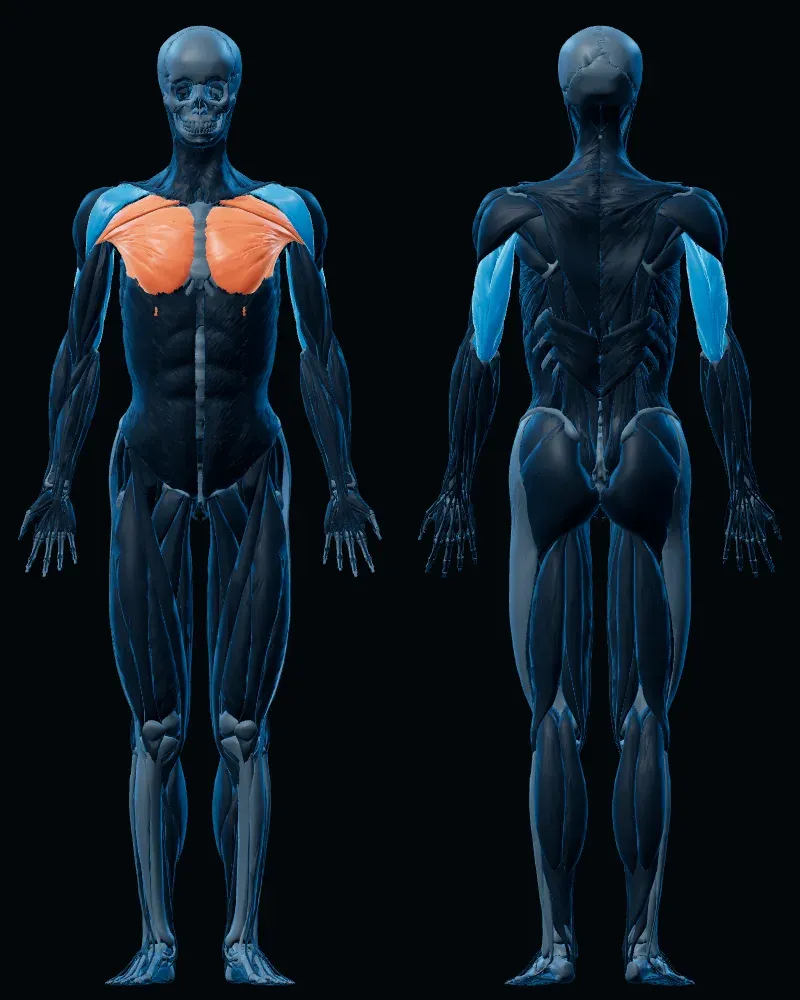
Muscles worked: chest
Main movers: pectoralis major
Assisting: front delts and triceps
Table of contents
If you are searching for how to build inner chest, here is the honest answer: you cannot isolate it, and no exercise targets it on its own. What you can do is grow the whole pectoralis major, train it from a couple of angles, and get lean enough to see the result. That is what fills the middle. This sits inside our complete chest training guide, which covers the rest of the chest.
Most “inner chest workouts” you see online are just flys and squeezes with a new name. Let’s look at why the idea does not hold up, and what to do instead.
Why “inner chest” is an anatomy myth
The pec is a fan-shaped muscle. Its fibres start along the collarbone and the breastbone (sternum) and run outward to a single tendon on the upper arm. A muscle fibre is a single long cell, and when it contracts it shortens along its whole length. It does not tighten near the sternum and stay relaxed near the arm.
So there is no “inner” fibre sitting apart from an “outer” one. There are only fibres starting at different heights on your torso.
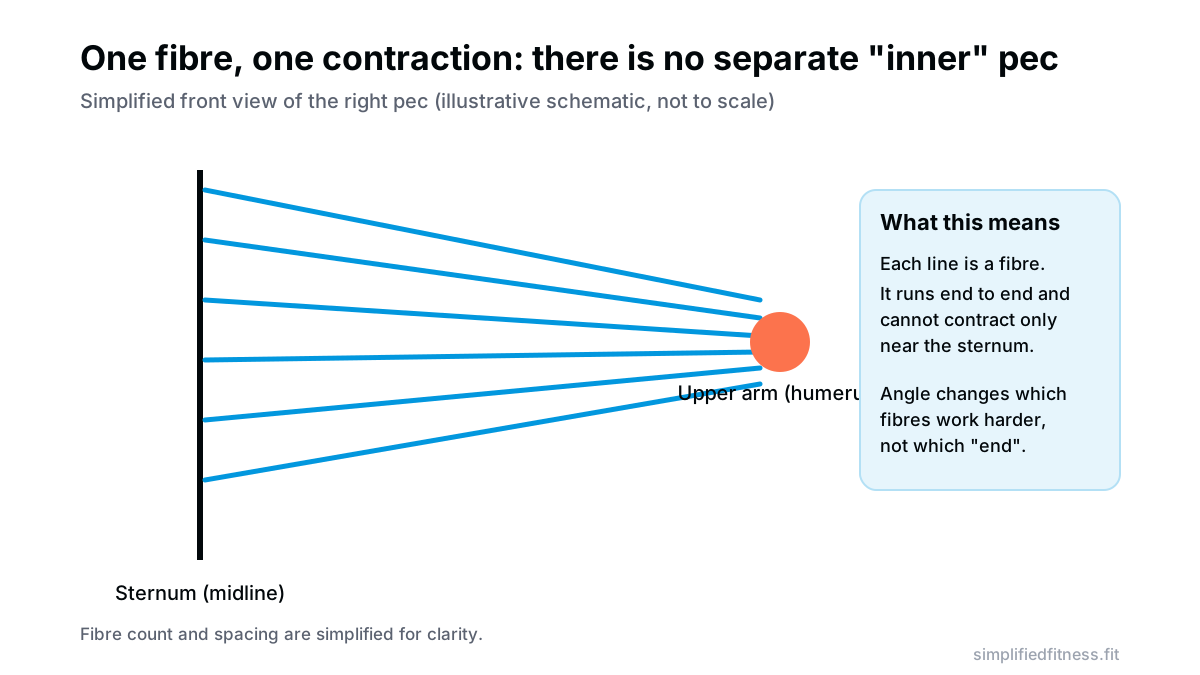
Where the myth gets some life is the angle. Fibres that start higher (collarbone) and lower (ribs and sternum) pull in slightly different directions, so changing your body position changes which ones do more of the work. That is real. It is just not the same as “inner versus outer”.
Why do flys feel like they hit the inside?
Flys and crossovers bring your arms across your body (horizontal adduction), and the peak contraction sits near the midline. Of course that feels like an inner chest burn. Your hands are meeting in the middle.
Research on the muscle shows why the feeling can mislead you. Surface EMG, the sensor on the skin that people quote as proof, is affected by where the nerve endings sit within the muscle. One study found the innervation zones of the pec sit medially and move as the arm moves, so changes in EMG signal picked up near the midline may not reflect a true change in how active the muscle is (Mancebo et al., 2019). That was 11 healthy participants and an isometric task, so treat it as a caution about the measurement, not a final word.
Fly-type moves also do not seem to be a stronger stimulus than presses. In 12 college-age men and women, motor unit activation of the pec was similar in the barbell press, dumbbell press and dumbbell fly, though the fly showed less relative time of activation and the authors suggested it suits an auxiliary role (Welsch et al., 2005). It is a small, old study, but the practical takeaway fits what lifters see: flys are a finisher, not a replacement for pressing.
Does a fly-style exercise grow only one part of the pec?
This is the cleanest test of the myth. A 2025 within-subject trial had 15 untrained young men train the pec deck for 12 weeks, comparing 1 set with 3 sets per session, taken to failure with reps progressing from 20 down to 8 (Pinto et al., 2025). Ultrasound showed the clavicular portion thickened by 17% (1 set) and 18% (3 sets), and the sternocostal portion by 21% for both.
The authors concluded that the results did not support regional hypertrophy after pec deck exercise in untrained men.
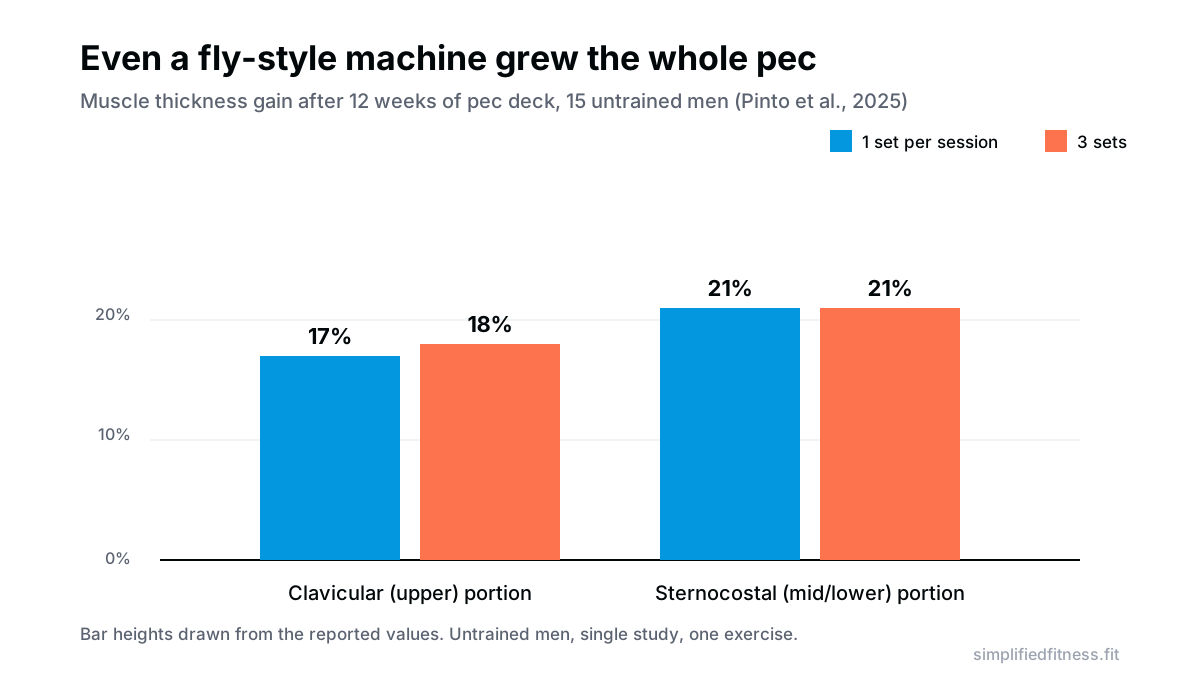
Caveats matter here. These were untrained men, so rapid early gains are expected, and it was a single exercise in a single study. Trained lifters may respond differently. Still, it is the opposite of what the inner chest idea predicts.
What actually changes between flat and incline pressing
Angle does shift emphasis, and this is worth using. High-density EMG across 15 regions of the pec found the biggest activity sat in the sternocostal head on a flat bench and moved toward the clavicular head at 45 degrees, in 8 volunteers at 50% and 70% of their one-rep max (Cabral et al., 2022). A follow-up in 13 men matched that with acute swelling: after four sets, the clavicular head swelled more following inclined presses and the sternocostal head more following flat presses (Albarello et al., 2022). Swelling right after a workout is not long-term growth, so this is suggestive rather than proof.
Bodybuilders showed the same pattern: in 10 competitive bodybuilders, the clavicular head was most excited in the 45 degree incline and the sternocostal head more so in flat and decline presses (Coratella et al., 2020). The same team saw the chest press machine excite the clavicular head the least.
How steep? In 30 trained adults, upper pec activity peaked at a 30 degree bench, while angles above 45 degrees raised anterior deltoid activity and cut pec performance (Rodriguez-Ridao et al., 2020).
For a deeper look at the heads of the muscle, see our guide to pectoralis major functional anatomy and the upper chest training guide.
What actually builds a full chest and cleavage
Think of four levers, three you control and one you do not.
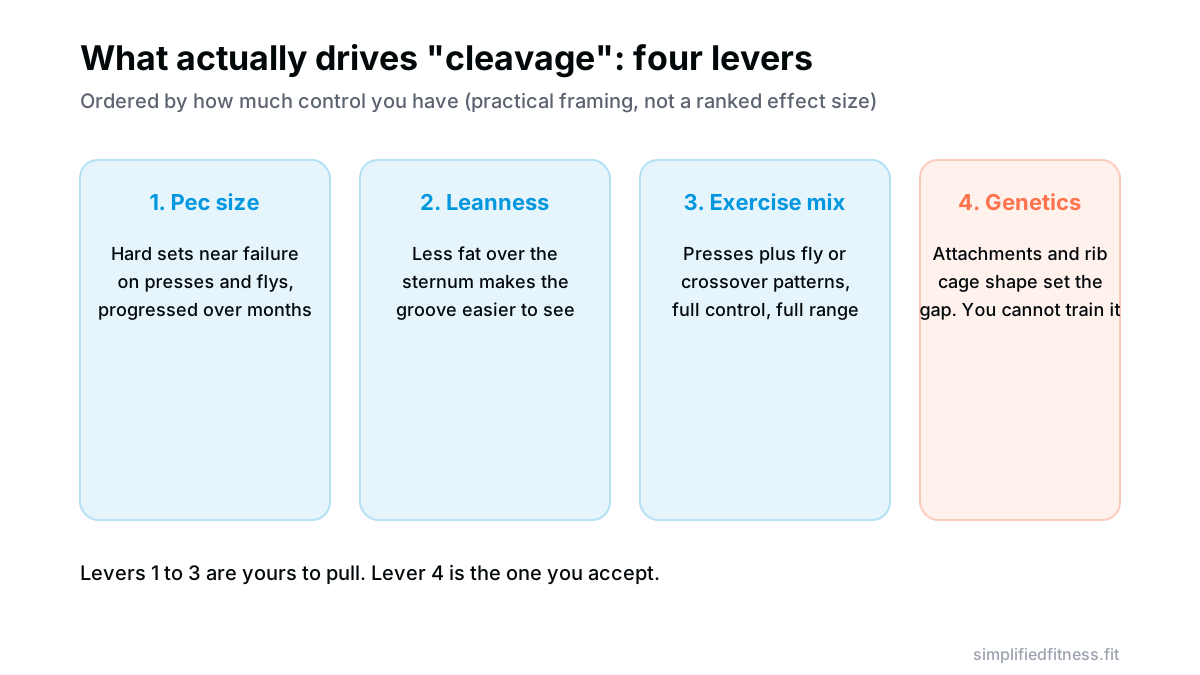
1. Total pec size. Growing the whole muscle makes both halves thicker, which narrows the visible gap. Volume matters: a meta-analysis of 15 studies found a graded dose-response, with more weekly sets generally linked to larger gains, about 0.37% extra growth per additional weekly set on average (Schoenfeld et al., 2017). That does not mean more is endlessly better, because your recovery still sets a limit.
2. Leanness. The groove between your pecs is partly skin and fat. Dropping body fat can make the same muscle look sharper. There is no spot reduction, so this comes from a slow overall cut, covered in our guide to energy balance for fat loss, bulking and recomposition. You can estimate where you stand with the body fat calculator.
3. A smart exercise mix. Cover the angles: a flat or slight decline press, a 30 degree incline press, then one fly pattern. Our breakdown of dumbbell flys vs cables vs pec deck shows how to pick between them, and the cable crossover angles guide explains the high-to-low and low-to-high lines.
4. Structure. How wide your ribcage is, and where your pecs attach along the sternum, set how far apart the two halves sit. I could not find trial data on this, so treat it as common anatomical reasoning rather than a measured effect. The practical point: some lifters will always have a visible groove, and that is normal.
A simple weekly plan to fill the middle
This is a starting template, not a rule. Adjust to your recovery.
- Day 1: flat or slight decline barbell or dumbbell press, 3 sets of 6-10. Then a 30 degree incline press, 3 sets of 8-12.
- Day 2 (a few days later): incline dumbbell press first, 3 sets of 8-12. Then a flat machine or dumbbell press, 2 sets. Finish with a cable crossover or pec deck, 3 sets of 12-15.
That is about 10-14 hard sets a week. Take sets within one to three reps of failure, control the lowering phase, and use a range of motion you own. Add a rep or a bit of weight when you can. Our free push day plan puts this together with shoulders and triceps, and the training volume calculator helps you count weekly sets.
Mistakes that keep the middle flat
- Chasing a squeeze instead of load. A light, constant-tension fly is fine for feel. It will not carry a program on its own.
- Doing 4 chest exercises that are all the same angle. Mix angles.
- Setting the incline too steep. Past about 45 degrees, front delt activity climbs and pec activity drops.
- Judging the gap in a mirror at the wrong body fat. Water, pump and lighting change what you see.
- Skipping pressing for “isolation”. Presses let you load heavier and progress faster.
Do push-ups and close grip presses help?
Push-ups are a perfectly good chest exercise. A 2018 study in 12 active men found few differences in primary muscle activity between push-ups and the bench press, apart from more core work in the push-up (Gottschall et al., 2018). Make them harder when they get easy, with a slow lowering phase or raised feet. A close grip bench shifts load to the triceps and does not create an inner pec zone. Keep it as a triceps-friendly option, not a chest hack.
When to get it checked
Aim for a symmetrical, painless chest. If one pec looks clearly smaller, has changed shape recently, or you notice a sudden bulge, pain, bruising or a lump in the chest or armpit area, see a doctor or physiotherapist rather than guessing. Chest changes are not something to self-diagnose from an article. See also our guide on uneven chest and unilateral pressing for ordinary left-right differences.
The bottom line
No exercise isolates the inner chest, because a pec fibre works along its whole length. What fills the middle is a bigger pec, a leaner torso and a mix of pressing angles, with a fly or crossover for extra volume. Your skeleton and tendon attachments set the rest, and that part is not up to you. Pick presses you can progress, hit about 10-14 hard sets a week, and give it a few months.
Frequently Asked Questions
How do you build inner chest?
You build it by growing the whole pectoralis major, because there is no separate inner muscle to target. Train presses and a fly or crossover pattern with hard sets near failure and add load or reps over time. Pair that with a leaner waist-to-chest look if your goal is visible cleavage.
Can you isolate the inner pecs?
No. Pec fibres run from the sternum and collarbone out to the humerus, so a contracting fibre shortens along its full length rather than at one end. Surface EMG can look different near the midline, but that mostly reflects where the signal is picked up. Choose exercises for how well you can load them and feel the pec work, not for a supposed inner zone.
Do cable crossovers and pec deck flys target the inner chest?
They train the pec through horizontal adduction, which is a good way to load the muscle, but they do not isolate an inner section. In one 12-week trial in untrained men, pec deck training grew the clavicular and sternocostal portions by similar amounts. Use them as a joint-friendly way to add volume after your presses.
Why does my chest have a gap in the middle?
The gap is mostly set by your skeleton, where your pecs attach along the sternum, and how much fat sits over it. Wider-set pecs leave a visible groove even when well developed. You can fill out the muscle on either side, but you cannot change the attachment points.
Is the inner chest gap genetic?
Largely, as far as basic anatomy suggests, though no trial has measured it. The width of your ribcage and the way your pecs attach decide how far apart the two halves sit. Training can make each pec thicker, which can narrow the visible gap somewhat, but it will not change the structure underneath.
Do close grip bench presses build inner chest?
A closer grip shifts more work to the triceps and does not create an inner chest zone. The pec still contracts as one muscle, and grip width mainly changes elbow and shoulder demands. A shoulder-width to slightly wider grip you can control through full range is usually the better chest builder.
Does squeezing at the top of a fly build more inner chest?
A hard squeeze can help you feel the pec working, but it does not recruit a separate inner portion. The fibres that shorten at the midline are the same fibres that shorten out at the arm. Keep the squeeze if it improves your mind-muscle connection, and put the real effort into taking sets close to failure.
How many sets per week do I need for chest growth?
A meta-analysis of 15 studies found a graded dose-response, with more weekly sets generally linked to more muscle growth. A sensible start for most lifters is roughly 10 hard sets per week for the pecs, spread over two sessions, then adjust to how you recover. Use the training volume calculator to keep track.
Will losing body fat make my chest cleavage more visible?
Usually, yes. Less fat over the sternum and between the pecs makes the groove and the pec edges easier to see, even at the same muscle size. There is no spot reduction, so fat comes off based on your overall energy balance. Aim for a slow, steady cut while keeping your pressing strength.
Do push-ups build inner chest?
Push-ups train the whole pec like any other press, with no special inner effect. A 2018 study in 12 active men found few differences in primary muscle activity between push-ups and the bench press. Use them for volume at home, and make them harder by slowing the lowering phase or elevating your feet.
Is incline or flat bench better for a full chest?
Both matter, because the angle changes which pec region works hardest. High-density EMG showed the greatest activity moving from the sternocostal head on a flat bench toward the clavicular head at 45 degrees. Using a flat or slight decline press plus a 30 degree incline covers the muscle without needing a special inner chest move.
How long does it take to fill out the chest?
Visible changes usually take months, not weeks, and depend on training age, food and sleep. In the pec deck study, untrained men added roughly 17-21% pec thickness over 12 weeks, but trained lifters gain more slowly. Track strength on your main presses every few weeks as a fair sign of progress.
Can I fix a flat or narrow-looking chest with exercise?
You can add thickness to the pec, and for many people that visibly improves the shape. What you cannot change is the underlying width and attachment that gives each person a different starting point. If one side is clearly different, or you have pain, a coach or physiotherapist can look at it in person.
Sources & References
Every claim above is checked against peer-reviewed research (PubMed, U.S. National Library of Medicine) or guidance from established health bodies. How we fact-check.
- Pinto MD, et al. Pectoralis clavicular and sternocostal thicknesses increase similarly in response to one and three sets of pec deck resistance training in untrained young men. J Strength Cond Res. 2025. PMID: 40266636
- Cabral HV, et al. Non-uniform excitation of the pectoralis major muscle during flat and inclined bench press exercises. Scand J Med Sci Sports. 2022. PMID: 34644424
- Albarello JCDS, et al. Non-uniform excitation of pectoralis major induced by changes in bench press inclination leads to uneven variations in the cross-sectional area measured by panoramic ultrasonography. J Electromyogr Kinesiol. 2022. PMID: 36334406
- Mancebo FD, et al. Innervation zone locations distribute medially within the pectoralis major muscle during bench press exercise. J Electromyogr Kinesiol. 2019. PMID: 30870768
- Rodriguez-Ridao D, et al. Effect of five bench inclinations on the electromyographic activity of the pectoralis major, anterior deltoid, and triceps brachii during the bench press exercise. Int J Environ Res Public Health. 2020. PMID: 33049982
- Coratella G, et al. Specific prime movers' excitation during free-weight bench press variations and chest press machine in competitive bodybuilders. Eur J Sport Sci. 2020. PMID: 31397215
- Welsch EA, et al. Electromyographic activity of the pectoralis major and anterior deltoid muscles during three upper-body lifts. J Strength Cond Res. 2005. PMID: 15903389
- Schoenfeld BJ, et al. Dose-response relationship between weekly resistance training volume and increases in muscle mass: a systematic review and meta-analysis. J Sports Sci. 2017. PMID: 27433992
- Gottschall JS, et al. Muscle activity patterns do not differ between push-up and bench press exercises. J Appl Biomech. 2018. PMID: 29809073
- Hernandez-Belmonte A, et al. Free-weight and machine-based training are equally effective on strength and hypertrophy: challenging a traditional myth. Med Sci Sports Exerc. 2023. PMID: 37535335

Umair Hazrami · Founder & Head Coach, Simplified Fitness
Umair Hazrami founded Simplified Fitness and the Simplified Lifter channel to cut through fitness noise. With 4+ years of consistent training and 10+ coaching clients, he writes every guide from the peer-reviewed research and links the sources so you can check them. Our editorial standards.
Educational content only, not medical advice. If you have a medical condition, are pregnant, or take medication, talk to a qualified doctor before changing your diet, supplements or training. Full disclaimer.
Keep reading

Exercise Technique
Arching on the Bench Press: Powerlifting Spine Arch vs Bodybuilding Setup
Is a bench press arch cheating or dangerous for your back? Learn the difference between a powerlifting arch and a natural upper back setup, with study data.
8 min read
Exercise Technique
Bench Press Grip Width: Pec Activation, Triceps and Shoulder Clearance
Bench press grip width changes triceps load, shoulder stress and little else for your pecs. See what EMG and joint-load studies show and how to pick your grip.
7 min read
Exercise Technique
Cable Crossover Angles: High-to-Low vs Low-to-High vs Horizontal Fly
Cable crossover angles explained: what high-to-low, low-to-high and horizontal flys likely train, what the research really says, and how to set each one up.
9 min read
Exercise Technique
Chest Dips: Forward Lean Angle, Scapular Position, and Shoulder Safety
Chest dips can build your chest if you lean, set your shoulders and stop at a depth that suits you. See what the research says and how to dip safely.
8 min read