Bench Press Grip Width: Pec Activation, Triceps and Shoulder Clearance
Bench press grip width changes triceps load, shoulder stress and little else for your pecs. See what EMG and joint-load studies show and how to pick your grip.

TL;DR. The short answer
- Bench press grip width has only a modest effect on chest activation. Studies find small or no differences in pec EMG across grips, with narrower grips shifting work toward the triceps and wider grips toward the shoulder horizontal adductors.
- A grip of about 1.5 times your biacromial width (shoulder-point distance) is a sensible starting point, not a proven optimum. In one 2024 biomechanics study, grips narrower than 1.5 times lowered AC joint compression and rotator cuff demand.
- Very wide grips raise shoulder joint moments and shorten the range of motion, and no study shows they build more chest. Very narrow grips lower the load you can use (6RM was lower in trained and novice men).
- No long-term study has compared grip widths for muscle growth, so any claim that one width 'maximizes' hypertrophy is inference. Pick the grip that lets you train hard, pain-free, for years.
- Sharp shoulder pain, numbness or pain at rest is a reason to see a doctor or physiotherapist, not to tweak your grip.
Part of our complete guide: The Complete Chest Workout Guide: Pec Anatomy, Bench Angles, Flys and Shoulder-Safe Pressing
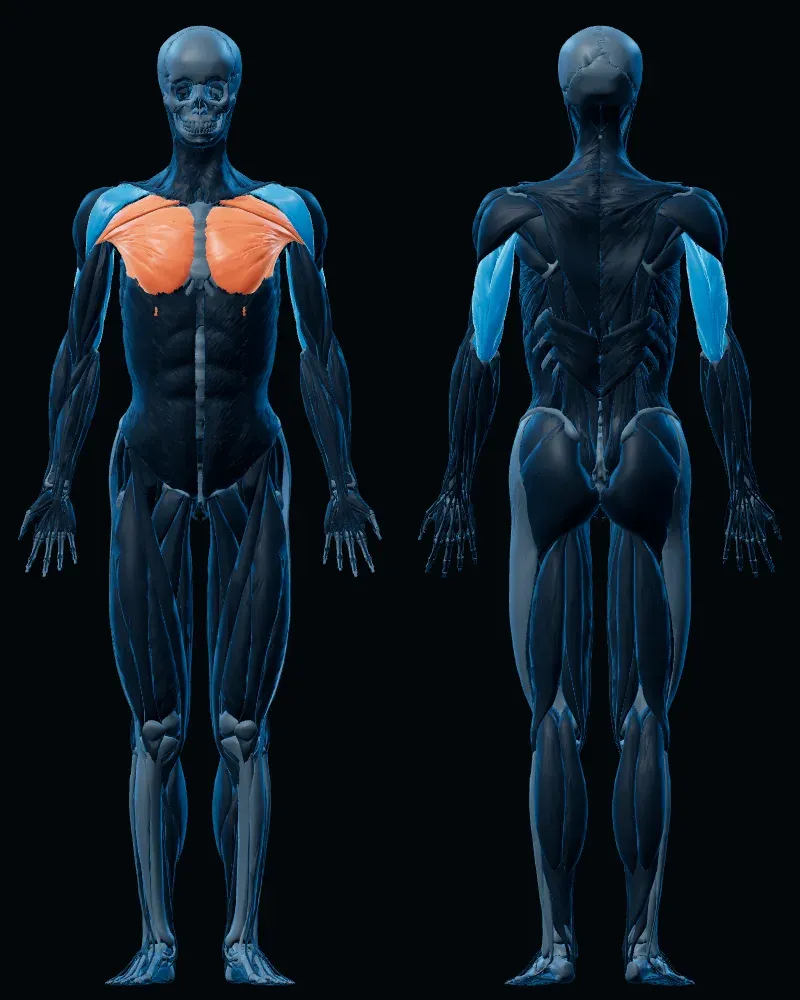
Muscles worked: chest
Main movers: pectoralis major
Assisting: front delts and triceps
Table of contents
Bench press grip width changes your triceps and shoulders more than it changes your chest. The research mostly finds similar pec activation across narrow, medium and wide grips, with narrower grips shifting work to the triceps and wider grips loading the shoulder more.
So “wide grip for chest, narrow for triceps” is only half right. If you want the full picture of chest training, start with our complete chest training guide. This article zooms in on one decision: where to put your hands on the barbell.
What does grip width actually change?
Three things move when your hands move: which muscles work harder, how much load your shoulder joint takes, and how far the bar travels. The chest is the least affected of the three.
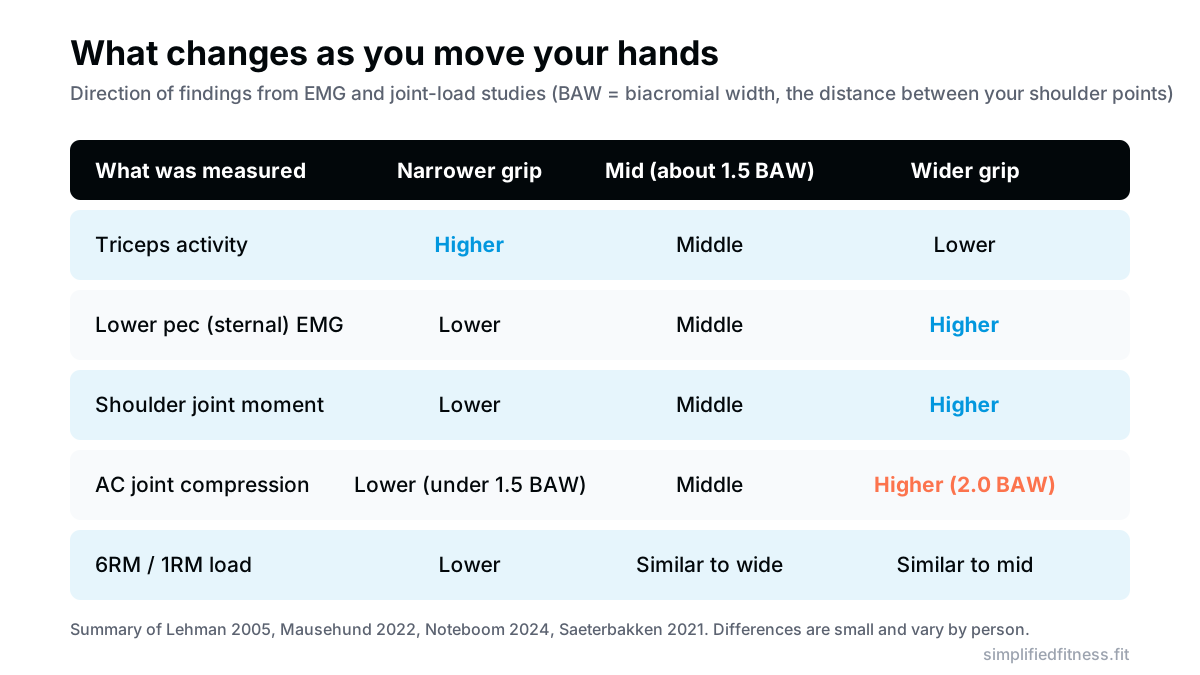
Researchers often express grip width as a multiple of biacromial width (BAW), the distance between the two bony points on top of your shoulders. A grip of 1.0 BAW puts your hands about shoulder-point width apart. At 2.0 BAW they are twice that.
Does a wide grip work the chest more?
Not by much. This is where the gym lore and the lab data part ways.
In a small EMG study of 12 healthy men, moving from a wide to a narrower grip increased triceps activity and decreased activity in the sternoclavicular (lower) portion of the pec. The authors noted the changes were small and suggested sport demands should guide grip choice over trying to target a muscle (Lehman, 2005). That was an isometric hold, not a full set, so it is only a rough guide.
A larger study put 35 strength-trained adults through 6-8 rep sets. Narrower grips produced bigger elbow moments and more activity in the lateral triceps, anterior deltoid and clavicular pec. Wider grips produced bigger shoulder moments and more activity in the abdominal (lower) head of the pec (Mausehund et al., 2022). The authors concluded all variations can stimulate growth, with narrower grips favouring the elbow extensors and wider ones the shoulder horizontal adductors.
Then there are studies finding almost nothing. Twelve national and international level bench pressers showed no significant differences in pec, triceps or deltoid activation across grip widths, except lower biceps activity with a narrow grip (Saeterbakken et al., 2017). A study of 14 men (seven trained, seven untrained) found the pec-to-triceps EMG ratio barely changed between 81 cm and 40 cm grips (Tanimoto et al., 2023).
Why the mismatch? Different grip definitions, different loads, different muscles sampled, and EMG that is noisy at best. EMG shows how active a muscle is, not how much it grows.
What does grip width do to your triceps?
This is the clearest effect. In 28 men (trained and novice), a wide grip gave lower triceps activation than medium or narrow grips, while biceps activity went up as the grip widened (Saeterbakken et al., 2021). In trained lifters doing one-rep maxes, triceps medialis activity was also greater with medium and narrow grips than with a wide grip (Larsen et al., 2020).
Practical read: if your triceps are the weak link and your lockout fails, a slightly narrower grip is a reasonable fix. If you want a proper triceps-focused version, see our guide to the close grip bench press and wrist spacing.
Which grip protects the shoulder?
The popular advice that about 1.5 times shoulder width is a safe spot has partial backing: the best data suggest not going wider than that.
Ten experienced strength athletes performed 21 technique variations, including grips of 1.0, 1.5 and 2.0 BAW. A musculoskeletal model estimated joint forces. Grips narrower than 1.5 BAW lowered acromioclavicular (AC) joint compression, and both a grip narrower than 1.5 BAW and scapula retraction reduced posterior shear at the glenohumeral joint and rotator cuff activity (Noteboom et al., 2024). The authors noted that sideways forces on the bar varied a lot between athletes and strongly affected shoulder loads.
Several things to keep in mind:
- It is a computer model on ten experienced lifters, not an injury trial. It estimates risk; it does not measure injuries.
- It says narrower than 1.5 BAW was gentler, so 1.5 is a ceiling to be cautious about, not a perfect target.
- Wider grips raised shoulder moments in another study. In 35 strength-trained adults, increasing the grip width produced larger shoulder net joint moments (Mausehund et al., 2022).
There is also a quirk of lateral force. A wide grip tends to push the bar outward and a narrow grip inward. In 14 men, the lateral-to-vertical force ratio was about 30% outward for a wide grip and about 10% inward for a narrow grip (Tanimoto et al., 2023). That is one reason forearm angle and elbow path matter as much as hand spacing.
Does a wider grip shorten the range of motion?
Generally yes, since the bar has less distance to travel when your hands are wide. Whether that matters for growth is not settled. A systematic review of range-of-motion studies found full range of motion helped lower-body hypertrophy, but upper-limb research was limited and conflicting, so strong inferences could not be drawn (Schoenfeld and Grgic, 2020). So do not assume a “longer” bench is automatically a better chest builder, and do not assume it is worse either.
Will a wider grip let you lift more?
Between medium and wide, probably not much. Between those and a narrow grip, yes, a narrow grip is usually weaker.
In 14 bench-trained men, one-rep maxes were 109.8 kg with a wide grip, 108.9 kg with a medium grip and 103.7 kg with a narrow grip (Larsen et al., 2020). In the 28-man study, both novice and trained groups lifted lower 6RM loads with a narrow grip than with the others (Saeterbakken et al., 2021). In competitive benchers, 6RM loads were 5.8-11.1% higher with medium and wide grips than with narrow (Saeterbakken et al., 2017). That group’s authors recommended a wide grip on a flat bench for high-load hypertrophy work in bench press athletes, which is specific to that population.
If you track your numbers, use the 1RM calculator to estimate strength from submaximal sets and save your joints from frequent max attempts.
How to pick your grip, step by step
Here is a method I would use with any lifter. It is a coaching process, not a published protocol.
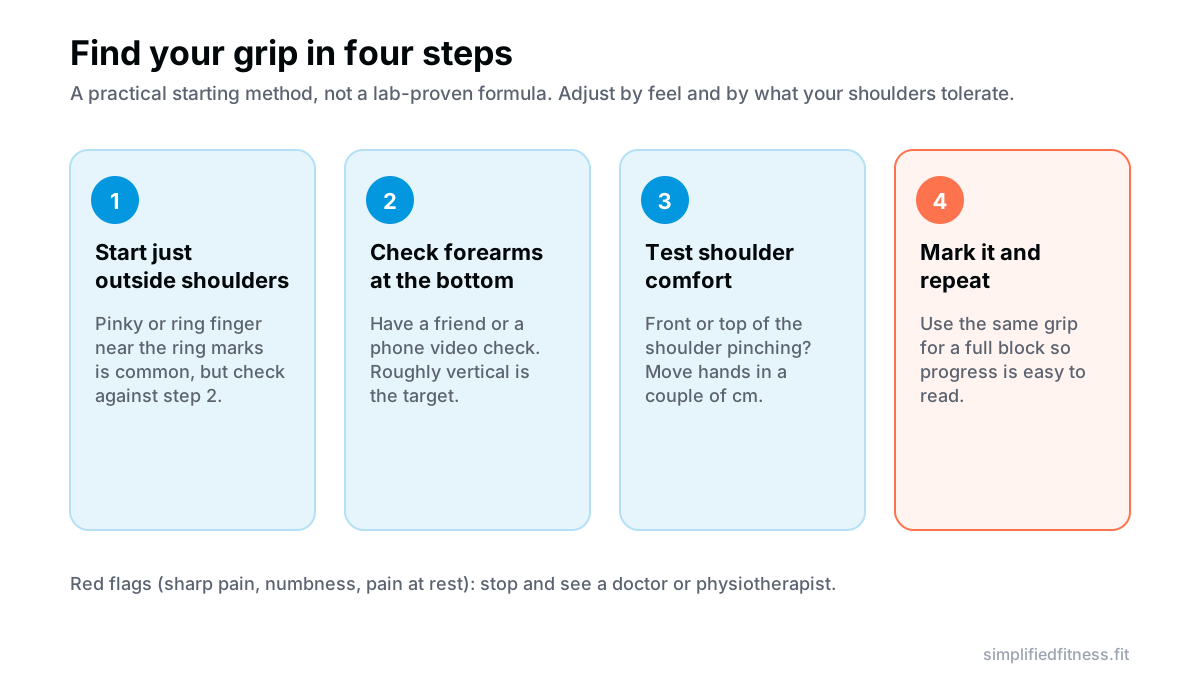
- Start just outside shoulder width. Many lifters land with hands roughly 1.5 times their shoulder-point width. Measure your BAW with a tape and multiply, or just grip and check step 2.
- Check your forearms at the bottom. Film from the front or ask a gym partner. Forearms that look close to vertical, with the wrist stacked over the elbow, is a handy cue. It is not a research-proven rule.
- Test shoulder comfort. If you feel pinching at the front or top of the shoulder, move your hands in by a couple of centimetres and tuck the elbows slightly. For more fixes, see our guide to shoulder pain on the bench press.
- Lock it in for 6-8 weeks. Using the same grip makes progress easy to read. Change only if pain or a sticking point tells you to.
Grip width by goal
- Chest size, general: a medium grip, about 1.5 times shoulder-point width, with a controlled lowering. Add incline and fly work. See dumbbell vs barbell pressing.
- Triceps or lockout weakness: a slightly narrower grip, a few centimetres in each side.
- Shoulder discomfort: narrower than 1.5 times, retracted shoulder blades, and a moderate elbow angle. If it persists, read about subacromial shoulder impingement and lifting solutions.
- Competition bench: depends on rules and technique, which our article on bench press arch for powerlifting vs bodybuilding covers.
For hand position beyond width, such as wrist angle and supination, read grip width and wrist orientation in lifting.
When to see a doctor
Grip tweaks will not fix every shoulder. Get assessed by a doctor or physiotherapist if you have sharp pain during the press, pain at rest or at night, numbness or tingling in the arm, a clicking shoulder with weakness, or pain that lasts more than a couple of weeks even after changing technique. Do not diagnose yourself from a gym article.
The bottom line
Grip width is a lever, not a switch. The best-supported statements are modest: narrower grips involve more triceps and lower AC joint load, wider grips involve more shoulder work, and pec activation changes only slightly. Pick a medium grip near 1.5 times shoulder-point width, check your forearms, and keep it long enough to see progress.
Then put it to work in a proper session, like our push day plan.
Frequently Asked Questions
What is the best grip width for bench press to build chest?
There is no single proven best width. EMG studies in trained men mostly show similar pec activation across narrow, medium and wide grips, so a medium grip that you can load heavily and that feels comfortable on your shoulders is a sensible choice. Start about 1.5 times your shoulder-point width, test it for a few weeks, and adjust by a couple of centimetres.
Does a wide grip bench press work the chest more?
Slightly in some measures, but not clearly enough to call it a chest builder. One study found larger sternal (lower) pec EMG with wider grips, while others found no meaningful differences in pec activation across widths. Wider grips mainly increase shoulder joint demand, so use them only if they feel good and you can control the bar.
Does a narrow grip bench press only work the triceps?
No, the chest still works hard on a narrow grip. Studies show triceps activity rises as the hands move in, while pec activation changes only a little. If you want the triceps emphasis, a moderately narrow grip with your elbows tucked is enough, and you do not need to go to a hands-touching extreme.
What is biacromial width and why does it matter for grip?
Biacromial width is the distance between the two bony points at the top of your shoulders. Researchers use it to scale grip width to body size, so 1.5 biacromial widths means hands 1.5 times that distance apart. You can estimate it by measuring across the shoulder points with a tape and then checking the grip against forearm angle at the bottom of the rep.
Should my forearms be vertical at the bottom of the bench press?
Roughly vertical forearms when the bar is at your chest is a widely used coaching cue because it keeps the bar over the elbows and limits wrist strain. It is a practical check rather than a research-proven rule, so treat it as a starting point. Film a rep from the front and adjust your hands in or out until the forearms look close to vertical.
Can grip width cause shoulder pain on the bench press?
It can contribute, because grip width changes how much load goes through the AC joint and the shoulder at the bottom of the rep. A 2024 study of ten experienced lifters estimated lower AC joint compression with grips narrower than 1.5 biacromial widths. If you have pain, try a slightly narrower grip and tucked elbows, and see a professional if it persists.
What grip width is safest for the shoulders?
No grip is guaranteed safe, but a mid-width grip is a reasonable middle ground. A biomechanics model of experienced lifters estimated lower AC joint compression and less posterior shear in the shoulder with grips narrower than 1.5 biacromial widths. Combine that with a retracted shoulder blade and moderate elbow flare, and stop if pain is sharp.
Is close grip bench better for triceps than wide grip?
Yes, narrower grips usually recruit the triceps more. In one 28-man study triceps activity was lower with a wide grip than with medium or narrow grips, and a 35-person study found larger triceps EMG and elbow moments when the grip narrowed. For more detail on technique, see the close grip bench guide linked in this article.
Will a wider grip let me lift more weight?
Medium and wide grips usually allow similar loads, and both beat a very narrow grip. In trained men the 1RM was 109.8 kg wide, 108.9 kg medium and 103.7 kg narrow, and a 6RM study found lower loads with a narrow grip. Use our 1RM calculator to track your own numbers without maxing out every week.
How often should I change my bench press grip width?
Rarely, because changing it constantly makes progress hard to read. Pick a grip, keep it for a training block of 6-8 weeks, and only change it if pain or a sticking point tells you to. Small rotations between a medium and a slightly narrower grip across different sessions can add variety without much confusion.
Does hand width matter for dumbbell bench press?
The studies in this article are on barbells, so we cannot transfer the numbers directly. Dumbbells let your hands and elbows find their own path, which many lifters find kinder to the shoulders. If barbell grip feels awkward, trying dumbbells for a block is a reasonable experiment.
Should I use a thumbless or false grip to change how the bench feels?
A false grip is not part of the grip width evidence, and it adds a real risk of the bar slipping. Keep your thumb wrapped around the bar, especially with heavy loads. If your wrists hurt, fix hand placement and wrist alignment first.
Sources & References
Every claim above is checked against peer-reviewed research (PubMed, U.S. National Library of Medicine) or guidance from established health bodies. How we fact-check.
- Lehman GJ. The influence of grip width and forearm pronation/supination on upper-body myoelectric activity during the flat bench press. J Strength Cond Res. 2005. PMID: 16095407
- Saeterbakken AH, et al. The Effect of Grip Width on Muscle Strength and Electromyographic Activity in Bench Press among Novice- and Resistance-Trained Men. Int J Environ Res Public Health. 2021. PMID: 34198674
- Larsen S, et al. A Biomechanical Analysis of Wide, Medium, and Narrow Grip Width Effects on Kinematics, Horizontal Kinetics, and Muscle Activity on the Sticking Region in Recreationally Trained Males During 1-RM Bench Pressing. Front Sports Act Living. 2020. PMID: 33554113
- Noteboom L, et al. Effects of bench press technique variations on musculoskeletal shoulder loads and potential injury risk. Front Physiol. 2024. PMID: 38974522
- Mausehund L, et al. Understanding Bench Press Biomechanics-The Necessity of Measuring Lateral Barbell Forces. J Strength Cond Res. 2022. PMID: 33555823
- Saeterbakken AH, et al. The Effects of Bench Press Variations in Competitive Athletes on Muscle Activity and Performance. J Hum Kinet. 2017. PMID: 28713459
- Tanimoto M, et al. Lateral Force and EMG Activity in Wide- and Narrow-Grip Bench Press in Various Conditions. Sports (Basel). 2023. PMID: 37624134
- Schoenfeld BJ, et al. Effects of range of motion on muscle development during resistance training interventions: A systematic review. SAGE Open Med. 2020. PMID: 32030125

Umair Hazrami · Founder & Head Coach, Simplified Fitness
Umair Hazrami founded Simplified Fitness and the Simplified Lifter channel to cut through fitness noise. With 4+ years of consistent training and 10+ coaching clients, he writes every guide from the peer-reviewed research and links the sources so you can check them. Our editorial standards.
Educational content only, not medical advice. If you have a medical condition, are pregnant, or take medication, talk to a qualified doctor before changing your diet, supplements or training. Full disclaimer.
Keep reading

Exercise Technique
Arching on the Bench Press: Powerlifting Spine Arch vs Bodybuilding Setup
Is a bench press arch cheating or dangerous for your back? Learn the difference between a powerlifting arch and a natural upper back setup, with study data.
8 min read
Exercise Technique
Cable Crossover Angles: High-to-Low vs Low-to-High vs Horizontal Fly
Cable crossover angles explained: what high-to-low, low-to-high and horizontal flys likely train, what the research really says, and how to set each one up.
9 min read
Exercise Technique
Chest Dips: Forward Lean Angle, Scapular Position, and Shoulder Safety
Chest dips can build your chest if you lean, set your shoulders and stop at a depth that suits you. See what the research says and how to dip safely.
8 min read
Exercise Technique
Dumbbell vs Cable vs Pec Deck Fly: Which Chest Fly Is Best?
Dumbbell vs cable vs pec deck fly: how each resistance curve loads your chest, what research does and does not show, and which fly to pick for growth.
8 min read