Pec Deck Machine Setup: Seat Height, Elbow Position and Safe Range
Pec deck machine setup made simple: seat height, elbow and shoulder blade position, and how close to failure to go so it hits your chest, not your shoulders.

TL;DR. The short answer
- Set the seat so the handles or pads sit at roughly mid-chest height, with your upper arms about parallel to the floor. Too low or too high shifts the work toward the shoulders and traps.
- Keep your back flat on the pad, shoulder blades gently down and back, and hold a slight fixed elbow bend. Do not let the bend change during the rep.
- Stretch until you feel the chest lengthen, not until the front of the shoulder takes over. Elbows stopping about in line with your torso is a sensible limit for most people.
- There are no pec deck specific hypertrophy trials, so the advice here rests on general research: training at long muscle lengths and training reasonably close to failure both look useful, with caveats.
- Sharp shoulder pain is a reason to stop and see a physio or doctor, not to adjust the seat and push through.
Part of our complete guide: The Complete Chest Workout Guide: Pec Anatomy, Bench Angles, Flys and Shoulder-Safe Pressing
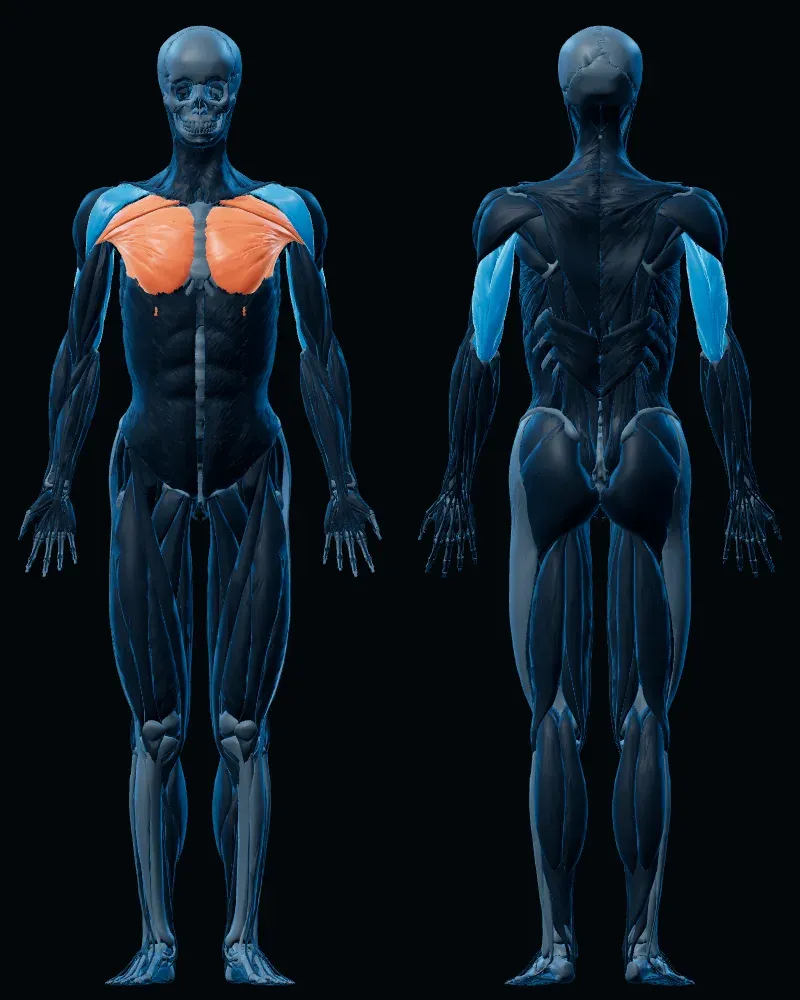
Muscles worked: chest
Main movers: pectoralis major
Assisting: front delts and triceps
Table of contents
A good pec deck machine setup comes down to three things: the handles at roughly mid-chest height, your shoulder blades set down and back, and a slight elbow bend that never changes. Get those right and the machine does what it was built for, which is to put a stable, stretched chest under tension. Get them wrong and your front delts and traps do half the work.
This is the equipment-specific walkthrough in our complete chest training guide. If you want the broader fly comparison first, see dumbbell vs cable vs pec deck flyes. Here we stay on the machine itself.
One honest note up front. I could not find a trial that compares pec deck setups or measures chest growth from the pec deck specifically. So where this article gives a cue, it is coaching logic built on general research about range of motion and effort, and I will say so each time.
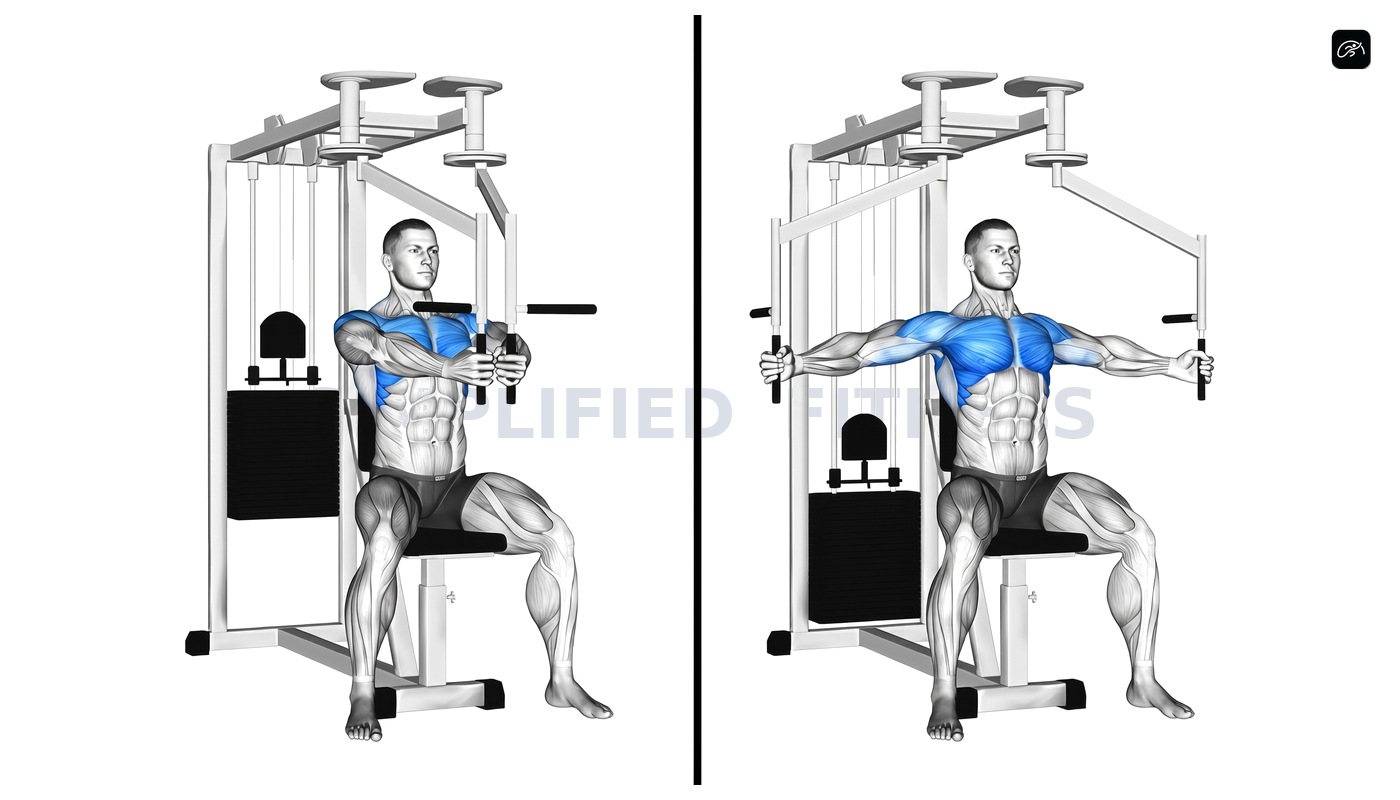
How do you set up the pec deck machine?
Work through five checks before your first working set. The whole thing takes under a minute once it is habit.
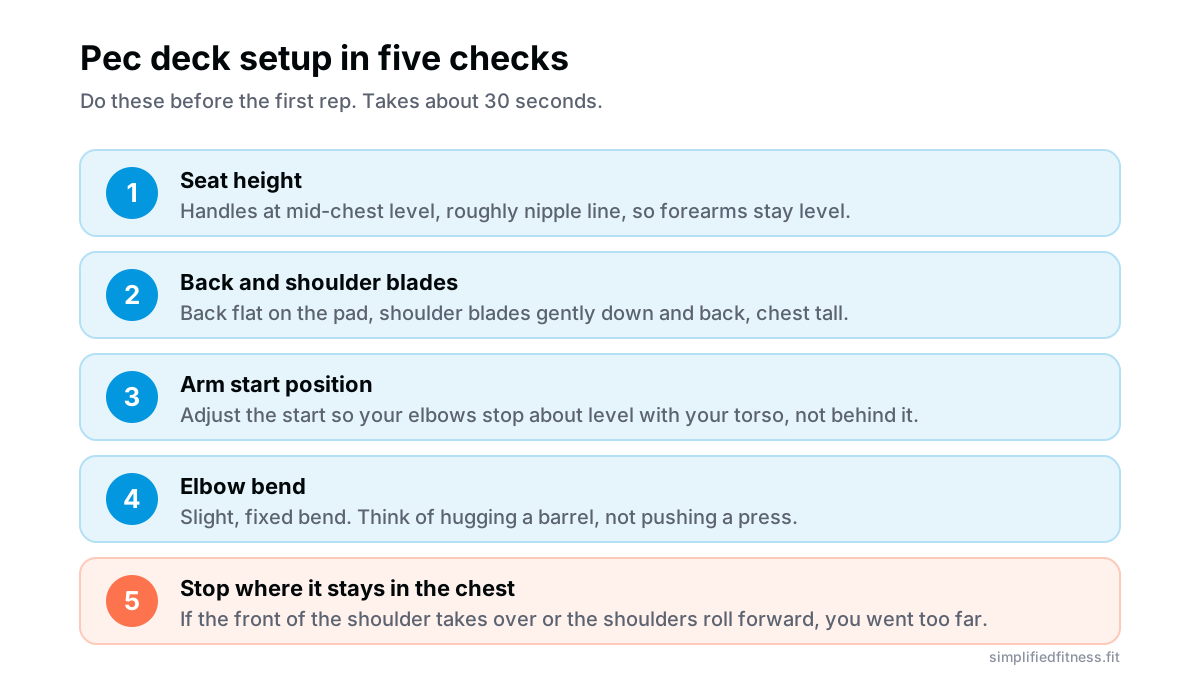
1. Seat height. Sit down and look at where the handles or pads sit. You want them around mid-chest, roughly level with your nipple line, so your upper arms are close to parallel to the floor. Too low and the arms drag downward and the shoulders and lats get involved. Too high and you shrug, and your neck gets tight.
2. Back and shoulder blades. Press your back flat against the pad and sit tall. Let your shoulder blades settle gently down and back, without cranking them together. Think of keeping your chest proud. Letting the shoulders roll forward is a common way this exercise turns into a front-delt movement.
3. Start position. Most machines have a lever that sets how far back the arms start. Set it so that, at the bottom, your elbows stop about level with your torso, not well behind it. Beginners should start with a shorter range and extend it over a few weeks.
4. Elbow bend. Keep a slight bend and hold that exact angle for the whole set. Imagine hugging a large barrel. If the elbows straighten and bend as you go, it becomes a messy half press.
5. Stopping point. Lower only as far as the stretch stays in your chest. If the front of the shoulder takes over or your shoulders roll forward, you went too far. Hold the handles loosely, or use the forearm pads if your machine has them; gripping hard tends to bring the forearms and shoulders into it.
Handles or pads: which grip is better?
Neither is proven better for growth. The machine fixes the arm path either way, so the difference is comfort.
Handles give a firmer connection and suit people who like a defined hand position. Forearm pads often feel kinder on the wrists and make it easier to think about squeezing the chest instead of the grip. A common mistake is choosing based on what looks standard rather than what lets you hold a stable elbow position. Try a set of each and keep whichever lets you feel the chest most.
Why is the pec deck popular for chest hypertrophy?
Three practical reasons, none of which are magic.
Stability. You are supported by a back pad and the path is fixed. You do not have to balance dumbbells or manage cables, so more of your effort can go into the chest.
A built-in stretch. The machine lets you load the pecs near their lengthened position. That matters because lengthened positions are a topic of active research. A 2025 meta-analysis of 12 studies in young adults found that training at longer versus shorter mean muscle lengths produced similar regional hypertrophy, with trivial differences and a trend favouring longer lengths toward the distal end (Varovic et al., 2025). The authors flagged that the differences in muscle length between groups were fairly small, so caution is needed.
Easy to take close to failure. Because the machine is stable and needs no spotter, you can push sets hard without worrying about dropping a weight. That does not make bad form safe.
How far should you stretch? Range of motion and shoulder safety
This is where the shoulder question lives. A deeper stretch is not automatically better for the chest.
The research on range of motion is mixed and depends on the muscle. A 2020 systematic review of six studies concluded that full range of motion looked beneficial for lower-body hypertrophy, but that upper-limb research was limited and conflicting, so strong inferences were not possible (Schoenfeld and Grgic, 2020). A 2021 meta-analysis of 16 studies found full range of motion beat partial for strength (effect size 0.56) and lower-limb hypertrophy (0.88), while differences in muscle thickness and architecture were not significant (Pallares et al., 2021).
In trained people, an 8-week within-person trial (30 participants, elbow flexors and extensors) found lengthened partial reps and full range of motion gave similar muscle thickness gains. The authors suggested emphasising the stretched position, by either full range or lengthened partials (Wolf et al., 2025). That was arms, not chest, so it is indirect.
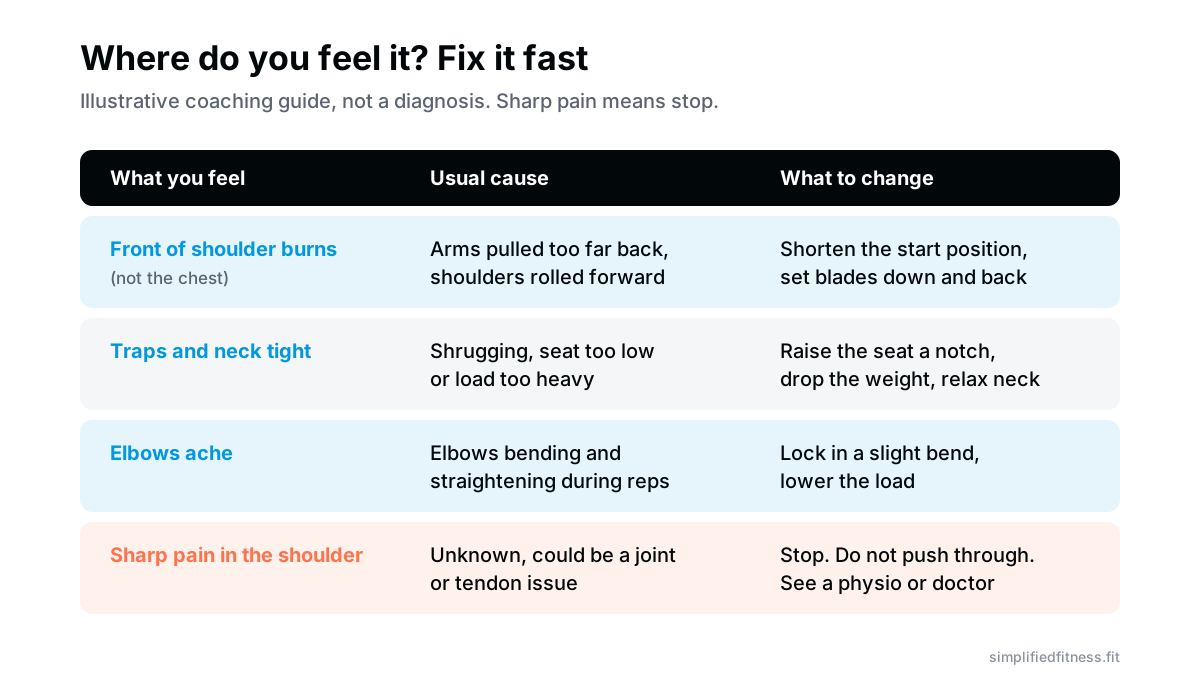
What does that mean for the pec deck? A sensible reading is that you want a real stretch in the chest, but you do not need to chase the extreme end of the shoulder’s range. If the stretch moves from the chest into the front of the shoulder, that extra depth is probably not buying you anything.
A practical stopping point
A simple rule: lower until your elbows are about in line with your torso, with your shoulder blades still set. Then pause for a beat and come back. If you cannot keep your shoulder blades in place at that depth, shorten the range with the start-position lever.
One study of recreational weight trainers found shoulder impingement features were associated with lateral raises and upright rows done above 90 degrees, and inversely associated with training the external rotators (Kolber et al., 2014). It was a small cross-sectional study of 77 men (46 who lifted), it shows association rather than cause, and it did not report on the pec deck, so I would not apply it directly here. But it is a reminder that exercise selection and balanced shoulder training can matter. Pairing chest work with some rowing and rear-delt work is a cheap habit.
Which part of the chest does the pec deck train?
Mostly the pec as a whole, at a mid-chest angle. Research with high-density EMG shows that different regions of the pectoralis major are excited depending on bench angle: the sternocostal region in the flat bench and the clavicular region in the 45 degree incline (Cabral et al., 2022). That was a bench press study of eight volunteers, not the pec deck.
So moving the seat a notch is not a reliable way to hit upper or lower chest. If upper chest is your priority, use an incline dumbbell press as the main tool and let the pec deck be a finisher.
How close to failure should you go?
This is the effort part of your pec deck machine setup, and it is where the stable machine earns its place.
A 2024 meta-regression found that for hypertrophy, outcomes tended to improve as sets were terminated closer to failure, while strength gains were similar across a wide range. The authors described the analysis as exploratory, and the reps-in-reserve values were estimated from study descriptions rather than measured, so the exact relationship remains unclear (Robinson et al., 2024).
Counterpoint: in an 8-week trial of 18 resistance-trained people training their quads, sets stopped 1-2 reps short of failure produced similar thickness gains to sets taken to failure (Refalo et al., 2024). That was legs, and a small sample.
Why might they differ? Different muscles, small samples, and estimates of “reps in reserve” are not very accurate. A cautious takeaway: end most pec deck sets with about 1-3 reps left, and take the last set of the session a little closer. If you want to calibrate, use the RIR/RPE calculator or read our guide to reps in reserve.
Sets, reps and where it fits in your session
A starting point, not a rule: 2-4 hard sets of about 8-15 reps, 1-3 reps in reserve, a slow lowering phase, once or twice a week. Evidence suggests muscle growth can occur across a wide span of loads (Schoenfeld et al., 2021), so pick a range where your form stays clean.
Put it after your presses. Heavy pressing needs fresh muscles, and the machine fly is easy to do tired. The free push day plan shows one way to slot it in.
When to see a doctor
Normal effort feels like muscle burn and stretch across the chest. It should not feel like a sharp pinch at the front of the shoulder, pain that lingers into the next day, numbness, or a sudden pop. If any of those show up, stop the exercise and get it assessed by a physio or doctor. This article cannot diagnose anything.
The bottom line
Set the seat to mid-chest, pin your shoulder blades down and back, hold a slight elbow bend, and stop the stretch where it is still a chest stretch. Train close to, but not necessarily to, failure. That is the whole recipe.
The pec deck is a good tool, not a required one. The big drivers of chest size are still heavy presses, enough weekly sets and eating enough protein. Work out your target with the protein calculator and keep the machine as a clean, controlled finisher.
Frequently Asked Questions
What is the correct seat height on a pec deck?
Set the seat so the handles or pads sit around mid-chest height, roughly level with your nipple line, with your upper arms close to parallel to the floor. At that height the arms travel across your chest instead of up or down. If you feel your traps or the front of your shoulders more than your chest, adjust one notch and test again.
How do I use the pec deck for chest and not shoulders?
Keep your shoulder blades down and back against the pad and stop the stretch before your elbows travel far behind your torso. This keeps the load on the pecs instead of letting the front of the shoulder take over the stretch. Use a weight you can control through a slow lowering phase.
Should my elbows be bent on the pec deck?
Yes, a slight bend is the usual recommendation, and it should stay the same through the whole rep. Straightening and bending the elbow turns the fly into a half press and adds strain at the elbow. Pick the bend that feels comfortable and keep it fixed.
Should I use the handles or the arm pads on the pec deck?
Both can work, so choose the one that lets you keep a stable elbow position without gripping hard. Handles suit people who like a firmer connection, while forearm pads often feel easier on the wrists and make squeezing the chest simpler. Try one set each and keep whichever lets you feel the chest most.
How far back should I let my arms go on the pec deck?
Lower until you feel a clear stretch across the chest, with your elbows roughly in line with your torso, then stop. Going much further tends to push the stress into the front of the shoulder joint. Use the machine's start position adjustment so the stretch is built in.
How many reps and sets of pec deck should I do?
Most lifters do well with 2-4 hard sets of about 8-15 reps. Research suggests muscle growth can occur across a wide range of loads when sets are taken reasonably close to failure. Choose a rep range where you can keep the elbow position and slow lowering phase consistent.
How close to failure should I train on the pec deck?
A reasonable starting point is finishing most sets with about 1-3 reps in reserve. A 2024 meta-regression found hypertrophy tended to improve as sets ended closer to failure, but the analysis was exploratory. Because the machine is stable and you do not need a spotter, it is a practical place to push close to failure, as long as your form holds.
Is the pec deck better than dumbbell flyes?
It is more stable and easier to control, but better is not proven. The evidence does not show one fly variation growing more chest than another, so the choice is mostly about comfort and consistency. Machines remove balance demands, which can help you push closer to failure with less setup.
Can the pec deck hurt your shoulders?
It can if you overstretch or let your shoulders roll forward, which loads the front of the joint. Keep the range controlled, keep shoulder blades set and choose a load you can lower slowly. Sharp or persistent pain should be checked by a physio or doctor rather than trained through.
Does the pec deck work upper chest or lower chest?
The pec deck mainly moves your arms across the chest at about mid-chest height, so it trains the pectoralis major broadly. Raising or lowering the seat slightly changes the angle, but there is no strong evidence you can isolate an upper or lower section. For upper chest focus, an incline press is the more reliable tool.
Is the pec deck good for beginners?
Yes. The machine guides the path, so beginners can focus on feeling the chest work without balancing dumbbells. Start light, learn the setup, and add weight only when the form stays identical across reps.
Should I do pec deck before or after bench press?
Most people do pressing first, because heavy compound lifts need the freshest muscles and the pec deck is easier to do when tired. Doing the machine fly last also lets you push it close to failure safely. If chest is a weak point, you can put it first on occasion and use lighter presses.
Sources & References
Every claim above is checked against peer-reviewed research (PubMed, U.S. National Library of Medicine) or guidance from established health bodies. How we fact-check.
- Schoenfeld BJ, et al. Effects of range of motion on muscle development during resistance training interventions: A systematic review. SAGE Open Med. 2020. PMID: 32030125
- Pallares JG, et al. Effects of range of motion on resistance training adaptations: A systematic review and meta-analysis. Scand J Med Sci Sports. 2021. PMID: 34170576
- Varovic D, et al. Does Muscle Length Influence Regional Hypertrophy? A Systematic Review and Meta-Analysis. Int J Sports Med. 2025. PMID: 40570881
- Wolf M, et al. Lengthened partial repetitions elicit similar muscular adaptations as full range of motion repetitions during resistance training in trained individuals. PeerJ. 2025. PMID: 39959841
- Robinson ZP, et al. Exploring the Dose-Response Relationship Between Estimated Resistance Training Proximity to Failure, Strength Gain, and Muscle Hypertrophy: A Series of Meta-Regressions. Sports Med. 2024. PMID: 38970765
- Refalo MC, et al. Similar muscle hypertrophy following eight weeks of resistance training to momentary muscular failure or with repetitions-in-reserve in resistance-trained individuals. J Sports Sci. 2024. PMID: 38393985
- Schoenfeld BJ, et al. Loading Recommendations for Muscle Strength, Hypertrophy, and Local Endurance: A Re-Examination of the Repetition Continuum. Sports (Basel). 2021. PMID: 33671664
- Cabral HV, et al. Non-uniform excitation of the pectoralis major muscle during flat and inclined bench press exercises. Scand J Med Sci Sports. 2022. PMID: 34644424
- Kolber MJ, et al. Characteristics of shoulder impingement in the recreational weight-training population. J Strength Cond Res. 2014. PMID: 24077379

Umair Hazrami · Founder & Head Coach, Simplified Fitness
Umair Hazrami founded Simplified Fitness and the Simplified Lifter channel to cut through fitness noise. With 4+ years of consistent training and 10+ coaching clients, he writes every guide from the peer-reviewed research and links the sources so you can check them. Our editorial standards.
Educational content only, not medical advice. If you have a medical condition, are pregnant, or take medication, talk to a qualified doctor before changing your diet, supplements or training. Full disclaimer.
Keep reading
Exercise Technique
Arching on the Bench Press: Powerlifting Spine Arch vs Bodybuilding Setup
Is a bench press arch cheating or dangerous for your back? Learn the difference between a powerlifting arch and a natural upper back setup, with study data.
8 min read
Exercise Technique
Bench Press Grip Width: Pec Activation, Triceps and Shoulder Clearance
Bench press grip width changes triceps load, shoulder stress and little else for your pecs. See what EMG and joint-load studies show and how to pick your grip.
7 min read
Exercise Technique
Cable Crossover Angles: High-to-Low vs Low-to-High vs Horizontal Fly
Cable crossover angles explained: what high-to-low, low-to-high and horizontal flys likely train, what the research really says, and how to set each one up.
9 min read
Exercise Technique
Chest Dips: Forward Lean Angle, Scapular Position, and Shoulder Safety
Chest dips can build your chest if you lean, set your shoulders and stop at a depth that suits you. See what the research says and how to dip safely.
8 min read