Cable Crossover Angles: High-to-Low vs Low-to-High vs Horizontal Fly
Cable crossover angles explained: what high-to-low, low-to-high and horizontal flys likely train, what the research really says, and how to set each one up.
TL;DR. The short answer
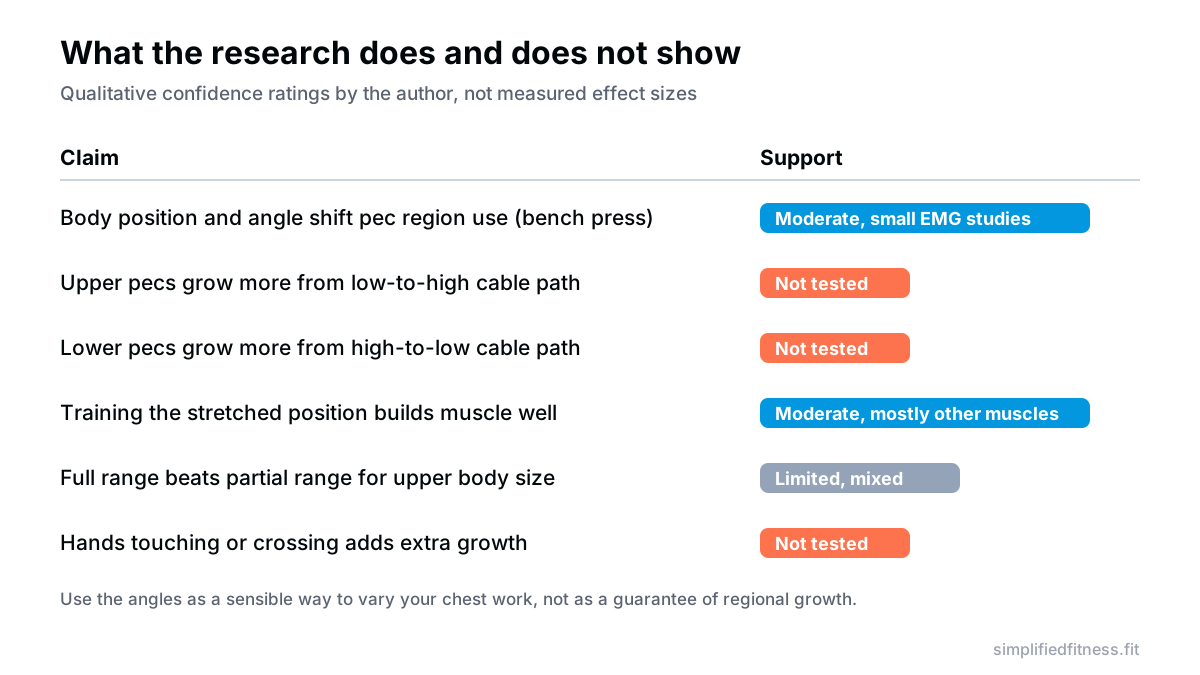
- Cable crossover angles change the line your hands travel, so they plausibly shift emphasis: low-to-high toward the upper chest, horizontal toward the mid chest, high-to-low toward the lower chest. No trial has tested cable fly heights directly, so treat this as a sensible working model.
- The best evidence is indirect. In bench press studies, flat versus 45 degree incline shifted activity between the sternocostal and clavicular heads of the pec, which supports the idea that body and arm angle matter.
- Pulley height matters less than getting a loaded stretch at the start and controlled tension through the rep. Research on training at long muscle lengths is encouraging, though mostly from other muscles.
- Letting your hands touch or cross at the finish is optional. Stopping just short of the crossover and squeezing is fine, and no study shows crossing adds growth.
- If a cable fly irritates your shoulder, lower the weight, shorten the stretch or switch heights, and see a doctor or physio if pain persists.
Part of our complete guide: The Complete Chest Workout Guide: Pec Anatomy, Bench Angles, Flys and Shoulder-Safe Pressing
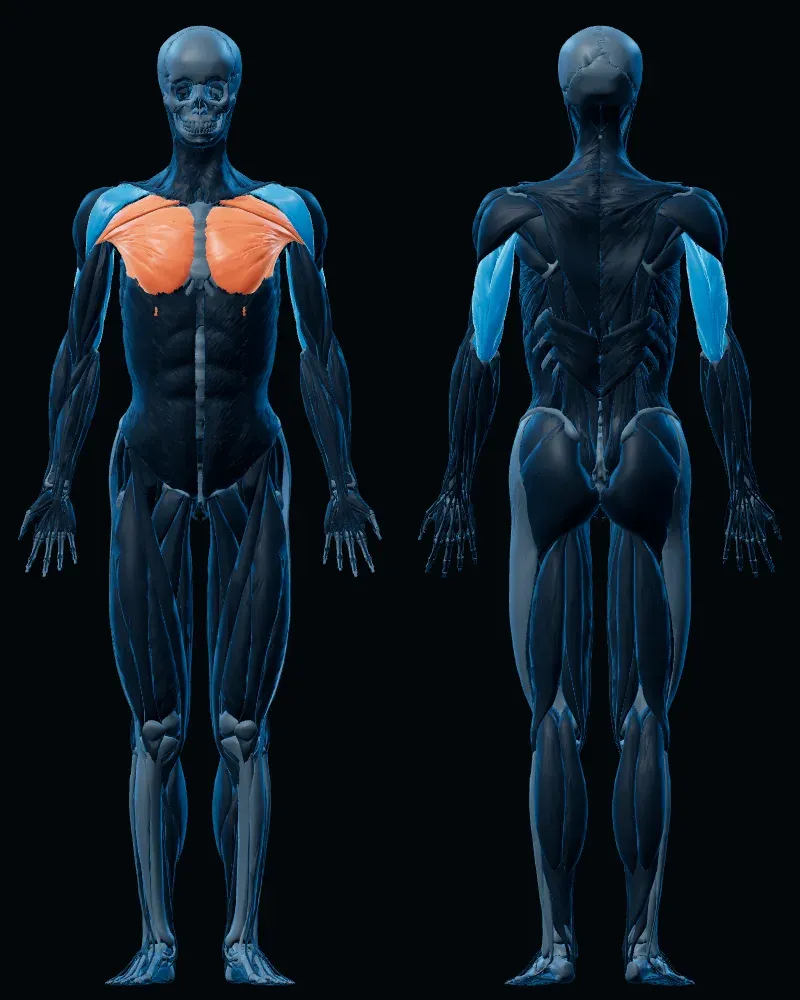
Muscles worked: chest
Main movers: pectoralis major
Assisting: front delts and triceps
Table of contents
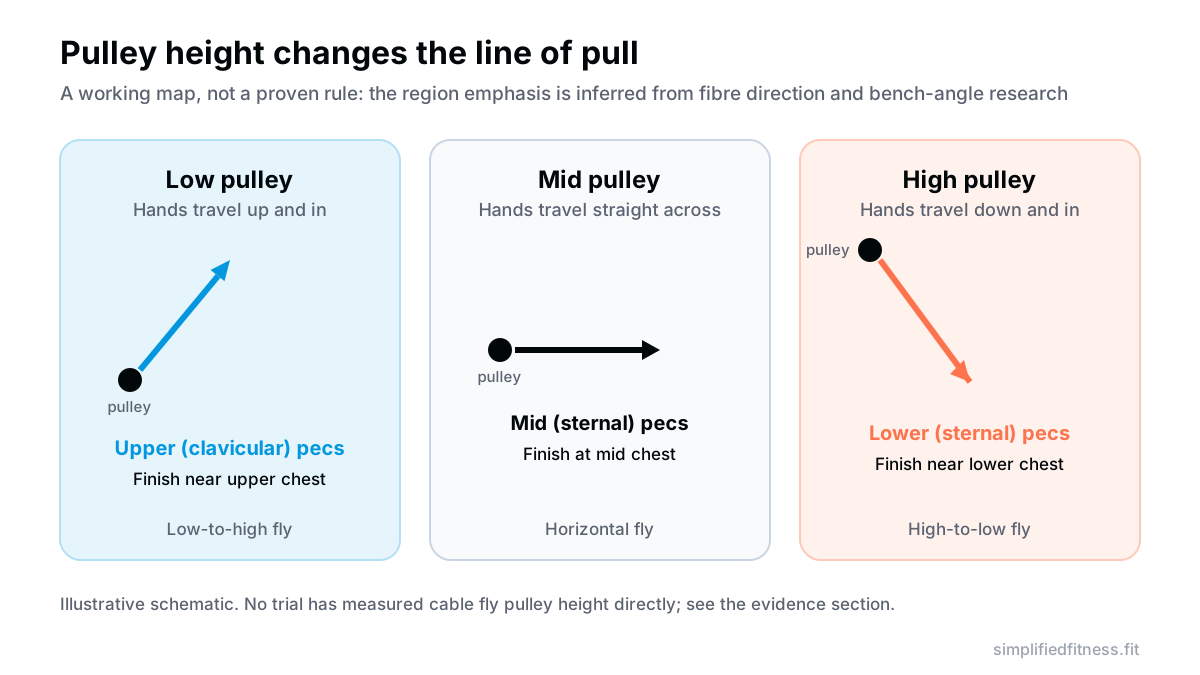
Cable crossover angles do change where your hands travel, and that plausibly shifts which part of the chest works hardest. A low pulley sends your hands up and in toward the upper chest, a mid pulley sends them straight across, and a high pulley sends them down and in toward the lower chest. The honest catch is that no study has tested cable fly heights head to head, so the exact regional effect is a reasoned estimate, not a proven rule.
This guide is a practical map for the lifter staring at a cable stack wondering what each height actually does. It sits inside our complete chest training guide, and it deliberately stays on cable setup and mechanics. For the full comparison of fly types, see dumbbell vs cable vs pec deck flys.
What do cable crossover angles actually change?
A fly is an arm-path exercise. Your elbow stays slightly bent, your upper arm swings through the shoulder joint, and the cable pulls along a straight line from the pulley to your hand. Change where the pulley sits and you change the direction the load pulls, and so the direction you have to resist and then drive against.
Think of it as three lanes:
- Low-to-high: pulleys near the floor, hands finish around upper chest or chin height.
- Horizontal (mid): pulleys around shoulder height, hands finish in front of the sternum.
- High-to-low: pulleys near the top, hands finish around the lower ribs or belly button.
The pec major is not one uniform sheet. Cadaver work describes a clavicular head with a fairly uniform structure and a sternal head split into several segments, with the clavicular fibres running at a larger pennation angle than the sternal ones (Fung et al., 2009). That is a small anatomical study (11 specimens), but it supports the basic idea that the muscle has parts with different geometry. Our guide to the pectoralis major heads goes deeper.
Does the pulley height really train different parts of the chest?
Here is where I want to be careful, because gym content often states this as fact.
What is supported: angle matters in pressing. In a 2022 study, eight volunteers did flat and 45 degree incline bench press while researchers recorded high-density EMG from 15 regions along the pec. The centre of activity moved toward the clavicular region on the incline, and the highest amplitudes sat at the sternocostal region on the flat bench (Cabral et al., 2022). A follow-up with 13 men found the same pattern, and also measured greater acute increases in cross-sectional area in the clavicular head after incline and in the sternocostal head after flat (Albarello et al., 2022). That second result is an acute swelling measure, not long-term growth.
What is mixed: older work is less tidy. In 14 resistance-trained men, upper pec EMG did not differ across 0, 30, 45 and -15 degree benches over the whole concentric phase, though 30 and 45 degrees were higher in the 26-50% window of the concentric phase, and lower pec activity at -15, 0 and 30 degrees was greater than at 45 degrees (Lauver et al., 2016). The authors concluded a flat bench activates both heads. Different EMG methods, load and timing likely explain why studies disagree.
What is missing: cable fly pulley height. I could not find a trial comparing low, mid and high cable flys for chest growth, and the bench press results do not transfer perfectly because a fly has a different joint action and resistance curve.
Low-to-high cable fly: for the upper chest
Set the pulleys low, step forward, and sweep your hands up and in until they meet around upper chest or chin height. The line of pull runs roughly along the fibres of the clavicular head, which is why it is the usual pick for upper chest.
It pairs well with an incline press. If your upper chest is a priority, our upper chest training guide and the comparison of incline vs flat bench press cover the pressing side.
Cue: keep your chest tall and do not shrug your shoulders toward your ears. If the front delts take over, the path is usually too high or the weight too heavy.
Horizontal cable fly: for the mid chest
With pulleys around shoulder height, the hands move straight across. This is the simplest and most forgiving crossover, and the one I would start most people on. The bench press data suggests a flat line of work loads the sternocostal region most, which fits the mid-to-lower fibres (Cabral et al., 2022).
This is also the version where the stretch is easiest to control, because the arms open out level with the chest instead of dropping behind you.
High-to-low cable fly: for the lower chest
Pulleys high, hands sweeping down and in toward the hips or belly button. Many lifters feel this one low on the pec near the sternum, which matches the downward line of pull. That feeling is subjective rather than studied, and the lower fibres also get plenty of work from flat and decline pressing. See lower chest training and sternal-costal biomechanics for the full picture.
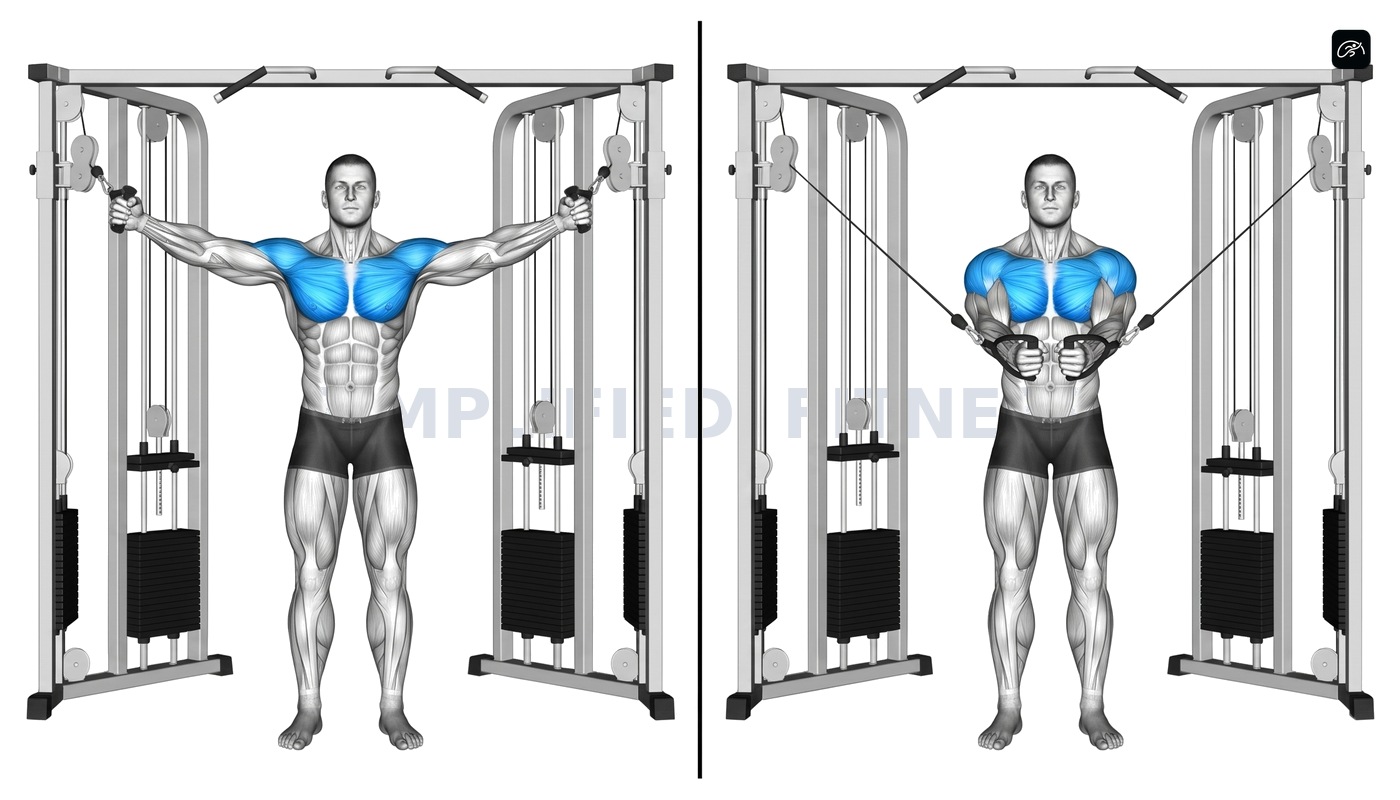
Cue: keep the elbow bend fixed, lean slightly forward and finish with your hands in front of the lower ribs, not pulled down to your thighs. Dropping the hands too low turns it into a front delt and lat-assisted pull-down.
How do I set up a cable crossover properly?
Most of the benefit comes from a clean setup, not from picking the perfect height. Here is the sequence that works for most people.
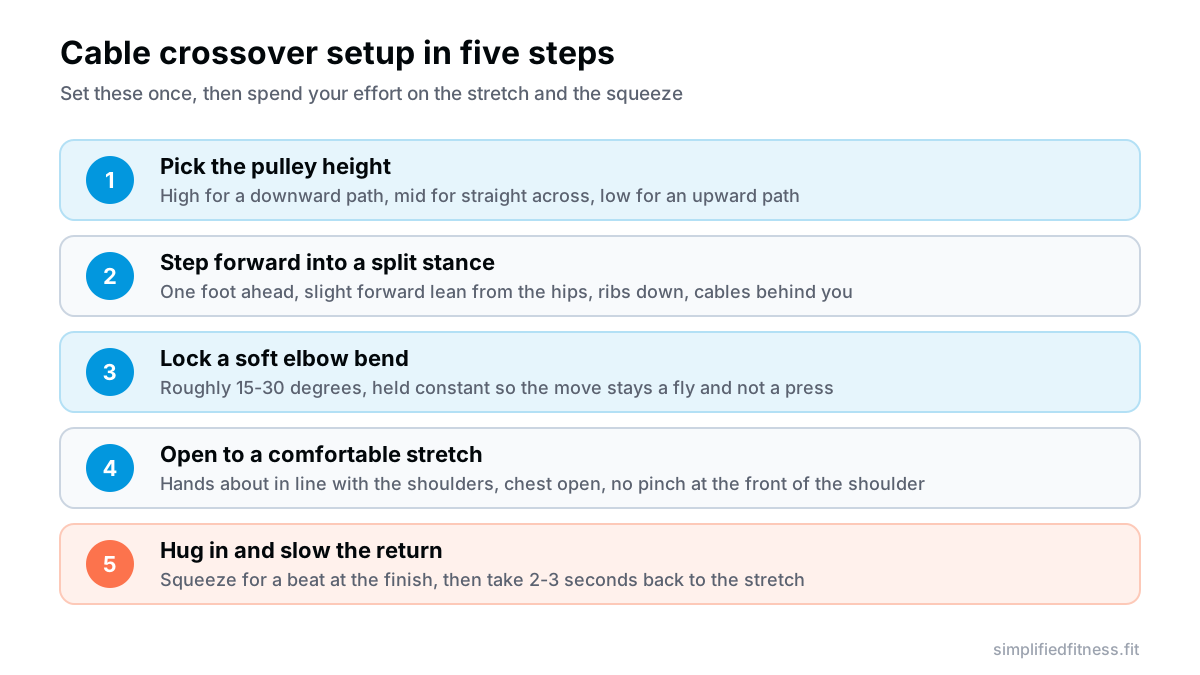
- Pulley height first. Set both pulleys to the same hole, and match them on both sides.
- Split stance. One foot forward, slight hip hinge, ribs down. This stops the stack from pulling you backward.
- Soft elbow, fixed. A small bend, held constant. If your elbows keep bending and straightening, you are pressing, not flying.
- Open only as far as you control. Hands roughly in line with your shoulders, not far behind them.
- Squeeze and slow down. Pause briefly at the finish and take 2-3 seconds on the way back.
Our cable pulley height cheat sheet covers setup across other exercises if you want the full machine tour.
Should the handles touch or cross at the end?
You will see two schools: hands stop a few centimetres apart, or hands cross over. Neither has been shown to build more muscle.
At the finish the pec is already shortened, so the extra inches of crossover mostly add a squeeze and a bit of front-delt involvement. A stretch at the start probably matters more. Training at longer muscle lengths has looked encouraging: in a trained group (30 participants, 8 weeks, mainly elbow flexors and extensors), lengthened partials produced similar growth to full range (Wolf et al., 2025), and the authors suggested emphasising the stretched position. A 2025 meta-analysis of regional hypertrophy found trivial differences between shorter and longer mean muscle lengths (Varovic et al., 2025), with the authors urging caution because the length difference between conditions was small.
Those findings are about arms and legs, so they only loosely apply to the chest. Our lengthened partials guide explains the idea in detail.
Practical takeaway: open to a controlled, comfortable stretch, close until the chest is fully squeezed, and do not stress about overlapping the hands.
What about full range vs partial range on the cable fly?
Evidence for the upper body is limited. A systematic review found that full range of motion favoured lower-body growth, while research on the upper limbs was limited and conflicting (Schoenfeld and Grgic, 2020). No study had examined trunk muscles at that point.
So a cable fly is mostly judged by how well you can control it. A deep stretch you cannot control is worse than a slightly shorter range you can own.
Are cable crossovers better than a bench press for chest?
No. Pressing lets you use heavier loads and drives more total chest work. In a small study of 12 college-age men and women, pec and front delt EMG activity was not significantly different between barbell bench, dumbbell bench and dumbbell fly, though the fly had less relative time of activation, and the authors suggested using flys as an auxiliary lift (Welsch et al., 2005). That was a dumbbell fly, not a cable, but the practical idea holds.
Use cables after your main press to add volume and a stretch. If your chest day needs structure, see our complete chest workout architecture and the free push day plan.
How should I program cable crossovers?
A simple way to use all three angles without overthinking:
| Goal | Cable fly choice | Sets and reps (a sensible starting point) |
|---|---|---|
| General chest volume | Horizontal or mid fly | 2-3 sets of 10-15 |
| Upper chest emphasis | Low-to-high fly | 2-3 sets of 10-15 |
| Lower chest emphasis | High-to-low fly | 2-3 sets of 10-15 |
| Variety across the week | Rotate heights each session | 2-4 total fly sets per session |
Place flys after your pressing. Stay one to three reps short of failure on most sets and go closer on the last one. Lighter loads and higher reps suit flys well, but do not assume cables are automatically easy on the shoulder: a motion-capture study in 20 healthy adults found larger peak shoulder moments in cable pulley exercises than in bench press at the loads tested, and flagged the cable crossover as needing careful joint control (Schütz et al., 2022). Check your weekly set count against the training volume calculator so cable work adds to your plan instead of crowding it out.
When should I see a doctor about shoulder or chest pain?
Muscle burn and stretch discomfort are normal. Sharp pain at the front of the shoulder, a pop with weakness, pain that lingers after training, numbness, or bruising high on the chest or arm need proper assessment. Chest pain with breathlessness, sweating, or pain spreading to the arm or jaw is different: stop and seek urgent medical care. A physio can help if you have a past pec or shoulder injury before you load deep stretches.
The bottom line
Pulley height shapes the line of pull, and a high, mid or low cable setup plausibly nudges emphasis toward the lower, mid or upper chest. The strongest evidence is indirect, from bench press studies showing that angle moves activity between pec heads, and nobody has yet tested cable fly heights directly. Use the angles for variety, set up with a soft elbow and a controlled stretch, and let progressive overload on your presses do the heavy lifting.
Frequently Asked Questions
Which cable crossover angle is best for chest?
No single angle is proven best. Using two or three heights across the week is a sensible way to cover different fibre directions, because each changes where your hands finish. Pick the one that gives you a strong stretch and no shoulder pinch, then rotate the others in.
Does high-to-low cable fly work the lower chest?
It likely shifts emphasis toward the lower fibres of the pec, because your arms travel down and in along that line. The direct evidence is missing, since studies on regional chest activity have mostly used bench press angles. Use it as a finisher after your pressing work and judge it by how well you feel the lower chest working.
Does low-to-high cable fly build the upper chest?
It is a reasonable choice for the clavicular head, because the hands travel up and in toward the collarbone area. In bench press research, a 45 degree incline moved the largest muscle activity toward the clavicular head compared with flat. No trial has confirmed the same for low pulley flys, so pair it with an incline press rather than relying on it alone.
What is the difference between a cable crossover and a cable fly?
In practice the names are used interchangeably. A fly means moving the arms in an arc with a fixed elbow bend, while crossover usually implies the hands meet or cross in front. You can do a fly without crossing, and that is often more comfortable.
Should my hands cross at the end of a cable crossover?
It is optional. At the finish the chest is already shortened, so overlapping the hands mainly adds a little extra squeeze and can shift the load toward the shoulders. Stop where you feel the pecs working hardest, and keep the stretch at the start as your priority.
How high should the pulleys be for cable crossover?
For a mid chest fly, set the handles about shoulder or upper chest height. For high-to-low, set them near the top of the stack or above your head, and for low-to-high, near the bottom. Test with a light weight to check your hands travel on a smooth line without your shoulders hunching.
Should I lean forward during cable crossover?
A slight forward lean from the hips, with a split stance, is common and helps you balance against the cables. Keep your ribs down and spine neutral rather than folding at the waist. Leaning further down also changes the path, so keep the angle consistent between sets.
How many sets of cable flys should I do?
Most lifters do around 2-4 hard sets of flys once or twice a week, on top of pressing. Chest growth depends on total weekly volume and effort, not on one exercise. Use the training volume calculator to see how your total sets fit together.
How heavy should cable crossovers be?
Moderate, in the range of about 8-15 reps, close to failure on the last set. Flys are not a heavy lift, and ego loading usually turns them into a sloppy press. Choose a weight that lets you control a stretch and a pause every rep.
Are cable crossovers better than dumbbell flys?
Cables keep tension on the chest through more of the rep, while a dumbbell fly loads the stretch and goes slack near the top. Neither is proven superior for growth, so pick the one you can do with good form. If you train at home, dumbbells still work well.
Why do I feel cable crossovers in my shoulders instead of my chest?
Usually the elbows are too straight, the stretch goes too far behind the body, or the weight is too heavy. The shoulder takes over when you cannot control the opening position. Reduce the load, shorten the range, bend the elbows slightly and keep your chest tall.
Are cable crossovers safe for shoulders?
For most healthy lifters they are fine when loaded sensibly, but a deep stretch under heavy load can bother the front of the shoulder. Stop short of the point where you feel pinching or sharp pain. If pain continues or you have a past shoulder injury, see a doctor or physiotherapist.
Can cable crossovers replace bench press?
No. Presses let you use heavier loads across the whole chest, shoulders and triceps, while flys are an isolation add-on. Keep a press as your main chest lift and use cable work to add volume and stretch.
Sources & References
Every claim above is checked against peer-reviewed research (PubMed, U.S. National Library of Medicine) or guidance from established health bodies. How we fact-check.
- Cabral HV, et al. Non-uniform excitation of the pectoralis major muscle during flat and inclined bench press exercises. Scand J Med Sci Sports. 2022. PMID: 34644424
- Albarello JCDS, et al. Non-uniform excitation of pectoralis major induced by changes in bench press inclination leads to uneven variations in the cross-sectional area measured by panoramic ultrasonography. J Electromyogr Kinesiol. 2022. PMID: 36334406
- Lauver JD, et al. Influence of bench angle on upper extremity muscular activation during bench press exercise. Eur J Sport Sci. 2016. PMID: 25799093
- Fung L, et al. Three-dimensional study of pectoralis major muscle and tendon architecture. Clin Anat. 2009. PMID: 19291757
- Welsch EA, et al. Electromyographic activity of the pectoralis major and anterior deltoid muscles during three upper-body lifts. J Strength Cond Res. 2005. PMID: 15903389
- Schoenfeld BJ, Grgic J. Effects of range of motion on muscle development during resistance training interventions: a systematic review. SAGE Open Med. 2020. PMID: 32030125
- Wolf M, et al. Lengthened partial repetitions elicit similar muscular adaptations as full range of motion repetitions during resistance training in trained individuals. PeerJ. 2025. PMID: 39959841
- Varovic D, et al. Does muscle length influence regional hypertrophy? A systematic review and meta-analysis. Int J Sports Med. 2025. PMID: 40570881
- Schütz P, et al. Chest Exercises: Movement and Loading of Shoulder, Elbow and Wrist Joints. Sports (Basel). 2022. PMID: 35202059

Umair Hazrami · Founder & Head Coach, Simplified Fitness
Umair Hazrami founded Simplified Fitness and the Simplified Lifter channel to cut through fitness noise. With 4+ years of consistent training and 10+ coaching clients, he writes every guide from the peer-reviewed research and links the sources so you can check them. Our editorial standards.
Educational content only, not medical advice. If you have a medical condition, are pregnant, or take medication, talk to a qualified doctor before changing your diet, supplements or training. Full disclaimer.
Keep reading
Exercise Technique
Arching on the Bench Press: Powerlifting Spine Arch vs Bodybuilding Setup
Is a bench press arch cheating or dangerous for your back? Learn the difference between a powerlifting arch and a natural upper back setup, with study data.
8 min read
Exercise Technique
Bench Press Grip Width: Pec Activation, Triceps and Shoulder Clearance
Bench press grip width changes triceps load, shoulder stress and little else for your pecs. See what EMG and joint-load studies show and how to pick your grip.
7 min read
Exercise Technique
Chest Dips: Forward Lean Angle, Scapular Position, and Shoulder Safety
Chest dips can build your chest if you lean, set your shoulders and stop at a depth that suits you. See what the research says and how to dip safely.
8 min read
Exercise Technique
Dumbbell vs Cable vs Pec Deck Fly: Which Chest Fly Is Best?
Dumbbell vs cable vs pec deck fly: how each resistance curve loads your chest, what research does and does not show, and which fly to pick for growth.
8 min read