Chest Dips: Forward Lean Angle, Scapular Position, and Shoulder Safety
Chest dips can build your chest if you lean, set your shoulders and stop at a depth that suits you. See what the research says and how to dip safely.
TL;DR. The short answer
- Chest dips are a good chest and triceps exercise for most healthy lifters, but the claim that they uniquely hit the lower chest is a coaching convention, not something dip studies have directly tested.
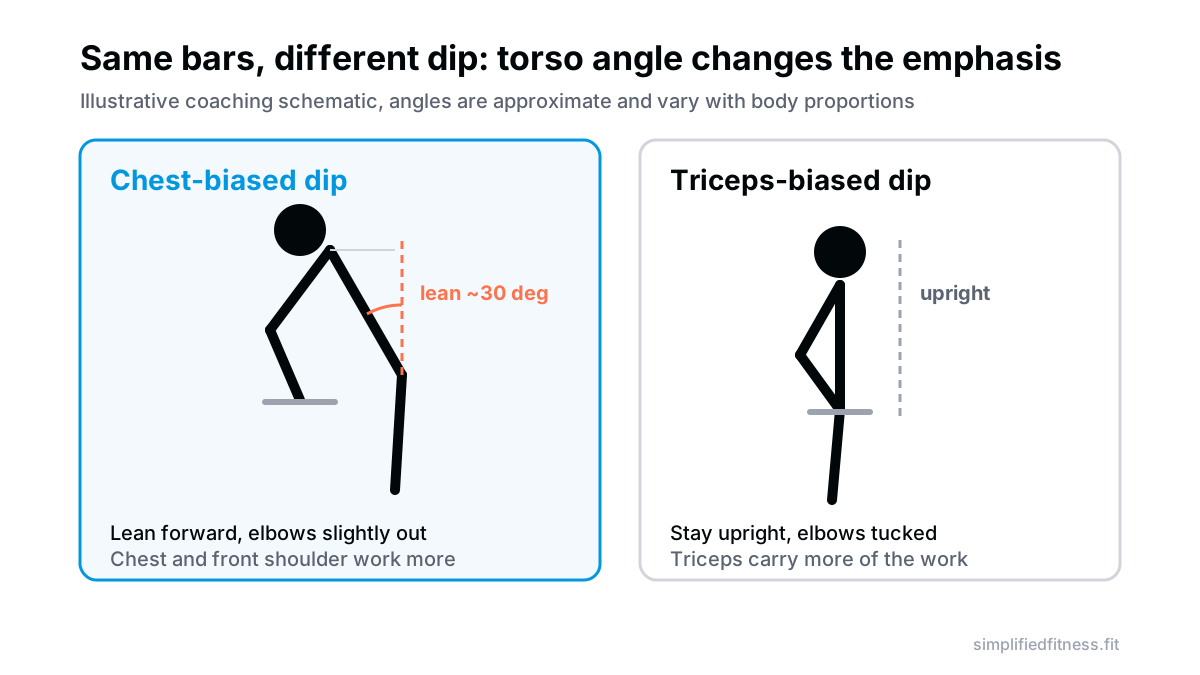
- A forward lean of roughly 30 degrees, elbows slightly out and chest tall is the standard setup for biasing the chest. Staying upright with elbows tucked shifts work toward the triceps.
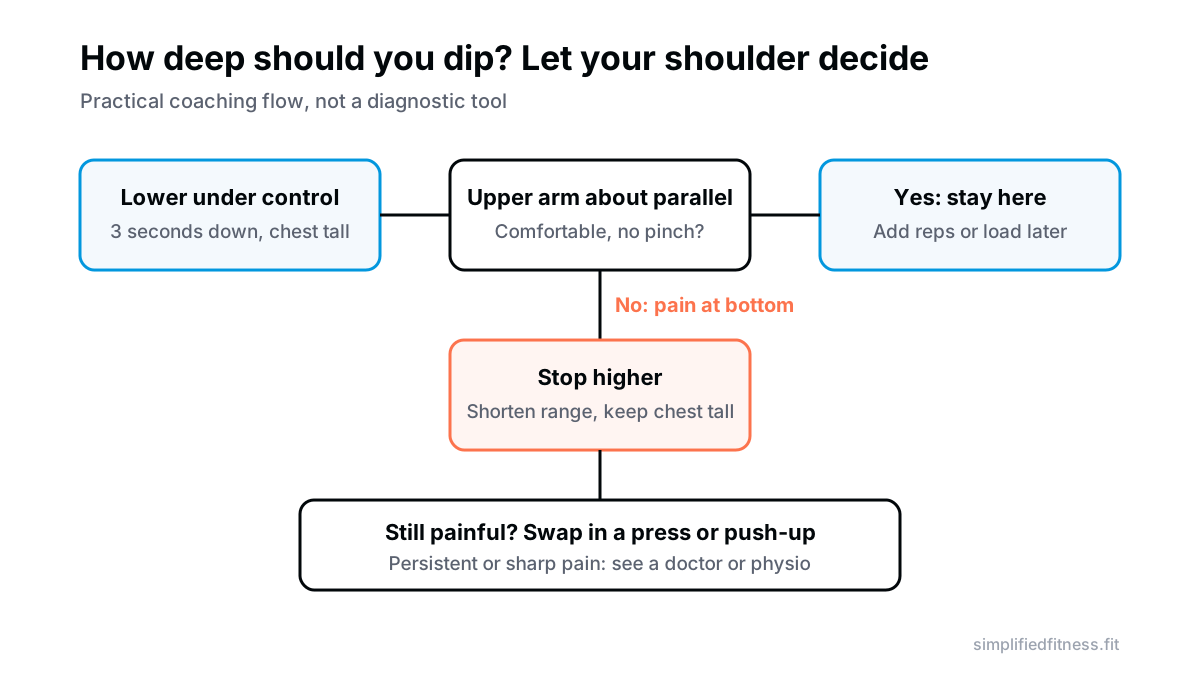
- Going deeper is not always better. Stop where your shoulder feels comfortable, because the research on range of motion for upper-body muscle growth is limited and mixed.
- Sharp pain at the front of the shoulder, on top of the shoulder, or at the breastbone is a signal to stop and swap the exercise. Persistent pain deserves a doctor or physio.
- Add load slowly with a dip belt once you can do about 10-12 clean reps, and use a decline or flat press if dips do not agree with your shoulders.
Part of our complete guide: The Complete Chest Workout Guide: Pec Anatomy, Bench Angles, Flys and Shoulder-Safe Pressing
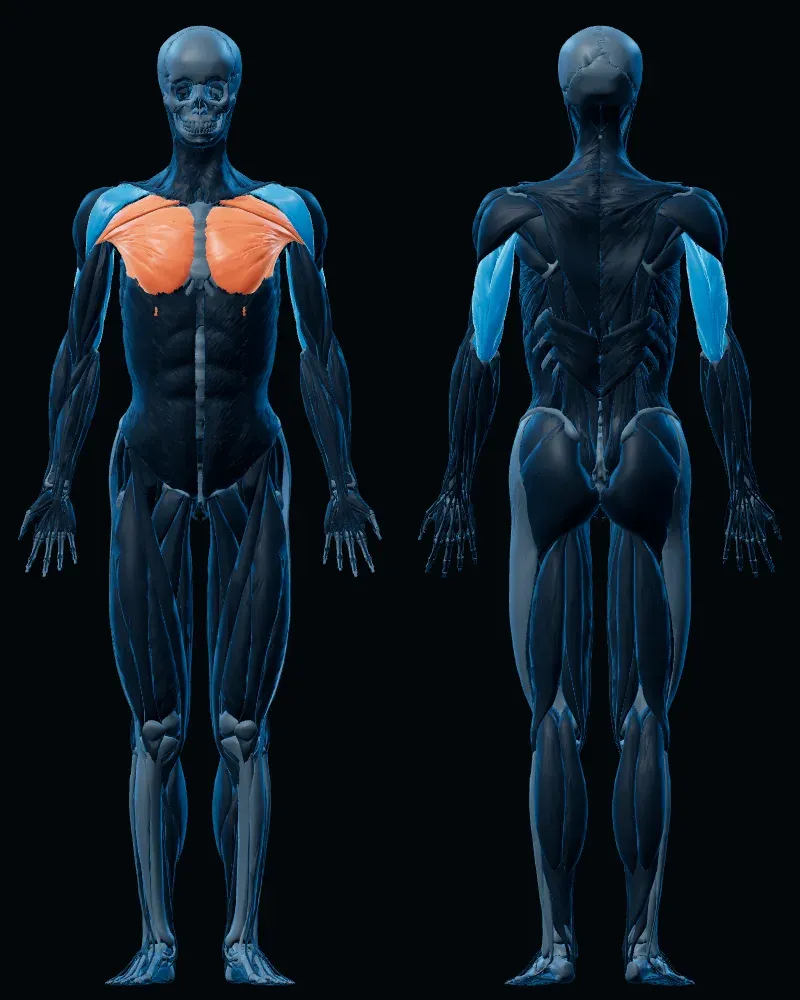
Muscles worked: chest
Main movers: pectoralis major
Assisting: front delts and triceps
Table of contents
Chest dips are a good exercise, not a trap, but they punish sloppy setup more than most chest movements. Lean your torso forward by roughly 30 degrees, keep your chest tall, stop at a depth your shoulder tolerates, and they can sit comfortably in a chest routine. Ignore those details and the front of the shoulder usually lets you know.
This guide covers the technique, what the research does and does not say, and when to skip dips altogether. It is part of our complete chest training guide, and if your goal is triceps instead, the upright version is covered in dips for triceps vs chest dips.
Are chest dips good for chest hypertrophy?
Mostly yes, with an honest caveat: the direct research on dips is small.
In a 2022 study, 13 experienced men performed bench, bar and ring dips while researchers recorded joint motion and surface EMG. The bar dip produced higher peak triceps activation than the bench dip (1.04 versus 0.83 mV), and the authors called it an appropriate progression from the bench dip (McKenzie et al., 2022). A second study of 15 healthy men doing bar dips to exhaustion found that fatigue raised the activation of both the pectoralis major and triceps brachii (McKenzie et al., 2022).
That tells us bar dips load the pecs and triceps meaningfully. It does not tell us dips beat any other press for growth, because nobody has run a long training trial comparing them. Both studies used small groups of young men, so treat the findings as a reasonable signal, not a verdict.
Does the forward lean really hit the lower chest?
The lean is the most repeated cue in dip coaching, and it is sensible. Tilting the torso forward changes the angle between your body and the bars, so the pressing direction moves from “straight down and back up” toward “down and forward”. The chest, especially its lower fibres, takes more of the job, and the triceps take less. Staying upright flips that balance.
Here is the honest part. Dip studies did not vary the lean angle, so the roughly 30 degrees figure is a coaching convention, not a measured optimum.
What we do have is indirect. High-density EMG showed that the greatest pectoralis major activity concentrates in the sternocostal head on a flat bench press and shifts toward the clavicular head at 45 degrees incline (Cabral et al., 2022). In bodybuilders, the sternocostal head was similarly excited in decline and flat pressing and more than in incline pressing (Coratella et al., 2020). A dip pushes your body away from the bars along a downward path, which is closer to the decline end of that spectrum. That is a reasonable inference, not proof.
If you want a deeper look at lower fibres, see our guide to lower chest training and the sternal-costal biomechanics.
How to set up a chest dip step by step
Treat this as a checklist and run through it every set.
- Grip the bars and lock out. Start at the top with straight elbows and shoulders pulled away from your ears, not shrugged up.
- Set your shoulders. Think “shoulders down and back”, with the shoulder blades gently depressed. This is coaching logic to keep the joint stable, not something the dip studies measured directly.
- Tilt forward. Lean your torso roughly 30 degrees and cross your ankles behind you so your legs do not swing you upright.
- Let your elbows travel slightly out. A small flare, not a full wing. Elbows jammed to your ribs shifts load to the triceps.
- Lower for about 3 seconds. Keep your chest tall and look slightly down.
- Stop when the upper arm is about parallel to the floor, or earlier if the shoulder complains. Pause briefly, then press back up.
How deep should chest dips go? Range of motion and your shoulder
This is where lifters get into trouble, because “full range” sounds like the safe default. The research is less clear.
A systematic review of range of motion studies found that full range of motion benefits lower-body hypertrophy, but research on the upper limbs is limited and conflicting (Schoenfeld and Grgic, 2020). A later meta-analysis of 16 studies found that full range of motion produced bigger gains in strength and lower-limb hypertrophy than partial range, with no significant superiority for either range on muscle thickness (Pallares et al., 2021).
So depth is a trade-off, not a rule. A deep stretch on the pecs may help, but the extreme bottom of a dip, with the shoulder pulled far behind the body, is also where many lifters feel discomfort. The bench, bar and ring dip study found that the bench dip needs greater shoulder extension range, and the authors said this matters when prescribing dips to people with a history of shoulder pain or injury (McKenzie et al., 2022).
A practical rule: go down to roughly upper arm parallel, and extend only if it feels completely comfortable. You can always add depth later, but it is hard to un-irritate a shoulder.
Who should skip or modify dips?
Dips are not for everyone, and “no pain, no gain” does not apply to joints.
Consider alternatives or ask a clinician first if you have:
- a current or recent shoulder injury, including pain at the top of the shoulder where the collarbone meets it (the AC joint)
- pain at the breastbone or where the collarbone meets the sternum
- a history of shoulder instability or dislocation
- shoulder pain that has lasted weeks, or that wakes you at night
The pressing alternatives in our guide to shoulder pain during bench press and floor press for hypertrophy and shoulder rehab are both good options. If the pain looks like pinching in the shoulder while lifting overhead or pressing, see subacromial shoulder impingement lifting solutions.
A narrative review on shoulder injury in the bench press suggests fatigue and loading strategy matter, and that autoregulated methods such as RPE or reps in reserve may be preferable to grinding sets to failure (Motlagh and Lipps, 2024). That review focused on powerlifters doing bench press, so applying it to dips is an extrapolation, but ending sets with a rep or two in the tank is sensible advice anyway.
How to progress dips: reps, weight and volume
Progression is where dips beat a lot of exercises, because a dip belt makes load easy to add.
- Build reps first. Work in the 6-12 rep range with clean form. When you can do about 10-12 reps with a 3 second descent, you are ready for load.
- Add weight in small steps. Hang a 2.5-5 kg plate on a dip belt or squeeze a dumbbell between your feet. Keep the same depth and lean.
- Stay a rep or two from failure. The last rep should still look like the first one. Use our RIR and RPE calculator if you are unsure how close to failure you are training.
- Count the sets. A meta-regression found a graded dose-response, with each added weekly set linked to a small gain in muscle size (Schoenfeld et al., 2017). Something like 3-6 hard dip sets a week, alongside other chest work, is a reasonable start.
For how to plan the rest of the chest session, see complete chest workout architecture, and for the wider principles of overload see progressive overload, deloads and plateaus.
Can’t do a bodyweight dip yet? Use an assisted machine, a band, or 3-5 second negatives. Push-ups are a useful bridge too, and our push-up progressions guide shows how to progress them.
Dips vs decline bench: which is better?
Neither is clearly better, and the evidence does not rank them for growth. The difference is practical.
| Chest dips | Decline bench press | |
|---|---|---|
| Equipment | Parallel bars, optional belt | Decline bench and barbell or dumbbells |
| Loading | Bodyweight plus belt, jumps of 2.5 kg+ | Easy to micro-load |
| Shoulder position | Loaded, extended, free path | Supported, more fixed path |
| Skill demand | Higher (lean, depth, control) | Lower |
| Cheap option in an Indian gym | Common, often free of queue | Decline benches are rarer |
If you have shoulder issues, the supported press is often easier to tolerate. If you have limited equipment, dips give you a lot for very little. Many lifters do well rotating them.
Where dips fit in your chest routine
Treat dips as a heavy compound near the start of the session, after a flat or incline press if you want to keep the best energy for the main lift, or as the first lift on days when pressing on a bench bothers your shoulder. A simple example is dips for 3 sets of 8-12, then an incline press, then a fly variation. Our free push day plan shows how pressing sits with shoulders and triceps in a full session.
If you train in a hot gym and your grip gets slippery, chalk or dry hands help. Do not let the belt chain swing, because that disrupts your lean.
The bottom line
Chest dips are worth using if your shoulders agree with them. Lean about 30 degrees, keep your chest tall, flare the elbows slightly, stop at a comfortable depth and add weight slowly. The lower chest claim is plausible but not proven by dip-specific research, so do not expect dips to replace a well-rounded pressing routine. If your shoulder or breastbone says no, swap the exercise, and see a doctor if the pain sticks around.
Frequently Asked Questions
Are chest dips good for building your chest?
Yes, for most healthy lifters they can be a productive chest exercise. In small EMG studies of young men, bar dips produced higher peak triceps activation than bench dips, and in a set taken to exhaustion, fatigue raised both pectoralis major and triceps activation. Treat them as one pressing option alongside bench and incline work, not a magic lower chest builder.
How far should I lean forward on chest dips?
A forward lean of roughly 30 degrees is the common coaching target. The reason is that tilting the torso moves the line of force so the chest does more and the triceps do less, although this has not been directly measured in dip studies. Start with a slight tilt, keep your chest tall and adjust until you feel your pecs stretch at the bottom.
Do dips target the lower chest?
Probably partly, but the evidence is indirect. EMG work on bench press variations shows the sternocostal (mid and lower) fibres of the pectoralis major are most active on flat and decline pressing, and dips have a similar downward pressing path. Do not rely on dips alone if lower chest is a weak point.
Are dips bad for your shoulders?
They are not automatically bad, but they put the shoulder in a loaded, extended position that some people tolerate poorly. A 2022 study of bench, bar and ring dips found the bench dip needs the greatest shoulder extension range, and the authors flagged the findings as relevant for people with a history of shoulder pain or injury. If dips hurt, shorten the range or switch to a press.
How deep should I go on a dip?
Go as deep as you can while the front of the shoulder stays comfortable, which for many lifters is about when the upper arm is parallel to the floor. Reviews on range of motion find limited and conflicting evidence for upper-body hypertrophy, so there is no proven reason to chase extra depth. Control the way down and stop before the shoulder rolls forward.
Are dips better than decline bench press?
Neither is clearly better for muscle growth based on current evidence. Dips use bodyweight and a free-moving path, while decline bench lets you load more precisely and tends to be easier on the shoulder for some lifters. Pick the one you can progress consistently without pain, or rotate both.
How do I add weight to dips?
Use a dip belt with a plate or a dumbbell between your feet once you can do about 10-12 clean reps with full control. Heavier loading works for hypertrophy when sets are taken close to failure, and small jumps of 2.5 kg keep technique intact. Drop back a step if your depth shrinks or your shoulder complains.
What if I cannot do a bodyweight dip yet?
Use an assisted dip machine, a resistance band or slow negatives to build the strength. Practising the lowering phase with a 3 second descent builds control in the same range you will eventually press through. Push-ups and flat dumbbell press are good bridges in the meantime.
Why does the front of my shoulder hurt when I dip?
Front shoulder pain at the bottom often means the shoulder is being pushed too far back at the bottom while the shoulders roll forward, which is a stressful position for the joint. Shortening your range, keeping the chest tall and avoiding rolling the shoulders forward often settles it. If the pain is sharp, lingers for days or comes with weakness, see a doctor or physio.
Why does my sternum or chest bone hurt on dips?
Pain at the breastbone or where the collarbone meets it can come from the joint there being compressed or irritated at the bottom of the dip. Cut the depth, reduce load and move to a pressing variation while it settles. Do not train through persistent or sharp pain, and see a doctor if there is swelling, a click that hurts or a lump.
How many sets of dips per week for chest growth?
A reasonable start is 3-6 hard sets of dips per week as part of your total chest volume. A meta-regression found each added weekly set was linked with a small extra gain in muscle size, so total hard sets matter more than any single exercise. Build up slowly and keep a rep or two in reserve on most sets.
Can women do chest dips?
Yes, the movement and the setup advice are the same. Strength to lift bodyweight varies a lot between people, so assisted dips or band-assisted dips are a perfectly good starting point. Progress to bodyweight when you can control 8-10 reps.
Sources & References
Every claim above is checked against peer-reviewed research (PubMed, U.S. National Library of Medicine) or guidance from established health bodies. How we fact-check.
- McKenzie A, et al. Bench, Bar, and Ring Dips: Do Kinematics and Muscle Activity Differ? Int J Environ Res Public Health. 2022. PMID: 36293792
- McKenzie A, et al. Fatigue Increases Muscle Activations but Does Not Change Maximal Joint Angles during the Bar Dip. Int J Environ Res Public Health. 2022. PMID: 36361276
- Schoenfeld BJ, et al. Effects of range of motion on muscle development during resistance training interventions: A systematic review. SAGE Open Med. 2020. PMID: 32030125
- Pallares JG, et al. Effects of range of motion on resistance training adaptations: A systematic review and meta-analysis. Scand J Med Sci Sports. 2021. PMID: 34170576
- Cabral HV, et al. Non-uniform excitation of the pectoralis major muscle during flat and inclined bench press exercises. Scand J Med Sci Sports. 2022. PMID: 34644424
- Coratella G, et al. Specific prime movers' excitation during free-weight bench press variations and chest press machine in competitive bodybuilders. Eur J Sport Sci. 2020. PMID: 31397215
- Motlagh JG, et al. The Contribution of Muscular Fatigue and Shoulder Biomechanics to Shoulder Injury Incidence During the Bench Press Exercise: A Narrative Review. J Strength Cond Res. 2024. PMID: 39808810
- Schoenfeld BJ, et al. Dose-response relationship between weekly resistance training volume and increases in muscle mass: A systematic review and meta-analysis. J Sports Sci. 2017. PMID: 27433992

Umair Hazrami · Founder & Head Coach, Simplified Fitness
Umair Hazrami founded Simplified Fitness and the Simplified Lifter channel to cut through fitness noise. With 4+ years of consistent training and 10+ coaching clients, he writes every guide from the peer-reviewed research and links the sources so you can check them. Our editorial standards.
Educational content only, not medical advice. If you have a medical condition, are pregnant, or take medication, talk to a qualified doctor before changing your diet, supplements or training. Full disclaimer.
Keep reading

Exercise Technique
Arching on the Bench Press: Powerlifting Spine Arch vs Bodybuilding Setup
Is a bench press arch cheating or dangerous for your back? Learn the difference between a powerlifting arch and a natural upper back setup, with study data.
8 min read
Exercise Technique
Bench Press Grip Width: Pec Activation, Triceps and Shoulder Clearance
Bench press grip width changes triceps load, shoulder stress and little else for your pecs. See what EMG and joint-load studies show and how to pick your grip.
7 min read
Exercise Technique
Cable Crossover Angles: High-to-Low vs Low-to-High vs Horizontal Fly
Cable crossover angles explained: what high-to-low, low-to-high and horizontal flys likely train, what the research really says, and how to set each one up.
9 min read
Exercise Technique
Dumbbell vs Cable vs Pec Deck Fly: Which Chest Fly Is Best?
Dumbbell vs cable vs pec deck fly: how each resistance curve loads your chest, what research does and does not show, and which fly to pick for growth.
8 min read