How Muscle Actually Grows: The Natural Lifter's Guide to Hypertrophy Science
A muscle hypertrophy guide for natural lifters: what really makes muscle grow, how long protein synthesis lasts, and which gym myths to drop, with studies.
TL;DR. The short answer
- Muscle grows mainly in response to mechanical tension: hard sets that put real load on the fibres, taken close to failure. The pump and soreness are side effects, not the cause.
- Light loads (around 30-50% of your max for 20-25 reps) and heavy loads (8-12 reps) built similar muscle in trained men when every set went to failure. Heavy loads still win for 1RM strength.
- One hard session raised muscle protein synthesis for roughly a day and a half in the classic McMaster studies, so training each muscle about twice a week keeps the growth signal switched on more often.
- Post-workout hormone spikes do not predict growth, and genetics create big differences between people. A natural lifter's ceiling is real, but most people are nowhere near it.
Table of contents
Muscle grows when hard sets put enough mechanical tension on your fibres, often enough, that protein synthesis outpaces breakdown for months on end. That is the whole engine. Soreness, the pump and post-workout hormone spikes are mostly noise around it.
This muscle hypertrophy guide is written for natural lifters who want the mechanism and the gym translation in one place. We will cover what actually triggers growth, how long the growth signal lasts after a session, which popular beliefs fall apart under the research, and what all of it means for your next workout. Every claim links to the study behind it.
One thing up front: this page is the map. The detailed numbers on sets and frequency, rep ranges and stretch-focused training live in their own guides, and we will point you to them as we go.
What is muscle hypertrophy, in plain terms?
Hypertrophy means your muscle fibres get thicker. You do not grow meaningful numbers of new fibres; the ones you have add more contractile protein (actin and myosin) and the support structures around it.
Your muscle protein is constantly being built and broken down. On an average day those two roughly cancel out. A hard training session tips the balance toward building for a while, and if you eat enough protein the net gain gets locked in. Repeat that a few hundred times and you have visibly bigger muscles.
That is why hypertrophy is slow. Each session adds a tiny deposit.
How muscle grows: the three proposed mechanisms
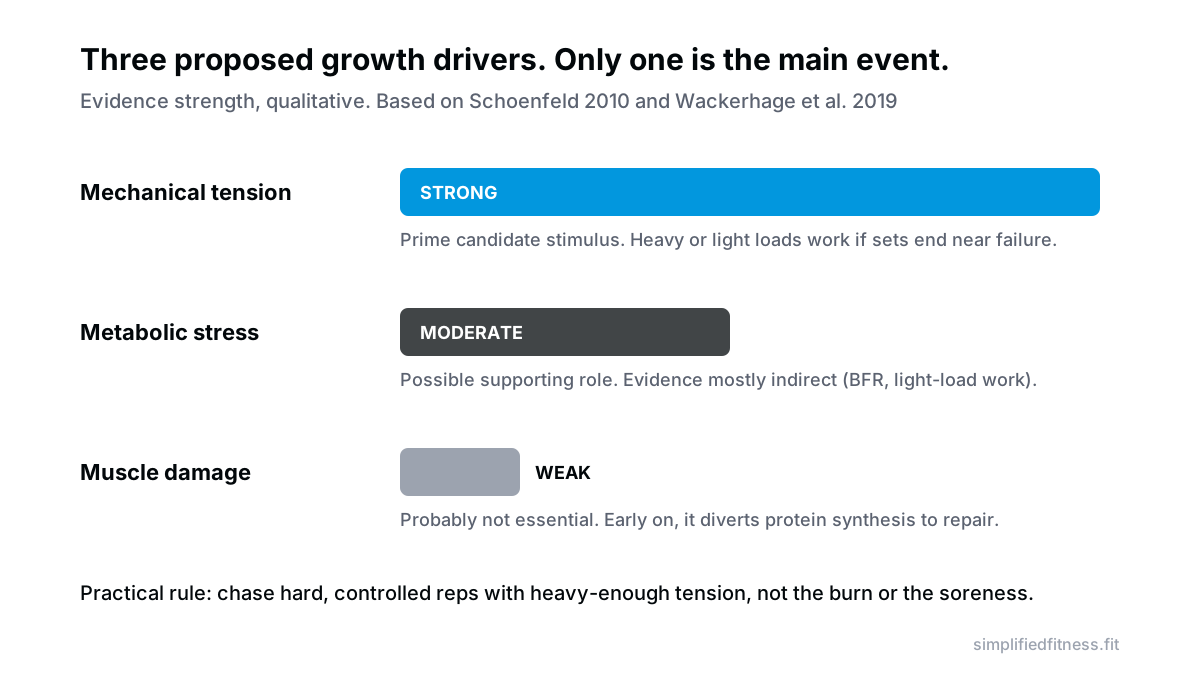
In 2010, Brad Schoenfeld pulled the research together into a framework that most lifters have since heard of: mechanical tension, muscle damage and metabolic stress can all play a role in exercise-induced growth (Schoenfeld, 2010). For years, gym culture treated these as three equal levers. Chase the pump, chase the soreness, chase heavy weights.
The science has since moved on, and the three are not equal.
A 2019 review on the stimuli and sensors behind hypertrophy concluded that mechanical signals are the prime candidates for triggering growth, that exercise-induced muscle damage is probably not essential, and that the case for metabolites (the “burn”) rests on indirect evidence, mainly from blood flow restriction and light-load studies (Wackerhage et al., 2019).
Mechanical tension hypertrophy: why it comes first
Mechanical tension is simply force pulling on the muscle fibres while they work. The fibres sense that force through structures in and around the cell, and the signal switches on growth machinery. We go deeper into this in mechanical tension vs muscle damage.
The catch: a fibre only experiences high tension if it is actually recruited. Your body recruits small, low-threshold motor units first and brings in the big, high-threshold ones as effort climbs. That is Henneman’s size principle, and it explains why the last few reps of a set matter so much. As fatigue builds, more of the growth-prone fibres are forced to contribute.
So “mechanical tension” does not mean “lift the heaviest weight possible.” It means sets hard enough that most of the muscle is doing serious work.
Metabolic stress: the burn and the pump
Metabolic stress is the build-up of by-products like lactate and hydrogen ions during sustained effort. It produces the burn and contributes to the swollen “pump” feeling.
Could it add something on top of tension? Possibly. Blood flow restriction training builds muscle with very light loads, which hints that metabolites matter in some way. But light, occluded sets also push fibres to fatigue and recruit high-threshold units, so separating the two effects is hard. The 2019 review describes this evidence as indirect for good reason.
If you want the full breakdown of whether your pump means anything, read gym pump vs true muscle hypertrophy.
Muscle damage: the most overrated of the three
For decades, “no pain, no gain” was treated as physiology. Tear the muscle, it rebuilds bigger.
A 2016 study tracked ten young men through 10 weeks of resistance training, taking thigh muscle biopsies at weeks 1, 3 and 10 (Damas et al., 2016). In week one, muscle damage and myofibrillar protein synthesis were both at their highest, yet that protein synthesis was not related to growth. By weeks 3 and 10, damage had faded and protein synthesis was strongly correlated with hypertrophy (r ≈ 0.9). The authors’ read: early protein synthesis goes into repair; growth comes once the damage settles.
That flips the bro logic. Heavy damage is not a growth bonus; early on, the extra protein synthesis appears to go into repair rather than growth. Our deeper reads on this are the muscle damage myth and the repeated bout effect, which explains why the same workout stops making you sore.
Inside the fibre: mTOR, protein synthesis and satellite cells
Here is what happens between your last rep and a thicker muscle, simplified.
Tension is detected by mechanosensors in the fibre. The 2019 review points to a filamin-C and BAG3 pathway as a plausible sensor, with costameres (the structures anchoring the fibre to its surroundings) and nuclear deformation as other candidates. Downstream, a protein complex called mTORC1 ramps up. The same review calls an mTORC1-driven rise in muscle protein synthesis “the key, but not sole” mechanism of resistance-exercise hypertrophy (Wackerhage et al., 2019).
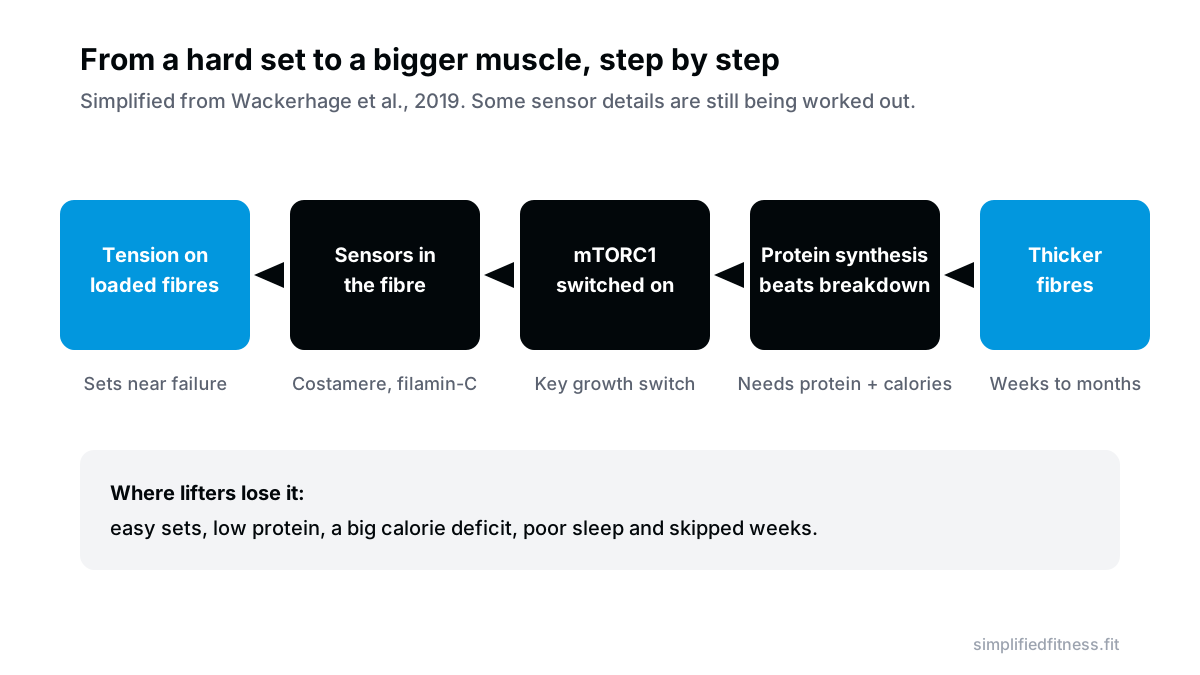
mTORC1 also listens to nutrients and energy status. That is why a big calorie deficit can blunt growth even when your training is solid, a topic we unpack in hypertrophy in a deficit vs a surplus.
Satellite cells and myonuclei
Each muscle fibre has many nuclei, and each nucleus can only support so much protein-building. Satellite cells are stem cells parked next to the fibre that can donate new nuclei.
The popular claim is that every bit of growth needs new myonuclei. The data in natural trainees is more nuanced. In a 10-week study of young men, satellite cell content rose quickly after training and stayed elevated, and type II fibres grew by about 16%, yet myonuclear number did not change (Damas et al., 2018). The authors concluded satellite cells play a bigger role in repair during the early phase, with a larger pool possibly mattering for future, larger growth.
So for a beginner’s first few months, existing nuclei appear to handle the job. Over years, the story may change. More in satellite cells and myonuclear addition.
The muscle protein synthesis timeline after a workout
How long does one workout keep the building process switched on?
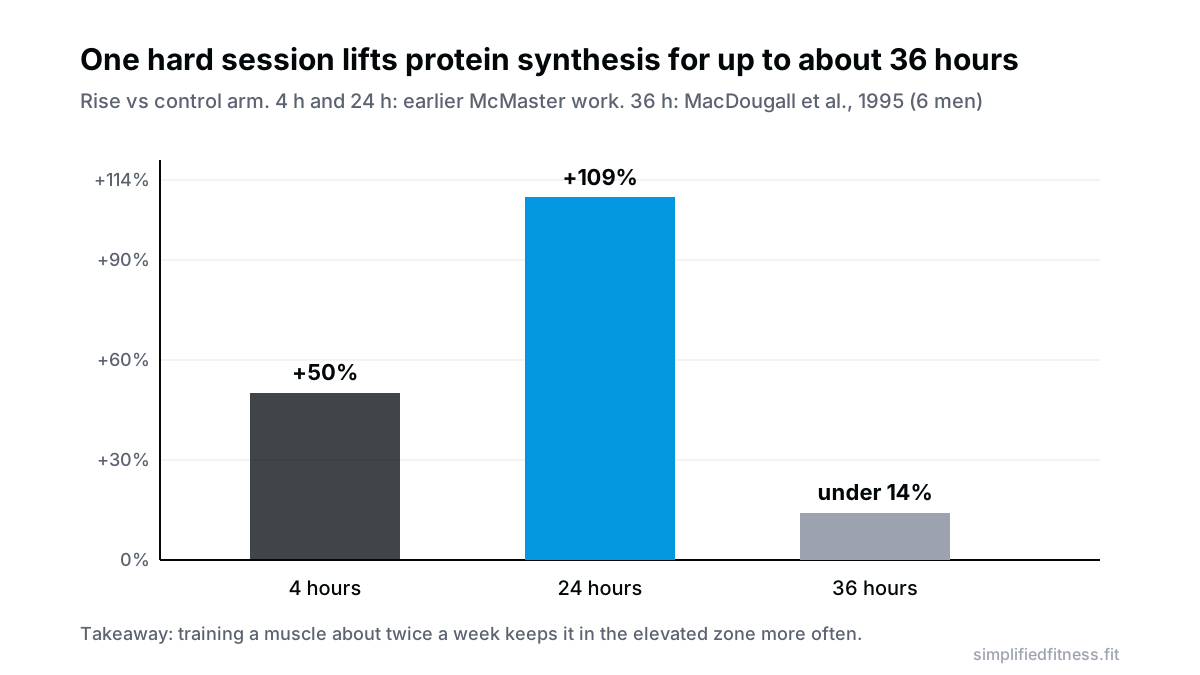
The classic data comes from McMaster University. Earlier work had shown muscle protein synthesis was about 50% higher at 4 hours and 109% higher at 24 hours after heavy training. MacDougall’s 1995 study added the 36-hour point: six young men did 12 sets of 6-12RM arm curls with one arm, and by about 36 hours protein synthesis in the trained arm was back to within 14% of the non-exercised arm, a non-significant difference (MacDougall et al., 1995).
Two honest caveats. This is a small, older study on one muscle group in young men, so treat the exact hours as approximate. And remember the Damas finding: early in a new program, a chunk of that elevated synthesis is repair work, not growth.
Still, the practical logic holds up. If one session keeps the muscle in “build mode” for about a day and a half, training it once a week leaves several days on the table. Training it twice a week fills more of them. The full timeline, including how meals and training status shift it, is in our muscle protein synthesis timeline guide.
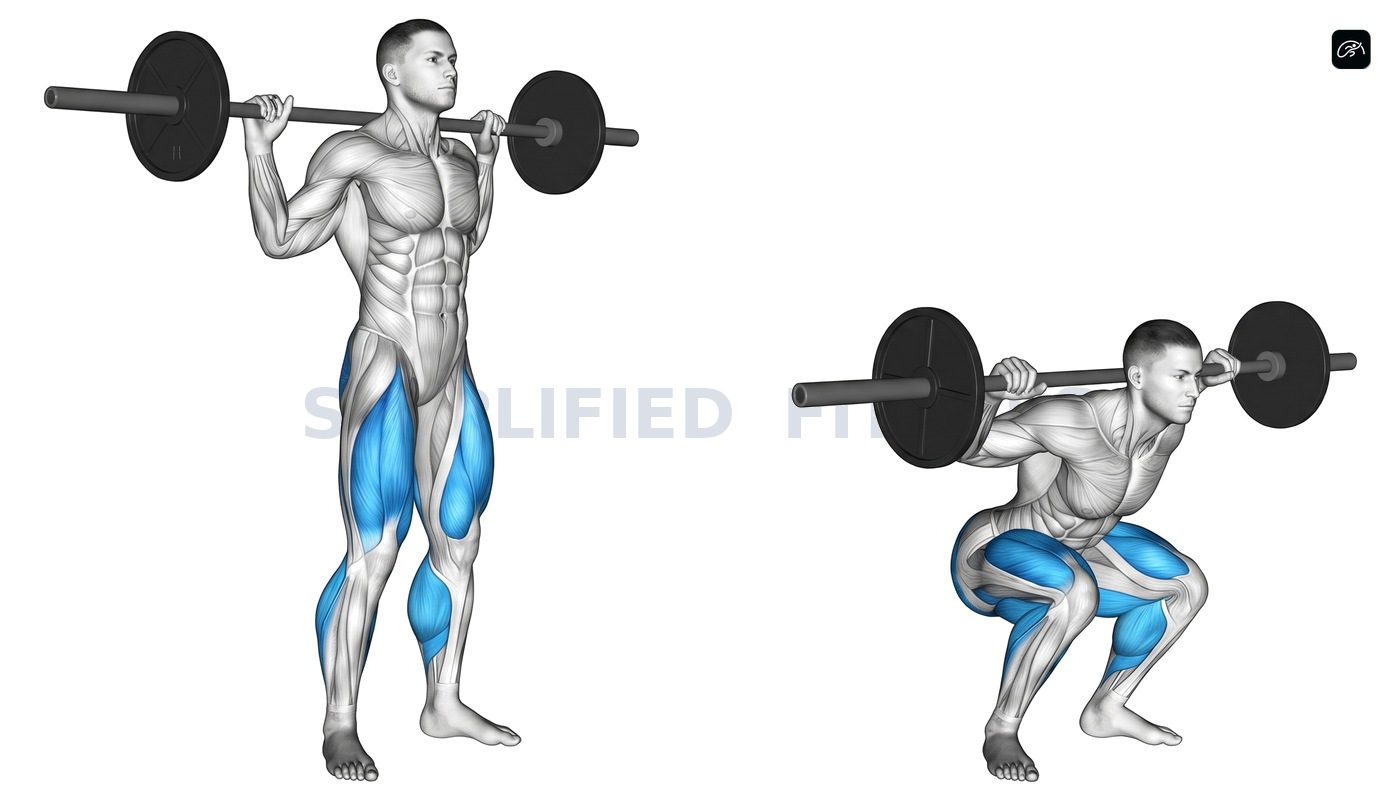
Heavy vs light: does load matter for natural lifters?
For years the “repetition continuum” said heavy weights build strength, moderate weights build size and light weights build endurance. The muscle growth part of that has not held up well.
A 2017 meta-analysis of 21 studies compared low loads (60% of 1RM or less) with high loads, with every set taken to momentary failure. Gains in 1RM strength favoured heavy training. Muscle growth was similar (Schoenfeld et al., 2017).
The obvious objection is that most of those studies used beginners. So look at trained lifters. A 12-week trial put 49 resistance-trained men on a whole-body program, either 20-25 reps at roughly 30-50% of their max or 8-12 reps at roughly 75-90%, all sets to volitional failure. Lean mass and both type I and type II fibre size increased with no significant difference between groups. Strength rose in both; only the bench press gain differed (14 kg vs 9 kg, favouring heavier loads) (Morton et al., 2016).
| Load style | Example | Hypertrophy (to failure) | 1RM strength | Practical downside |
|---|---|---|---|---|
| Heavy | 4-6 reps, 80-90% 1RM | Similar | Best | Joint stress, longer rests |
| Moderate | 6-15 reps | Similar | Good | Fewest trade-offs |
| Light | 20-30 reps, 30-50% 1RM | Similar | Weaker | Painful burn, hard to judge failure |
The fine print matters: “to failure.” Light sets only work if you genuinely push them. Stopping a 30-rep set at rep 18 because it burns is not the same stimulus. Most people get the best return from moderate reps for big compound lifts and some lighter work for isolation exercises. Our high-load vs low-load hypertrophy spectrum cluster gets into the nuance, and the full guide on rep ranges, RIR and rest periods turns it into a plan.
Fibre types: do you need to train fast and slow twitch differently?
In the Morton trial above, both type I (slow) and type II (fast) fibres grew with heavy and light training. That does not settle every question about fibre-type targeting, but it makes the idea of special “slow-twitch days” hard to justify for most lifters. Using a range of loads across the week covers you either way. More in muscle fibre types and training.
How close to failure do you need to train?
Effort is where the mechanisms meet the gym floor. Here the research is genuinely mixed, so let’s lay it out.
Study A: A 2023 meta-analysis of 15 studies found a trivial advantage for training to set failure versus non-failure when all definitions of failure were pooled (effect size 0.19). When it isolated true momentary muscular failure, there was no significant advantage (effect size 0.12) (Refalo et al., 2023).
Study B: A 2024 series of meta-regressions estimated reps in reserve (RIR) for each study and found that muscle growth increased as sets ended closer to failure, while strength gains were similar across a wide range of RIR (Robinson et al., 2024). The authors flagged the analysis as exploratory because RIR had to be estimated from study descriptions.
Why the difference? Refalo asked a yes/no question (failure or not), while Robinson modelled distance from failure as a sliding scale. Both can be true at once: getting close matters, and the final, grinding rep to absolute failure may add little.
There is also a fatigue angle. Some of the drop-off you feel late in a session is your nervous system, not your muscle. We cover that in central vs peripheral fatigue.
How much volume do natural lifters need?
Tension per set matters; so does how many hard sets you accumulate.
A 2017 meta-analysis of 15 studies found a graded dose-response between weekly sets and muscle growth. Each additional weekly set was associated with about 0.37% more gain on average, and higher-volume conditions beat lower-volume ones by about 3.9 percentage points (Schoenfeld et al., 2017). The three-level comparison (under 5, 5-9 and 10+ sets per muscle per week) only showed a trend, not a clean significant difference.
This is not permission for 30-set chest days. The relationship is averaged across studies, and returns shrink once recovery cannot keep up. A sensible range for most natural lifters, how to split it and when to add more is the job of our training volume and frequency guide. If you want to count what you are doing now, plug your sessions into the training volume calculator.
Range of motion is another lever that sits on top of volume. Training muscles at long lengths appears to help in several studies; we cover that separately in the range of motion and stretch-mediated hypertrophy guide.
Myth check: hormones, sarcoplasmic growth and “neural gains”
“Train legs to boost testosterone for bigger arms”
This one sounds clever. Big leg session → testosterone and growth hormone spike → arms grow more.
Researchers tested it directly. Twelve young men trained one arm alone (no hormone spike) and the other arm followed by heavy leg work that raised testosterone, growth hormone and IGF-1. After 15 weeks, arm muscle size rose 12% in the low-hormone arm and 10% in the high-hormone arm, with no significant difference (West et al., 2010). The later trial in 49 trained men found no correlation between the post-workout hormone rise and gains in muscle or strength (Morton et al., 2016).
That does not mean your baseline hormone levels are irrelevant. Clinically low testosterone is a medical issue worth checking with a doctor if you have symptoms. It means the short spike after a workout is not a growth lever you can program. See post-workout hormone spikes and local IGF-1 vs systemic hormones.
“High reps build sarcoplasmic size, low reps build dense muscle”
Sarcoplasmic hypertrophy (more fluid and non-contractile material) and myofibrillar hypertrophy (more contractile protein) are real concepts. Whether they occur as separate, trainable types is still argued over, and there is no solid evidence you can pick one with a rep range. Given that heavy and light training produced similar growth in trained men, the practical answer is the same either way. Our sarcoplasmic vs myofibrillar hypertrophy cluster walks through the debate.
“My first two months were all muscle”
Early strength gains come fast. Early size gains do not. In the Damas study, fibre cross-sectional area only increased significantly at week 10, not at week 3 (Damas et al., 2016). Much of the initial jump in your numbers is your nervous system learning the movement. That is normal and useful, just not the same thing as new muscle. More in neural adaptations vs muscle growth.
Genetics and the natural ceiling
Two people can follow the same plan and get wildly different results.
In a study of 585 men and women who did the same 12-week biceps program, changes in muscle cross-sectional area ranged from -2% to +59% (Hubal et al., 2005). Some gained almost nothing. Others grew their biceps by more than half. Men gained only about 2.5% more in relative size than women, while women gained more in relative strength.
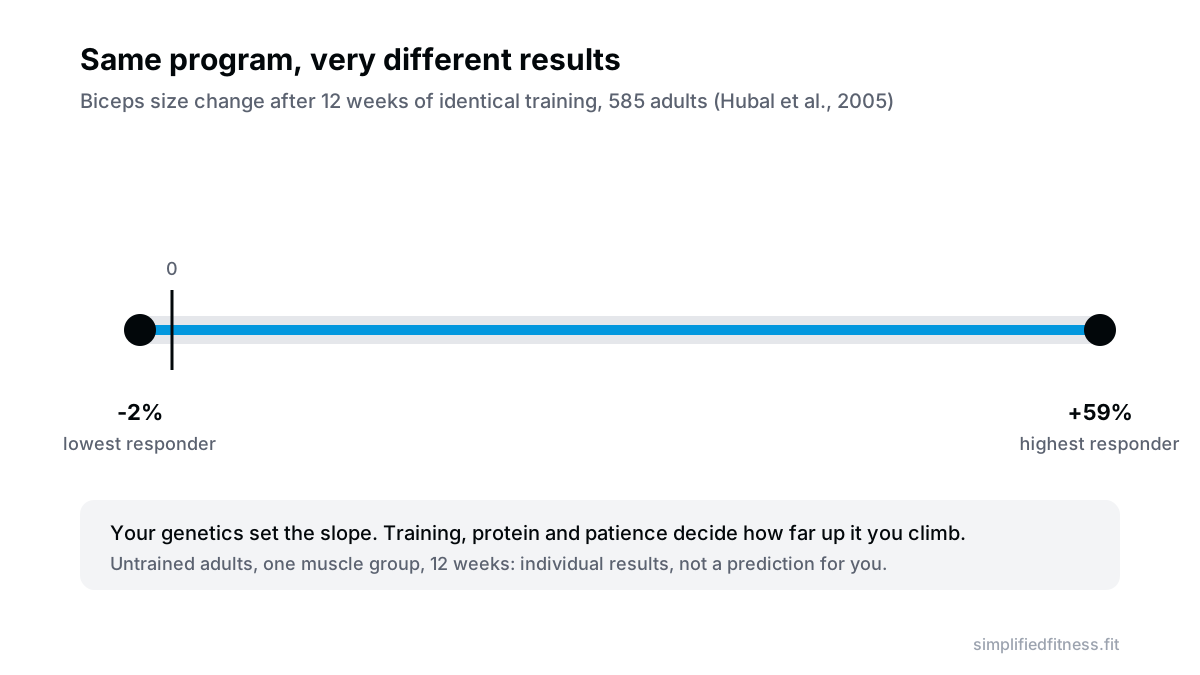
These were untrained adults training one muscle for 12 weeks, so the spread says more about short-term responsiveness than about anyone’s lifetime potential. Low responders to one program sometimes respond better to more volume or a different setup. We explore this in genetics and lifting responders, and the sex differences question gets its own piece in men vs women hypertrophy.
So how big can a natural lifter get? A 1995 study of 157 male athletes found that those not using steroids topped out at a height-adjusted fat-free mass index (FFMI) of about 25.0, and pre-steroid-era Mr. America winners averaged around 25.4. Many steroid users exceeded 25, some above 30 (Kouri et al., 1995). The authors called the findings preliminary, and an FFMI of 25 is not a hard wall for every individual. It is a useful reality check against social media physiques. You can work out your own number with the FFMI calculator.
Most people reading this are many years of consistent training away from that ceiling. That is good news.
Nutrition: feeding the growth signal
Training creates the signal; food decides how much of it turns into tissue.
Protein. A 2018 meta-analysis of 49 trials with 1,863 participants found protein supplementation increased fat-free mass gains by about 0.30 kg during training, was more effective in trained lifters, became less effective with age, and gave no further fat-free mass benefit beyond total intakes of about 1.62 g/kg/day (Morton et al., 2018). For a 70 kg lifter that is roughly 110-115 g a day.
In an Indian kitchen, that is very doable on a budget: a bowl of thick dal, 100 g of paneer, a big katori of curd and a serving of soya chunks across the day gets a vegetarian most of the way there before any supplement. Eggs, chicken and fish make it easier still. Get your personal target from the protein calculator, and see the complete protein guide for hypertrophy for timing and quality, or the Indian high-protein nutrition guide for meal ideas.
Calories. A 2022 meta-analysis found that training in an energy deficit impaired lean mass gains compared with no deficit, while strength gains were similar. Its meta-regression suggested that a deficit of around 500 kcal a day was enough to prevent lean mass gains (Murphy et al., 2022). If your main goal is muscle, eat at maintenance or a small surplus. If you are cutting, keep the deficit moderate and accept slower growth.
Age. Older lifters still grow, but the protein meta-analysis found its benefit shrank with age. If you are over 50, read overcoming anabolic resistance, and get a medical check before starting hard training if you have heart, blood pressure, joint or metabolic issues.
The whole muscle hypertrophy guide in one checklist
Everything above collapses into a short list.
- Train hard. Most sets end 1-3 reps from failure. Easy sets do not recruit the fibres you want to grow.
- Use a range of loads. Moderate reps for compound lifts, some lighter, higher-rep isolation work. Load matters less than effort.
- Hit each muscle about twice a week. It spreads your volume and keeps protein synthesis elevated more of the week.
- Accumulate enough hard sets, then add more only if recovery allows. Details in the volume guide.
- Progress. Add reps or load over time. Tension that never increases stops being a new signal. Our free push pull legs plans build this in.
- Eat about 1.6 g/kg of protein and avoid big, long deficits when growth is the goal.
- Sleep and be patient. Judge a program over 8-12 weeks, not 8-12 days.
Ignore the stuff that does not move the needle: soreness as a scorecard, post-workout hormone timing, chasing a pump with no load progression, and switching programs every few weeks.
When to talk to a doctor
Hard training is safe for most healthy adults, but check with a doctor first if you have heart disease, uncontrolled blood pressure, diabetes, kidney problems, a recent injury or surgery, or you are pregnant. See one promptly if you notice chest pain, fainting, or dark, cola-coloured urine with severe muscle pain and swelling after an unusually brutal session, as that can signal a serious muscle breakdown condition that needs medical care. If you suspect a hormone problem (persistent fatigue, low libido, unexplained loss of strength), ask for proper blood work rather than guessing.
Start with the free training plans, build the habit, and use the cluster guides linked above whenever you want to go deeper on a single piece of the puzzle.
Go deeper: every guide in this topic
- Anabolic Resistance in Older Adults: Why Muscle Responds Less and How to Beat It
- How Blood Flow Restriction Builds Muscle: Venous Occlusion, Metabolites and Cell Swelling
- CNS Fatigue vs Muscle Fatigue: Is Your Nervous System Really Fried?
- Exercise-Induced Muscle Damage (EIMD): Why Chasing Soreness Is Counterproductive
- Genetics and Muscle Growth: Are You a Non-Responder to Lifting?
- Does a Gym Pump Build Muscle? Swelling vs Real Hypertrophy
- Motor Unit Recruitment and Henneman's Size Principle: How Heavy Do You Really Need to Lift?
- High-Load vs Low-Load Hypertrophy: Do Light Weights Build Equal Muscle?
- Muscle Growth in a Calorie Deficit: What mTORC1 and AMPK Really Do
- Local IGF-1 vs Blood Hormones: How Muscle Really Grows
- Mechanical Tension vs Muscle Damage vs Metabolic Stress: What Truly Drives Hypertrophy?
- Muscle Fiber Types (Type I vs Type II): Can You Target Slow vs Fast Twitch Fibers?
- Muscle Protein Synthesis (MPS) vs Breakdown (MPB): The Net Anabolic Balance Timeline
- Neural Adaptations vs Muscle Growth: Why You Get Stronger Before You Look Bigger
- Post-Activation Performance Potentiation (PAPP): Using Heavy Singles to Prime Sets
- Do Post-Workout Growth Hormone and Testosterone Spikes Drive Muscle Growth?
- The Repeated Bout Effect: Why Soreness Fades and What Protects Your Muscles
- Sarcoplasmic vs Myofibrillar Hypertrophy: Bodybuilding Myth vs Cellular Reality
- Satellite Cells and Myonuclei: How Muscle Fibers Add Nuclei to Grow
- Sex Differences in Muscle Hypertrophy: Do Men and Women Grow Muscle Differently?
Frequently Asked Questions
How does muscle hypertrophy actually happen?
Muscle hypertrophy happens when hard training repeatedly pushes muscle protein synthesis above breakdown, so the fibres slowly add contractile protein and get thicker. Mechanical tension on the fibres is sensed inside the cell and switches on growth signalling, with mTORC1-driven protein synthesis as a central (but not the only) pathway. In practice that means hard sets near failure, enough protein and calories, and months of consistency.
What is the main driver of muscle growth?
Mechanical tension is considered the main driver of muscle growth. Reviews of the hypertrophy stimulus describe mechanical signals as the prime candidates for starting the growth response, while metabolic stress and muscle damage play smaller or uncertain roles. Prioritise controlled reps with a meaningful load, taken close to failure, over chasing the burn.
Does muscle soreness mean muscle growth?
No, soreness is a poor marker of muscle growth. In a 10-week training study, protein synthesis was highest in the first week when muscle damage was greatest, yet that early response was not related to hypertrophy; it only tracked growth once damage had faded. Judge your sessions by performance and progression, not by how sore you feel two days later.
Is the pump important for muscle growth?
The pump is a temporary swelling of the muscle from fluid and metabolites, and it is not required for growth. Metabolic stress may play a supporting role, but the evidence for it is mostly indirect, coming from blood flow restriction and light-load studies. Enjoy the pump if it happens, but do not swap progressive, heavy-enough sets for pump-chasing.
Can you build muscle with light weights?
Yes, light weights can build muscle if the sets are taken close to failure. A 2017 meta-analysis of 21 studies found similar hypertrophy with low loads (60% of 1RM or less) and high loads when all sets went to failure, and a 2016 trial in 49 trained men found the same. Light sets are tougher mentally and burn more, so most lifters do best with a mix of 6-15 rep work and some lighter sets.
Are heavy weights better than light weights for building muscle?
Not for muscle size, as long as effort is matched. Heavy loads clearly beat light loads for gaining 1RM strength, while muscle growth was similar across loading ranges in the research. If you want to get stronger at a specific lift, keep some heavy work; for size, pick the load that lets you train hard safely.
How long does muscle protein synthesis stay elevated after a workout?
After heavy arm training, muscle protein synthesis was about 50% higher at 4 hours and roughly doubled (109% higher) at 24 hours in earlier McMaster work, and a 1995 follow-up found it close to baseline by about 36 hours. That follow-up involved only six young men, so the exact hours are approximate. It is one reason most evidence-based programs train each muscle around twice a week.
How often should you train a muscle to grow?
Most natural lifters do well training each muscle about twice a week. Protein synthesis after a hard session rises and falls back within roughly a day and a half, so a second session keeps the growth signal elevated more often across the week. Total weekly hard sets matter more than the exact split, which we cover in our volume and frequency guide.
How many sets per week do I need to build muscle?
More weekly sets generally produce more growth, up to a point. A 2017 meta-analysis found a graded dose-response, with each extra weekly set linked to roughly 0.37% more muscle gain on average. A practical starting point is around 10 hard sets per muscle per week, adjusted to your recovery.
Do I need to train to failure to build muscle?
No, you do not need to hit true failure on every set, but you do need to train close to it. A 2023 meta-analysis found no clear advantage for momentary failure over non-failure training, while a 2024 meta-regression suggested growth improves as sets end closer to failure. Finishing most sets with about 1-3 reps in reserve is a sensible middle ground.
Do testosterone and growth hormone spikes after training build muscle?
No, the short hormone spikes after a workout do not appear to drive muscle growth. When researchers deliberately raised post-exercise testosterone, growth hormone and IGF-1 with heavy leg work, arm muscle growth over 15 weeks was no different from the low-hormone arm. Do not program leg day to 'boost hormones' for your arms; train each muscle on its own merits.
What are satellite cells and do they matter for natural lifters?
Satellite cells are muscle stem cells that sit next to the fibres and can donate new nuclei. In a 10-week study in young men, their numbers rose with training, but myonuclear number did not change even though fibres grew, suggesting their early role is mainly repair. They likely matter more for larger, long-term growth, so they are one more reason consistency over years pays off.
What is the difference between sarcoplasmic and myofibrillar hypertrophy?
Myofibrillar hypertrophy means adding contractile protein, while sarcoplasmic hypertrophy refers to an increase in the fluid and non-contractile parts of the fibre. Whether these happen as separate, trainable types is still debated, and there is no proven way to target one with special rep ranges. Train for progressive overload in a range of reps and both will take care of themselves.
Do slow-twitch and fast-twitch fibres need different training?
Both fibre types grow with hard training, and they do not need separate programs for most lifters. In a 12-week study in trained men, both type I and type II fibres grew with either light-load or heavy-load training taken to failure. Using a range of loads across the week is an easy way to cover both.
How much muscle can a natural lifter build?
There is a ceiling, but it is higher than most people reach. In a 1995 study, non-steroid-using athletes topped out at a height-adjusted fat-free mass index of about 25, while many steroid users exceeded it; the authors called the finding preliminary. You can check your own number with an FFMI calculator, but focus on beating your last log entry rather than a cut-off.
Why do some people build muscle faster than others?
Genetics, training history and lifestyle create large differences between people. In a study of 585 adults doing the same 12-week arm program, biceps size changes ranged from -2% to +59%. If you are on the slower end, adjust volume, effort, food and sleep before deciding you are a 'non-responder'.
Can you build muscle in a calorie deficit?
You can, but it gets harder as the deficit grows. A 2022 meta-analysis found that energy deficits impaired lean mass gains from resistance training while strength gains were similar, and a deficit of around 500 kcal a day was linked to no lean mass gain. If muscle is the priority, eat at maintenance or a small surplus; if fat loss is the priority, keep the deficit moderate.
How much protein do I need to build muscle?
Around 1.6 g of protein per kg of body weight per day covers most natural lifters. A 2018 meta-analysis of 49 trials found protein supplementation improved muscle gains, with no further benefit to fat-free mass beyond about 1.62 g/kg/day on average. A 70 kg lifter would aim for roughly 110-115 g a day from foods like dal, paneer, curd, soya, eggs or chicken.
How long does it take to see muscle growth?
Measurable growth usually takes several weeks, and visible change takes longer. In one study, fibre size increased significantly only by week 10, while the early weeks showed protein synthesis aimed mostly at repairing damage. Expect early strength jumps first, then size, and take progress photos and measurements every 4-6 weeks.
Why am I getting stronger but not bigger?
Early strength gains are largely driven by your nervous system getting better at the lift, not just by bigger muscles. Strength can also rise in a calorie deficit while lean mass stalls, as shown in a 2022 meta-analysis. Check that you are eating enough, training each muscle with enough hard sets, and giving it at least 8-12 weeks.
Is muscle damage necessary for hypertrophy?
No, muscle damage is probably not necessary for hypertrophy. Researchers reviewing the hypertrophy stimulus concluded that damage is likely non-essential, and training studies show protein synthesis tracks growth best after damage has faded. Use sensible progressions so you are not crippled by soreness, which only gets in the way of the next session.
Does age affect muscle growth?
Yes, older muscles tend to respond a little less to the same stimulus, but they still grow. The 2018 protein meta-analysis found that the extra benefit from protein supplementation got smaller with increasing age. Older lifters should keep training hard, prioritise protein at each meal, and check with a doctor before starting if they have heart, joint or metabolic conditions.
Do women build muscle the same way as men?
Yes, the same mechanisms drive muscle growth in women and men. In a study of 585 adults, men gained only about 2.5% more in relative biceps size, while women gained more in relative strength. Women can follow the same principles of hard sets, progression and enough protein.
Sources & References
Every claim above is checked against peer-reviewed research (PubMed, U.S. National Library of Medicine) or guidance from established health bodies. How we fact-check.
- Schoenfeld BJ. The mechanisms of muscle hypertrophy and their application to resistance training. J Strength Cond Res. 2010. PMID: 20847704
- Wackerhage H, et al. Stimuli and sensors that initiate skeletal muscle hypertrophy following resistance exercise. J Appl Physiol. 2019. PMID: 30335577
- Schoenfeld BJ, et al. Strength and hypertrophy adaptations between low- vs. high-load resistance training: a systematic review and meta-analysis. J Strength Cond Res. 2017. PMID: 28834797
- Morton RW, et al. Neither load nor systemic hormones determine resistance training-mediated hypertrophy or strength gains in resistance-trained young men. J Appl Physiol. 2016. PMID: 27174923
- Kouri EM, et al. Fat-free mass index in users and nonusers of anabolic-androgenic steroids. Clin J Sport Med. 1995. PMID: 7496846
- Schoenfeld BJ, et al. Dose-response relationship between weekly resistance training volume and increases in muscle mass: a systematic review and meta-analysis. J Sports Sci. 2017. PMID: 27433992
- Refalo MC, et al. Influence of resistance training proximity-to-failure on skeletal muscle hypertrophy: a systematic review with meta-analysis. Sports Med. 2023. PMID: 36334240
- Robinson ZP, et al. Exploring the dose-response relationship between estimated resistance training proximity to failure, strength gain, and muscle hypertrophy: a series of meta-regressions. Sports Med. 2024. PMID: 38970765
- MacDougall JD, et al. The time course for elevated muscle protein synthesis following heavy resistance exercise. Can J Appl Physiol. 1995. PMID: 8563679
- Damas F, et al. Resistance training-induced changes in integrated myofibrillar protein synthesis are related to hypertrophy only after attenuation of muscle damage. J Physiol. 2016. PMID: 27219125
- Damas F, et al. Early- and later-phases satellite cell responses and myonuclear content with resistance training in young men. PLoS One. 2018. PMID: 29324825
- West DW, et al. Elevations in ostensibly anabolic hormones with resistance exercise enhance neither training-induced muscle hypertrophy nor strength of the elbow flexors. J Appl Physiol. 2010. PMID: 19910330
- Hubal MJ, et al. Variability in muscle size and strength gain after unilateral resistance training. Med Sci Sports Exerc. 2005. PMID: 15947721
- Morton RW, et al. A systematic review, meta-analysis and meta-regression of the effect of protein supplementation on resistance training-induced gains in muscle mass and strength in healthy adults. Br J Sports Med. 2018. PMID: 28698222
- Murphy C, et al. Energy deficiency impairs resistance training gains in lean mass but not strength: a meta-analysis and meta-regression. Scand J Med Sci Sports. 2022. PMID: 34623696

Umair Hazrami · Founder & Head Coach, Simplified Fitness
Umair Hazrami founded Simplified Fitness and the Simplified Lifter channel to cut through fitness noise. With 4+ years of consistent training and 10+ coaching clients, he writes every guide from the peer-reviewed research and links the sources so you can check them. Our editorial standards.
Educational content only, not medical advice. If you have a medical condition, are pregnant, or take medication, talk to a qualified doctor before changing your diet, supplements or training. Full disclaimer.
Keep reading
Hypertrophy
Active vs Passive Insufficiency: How Two-Joint Muscles Change Your Exercise Choice
Active vs passive insufficiency explained for lifters: why hamstrings, triceps, quads and calves grow differently depending on your second joint position.
10 min read
Hypertrophy
Squat Mobility With Long Femurs: Adapting Range of Motion to Your Hips
Squat mobility with long femurs is mostly a lever and hip-socket issue, not a flaw. Learn how to adjust depth, stance and heels without risking your hips.
10 min read

Hypertrophy
Anabolic Resistance in Older Adults: Why Muscle Responds Less and How to Beat It
Anabolic resistance in older adults explained: why muscle responds less to protein and lifting after 50, plus the protein dose, leucine and sets that help.
8 min read

Hypertrophy
How Blood Flow Restriction Builds Muscle: Venous Occlusion, Metabolites and Cell Swelling
BFR training hypertrophy mechanisms explained: how a cuff and 20% 1RM can match heavy lifting for size. Metabolites, swelling, mTOR, myostatin and cuff safety.
8 min read