Dumbbell vs Cable vs Pec Deck Fly: Which Chest Fly Is Best?
Dumbbell vs cable vs pec deck fly: how each resistance curve loads your chest, what research does and does not show, and which fly to pick for growth.
TL;DR. The short answer
- A dumbbell fly is hardest with your arms wide and close to easy at the top, so the chest gets little tension where it is strongest. Cables and the pec deck keep tension on through more of the rep.
- No trial has directly compared dumbbell, cable and pec deck flies for chest growth. The case for cables and machines rests on mechanics and on stretch-focused training research, not on a head-to-head result.
- Dumbbell flies are not useless. They work as a light finisher if you keep a slight elbow bend, stay short of a painful stretch and use a weight you can control.
- Free weights and machines produce similar strength and muscle gains when effort and volume are matched (38 resistance-trained men, 8 weeks), so choose the one you can load, control and repeat.
- Pain at the front of the shoulder in the stretched position is a signal to shorten the range, change the angle or swap the exercise. Persistent or sharp pain is a reason to see a doctor or physio.
Part of our complete guide: The Complete Chest Workout Guide: Pec Anatomy, Bench Angles, Flys and Shoulder-Safe Pressing
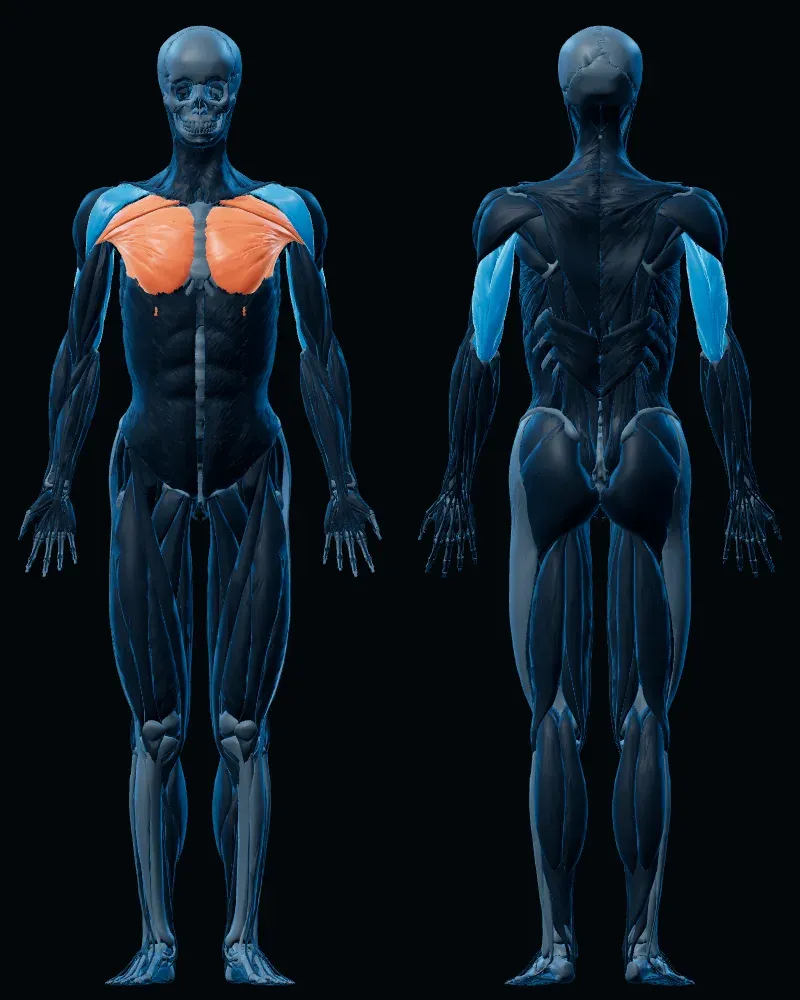
Muscles worked: chest
Main movers: pectoralis major
Assisting: front delts and triceps
Table of contents
The dumbbell vs cable vs pec deck fly debate has a simple mechanical answer. A dumbbell fly is hard at the bottom and almost easy at the top, while cables and the pec deck keep more tension on your chest through the whole rep. That makes cables and machines the more efficient choice for most people, but it does not make the dumbbell fly useless.
This article covers the resistance curve of each version, what the research can and cannot say about chest growth, and how to protect your shoulders. It sits inside our complete chest training guide, so here we stay on the fly itself.
How the chest fly works, and why the weight matters
A fly is a horizontal adduction movement. Your upper arms swing in from wide to together, and the chest (pectoralis major) does the pulling. The elbow stays at a fixed slight bend so the shoulder is the only joint doing the work.
The question is not “which fly is best” in a vacuum. It is “where in the rep does each version load the chest, and does that match where the chest benefits most?”
What is the dumbbell fly resistance curve flaw?
A dumbbell has one source of resistance: gravity. It always pulls straight down.
Lying on a bench with your arms out to the sides, the weight is far from your shoulder joint in the horizontal direction, so the lever is long and the chest has to work hard. As your hands rise toward the ceiling, the dumbbells move over the shoulder joint. The lever shrinks. At the very top the weight is stacked over your shoulders and your chest is barely needed. You could almost rest the bones under it.
So the curve is steep: heavy in the stretch, light to nothing at the top.
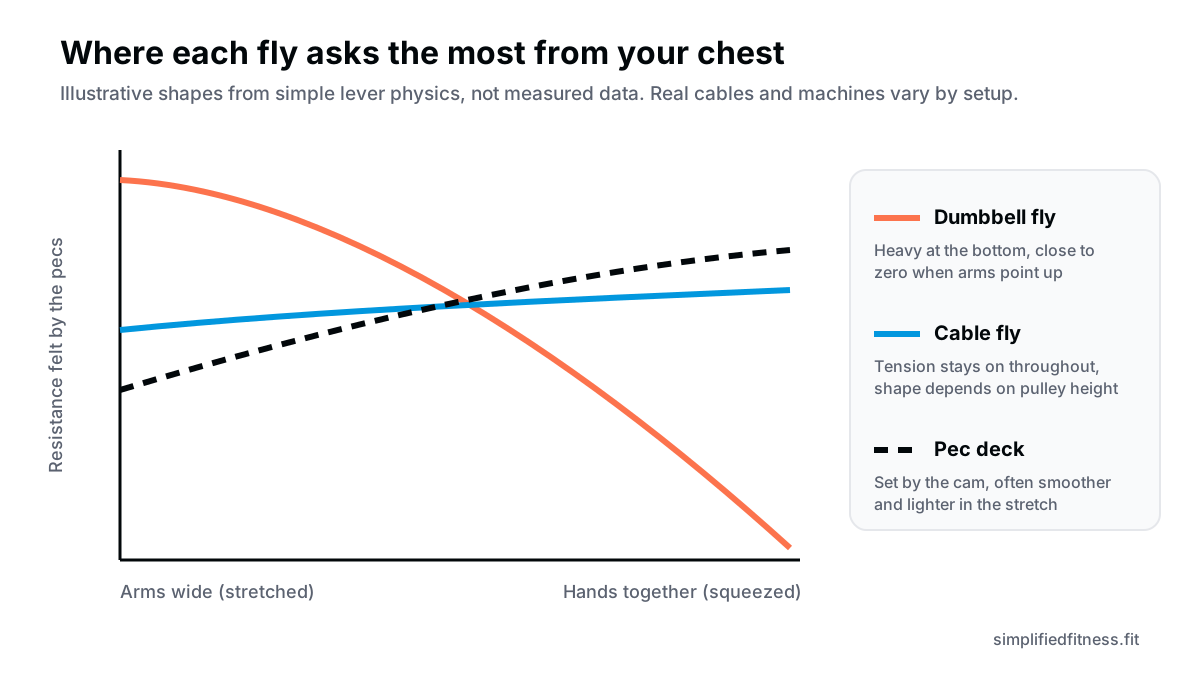
Is that a flaw or a feature? Both, depending on your goal.
- Flaw: the top of the rep, where your chest is shortest, gets almost no tension. A good chunk of the set is wasted.
- Feature: the stretched position is loaded hard, and there is growing interest in training muscles at long lengths (more on that below).
How do cable flies and the pec deck change the load?
A cable pulls along the line from the pulley to your hand. Because that line can be horizontal or angled, tension stays on the chest as your hands move together. Where it is hardest depends on pulley height and how you stand, and that is why cables are so flexible. We go deeper on this in our cable crossover angles guide.
A pec deck uses a lever arm, often with a cam, to give a smoother and more consistent load. Many machines are lighter in the very stretched position than a dumbbell and harder as you squeeze, but this varies by brand. Machines also give back support, which means less balance work and a safer fail. Our pec deck setup guide covers seat height and handle position.
None of these curves is “correct” in a lab-proven sense. They are patterns from basic lever physics, and real equipment varies. For a broader look at matching load to strength, see matching resistance profiles to human strength curves.
What does the research say about flies and chest growth?
Here is the honest version. No trial we could find has compared dumbbell, cable and pec deck flies head to head for chest growth. So the “cables and machines are superior” claim rests on mechanics plus indirect evidence, not a direct result.
What we do have:
Muscle activation. In 12 college-age men and women with varied lifting experience, motor unit activation of the pectoralis major and anterior deltoid did not differ between a barbell bench press, a dumbbell bench press and a dumbbell fly at 6RM. The dumbbell fly had a shorter relative time of activation, and the authors suggested it is better suited as an auxiliary lift (Welsch et al., 2005). That is a small, older study using EMG, which does not directly show growth.
Range of motion. A systematic review of six studies (135 participants, mostly men) concluded that full range of motion benefits lower body hypertrophy versus partial range of motion. For the upper limbs, the evidence was limited and conflicting, and no study had looked at trunk muscles (Schoenfeld and Grgic, 2020). So there is no chest-specific answer.
Long muscle lengths. A narrative review from the same research group recommends a range of motion that emphasizes training at long muscle lengths (Androulakis Korakakis et al., 2023). In an 8-week trial in 30 resistance-trained people, lengthened partial reps and full range of motion gave similar arm muscle growth, which the authors read as support for emphasizing the stretched position (Wolf et al., 2025). In 45 untrained women doing knee extensions, training the initial, stretched part of the range grew some muscle regions more than other ranges (Pedrosa et al., 2022). These studies did not test chest flies, and the untrained knee extension data may not carry over to a fly.
If you want the full explanation of the stretch idea, see stretch-mediated hypertrophy and our lengthened partials guide.
Dumbbell vs cable vs pec deck: side-by-side
| Dumbbell fly | Cable fly | Pec deck | |
|---|---|---|---|
| Tension at the stretch | High | Moderate to high, setup dependent | Often lighter, varies by machine |
| Tension at the top | Close to zero | Stays on | Stays on |
| Elbow and shoulder control | Hardest, you balance the weights | Moderate, you control the line | Easiest, guided path |
| Setup flexibility | Low (incline or flat bench) | High (pulley height, angle) | Low (seat and handles) |
| Easy to fail safely | Moderate | Good | Best |
| Typical cost | Cheapest | Needs a cable stack | Needs a machine |
Many commercial gyms in India have all three. In a home setup with a pair of adjustable dumbbells, the dumbbell fly may be your only option. That is fine.
Do you need to avoid free weights for chest?
No. Free-weight and machine-based training are not a contest. In an 8-week trial of 38 resistance-trained men, training with barbell or machine versions of squat, bench press, row and shoulder press gave similar strength and muscle size gains, including in the pectoralis major, when training variables were matched (Hernandez-Belmonte et al., 2023). That trial used presses and not flies, but it supports a general principle: the best implement is the one you can progress and control.
How to do each fly well
Dumbbell fly
- Lie on a flat or low incline bench with the dumbbells above your chest, slight fixed elbow bend.
- Lower in a wide arc until you feel a deep but comfortable stretch. Stop before the front of your shoulder feels strained.
- Squeeze back up, but think “hug a tree,” not “touch the dumbbells together.” The top is easy anyway.
- Choose a lighter weight than you would use for a press. Control beats ego here.
Cable fly
- Set the pulleys at about chest height for a middle-chest line, or higher or lower to shift the angle. Our cable crossover guide covers this.
- Take a small step forward with one foot, slight lean, ribs down.
- Keep the elbow bend fixed and bring your hands together in a smooth arc.
- Let the cables pull you into the stretch under control at the bottom.
Pec deck
- Adjust the seat so the handles line up with the middle of your chest.
- Sit tall with your back against the pad and shoulder blades gently set.
- Start the range at a depth that does not pull the arms behind your body uncomfortably.
- Use the lighter weights first, then add load slowly.
Do flies hurt the shoulders?
They can, mostly when the load is heavy, the stretch is too deep and control is poor. The front of the shoulder (the anterior capsule) takes strain when the arm is pulled back behind the body under load.
The evidence here is limited. In a study of 123 regular lifters and 36 non-lifters (mean age 28, all men), the lifters showed more clinical signs of anterior shoulder looseness. The exercises linked with those signs were behind-the-neck lat pulldowns and military press, which use the “high-five” position, and external rotator strengthening was associated with fewer signs. Flies were not the exercise tested, and the design cannot prove cause and effect (Kolber et al., 2013).
Practical protection steps:
- Keep the load moderate, so the bottom of the rep is under control.
- Stop at a stretch you can own, not the deepest your arms can reach.
- Keep your shoulder blades set against the bench or pad.
- Include some external rotation and back work in your week.
Which chest fly should you pick?
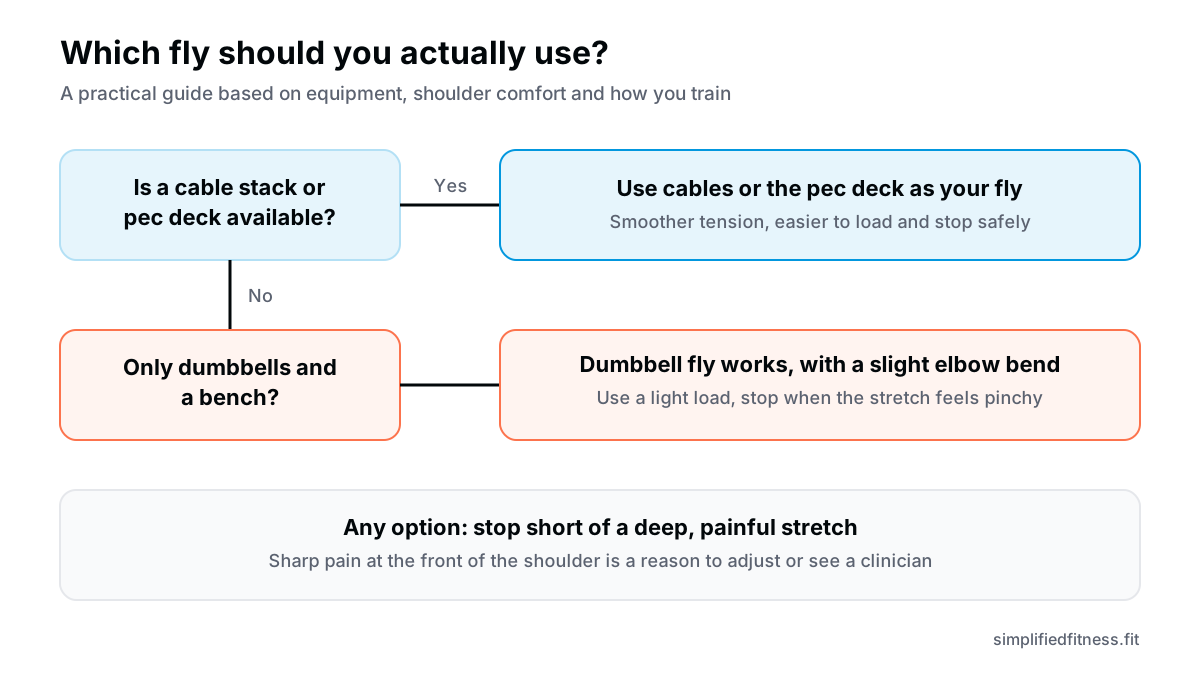
A sensible plan for most people:
- Press first (barbell, dumbbell or machine). Our incline dumbbell press angle comparison helps you choose the bench angle.
- Add one fly variation after pressing: cable or pec deck if available, dumbbell if not.
- Aim for 2-4 hard sets of about 10-20 reps, stopping close to failure with good form.
- Rotate the variation every few months if you like, but do not chase novelty.
You can drop a fly into our free push day plan and see how it fits with pressing work. For how the whole session fits together, see complete chest workout architecture. And if you have heard that flies build an “inner chest”, read the inner chest myth first.
The bottom line
The dumbbell fly has a real mechanical limit: little tension at the top. Cables and the pec deck smooth that out, so they are the better default when you have access. The research does not directly settle the three-way comparison, so treat the advantage as logical rather than proven.
Pick the version you can load, control and repeat without shoulder trouble, keep a slight elbow bend, and progress slowly. That is more important than the label on the equipment.
Frequently Asked Questions
Is the dumbbell fly useless for chest growth?
No, but it is a less efficient tool than a cable or machine fly for most people. The dumbbell version loads the chest hard in the stretch and almost not at all at the top, because gravity pulls straight down. If dumbbells are all you have, a controlled fly with a slight elbow bend still gives the pecs a stretched-position stimulus.
Which is better for chest, cable fly or pec deck?
Neither has been shown to beat the other for muscle growth in direct trials. Cables give you freedom to set the angle and a smooth line of pull, while the pec deck is easier to set up and fail safely on. Pick the one that lets you feel your chest working with the least shoulder discomfort.
What is the dumbbell fly resistance curve flaw?
The resistance on a dumbbell comes from gravity, so it is greatest when your arms are level with the floor and falls to near zero when your hands meet over your chest. That means the part where the chest is shortest and strongest gets the least load. Cables and many machines avoid this because the load pulls sideways rather than straight down.
Do dumbbell flies work the upper chest or the inner chest?
A fly on an incline bench shifts emphasis toward the upper fibres, but no exercise selectively builds an inner chest. The chest fibres work as a whole, and the angle of the arms changes which parts are loaded more. For the full story on the inner chest idea, read our inner chest myth article.
Should I bend my elbows on a chest fly?
Yes, a slight, fixed bend is a sensible default. It keeps the load on the chest rather than the elbow joint and makes the lift easier to control. If you bend and straighten the elbows during the rep, it turns into a press.
How low should I go on a dumbbell fly?
Go to a deep stretch you can control, usually until your upper arms are about level with the bench, and stop before the front of your shoulder feels pinched or strained. Research on stretched-position training supports using long muscle lengths, but it does not say deeper is always better. If the bottom feels sharp or unstable, shorten the range.
Can the dumbbell fly hurt my shoulders?
It can irritate the front of the shoulder if you load it heavy, go very deep or lose control at the bottom. A study of 123 regular lifters found more signs of anterior shoulder looseness than in 36 non-lifters, though the exercises linked to it were behind-the-neck pulldowns and military press, not flies. Use a moderate load, keep your shoulder blades set and see a clinician if pain persists.
How many reps and sets should I do for chest flies?
Most lifters do well with 2-4 hard sets of about 10-20 reps, after pressing work. The load needs to be light enough to control the stretch but heavy enough that the last reps are close to failure. Track your reps over several weeks and add weight or reps slowly.
Should I do flies before or after bench press?
After, for most people. Pressing is the heavier, more skill-dependent lift, and doing flies first tires the chest and may lower the load you can press. Use the fly as an accessory once your main pressing is done.
Are machines worse than free weights for building muscle?
No. In an 8-week trial of 38 resistance-trained men, free-weight and machine training gave similar strength and muscle size gains when training variables were matched. Choose what you can load progressively and perform with good control.
Is the pec deck bad for your shoulders?
Not inherently, but the starting position can pull your arms back further than is comfortable for some people. Set the seat so your elbows sit around chest height and the handles start at a comfortable depth. If you feel strain at the front of the shoulder, reduce the range or switch to cables.
Can I build a big chest with just flies?
Flies alone are unlikely to be the best plan because you cannot load them as heavily as presses. A press for heavy work plus one fly for stretch and volume is a more practical combination. Our complete chest workout architecture article shows how to fit them together.
Sources & References
Every claim above is checked against peer-reviewed research (PubMed, U.S. National Library of Medicine) or guidance from established health bodies. How we fact-check.
- Schoenfeld BJ, et al. Effects of range of motion on muscle development during resistance training interventions: A systematic review. SAGE Open Med. 2020. PMID: 32030125
- Androulakis Korakakis P, et al. Optimizing resistance training technique to maximize muscle hypertrophy: a narrative review. J Funct Morphol Kinesiol. 2023. PMID: 38249086
- Wolf M, et al. Lengthened partial repetitions elicit similar muscular adaptations as full range of motion repetitions during resistance training in trained individuals. PeerJ. 2025. PMID: 39959841
- Pedrosa GF, et al. Partial range of motion training elicits favorable improvements in muscular adaptations when carried out at long muscle lengths. Eur J Sport Sci. 2022. PMID: 33977835
- Welsch EA, et al. Electromyographic activity of the pectoralis major and anterior deltoid muscles during three upper-body lifts. J Strength Cond Res. 2005. PMID: 15903389
- Hernandez-Belmonte A, et al. Free-weight and machine-based training are equally effective on strength and hypertrophy: challenging a traditional myth. Med Sci Sports Exerc. 2023. PMID: 37535335
- Kolber MJ, et al. Characteristics of anterior shoulder instability and hyperlaxity in the weight-training population. J Strength Cond Res. 2013. PMID: 22836608

Umair Hazrami · Founder & Head Coach, Simplified Fitness
Umair Hazrami founded Simplified Fitness and the Simplified Lifter channel to cut through fitness noise. With 4+ years of consistent training and 10+ coaching clients, he writes every guide from the peer-reviewed research and links the sources so you can check them. Our editorial standards.
Educational content only, not medical advice. If you have a medical condition, are pregnant, or take medication, talk to a qualified doctor before changing your diet, supplements or training. Full disclaimer.
Keep reading
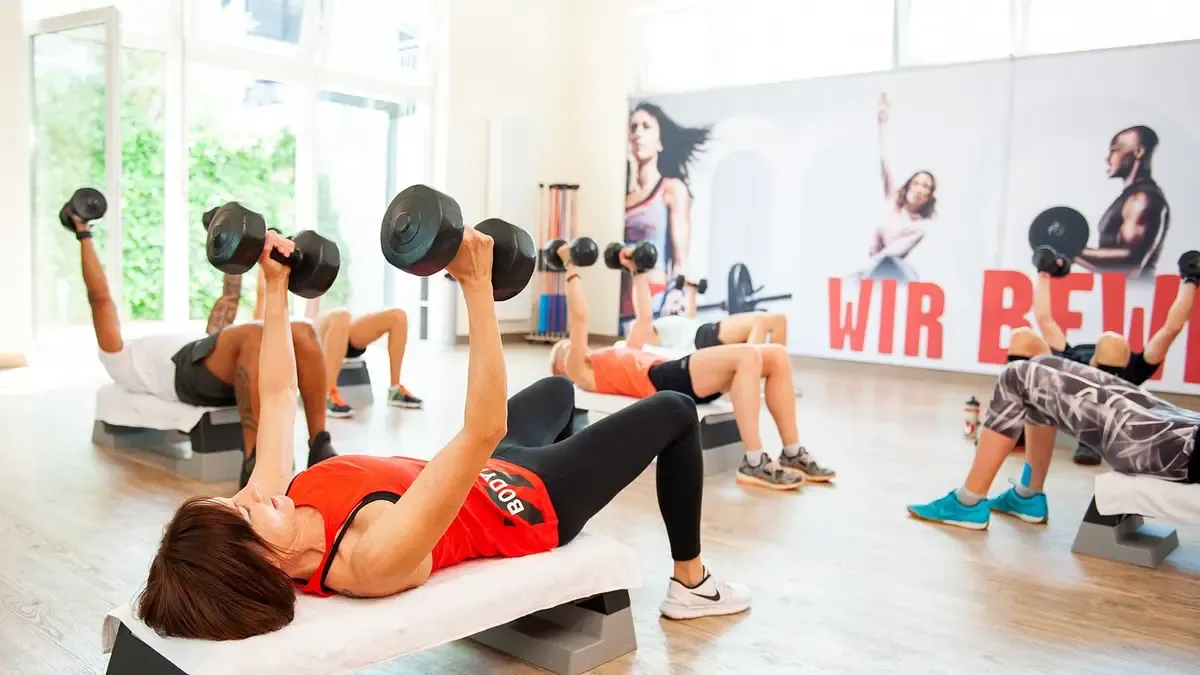
Exercise Technique
Arching on the Bench Press: Powerlifting Spine Arch vs Bodybuilding Setup
Is a bench press arch cheating or dangerous for your back? Learn the difference between a powerlifting arch and a natural upper back setup, with study data.
8 min read
Exercise Technique
Bench Press Grip Width: Pec Activation, Triceps and Shoulder Clearance
Bench press grip width changes triceps load, shoulder stress and little else for your pecs. See what EMG and joint-load studies show and how to pick your grip.
7 min read
Exercise Technique
Cable Crossover Angles: High-to-Low vs Low-to-High vs Horizontal Fly
Cable crossover angles explained: what high-to-low, low-to-high and horizontal flys likely train, what the research really says, and how to set each one up.
9 min read
Exercise Technique
Chest Dips: Forward Lean Angle, Scapular Position, and Shoulder Safety
Chest dips can build your chest if you lean, set your shoulders and stop at a depth that suits you. See what the research says and how to dip safely.
8 min read