Converging Chest Press Machines: Why the Pump Feels So Good and What Science Says
Converging chest press machine explained: how the biangular path trains chest adduction, what the research says about hypertrophy, and how to set it up.
TL;DR. The short answer
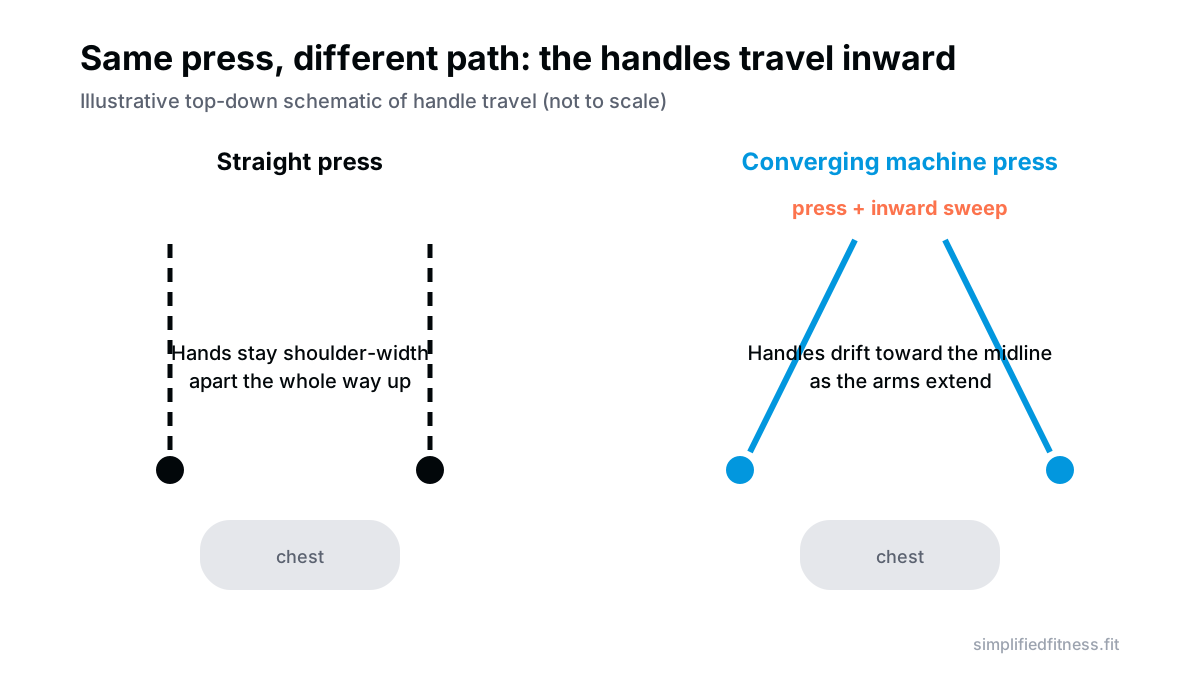
- A converging chest press moves the handles forward and inward, so your hands finish closer together than they started. That adds extra horizontal adduction (arms sweeping toward the midline) near lockout, which a fixed-width barbell cannot give you.
- No study has tested converging machines against barbells for chest growth. The case for them rests on biomechanics and on broader machine vs free-weight data, which show similar hypertrophy.
- A 2023 meta-analysis of 13 studies (1016 adults, of which 5 studies measured hypertrophy) found no detectable growth difference between free-weight and machine training, so a converging press is a good swap, not a magic upgrade.
- The real advantages are practical: a fixed path, no balancing, easier wrist and shoulder positioning, and safer hard sets without a spotter.
- Set the seat so the handles start level with the lower chest, keep your shoulder blades on the pad, and stop most sets 1-3 reps short of failure.
Part of our complete guide: The Complete Chest Workout Guide: Pec Anatomy, Bench Angles, Flys and Shoulder-Safe Pressing
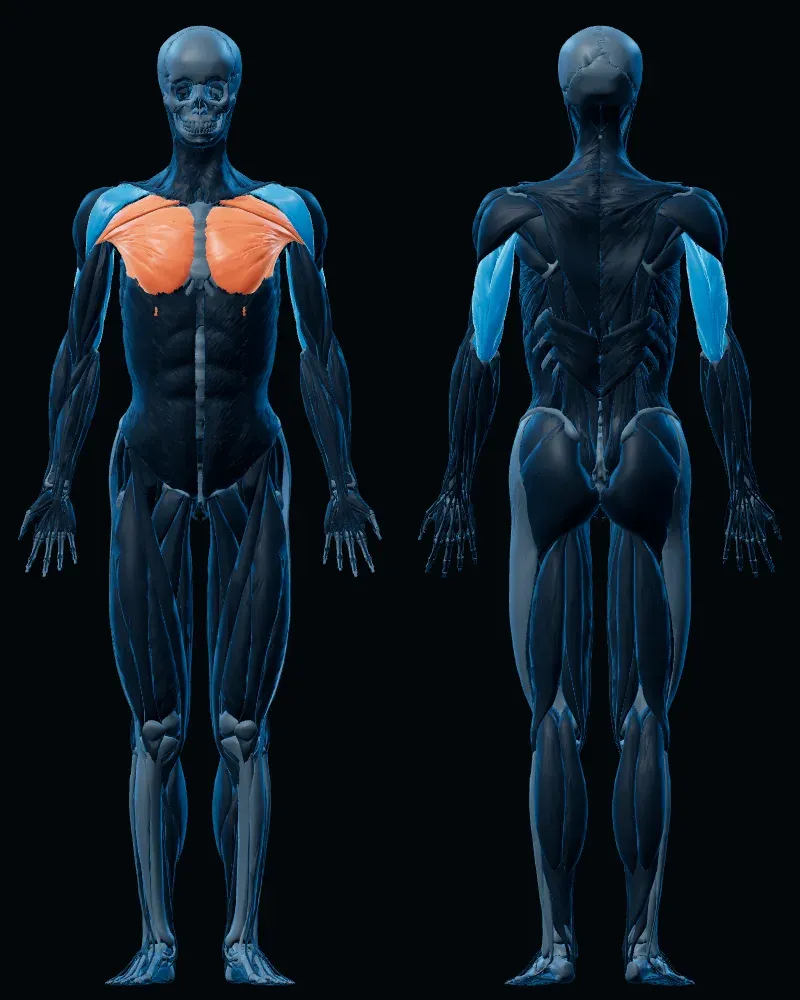
Muscles worked: chest
Main movers: pectoralis major
Assisting: front delts and triceps
Table of contents
A converging chest press machine moves the handles forward and inward, so each rep combines a press with a sweep toward the midline of your body. That sweep, called horizontal adduction, is a main job of the pectoralis major. Any bench press already involves some of it, but a barbell locks your hands at one width, so the converging path adds extra inward travel near lockout. The catch is that nobody has run a trial proving converging machines build more chest than a barbell, so the honest case rests on mechanics, comfort and training quality.
This article is a deep dive inside our complete chest training guide. We will cover what the biangular path actually does, what research exists, and how to set the machine up so the pump turns into progress.
What is a converging chest press machine?
On a regular chest press the handles move in a fixed line away from you. On a converging (biangular) press, the arms of the machine swing on arcs, so the handles travel forward and also drift toward each other. Plate-loaded Hammer Strength presses made this design famous, and many selectorized machines copy it.
Your chest muscle does more than push. The pectoralis major pulls the upper arm forward and across the body. A barbell moves in roughly one vertical line, and your hands stay a fixed distance apart. On the converging machine the hands travel inward as you extend.
How does the biangular path work on your chest?
Think of two movements stacked together. In any flat press, the upper arm swings forward toward the front of the body (horizontal adduction) while the elbow straightens, and the triceps and front delts share the work with the chest. On a barbell, that sweep stops once the arms are vertical, because the hands cannot move closer. On a converging machine the handles keep drifting inward, so the arm continues a little further across the body, which is a position where the chest is still doing much of the work.
A biomechanics paper on the pectoralis major tested force direction and arm position in 26 healthy men during maximal horizontal adduction. Arm rotation was the dominant factor, and none of the tested conditions fully separated the clavicular and sternal parts of the muscle (Lee, 2019). That was an isometric strength test with surface EMG, not a training trial, so it supports the idea that arm position and direction of force matter, but it does not prove a converging press grows more muscle.
What it does tell us: do not expect a machine to isolate one region of the chest by itself. Arm position and seat height still decide what you feel.
Does it really beat a straight barbell press?
Short answer: it is different, and different is not the same as better.
Here is what the direct evidence looks like. In 10 competitive bodybuilders, researchers recorded surface EMG on the chest, triceps and shoulders at 80% of 1RM during flat, incline and decline barbell presses and a chest press machine. The machine produced less clavicular (upper) chest excitation than all the other exercises, and the sternocostal (mid and lower) head was similarly excited in the flat bench and the machine. Triceps excitation was overall greater in the flat and decline barbell presses, and lateral delt excitation was greater in all three barbell variations than in the machine, which the authors linked to instability (Coratella et al., 2020).
Two cautions. The sample was small, surface EMG measures electrical signal rather than growth, and the study did not specify whether the machine had a converging arm. So we can say a chest press machine can load the main part of the chest about as well as a flat bench, while taking some work off the triceps and side delts.
What does the long-term research say about machines vs free weights?
Growth is the real question. Two sources help.
In a 2023 randomized trial, 38 resistance-trained men did 8 weeks of identical programs using either barbells or machines for squat, bench press, row and shoulder press. Ultrasound showed pectoralis major cross-sectional area rose significantly in both groups, with no significant difference between them (difference 2.0% or less), and joint discomfort scores fell in both (Hernandez-Belmonte et al., 2023).
A 2023 meta-analysis pooled 13 studies and 1016 adults, though only 5 of those studies measured hypertrophy. Hypertrophy did not differ between free-weight and machine training (SMD -0.055, 95% CI -0.397 to 0.287), and the same was true for dynamic and isometric strength. Strength was specific to the mode you trained: free-weight training raised free-weight tests more, and machine training tended to raise machine tests more (Haugen et al., 2023).
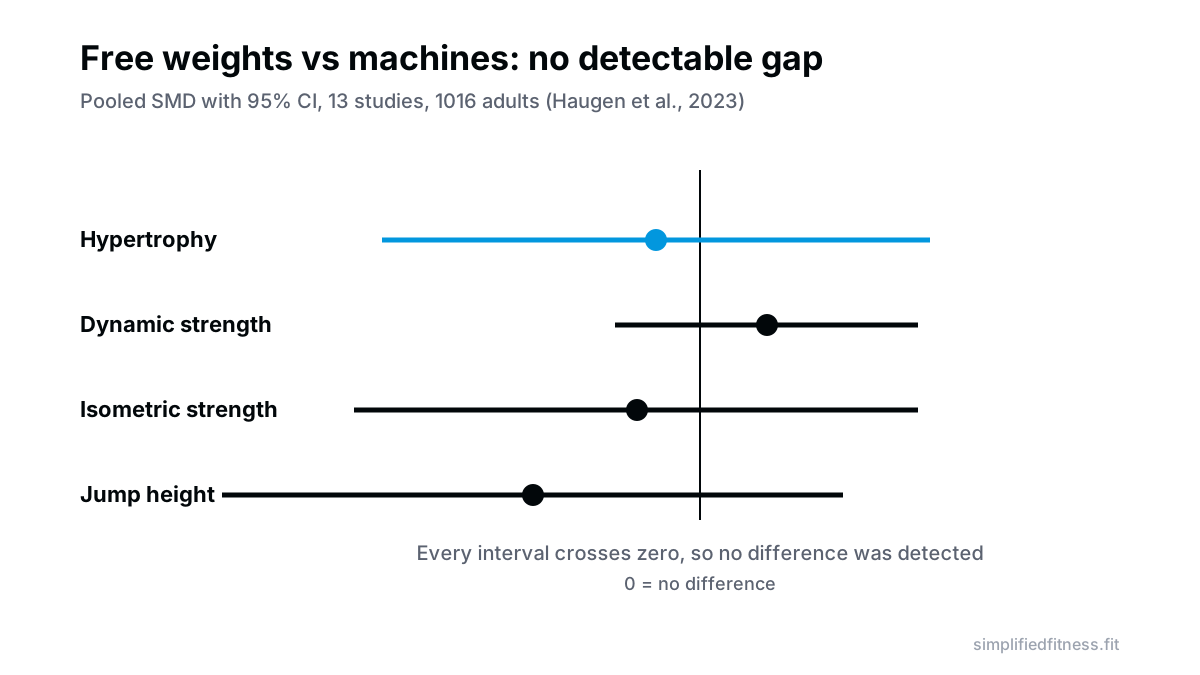
Notice what is missing. None of these trials isolated a converging path. The honest takeaway: machines build chest as well as barbells on average, and a converging machine fits inside that finding, with its extra benefit being mechanical rather than proven.
Why does the converging press feel like such a good chest exercise?
Five practical reasons, and these are coaching explanations, not study findings.
- The path fits your arms. The inward sweep matches how the pecs naturally pull the arms together, so many lifters feel the chest earlier in the rep.
- No balancing. The machine is stable, so more effort goes into pushing instead of controlling the bar.
- Wrists stay neutral. Fixed handles let your forearms stack over your wrists, which reduces the bending force a bar can put on them.
- Safer near failure. You can finish a hard set without a spotter, with the handles stopping where the machine allows.
- Easy to repeat. The same seat position every week makes progress simple to track.
The part that matters most is the fourth. If you can push closer to the limit with confidence, you can train the chest harder more often, and that is how machines earn their place.
How do you set up a converging chest press?
Seat height does most of the work here. Get it wrong and the machine feels pointless.
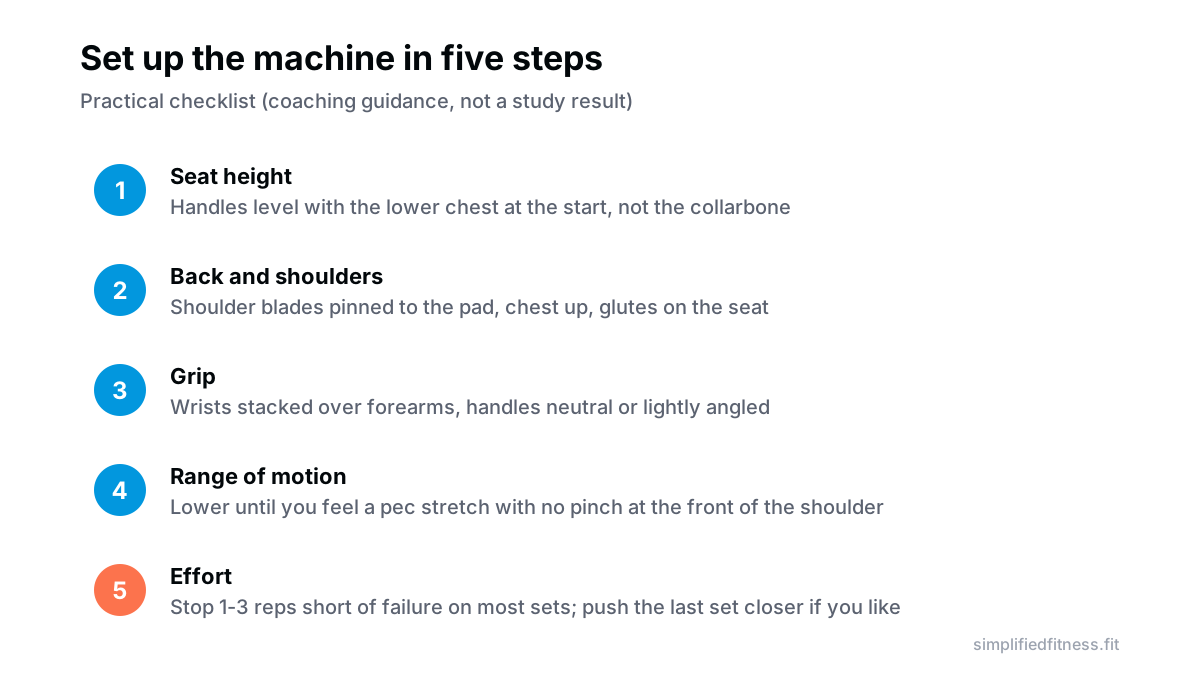
Seat height. Handles should start about level with the lower chest. If they start at your collarbone, your elbows flare up and the front of the shoulder takes more load. If they start at your belly, the press gets awkward.
Shoulder blades. Pin them back and slightly down against the pad, with your chest up. Do not let the shoulders roll forward as the handles come inward.
Grip and wrists. Keep the wrist stacked over the forearm. On many machines a neutral or slightly angled grip is more comfortable for the shoulder than a flat overhand one.
Range of motion. Lower until you feel a stretch across the chest, and stop before any pinch at the front of the shoulder. Press out and let the hands come toward each other at the top, without slamming the machine’s stops together or shrugging.
Tempo. A controlled 2-second lowering and a firm push are a reasonable default. Skipping the lowering is the most common mistake here, because the machine makes it easy to bounce.
How close to failure should you take it?
This is where the machine shines. A fixed path means you can grind out the last rep without losing the bar over your face.
Still, closer to failure is not always better. A 2023 meta-analysis of 15 studies found a trivial advantage for training to set failure versus non-failure (effect size 0.19, 95% CI 0.00 to 0.37), and no advantage for momentary muscular failure versus non-failure (effect size 0.12, 95% CI -0.13 to 0.37) (Refalo et al., 2023). The authors suggested the relationship between proximity to failure and growth may not be linear.
What that means for you:
- Stop most sets 1-3 reps short of failure.
- Take the last set of an exercise close to failure if you want to.
- Add load or reps when you hit the top of your range with clean form.
Our RIR and RPE calculator helps you judge how close to failure a set really was.
How do you fit it into your chest day?
A converging press can be your main press or a second press after a free-weight movement. Because it is stable, it works well after you are already tired, when a barbell would feel risky.
A simple order that works for many lifters:
- A heavier free-weight press (see why the flat barbell bench has limits).
- The converging press for 2-3 hard sets of 8-12 reps.
- A stretch-focused fly such as a cable or pec deck. The chest fly comparison explains which fly to choose.
If you only have machines, train the chest twice a week with 2-4 hard sets per session and progress the loads. That is a practical starting range, not a precise prescription. Our free push day plan shows how pressing, shoulders and triceps fit together.
Wondering whether your gym has the plate-loaded or the selectorized version? Our guide on plate-loaded vs pin-loaded chest machines covers the differences. If you want to understand which part of the muscle does what, read about the pectoralis major heads.
Who gets the most from a converging chest press?
Three groups come to mind.
- Lifters with cranky shoulders or wrists. A guided path and neutral grip can make pressing tolerable. If shoulder pain persists, or you have numbness, a sudden pop, or pain at rest, see a doctor or physiotherapist rather than training through it. Our guide to fixing shoulder pain on the bench helps with technique, not diagnosis.
- Lifters training alone. Without a spotter, a stable machine lets you work hard with less risk.
- Anyone chasing more chest volume. A second pressing option lets you add sets without beating up the same joints.
If you are a competitive powerlifter, the barbell still matters because strength is specific to the lift you practise.
What are the limits of this idea?
Be fair to the evidence.
- No direct trial. No study we found compares converging and straight chest presses for muscle growth.
- Small EMG samples. The bodybuilder study had 10 participants, and EMG is not growth.
- Machine geometry varies. Brands differ in arm length, arc and seat, so what works on one machine may not on another.
- Short trials. The 8-week ultrasound trial involved trained men only, so results may differ in women or in longer programs.
- Pump is not proof. A great pump feels convincing, but no study has linked it to growth.
The cautious practical takeaway: use the converging press because it lets you train hard and pain-free, and judge it by progress in load and reps over 8 to 12 weeks, not by how the chest feels in the mirror afterwards.
Frequently Asked Questions
What is a converging chest press machine?
It is a chest press where the two handles travel along arcs that move toward each other as you push. This design is often called biangular or converging, and plate-loaded Hammer Strength presses are a well-known example. The inward path mimics how your arms naturally sweep together, so pick a machine with this path if you want a chest press that feels more like bringing your arms across the body.
Is a converging chest press better than a barbell bench press for building chest?
There is no direct evidence that it is better. A 2023 meta-analysis found no difference in hypertrophy between free-weight and machine training, and one trial in trained men found similar pectoralis growth over 8 weeks. Use the converging press as a strong chest builder alongside or instead of the bench, based on which one you can train hard without joint irritation.
What does biangular mean in a chest press?
Biangular means the handle path changes direction through the rep, usually forward first and then inward, instead of a single straight line. The idea is to match the arc your arms follow when you press and adduct together. Think of it as two movements, press and squeeze, built into one lever.
Why does the converging chest press give such a good pump?
The fixed path lets you push close to your limit without worrying about balance, which makes the chest do most of the work. The pump itself is blood and fluid pooling in the muscle, and no study has shown it predicts growth. Enjoy it, but judge the exercise by whether your load and reps climb over weeks.
Does the converging chest press work the upper or lower chest?
That depends on seat height and handle angle, not on the converging path itself. In bodybuilders, a chest press machine produced less clavicular (upper) head excitation than free-weight bench variations in one 2020 study. Lowering the seat so the handles line up nearer your upper chest may shift a little emphasis upward, but that has not been tested; an incline press is the more reliable way to bias the upper chest.
How should I set the seat height on a converging chest press?
Set the seat so the handles start around lower-chest level, with your elbows slightly below or at shoulder height. Handles that start too high push the elbows up and load the front of the shoulder. Test with an empty machine: if your shoulders shrug toward your ears at the bottom, drop the seat.
Should I train to failure on a converging chest press?
You can, but you do not need to on every set. A 2023 meta-analysis found no clear hypertrophy advantage for training to momentary failure over stopping short of it. Keep most sets 1-3 reps from failure and push the final set closer, since the fixed path makes that safer than on a barbell.
Is the converging chest press easier on the shoulders than the barbell bench?
For many people it feels easier, because the handle path is guided and your hands can sit in a more natural position. One trial found machine and free-weight training did not differ in joint discomfort changes in trained men. If a bench hurts your shoulders and the machine does not, that is a sensible reason to switch; if both hurt, see a physiotherapist or doctor.
Can I build a big chest using only machines?
Probably yes, if you progress the loads and train close enough to failure. In the 2023 meta-analysis of 13 studies, hypertrophy did not differ between free-weight and machine training. Strength is more specific to what you practise, so if you also want a bigger barbell bench, keep benching.
Hammer Strength chest press vs barbell: which one is stronger?
You will usually move different loads on each, so the numbers are not comparable. The meta-analysis found strength gains were specific to the training modality: free-weight training raised free-weight test results more, and machine training tended to raise machine test results more. Track progress within one machine, and do not compare plates to your bench.
How many sets of converging chest press do I need?
A reasonable range is 2-4 hard sets per session, 2 times a week, as part of your total weekly chest volume. This is a practical starting range, not a number taken from one trial. Increase sets only if your reps and loads are still climbing and recovery is fine.
Do converging machines work well for beginners?
Yes, because the guided path lowers the skill demand and lets a beginner push the chest hard without balancing a bar. Beginners still need to learn a stable shoulder position and a full range of motion. Start with 2-3 sets of 8-12 reps and add weight slowly.
Can I use a converging chest press if I train at a budget gym in India?
Yes, because many commercial gyms already have a plate-loaded or selectorized chest press with a converging arm, and you do not need extra equipment. If your gym only has a straight press, the same principles still apply. Ask the trainer which machine has the inward path and test it with a light warm-up set.
Sources & References
Every claim above is checked against peer-reviewed research (PubMed, U.S. National Library of Medicine) or guidance from established health bodies. How we fact-check.
- Coratella G, et al. Specific prime movers' excitation during free-weight bench press variations and chest press machine in competitive bodybuilders. Eur J Sport Sci. 2020. PMID: 31397215
- Hernandez-Belmonte A, et al. Free-weight and machine-based training are equally effective on strength and hypertrophy: challenging a traditional myth. Med Sci Sports Exerc. 2023. PMID: 37535335
- Haugen ME, et al. Effect of free-weight vs. machine-based strength training on maximal strength, hypertrophy and jump performance: a systematic review and meta-analysis. BMC Sports Sci Med Rehabil. 2023. PMID: 37582807
- Refalo MC, et al. Influence of resistance training proximity-to-failure on skeletal muscle hypertrophy: a systematic review with meta-analysis. Sports Med. 2023. PMID: 36334240
- Lee HM. Force direction and arm position affect contribution of clavicular and sternal parts of pectoralis major muscle during muscle strength testing. J Hand Ther. 2019. PMID: 28943236

Umair Hazrami · Founder & Head Coach, Simplified Fitness
Umair Hazrami founded Simplified Fitness and the Simplified Lifter channel to cut through fitness noise. With 4+ years of consistent training and 10+ coaching clients, he writes every guide from the peer-reviewed research and links the sources so you can check them. Our editorial standards.
Educational content only, not medical advice. If you have a medical condition, are pregnant, or take medication, talk to a qualified doctor before changing your diet, supplements or training. Full disclaimer.
Keep reading
Exercise Technique
Arching on the Bench Press: Powerlifting Spine Arch vs Bodybuilding Setup
Is a bench press arch cheating or dangerous for your back? Learn the difference between a powerlifting arch and a natural upper back setup, with study data.
8 min read
Exercise Technique
Bench Press Grip Width: Pec Activation, Triceps and Shoulder Clearance
Bench press grip width changes triceps load, shoulder stress and little else for your pecs. See what EMG and joint-load studies show and how to pick your grip.
7 min read
Exercise Technique
Cable Crossover Angles: High-to-Low vs Low-to-High vs Horizontal Fly
Cable crossover angles explained: what high-to-low, low-to-high and horizontal flys likely train, what the research really says, and how to set each one up.
9 min read
Exercise Technique
Chest Dips: Forward Lean Angle, Scapular Position, and Shoulder Safety
Chest dips can build your chest if you lean, set your shoulders and stop at a depth that suits you. See what the research says and how to dip safely.
8 min read