Floor Press: Triceps Overload, Reduced Shoulder Extension, and Pec Activation
Floor press for chest and triceps: how the floor limits shoulder extension, what it does to your pecs, and who should use it. Barbell vs dumbbell, with sources.

TL;DR. The short answer
- The floor press stops your upper arms on the ground, so your shoulders never travel into the deepest bottom position of a bench press. That is why many lifters with an irritated front shoulder tolerate it better.
- It shifts the work toward the triceps and the top half of the press. No study has directly tested floor press for muscle growth, so treat it as a smart substitute, not a proven chest builder.
- You give up the deepest pec stretch. Research on upper-body range of motion is limited and mixed, so the cost for chest size is probably small but uncertain.
- Dumbbells let your wrists and elbows find a comfortable path, which many lifters find easier on the shoulder. A barbell lets you load heavier and track progress more easily.
- Pain that lingers, causes night aches, or comes with weakness or numbness needs a clinician, not a new exercise.
Part of our complete guide: The Complete Chest Workout Guide: Pec Anatomy, Bench Angles, Flys and Shoulder-Safe Pressing
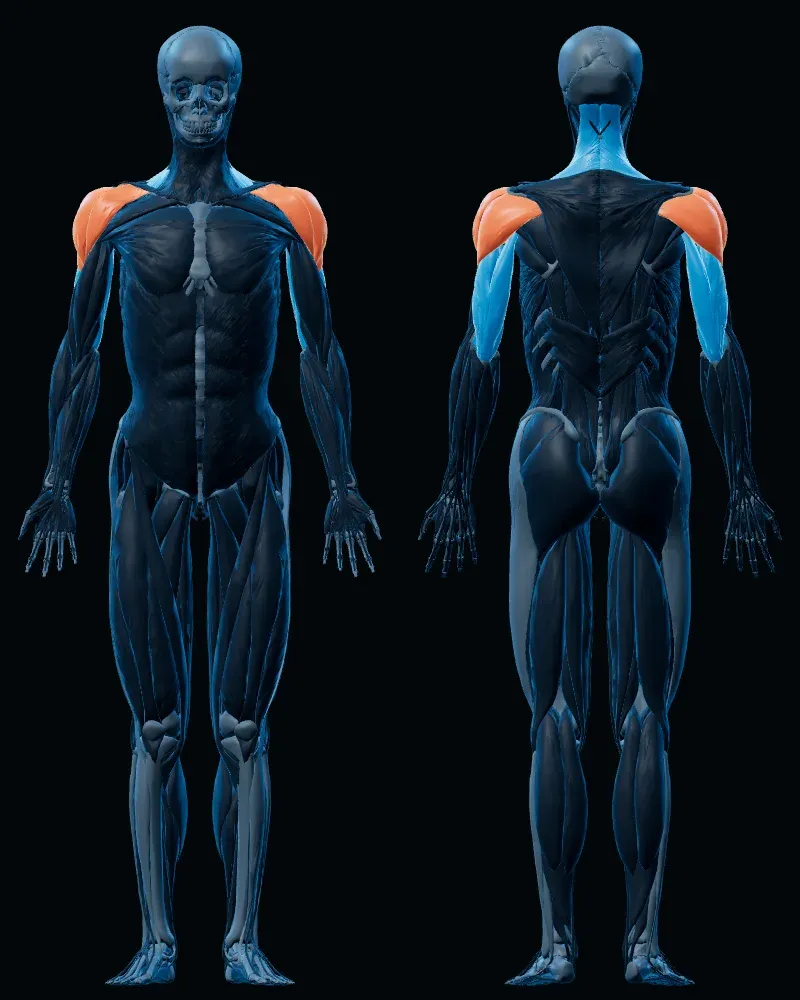
Muscles worked: shoulders
Main movers: all three heads of the deltoid
Assisting: supraspinatus, upper traps and triceps
Table of contents
The floor press is a bench press done lying on the floor, so your upper arms stop the moment your triceps touch the ground. That hard stop keeps your shoulders out of the deepest bottom position, which is why it is one of the first swaps lifters try when a regular bench makes the front of the shoulder grumble. It works the same pressing muscles (chest, triceps, front delts), leans toward the triceps and the top half of the rep, and costs you the deepest pec stretch.
This guide covers floor press for chest and triceps in the context of the complete chest training guide: what the floor actually changes, what the research can and cannot say, barbell versus dumbbell, and who should (and should not) lean on it.
One honest note first. I could not find a single trial that tested floor press for muscle growth or shoulder pain. Everything below is built from range-of-motion research on the bench press, basic joint mechanics and normal coaching practice. I will flag which is which.
What does the floor press actually change?
On a regular bench press, your elbows can drop below the line of your torso. That is where the shoulder moves into extension and where many lifters feel a pinch at the front of the joint.
On the floor, your upper arm is physically blocked about parallel with the ground. The range is shorter, and the bottom position is capped.
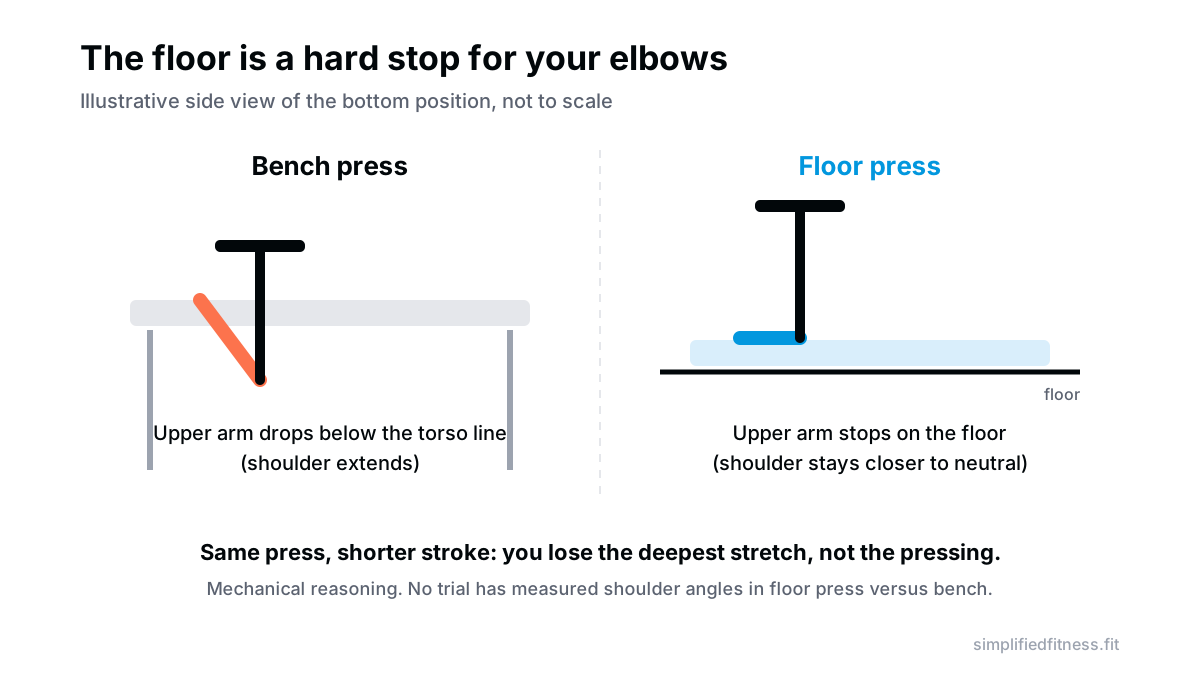
Three things shift as a result:
- Shoulder range is capped. The floor, not your pain tolerance or your spotter, sets the bottom.
- Triceps do more of the work. The press begins from a dead stop at the point where the elbow is bent about 90 degrees and the triceps are strongly involved through lockout.
- Leg drive and arch shrink. Lying flat on the ground limits how much you can arch and push through your feet, so the arms carry more of the load.
None of that makes the floor press magic. It makes it a different tool, closer to the top half of a bench rep.
Is floor press good for chest hypertrophy?
Possibly, with caveats. Here is what the nearby evidence says.
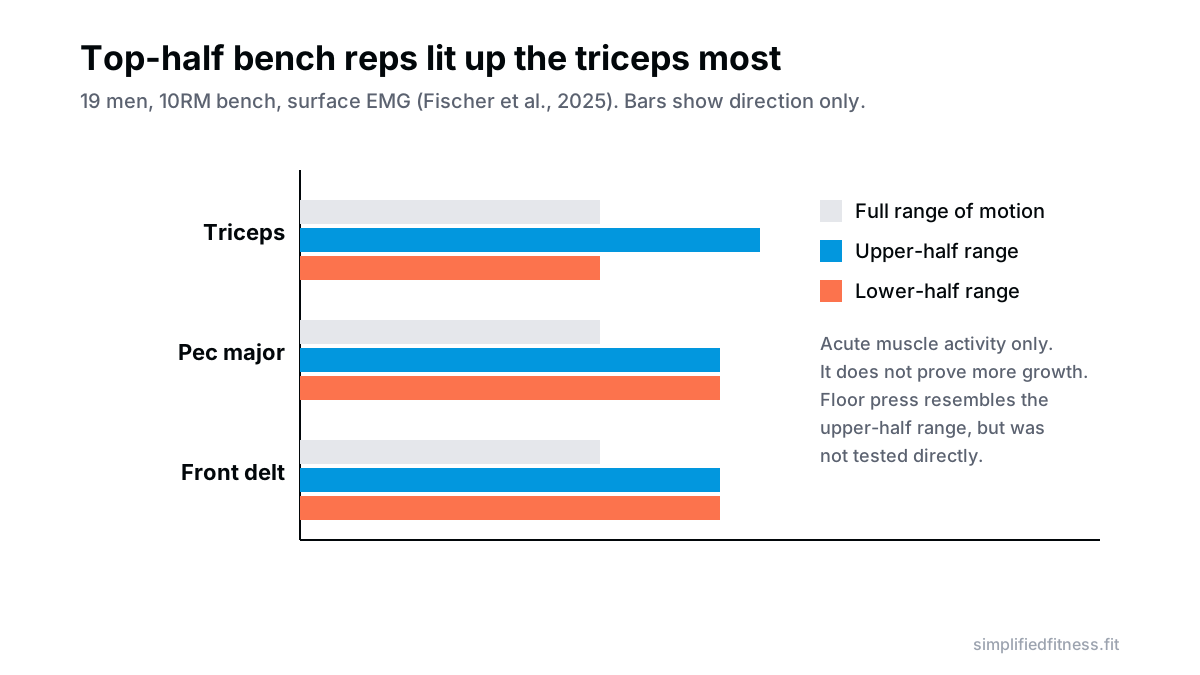
A 2025 study in Scientific Reports had 19 men perform a 10-rep-max bench press in three ranges: full, upper half and lower half (Fischer et al., 2025). The upper-half range produced the highest average triceps excitation, and both partial ranges produced greater pectoralis major and front deltoid excitation than the full range. This is a small, acute EMG study in men. It tells us what the muscles did in one session, not what happens over months.
Now the other side. A 2020 systematic review found that full range of motion helped lower-body growth, but research on the upper limbs was limited and conflicting, so strong conclusions were not possible (Schoenfeld and Grgic, 2020). A 2021 meta-analysis of 16 studies found full range of motion produced greater strength gains and lower-limb hypertrophy, while differences in muscle thickness, pennation angle and fascicle length were not significant (Pallares et al., 2021).
Why might they disagree? Most of the strongest range-of-motion effects show up in leg exercises, many studies are short, and few measured the chest directly. The floor press also removes the stretched position, and the authors of a recent trial in trained people concluded that lifters should likely emphasise the stretched position, either with a full range or with lengthened partials (Wolf et al., 2025). That study measured the elbow flexors and extensors (biceps and triceps), not the chest, in 30 resistance-trained participants over 8 weeks.
Floor press vs bench press: which wins?
Neither, across the board. It depends on what you are trying to do this month.
| Question | Bench press | Floor press |
|---|---|---|
| Deepest chest stretch | Yes | No, capped by the floor |
| Shoulder extension at the bottom | Can go deep | Limited by the floor |
| Triceps emphasis | Moderate | Higher, based on mechanics |
| Leg drive and arch | Large | Small |
| Best for | Full-range chest work and bench-specific strength | Sore front shoulders, triceps lockout work, controlled hypertrophy sets |
If your bench is pain-free, there is no need to abandon it. See why flat bench has limits for chest growth for the case for mixing pressing angles.
Dumbbell floor press vs barbell: pick your tool
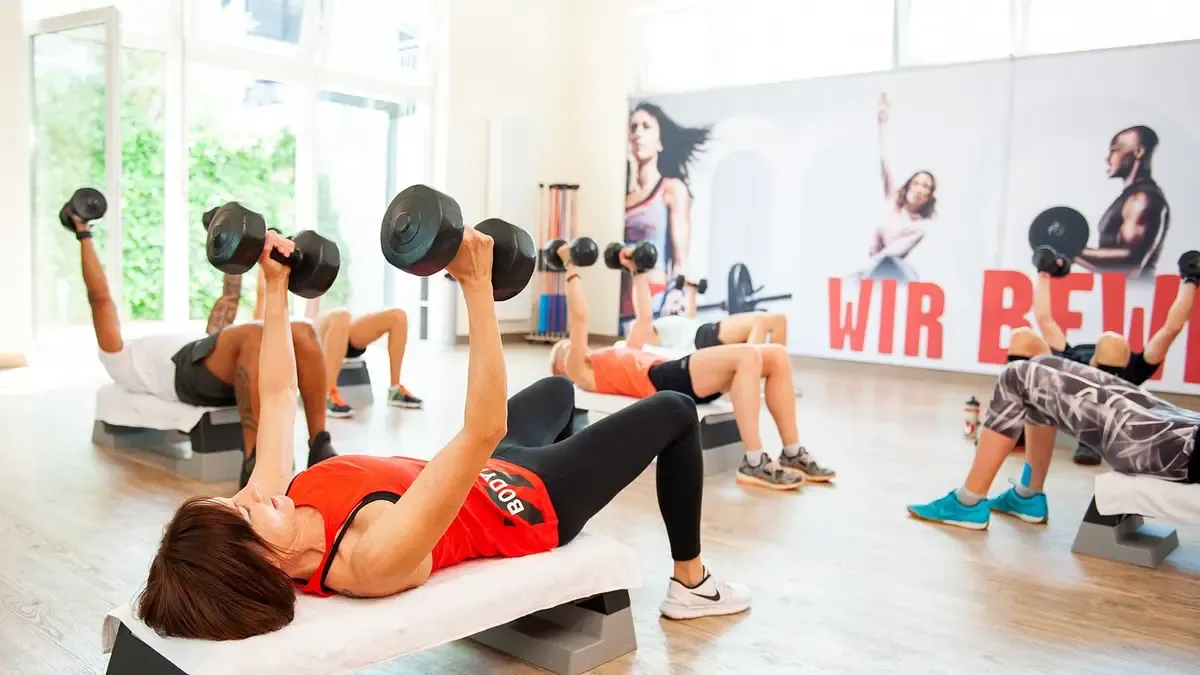
Dumbbells. Each hand moves on its own path, so your wrists and elbows can find a position that feels okay. You can also bail out sooner with a smaller load if something pinches. The downside is setup: getting heavy dumbbells into position lying on the floor is awkward, and you may need to kick them up.
Barbell. Easier to load and progress, and the lift itself is simpler to repeat from week to week. The bar fixes your hands in one position, so if your shoulders are irritable this can be less forgiving.
A practical rule many coaches use: start with dumbbells while the shoulder is sore, return to the barbell when you can press without pain, and keep the grip a touch narrower than your bench grip. This is coaching convention, not trial-tested.
How to do the floor press
- Set up. Lie on the floor with your eyes under the bar (or the dumbbells at your chest). Feet flat with knees bent, or legs straight; pick whichever keeps your lower back comfortable.
- Tighten. Pull your shoulder blades back and down. Keep your forearms vertical.
- Lower under control. Take 2-3 seconds. Stop when your upper arms touch the floor.
- Pause. About one second, without relaxing. Don’t let the weight bounce off your triceps.
- Press. Drive the weight up and slightly back toward your face line, finishing with your chest still lifted.
Will floor press protect my shoulders?
It can make a painful lift more tolerable. It does not make training risk-free.
In the gym, the logic is simple. A lot of front-shoulder irritation shows up in the bottom of the bench press, and the floor removes that position. A 2024 narrative review of bench press shoulder injuries in experienced powerlifters argues that fatigue and shoulder joint mechanics both matter and suggests using RPE or reps in reserve rather than always training to failure, while noting that solid data on joint mechanics are lacking (Motlagh and Lipps, 2024).
How common are the problems? In a cross-sectional survey of 104 Swedish subelite powerlifters, 70% were currently injured and the shoulder was among the most commonly injured areas, though only 16% of those currently injured had to stop training completely (Stromback et al., 2018). That population lifts heavier than most gym-goers, so don’t read it as your personal risk.
When to see a doctor
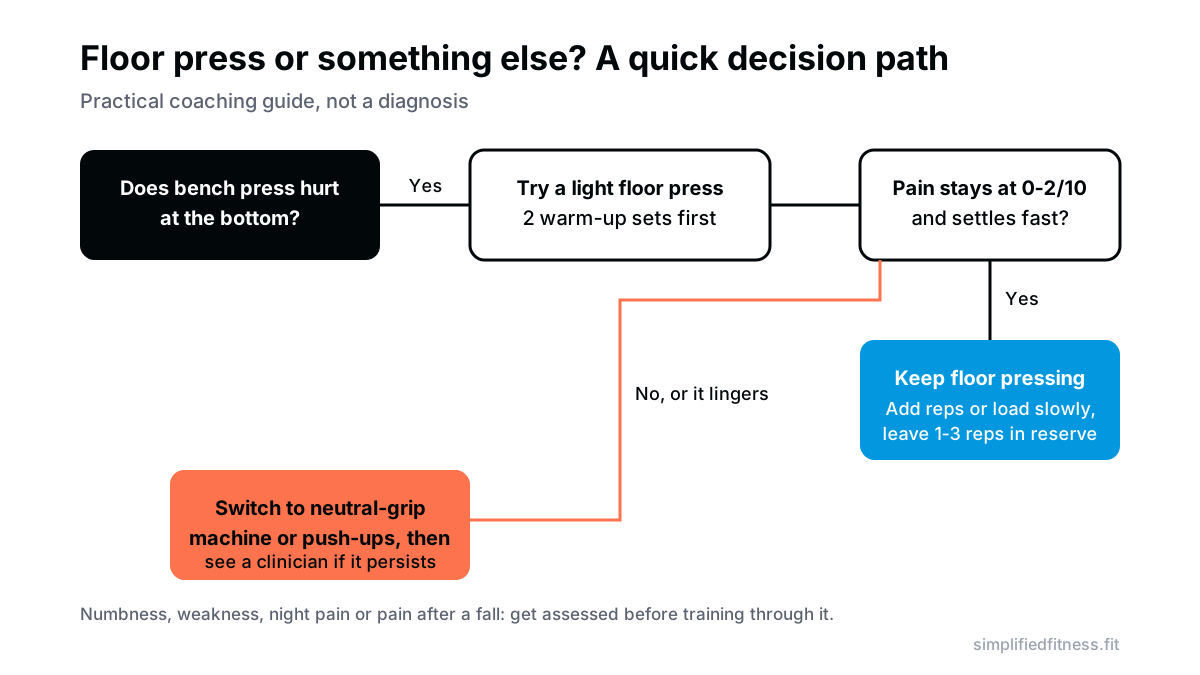
See a doctor or physiotherapist if you have pain that wakes you at night, weakness lifting your arm, numbness or tingling down the arm, a clicking joint with sharp pain, or pain after a fall or a pop. This article cannot tell you what is wrong with your shoulder. For a deeper look at fixes, see our guides on bench press shoulder pain biomechanics and alternatives when bench hurts.
How heavy and how many reps?
Moderate. The shorter range helps, but the dead stop and lack of leg drive work against you, so your floor press load may end up above or below your bench. Start lighter than you think and build up; there is no benefit to ego loading a pain-prone shoulder.
A 2017 meta-analysis of 21 studies found that muscle growth was similar between low-load and high-load training when sets were taken to failure, while heavy loads gave greater 1RM strength (Schoenfeld et al., 2017). A 2021 review reaches a similar view, proposing that muscular adaptations can be obtained across a wide spectrum of loading zones (Schoenfeld et al., 2021). For floor press, that supports a practical range of about 6-15 reps with 1-3 reps in reserve.
A simple weekly setup:
- Day 1: 3-4 sets of 6-10 reps, barbell or heavy dumbbell floor press.
- Day 2: 2-3 sets of 10-15 reps, dumbbell floor press or a chest-supported press.
- Add a stretched-position chest move such as flyes to cover what the floor removes.
Not sure what load to pick? Use our 1RM calculator to estimate a starting weight, and the RIR and RPE calculator to check you are not grinding every set. For the overall layout of chest training, the complete chest workout architecture article shows where this fits, and our push day plan has ready-made sessions.
Who benefits most from the floor press?
- Lifters with a sore front shoulder who want to keep pressing while it calms down.
- Lifters whose triceps limit their bench, who want more lockout work.
- People training at home with a barbell or dumbbells and no bench, which is common in small flats where a bench takes up too much space.
- Anyone who tends to arch and bounce and wants a cleaner, more controlled pressing pattern.
Who gets less from it? Lifters who are pain-free and want the longest possible chest stretch, and powerlifters who need the arch and leg drive of competition bench.
A note for Indian lifters training at home: a firm mat on the floor is more comfortable than bare tile or concrete for your elbows and upper back, and a pair of adjustable dumbbells covers a lot of ground on a small budget.
A simple plan if your shoulder is irritated
- Swap your flat bench for dumbbell floor press for 2-4 weeks.
- Keep sets 1-3 reps from failure.
- Add rows and rear-delt work to balance the pressing volume.
- Re-test your regular bench with a light load. If it feels fine, bring it back.
- If pain persists, book an assessment.
For adding strength around the joint, see the guide to rotator cuff strengthening.
Frequently Asked Questions
Is the floor press good for chest growth?
It can be a useful chest and triceps exercise, but no study has tested floor press specifically for hypertrophy. Pressing through the upper half of the bench range produced higher pec and triceps activity in one small acute study, which is a reasonable signal but not proof of growth. Use it as a staple or a substitute and pair it with a chest exercise that trains the stretched position.
Is floor press better than bench press for shoulder pain?
For some people it feels better because the floor stops the upper arm before the shoulder extends past the torso. That is mechanical reasoning, and no trial has compared shoulder angles or pain between the two lifts. Test it with light loads, and if pain stays low and settles quickly, keep it.
Does the floor press work the triceps more than the chest?
It tends to emphasise the triceps because the lockout portion of the press is where they work hardest. A 2025 study of 19 men found the highest triceps excitation in the upper half of the bench range. Keep chest in the picture by using a moderate grip, a slow lowering phase and a full squeeze at the top.
What muscles does the floor press work?
The main movers are the pectoralis major, the triceps and the front deltoids, the same as the bench press. The floor changes the range, not the cast of muscles. Treat it as a chest and triceps press that happens to start from a dead stop.
Should I use a barbell or dumbbells for the floor press?
Either works. Dumbbells give your wrists and elbows freedom to find a pain-free path, and they let you stop sooner if something pinches. Use a barbell when you want heavier loads and easy progression, and dumbbells when your shoulders are cranky.
Can I do floor press if I have shoulder impingement?
Many lifters can, but impingement is a diagnosis for a clinician, not for a gym article. The shorter range may reduce irritation, and evidence for floor press itself is mostly practical and not trial-based. If symptoms persist for more than a couple of weeks, get assessed.
Do I need leg drive on the floor press?
Not really. Lying on the floor reduces the arch and the drive you can generate, so more of the load lands on your arms and chest. Plant your feet or straighten your legs, whichever keeps your lower back comfortable, and keep it the same each session.
How heavy should I go on the floor press?
A moderate load you can control for 6-15 reps works well. A 2021 review argues that hypertrophy can be achieved across a wide spectrum of loads, and a 2017 meta-analysis found similar muscle growth with low and high loads when sets were taken close to failure. Stop most sets with 1-3 reps in reserve and use our RIR and RPE calculator if you want help judging that.
How do I set up a barbell floor press?
Set the bar on low safety pins or a rack so you can unrack it without straining. Lie flat with your upper back tight, lower the bar until your triceps touch the floor, pause briefly without relaxing, and press back up. A short pause kills the stretch-reflex bounce and keeps the shoulders honest.
How often should I floor press?
Once or twice a week is a sensible starting point, in place of or alongside your usual press. Because it is more triceps-driven, it can fatigue your elbows if you also do heavy triceps work. Watch how your elbows feel and adjust the total weekly sets.
Is floor press safer than bench press?
Not necessarily. Shoulder complaints are common in lifters generally, for example in one survey of 104 subelite powerlifters the shoulder was among the most commonly injured areas. The floor limits one risky position, but load, fatigue and technique still matter, so manage volume and avoid grinding every set to failure.
What can I do instead of floor press if it still hurts?
Try a neutral-grip dumbbell press, a machine chest press, or push-ups with a hand position that feels comfortable. The goal is to keep training the chest through a pain-free range. If nothing feels comfortable, see a physiotherapist or doctor.
Sources & References
Every claim above is checked against peer-reviewed research (PubMed, U.S. National Library of Medicine) or guidance from established health bodies. How we fact-check.
- Fischer J, et al. Acute muscle excitation response across various bench press ranges of motion. Sci Rep. 2025. PMID: 40269203
- Pallares JG, et al. Effects of range of motion on resistance training adaptations: a systematic review and meta-analysis. Scand J Med Sci Sports. 2021. PMID: 34170576
- Schoenfeld BJ, et al. Effects of range of motion on muscle development during resistance training interventions: a systematic review. SAGE Open Med. 2020. PMID: 32030125
- Wolf M, et al. Lengthened partial repetitions elicit similar muscular adaptations as full range of motion repetitions during resistance training in trained individuals. PeerJ. 2025. PMID: 39959841
- Motlagh JG, et al. The contribution of muscular fatigue and shoulder biomechanics to shoulder injury incidence during the bench press exercise: a narrative review. J Strength Cond Res. 2024. PMID: 39808810
- Stromback E, et al. Prevalence and consequences of injuries in powerlifting: a cross-sectional study. Orthop J Sports Med. 2018. PMID: 29785405
- Schoenfeld BJ, et al. Strength and hypertrophy adaptations between low- vs. high-load resistance training: a systematic review and meta-analysis. J Strength Cond Res. 2017. PMID: 28834797
- Schoenfeld BJ, et al. Loading recommendations for muscle strength, hypertrophy, and local endurance: a re-examination of the repetition continuum. Sports (Basel). 2021. PMID: 33671664

Umair Hazrami · Founder & Head Coach, Simplified Fitness
Umair Hazrami founded Simplified Fitness and the Simplified Lifter channel to cut through fitness noise. With 4+ years of consistent training and 10+ coaching clients, he writes every guide from the peer-reviewed research and links the sources so you can check them. Our editorial standards.
Educational content only, not medical advice. If you have a medical condition, are pregnant, or take medication, talk to a qualified doctor before changing your diet, supplements or training. Full disclaimer.
Keep reading
Exercise Technique
Arching on the Bench Press: Powerlifting Spine Arch vs Bodybuilding Setup
Is a bench press arch cheating or dangerous for your back? Learn the difference between a powerlifting arch and a natural upper back setup, with study data.
8 min read

Exercise Technique
Bench Press Grip Width: Pec Activation, Triceps and Shoulder Clearance
Bench press grip width changes triceps load, shoulder stress and little else for your pecs. See what EMG and joint-load studies show and how to pick your grip.
7 min read
Exercise Technique
Cable Crossover Angles: High-to-Low vs Low-to-High vs Horizontal Fly
Cable crossover angles explained: what high-to-low, low-to-high and horizontal flys likely train, what the research really says, and how to set each one up.
9 min read
Exercise Technique
Chest Dips: Forward Lean Angle, Scapular Position, and Shoulder Safety
Chest dips can build your chest if you lean, set your shoulders and stop at a depth that suits you. See what the research says and how to dip safely.
8 min read