Complete Chest Workout Architecture: Weekly Set Volume, Exercise Pairings, and Progression
The best chest workout routine, built from the research: 8-12 weekly sets, a press, a fly and one extra movement, twice a week, with a progression plan.
TL;DR. The short answer
- A sound chest workout needs three slots: one stable press, one fly with tension in the stretched position, and one optional auxiliary movement such as a dip or push-up.
- About 8-12 hard direct sets per week is a sensible starting zone for most lifters, because meta-analyses show more sets tend to produce more growth, with diminishing returns.
- Training chest twice a week is a practical way to spread those sets. When volume is matched, frequency itself shows little effect on growth.
- Stop most sets 1-3 reps short of failure and use double progression: add reps first, then add the smallest possible load jump.
- Shoulder pain that is sharp, persistent or comes with numbness or weakness is a reason to see a doctor or physiotherapist, not to push through.
Part of our complete guide: The Complete Chest Workout Guide: Pec Anatomy, Bench Angles, Flys and Shoulder-Safe Pressing
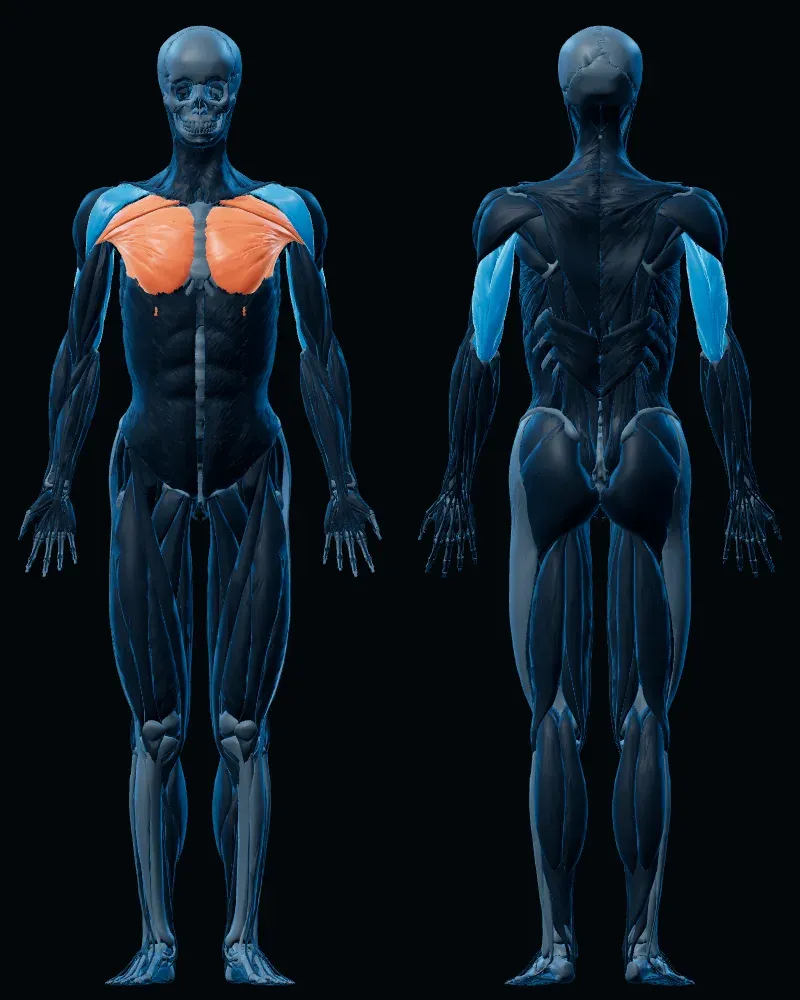
Muscles worked: chest
Main movers: pectoralis major
Assisting: front delts and triceps
Table of contents
The best chest workout routine is not a list of 12 exercises. It is three well-chosen movements, about 8-12 hard sets per week, spread across two sessions, with a clear way to add reps or weight over time.
Most chest advice stops at “do bench, do flyes, do dips.” That is a parts list, not a plan. This article assembles the parts: how many sets, which exercises pair well, how hard to push each set, and how to progress. For the anatomy and exercise-by-exercise detail behind it, start with our complete chest training guide.
What does a science-based chest workout actually need?
Strip away the noise and a hypertrophy chest session has three jobs.
- Load the muscle heavily and stably. A press does this.
- Load it with tension in the stretched position. A fly or pec deck does this.
- Add a little extra volume without wrecking your shoulders. A dip or push-up variation does this.
That is the template. One slot each, in that order.
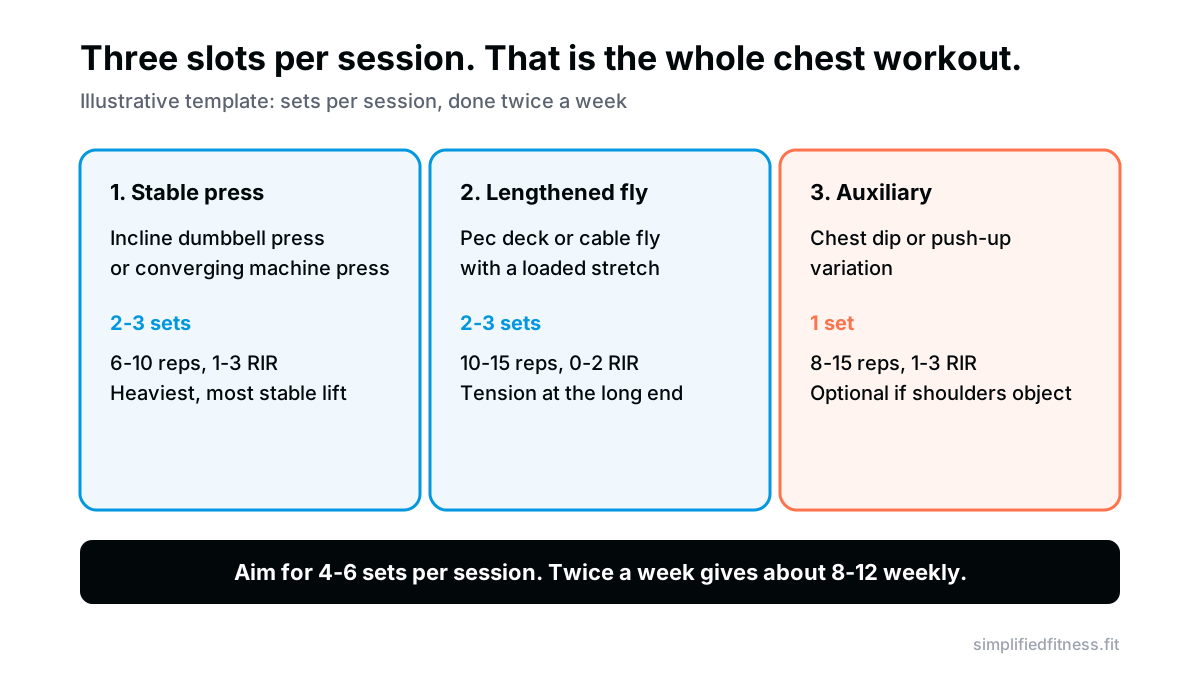
The set counts and rep ranges above are a practical template, not a number any single trial proved. They are built from the volume and frequency research below, plus common coaching sense about fatigue. Treat them as a starting point you adjust.
How many sets per week for chest?
Weekly volume is the lever with the strongest evidence behind it.
A 2017 meta-regression pooled 15 studies (34 treatment groups) and found a graded dose-response relationship: each additional weekly set was associated with a small increase in muscle growth, about 0.37% extra gain per set on average (Schoenfeld et al., 2017). When the authors compared sets in three bands (under 5, 5-9, and 10 or more per muscle), the trend favoured more sets but did not quite reach significance.
A larger 2026 meta-regression of 67 studies and 2,058 participants agreed on direction but added an important nuance. Gains in muscle size increased as volume increased, but the best-fit models showed diminishing returns (Pelland et al., 2026). The authors also separated direct sets from indirect ones (a bench press is a direct set for chest and an indirect one for triceps), which is relevant to how you count.
So what number should you pick? Here is a cautious reading:
- Under about 6 weekly sets: probably enough to make progress if you are new, but you leave growth on the table later.
- About 8-12 weekly sets: a sensible zone for most lifters. It sits in the range where extra sets still help and recovery is manageable.
- Above 12-15: may help some advanced lifters who recover well, but returns shrink, so earn each extra set.
One caution: very low volumes can work too, at least early on. In a 12-week within-person trial of 15 untrained young men, one versus three sets of pec deck produced similar increases in pectoral thickness (about 17-21% across portions) (Pinto et al., 2025). That was untrained people, one exercise, sets taken to failure, so do not read it as proof that more sets are pointless for trained lifters. It does show that beginners do not need an elaborate program.
What counts as a “hard set”?
A set that ends within roughly 1-3 reps of failure, with decent form, on a load you can track. Warm-up sets do not count. Neither do half-hearted sets you stopped because you were bored. If you want help picking your weekly number, try our training volume calculator.
Should I train chest once or twice a week?
The research here is more conflicting than gym talk suggests.
A 2016 meta-analysis of ten studies found higher frequency was associated with a larger effect size (0.49 versus 0.30), and the authors concluded major muscle groups should be trained at least twice a week (Schoenfeld et al., 2016). A 2019 update with 25 studies found something different: no significant difference between higher and lower frequencies on a volume-equated basis, including in resistance-trained people and for the upper body (Schoenfeld et al., 2019). In the 2026 meta-regression, frequency’s effect on hypertrophy was compatible with negligible effects (Pelland et al., 2026).
Why the gap? The 2019 update had more than twice as many studies. In it, higher frequencies only came out ahead in trials where volume was not equated, meaning the group training more often also did more total sets, and even then the difference was modest. Once volume is matched, the frequency benefit mostly fades.
The practical takeaway is mild but useful. Frequency is not magic. It is a way to divide your sets so each session stays high quality. Ten sets of pressing in one day will usually be sloppier than five and five three days apart. For most people, two chest sessions a week is the tidy answer. If your schedule only allows one, keep the sets honest and it can still work.
Which chest exercises should I pair together?
Pair by job, not by name. Here is how the slots work.
| Slot | Job | Good picks | Typical range |
|---|---|---|---|
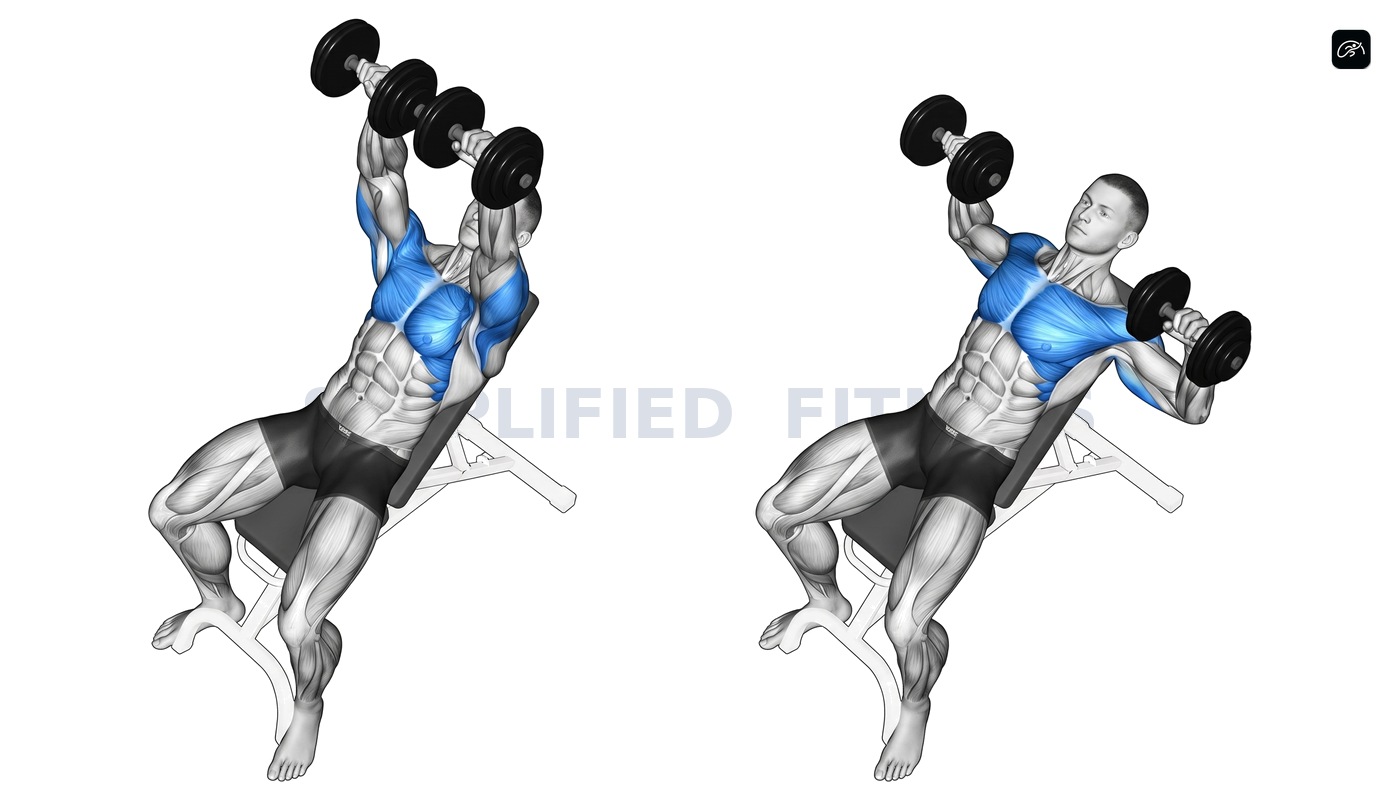
| Stable press | Heavy, progressable tension | Incline dumbbell press, converging machine press | 6-10 reps |
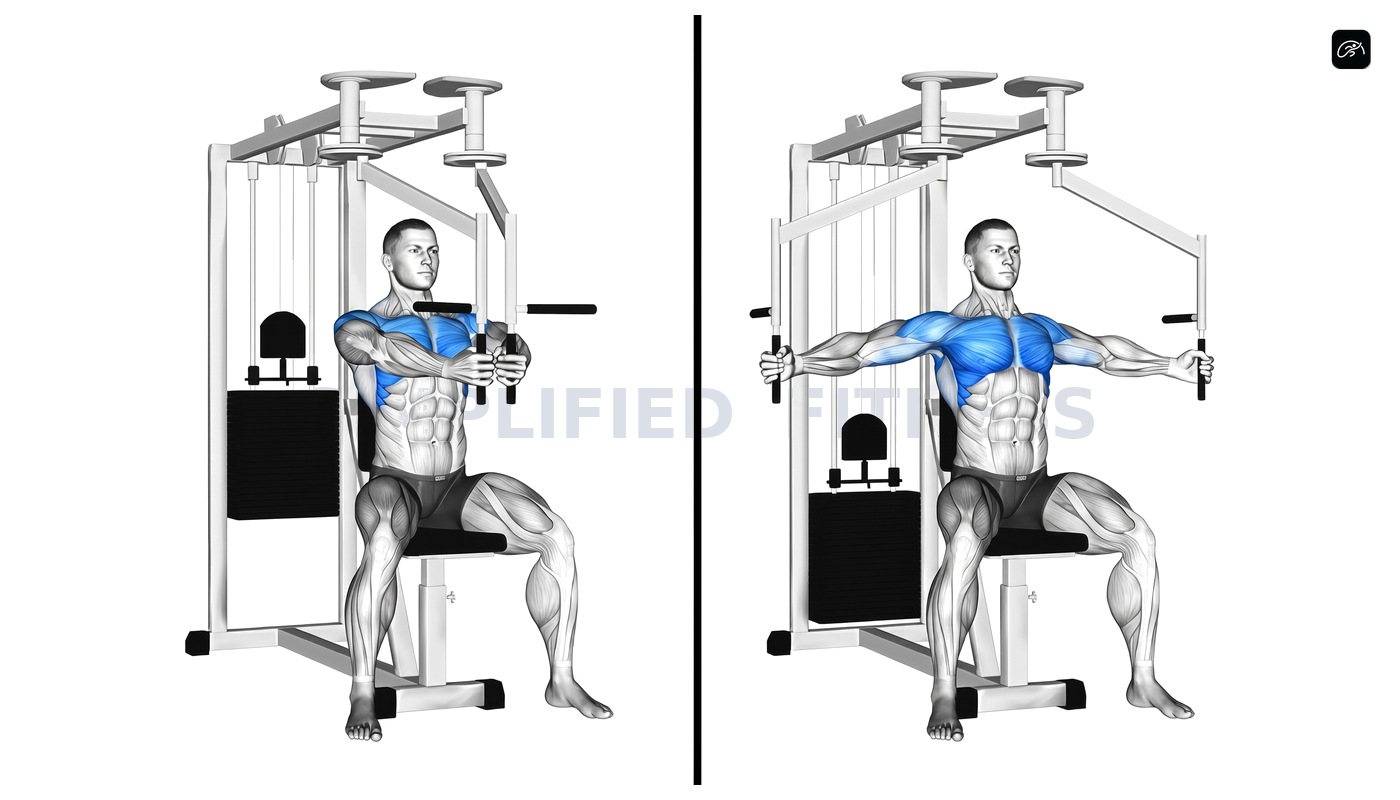
| Lengthened fly | Tension in the stretched position | Pec deck, cable fly | 10-15 reps |
| Auxiliary | Extra volume, different path | Chest dip, push-up variations | 8-15 reps |
Slot 1: the stable press
You want a press where the weight feels controlled and you can add load in small steps. Incline dumbbells give a free arm path, and the converging machine removes the balance demand entirely. Our guides on the incline dumbbell bench press angle and converging chest press machines cover the setup details.
Slot 2: the lengthened fly
The fly fills the gap that pressing leaves: the stretched, shoulder-open position where the chest is under load but your triceps are not the limiter. A pec deck or cable fly does this safely, since the machine holds a stable path. If you are choosing between them, see dumbbell vs cable vs pec deck flyes.
Does the stretched position matter for growth? Evidence is encouraging but not settled for chest specifically. A 2020 systematic review found research on range of motion in the upper limbs is limited and conflicting, and no study to date had examined the trunk musculature (Schoenfeld & Grgic, 2020). A more recent 8-week within-participant trial in 30 resistance-trained people found lengthened partial reps and full range produced similar growth in the elbow flexors and extensors, with the authors suggesting emphasis on the stretched position (Wolf et al., 2025). That was arms, not chest. So the honest summary: training through a controlled, deep range is a reasonable default, and we do not have chest-specific proof that one particular fly beats another.
Slot 3: the auxiliary movement
A dip or push-up variation adds volume from a different angle. Dips are efficient but shoulder-demanding, so read our chest dip forward lean and shoulder safety guide before loading them. If dips bother you, a push-up progression is a good substitute, and it works at home too.
How close to failure should chest sets be?
Closer than comfortable, but not always all the way.
A 2023 meta-analysis of 15 studies found a trivial advantage for training to “set failure” versus non-failure (effect size 0.19), but no advantage for momentary muscular failure versus stopping short (effect size 0.12, with a confidence interval spanning zero) (Refalo et al., 2023). The authors concluded there is no evidence that momentary failure is superior for hypertrophy.
For chest, this lines up with common sense. Failure on a heavy barbell or dumbbell press has a real cost if your spotter is absent or your form breaks. So:
- Heavy press: finish with 1-3 reps in reserve (RIR).
- Pec deck or cable fly: 0-2 RIR is fine, since the machine path is stable.
- Push-ups and dips: 1-3 RIR, stopping when form degrades.
Not sure how to judge RIR? Our RIR and RPE calculator helps you calibrate. If you cannot tell the difference between 1 and 4 reps left yet, be patient. That judgement improves with practice.
How do I progress a chest workout?
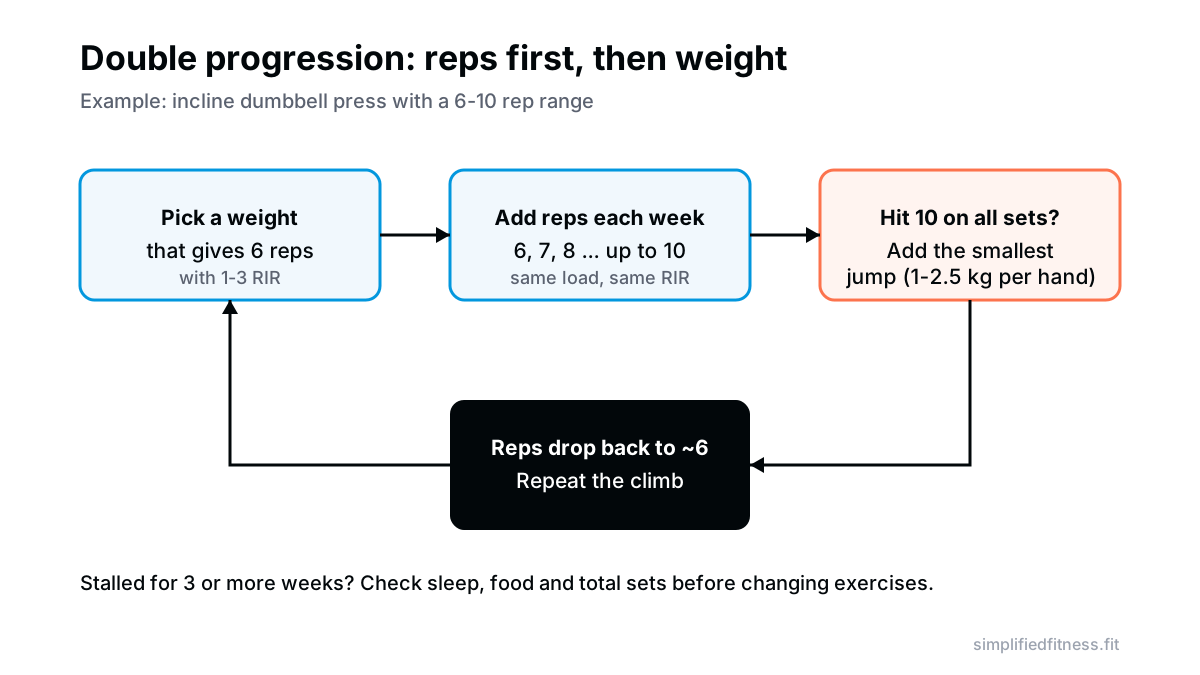
Use double progression. It is simple, trackable, and does not require percentages.
Pick a rep range, say 6-10 on incline dumbbell press. Start at a weight where you get about 6 reps. Next week, aim for 7 at the same weight. Keep adding reps until every set reaches 10. Then add the smallest jump you can (1-2.5 kg per hand) and start again around 6.
Rules that keep this honest:
- Log every set. If it is not written down, you will not know whether you progressed.
- Use the same rest time and the same RIR target week to week.
- Do not count sloppy reps. If your elbows flare or the bench bounce returns, it does not count.
- Stalled three or more weeks? Check sleep, protein and total weekly sets before swapping exercises.
What does a sample push day look like?
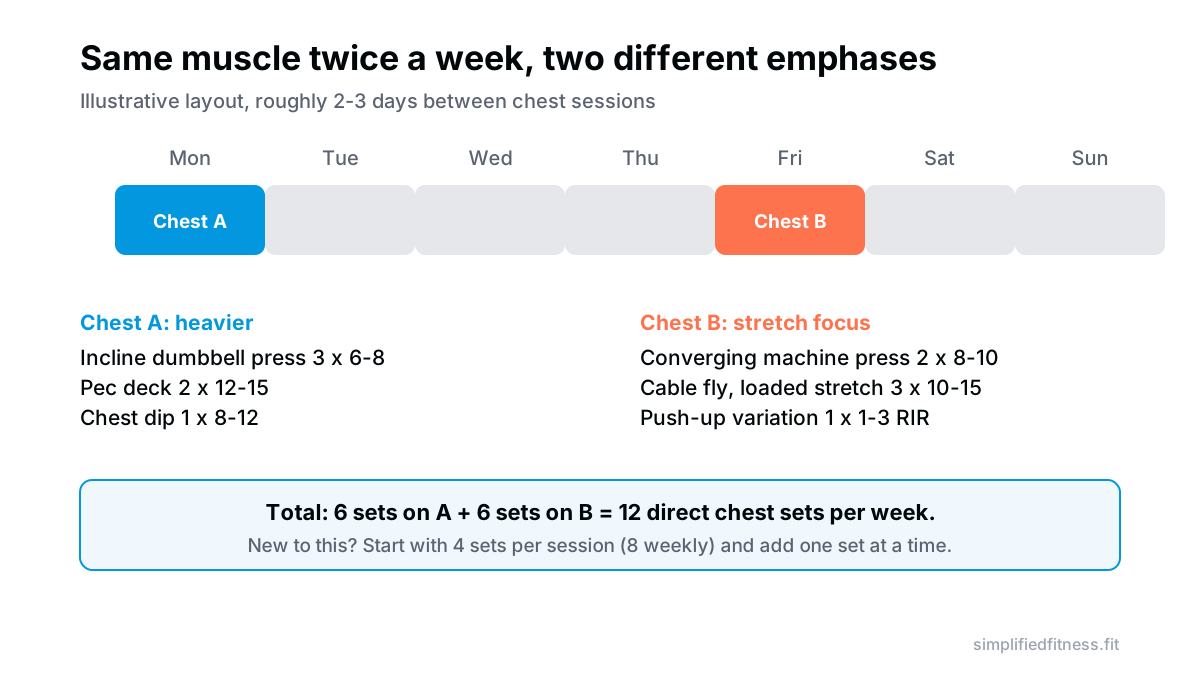
Here is a straightforward version of the two-day layout, assuming chest is part of a push day. For a full ready-made session, see our push day plan.
Chest A (heavier, about 6 sets):
- Incline dumbbell press: 3 x 6-8, 2-3 minutes rest, 1-3 RIR
- Pec deck: 2 x 12-15, 90 seconds rest, 0-2 RIR
- Chest dip or assisted dip: 1 x 8-12, 1-3 RIR
Chest B (stretch emphasis, about 6 sets):
- Converging machine press: 2 x 8-10, 2 minutes rest, 1-3 RIR
- Cable fly with a loaded stretch: 3 x 10-15, 90 seconds rest, 0-2 RIR
- Push-up variation: 1 set, stopping at 1-3 RIR
That adds up to about 12 direct sets. Remember that these sets also give your front delts and triceps indirect work, so shoulders and arms may need less direct volume on push days. If 12 sets feels like too much, start at 4 per session and build up.
What if I train at home or on a budget?
You can build a decent chest with very little. A pair of adjustable dumbbells, a bench or sturdy chair, and a floor give you incline or flat dumbbell press, floor fly variations and push-ups. Use a backpack loaded with books for extra push-up resistance, or elevate your feet.
The structure stays the same: one press-type movement, one fly-type movement, one auxiliary. If you eat mostly vegetarian, protein matters for growth, and dal, paneer, curd, soya and eggs (if you eat them) can all contribute. Our protein calculator can estimate a daily target, and the diet plan page has Indian meal ideas.
When should you worry about pain?
Muscle soreness a day or two after chest training is normal. Sharp pain at the front of the shoulder during pressing, pain that lingers for days, pain that wakes you at night, or tingling and weakness in the arm is not something to push through. Swap to a more shoulder-friendly press, reduce load, and see a doctor or physiotherapist if it persists.
Chest pain at rest, pain with breathlessness or sweating, or pain that spreads to the arm or jaw is different. That needs urgent medical attention, not a training tweak.
The bottom line
Pick one stable press, one lengthened fly and one auxiliary movement. Aim for about 8-12 hard direct sets per week, spread over two sessions. Stop most sets 1-3 reps short of failure, log everything, and use double progression. Then run it for 8-12 weeks before judging it.
If you want a done-for-you version, try our chest and push day plan and adjust sets to match your recovery.
Frequently Asked Questions
What is the best chest workout routine for muscle growth?
A simple routine with one stable press, one fly or pec deck, and one dip or push-up variation, done twice a week, covers the evidence well. Meta-analyses show weekly set volume is the main lever, and frequency matters mostly as a way to spread those sets. Start with about 8-12 hard sets per week and adjust based on recovery and progress.
How many sets per week should I do for chest?
A reasonable starting point is 8-12 hard direct sets per week. Meta-analyses link more weekly sets to more muscle growth, but with diminishing returns, so more is not always better. Add one set at a time only if your performance and recovery are holding up.
How many chest exercises do I need per workout?
Two to three is enough for most people. One press and one fly cover the heavy and the stretched ends of the movement, and a dip or push-up variation is a useful third. Adding more exercises mostly adds fatigue, so spend the effort on harder, better-tracked sets instead.
Is training chest twice a week better than once?
It can be, mainly because it lets you split volume into better-quality sets. A 2016 meta-analysis favored twice weekly over once weekly, while a 2019 meta-analysis found no difference when volume was equated. Pick twice a week if you want to do 8 or more sets, and once is fine if you cannot recover from the extra session.
How close to failure should I train chest?
Most sets can finish with about 1-3 reps in reserve. A 2023 meta-analysis found no evidence that going to momentary failure beats stopping short for hypertrophy. Save failure for the last set of safe machine or cable exercises, not heavy barbell or dumbbell presses.
What is double progression?
Double progression means you work within a rep range, such as 6-10, and add reps each week at the same weight. When every set reaches the top of the range, you increase the load slightly and start from the bottom again. It works well for chest because small load jumps are easy on dumbbells and machines.
Should I do flyes or presses first?
Do the press first in most sessions because it is the heavier, more fatiguing lift and benefits from fresh energy. A fly or pec deck then finishes the chest with less joint stress. If chest lags and you want to prioritise the fly, you can swap the order for a few weeks, though research here is limited.
Do I need a barbell bench press for a big chest?
No. Incline dumbbells, converging machine presses and push-ups can all load the chest well. The best press is the one you can progress consistently and perform without shoulder discomfort.
Are partial reps at the stretched position worth doing?
They can be a useful option. A 2025 within-participant trial in 30 resistance-trained people found lengthened partial reps and full range of motion produced similar arm muscle growth over 8 weeks, though chest was not measured. Treat them as an extra tool, and use full range as your default.
Can I build chest with push-ups and no gym?
Yes, as long as the sets are hard enough. Progress by adding reps, slowing the lowering phase, elevating your feet or using a backpack with books. Stop 1-3 reps short of failure on most sets and track reps like you would track weight.
How long should I rest between chest sets?
Rest about 2-3 minutes after heavy presses and 1.5-2 minutes after flyes or push-ups. Longer rests let you repeat reps on the next set, which keeps your total volume higher. Use the rest to note your reps so progression stays visible.
Why is my chest not growing?
The usual causes are too few hard sets, no tracking of reps or load, and changing exercises every week. The dose-response research suggests more sets help up to a point, so check your weekly count first. Then confirm you are eating enough protein and calories and sleeping consistently before changing the plan.
When should I see a doctor about chest or shoulder pain from training?
See a doctor if pain is sharp, getting worse, wakes you at night, follows a sudden pop, or comes with numbness, weakness or chest tightness at rest or with exertion. Chest pain with breathlessness, sweating or pain spreading to the arm or jaw needs urgent medical attention. For mild, familiar soreness, reduce load or swap to a machine press and monitor.
Sources & References
Every claim above is checked against peer-reviewed research (PubMed, U.S. National Library of Medicine) or guidance from established health bodies. How we fact-check.
- Schoenfeld BJ, et al. Dose-response relationship between weekly resistance training volume and increases in muscle mass: A systematic review and meta-analysis. J Sports Sci. 2017. PMID: 27433992
- Pelland JC, et al. The Resistance Training Dose Response: Meta-Regressions Exploring the Effects of Weekly Volume and Frequency on Muscle Hypertrophy and Strength Gains. Sports Med. 2026. PMID: 41343037
- Schoenfeld BJ, et al. Effects of Resistance Training Frequency on Measures of Muscle Hypertrophy: A Systematic Review and Meta-Analysis. Sports Med. 2016. PMID: 27102172
- Schoenfeld BJ, et al. How many times per week should a muscle be trained to maximize muscle hypertrophy? A systematic review and meta-analysis of studies examining the effects of resistance training frequency. J Sports Sci. 2019. PMID: 30558493
- Refalo MC, et al. Influence of Resistance Training Proximity-to-Failure on Skeletal Muscle Hypertrophy: A Systematic Review with Meta-analysis. Sports Med. 2023. PMID: 36334240
- Schoenfeld BJ, et al. Effects of range of motion on muscle development during resistance training interventions: A systematic review. SAGE Open Med. 2020. PMID: 32030125
- Wolf M, et al. Lengthened partial repetitions elicit similar muscular adaptations as full range of motion repetitions during resistance training in trained individuals. PeerJ. 2025. PMID: 39959841
- Pinto MD, et al. Pectoralis Clavicular and Sternocostal Thicknesses Increase Similarly in Response to One and Three Sets of Pec Deck Resistance Training in Untrained Young Men. J Strength Cond Res. 2025. PMID: 40266636

Umair Hazrami · Founder & Head Coach, Simplified Fitness
Umair Hazrami founded Simplified Fitness and the Simplified Lifter channel to cut through fitness noise. With 4+ years of consistent training and 10+ coaching clients, he writes every guide from the peer-reviewed research and links the sources so you can check them. Our editorial standards.
Educational content only, not medical advice. If you have a medical condition, are pregnant, or take medication, talk to a qualified doctor before changing your diet, supplements or training. Full disclaimer.
Keep reading
Exercise Technique
Arching on the Bench Press: Powerlifting Spine Arch vs Bodybuilding Setup
Is a bench press arch cheating or dangerous for your back? Learn the difference between a powerlifting arch and a natural upper back setup, with study data.
8 min read
Exercise Technique
Bench Press Grip Width: Pec Activation, Triceps and Shoulder Clearance
Bench press grip width changes triceps load, shoulder stress and little else for your pecs. See what EMG and joint-load studies show and how to pick your grip.
7 min read
Exercise Technique
Cable Crossover Angles: High-to-Low vs Low-to-High vs Horizontal Fly
Cable crossover angles explained: what high-to-low, low-to-high and horizontal flys likely train, what the research really says, and how to set each one up.
9 min read
Exercise Technique
Chest Dips: Forward Lean Angle, Scapular Position, and Shoulder Safety
Chest dips can build your chest if you lean, set your shoulders and stop at a depth that suits you. See what the research says and how to dip safely.
8 min read