Plate-Loaded vs Pin-Loaded Chest Machines: Which Actually Builds More Muscle?
Plate loaded vs pin loaded chest press: does Hammer Strength build more chest than a stack machine? Lever physics, friction and research, explained simply.
TL;DR. The short answer
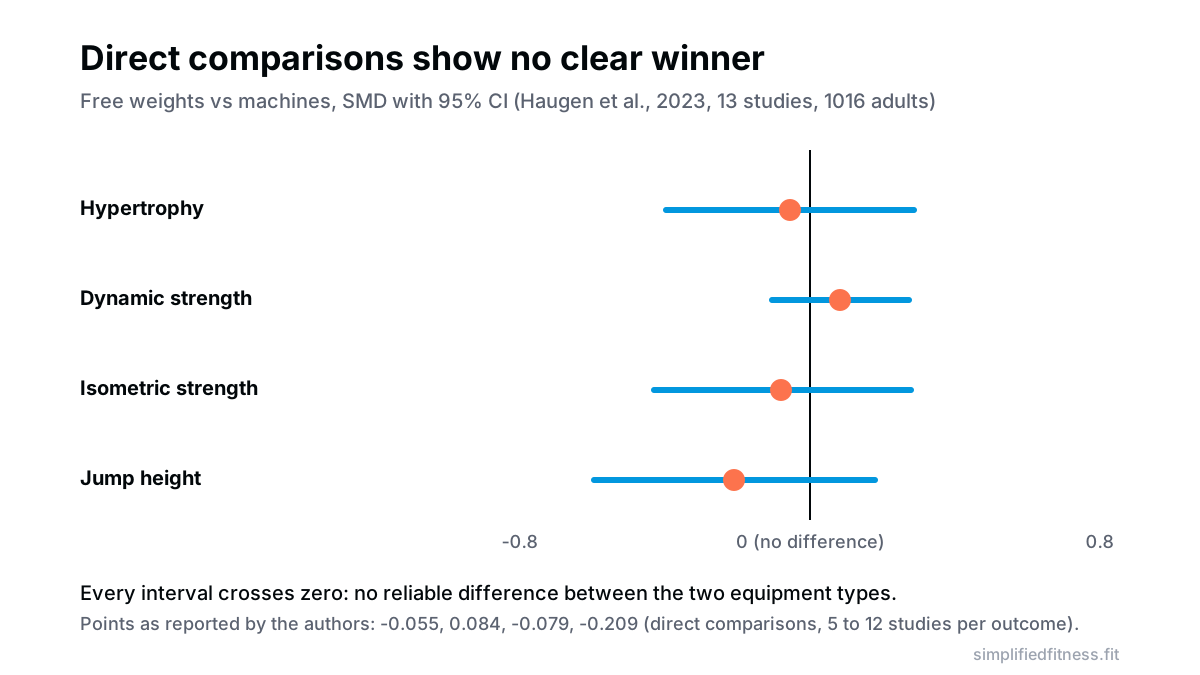
- No study has shown that plate-loaded chest presses build more muscle than pin-loaded ones. A meta-analysis of free weights versus machines (13 studies, 1016 adults, 5 of them measuring muscle size) found no difference in hypertrophy.
- The real differences are practical: how fine you can jump the load, where friction sits, and how the handle path and resistance curve suit your body.
- Friction is a hardware engineering concern. No trial has measured how much it changes chest growth, so treat claims about it as reasoning, not proof.
- Pick the machine that feels smooth, lets you add small increments, and that you will log every week. Then train close to failure.
- Shoulder pain on a chest machine is a reason to adjust the seat or switch machines, and to see a doctor or physio if it persists.
Part of our complete guide: The Complete Chest Workout Guide: Pec Anatomy, Bench Angles, Flys and Shoulder-Safe Pressing
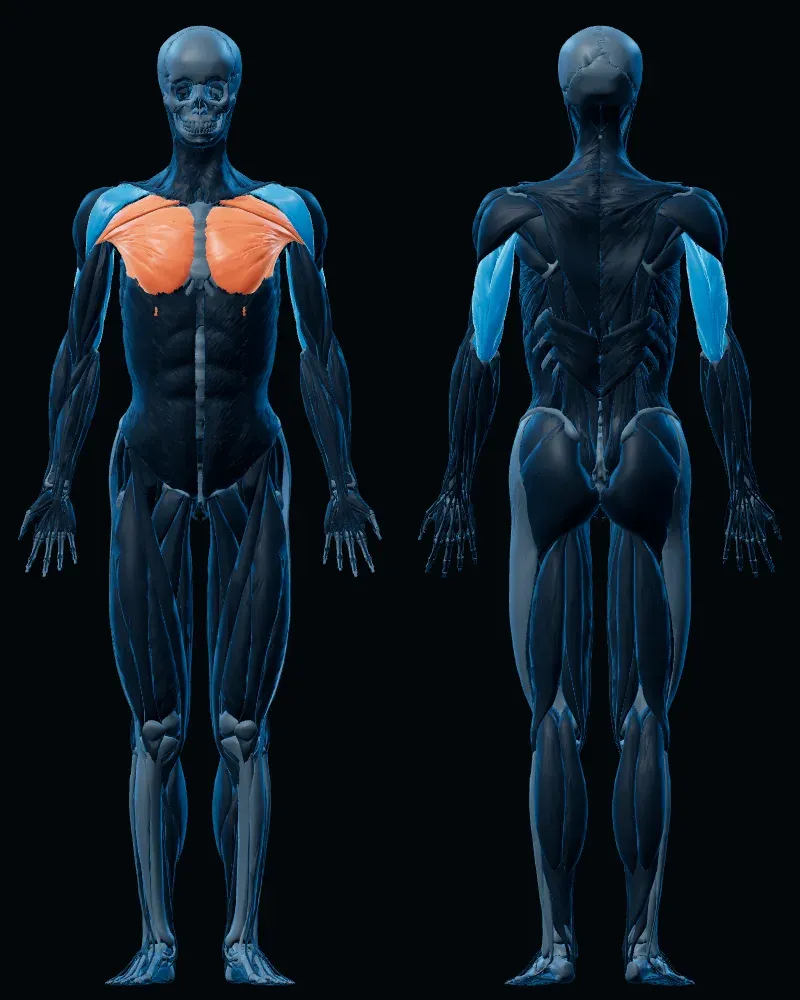
Muscles worked: chest
Main movers: pectoralis major
Assisting: front delts and triceps
Table of contents
If you are asking about plate loaded vs pin loaded chest press machines, the short answer is that neither has been shown to build more muscle. The differences are in the hardware: how the load is delivered, how finely you can change it, and where friction creeps in.
That makes the choice a practical one. This article covers the lever physics, the friction question, and when each type earns a spot in your session. (It sits inside our complete chest training guide, so start there if you want the bigger picture.)
How do plate-loaded and pin-loaded chest machines actually work?
A plate-loaded machine (Hammer Strength is the best-known example) is a lever. You push a handle attached to an arm that pivots, and weight plates sit on a horn at the other end. The load you feel depends on the plate weight and on the lever geometry: how far the plates sit from the pivot compared with how far your hands sit from it.
A pin-loaded (selectorized) machine routes a cable over pulleys to a stack of plates. You choose the load by moving a pin. Some chest presses use a cam, a shaped pulley, to change how heavy the load feels through the rep. Our deeper explainer on selectorized machine cam profiles covers that part.
So in plain terms:
- Plate-loaded: lever and plates, usually a handle path built into the arm.
- Pin-loaded: stack, cable and pulleys, with the curve set by a cam or pulley ratio.
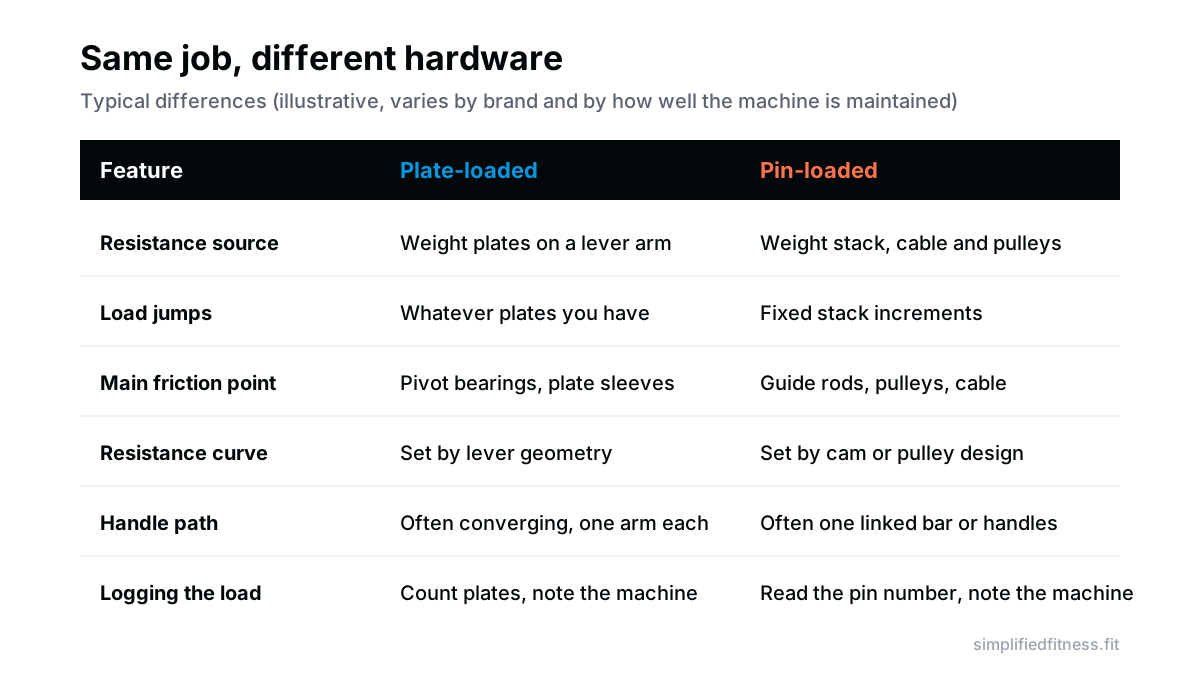
Plate loaded vs pin loaded chest press: what does the research say?
Here is the uncomfortable truth: nobody has run a clean trial of plate-loaded versus pin-loaded chest presses. What we have is the broader free-weight versus machine literature, and it points the same direction.
A 2023 systematic review and meta-analysis pooled 13 studies and 1016 adults (aged 18-60, training for at least 6 weeks), though only 5 of those studies measured hypertrophy. In direct comparisons there were no differences in dynamic strength, isometric strength, jump performance or hypertrophy (Haugen et al., 2023). One nuance: strength rose a little more on the tested equipment. Free-weight training favoured free-weight tests, and machine training tended to favour machine tests. The authors concluded that the choice comes down to individual preference and goals.
Smaller trials agree, with caveats:
- In 46 young adults (average age 22, 26 of them women), 8 weeks of free weights or machines raised biceps and quadriceps thickness equally. Machine bench press strength rose more in the machine group (13.9% vs 8.6%) (Schwanbeck et al., 2020).
- In 38 resistance-trained men, 8 weeks of barbell versus machine squat, bench press, bench pull and shoulder press increased pectoralis major cross-sectional area similarly, with no significant difference between groups (Hernandez-Belmonte et al., 2023). This is the closest thing we have to a chest-specific answer, though it compared machines with barbells, not two machine types.
- In a similar 8-week trial of 34 resistance-trained men from the same lab, the two approaches produced no meaningful differences in muscle architecture or athletic performance (Hernandez-Belmonte et al., 2023).
- In 8 untrained women, one leg trained with lunges and the other with a leg press for 9 weeks showed comparable quadriceps growth on ultrasound (Amanuma et al., 2025).
Two limits worth stating. None of these compared plate-loaded with pin-loaded presses specifically, and the Amanuma study is tiny and lower-body. So the sensible reading is: equipment type alone is unlikely to be the lever that decides your chest growth, though we cannot rule out small differences.
Does lever physics change the resistance curve?
Yes, in principle. On a plate-loaded press, as the arm rotates the plates move along an arc, and the effective resistance at your hands changes with lever angle. Designers shape that arc so the hardest point lands where most people are strongest, or where the chest is under the most stretch.
Pin-loaded machines use a cam or pulley ratio to do a similar job. Some give a flatter feel; some load the stretched position more. Both are engineering choices, and they vary a lot between brands.
Does that matter for growth? Honestly, we do not have direct trial evidence for chest presses. The closest relevant research is on range of motion. A 2020 review found that full range of motion benefits lower-body hypertrophy, while the upper-limb evidence was limited and conflicting, so strong conclusions are not possible (Schoenfeld and Grgic, 2020).
My practical take: the best curve is the one that lets you use a full, controlled range without your shoulders complaining. If you want the geometry side of this, see our guide to converging chest press machines.
Machine friction: does it hurt hypertrophy?
This is the angle gym forums love, so let’s be careful.
Where friction sits:
- Plate-loaded: the pivot bearings and the sleeves where plates sit.
- Pin-loaded: guide rods, pulleys and the cable itself.
Friction means the number on the plates or stack is not the exact load your chest feels. It matters more when machines are old, dry or rusty. And because friction opposes motion in both directions, it can make the lowering phase feel lighter than the lifting phase.
Is that a problem? Probably not a big one, because trials of concentric-only training still show muscle growth. A 2017 meta-analysis of 15 trials found a larger average effect for eccentric actions than concentric, but it did not reach statistical significance (10.0% vs 6.8% mean muscle growth, p = 0.076), and the authors still recommend including both (Schoenfeld et al., 2017). A newer 2025 meta-analysis of 26 studies (682 participants) found no statistically significant difference, with very low certainty, though some subgroups, including upper-limb muscles, favoured eccentric actions (da Silva et al., 2025).
So the studies disagree slightly on whether eccentrics have an edge, probably because the trials differ in design and measurement. The cautious takeaway is to control the lowering phase on any machine instead of letting the handles slam back.
Importantly, no study has measured how friction on a chest press changes hypertrophy. That part is reasoning, not data.
Progressive overload: where the real difference shows up
Here is where hardware genuinely changes your training. To grow, you need to progress over time, and how easily you can add load differs.
- Plate-loaded: you can often add small plates if your gym stocks them, giving finer jumps. Some gyms only have big plates, which makes it chunky.
- Pin-loaded: jumps follow the stack. If the step between pins is large relative to your strength, you can get stuck. Rep progression helps, and some stacks accept add-on weights.
The fix is the same either way. Work in a rep range, add a rep when you can, and move up when you hit the top of the range. Our piece on progressive overload with machines vs free weights covers the logging side in more detail, and the plate calculator helps when you are loading odd combinations.
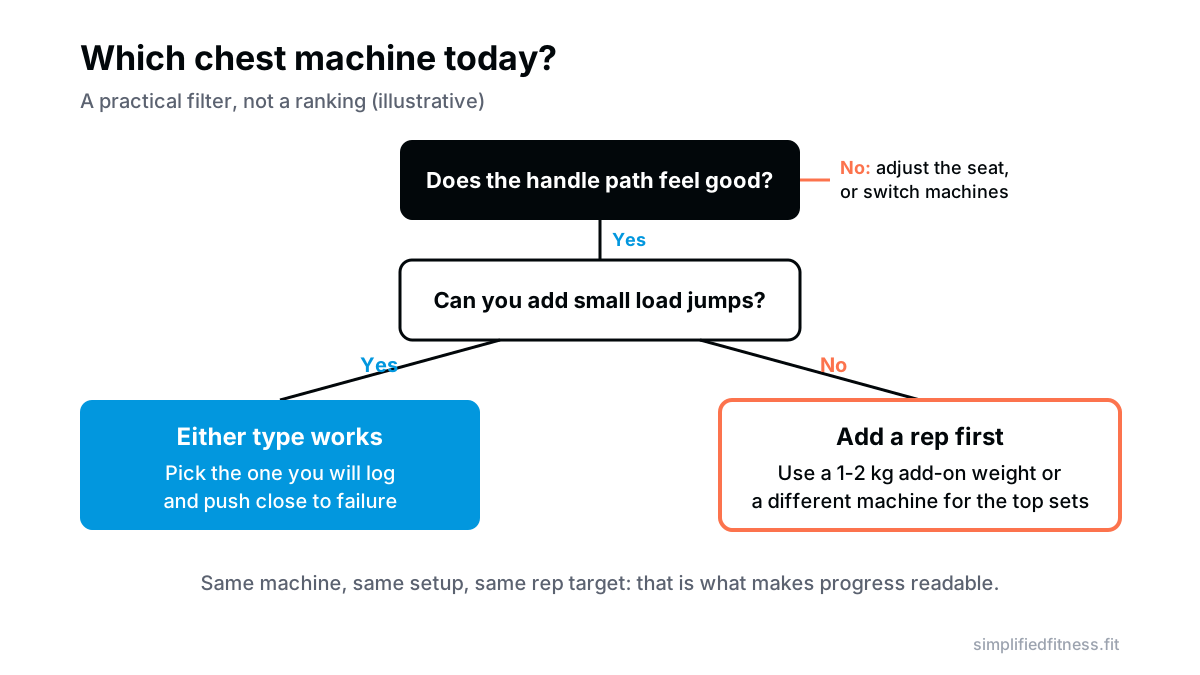
How hard should you push on either machine?
Machines make it easy to get close to failure safely, which is a real advantage of both types. A 2023 meta-analysis of 15 studies found a trivial hypertrophy advantage for training to set failure versus non-failure (effect size 0.19), and no advantage for momentary muscular failure specifically. The authors concluded that there is no evidence that going to momentary failure is superior to stopping short (Refalo et al., 2023).
In gym terms: finish sets hard, with a rep or two left, and stop before form breaks down. The most common mistake here is stopping five reps short because the machine “feels easy.”
Which should you use, and when?
There is no universal winner, so here is how I would frame it.
| Situation | Leaning toward | Why |
|---|---|---|
| You need small load jumps | Plate-loaded (if micro plates exist) | Finer increments |
| Quick set-up, busy gym, drop sets | Pin-loaded | Move the pin in seconds |
| One side is weaker | Any machine with independent arms (common on plate-loaded) | Each arm works on its own |
| Machine feels smooth and fits you | Whichever it is | Fit beats type |
| Shoulders pinch | Adjust seat, then switch | Comfort drives consistency |
If you also like cables, see our free weights vs cables vs machines comparison, and for how to judge whether a movement is worth the effort, our article on stimulus-to-fatigue ratio.
Shoulder comfort and when to see a doctor
Machines guide the path, but they do not guarantee a joint-friendly one. If a chest machine pinches the front of your shoulder, try a lower or higher seat setting so the handles sit near mid-chest at the bottom, and shorten the range a little.
Sharp pain, numbness or tingling in the arm, pain that lingers after training, or pain at night is not something to push through. See a doctor or physiotherapist, and do not train through it. This article is general information and cannot diagnose a cause.
Indian gym reality check
Many gyms here have a mix of branded and local machines, and condition varies. Sticky guide rods and loose cables are common in crowded commercial gyms, and humidity and heat can speed up rust. If you cannot get a smooth machine, a dumbbell press or pec deck set up properly is a fine alternative. Whatever you use, eat enough protein across the day (dal, paneer, curd, eggs, soya or chicken as your diet allows), because equipment choice matters far less than consistent training and recovery. You can pair a machine-based session with our push day plan.
The bottom line
Plate-loaded and pin-loaded chest presses are tools, not tiers. The evidence we have says equipment type does not decide hypertrophy, so choose for smoothness, fit, and the ability to add load in small steps. Keep the same machine, log it, and train hard. If you want to check your strength numbers across lifts, our 1RM calculator is a good companion.
Frequently Asked Questions
Do plate-loaded machines build more muscle than pin-loaded machines?
There is no evidence that they do. A 2023 meta-analysis of free weights versus machines found no difference in hypertrophy, and no trial has isolated plate-loaded versus pin-loaded designs. Choose by feel, smoothness and how precisely you can add load.
Is Hammer Strength better than a cable chest press?
Not in any way research has shown. Hammer Strength style machines are plate-loaded levers, while cable chest presses use pulleys, so their resistance curves and friction differ. Both can work, so pick the one where your chest feels the effort and your shoulders stay comfortable.
How much does friction matter on a chest press machine?
Probably less than gym forums suggest, but nobody has measured it for chest hypertrophy. Friction means the weight you read on the stack or plates is not exactly the load your muscles feel, especially on the lowering phase. The practical move is to compare the same machine week to week rather than across brands.
Why does the same weight feel different on different chest machines?
Each machine has its own lever lengths, cam shape, pulley ratio and friction, so the plate or pin number is not a true load. A stack marked 60 kg can feel lighter or heavier than 60 kg on another brand. Record the machine name beside the number in your log.
Can I progressively overload on a pin-loaded machine with big weight jumps?
Yes, but you may need to progress through reps first. Add reps within your target range until you can move up a pin, then drop back to the lower end of the range. Many stacks also accept a small add-on weight if your gym provides one.
Are plate-loaded machines safer than pin-loaded machines?
Neither type is clearly safer, and I am not aware of good injury data comparing them. Both guide the path, which removes balance demands but cannot fix a seat that is set badly for you. Set the handles near mid-chest height and stop if you feel sharp shoulder pain.
Do chest machines work as well as the barbell bench press?
For muscle size, the available research says roughly yes. A 2023 meta-analysis found similar hypertrophy for free weights and machines, though strength gains were more specific to the equipment you trained. If you want a heavier bench, keep some bench practice.
Is a Smith machine the same as a plate-loaded chest machine?
No. A Smith machine is a barbell on fixed vertical rails, while a plate-loaded chest press is a lever with its own pivot and handle path. Both take plates, but their movement paths and feel are different.
Should beginners start on plate-loaded or pin-loaded chest machines?
Either is fine. Pin-loaded machines are quick to adjust and easy to learn, while plate-loaded ones need plate handling. Start with whichever gets you comfortable and consistent, and learn proper seat setup first.
How do I know if a chest machine fits my body?
It fits if the handles sit around mid-chest at the bottom, your shoulders feel comfortable, and you feel the chest working more than your front delts or wrists. If your shoulders pinch or the stretch feels forced, adjust the seat height. If that does not help, use a different machine.
Is a worn-out or rusty stack machine bad for training?
It can make the movement jerky and the load less consistent. Sticky guide rods or a stretched cable add friction that changes through the rep. If a machine catches or squeaks, use another one and tell the gym staff.
How should I log progress on chest machines?
Write down the machine, the setting (seat height), the weight or pin, and reps. Use the same machine each week when you can. If you change gyms or machines, expect a reset and rebuild from reps rather than chasing the old number.
Sources & References
Every claim above is checked against peer-reviewed research (PubMed, U.S. National Library of Medicine) or guidance from established health bodies. How we fact-check.
- Haugen ME, et al. Effect of free-weight vs. machine-based strength training on maximal strength, hypertrophy and jump performance - a systematic review and meta-analysis. BMC Sports Sci Med Rehabil. 2023. PMID: 37582807
- Amanuma MT, et al. Comparable regional hypertrophy of the knee extensor muscles in response to resistance training with machines versus free weights: a randomized within-subject approach. J Bodyw Mov Ther. 2025. PMID: 41316621
- Schwanbeck SR, et al. Effects of training with free weights versus machines on muscle mass, strength, free testosterone, and free cortisol levels. J Strength Cond Res. 2020. PMID: 32358310
- Hernandez-Belmonte A, et al. Adaptations in athletic performance and muscle architecture are not meaningfully conditioned by training free-weight versus machine-based exercises: challenging a traditional assumption using the velocity-based method. Scand J Med Sci Sports. 2023. PMID: 37340878
- Schoenfeld BJ, et al. Hypertrophic effects of concentric vs. eccentric muscle actions: a systematic review and meta-analysis. J Strength Cond Res. 2017. PMID: 28486337
- da Silva LSL, et al. Comparison between eccentric vs. concentric muscle actions on hypertrophy: a systematic review and meta-analysis. J Strength Cond Res. 2025. PMID: 39652733
- Refalo MC, et al. Influence of resistance training proximity-to-failure on skeletal muscle hypertrophy: a systematic review with meta-analysis. Sports Med. 2023. PMID: 36334240
- Schoenfeld BJ, Grgic J. Effects of range of motion on muscle development during resistance training interventions: a systematic review. SAGE Open Med. 2020. PMID: 32030125
- Hernandez-Belmonte A, et al. Free-weight and machine-based training are equally effective on strength and hypertrophy: challenging a traditional myth. Med Sci Sports Exerc. 2023. PMID: 37535335

Umair Hazrami · Founder & Head Coach, Simplified Fitness
Umair Hazrami founded Simplified Fitness and the Simplified Lifter channel to cut through fitness noise. With 4+ years of consistent training and 10+ coaching clients, he writes every guide from the peer-reviewed research and links the sources so you can check them. Our editorial standards.
Educational content only, not medical advice. If you have a medical condition, are pregnant, or take medication, talk to a qualified doctor before changing your diet, supplements or training. Full disclaimer.
Keep reading
Exercise Technique
Arching on the Bench Press: Powerlifting Spine Arch vs Bodybuilding Setup
Is a bench press arch cheating or dangerous for your back? Learn the difference between a powerlifting arch and a natural upper back setup, with study data.
8 min read
Exercise Technique
Bench Press Grip Width: Pec Activation, Triceps and Shoulder Clearance
Bench press grip width changes triceps load, shoulder stress and little else for your pecs. See what EMG and joint-load studies show and how to pick your grip.
7 min read
Exercise Technique
Cable Crossover Angles: High-to-Low vs Low-to-High vs Horizontal Fly
Cable crossover angles explained: what high-to-low, low-to-high and horizontal flys likely train, what the research really says, and how to set each one up.
9 min read
Exercise Technique
Chest Dips: Forward Lean Angle, Scapular Position, and Shoulder Safety
Chest dips can build your chest if you lean, set your shoulders and stop at a depth that suits you. See what the research says and how to dip safely.
8 min read