Push Ups for Chest Hypertrophy: Deficits, Weighted Vests and Elevation
Can push ups build a big chest? See what research says about load-matched push-ups, deficits, weighted vests and bands, plus a simple progression plan.
TL;DR. The short answer
- Push-ups can build chest muscle. In an 8-week trial of 18 young men, push-ups matched to 40% of bench press 1RM grew the pecs by the same amount as the bench press (17.0 to 20.8 mm thickness in both groups).
- Growth depends on load and effort, not on the exercise name. Once bodyweight push-ups feel easy, you need to make them harder with a backpack, vest, band, deficit or elevated feet.
- Weighted vests, deficits and ring push-ups have little or no direct hypertrophy trials. They are reasonable ways to add difficulty, but their extra benefit over simple load progression is unproven.
- Unstable surfaces like rings or straps reduce pec and front delt activity while raising triceps, rear delt, trap and abdominal demand, so they are a poor choice as your main chest builder.
- Sharp shoulder, elbow or wrist pain during any variation is a reason to regress it and, if it persists, see a doctor or physio.
Part of our complete guide: The Complete Chest Workout Guide: Pec Anatomy, Bench Angles, Flys and Shoulder-Safe Pressing
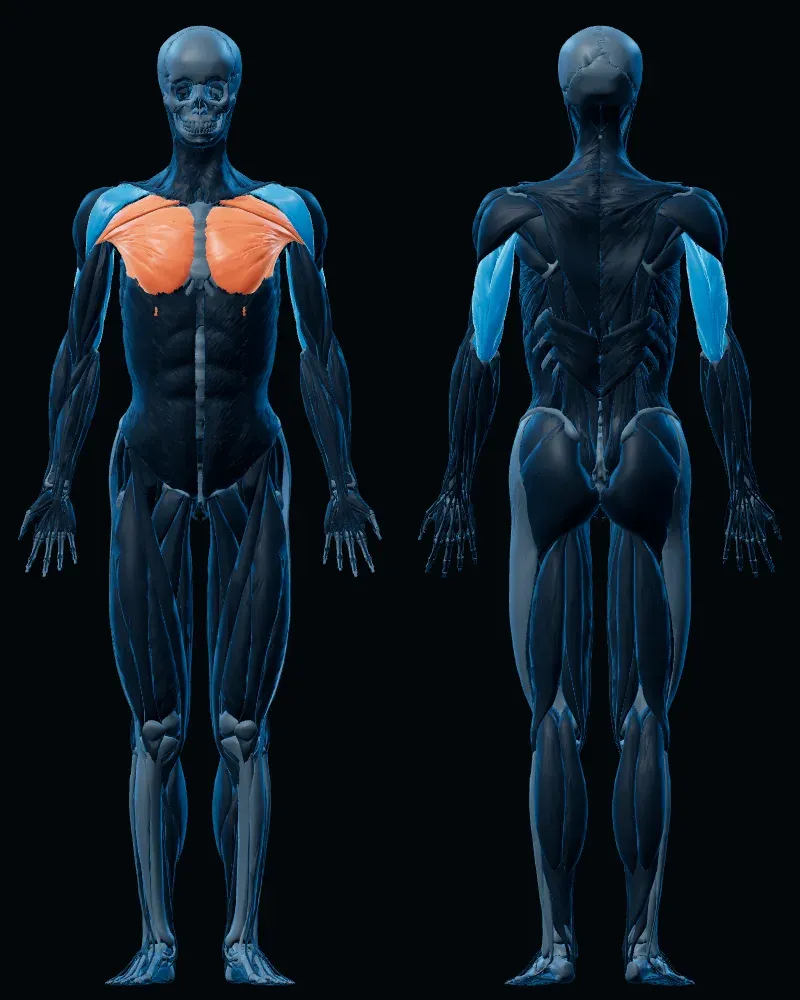
Muscles worked: chest
Main movers: pectoralis major
Assisting: front delts and triceps
Table of contents
Push-ups for chest hypertrophy work, with one big condition: the sets have to be hard. In an 8-week trial, push-ups matched to the same load as a light bench press grew the pecs by the same amount (Kikuchi and Nakazato, 2017). So the push-up is not the problem. Bodyweight that stops being challenging is.
This guide covers how to keep push-ups challenging: elevation, deficits, weighted backpacks and vests, bands, and rings, with honest notes on where the evidence runs out. It sits inside our complete guide to chest training, and it pairs well with the home gym resistance training blueprint if you are building a routine without a bench.
Can push-ups build a big chest?
They can build real chest muscle, and the best evidence is a small but clean trial. Eighteen young men were randomly assigned to bench press at 40% of their 1RM or to push-ups, with hand and knee position adjusted so the load matched the bench group. Both trained twice a week for 8 weeks. Pec major thickness rose from 17.0 mm to 20.8 mm in both groups, and 1RM bench press went up in both (Kikuchi and Nakazato, 2017).
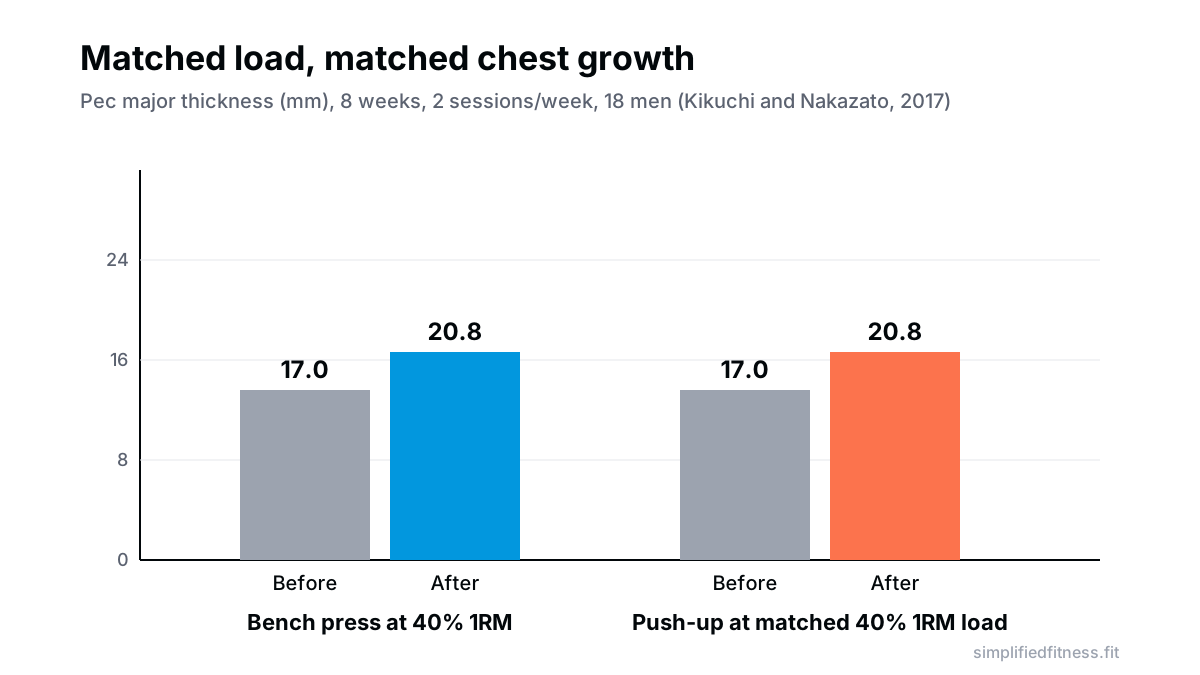
Now the limits. It was 18 people, young men, over 8 weeks, and the load was low (40% 1RM). It does not prove push-ups beat or equal heavy benching for a decade of growth. It does show the exercise itself is not the bottleneck.
Strength results line up. In experienced lifters, a 6RM bench press and a 6RM elastic-band push-up produced similar 1RM and 6RM gains over 5 weeks, and muscle activity was not significantly different between the two (Calatayud et al., 2015). Surface EMG in 12 men also found few differences between push-ups and bench press for the main muscle groups, other than more core activity in the push-up (Gottschall et al., 2018).
Why do push-ups stop working? The load problem
Here is the reality. In a standard push-up you lift a fixed share of your bodyweight, and that does not change as you get stronger. Once you can bang out 40 reps, each set takes so long to get near failure that most people stop well short of it.
The research on loading helps here. A review of the “repetition continuum” argues that muscle growth can occur across a wide range of loads, not just 8-12 reps (Schoenfeld et al., 2021). In well-trained men, 25-35 rep sets and 8-12 rep sets both increased muscle thickness of the elbow flexors, elbow extensors and quads over 8 weeks when taken to failure (the chest was not measured), while heavier training was better for strength (Schoenfeld et al., 2015).
That is good news for anyone training with a bodyweight. Light loads can work. But note the phrase “to failure”. Those trials had people train very hard. Twenty easy push-ups while scrolling your phone is not that.
A common mistake here is staying at 25 reps with the same form for months and wondering why nothing changes. Progress means either more reps with better control, or a harder variation. Our guide to progressive overload beyond adding iron and the five modalities of progressive overload explain why reps, tempo and range are all legitimate levers.
How do I progress push-ups for muscle growth?
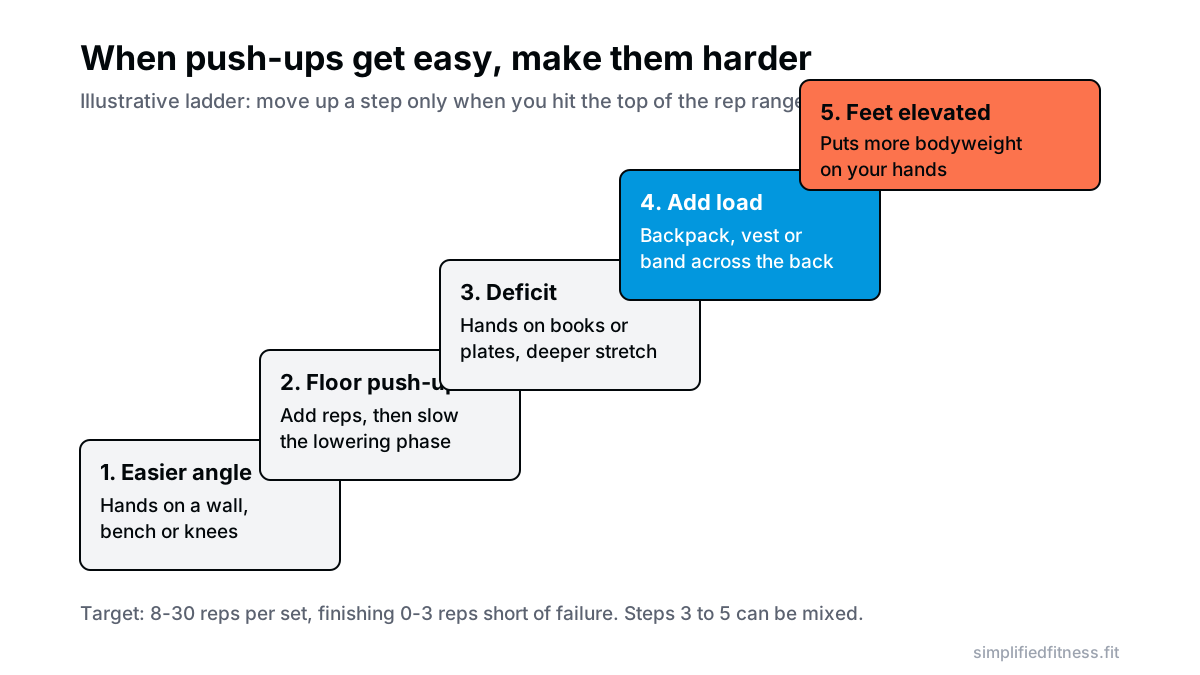
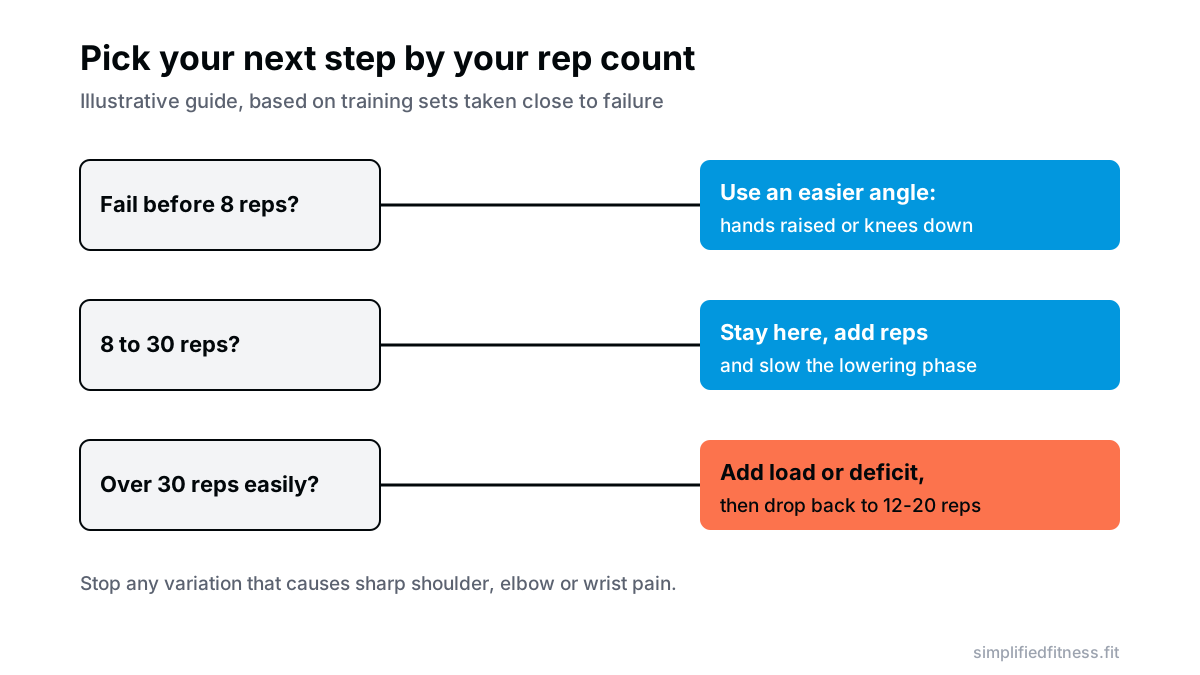
Think of it as a ladder. Move up when you reach the top of your rep range with clean form and are near failure.
Step 1: Fix the angle
If you fail before 8 reps, make the push-up easier, not harder. Put your hands on a bench or the edge of a table, or go to your knees. In the Gottschall study, toe versus knee push-ups did not differ much in the share of work done by the primary muscles, and the authors suggest knee push-ups as a novice option (Gottschall et al., 2018).
Step 2: Add reps and slow the lowering
Between 8 and 30 clean reps, stay on the floor. Take 2-3 seconds to lower, touch your chest lightly, press up. That is more time under tension without any equipment.
Step 3: Try a deficit
A deficit push-up has your hands on two stacks of books, plates or parallettes so your chest can sink below your hands. The idea is a deeper stretch at the bottom, where the pec is lengthened.
Does it grow more chest? Nobody has tested that directly. A systematic review of range-of-motion studies found good evidence for full range in the lower body, but said upper-limb research was limited and conflicting (Schoenfeld and Grgic, 2020). So a deficit is a reasonable tool, especially if your normal push-up stops at your hands, but I would not sell it as a magic stretch trick.
Step 4: Add load
A backpack with books or water bottles, a weighted vest, or a weight plate on your upper back all work. The Kikuchi trial was built on the idea of matching load, not on any special equipment, and the same principle applies in reverse: when bodyweight is too light, increase the load until the set is hard again.
In India, a backpack filled with rice or dal packets (1 kg each) is a cheap way to add 5-10 kg without buying a vest. Pack it tight so it does not slide, and have a partner or a mirror check your form.
I could not find a hypertrophy trial that tested weighted vests against plain push-ups. So the claim here is about logic, not a measured result: if you cannot reach failure within about 30 reps, extra load brings you back to a challenging range.
Step 5: Use a band across the back
Loop a resistance band around your upper back and hold the ends under your palms. In young fit men, elastic-resisted push-ups produced similar muscle activity in the prime movers to the bench press at high loads, with more core demand (Calatayud et al., 2014). The band gets heavier near lockout, which is where a regular push-up is easiest.
Step 6: Elevate the feet
Putting your feet on a chair or bench shifts more bodyweight onto your hands and tilts the line of push upward. It is a handy way to make the push-up harder without any gear. There is no trial I know of that shows it changes which part of the pec grows, so treat the “upper chest” claim as a plausible idea, not a result. For upper chest work with real evidence, read our upper chest training guide.
Are ring push-ups good for chest growth?
Rings and straps feel brutal, which tricks people into thinking they are better. The data suggests otherwise for the chest. In 29 young men, the pec major, anterior deltoid and serratus were highly active in more stable conditions, while abdominal muscles, triceps, rear delts and upper traps were more active on unstable setups (Calatayud et al., 2014).
You may see claims that rings improve “convergent adduction” for the inner chest. I found no hypertrophy trial supporting that. What rings clearly do is demand shoulder control and core stiffness. Use them for variety, and keep the heavy chest sets on a stable surface.
Push-up variations compared
| Variation | What it changes | Evidence for chest growth | Best use |
|---|---|---|---|
| Matched-load push-up (hands raised or knees) | Lowers the load to a workable level | Direct trial: same pec growth as bench at 40% 1RM | Beginners, high reps |
| Floor push-up, slow lowering | More time under tension | Indirect (loading research) | 8-30 rep sets |
| Deficit push-up | Deeper range at the bottom | None direct; upper-limb range-of-motion data mixed | Lifters whose range is cut short |
| Backpack or weighted vest | Adds external load | None direct; logical extension of load principle | When reps exceed about 30 |
| Band across the back | Resistance rises toward lockout | EMG similar to heavy bench; 5-week strength gains similar | Travel, home, stronger lifters |
| Feet elevated | Shifts more bodyweight forward | None direct | Harder push-up with no gear |
| Rings or straps | Instability, core demand | EMG shows lower pec, higher stabilizer activity | Shoulder control, variety |
What should a push-up chest session look like?
A simple template, using your free push day plan as the base if you have equipment:
- 3-4 sets of your main push-up variation, ending 1-3 reps before failure.
- Rest 90-120 seconds between sets so reps do not collapse.
- 2-3 sessions a week, with at least a day between hard ones.
- Add one rep per set each week. When you reach the top of your range, move up the ladder.
Not sure how close to failure you are? Use our RIR and RPE calculator to calibrate your sense of effort. If your goal is a fuller routine, our complete chest workout architecture shows how pressing, flyes and volume fit together.
What push-ups cannot do well
Honest limits help you plan. Push-ups are a pressing movement, so they do not train the stretched, arm-across-body fly pattern. And small loading steps are harder than on a barbell. If you have access to a gym, the flat barbell bench press and machines are easier to load precisely. If one side of your chest lags, the unilateral pressing fixes for chest asymmetry may help.
Also note the research is limited. Most of the trials above used young men, small groups and short periods. Results for women, older adults and long-term training are less clear.
When to see a doctor
Muscle soreness is normal. Sharp shoulder pain, wrist pain that does not settle in a day or two, numbness or tingling in the hand, or chest pain with exertion are not. Stop the exercise and speak to a doctor or physiotherapist. We cannot diagnose anything from an article, and no push-up variation is worth training through pain.
Frequently Asked Questions
Can push-ups build a big chest?
Yes, push-ups can build meaningful chest muscle if the sets are hard enough. In one 8-week trial, push-ups matched to a 40% 1RM bench press load increased pec thickness by the same amount as the bench press. The catch is progression, so once you can do 30 clean reps, add load or a harder variation.
How many push-ups should I do to grow my chest?
Aim for sets that end within a few reps of failure, usually somewhere in the 8-30 rep range. Research on loading shows muscle can grow across a wide range of loads when sets are taken close to failure. Start with 3-4 sets and add reps or load every week or two.
Are push-ups as good as the bench press for chest growth?
At matched loads, the small trials we have suggest yes. An 8-week hypertrophy trial and a 5-week strength trial found similar results between push-ups and bench press when load and effort were comparable. The bench press is simply easier to load in small steps, so a lifter with a gym still benefits from it.
How do I make push-ups harder without weights?
Raise your feet, slow the lowering phase to 3 seconds, add a pause at the bottom, or switch to one-arm assisted variations. Each change raises the share of bodyweight or time under tension you handle. Change one variable at a time so you can tell what worked.
Do weighted push-ups build more muscle than regular push-ups?
Not necessarily. We have no direct trial of weighted vests versus plain push-ups for hypertrophy, but load matters only when bodyweight stops being challenging. If you cannot reach failure within about 30 reps, a backpack or vest is a sensible next step.
What is a deficit push-up and does it grow the chest more?
A deficit push-up has your hands on raised surfaces so your chest can drop below hand level. It lengthens the range of motion at the shoulder, but no trial has tested it for pec growth. A review of range-of-motion research found upper-body results were limited and conflicting, so treat deficits as an option, not a requirement.
Are ring push-ups good for chest?
Rings and straps are better for shoulder control and core work than for pec size. Electromyography in 29 young men found the pec major and anterior serratus were most active in stable conditions, while triceps, rear delts, traps and abs rose in unstable ones. Use rings occasionally, but do your heavy chest sets on the floor.
Do resistance bands across the back work for push-ups?
Yes. Elastic-band push-ups produced similar muscle activity in the prime movers to a high-load bench press, and a 5-week trial in experienced lifters found similar strength gains. A band adds the most resistance near lockout, where a plain push-up is easiest.
How close to failure should push-ups be?
For hypertrophy, finish most sets with roughly 0-3 reps left in the tank. The low-load trials in trained men had participants train to failure, so effort is part of the recipe. Use our RIR and RPE calculator to check how hard your sets really are.
Are knee push-ups useless?
No. In the Kikuchi trial, the push-up group trained in positions such as kneeling to match the load, and the pecs still grew. Surface EMG in 12 active men also found no significant difference in the percent contribution of the primary muscles between toes and knee push-ups. Use the knee version while you build up, and move to full push-ups when you can do 8-10 clean reps.
Are push-ups enough for a full chest workout?
They can cover the horizontal pressing part of chest training. Push-ups alone leave out the stretched fly pattern and make upper chest bias harder to control. If you have no equipment, pair them with raised-feet variations and a cheap resistance band for flyes.
How often should I train push-ups for chest growth?
Two to three sessions a week works for most people. The main hypertrophy trial used two sessions a week for 8 weeks, and the pecs grew. Leave at least a day between hard sessions if your shoulders feel sore.
Will push-ups hurt my shoulders or wrists?
They can if volume jumps too fast or your elbows flare to 90 degrees. Keep elbows at roughly 45 degrees from your torso and build volume gradually. Sharp pain, numbness or pain that lingers beyond a day or two means you should regress the move and see a doctor or physiotherapist.
Sources & References
Every claim above is checked against peer-reviewed research (PubMed, U.S. National Library of Medicine) or guidance from established health bodies. How we fact-check.
- Kikuchi N, et al. Low-load bench press and push-up induce similar muscle hypertrophy and strength gain. J Exerc Sci Fit. 2017. PMID: 29541130
- Calatayud J, et al. Bench press and push-up at comparable levels of muscle activity results in similar strength gains. J Strength Cond Res. 2015. PMID: 24983847
- Calatayud J, et al. Muscle activity levels in upper-body push exercises with different loads and stability conditions. Phys Sportsmed. 2014. PMID: 25419894
- Gottschall JS, et al. Muscle activity patterns do not differ between push-up and bench press exercises. J Appl Biomech. 2018. PMID: 29809073
- Schoenfeld BJ, et al. Effects of range of motion on muscle development during resistance training interventions: a systematic review. SAGE Open Med. 2020. PMID: 32030125
- Schoenfeld BJ, et al. Loading recommendations for muscle strength, hypertrophy, and local endurance: a re-examination of the repetition continuum. Sports (Basel). 2021. PMID: 33671664
- Schoenfeld BJ, et al. Effects of low- vs. high-load resistance training on muscle strength and hypertrophy in well-trained men. J Strength Cond Res. 2015. PMID: 25853914

Umair Hazrami · Founder & Head Coach, Simplified Fitness
Umair Hazrami founded Simplified Fitness and the Simplified Lifter channel to cut through fitness noise. With 4+ years of consistent training and 10+ coaching clients, he writes every guide from the peer-reviewed research and links the sources so you can check them. Our editorial standards.
Educational content only, not medical advice. If you have a medical condition, are pregnant, or take medication, talk to a qualified doctor before changing your diet, supplements or training. Full disclaimer.
Keep reading

Exercise Technique
Arching on the Bench Press: Powerlifting Spine Arch vs Bodybuilding Setup
Is a bench press arch cheating or dangerous for your back? Learn the difference between a powerlifting arch and a natural upper back setup, with study data.
8 min read

Exercise Technique
Bench Press Grip Width: Pec Activation, Triceps and Shoulder Clearance
Bench press grip width changes triceps load, shoulder stress and little else for your pecs. See what EMG and joint-load studies show and how to pick your grip.
7 min read
Exercise Technique
Cable Crossover Angles: High-to-Low vs Low-to-High vs Horizontal Fly
Cable crossover angles explained: what high-to-low, low-to-high and horizontal flys likely train, what the research really says, and how to set each one up.
9 min read
Exercise Technique
Chest Dips: Forward Lean Angle, Scapular Position, and Shoulder Safety
Chest dips can build your chest if you lean, set your shoulders and stop at a depth that suits you. See what the research says and how to dip safely.
8 min read