Exercise Selection Biomechanics: Moment Arms, Strength Curves and Free Weights vs Machines
Exercise selection biomechanics made simple: how moment arms, strength curves and stability decide which lifts grow muscle, and why gym wars miss the point.
TL;DR. The short answer
- Good exercise selection comes down to three checks: the target muscle is what ends the set, the exercise is hard where that muscle is stretched, and you can add load or reps over time without pain.
- Torque is force times moment arm. The same dumbbell gets heavier or lighter through a rep because its horizontal distance from the working joint changes.
- A 2023 meta-analysis of 13 studies found no significant difference in muscle growth between free-weight and machine training. Strength gains were specific to the equipment people trained with.
- Adding instability (wobble boards, Swiss balls) lowers the force you can produce, so it is a poor primary tool for building muscle.
- Some planned variation can help regional growth, but constantly rotating exercises or stacking near-identical ones gives you little extra.
Table of contents
The best exercise for a muscle is the one where that muscle, not your grip, balance or lower back, is what ends the set, where the load is hardest roughly where the muscle is stretched, and where you can keep adding reps or weight without pain. That is exercise selection biomechanics in one sentence. Whether the tool is a barbell, a cable or a machine matters far less than gym arguments suggest: a 2023 meta-analysis found no significant difference in muscle growth between free weights and machines (Haugen et al., 2023).
The rest of this guide explains why. No equations beyond one multiplication. Just enough physics to look at any exercise in any gym and judge whether it is worth your sets.
This is the hub for everything technical on the site. The muscle-by-muscle guides (for example the complete chest training guide and complete back training guide) apply these rules to specific body parts. If you are new to how growth works in the first place, start with the complete guide to muscle hypertrophy for natural lifters.
What does exercise selection biomechanics actually mean?
Muscles do not know what equipment you are using. They only feel tension: how much, for how long, and at what length.
Biomechanics is the study of how forces act on the body. For lifting, it boils down to four questions:
- Which joint is the load trying to rotate? That decides which muscles have to resist it.
- How hard is it at each point of the rep? That is the resistance profile.
- How strong are you at each point? That is your strength curve.
- What gives out first? The target muscle, or something else like grip, balance or your spinal erectors?
Get those right and the exercise is a good one, whatever it looks like. Get them wrong and you can do a “perfect” textbook lift that barely challenges the muscle you came to train.
Moment arms: why the same weight feels heavier in some positions
Here is the only formula you need:
Torque = force x moment arm
Torque is rotational force around a joint. The moment arm is the perpendicular distance between the joint and the line the force acts along. For a dumbbell, the force acts straight down (gravity), so the moment arm is simply the horizontal distance from your joint to the weight.
Take a standing dumbbell curl. With your arm hanging straight, the dumbbell sits almost directly under your elbow. Horizontal distance: tiny. Torque: tiny. That is why the first few degrees feel effortless. When your forearm reaches horizontal, the dumbbell is as far from the elbow as it will ever be, and the torque peaks. Keep curling and the dumbbell moves back toward the line of your elbow, so the top feels easy again.
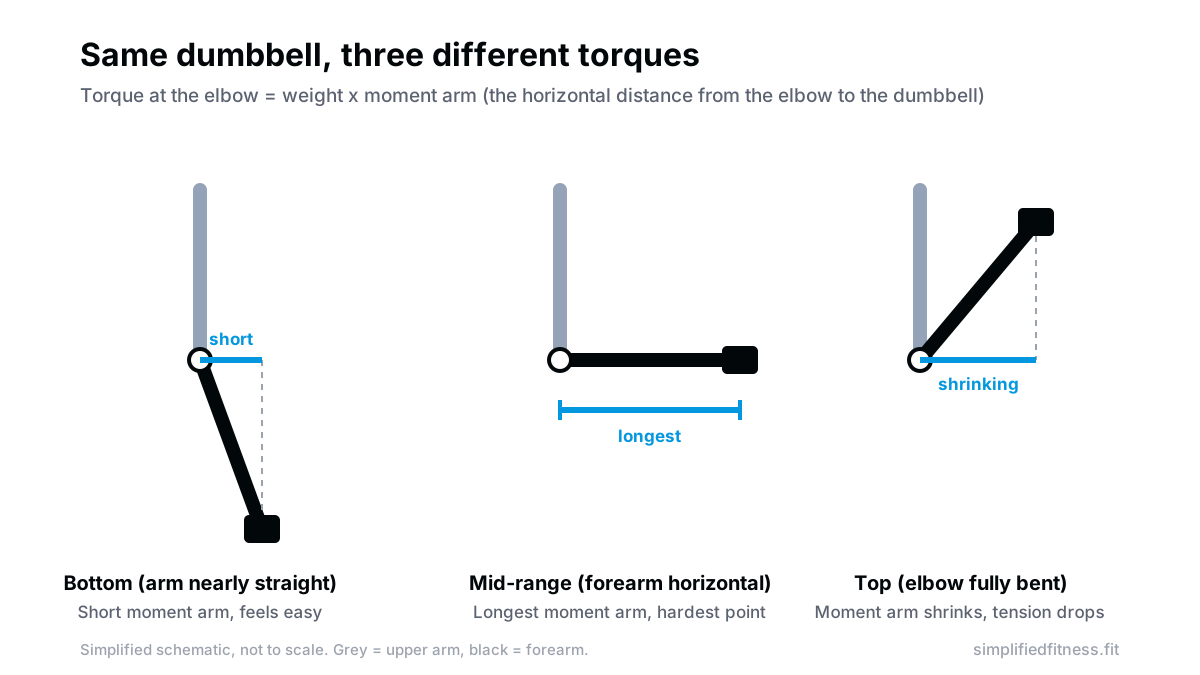
That is the external moment arm, created by the load. Your muscles have internal moment arms too: the distance from the joint to the tendon’s line of pull. Internal moment arms also change through a joint’s range, and they differ between people because of bone structure and tendon attachment points. You cannot train them, but they partly explain why two lifters feel the same exercise so differently.
Two practical consequences fall straight out of this:
- Moving the load changes which joint works hardest. In a squat, sitting back increases the horizontal distance from the bar to your hips and shifts work toward the hip extensors. Staying more upright moves the knees forward and shifts it toward the quads.
- “Heavier” is not always “harder” for the target muscle. A longer moment arm with a lighter weight can create more torque than a heavy weight held close to the joint.
The full physics, with squat, bench and row examples, lives in moment arms, lever arms and joint torque explained simply.
Resistance profiles vs strength curves: where is each exercise hardest?
Every exercise has a resistance profile: the pattern of difficulty across the rep. Every muscle and joint has a strength curve: the pattern of how much force you can produce across that same range. These are not the same thing, and the gap between them explains a lot of what you feel in the gym.
Strength curves come in three broad shapes:
- Ascending: you get stronger as the rep progresses. Squats, leg presses and most presses work like this, which is why lockout is easier than the hole.
- Descending: you are strongest early and weaker near the end. Many pulling movements behave this way.
- Bell-shaped: strongest in the middle. The elbow flexors in a curl are the classic example.
Resistance profiles depend on the equipment and your body position. A dumbbell lateral raise is close to zero torque at the bottom (arm hanging) and maximal when your arm is horizontal: an ascending profile. A standing curl peaks mid-range. A preacher curl on a 45 degree pad shifts the peak much earlier, toward the stretched part of the rep.
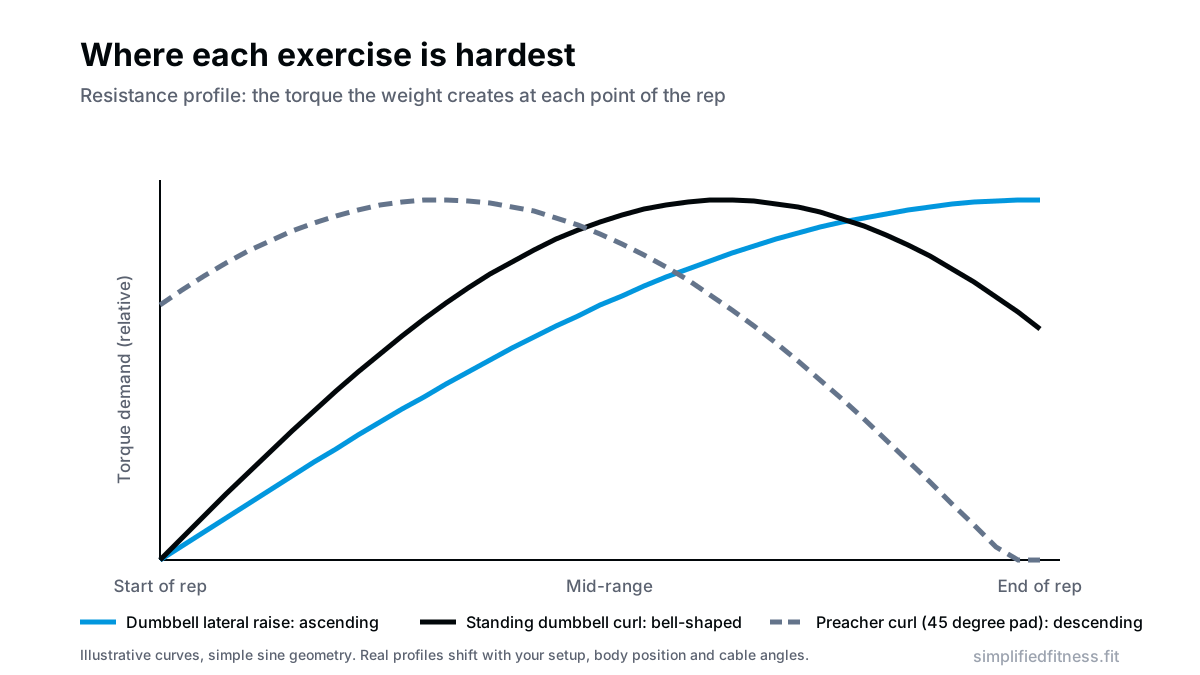
When the resistance profile and your strength curve are badly mismatched, you get a sticking point: a spot where difficulty jumps and where you usually fail. Researchers who reviewed the topic describe the sticking point as the position where difficulty rises disproportionately, the place reps typically fail, and a spot linked with form breaking down (Kompf & Arandjelović, 2016). On a bench press, that is often a few centimetres off the chest, not at lockout.
Equipment makers try to close that gap. Cam-based machines vary the moment arm through the rep, and cables let you set the line of pull. We break those down in matching resistance profiles to human strength curves, how selectorized machine cam profiles shape loading and cable setup mastery: pulley heights and angles.
Does matching the strength curve actually build more muscle?
This is where the physics gets ahead of the evidence.
For strength, adding bands or chains to make a lift harder near lockout (variable resistance) has not beaten normal training. A 2022 meta-analysis of 17 studies and 491 healthy adults found variable resistance and traditional resistance training equally effective for maximal strength and power (Andersen et al., 2022).
For hypertrophy, the clearer signal is not about perfectly matching a curve. It is about where the muscle gets loaded hardest. Several MRI studies now suggest that challenging a muscle at longer lengths tends to grow it more:
- Seated leg curls (hip bent, hamstrings stretched) increased whole hamstring volume by about 14%, versus about 9% for lying leg curls, over 12 weeks in 20 healthy adults (Maeo et al., 2021).
- Overhead cable triceps extensions grew the whole triceps by 19.9% versus 13.9% with the arm at the side, in 21 adults over 12 weeks, despite lifting 34-39% less weight overhead (Maeo et al., 2023).
Two honest caveats. These studies used small samples, trained one limb against the other, and did not focus on long-term trained lifters. And not every comparison shows big differences. The deeper dive, including partial reps and where the evidence is still thin, is in our pillar on range of motion and stretch-mediated hypertrophy.
Free weights vs cables vs machines: what does the research say?
This is the most argued topic in exercise selection biomechanics, and the data are calmer than the comment sections.
The best summary we have is a 2023 meta-analysis that pooled 13 studies and 1,016 adults aged 18-60, each comparing free-weight and machine training for at least six weeks (Haugen et al., 2023). When they compared the two directly, there was no significant difference for dynamic strength, isometric strength, jump height or muscle hypertrophy.
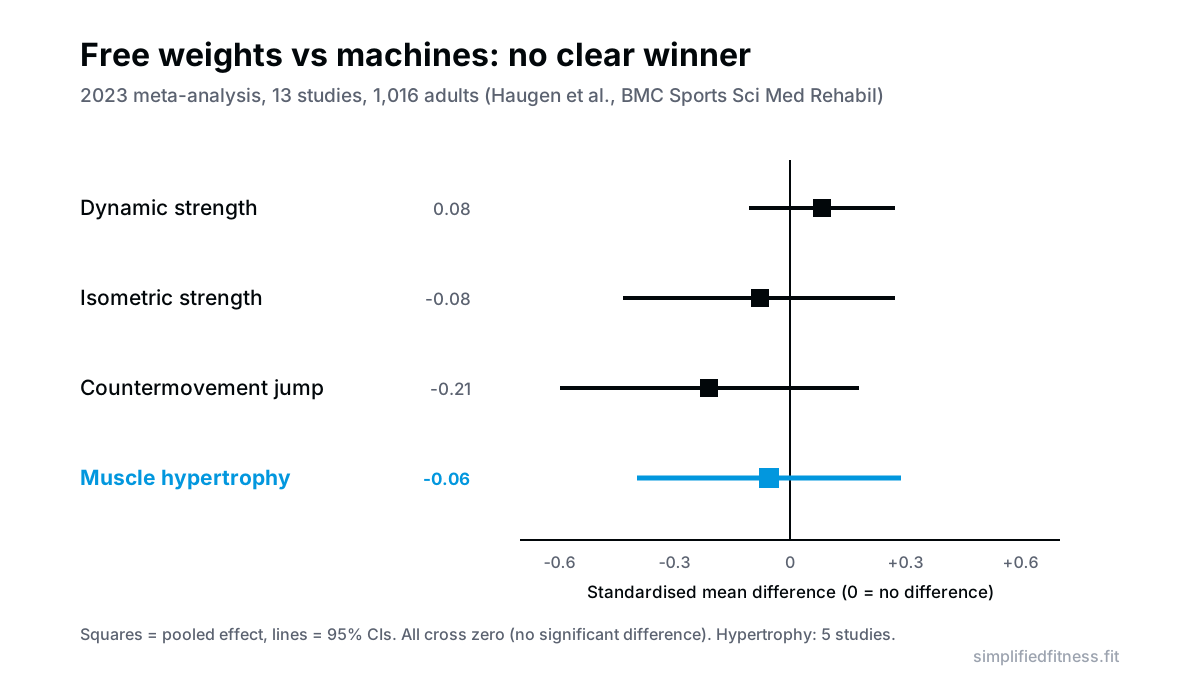
There is one important nuance. Strength was specific to the tool: people improved more on free-weight strength tests when they trained with free weights, and machine-tested strength tended to rise more with machine training. The authors concluded the choice comes down to individual preferences and goals.
A single trial shows the same pattern. In an 8-week study, 46 young adults (26 women) trained with either free weights or machines, 2-3 times per muscle per week. Biceps and quadriceps muscle thickness increased similarly in both groups. The machine group improved machine bench press more (13.9% vs 8.6%), while free-weight bench, squat and Smith squat strength rose similarly in both (Schwanbeck et al., 2020). Free-weight sessions caused a bigger acute rise in free testosterone in men, but that did not translate into more muscle.
Two limitations to keep in mind: only five of the meta-analysis studies actually measured hypertrophy, and few studies used highly trained lifters. So “no meaningful difference” is the best current read, not a closed case.
| Tool | Biggest strength | Biggest weakness | Best use |
|---|---|---|---|
| Barbell | Heavy loading, easy to progress in small jumps | Fixed hand position, balance and lower back can limit sets | Main compound lifts, strength goals |
| Dumbbells | Free path for wrists and shoulders, each side works alone | Gravity only pulls down, so some ranges go slack | Presses, rows, curls, home training |
| Cables | Tension in any direction you set the pulley | Stack increments can be big; setup takes thought | Lateral raises, flys, triceps, curls |
| Plate-loaded or selectorized machines | Stable, repeatable, often good profiles | Fit depends on your body size; fixed path | Training close to failure safely, isolation |
| Smith machine | Removes balance, lets you push hard | Bar path may not suit everyone’s build | Squats, presses, split squats |
The detailed comparisons sit in free weights vs cables vs machines for hypertrophy, Smith machine vs free barbell, dumbbell vs barbell pressing for pec growth and progressive overload on machines vs free weights.
Stability: does more wobble mean more growth?
Free weights demand more balance, and balance recruits more muscles. That part is true. A small 2009 study of six people found average muscle activity across seven muscles was 43% higher in the free-weight squat than the Smith machine squat (Schwanbeck et al., 2009).
But muscle activity during one set is not the same as muscle growth over months. Surface EMG records electrical signal, which is influenced by many factors, and it cannot tell you whether a muscle will grow more. When the same research group later ran an 8-week training study, free weights and machines produced similar muscle thickness gains (the 2020 trial above).
Instability devices take the idea too far. The Canadian Society for Exercise Physiology position stand notes that adding unstable bases to resistance exercises can decrease force, power, velocity and range of motion, and does not recommend them as the primary mode for athletic conditioning (Behm et al., 2010). It also notes that ground-based free-weight lifts like squats and deadlifts can produce similar or higher core activation.
For hypertrophy, the logic is simple. If a muscle is going to grow from tension, you want it producing as much force as possible. Anything that makes balance the limiting factor caps that force.
Stability also has a cost for the rest of your body. A biomechanics study of seven healthy men compared three rows. The standing bent-over row produced the largest lumbar spine load, while the inverted row produced the highest lat activation with the lowest spine load (Fenwick et al., 2009). If your lower back is still tired from deadlifts, a chest-supported row lets your back muscles work without that extra spinal demand.
More on this in external stability in exercise design and axial loading vs non-axial exercises.
Compound vs isolation exercises: do you need both?
Compound (multi-joint) lifts train several muscles at once. Isolation (single-joint) lifts focus on one. The research is more nuanced than either camp claims.
A Sports Medicine review of 23 studies found no clear difference in prime-mover EMG activation between single-joint and multi-joint exercises for the limbs. In the upper limbs, long-term studies reported no difference in muscle size or strength between the two, and no extra effect when single-joint exercises were added to a multi-joint programme (Gentil et al., 2017). The lumbar extensors were the exception, where single-joint work seemed to help.
The trial most often cited for trained lifters had 20 men with at least two years of training experience. Over 8 weeks, adding curls and triceps work to presses and rows did not add significant arm strength or size (de França et al., 2015). Arm size was measured with circumference rather than imaging, which is a fairly blunt tool for small changes.
Now the other side. Schoenfeld and colleagues argue that compound lifts do not load every muscle equally. During leg presses and squats, for example, hamstring activation is markedly lower than quadriceps activation (Schoenfeld et al., 2019). They note longitudinal evidence is limited mostly to the elbow flexors and somewhat conflicting, and suggest counting sets 1:1 for now while using common sense.
Why might these differ? The no-difference studies mostly looked at arms, where presses and rows already load the triceps and biceps reasonably well. For muscles that compounds barely touch, like the hamstrings in a squat or the side delts in a bench press, the logic for isolation work is stronger.
Practical takeaway: build around compounds for efficiency, then add isolation where a muscle is clearly under-loaded. Full breakdown: compound vs isolation exercises for hypertrophy.
Small tweaks that change everything: grip, stance, angle and line of pull
Once you choose a movement, small setup changes alter the moment arms and muscle lengths again.
- Shoulder position on curls. A 2026 MRI study had 21 untrained adults train one arm with incline curls (shoulder behind the body) and the other with preacher curls (shoulder in front). Incline curls grew the biceps more (22.1% vs 18.9%), preacher curls grew the brachialis (21.1% vs 17.1%) and brachioradialis more, and total elbow flexor growth was similar (Kobayashi et al., 2026). Different curls, different emphasis, similar total.
- Grip width and wrist angle change which muscles cross the working joint at a useful angle. See grip width and wrist orientation.
- Stance width and foot position shift work between the quads, adductors and glutes. See stance width and foot placement for squats and leg press.
- Line of pull should roughly follow the direction of the muscle fibres you want to bias. See line of pull vs muscle fibre orientation.
- One side at a time can fix a weak side and add stability demand, with trade-offs. See unilateral vs bilateral training and open vs closed kinetic chain movements.
How your body proportions change an exercise
Two people can do the same squat and get very different exercises. Limb and torso lengths change the external moment arms at each joint, so the same bar path loads the hips and knees in different proportions.
A lifter with long thighs relative to the torso usually has to lean forward more to keep the bar balanced over the mid-foot. That lean lengthens the moment arm at the hips and shifts work toward the glutes and spinal erectors. A lifter with shorter thighs can stay more upright and keep more of the load on the quads. Arm length matters for pressing range of motion in a similar way.
Research directly linking body proportions to long-term muscle growth on specific exercises is thin, so treat this as physics-based reasoning rather than settled science.
Practical options for different builds are in anthropometry-based exercise selection.
The stimulus-to-fatigue ratio: a useful idea, not a measured number
The stimulus-to-fatigue ratio (SFR) is a coaching heuristic. It asks: how much growth signal does this exercise give the target muscle, compared with how much fatigue it costs you overall?
No study has measured SFR for exercises, and you should be suspicious of anyone who gives you an exact score. But the idea is a practical lens. Exercises tend to score poorly when:
- a different muscle or your lower back gives out first
- your joints ache well before the target muscle is challenged
- the setup is so demanding that it drains your next few sessions
- they mostly repeat what another exercise in your plan already does
Exercises tend to score well when they are stable, load the muscle hard at a long length and let you push close to failure safely. How to apply this without overthinking it: the stimulus-to-fatigue ratio explained.
How much exercise variation do you need?
Enough to cover the muscle, not so much that you never get good at anything.
A systematic review of eight studies (241 young men) concluded that some systematic variation seems to help regional hypertrophy and dynamic strength, while excessive, random variation may compromise gains. Using exercises that give a redundant stimulus did not help either (Kassiano et al., 2022).
A later trial from the same group tested this in 70 young women over 10 weeks. One group did leg press and stiff-leg deadlifts every session. The other rotated each session through three pairings: leg press with stiff-leg deadlift, hack squat with lying leg curl, and Smith squat with seated leg curl. Thigh muscle thickness and strength increased similarly in both (Kassiano et al., 2025).
So rotating exercises on purpose does not seem to hurt, and it does not seem to work magic either. A reasonable middle ground: two or three exercises per muscle that load it differently (for example one stretched-position movement and one shortened-position movement), kept for a full block. Avoid stacking three exercises with the same resistance profile, which we cover in exercise redundancy.
A four-question filter for any exercise
Put everything above into a checklist you can run in the gym.
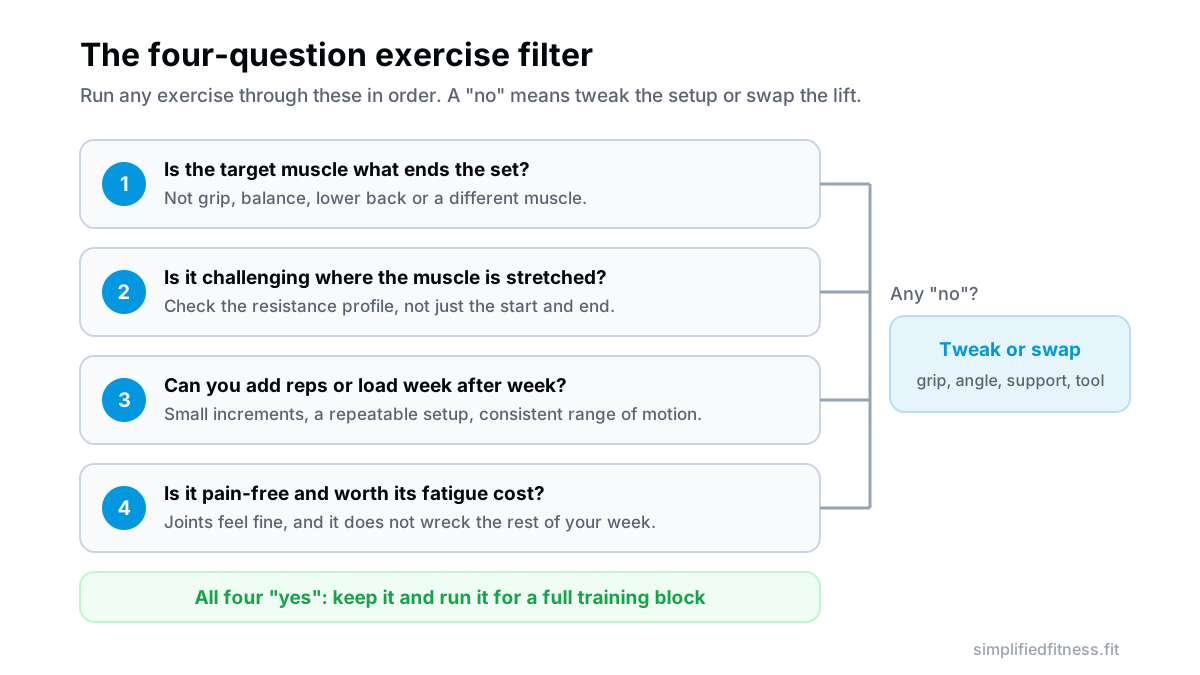
- Is the target muscle what ends the set? If grip goes first, use straps. If balance goes first, add support.
- Is it challenging where the muscle is stretched? If the hardest point is at the shortened end, consider a variation or angle that shifts it.
- Can you add reps or load week after week? Choose setups you can repeat exactly. Track your top sets and estimate strength trends with the 1RM calculator.
- Is it pain-free and worth its fatigue cost? If an exercise keeps aggravating a joint, swap it. Our joint-friendly lifting guide has options.
Real-world exercise selection in Indian gyms
Theory meets reality at 7 pm in a crowded commercial gym. The one cable station has a queue, the squat rack is taken, and the leg curl machine has been “in use” by someone on their phone for ten minutes.
This is where understanding biomechanics pays off. If you know why an exercise works, you can swap tools without losing the stimulus:
- No free cable for lateral raises? Lean away from a post holding a dumbbell, or do them lying on an incline bench, so the dumbbell is harder in the lower range.
- Squat rack taken? A leg press, hack squat or Smith squat loads the quads with less balance demand.
- Leg curl machine busy? Romanian deadlifts load the hamstrings at long lengths, though with more lower-back fatigue.
- Home setup with only adjustable dumbbells? Bench angles and body position are your “cable pulleys”. Use them.
More swaps in gym equipment shortages and exercise substitutions.
If you would rather not design this from scratch, our free push pull legs plans already apply these principles, and the training volume calculator helps you count sets per muscle across the week. Once your exercises are set, the next lever is progression; see progressive overload, deloads and breaking plateaus.
The bottom line
Exercise selection biomechanics is not about finding one perfect exercise or picking a side in the free weights vs machines debate. The research shows similar muscle growth with either. What matters is that the target muscle limits the set, that the exercise loads it hard (ideally including the stretched position), and that you can progress it without pain.
Torque is force times moment arm. Learn to see where that distance is longest in a rep and you will understand why an exercise feels the way it does. Then choose the tool that puts the tension where you want it, run it long enough to get stronger, and spend the rest of your energy on what actually moves the needle: hard sets, consistent training and enough food and sleep to recover.
Go deeper: every guide in this topic
- Anthropometry-Based Exercise Selection: Long Limbs, Short Torsos, and Lever Adjustments
- Axial Loading vs Non-Axial Exercises: Managing Spinal Fatigue for Bigger Legs and Back
- Cable Setup Mastery: Pulley Heights, Cable Angles, and Customizing Force Vectors
- Compound vs Isolation Exercises for Hypertrophy: Do You Need Both?
- Dumbbell vs Barbell Bench Press for Chest: Which Builds More Pec?
- Exercise Redundancy: Why 3 Near-Identical Exercises Waste Your Energy
- External Stability in Resistance Training: Why Chest Support Makes Rows and Curls Feel More Targeted
- Free Weights vs Cables vs Machines: What Actually Builds Muscle
- Grip Width and Wrist Orientation: What Your Hands Really Change
- Gym Equipment Shortages and Substitutions: Science-Based Swaps for Crowded Gyms
- Line of Pull vs Muscle Fiber Orientation: Eliminating Wasted Force in Exercise Paths
- Matching Resistance Profiles to Human Strength Curves: Ascending vs Descending
- Moment Arms, Lever Arms, and Joint Torque: The Physics of Weightlifting Explained Simply
- Open vs Closed Kinetic Chain Exercises: Are Leg Extensions Really Worse Than Squats?
- Progressive Overload on Machines: What to Do When the Next Pin Is Too Heavy
- Selectorized Machine Cam Profiles: How Variable Resistance Shapes Muscle Loading
- Smith Machine vs Free Barbell for Hypertrophy: What the Research Says
- Stance Width and Foot Placement: Squat and Leg Press Biomechanics
- Stimulus-to-Fatigue Ratio (SFR): How to Pick Exercises That Pay Off
- Unilateral vs Bilateral Training: The Bilateral Deficit and Correcting Asymmetries
Frequently Asked Questions
What is exercise selection biomechanics?
Exercise selection biomechanics is the practice of choosing lifts based on how they load a muscle: where the resistance is hardest, which joint the torque acts on, and what limits the set. It uses basic physics such as moment arms and resistance profiles rather than tradition or equipment loyalty. In practice, it means asking whether the target muscle, not your grip or balance, is what makes you stop.
Are free weights better than machines for building muscle?
No, current evidence does not show free weights building more muscle than machines. A 2023 meta-analysis of 13 studies found no significant difference in hypertrophy between the two, although only five of those studies measured muscle size. Pick whichever version lets you train hard, progress steadily and stay pain-free.
Are cables better than dumbbells?
Cables are not better overall, they simply load the muscle differently. A cable keeps tension along the line of the cable, so you can angle it to stay hard in positions where a dumbbell goes slack, such as the bottom of a lateral raise. Use dumbbells when they load the stretched position well and cables when the dumbbell's resistance profile leaves a gap.
What is a moment arm in weightlifting?
A moment arm is the perpendicular distance between a joint and the line along which a force acts. Torque equals that force multiplied by the moment arm, which is why a dumbbell feels heaviest when your forearm is horizontal in a curl. Shift the load or your body position and you change which joint does most of the work.
What is the difference between a resistance profile and a strength curve?
A resistance profile describes how hard the exercise is at each point of the rep, while a strength curve describes how strong you are at each point. They come from different sources: one from the equipment and body position, the other from your muscle length and internal moment arms. When the two are badly mismatched, you fail at one sticking point while the rest of the range stays easy.
What are ascending, descending and bell-shaped strength curves?
An ascending curve means you get stronger as the rep goes on, like the squat and most presses. A descending curve means you are strongest early, like many pulling movements, and a bell-shaped curve peaks in the middle, like the biceps curl. Knowing the shape helps you pick tools, for example a cam machine or cable, that keep tension where you need it.
Do bands and chains build more strength than normal weights?
On average, no. A 2022 meta-analysis of 17 studies and 491 adults found variable resistance training and traditional training were equally effective for maximal strength and power. Use bands or chains if you enjoy them or want to train lockout, but they are optional.
Is the Smith machine bad for building muscle?
No, the Smith machine is a perfectly reasonable muscle-building tool. Its fixed bar path removes balance demands, which lowers stabiliser activity but lets you focus effort on the target muscle. In an 8-week trial, people training with machines gained muscle thickness similar to those using free weights, so use the Smith if it helps you train hard and consistently.
Do I need compound exercises to build muscle?
Compound exercises are efficient but not mandatory for hypertrophy. A Sports Medicine review of 23 studies found no difference in upper-limb muscle growth between single-joint and multi-joint training in long-term studies. Most lifters do best with a mix: compounds for efficiency and isolation work for muscles the compounds under-load.
Do I need isolation exercises if I do compound lifts?
For the arms, research in trained men suggests isolation work adds little on top of presses and rows over 8 weeks, though that study used tape measurements rather than imaging. Muscles like the hamstrings are activated much less than the quads during squats and leg presses, so they likely benefit from direct work. Add isolation exercises where your compounds clearly leave a muscle under-trained.
What is the stimulus-to-fatigue ratio?
The stimulus-to-fatigue ratio is a coaching heuristic comparing how much growth signal an exercise gives the target muscle with how much overall fatigue it costs. It is not a measured value from research, so treat it as a rough judgement tool. Exercises that tire your lower back, grip or joints before the target muscle usually score poorly.
Do unstable surfaces like Bosu balls build more muscle?
No, instability is a poor main tool for muscle growth. The Canadian Society for Exercise Physiology position stand notes that unstable bases reduce force, power, velocity and range of motion. Keep bodybuilding work stable and heavy, and use instability training only for specific balance or rehab goals.
Why do free-weight squats show more muscle activity than Smith machine squats?
Free-weight squats require more balance, so a small 2009 EMG study of six people found higher average muscle activity than in Smith machine squats. EMG measures electrical activity during a set, not muscle growth over months. Pick the squat variation you can load and progress safely, since long-term growth data does not favour either.
How do my limb lengths affect exercise selection?
Limb and torso lengths change the moment arms at each joint, so the same exercise can load your hips and knees differently from someone else's. A lifter with long thighs relative to the torso usually leans forward more in a back squat, which shifts work toward the hips. If an exercise never lets the target muscle limit the set, adjust stance, bar position or swap to a variation that suits your build.
How often should I change exercises?
Change exercises occasionally and on purpose, not every session. A systematic review concluded that planned variation may help regional growth, while excessive random rotation may compromise gains, and a 2025 trial in 70 women found varied and constant programmes produced similar results. Keep your main lifts for at least one full training block so you can track progress.
Is exercise variety necessary for muscle growth?
A moderate amount of well-chosen variety helps, but you do not need a new exercise every week. Different exercises can bias different muscles within a group, as shown when incline curls grew the biceps more and preacher curls grew the brachialis more in a 2026 MRI study. Choose two or three exercises per muscle that load it differently and stick with them.
Why do overhead triceps extensions build more triceps?
Overhead extensions stretch the long head of the triceps because it also crosses the shoulder. A 12-week MRI study found overhead cable extensions grew the whole triceps about 1.4 times more than the same exercise with the arm at the side. Include at least one overhead triceps movement in your week.
Are seated leg curls better than lying leg curls?
Seated leg curls appear to grow the hamstrings more than lying versions. A 12-week MRI study found whole hamstring volume increased by about 14% with seated curls versus 9% with prone curls, likely because the flexed hip puts the hamstrings at a longer length. If your gym has both, make the seated version your default.
Is the bent-over row bad for your lower back?
The bent-over row is not inherently bad, but it does load the lower back heavily. A biomechanics study found it produced the largest lumbar spine load of three rowing variations, while the inverted row produced the lowest. If your lower back is the limiting factor or already fatigued from deadlifts, use a chest-supported row instead.
What is a sticking point in a lift?
A sticking point is the part of a rep where difficulty rises disproportionately, and it is usually where you fail. It happens where the resistance profile and your strength curve are most mismatched, often because your moment arms or muscle lengths are at a disadvantage there. Knowing your sticking point helps you choose accessories and setups that train that range.
Can I build muscle with only machines?
Yes, you can build muscle with machines alone. Meta-analytic data show similar hypertrophy with machines and free weights, and machines often offer stable setups and small load jumps that make progression easy. If you later want to test strength on a barbell, expect to need practice because strength gains are partly specific to the equipment.
Can I build muscle with only dumbbells at home?
Yes, dumbbells alone can build substantial muscle if you train close to failure and progress over time. Their main weakness is a fixed vertical line of force, which leaves some muscles like the side delts lightly loaded in the bottom range. Use body angle, such as leaning or lying on an incline bench, to shift where the dumbbell is hardest.
How many exercises per muscle group should I do?
Most lifters do well with one to three exercises per muscle group per session, depending on weekly volume. The key is that each exercise adds a different loading pattern rather than repeating the same resistance profile. Use our training volume calculator to keep total weekly sets sensible.
Sources & References
Every claim above is checked against peer-reviewed research (PubMed, U.S. National Library of Medicine) or guidance from established health bodies. How we fact-check.
- Haugen ME, et al. Effect of free-weight vs. machine-based strength training on maximal strength, hypertrophy and jump performance: a systematic review and meta-analysis. BMC Sports Sci Med Rehabil. 2023. PMID: 37582807
- Schwanbeck SR, et al. Effects of training with free weights versus machines on muscle mass, strength, free testosterone, and free cortisol levels. J Strength Cond Res. 2020. PMID: 32358310
- Schwanbeck S, et al. A comparison of free weight squat to Smith machine squat using electromyography. J Strength Cond Res. 2009. PMID: 19855308
- Andersen V, et al. Comparing the effects of variable and traditional resistance training on maximal strength and muscle power in healthy adults: a systematic review and meta-analysis. J Sci Med Sport. 2022. PMID: 36130847
- Kompf J, et al. Understanding and overcoming the sticking point in resistance exercise. Sports Med. 2016. PMID: 26758462
- Behm DG, et al. Canadian Society for Exercise Physiology position stand: the use of instability to train the core in athletic and nonathletic conditioning. Appl Physiol Nutr Metab. 2010. PMID: 20130673
- Fenwick CM, et al. Comparison of different rowing exercises: trunk muscle activation and lumbar spine motion, load, and stiffness. J Strength Cond Res. 2009. PMID: 19620925
- Gentil P, et al. A review of the acute effects and long-term adaptations of single- and multi-joint exercises during resistance training. Sports Med. 2017. PMID: 27677913
- de Franca HS, et al. The effects of adding single-joint exercises to a multi-joint exercise resistance training program on upper body muscle strength and size in trained men. Appl Physiol Nutr Metab. 2015. PMID: 26244600
- Schoenfeld BJ, et al. Calculating set-volume for the limb muscles with the performance of multi-joint exercises: implications for resistance training prescription. Sports (Basel). 2019. PMID: 31336594
- Maeo S, et al. Greater hamstrings muscle hypertrophy but similar damage protection after training at long versus short muscle lengths. Med Sci Sports Exerc. 2021. PMID: 33009197
- Maeo S, et al. Triceps brachii hypertrophy is substantially greater after elbow extension training performed in the overhead versus neutral arm position. Eur J Sport Sci. 2023. PMID: 35819335
- Kobayashi Y, et al. Exercise-specific preferential hypertrophy of individual elbow flexor muscles after incline versus preacher dumbbell curl training. J Sports Sci. 2026. PMID: 42829982
- Kassiano W, et al. Does varying resistance exercises promote superior muscle hypertrophy and strength gains? A systematic review. J Strength Cond Res. 2022. PMID: 35438660
- Kassiano W, et al. Muscle hypertrophy and strength adaptations to systematically varying resistance exercises. Res Q Exerc Sport. 2025. PMID: 39388663

Umair Hazrami · Founder & Head Coach, Simplified Fitness
Umair Hazrami founded Simplified Fitness and the Simplified Lifter channel to cut through fitness noise. With 4+ years of consistent training and 10+ coaching clients, he writes every guide from the peer-reviewed research and links the sources so you can check them. Our editorial standards.
Educational content only, not medical advice. If you have a medical condition, are pregnant, or take medication, talk to a qualified doctor before changing your diet, supplements or training. Full disclaimer.
Keep reading
Exercise Technique
3D Shoulder Protocol: Weekly Volume, Frequency (2-3x/Week) and Rep Ranges
How to build 3D shoulders: how many weekly sets, how often to train side and rear delts, and which rep ranges to use, with an 8-week plan and the research.
8 min read
Exercise Technique
Adductor Magnus Training: Seated Adductor Machine and Copenhagen Planks for Thigh Mass
Adductor magnus training explained: what research says on deep squats, the adductor machine and Copenhagen planks for thicker inner thighs and groin strength.
7 min read

Exercise Technique
Antagonist Arm Supersets: Biceps and Triceps Pairing for a Faster, Pumpier Arm Day
A biceps triceps superset workout can shorten arm day while keeping volume close to straight sets. See the research, pairing tips and a 20-minute routine.
9 min read

Exercise Technique
Are Front Raises Necessary? Why Bench Pressers Rarely Need Direct Front Delt Work
Are front raises necessary if you bench and overhead press? See what EMG and volume research says, when they can still help, and where to spend those sets.
8 min read