Progressive Overload Methods, Deloads and Plateaus: The Long-Term Progression Guide
Progressive overload methods that still work after beginner gains: double progression, microloading, deload weeks and a plateau checklist, with studies linked.
TL;DR. The short answer
- Progressive overload means making training gradually harder over time. Adding reps works too: in two randomized trials, adding reps at a fixed load built muscle about as well as adding weight.
- Double progression is the simplest method for most lifters: pick a rep range, add reps until every set hits the top, then add the smallest load you can and start again.
- Periodization helps maximal strength a little in meta-analyses, but has not been shown to matter much for muscle growth when total volume is equal.
- A deload is a short, planned drop in training stress. Surveyed strength and physique athletes deload for about a week every 5-6 weeks; a 2024 trial found a full week off cost some strength gains but not muscle growth.
- Common plateau causes are poor recovery, inconsistent technique, accumulated fatigue and load jumps that are too big. Check those, in that order, before changing your whole program.
Table of contents
Progressive overload means making your training a little harder over time, so your body keeps having a reason to adapt. The most reliable progressive overload methods for natural lifters are adding reps within a set rep range, adding small amounts of load once you earn it, and planning a lighter deload week every month or two. Adding weight to the bar is only one of several options, and research suggests adding reps can build muscle about as well.
That is the short answer. The long answer is where most people go wrong.
Beginners can add 2.5 kg to the squat every session and it works for a few months. Then it stops. The bar slows down, reps get ugly, and suddenly you have been stuck on the same bench press for half a year. This guide covers what to do after the easy gains run out: double progression, rep quality, microloading, how to structure a training block, when and how to deload, and a step-by-step way to diagnose a plateau. Each topic links to a deeper article if you want the full detail.
What progressive overload actually means
Your muscles adapt to the demands you place on them. Once a given workload stops being challenging, it stops being much of a signal. So the demand has to rise, gradually.
The American College of Sports Medicine put it plainly in its 2009 position stand: progressive protocols are necessary to stimulate further adaptation toward specific training goals (ACSM, 2009). Its 2026 update, an overview of 137 systematic reviews covering more than 30,000 participants, still concludes that healthy adults should perform progressive resistance training (Currier et al., 2026).
Progression is not one thing, though. You can make a set harder by:
- Adding load at the same reps
- Adding reps at the same load
- Adding sets across the week
- Improving the rep: fuller range of motion, controlled lowering, no bounce
- Reducing reps in reserve, so you finish closer to failure
- Doing the same work in less rest (useful in some contexts, less so for pure size)
We break each one down, with when to use it, in our checklist of the modalities of progressive overload. And if you are still convinced overload only means “more plates”, read progressive overload beyond adding iron first.
Progressive overload methods: does adding reps work as well as adding weight?
This is the question the research has answered best, and the answer is reassuring.
In a 2022 randomized trial, 43 people with at least a year of lower body training were split into two groups for 8 weeks. One group tried to add load while keeping reps constant. The other kept load constant and tried to add reps. Both did four sets of back squats, leg extensions and two calf raise variations, twice a week (Plotkin et al., 2022).
Results? Rectus femoris growth modestly favoured the reps group. Smith machine squat strength slightly favoured the load group, by about 2 kg. The authors called both differences of questionable practical significance, and most other outcomes were nearly identical.
A 2024 study ran a similar comparison in 39 untrained young men and women, with each person training one leg with load progression and the other with rep progression for 10 weeks. Leg extension strength and vastus lateralis (outer quad) size rose similarly with both methods, with no significant difference between them (Chaves et al., 2024).
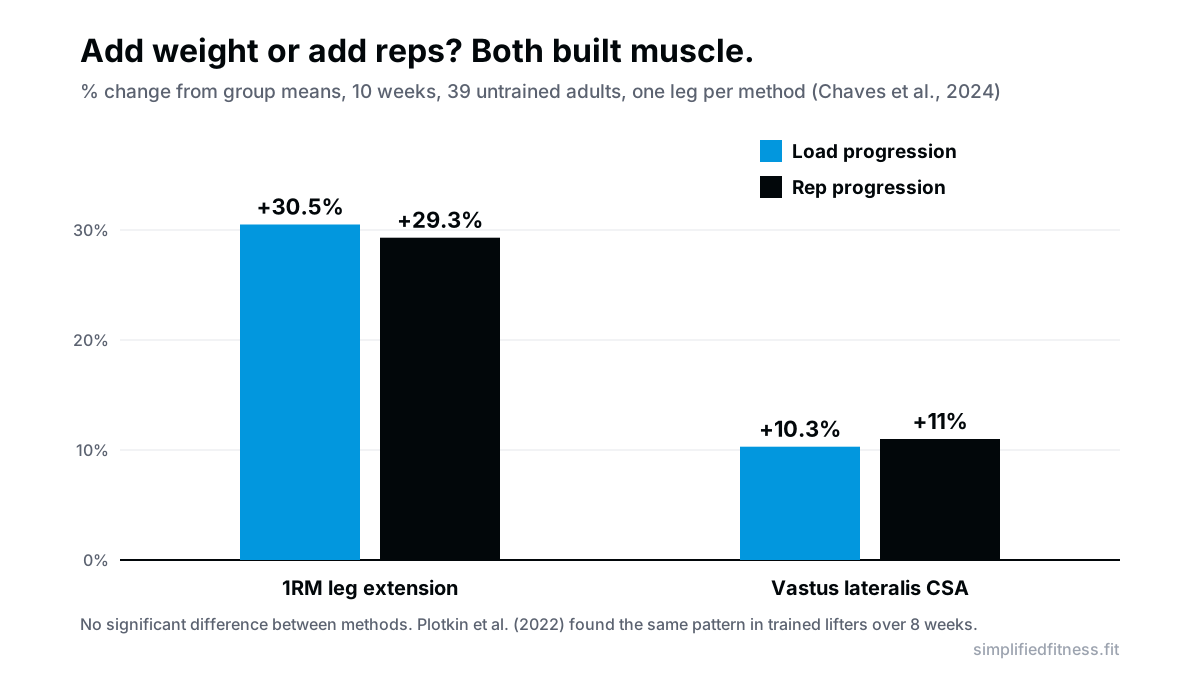
Two caveats keep this honest. Both studies lasted only 8-10 weeks and trained the legs, and the Chaves trial used beginners. Strength specialists probably still need heavy load progression, because strength is specific to the loads you practise with. For muscle growth, though, the evidence suggests you have more freedom than gym folklore allows.
The double progression system, step by step
Double progression combines both methods, which is why it is the default we suggest for most intermediate lifters. It also removes guesswork about when to add weight.
Here is the system:
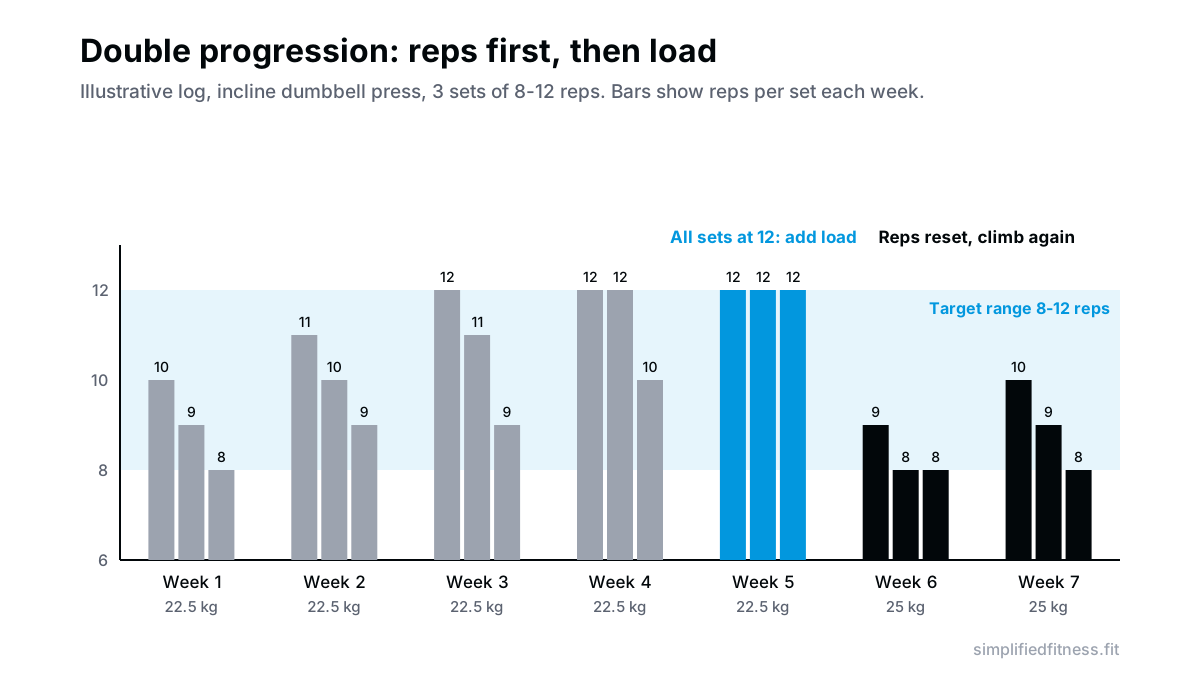
- Pick a rep range for the exercise, for example 8-12 on an incline dumbbell press.
- Pick a load you can lift for at least 8 reps on every set, stopping about one to three reps short of failure.
- Add reps each session where you can, keeping identical technique.
- When every set hits 12, increase load by the smallest available step.
- Your reps drop back toward 8. Start climbing again.
This lines up with the ACSM’s 2009 rule of thumb: increase the load by 2-10% once you can perform the current workload for one or two reps over your target (ACSM, 2009).
The full set-up, including how wide your rep range should be for different exercises, is in our guide to mastering the double progression model. Two upgrades are worth knowing:
- Dynamic double progression. Each set progresses on its own, so a set that hits 12 gets more load next time even if set three is still at 10. Useful when one set keeps lagging. See dynamic double progression for individual sets.
- Triple progression. Add a set as a third lever once reps and load both stall. Covered in triple progression and volume progression.
| Method | How it progresses | Best for | Watch out for |
|---|---|---|---|
| Linear load | Same reps, more weight each session | Beginners, big compound lifts | Stalls within months |
| Rep progression | Same weight, more reps | Small isolation lifts, home gyms | Sets drifting to very high reps |
| Double progression | Reps to top of range, then load | Most intermediate lifters | Sloppy reps to “hit the number” |
| Dynamic double | Each set progresses separately | Lifters with one lagging set | More bookkeeping |
| Triple progression | Reps, then load, then sets | Stalled intermediates | Volume creeping too high |
| Autoregulated (RIR or RPE) | Load set by daily readiness | Experienced lifters | Honest effort ratings required |
Rep quality: the progression that only exists on paper
Here is a very common logbook mistake. The numbers go up, but the reps changed.
Picture this: week one, 60 kg bench for 8, bar touching the chest. Week four, 60 kg for 10, bar stopping 5 cm higher with a little bounce and a butt lift. On paper that is two extra reps. In reality it is a different, easier exercise.
Progression only counts when the rep is standardized: same range of motion, same tempo, same setup. Our guide to technical vs mechanical failure and form standardization shows how to define where a set really ends.
Effort matters too. Most double progression schemes end sets a rep or two short of failure, so you need to estimate reps in reserve (RIR). The good news: in a study of 24 resistance-trained men and women, lifters predicted 1 RIR and 3 RIR on the bench press at 75% of 1RM with an average absolute error of about 0.65 reps, with a slight tendency to underpredict (Refalo et al., 2024). That was one exercise in trained lifters, so beginners on unfamiliar movements may be less accurate. Still, with practice, effort ratings seem reliable enough to log. If you want to convert between RIR and RPE, use our RIR and RPE calculator.
Microloading: when 2.5 kg is too big a jump
Load jumps are relative. Adding 2.5 kg to a 120 kg squat is about a 2% increase. Adding 2.5 kg to a 30 kg overhead press is over 8%. Moving from 10 kg to 12 kg dumbbells on lateral raises is a 20% jump, which is why so many people get stuck there for months.
That is where microloading comes in: using fractional plates of 0.5-1.25 kg so each step stays small. On dumbbells, where the gym only stocks 2 kg or 2.5 kg increments, rep progression does the job instead. Stay at 10 kg until you own the top of a wider range like 12-20, then move up.
Many commercial gyms in India do not stock anything below 1.25 kg plates, and some do not have those either. A pair of fractional plates is a cheap, one-time purchase that fits in a gym bag. Our microloading guide for upper body lifts covers options, and the plate calculator helps you work out what to load.
Mesocycle periodization for bodybuilding: how to structure a block
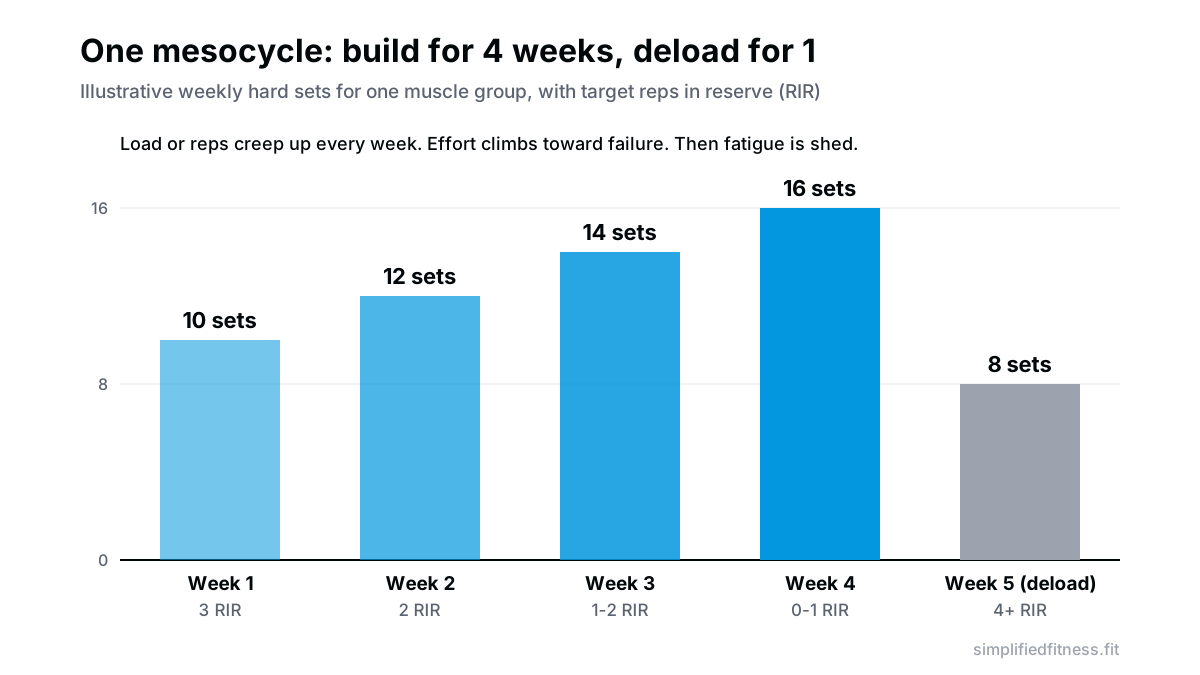
A mesocycle is simply a training block, usually about 4-8 weeks, where training gets progressively harder and then backs off. Weeks sit inside mesocycles, mesocycles sit inside your training year.
Does a formal periodization model matter? The evidence splits by goal.
For strength, it seems to help a little. A 2017 meta-analysis of 18 studies found periodized programs improved 1RM more than non-periodized ones, with a moderate effect size of 0.43. Undulating programs looked more favourable, and gains were larger in untrained participants (Williams et al., 2017). A 2022 meta-analysis of 35 volume-equated studies also found periodized training improved 1RM more (effect size 0.31), but its subgroup analysis found the edge for undulating over linear periodization appeared only in trained participants (Moesgaard et al., 2022).
Why the difference on trained versus untrained? The two analyses asked slightly different questions (periodized versus not, versus one model against another), and Moesgaard only included studies where total volume was matched. When extra volume is not doing the work, the remaining effect of periodization looks smaller and more specific.
For muscle growth, it does not seem to matter much. The same 2022 analysis found no difference in hypertrophy between periodized and non-periodized training, or between linear and undulating models (Moesgaard et al., 2022). The 2026 ACSM overview of reviews likewise concluded that periodization did not consistently affect training outcomes, while higher volumes (10 or more sets per week) did enhance hypertrophy (Currier et al., 2026).
So for physique goals, think of a mesocycle less as a fancy model and more as a container for progression: build load, reps or sets for a few weeks, then deload. That is the structure in our guide to mesocycle architecture and training blocks. How it changes as you get more experienced is covered in novice to intermediate periodization, and how the weekly layout fits in belongs to the workout splits and session architecture guide.
What about autoregulation? Instead of fixed percentages, you adjust load based on how the day feels, using RIR or bar speed. In a 2022 meta-analysis, the six studies comparing autoregulated load prescription with standard percentage-based prescription in trained lifters found no significant difference in 1RM strength (Hickmott et al., 2022). Neither clearly wins. If you want a structured version, see autoregulated progressive overload and APRE rules.
Deload week guide: what the research actually shows
A 2023 international Delphi consensus of strength and physique coaches defined deloading as “a period of reduced training stress designed to mitigate physiological and psychological fatigue, promote recovery, and enhance preparedness for subsequent training” (Bell et al., 2023). Notice what that consensus is built on: expert opinion and experience, not controlled trials.
How do experienced athletes actually do it? A 2024 survey of 246 competitive strength and physique athletes found everyone deloaded. The typical deload lasted about 6.4 days and came every 5.6 weeks or so. They usually cut reps per set and sets per week, reduced load, left more reps in reserve, and kept the same exercises and training frequency (Rogerson et al., 2024).
Controlled trials are fewer, and they do not all point the same way.
| Study | Who | Deload type | Result |
|---|---|---|---|
| Coleman et al., 2024 | 39 trained men and women, 9 weeks | One full week off at midpoint | Similar lower body growth; smaller lower body strength gains than training through |
| Pancar et al., 2026 | 19 untrained men, 8 weeks | Weeks 4 and 8 cut to 1 session and 2 sets | Similar muscle thickness and 10RM gains to continuous training |
| Ogasawara et al., 2013 | 14 young men, 24 weeks of bench press | 3 weeks off between 6-week blocks | Overall chest and triceps growth and strength similar to continuous training |
Put together: short breaks do not seem to cost muscle, at least over these study lengths. A full week of complete rest may cost a little strength momentum, according to the Coleman trial, which also found slightly better readiness-to-train scores in the group that never stopped. The Pancar study suggests a reduced week is fine, but it used untrained men, so applying it to experienced lifters is a reasonable guess rather than a proven fact.
Deloads are also not purely about muscles. Joints, tendons, sleep and motivation all get a breather. The deeper physiology is in the science of deloads and fatigue dissipation, the options are compared in volume vs intensity deloads, and the warning signs are listed in signs you need a deload. Whether to schedule them or wait for symptoms is debated in proactive vs reactive deloads.
How to break gym plateaus: check things in the right order
A plateau is not one problem. It is a symptom, and the fix depends on the cause. The order you check things matters, because changing your program while sleeping five hours a night just hides the real issue.
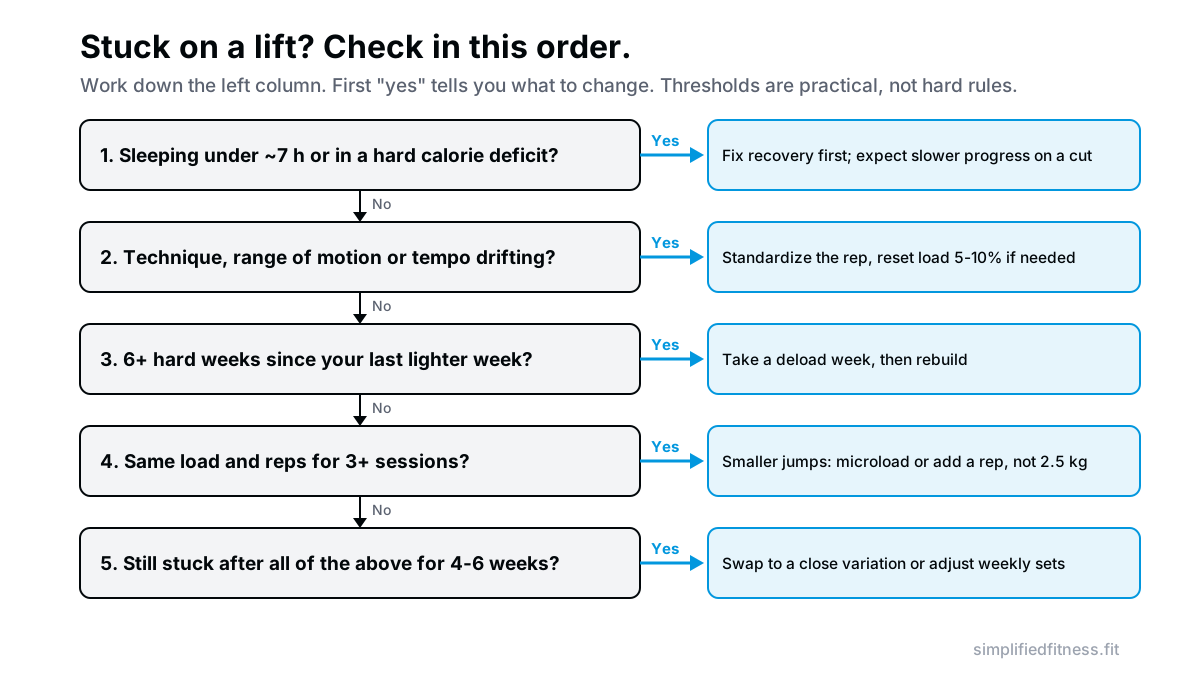
1. Recovery and diet. Short sleep and aggressive calorie deficits are common hidden causes. Lifters on a cut often stall weeks before they stop losing fat; holding your numbers during a diet is a decent outcome. Our guides on sleep and recovery and energy balance for fat loss and bulking go deeper. In hot, humid Indian summers, training in a non-air-conditioned gym can also drop your reps on a given day; note the conditions in your log so you do not mistake a hot afternoon for a true plateau.
2. Technique drift. If depth, tempo or setup has changed, your numbers are not comparable. Reset the standard, drop the load 5-10% if needed, and rebuild.
3. Accumulated fatigue. If you have trained hard for six or more weeks straight and several lifts are stalling at once, take a deload before you change anything else.
4. Step size. If one lift is stuck on the same weight and reps for three or more sessions, your jumps are probably too big. Microload, widen the rep range, or add a set.
5. Exercise selection. Only now consider swapping the exercise. A 2022 systematic review of 8 studies (241 young men) concluded that systematic variation may enhance regional growth and strength, but that excessive, random rotation may compromise gains (Kassiano et al., 2022). Swap a stalled lift for a close variation, for example flat barbell bench to a slight incline or to dumbbells, and keep it for a full block. More on this in exercise rotation and the muscle confusion myth.
The full decision tree, with more branches, is in our systematic plateau troubleshooting flowchart. Two related traps are worth naming: fear of adding weight (see psychological barriers to progressive overload) and judging muscle growth purely by strength, which can rise or stall for neural reasons (see strength gains vs muscle growth). For lifters returning from a long block of high volume, a deliberate lower-volume phase is discussed in hypertrophy resensitization and maintenance blocks.
Logbook habits that make progression visible
You cannot progress what you do not measure. Memory is optimistic; a log is not.
For every working set, record:
- Exercise and the exact variation (machine brand or seat setting if it matters)
- Load and reps
- Reps in reserve, or RPE
- Rest time, roughly
- One short note: sleep, stress, heat, a tweak, a changed setup
Then review it. Once a week, look at each main lift. Is load or reps moving in the right direction over the last three to four sessions? If yes, carry on. If no, run the plateau checklist. Our training logbook guide shows what is worth tracking and what is noise.
Two tools help here. The 1RM calculator lets you compare a set of 8 at one load with a set of 5 at another by estimating the same thing. The training volume calculator shows whether your weekly hard sets per muscle are creeping up across a block.
How progression changes from beginner to intermediate
Beginners progress almost every session, so simple linear load progression on a few compound lifts works well. The ACSM’s 2009 guidance suggests novices start with loads around an 8-12 repetition maximum and that intermediate and advanced lifters use a wider 1-12 RM range in a periodized way (ACSM, 2009).
As you get more experienced, three things change:
- Progress slows, so the time between load jumps stretches from sessions to weeks.
- Fatigue accumulates faster, because you are lifting heavier loads with more total work, which is why deloads become more useful.
- Smaller steps matter more, so double progression, microloading and adding sets take over from simple weight jumps.
None of this changes the rep ranges themselves, which are covered in our load, rep ranges and RIR guide.
A simple six-week block you can run
Put the pieces together and a block looks like this:
- Weeks 1-5: run double progression on every exercise, 2-4 sets per exercise, stopping 1-3 reps short of failure on compounds and 0-2 on isolation work. Log every set.
- When a lift stalls for three sessions, add a set to that exercise or microload, not both.
- Week 6: deload. Same exercises, roughly half the sets, lighter loads, 3-4 reps in reserve.
- Week 7: start the next block a little below your best numbers and climb again.
If you want a program already built around this, our free push pull legs plans use rep ranges that work with double progression. The push day, pull day and leg day templates each list target rep ranges per exercise.
The bottom line
Progressive overload is a broad principle, not just a heavier bar. For muscle growth, adding reps appears to work about as well as adding load, at least in the short trials available. Double progression is the easiest way to combine both. Microloading keeps small lifts moving. Formal periodization helps strength more than size, and a lighter week every month or two is a sensible, low-risk habit even though the research on deloads is still young.
When you stall, check recovery, technique and fatigue before you blame the program. Most plateaus are hiding in the logbook, not in the exercise list.
Go deeper: every guide in this topic
- The 5 Modalities of Progressive Overload: A Checklist for When Weight Won't Go Up
- Autoregulated Progressive Overload (APRE): How Much Weight to Add Next Week
- Deload Science: What a Deload Week Really Does to Fatigue, Muscle and Strength
- How to Do a Deload Week: Volume Cut vs Intensity Cut vs Time Off
- The Double Progression Model: Mastering Rep Ranges (e.g., 8-12 Reps) for Consistent Growth
- Dynamic Double Progression (DDP): How to Progress Each Set Independently
- Exercise Rotation Strategy: How Often to Change Exercises (and Why Muscle Confusion Is a Myth)
- Hypertrophy Resensitization: Do Low-Volume Maintenance Blocks Really Reboot Muscle Growth?
- Mesocycle Architecture: Structuring 4-8 Week Training Cycles for Natural Lifters
- Microloading in Resistance Training: Using Fractional Plates (0.25-0.5kg) on Upper-Body Lifts
- From Novice Linear Progression to Intermediate Periodization: What to Do When 5x5 Stalls
- Do Deloads Prevent Injuries? Proactive vs Reactive Deloads by Experience Level
- The Progressive Overload Principle: What Counts When You Can't Add Weight
- Fear of Lifting Heavier Weights: How to Overcome Load Hesitancy and Gym Intimidation
- Signs You Need a Deload Week: A Four-Point Checklist for Tired Lifters
- Strength Gains vs Muscle Growth: Why Your Lifts Go Up but Your Muscles Look the Same
- Technical Failure vs Mechanical Failure: Standardizing Form Across Training Cycles
- Training Logbook Science: What to Record, What to Skip and the Mistakes That Stall Progress
- Triple Progression and Volume Progression: What to Do When Load and Reps Stall
- Troubleshooting Lifting Plateaus: A 4-Step Check for Technique, Sleep, Volume and Fatigue
Frequently Asked Questions
What are the best progressive overload methods?
The most practical progressive overload methods are adding reps at the same load, adding load once you hit the top of a rep range, and adding sets when progress stalls. Randomized trials in both trained and untrained lifters found rep progression and load progression produced similar muscle growth over 8-10 weeks. Use double progression as your default and keep the others for when it stops working.
Does progressive overload have to mean adding weight?
No. Adding reps, adding a set, improving range of motion or cleaning up technique at the same weight all make a set harder. A 2022 trial in trained lifters found that increasing reps at a constant load built quadriceps muscle about as well as increasing load. Pick whichever variable you can increase without your form changing.
What is the double progression system?
Double progression means you progress reps first and load second within a fixed rep range, for example 3 sets of 8-12. You add reps week by week until every set reaches 12 with good form, then increase the weight and drop back toward 8. Log every set so you know exactly when you have earned the jump.
How much weight should I add when I progress?
The smallest jump your equipment allows is usually the right one. The ACSM's 2009 position stand suggests a 2-10% increase once you can do one or two reps more than your target. On small lifts like lateral raises that often means microplates or adding a rep instead of jumping a full dumbbell size.
How often should I increase weight in the gym?
Increase weight only when you have beaten your rep target with the same technique, not on a fixed calendar. Beginners may earn a jump every session or week, while experienced lifters might need several weeks per small increase on the same lift. Your logbook, not your mood, should decide.
What is dynamic double progression?
Dynamic double progression applies the double progression rule to each set separately rather than to the whole exercise. A set that hits the top of the range gets more load next time while the other sets keep chasing reps at the old load. It suits intermediate lifters who find that one set always lags behind and holds the whole exercise back.
What is a deload week?
A deload week is a planned period of reduced training stress meant to clear fatigue and set you up for the next block. A 2023 international Delphi consensus of strength and physique coaches defined it exactly that way. In practice most lifters cut sets and effort for about a week while keeping their usual exercises.
How often should you deload?
There is no proven ideal frequency, but a 2024 survey of 246 strength and physique athletes found they deloaded roughly every 5-6 weeks for about 6 days. Some deload on a fixed schedule and others wait for signs like stalled lifts or achy joints. Start with a lighter week after every 4-6 hard weeks and adjust based on how you respond.
Do you lose muscle during a deload week?
There is no evidence that a well-run deload week costs you muscle. In a 2024 trial in trained lifters, taking a full week off in the middle of a 9-week program produced similar lower body muscle growth to training straight through, though lower body strength gains were smaller. A reduced-volume deload rather than complete rest is a reasonable middle ground.
Should I take a week off or train lighter during a deload?
For most lifters, training lighter is the safer default. A 2024 trial found a full week off did not hurt muscle growth but did blunt strength gains compared with continuous training, while a 2026 study in untrained men found reduced-volume deload weeks did not hinder growth. Keep your exercises, cut sets by roughly a third to a half and stop each set well short of failure.
How do I know if I need a deload?
Common signs are stalled or falling performance across several lifts, joint aches, unusual soreness, poor sleep and dreading sessions you normally enjoy. Surveyed athletes said they deload when performance stalls or soreness and joint aches build up. If two or more of these show up together for a week or more, take a lighter week.
How do I break a plateau in the gym?
Check recovery first, then technique consistency, then accumulated fatigue, and only then your progression step and exercise choice. Common causes of a stall are short sleep, an aggressive diet, sloppy reps that drift between sessions and load jumps that are too large. Fix one variable at a time for two to four weeks so you know what actually worked.
Why am I not getting stronger even though I train hard?
Training hard is not the same as progressing, and the usual culprits are recovery, inconsistency or too much fatigue. Strength responds to repeated practice with heavy loads plus enough sleep and food to recover between sessions. Log every session for four weeks and compare like for like; you will usually spot the leak.
What is a mesocycle in bodybuilding?
A mesocycle is a training block, typically about 4-8 weeks, in which you progressively build load, reps or sets and then reduce training stress with a deload. It is the middle layer between a single week and a full training year. A simple version is four building weeks followed by one lighter week.
Is periodization necessary for muscle growth?
Periodization does not appear to be necessary for muscle growth when total volume is matched. A 2022 meta-analysis of 35 studies found periodized training improved 1RM strength more than non-periodized training but did not change hypertrophy. If size is your goal, consistent progression and enough weekly sets matter more than the periodization model you pick.
Linear vs undulating periodization: which is better?
For muscle growth the two models produce similar results in meta-analyses. For maximal strength, a 2022 meta-analysis found undulating periodization had an edge, but only in trained participants. Choose the one that fits your schedule and that you will actually follow.
Should I change exercises to break a plateau?
Sometimes, but rotating exercises too often can backfire. A 2022 systematic review concluded that systematic, planned variation may help regional growth and strength, while excessive random variation may compromise gains. Keep your main lifts for at least one full block and swap to a close variation only when a lift has stalled despite good recovery.
Is muscle confusion real?
No, muscles do not need to be confused to grow, and constantly changing workouts makes progressive overload hard to track. The research on exercise variation supports planned, occasional swaps rather than new exercises every session. Repeat the same exercises long enough to beat your previous numbers.
What is microloading?
Microloading means using very small increments, such as 0.5-1.25 kg plates, so load increases stay small relative to what you lift. A 2.5 kg jump is minor on a 100 kg squat but large on a 30 kg overhead press or a 10 kg lateral raise. A pair of fractional plates is one of the cheapest upgrades a home or commercial gym lifter can buy.
How should I track progressive overload?
Write down the exercise, load, reps for every set, rest time and an effort rating such as reps in reserve. Research shows trained lifters can estimate reps in reserve on the bench press to within about one rep, so effort ratings are worth logging. Compare the same exercise under the same conditions week to week, not your best day against your worst.
Can you progressively overload while cutting?
You can often maintain or slowly progress while cutting, but expect smaller gains than when eating at maintenance or in a surplus. A calorie deficit reduces the energy available for recovery, so performance commonly stalls before body fat stops dropping. During a cut, holding your rep numbers on main lifts is a reasonable goal.
How long does a plateau usually last?
There is no fixed timeline because a plateau depends on its cause. A stall caused by fatigue can lift within a week or two of a deload, while one caused by under-eating will last until you fix your intake. If a lift has not moved for four to six weeks after you have addressed recovery and technique, change one programming variable.
Is autoregulation better than percentage-based training?
Not clearly. In a 2022 meta-analysis, the six studies on autoregulated load prescription in trained lifters showed similar 1RM strength gains to standard percentage-based training. Autoregulation is mostly useful for adjusting to good and bad days, so use it if it helps you train consistently hard.
Sources & References
Every claim above is checked against peer-reviewed research (PubMed, U.S. National Library of Medicine) or guidance from established health bodies. How we fact-check.
- Plotkin D, et al. Progressive overload without progressing load? The effects of load or repetition progression on muscular adaptations. PeerJ. 2022. PMID: 36199287
- Chaves TS, et al. Effects of Resistance Training Overload Progression Protocols on Strength and Muscle Mass. Int J Sports Med. 2024. PMID: 38286426
- American College of Sports Medicine. American College of Sports Medicine position stand. Progression models in resistance training for healthy adults. Med Sci Sports Exerc. 2009. PMID: 19204579
- Currier BS, et al. American College of Sports Medicine Position Stand. Resistance Training Prescription for Muscle Function, Hypertrophy, and Physical Performance in Healthy Adults: An Overview of Reviews. Med Sci Sports Exerc. 2026. PMID: 41843416
- Schoenfeld BJ, et al. Dose-response relationship between weekly resistance training volume and increases in muscle mass: A systematic review and meta-analysis. J Sports Sci. 2017. PMID: 27433992
- Moesgaard L, et al. Effects of Periodization on Strength and Muscle Hypertrophy in Volume-Equated Resistance Training Programs: A Systematic Review and Meta-analysis. Sports Med. 2022. PMID: 35044672
- Williams TD, et al. Comparison of Periodized and Non-Periodized Resistance Training on Maximal Strength: A Meta-Analysis. Sports Med. 2017. PMID: 28497285
- Hickmott LM, et al. The Effect of Load and Volume Autoregulation on Muscular Strength and Hypertrophy: A Systematic Review and Meta-Analysis. Sports Med Open. 2022. PMID: 35038063
- Refalo MC, et al. Accuracy of Intraset Repetitions-in-Reserve Predictions During the Bench Press Exercise in Resistance-Trained Male and Female Subjects. J Strength Cond Res. 2024. PMID: 37967832
- Bell L, et al. Integrating Deloading into Strength and Physique Sports Training Programmes: An International Delphi Consensus Approach. Sports Med Open. 2023. PMID: 37730925
- Rogerson D, et al. Deloading Practices in Strength and Physique Sports: A Cross-sectional Survey. Sports Med Open. 2024. PMID: 38499934
- Coleman M, et al. Gaining more from doing less? The effects of a one-week deload period during supervised resistance training on muscular adaptations. PeerJ. 2024. PMID: 38274324
- Pancar Z, et al. Effects of deload periods in resistance training on muscle hypertrophy and strength endurance in untrained young men using a randomized within subject design. Sci Rep. 2026. PMID: 41730991
- Ogasawara R, et al. Comparison of muscle hypertrophy following 6-month of continuous and periodic strength training. Eur J Appl Physiol. 2013. PMID: 23053130
- Kassiano W, et al. Does Varying Resistance Exercises Promote Superior Muscle Hypertrophy and Strength Gains? A Systematic Review. J Strength Cond Res. 2022. PMID: 35438660

Umair Hazrami · Founder & Head Coach, Simplified Fitness
Umair Hazrami founded Simplified Fitness and the Simplified Lifter channel to cut through fitness noise. With 4+ years of consistent training and 10+ coaching clients, he writes every guide from the peer-reviewed research and links the sources so you can check them. Our editorial standards.
Educational content only, not medical advice. If you have a medical condition, are pregnant, or take medication, talk to a qualified doctor before changing your diet, supplements or training. Full disclaimer.
Keep reading

Programming
2-Day per Week Lifting Programs: Minimum Effective Dose for Busy Professionals
Can a 2 day a week workout routine hypertrophy goals support? Yes. Get a ready two-day full-body plan, the research behind it and how to run it in 60 minutes.
9 min read
Programming
30-Minute High-Density Hypertrophy Sessions: Micro-Workouts for Time-Constrained Lifters
Can a 30 minute workout for muscle growth work? See how paired sets, Myo-reps and machine setups fit 16 hard sets into half an hour, plus a 4-day plan.
10 min read
Programming
The 5 Modalities of Progressive Overload: A Checklist for When Weight Won't Go Up
5 ways to progressive overload: load, reps, range of motion, tempo and rest density. A practical checklist for compounds and isolations, with the research.
7 min read

Programming
The 7-Minute Dynamic Warm-Up: A Fast Routine to Prep Joints Before Lifting
A dynamic warm up for lifting takes about 7 minutes, not 25. See the 2-3-2 routine, what the research says about stretching and foam rolling, and what to skip.
9 min read