The Progressive Overload Principle: What Counts When You Can't Add Weight
The progressive overload principle explained: why adding reps, range or sets counts, why ego-lifting does not, and what trials in lifters actually show.
TL;DR. The short answer
- Progressive overload means gradually asking your muscles to do more demanding work over time. Adding load is one way, not the only way.
- In a trial of 43 trained lifters, adding reps at a fixed load and adding load at fixed reps gave similar results over 8 weeks.
- In untrained women, a group that kept load and reps identical for 8 weeks still grew, but the group that progressed grew about twice as much.
- Weight added through a shorter range, bouncing or swinging is not true overload, because the target muscle is not doing more work.
- Log every working set so you can see whether reps, load, range or set count actually moved.
Part of our complete guide: Progressive Overload Methods, Deloads and Plateaus: The Long-Term Progression Guide
Table of contents
The progressive overload principle says your muscles keep adapting only when the work you ask of them rises gradually over time. Adding plates is the classic way to do that. It is not the only way, and it is not the point.
If your squat has been stuck at the same weight for six weeks, you are not necessarily stuck. You may just be looking at one lever. This article is part of our complete guide to progressive overload, deloads and plateaus, and it covers the foundation: what overload really means, what counts, and what is fake progress.
What is the progressive overload principle?
Your body adapts to a stress, and the logic of overload is that the response fades once that stress becomes routine. Lift 60 kg for 3 sets of 10 forever and, sooner or later, you stop giving your muscles anything new to adapt to. How quickly that happens is not well mapped (the trial below found beginners still grew over 8 weeks without progressing), but it is the reason the demand should creep up.
A working way to think about it is progressive demand on the muscle: more total work, done well, for the target muscle. Load is one input. Reps, sets, range of motion and how close you push to failure are others. This is a practical model, not a law of physics, and the research below tests pieces of it rather than proving the whole thing.
Does progressive overload actually matter?
Fair question, because some trials suggest muscle grows even without much progression.
One 2026 trial in 55 untrained young women trained one arm at a time on triceps extensions, 3 sets of 8-12 reps, 3 days a week for 8 weeks. One arm raised the load whenever the top of the rep range was reached. The other kept the same load and reps throughout. Triceps thickness rose about 22.9% with progression, about 11.6% without, and about 1.8% in a non-training control arm (Kassiano et al., 2026).
So training without progression still built muscle in beginners. Progressing roughly doubled it.
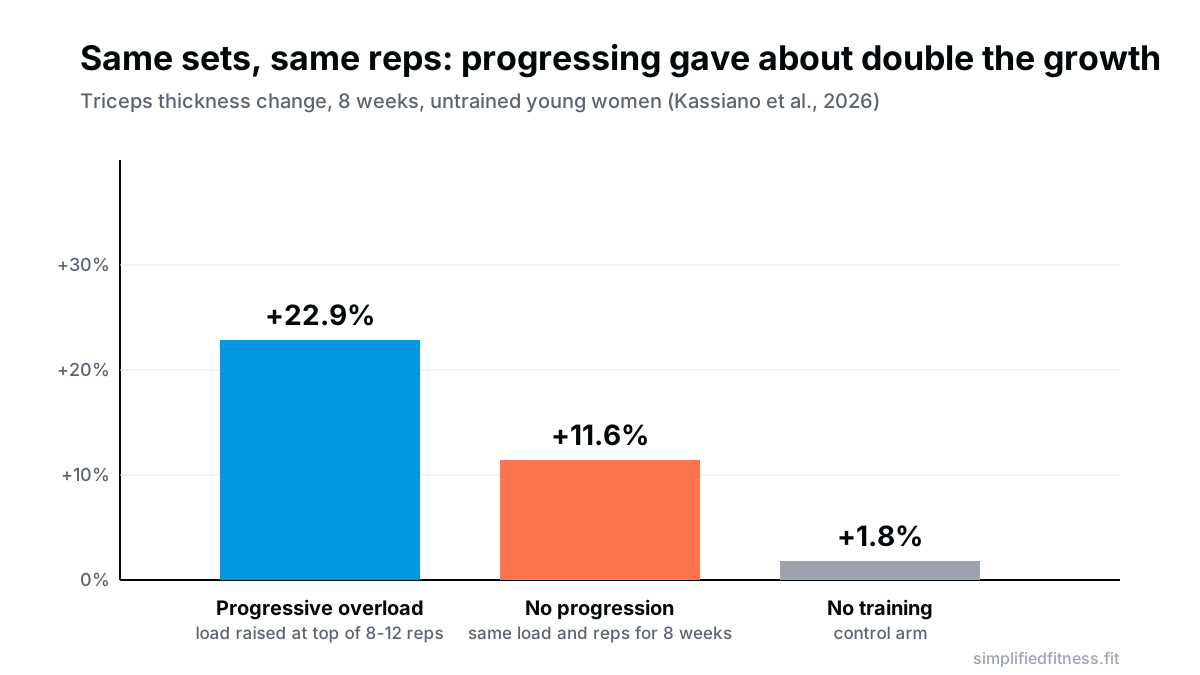
The authors are careful here. Whether non-progressive training keeps working over longer periods is described as an open question, and these were untrained women, so do not assume the gap is identical in experienced lifters.
Progressive overload without adding weight: does it work?
Yes, and there is trial evidence for it.
In a 2022 study, 43 people with at least a year of lower-body training were split into two groups for 8 weeks. One group kept reps constant and added load. The other kept load constant and added reps. They trained back squat, leg extension and two calf raises, twice a week. Rectus femoris growth modestly favoured the reps group (2.8 mm, with a wide confidence interval). Strength slightly favoured the load group (2.0 kg). The authors called both differences of questionable practical significance, and found nothing else notable between groups (Plotkin et al., 2022).
A 2024 trial reached a similar place with untrained people. Thirty-nine young men and women trained one leg with load progression and the other with rep progression for 10 weeks. Both legs gained strength and vastus lateralis size, with no difference between them (Chaves et al., 2024).
What do these studies tell us, and what don’t they?
- They support: adding reps at a fixed load is a legitimate progression, at least for 8-10 weeks.
- They don’t show: that you can add reps forever. Rep ranges top out, and these trials were short.
- They don’t show: that load is unimportant. Both groups in each study were still training hard and progressing in something.
This fits a broader shift in thinking. A 2021 review argued that muscle adaptations can be obtained across a wide spectrum of loading zones, not just one “hypertrophy range” (Schoenfeld et al., 2021). If a range of loads can work, then a range of ways to progress makes sense too.
The levers: what actually counts as overload
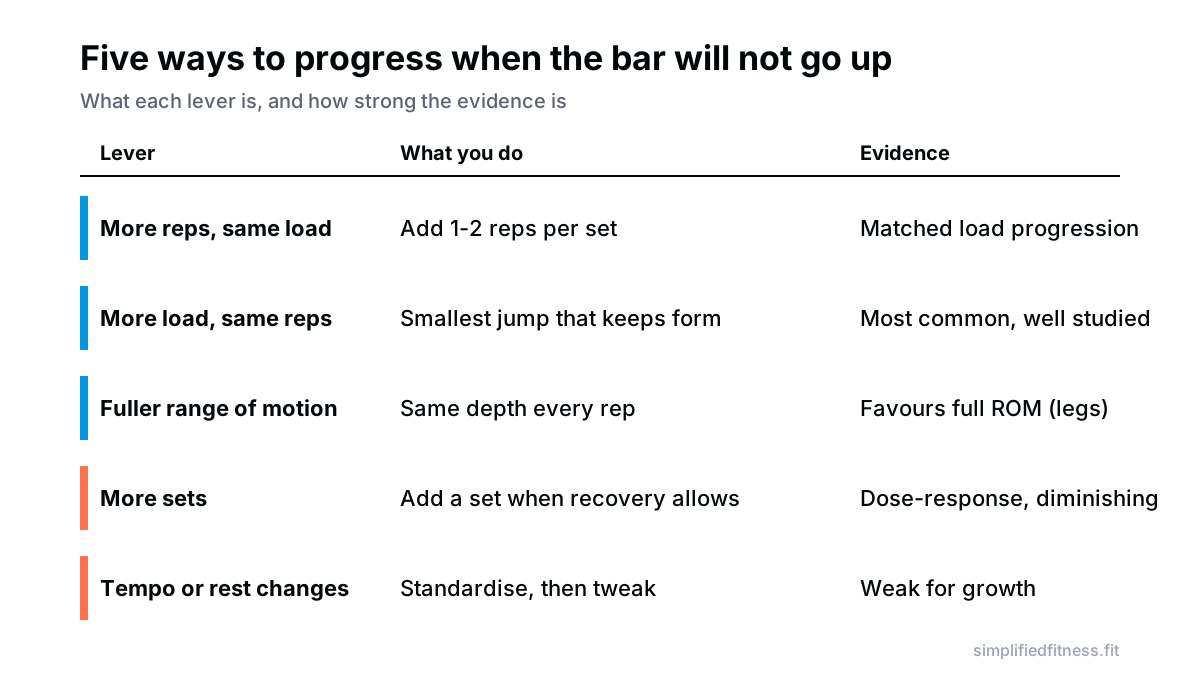
Here is how each lever stacks up.
1. More reps at the same load. Best-supported alternative to adding weight (see above). Aim for one more rep per set before touching the load.
2. More load at the same reps. Still the cleanest, easiest to track. If the smallest jump at your gym feels huge, our guide to microloading with fractional plates helps.
3. Fuller range of motion. A 2021 meta-analysis of 16 studies found full range of motion produced greater gains than partial range in strength (effect size 0.56) and lower-limb hypertrophy (0.88). It found no significant difference for muscle thickness, pennation angle and fascicle length overall (Pallarés et al., 2021). So going deeper is a fair way to progress. Going shallower to move more weight is the opposite. We go deeper on this in range of motion and stretch-mediated hypertrophy.
4. More sets. Each extra weekly set has been associated with a small additional gain in muscle size, with diminishing returns. That is the dose-response story in weekly set volume and hypertrophy. Add sets only if you are recovering well.
5. Closer to failure. A 2024 meta-regression found muscle growth tended to increase as sets ended closer to failure, while the link with strength gain was negligible. The reps-in-reserve values were estimated from study descriptions, so treat the numbers as rough (Robinson et al., 2024). You can practise judging this with our RIR and RPE calculator, and read more in training to failure vs RIR.
6. Tempo and rest changes. This is where gym lore runs ahead of data.
- Tempo: a 2015 meta-analysis found similar hypertrophy for rep durations of 0.5 to 8 seconds, while very slow reps over 10 seconds looked inferior, though the authors noted too few controlled studies for firm conclusions (Schoenfeld et al., 2015).
- Rest: a 2024 Bayesian meta-analysis of 9 studies found a small possible benefit of resting longer than 60 seconds, perhaps because longer rest preserves volume load (Singer et al., 2024).
So slowing reps down or cutting rest does not obviously add growth. Use tempo as a standardiser, not a progression tool. Keep it the same each session so reps are comparable.
Why adding weight with sloppy form is fake overload
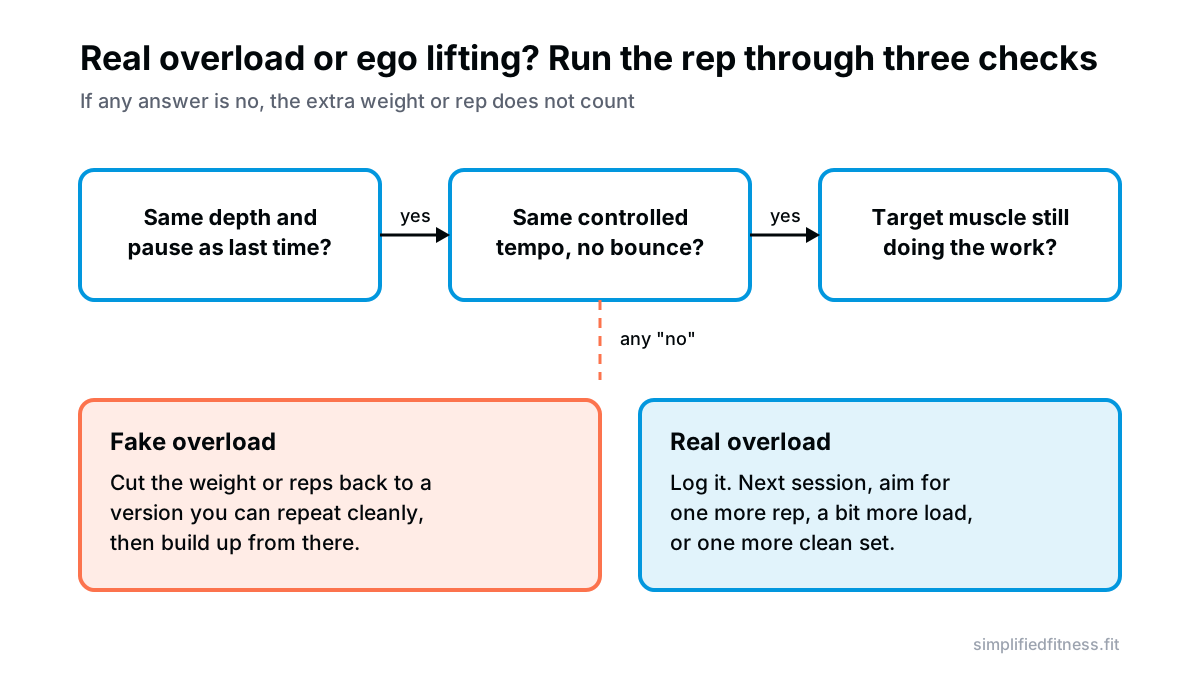
This is where ego lifting gets exposed. If the bar went up 5 kg but the squat went from below parallel to a quarter dip, what did the quadriceps actually do? Probably less.
In the gym, this looks like:
- Cutting depth the second the weight gets heavy.
- Bouncing the bar off your chest.
- Swinging the torso to finish a curl.
- Letting the lowering phase turn into a drop.
All of these add load to the bar while taking work away from the muscle you meant to train. The range-of-motion data above is the reason the shortcut matters: shallower reps are not a neutral swap. The most common mistake here is treating the number on the bar as the score.
A simple way to run overload without adding weight every week
Pick one lever at a time. Keep everything else the same.
- Choose a rep range, say 8-12, and a load you can hit 8 clean reps with, leaving about 1-3 reps in reserve.
- Add reps across sessions until you reach 12 on all sets with the same depth and tempo.
- Then raise the load by the smallest available jump and drop back to the bottom of the range.
- If load will not move, try a slightly deeper range (and keep it), or add one set.
- Write everything down.
That loop is the core of a double progression model. For a wider tour of the options, see our five modalities of progressive overload and the checklist on what to record in a training log.
A quick Indian-gym note. If your gym only has 2.5 kg plates and a 5 kg jump on lateral raises is impossible, rep progression is not a consolation prize. It is the plan. Same with home setups using adjustable dumbbells or a pair of fixed ones.
Want a structure to follow? Our free training plans already use rep ranges you can progress inside, and the training volume calculator can help you sanity-check weekly sets.
When progress really does stall
Overload is a means, not a guarantee. If you cannot progress anything for several weeks, run through sleep, food, set quality and total volume first. Our plateau troubleshooting flowchart walks that through.
Persistent joint pain, sharp pain during a lift, or a sudden drop in performance with fatigue that does not clear are good reasons to see a doctor or physiotherapist instead of grinding on. Overload is meant to be gradual.
Limits of the evidence
- Most of the trials above ran 8-10 weeks. Long-term effects of rep-only progression are unknown.
- Two of the three overload trials used untrained participants, who respond to almost anything.
- The range-of-motion results are strongest for lower-limb hypertrophy, and they are pooled across very different exercises.
- Proximity to failure was estimated, not measured.
The practical takeaway survives all of that: raise demand gradually, keep reps honest, and track it.
Frequently Asked Questions
What is the progressive overload principle?
It is the idea that muscles keep adapting only if the demand placed on them rises gradually over time. The usual reasoning is that the body adapts to a stimulus, and the response tends to shrink once that stimulus becomes routine. In practice, log your sets and try to beat last session by a rep, a small amount of load or a clean extra set.
Do I have to add weight every week to progressive overload?
No. Adding load is the most common method, but trials show that adding repetitions at a fixed load can produce similar strength and size gains over 8-10 weeks. Weekly jumps are unrealistic for most people past the beginner stage anyway. Use reps, range of motion or sets as your lever when the plates will not go up.
Is adding reps as good as adding weight for muscle growth?
In the studies we have, they look similar. A 2022 trial in trained lifters found no meaningful difference between rep progression and load progression, and a 2024 trial in untrained people found the same. Both were short, so choose whichever your gym, joints and equipment make easier.
Does progressive overload work without increasing weight?
Yes, within limits. Increasing reps, using a fuller range of motion or adding sets all raise the total demand even if the bar stays the same. Eventually a rep range tops out, so at that point nudge the load up and restart the rep climb.
What is the difference between progressive overload and just training hard?
Training hard is effort within one session, while progressive overload is measurable progress across sessions. One trial found that untrained women who trained without progressing still grew, but progressing doubled the growth in the triceps. Write down your numbers so hard work turns into tracked progress.
Is lifting heavier with sloppy form still progressive overload?
Usually not. If you shorten the range, bounce the weight or let other muscles take over, the target muscle may be doing no more work than before. Reps should look the same as last month: same depth, same control, same pause. If the extra weight changes the rep, drop back.
How often should I increase the load?
Increase it when you hit the top of your planned rep range with clean form, not on a fixed calendar date. Some lifts progress every session early on, while others may take months. When you move up, pick the smallest jump available.
Does a fuller range of motion count as progressive overload?
It can. A 2021 meta-analysis of 16 studies found full range of motion produced greater strength gains and greater lower-limb hypertrophy than partial range, though muscle thickness overall showed no significant difference. Deepening a squat or pausing at the stretch of a row is a legitimate way to progress as long as you keep it consistent afterward.
How close to failure should I train for overload to work?
Closer to failure appears to help muscle growth, but you do not need to hit it every set. A 2024 meta-regression found hypertrophy tended to rise as sets ended closer to failure, with a negligible relationship for strength. Stopping 1-3 reps short on most sets is a sensible compromise.
What do I do when my progress stalls for several weeks?
First check the basics: sleep, food, and whether you are really repeating the same quality of reps. Then change one lever, such as an extra set, a slightly different rep target or a smaller load jump. If you also feel run down or have joint pain, see a doctor or physio rather than pushing through.
Do I need progressive overload if I just want to maintain muscle?
Not strictly, since maintaining is easier than building. The same logic still applies to growth, though, so once you want to add muscle you need to give your body a reason to. Keep a log so you can tell whether you are maintaining or genuinely progressing.
Sources & References
Every claim above is checked against peer-reviewed research (PubMed, U.S. National Library of Medicine) or guidance from established health bodies. How we fact-check.
- Plotkin D, et al. Progressive overload without progressing load? The effects of load or repetition progression on muscular adaptations. PeerJ. 2022. PMID: 36199287
- Chaves TS, et al. Effects of resistance training overload progression protocols on strength and muscle mass. Int J Sports Med. 2024. PMID: 38286426
- Kassiano W, et al. Progressive overload affects the magnitude of muscle hypertrophy. Med Sci Sports Exerc. 2026. PMID: 41718594
- Pallares JG, et al. Effects of range of motion on resistance training adaptations: a systematic review and meta-analysis. Scand J Med Sci Sports. 2021. PMID: 34170576
- Singer A, et al. Give it a rest: a systematic review with Bayesian meta-analysis on the effect of inter-set rest interval duration on muscle hypertrophy. Front Sports Act Living. 2024. PMID: 39205815
- Schoenfeld BJ, et al. Effect of repetition duration during resistance training on muscle hypertrophy: a systematic review and meta-analysis. Sports Med. 2015. PMID: 25601394
- Robinson ZP, et al. Exploring the dose-response relationship between estimated resistance training proximity to failure, strength gain, and muscle hypertrophy: a series of meta-regressions. Sports Med. 2024. PMID: 38970765
- Schoenfeld BJ, et al. Loading recommendations for muscle strength, hypertrophy, and local endurance: a re-examination of the repetition continuum. Sports (Basel). 2021. PMID: 33671664

Umair Hazrami · Founder & Head Coach, Simplified Fitness
Umair Hazrami founded Simplified Fitness and the Simplified Lifter channel to cut through fitness noise. With 4+ years of consistent training and 10+ coaching clients, he writes every guide from the peer-reviewed research and links the sources so you can check them. Our editorial standards.
Educational content only, not medical advice. If you have a medical condition, are pregnant, or take medication, talk to a qualified doctor before changing your diet, supplements or training. Full disclaimer.
Keep reading
Programming
The 5 Modalities of Progressive Overload: A Checklist for When Weight Won't Go Up
5 ways to progressive overload: load, reps, range of motion, tempo and rest density. A practical checklist for compounds and isolations, with the research.
7 min read
Programming
Autoregulated Progressive Overload (APRE): How Much Weight to Add Next Week
Autoregulated progressive overload (APRE) uses your last-set reps to set next week's weight. Get simple jump rules, a worked example and the evidence.
9 min read

Programming
Deload Science: What a Deload Week Really Does to Fatigue, Muscle and Strength
Deload science explained: the fitness-fatigue model, what trials show for muscle size and strength, and what happens in a deload week. Studies linked.
8 min read

Programming
How to Do a Deload Week: Volume Cut vs Intensity Cut vs Time Off
How to do a deload week workout: compare cutting sets by half, lowering weight by 20%, or taking time off, with a step-by-step template and the research.
9 min read