Fear of Lifting Heavier Weights: How to Overcome Load Hesitancy and Gym Intimidation
Fear of lifting heavier weights stalls progress more than most people admit. Learn safe setups, walkout drills and small jumps that rebuild confidence.
TL;DR. The short answer
- Fear of lifting heavier weights is common and fixable. The most reliable approach is gradual exposure: set up safely, rehearse the unrack, then add small jumps you can repeat.
- Weight-training sports show relatively low injury rates versus common team sports: roughly 1.0-4.4 injuries per 1000 training hours in powerlifting and 2.4-3.3 in Olympic weightlifting (mostly competitive athletes, mostly retrospective data).
- You do not need to go heavy to grow muscle. Reviews suggest hypertrophy can be achieved across a wide range of loads, so hesitancy about heavy singles need not block progress.
- Mental rehearsal and instructional self-talk can support, but not replace, real reps. Imagery produced smaller strength gains than physical training in a meta-analysis and a training study.
- Pain that is sharp, persistent or comes with numbness or chest symptoms is a reason to stop and see a doctor, not something to push through.
Part of our complete guide: Progressive Overload Methods, Deloads and Plateaus: The Long-Term Progression Guide
Table of contents
If you have a fear of lifting heavier weights, you are not alone, and the fix is rarely “just be braver.” What works is making the heavier load familiar in small steps: a safe setup, a rehearsed unrack, then increases small enough that you can repeat them. Confidence follows evidence, and you build the evidence one controlled rep at a time.
This guide is the mental side of progressive overload, deloads and plateaus. The arithmetic of adding load is easy. The part that stalls people is standing in front of the bar with a plate in your hand, doing the math on what could go wrong.
Why does adding weight feel so scary?
Load hesitancy is usually three worries stacked together.
- Injury fear. “What if something tears?”
- Failure fear. “What if I get pinned and everyone sees?”
- Imposter feeling. “People who lift that much actually know what they are doing. I do not.”
All three are predictions, and predictions can be tested. A common mistake is treating the fear as a character flaw. It is just a mismatch between an unfamiliar load and a setup you do not yet trust.
Notice that the first two are really about the setup, not your courage. If the safeties are right and you know your bail-out, the worst case on a failed rep becomes boring. That is exactly what we want.
Is lifting heavier weights actually dangerous?
Less than it feels. Systematic reviews of weight-training sports are the best data we have, with caveats.
A 2017 review covering weightlifting, powerlifting, bodybuilding, strongman, Highland Games and CrossFit found relatively low injury rates compared with common team sports. Bodybuilding had the lowest rates (0.24-1 injury per 1000 hours), while strongman (4.5-6.1) and Highland Games (7.5) were highest (Keogh and Winwood, 2017). A separate review of 9 studies reported 2.4-3.3 injuries per 1000 training hours in Olympic weightlifting and 1.0-4.4 in powerlifting, and concluded the risk was similar to other non-contact strength and power sports and low compared with contact sports (Aasa et al., 2017).
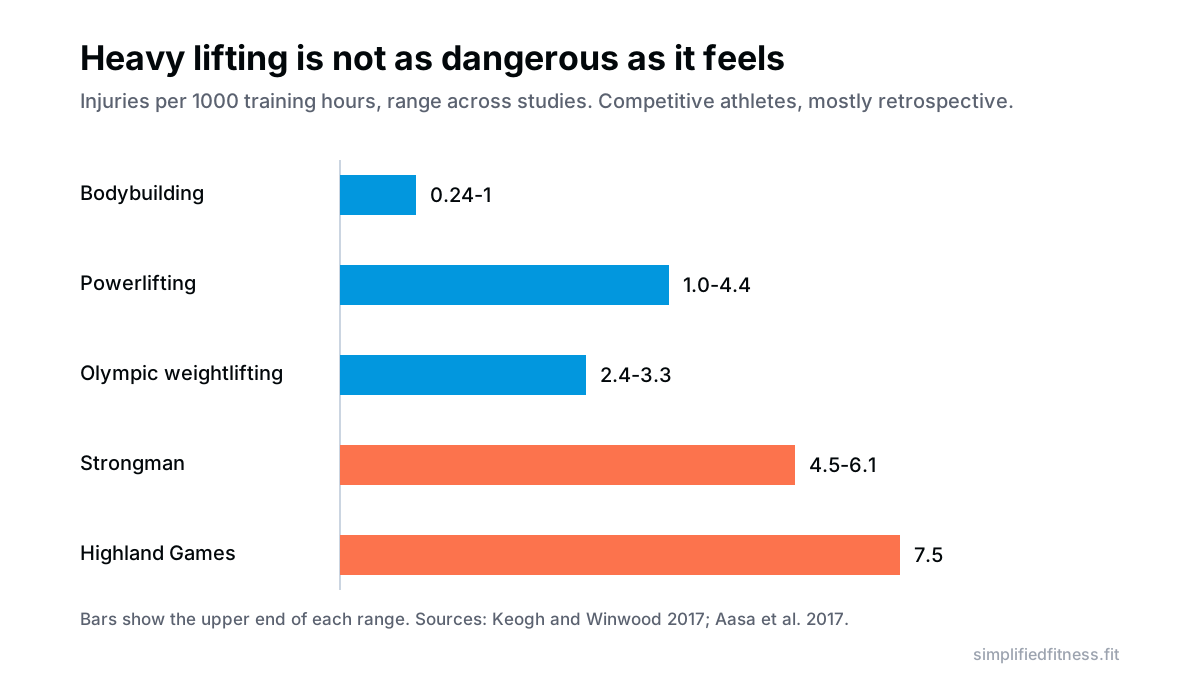
Two honest caveats. Most of these studies were retrospective and of low to moderate quality, and they involve competitive athletes, not a beginner in a commercial gym. The shoulder, lower back and knee were the usual trouble spots, and strains and tendon irritation were the common injury types.
There is also a flip side. A meta-analysis of six trials with 7,738 participants aged 12-40 found that strength training lowered sports injury risk, with a relative risk of 0.338 (0.238-0.480) (Lauersen et al., 2018). Those were athletes in injury-prevention programs, so it does not mean every program protects every person. But it does push against the idea that getting stronger is the risky part.
Do I even need to lift heavy to build muscle?
No, and this takes a lot of pressure off. For years lifters were told that muscle growth lives in a narrow moderate-rep zone and that heavy weights are for strength. A 2021 review argues the evidence does not fully support that rigid “repetition continuum,” and proposes that muscular adaptations can be obtained, and in some cases optimised, across a wide spectrum of loading zones (Schoenfeld et al., 2021).
In practice that means you can keep making progress on, say, 12-15 controlled reps while you work up to heavier sets. If your goal is a stronger squat or bench, heavier loads matter more, but if your goal is size, you are not failing by staying in a rep range you can control. For the structure behind this, see our guide to double progression and rep ranges.
How do I set up safely so the bar stops feeling threatening?
Most of the fear sits in the setup, so fix that first. This is generic coaching practice, not a single trial’s protocol, but it is what removes the “what if” from the lift.
- Use the rack. Squat and bench inside a power rack or with proper stands where you can.
- Set safety pins just below your lowest rep. Test with an empty bar: squat to your normal depth, then sink a little lower. The pins should catch the bar there. Do this every session.
- Bench with safeties or a spotter. Set the pins so the bar clears them when it touches your chest on a normal rep, but lands on them if you flatten your back and let it sink. Or use a spotter who knows how you want help.
- Learn your bail-out. On a squat, sink down until the bar rests on the pins, then slide out from under it. On dumbbells, tilt and set them down. Rehearse it once with a light load.
- Use collars and balanced plates. An uneven bar is one more thing to distrust.
- Leave your ego at the plate rack. Warm up properly, which is covered in warm-up protocols and ramping sets.
What is a walkout drill and how does it build confidence?
A walkout is the simplest exposure drill I know. With the safety pins set, you load the bar a little heavier than your current working weight, unrack it, take your steps back, stand still for three to five seconds, and re-rack. No squat.
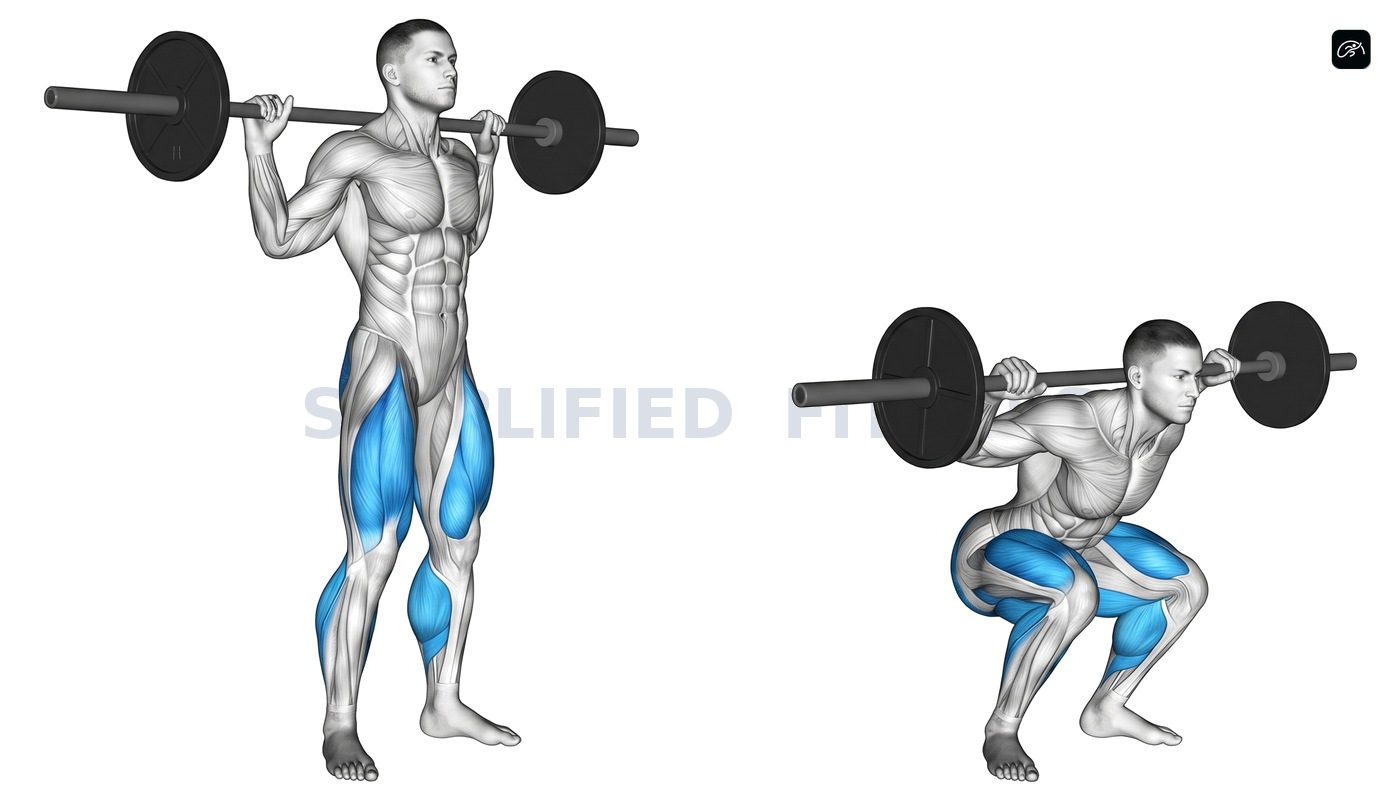
The point is to feel the weight on your back while the stakes are low. The same idea works for other lifts: hold a heavier dumbbell at the starting position for a few seconds, or unrack a slightly heavier bench and hold it at lockout for a few seconds with the safeties set. Do one or two of these before your normal sets on heavy days.
I am not aware of a controlled trial testing walkouts specifically, so treat this as a coaching technique based on gradual exposure, not a proven protocol. It is also the lowest-risk way to try, because the bar never has to move.
How big should the next jump be?
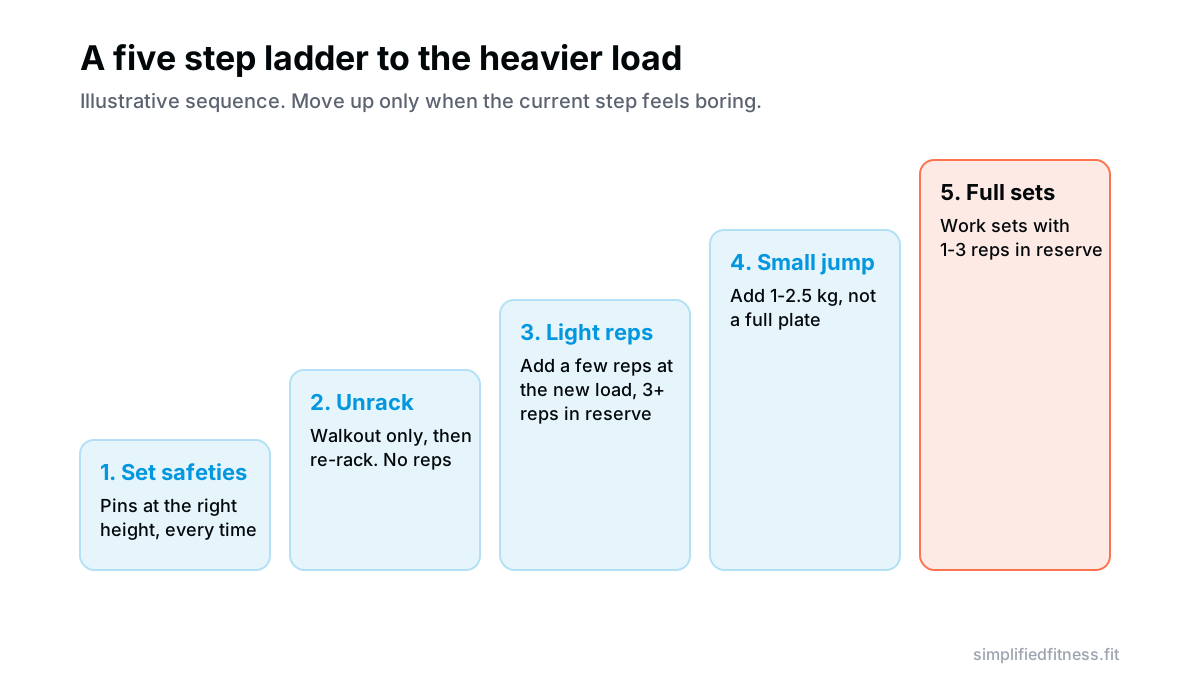
Smaller than your ego wants. If a 5 kg total jump (2.5 kg a side) feels like a cliff, take a smaller step. Fractional plates exist for exactly this reason, and we cover the approach in microloading with fractional plates.
A simple rule that works for many people:
- End each work set with 1-3 reps in reserve.
- When you hit the top of your rep range with that margin, add the smallest load you have.
- If a jump feels bad, repeat the old load for another session. That is not failure, it is data.
Use the plate calculator to see exactly which plates make up the new load, so you are not doing mental math under the bar.
One caution on reps in reserve (RIR). It is a skill, and it is less accurate than people think. In 25 trained men squatting at 70% of 1RM, predictions were less accurate when lifters were farther from failure and when sets had more reps (Zourdos et al., 2021). So practise RIR on safer exercises first, and stay conservative on barbell lifts. Our guide to how accurately lifters gauge RIR goes deeper, and the RIR and RPE calculator helps translate effort into load.
Does visualization actually work?
A little, as a supplement. Motor imagery means vividly simulating the movement without doing it.
A 2018 meta-analysis of 13 articles (370 participants) found that imagery practice improved maximal voluntary strength compared with no exercise, but less than physical practice, and suggested it could be a substitute or additional tool when athletes are not exposed to maximal training intensities (Paravlic et al., 2018). In one training study, groups that replaced 25-75% of maximal isometric contractions with imagined ones gained 3.0-4.2% in strength, versus 5.1% for real contractions only and -0.2% for no training (Reiser et al., 2011).
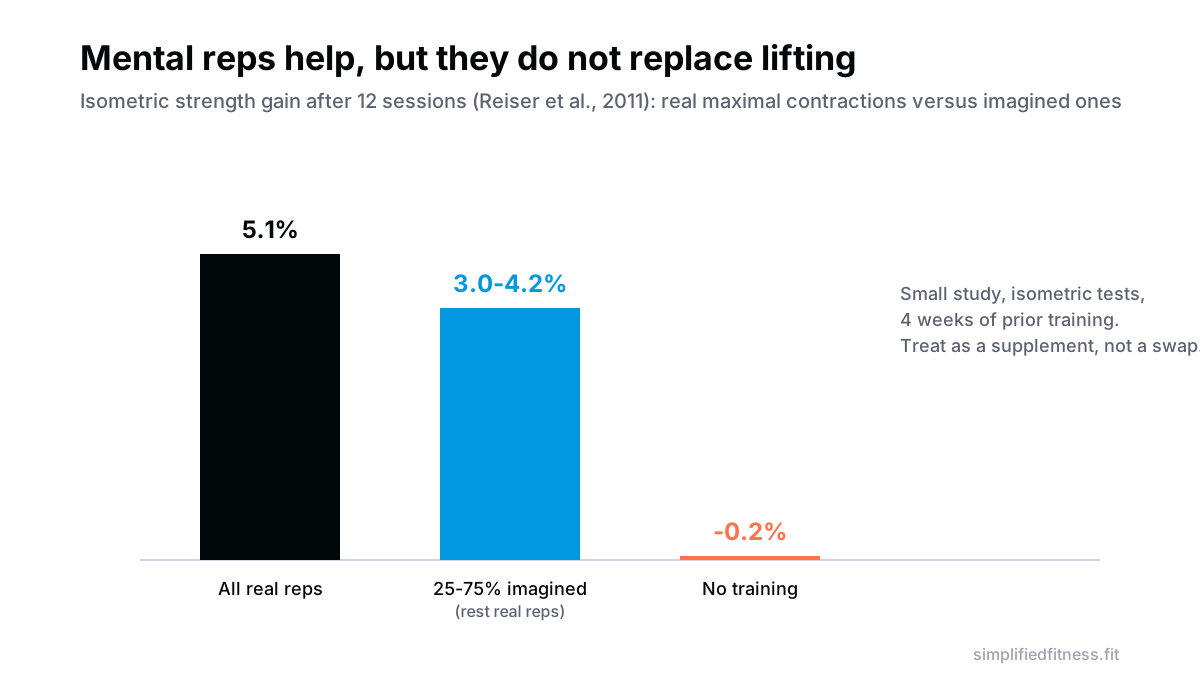
These were small, short-term studies with isometric tests, mostly in healthy volunteers, so do not expect a barbell miracle. The practical use is simple: before a heavy set, spend 20-30 seconds mentally running the whole lift from unrack to re-rack, including the bracing and your bail-out.
Can self-talk calm me down under the bar?
Probably, modestly. A meta-analysis of 32 studies found a moderate positive effect of self-talk on sports task performance (ES = 0.48), (Hatzigeorgiadis et al., 2011). Self-talk worked better for fine motor tasks than gross ones and for novel tasks than well-learned ones, and instructional cues were especially useful for fine tasks. A heavy squat is a gross motor task, so expect a smaller effect there than in, say, a skill drill.
What I would take from it: use short, instructional cues (“brace, chest up, drive”) instead of vague pep talks. One cue, same words every rep, same routine before every unrack. A fixed pre-lift routine can cut the dithering where fear grows.
What about gym intimidation and feeling like an imposter?
Intimidation is about being watched, and in practice most people in the weight room are thinking about their own next set. A few moves that help:
- Walk in with a written plan. Not knowing what to do next is what makes you look lost. Our free push pull legs plan gives you something to follow.
- Learn one station deeply. Master one rack or one dumbbell zone before you branch out.
- Train at a quiet hour until the room stops feeling loud.
- Ask for one favour. A regular who is happy to watch your first heavier set is worth a lot.
- Track and review. Seeing numbers climb in a log is the best antidote to feeling like a fraud. See why the training log matters, and for the wider habit side, behavioural science of gym habits.
When fear is not just fear
Be honest with yourself about the difference. Normal hesitancy sounds like “this is heavier than I am used to.” A warning sign sounds like sharp joint pain, pain that is getting worse each session, numbness or tingling, dizziness, or any chest symptoms. Those are reasons to stop and see a doctor or physiotherapist, not to push through. If fear of lifting is intense, avoids all training, or is tied to a past injury, speaking to a qualified professional is a good idea. Nothing here is a diagnosis.
The bottom line
Fear of lifting heavier weights is normal, and it is workable. Check your setup, rehearse the unrack, take small jumps with reps in reserve, and let the log show you that you are stronger than you feel. The research suggests imagery and self-talk can help a bit, injury rates are modest, and you do not need heavy singles to build muscle. The next plate is not a test of your character. It is just the next small step.
Frequently Asked Questions
Why am I scared to lift heavier weights?
Fear of heavier loads is a normal threat response to an uncertain outcome, and it usually combines worry about injury, getting stuck under the bar and being watched. Anxiety tends to ease as a task becomes predictable, which is why repeating a safe setup helps. Start by changing one thing at a time, such as pin height or a small load jump, so each session feels familiar.
Is lifting heavy weights actually dangerous?
For most healthy lifters the risk is lower than people expect. Systematic reviews of weight-training sports report relatively low injury rates compared with common team sports, though most data come from competitive athletes and are retrospective. Use sensible warm-ups, safeties and small increases, and see a doctor if you have a heart, joint or spine condition.
How do I get over gym intimidation?
Gym intimidation usually fades with familiarity, and most people in the weight room are busy with their own sets. Go at a quiet time, follow a written plan so you never wander, and learn the setup of one station well. Use a free plan such as our push pull legs routine to remove the guesswork.
How much weight should I add to the bar each week?
Small, repeatable jumps are easier to trust than big ones. Adding 1-2.5 kg to compound lifts, or using fractional plates, keeps each change small enough to feel like a step rather than a leap. If a jump feels scary, take half of it and keep your reps in reserve.
What is a squat walkout drill?
A walkout is unracking the loaded bar, stepping back, standing still for a few seconds and re-racking without squatting. It lets you feel the weight on your back at a controlled, low-risk level. Use it as a warm-up step on heavier days until the load feels familiar.
Where should I set the safety pins for squats?
Set them just below the bottom of your squat so the bar lands on them if you cannot stand up. Check the height with an empty bar by squatting to your usual depth and sitting slightly lower. Re-check them every session and any time you change lifts or shoes.
Does visualization really help me lift more?
It helps a little, but it is a supplement. A meta-analysis of 13 studies found imagery practice improved maximal strength versus no exercise but less than physical practice. Use a short mental run-through before heavy sets, and keep doing the actual lifting.
Do I need heavy weights to build muscle?
No. A 2021 review argues muscle growth can be obtained across a wide spectrum of loads, not only in a narrow moderate-rep zone. That means you can keep building muscle with lighter loads taken close to failure while confidence with heavier loads catches up. Pick loads you can control, and track progress with reps and sets.
Should I use a spotter or train alone?
A spotter helps on bench press and some dumbbell work, but safeties, a power rack or machines can protect you when training alone. Know your bail-out plan before the set, such as how to roll a bar or tilt a dumbbell. Ask a regular to watch your first heavier sets, and tell them how you want to be spotted.
How do I know how close to failure I am?
Judging reps in reserve is a skill, and research shows predictions are less accurate when you are far from failure. Practise on safe, controlled lifts such as machines or dumbbells, and stay conservative with barbells. Our RIR calculator can help you translate effort into load.
What if I freeze up under the bar?
Freezing is a stress reaction, not a sign you are weak. Slow breathing, a short instruction cue like 'brace, drive' and a consistent routine before each unrack can reduce hesitation. If it keeps happening, drop the load slightly and rebuild confidence before progressing.
When is fear a sign I should see a doctor?
Fear of the weight itself is normal, but sharp joint pain, numbness, dizziness, chest pain or a recent injury is not. Those need medical advice before you add load, not more courage. A physiotherapist or doctor can clear the problem and show you what is safe.
Can self-talk improve my lifting?
Probably, in a modest way. A meta-analysis of 32 studies found a moderate positive effect of self-talk on sports performance, with instructional self-talk especially useful for technical tasks. Pick one short cue for each lift and use it every rep.
Sources & References
Every claim above is checked against peer-reviewed research (PubMed, U.S. National Library of Medicine) or guidance from established health bodies. How we fact-check.
- Keogh JW, et al. The Epidemiology of Injuries Across the Weight-Training Sports. Sports Med. 2017. PMID: 27328853
- Aasa U, et al. Injuries among weightlifters and powerlifters: a systematic review. Br J Sports Med. 2017. PMID: 27707741
- Lauersen JB, et al. Strength training as superior, dose-dependent and safe prevention of acute and overuse sports injuries: a systematic review, qualitative analysis and meta-analysis. Br J Sports Med. 2018. PMID: 30131332
- Paravlic AH, et al. Effects and Dose-Response Relationships of Motor Imagery Practice on Strength Development in Healthy Adult Populations: a Systematic Review and Meta-analysis. Sports Med. 2018. PMID: 29541965
- Reiser M, et al. Strength gains by motor imagery with different ratios of physical to mental practice. Front Psychol. 2011. PMID: 21897826
- Hatzigeorgiadis A, et al. Self-Talk and Sports Performance: A Meta-Analysis. Perspect Psychol Sci. 2011. PMID: 26167788
- Schoenfeld BJ, et al. Loading Recommendations for Muscle Strength, Hypertrophy, and Local Endurance: A Re-Examination of the Repetition Continuum. Sports (Basel). 2021. PMID: 33671664
- Zourdos MC, et al. Proximity to Failure and Total Repetitions Performed in a Set Influences Accuracy of Intraset Repetitions in Reserve-Based Rating of Perceived Exertion. J Strength Cond Res. 2021. PMID: 30747900

Umair Hazrami · Founder & Head Coach, Simplified Fitness
Umair Hazrami founded Simplified Fitness and the Simplified Lifter channel to cut through fitness noise. With 4+ years of consistent training and 10+ coaching clients, he writes every guide from the peer-reviewed research and links the sources so you can check them. Our editorial standards.
Educational content only, not medical advice. If you have a medical condition, are pregnant, or take medication, talk to a qualified doctor before changing your diet, supplements or training. Full disclaimer.
Keep reading
Programming
The 5 Modalities of Progressive Overload: A Checklist for When Weight Won't Go Up
5 ways to progressive overload: load, reps, range of motion, tempo and rest density. A practical checklist for compounds and isolations, with the research.
7 min read
Programming
Autoregulated Progressive Overload (APRE): How Much Weight to Add Next Week
Autoregulated progressive overload (APRE) uses your last-set reps to set next week's weight. Get simple jump rules, a worked example and the evidence.
9 min read

Programming
Deload Science: What a Deload Week Really Does to Fatigue, Muscle and Strength
Deload science explained: the fitness-fatigue model, what trials show for muscle size and strength, and what happens in a deload week. Studies linked.
8 min read
Programming
How to Do a Deload Week: Volume Cut vs Intensity Cut vs Time Off
How to do a deload week workout: compare cutting sets by half, lowering weight by 20%, or taking time off, with a step-by-step template and the research.
9 min read