Do Deloads Prevent Injuries? Proactive vs Reactive Deloads by Experience Level
Do deloads prevent injuries? What the research shows, why it is untested, and whether newer or experienced lifters should schedule or autoregulate deloads.

TL;DR. The short answer
- A proactive deload is a lighter week you schedule (often every 5-8 weeks) whatever you feel. A reactive deload is taken only when fatigue signs show up. Neither has been proven to prevent injuries better in a head-to-head trial.
- Newer lifters usually do better with a calendar, because research shows people misjudge how close to failure they are, and that accuracy improves with experience.
- Experienced lifters can deload reactively if they keep a log and rate effort honestly. Many blend both: a planned slot that is moved or skipped based on how they are recovering.
- In a 2024 trial of resistance-trained adults, a full week off at the midpoint of 9 weeks did not change lower-body muscle growth but led to smaller lower-body strength gains than training continuously.
- Sharp, worsening or night pain is not something a deload fixes. Get it checked by a doctor or physiotherapist.
Part of our complete guide: Progressive Overload Methods, Deloads and Plateaus: The Long-Term Progression Guide
Table of contents
Do deloads prevent injuries? Nobody has shown that they do, and nobody has tested whether scheduled (proactive) or symptom-triggered (reactive) deloads protect you better. What the evidence does tell us is how well lifters at different stages read their own fatigue, and that decides which style is safer for you. Newer lifters usually do better with a calendar; experienced lifters can often manage the reactive route. This sits inside our wider guide to progressive overload, deloads and plateaus. If you just want a quick decision flowchart for timing, see reactive vs proactive deload schedules.
What follows is the best reading of adjacent evidence, plus coaching logic, and I will say which is which.
What is the difference between a proactive and a reactive deload?
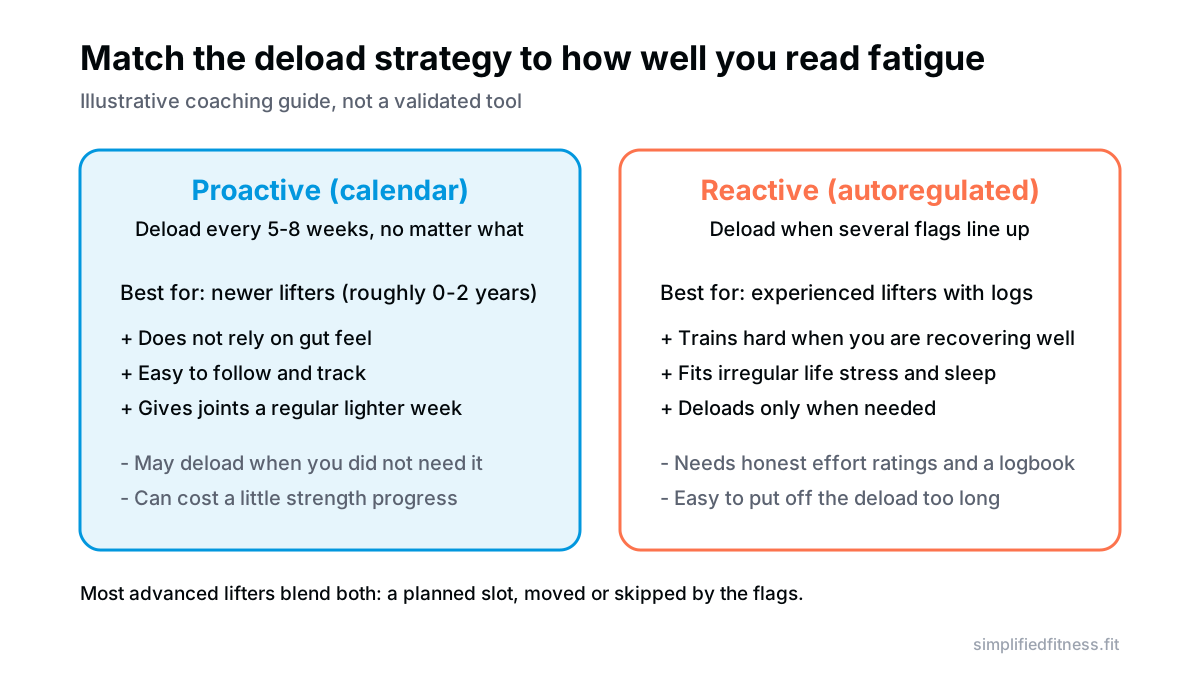
Proactive (scheduled): you decide in advance. Every fifth, sixth or eighth week, volume and effort drop, regardless of how you feel. It is the “deload every 6 weeks” approach.
Reactive (autoregulated): you keep training hard until the signs say stop. Reps slip, sleep falls apart, joints ache, and you pull the plug.
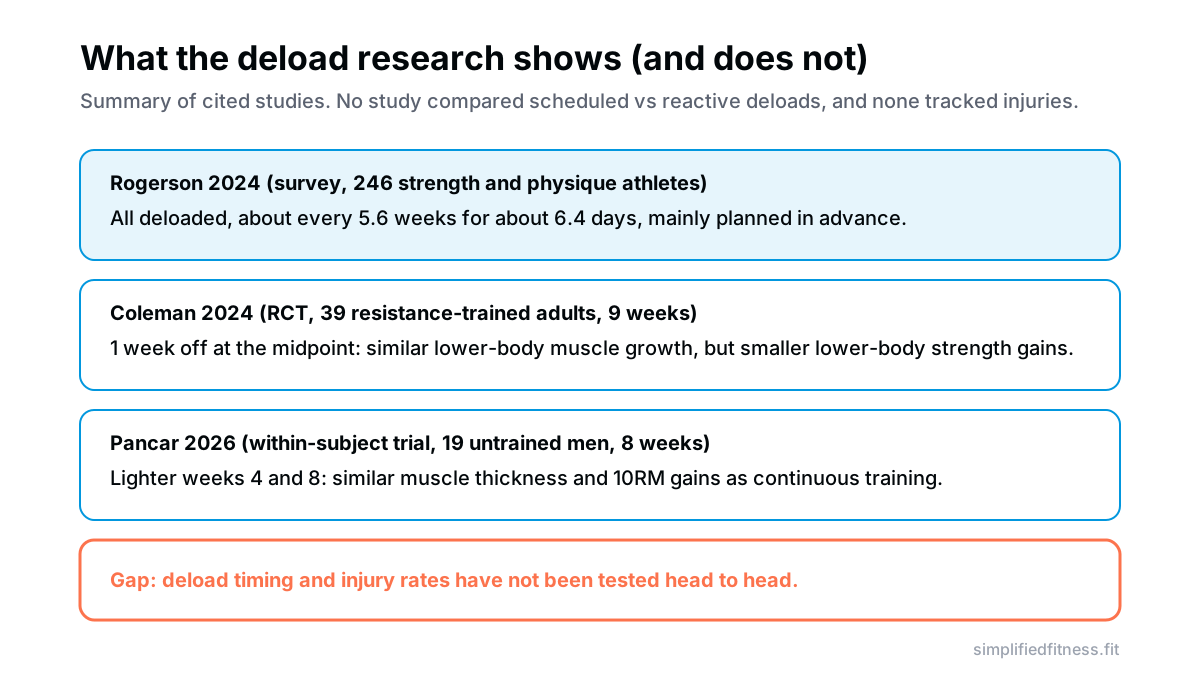
Real lifters rarely sit at either extreme. A 2024 survey of 246 competitive strength and physique athletes found that all of them deloaded, on average about every 5.6 weeks for about 6.4 days. They mainly reported a pre-planned strategy, sometimes combined with autoregulation, and also deloaded when performance stalled or soreness and joint aches built up (Rogerson et al., 2024). Note that this is a self-report survey of what people do, not evidence of what works best.
For the mechanics of how to cut volume, see volume vs intensity deloads. This article is about the timing decision.
Why newer lifters usually do better with a schedule
Reactive deloading only works if you can read your own fatigue. That is harder than it sounds.
Many RIR (reps in reserve) systems assume you can predict how many reps you have left. A study of 141 participants who did single sets to momentary failure in one full-body session found they underpredicted reps to failure, and prediction tended to improve with more experience (Steele et al., 2017). The authors concluded that RIR should be used cautiously. Another study of people with at least a year of training found they typically underpredicted by about 2 reps, with a wide confidence interval of 0 to 4 (Armes et al., 2020).
There is a counterpoint. In a bench press study of 27 men, RIR-based ratings correlated strongly with bar velocity in both experienced (about 4.7 years of training) and novice (about 1.1 years) groups, with r = 0.85 in each (Ormsbee et al., 2019). So the ratings tracked effort fairly well in one lift, in young college men, in a lab. Why the difference? Steele and Armes compared predicted reps with the reps people actually managed when pushed to failure (across a full-body session in Steele, on knee extensions in Armes). Ormsbee compared ratings with bar speed on one lift. Those are different questions.
My reading: ratings are probably useful, but too noisy for a beginner to hang a deload decision on. A beginner who feels “fine” may be further into fatigue than they realise, or may be fine and just be nervous. A calendar removes the guesswork.
There is also a practical point. Beginners rarely keep the detailed logs reactive deloading needs. If you do not write down your sets, you cannot see the slow slide.
Do deloads prevent injuries? What the evidence actually says
Short answer: not proven.
Injury rates in lifting sports are fairly low. A systematic review found 2.4-3.3 injuries per 1000 training hours in weightlifting and 1.0-4.4 in powerlifting, with the spine, shoulder and knee the most common sites, and the risk similar to other non-contact strength sports but lower than contact sports (Aasa et al., 2017). The review also rated most studies as low quality, and only one had looked at risk factors. So nobody knows whether lighter weeks reduce those numbers.
Workload ideas from team sports do not rescue the claim either. The popular acute:chronic workload ratio has been criticised heavily, with a 2020 paper concluding there is no evidence supporting its use in load-management systems to reduce injury risk (Impellizzeri et al., 2020). That paper was about load monitoring in sport generally, not lifters specifically, but it is a warning against sounding more certain than the data allow.
So why deload at all? The reasoning is that tendons, joints and connective tissue adapt more slowly than muscle, and a lighter week lowers cumulative load while you still train. It is plausible, and it matches what coaches see. It is not a tested injury-prevention result.
What deload trials show about muscle and strength
Two recent trials give some guidance on cost.
In a 2024 randomized trial, 39 resistance-trained men and women either trained for 9 weeks straight or took one full week off at the midpoint. Lower-body muscle growth, local endurance and power were not appreciably different (only lower-body outcomes were measured). The continuous group made bigger lower-body strength gains, with a slight edge on a readiness-to-train questionnaire (Coleman et al., 2024). The authors suggested a full week off may negatively influence strength.
A 2026 within-subject trial used 19 untrained young men. Each person’s legs and arms were randomly assigned to continuous training or a lighter schedule (once a week at 2 sets per exercise in weeks 4 and 8). Both conditions improved muscle thickness and 10RM similarly, with no meaningful difference between them (Pancar et al., 2026).
Do these conflict? Not really. They suggest a deload costs little for muscle size. Coleman’s group lost a bit of strength with a full week off; Pancar’s untrained group, using lighter training rather than no training, did not. The populations differ (trained vs untrained), as do the protocols and the lengths. Both were short, neither tested injuries, and neither compared scheduled with reactive timing.
The cautious takeaway: a planned easy week is unlikely to wreck your gains. If strength is your focus, a lighter week with some work in it may be safer than total rest.
Which strategy fits which lifter?
Here is how I would match them, using the evidence above plus ordinary coaching logic.
| Situation | Better default | Why |
|---|---|---|
| Under about 2 years of lifting | Proactive, every 6-8 weeks | Effort ratings are less reliable and logs are patchy |
| Intermediate, tracks sets and sleep | Hybrid | Planned slot, moved by flags |
| Advanced, years of consistent logs | Reactive, with a cap | Can spot trends early |
| Irregular shifts, travel, exams | Reactive | Life stress does not follow a calendar |
| Chasing a specific peak or meet | Proactive | Timing matters more than feel |
The “under 2 years” cut-off is a rule of thumb, not a research threshold. The studies above only show that prediction improves with experience, not where the line falls.
The hybrid approach most experienced lifters end up using
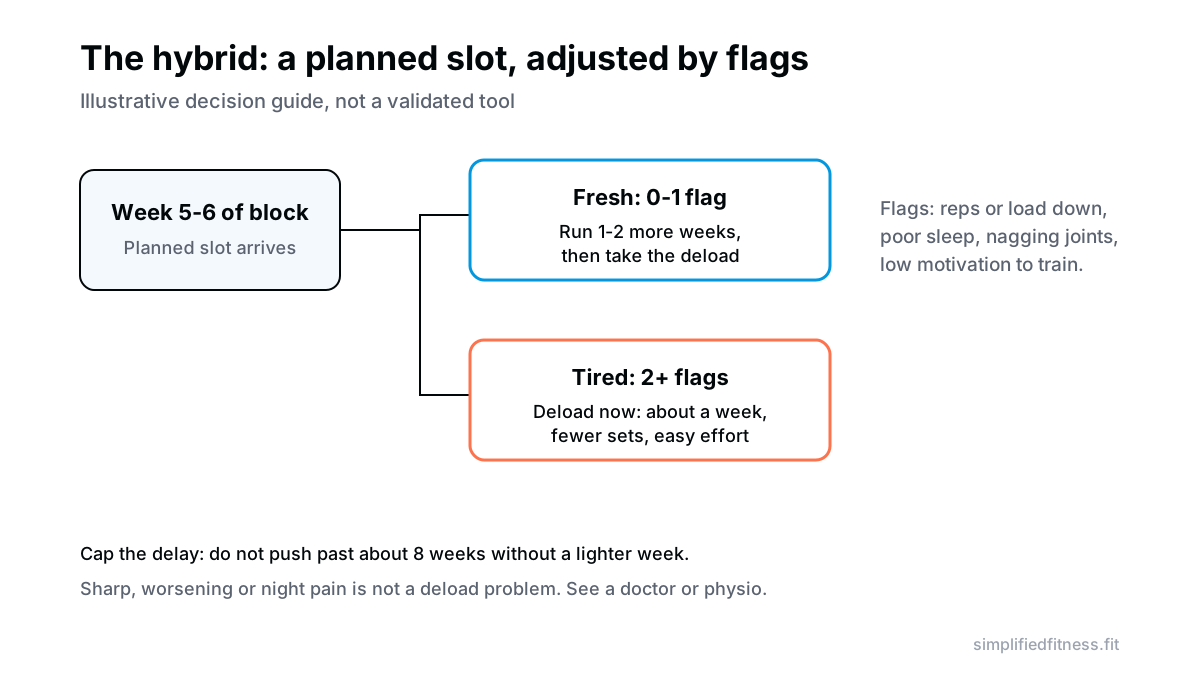
In practice, a planned slot checked against flags works better than either extreme. You pencil a deload into week 6. When week 6 arrives, you look at your log.
If you are fresh, you push one or two more weeks, then deload. If you are fraying, you deload now. The cap matters: do not drift past about 8 weeks without a lighter week. Once “I feel fine” starts to stretch a block to 12 weeks, you have stopped autoregulating and started rationalising.
For what counts as a flag, use our checklist of objective and subjective deload indicators. For why the lighter week helps, see the science of deloading and fatigue dissipation.
How to rate effort so reactive deloads work
If you go reactive, your data has to be honest.
- Log every working set: load, reps, and a rating of how many reps you had left.
- Track two or three outside variables: sleep hours, and a simple 1-5 mood or motivation score.
- Compare weeks, not days. One bad session is noise.
- Treat a flag cluster, not a single flag, as the trigger.
Because people underpredict reps in reserve, calibrate occasionally by taking a safe final set closer to failure on a low-risk lift, like a machine row or leg extension. Our RIR and RPE calculator helps translate ratings into loads. If you use ratings to set loads week to week, see autoregulated progressive overload with APRE rules.
A simple deload week in practice
Whichever timing you choose, the week itself looks similar. In the survey above, athletes typically kept training frequency and exercise selection, cut sets and reps, lowered load and stayed further from failure (Rogerson et al., 2024).
A sensible version for most gym-goers:
- Keep your usual days and exercises.
- Cut sets by about a third to a half.
- Leave 3-4 reps in reserve (stop well short of grinding).
- Keep loads the same or slightly lighter.
- Walk, sleep, eat enough protein. Dal, paneer, curd, eggs or soya all count. A hot, humid week or a poor night’s sleep is a good reason to stay on the light side.
If you want a ready-made routine to scale down, use our free push, pull, leg plans.
When to see a doctor instead of deloading
A deload is for ordinary training fatigue. It is not a treatment.
See a doctor or physiotherapist if you have sharp or worsening pain, pain that wakes you at night, swelling, numbness or tingling, chest pain or unusual breathlessness, or fatigue and low mood that last weeks despite rest. A lighter week should not be used to train around those symptoms. I cannot diagnose anything from an article, and nobody can.
So, which should you choose?
If you are newer to lifting, schedule your deloads, roughly every 6-8 weeks, and keep a basic log. If you are experienced and keep honest records, go reactive with a cap, or use the hybrid. Re-check your choice every few blocks.
Injury prevention comes from the boring things as well: sensible weekly jumps, technique you can repeat, enough sleep, and a lighter week when your body is clearly asking for one. Which exact method you pick matters less than doing it consistently.
Frequently Asked Questions
What is the difference between a proactive and a reactive deload?
A proactive deload is planned in advance, for example every sixth week, whether or not you feel tired. A reactive deload is triggered only when your numbers and body say you need it, such as stalled lifts, poor sleep and achy joints at the same time. Pick one as your default, then adjust it after a few blocks of honest logging.
Should you schedule deloads or wait until you feel tired?
If you are newer to lifting, scheduling is usually the safer default because untrained and early-stage lifters tend to misjudge effort. Research on predicting reps to failure found trainees underpredicted how many reps they had left, with accuracy improving as experience grew. If you have years of logs behind you, waiting for clear flags can work, as long as you cap how long you push.
How often should you deload if you schedule it?
Most coaching advice lands at every 5-8 weeks, and a 2024 survey of 246 competitive strength and physique athletes reported deloads about every 5.6 weeks on average. That survey describes habits, not proof of what works best. Start around week 6 and move it by a week either way based on how you feel.
Do deloads actually prevent injuries?
There is no trial showing that deloading reduces injury rates in lifters. The logic is that a lighter week lowers cumulative joint and tendon stress, but that is a reasonable idea rather than a tested result. Treat a deload as one tool alongside sensible progression, good technique and enough sleep.
What are the signs that I need a reactive deload?
Look for a cluster, not one bad day: reps or loads dropping across a couple of sessions, sleep getting worse, joints that stay sore, and dread about training. One flag alone is usually fixed with sleep and food. Two or more at once for a week or two is a good reason to back off, as covered in our checklist of deload indicators.
Can a deload hurt my progress?
It can slow strength a little. In a 2024 randomized trial of resistance-trained adults, a full week off at the midpoint of 9 weeks left lower-body muscle growth unchanged but strength gains were smaller than in continuous training. That is a short, single trial, so a lighter week rather than a full week off may be a better middle path.
Do beginners need deloads at all?
Often less than intermediates, because they lift lighter loads and recover quickly. In an 8-week study of 19 untrained men, lighter weeks at weeks 4 and 8 produced similar muscle and strength-endurance gains to continuous training, so they did no harm. A planned easy week every 6-8 weeks is a simple habit that costs very little.
Is RPE or RIR accurate enough to decide when to deload?
It is useful but imperfect. One study of trained lifters found they underpredicted reps in reserve by about 2 reps on average, another found accuracy tends to improve with experience, while a bench press study found RIR-based ratings tracked bar speed well in both novice and experienced lifters. Use ratings to spot trends over weeks rather than to judge a single set.
How long should a deload last?
Around one week is typical; the 2024 survey of strength and physique athletes reported deloads averaging about 6.4 days. Most athletes kept training frequency and exercises the same but cut sets and effort. Keep the movements familiar, stop well short of failure and return the following week.
What if I still feel tired after a deload?
Look outside the gym first: sleep, calories, protein, stress and illness. A lighter week rests the muscles and joints but cannot fix a poor sleeper or an under-eater. If fatigue, low mood or poor performance lasts several weeks despite rest, speak to a doctor.
Should I deload when I have a nagging joint pain?
A lighter week can help an irritated joint that is just overworked, especially if you also reduce the aggravating exercise. Pain that is sharp, worsening, wakes you at night or comes with swelling or numbness needs a professional assessment, not a deload. Never train through those symptoms.
Can advanced lifters skip planned deloads?
Some can, if they have reliable logs and notice early signs of fatigue. The practical risk is rationalising: pushing on for 10-12 weeks because you feel fine, then crashing. A safer approach is a loose planned slot that you may delay by a week or two but not drop.
Sources & References
Every claim above is checked against peer-reviewed research (PubMed, U.S. National Library of Medicine) or guidance from established health bodies. How we fact-check.
- Rogerson D, et al. Deloading Practices in Strength and Physique Sports: A Cross-sectional Survey. Sports Med Open. 2024. PMID: 38499934
- Coleman M, et al. Gaining more from doing less? The effects of a one-week deload period during supervised resistance training on muscular adaptations. PeerJ. 2024. PMID: 38274324
- Pancar Z, et al. Effects of deload periods in resistance training on muscle hypertrophy and strength endurance in untrained young men using a randomized within subject design. Sci Rep. 2026. PMID: 41730991
- Steele J, et al. Ability to predict repetitions to momentary failure is not perfectly accurate, though improves with resistance training experience. PeerJ. 2017. PMID: 29204323
- Armes C, et al. Just One More Rep! Ability to Predict Proximity to Task Failure in Resistance Trained Persons. Front Psychol. 2020. PMID: 33424678
- Ormsbee MJ, et al. Efficacy of the Repetitions in Reserve-Based Rating of Perceived Exertion for the Bench Press in Experienced and Novice Benchers. J Strength Cond Res. 2019. PMID: 28301439
- Aasa U, et al. Injuries among weightlifters and powerlifters: a systematic review. Br J Sports Med. 2017. PMID: 27707741
- Impellizzeri FM, et al. Acute:Chronic Workload Ratio: Conceptual Issues and Fundamental Pitfalls. Int J Sports Physiol Perform. 2020. PMID: 32502973

Umair Hazrami · Founder & Head Coach, Simplified Fitness
Umair Hazrami founded Simplified Fitness and the Simplified Lifter channel to cut through fitness noise. With 4+ years of consistent training and 10+ coaching clients, he writes every guide from the peer-reviewed research and links the sources so you can check them. Our editorial standards.
Educational content only, not medical advice. If you have a medical condition, are pregnant, or take medication, talk to a qualified doctor before changing your diet, supplements or training. Full disclaimer.
Keep reading

Programming
The 5 Modalities of Progressive Overload: A Checklist for When Weight Won't Go Up
5 ways to progressive overload: load, reps, range of motion, tempo and rest density. A practical checklist for compounds and isolations, with the research.
7 min read
Programming
Autoregulated Progressive Overload (APRE): How Much Weight to Add Next Week
Autoregulated progressive overload (APRE) uses your last-set reps to set next week's weight. Get simple jump rules, a worked example and the evidence.
9 min read

Programming
Deload Science: What a Deload Week Really Does to Fatigue, Muscle and Strength
Deload science explained: the fitness-fatigue model, what trials show for muscle size and strength, and what happens in a deload week. Studies linked.
8 min read

Programming
How to Do a Deload Week: Volume Cut vs Intensity Cut vs Time Off
How to do a deload week workout: compare cutting sets by half, lowering weight by 20%, or taking time off, with a step-by-step template and the research.
9 min read