Dynamic Double Progression (DDP): How to Progress Each Set Independently
Dynamic double progression (DDP) lets you add load to set 1 as soon as it hits the top of the rep range. Includes an 8-week tracking table and the evidence.
TL;DR. The short answer
- Dynamic double progression (DDP) means each set has its own load and its own progression: set 1 gets heavier the moment set 1 hits the top of your rep range, without waiting for sets 2 and 3.
- It fixes a real problem with classic double progression: fatigue makes later sets drop reps, so 'all sets hit 12' can take weeks longer than set 1 needs.
- DDP is a coaching method, not a lab-tested protocol. The evidence behind it is indirect: load and rep progression both work, and stopping short of failure does not appear to cost much hypertrophy.
- Use a small load jump, stay 1-2 reps from technical failure, rest long enough that set 2 is not wrecked, and log each set separately.
- If every set is stuck for 3-4 weeks, the answer is usually not a cleverer progression model. Check sleep, food, volume and rest first.
Part of our complete guide: Progressive Overload Methods, Deloads and Plateaus: The Long-Term Progression Guide
Table of contents
Dynamic double progression (DDP) is a way of progressing each set of an exercise on its own schedule. Set 1 gets heavier as soon as set 1 hits the top of your rep range. Sets 2 and 3 stay at lighter loads until they earn the same jump.
It is built for one specific problem: your first set looks great, your second and third sets keep dropping reps, and “hit 12 on every set” never seems to happen. This guide sits inside our complete guide to progressive overload, deloads and plateaus. If you have not used the classic version, read the double progression model first.
One honest note up front. DDP is a coaching method. I could not find a trial that tests it against standard double progression, so everything below is a practical extension of research on load progression, proximity to failure and rest, not proof that DDP beats anything.
Why classic double progression stalls on later sets
Classic double progression is simple. Pick a rep range, say 8-12. Keep the weight until every set reaches 12. Then add load and start again near 8.
The catch is the words “every set.” Fatigue accumulates, so with one load your first set might hit 12, your second 10 and your third 8. Set 1 was ready to go heavier two weeks ago. Set 3 is the one that decides when you progress.
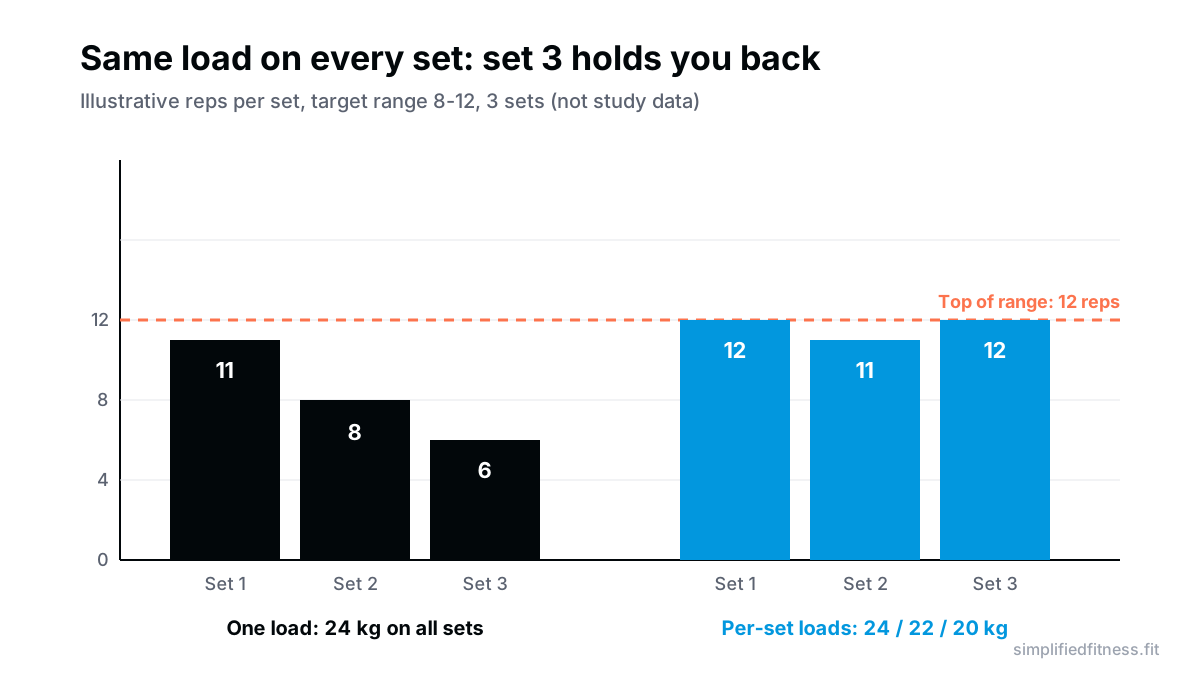
This tends to matter more once you have a few years of training behind you. Early on you progress every session and the problem never shows. Later, the gap between your freshest set and your most tired set becomes the bottleneck.
What is dynamic double progression, exactly?
The rules are short.
- Choose a rep range about 4 reps wide (8-12 is the classic example).
- Give each working set its own load. Set 1 is the heaviest. Later sets are a notch lighter so they can land in the range.
- When a set reaches the top of the range with clean reps, add the smallest load jump to that set only.
- After a jump, that set restarts near the bottom of the range. Other sets are untouched.
- Repeat every session, set by set.
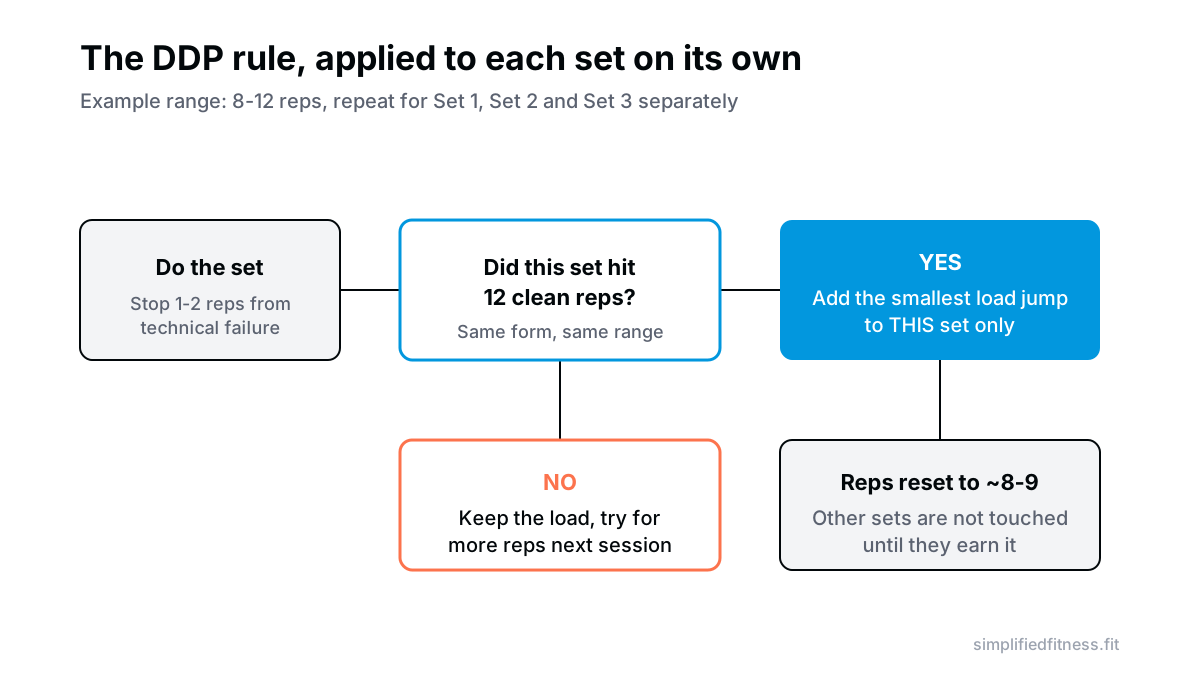
The result looks like a staircase. Over the weeks the three loads climb at different times, and the total workload still goes up.
DDP vs double progression: which should you use?
| Classic double progression | Dynamic double progression | |
|---|---|---|
| Load per set | One load for all sets | A load for each set |
| When you add weight | When every set hits the top | When that set hits the top |
| Pace set by | The weakest (usually last) set | Each set individually |
| Tracking effort | Low | Medium |
| Best for | Beginners to intermediates | Advanced intermediates with big fatigue drop-off |
If classic double progression is still working, keep it. It is easier and you do not need a more complicated tool. DDP earns its place when you notice the same pattern week after week: set 1 is ready, sets 2 and 3 are not, and nothing moves.
What does the research say?
No study has tested DDP directly, so the case for it is built from neighbouring evidence. I will say what each piece supports and what it does not.
Both load and rep progression build muscle. In a trial of 43 resistance-trained people over 8 weeks, one group added load while keeping reps constant and the other added reps at a fixed load. Rectus femoris growth modestly favoured the reps group, squat strength slightly favoured the load group, and the other muscle thickness differences were under 1 mm, with the authors calling both strategies viable (Plotkin et al., 2022). A 10-week within-person trial in 39 untrained young adults found no difference in strength or muscle size between the two approaches (Chaves et al., 2024). What this means for DDP: climbing through reps first, then load, is a defensible plan.
Individuals differ. In a related study of 37 untrained participants from the same lab, about 34% grew more with rep progression, about 19% grew more with load progression, and about 35% showed no difference (Scarpelli et al., 2025). Five people grew well with neither. This was a small study in untrained people, so treat it as a hint, not a rule. It does suggest there is no single perfect progression model.
A wide range of loads can work. A review of the repetition continuum argues that muscle growth can be achieved across a broad spectrum of loading zones, not only the traditional moderate range (Schoenfeld et al., 2021). That is why DDP can use different loads on different sets and still keep reps in a productive range.
How hard should each set be?
DDP only works if “hit 12 reps” means something consistent. Sloppy reps on set 1 will make you add weight too early.
A 2023 meta-analysis of 15 studies found no evidence that training to momentary failure beats stopping short of it for muscle growth, with a trivial advantage for “set failure” under looser definitions (Refalo et al., 2023). So you do not need to grind every set to the wall.
Can you judge 1-2 reps in reserve accurately? In 24 resistance-trained people doing bench press at 75% of 1RM, predictions of 1 and 3 reps in reserve were fairly accurate, with an average absolute error of about 0.65 reps and a slight tendency to underpredict (Refalo et al., 2024). That is one lift, one load and trained lifters, so accuracy on other exercises and at the end of long sessions may be worse. Our RIR and RPE calculator can help you turn that into a load.
A practical standard for DDP: take each set to about 1-2 reps from technical failure, with the same depth, pause and tempo every time.
Managing fatigue between sets
Set-to-set drop-off is the engine of DDP, so controlling it matters.
- Rest long enough. A 2024 Bayesian meta-analysis of 9 studies found a small hypertrophy benefit for rests longer than 60 seconds, and no appreciable difference beyond 90 seconds (Singer et al., 2024). Heavy compounds often feel better with 2-3 minutes. Those numbers are about hypertrophy, not about keeping rep counts up, so use feel as well.
- Step down loads modestly. A 2-4 kg gap between sets on a dumbbell press is plenty. If set 3 needs a huge drop, your set 1 may be too close to failure.
- Do not chase symmetry. A final set that finishes with 8-10 reps is fine. It still counts as a working set.
- Put the exercise early. If your priority lift is the last thing in the session, fatigue from earlier work will shrink set 1 as well.
Sample 8-week DDP table
This is an illustrative incline dumbbell press log, per hand, 3 sets, range 8-12, 2 kg dumbbell jumps. It is not real client data. Loads are shown as kg x reps.
| Week | Set 1 | Set 2 | Set 3 | What happened |
|---|---|---|---|---|
| 1 | 24 x 9 | 22 x 9 | 20 x 9 | Starting point |
| 2 | 24 x 10 | 22 x 10 | 20 x 9 | Reps climbing |
| 3 | 24 x 11 | 22 x 10 | 20 x 10 | Set 1 near the top |
| 4 | 24 x 12 | 22 x 11 | 20 x 11 | Set 1 hits 12 |
| 5 | 26 x 9 | 22 x 12 | 20 x 11 | Set 1 gets heavier, set 2 hits 12 |
| 6 | 26 x 10 | 24 x 9 | 20 x 12 | Set 2 heavier, set 3 hits 12 |
| 7 | 26 x 11 | 24 x 10 | 22 x 9 | Set 3 heavier |
| 8 | 26 x 12 | 24 x 11 | 22 x 10 | All three loads moved up one step |
By week 8 every set is 2 kg heavier. Under classic double progression with one load, set 3 would probably have set the pace, and the whole exercise might have waited. In practice real weeks are messier than this table, with off days and missed reps. Treat the pattern, not the numbers, as the guide. Our training logbook guide covers what to record.
When DDP does not help
DDP is a tool for a particular situation. Skip it when:
- You are a beginner. Progress is fast, so simple methods work.
- You are cutting calories hard or sleeping badly. Reps will drop on every set and no model fixes that.
- Your technique varies from week to week. You cannot compare numbers you are not measuring consistently.
- You have joint pain on a lift. Pain is a reason to adjust the exercise, not to push progression. If it persists, see a doctor or physiotherapist.
If everything has stalled for 3-4 weeks, run through the plateau troubleshooting flowchart before changing the model.
DDP and its relatives
DDP sits between two neighbours. Triple progression adds sets as a third lever, which suits you when reps and load are both maxed. APRE rules use a single test set to decide next week’s load. DDP is the one to pick when the issue is specifically the gap between set 1 and the last set.
If you want a place to apply it, the free push, pull and legs plans give you a rep range per exercise to start from.
A simple way to start
- Pick 2-3 key lifts, not your entire programme.
- Set a rep range 4 reps wide and a loading step you can actually load.
- Start set 1 at a load you can do for the bottom of the range with 1-2 reps in reserve. Drop sets 2 and 3 by the smallest step that gets them into the range.
- Log each set on its own line.
- Add load to a set only when that set hits the top with clean reps.
- Keep this up for 8 weeks before judging it.
Used this way, DDP is just a tidier way to keep every set moving. Most of the gains still come from showing up, eating enough protein (including dal, paneer, curd and soya if you are vegetarian), sleeping and not rushing the jumps.
Frequently Asked Questions
What is dynamic double progression?
Dynamic double progression (DDP) is a rep-range progression method where each set is progressed on its own. When set 1 reaches the top of the range (say 12 reps), you raise the load on set 1 next session, while sets 2 and 3 stay lighter until they reach 12 too. It is a coaching adaptation of standard double progression rather than a protocol tested in trials.
How is DDP different from regular double progression?
In regular double progression you add weight only when every set reaches the top of the range, so the weakest set sets the pace. In DDP each set qualifies individually, so a strong first set is not held back by a tired third set. The trade-off is more numbers to track.
Is DDP better than double progression for muscle growth?
There is no direct research comparing the two, so nobody can honestly say it is better. Trials show that progressing by load or by reps both build muscle, which suggests the exact bookkeeping matters less than progressing consistently. DDP is worth trying if you stall because of fatigue on later sets.
Why do my second and third sets always drop reps?
Fatigue carries over from set to set, especially with short rests and when set 1 is taken very close to failure. Longer rests of 2-3 minutes usually reduce the drop, and a small reduction in load on later sets can bring reps back into the range. Some drop is normal, so do not treat it as a sign you are doing something wrong.
How much weight should I add when a set hits the top of the range?
Use the smallest jump you can: 1-2.5 kg on barbells and machines, or the next dumbbell up. Adding the jump to one set only keeps the overall change small and manageable. If your gym lacks small plates, add reps first or use the microloading ideas in our related guide.
Should I train to failure when using DDP?
No, stopping 1-2 reps short of technical failure works well. A 2023 meta-analysis found no clear hypertrophy advantage for training to momentary failure versus stopping short. Leaving a rep or two in reserve also protects the quality of the sets that follow.
What rep range works best for DDP?
A range of 4 reps wide, such as 6-10 or 8-12, is practical for most compound and machine lifts. Research suggests muscle growth can occur across a wide spectrum of loads, so choose a range you can perform with good technique. Use higher ranges like 10-15 for isolation work and joint-friendly exercises.
Can beginners use dynamic double progression?
Beginners rarely need it. They can usually add load or reps nearly every session using plain double progression or simple linear progression. DDP becomes useful once progress slows and the gap between set 1 and set 3 grows.
How many sets should I use with DDP?
Two to four working sets per exercise is the practical zone. More sets mean more fatigue, a bigger gap between set 1 and the last set, and more to track. Start with 3 and adjust your weekly volume only if you are recovering well.
How long should I rest between sets on DDP?
Around 2-3 minutes on compound lifts, and 60-90 seconds on easy isolation lifts. A 2024 meta-analysis found a small hypertrophy benefit for rests longer than 60 seconds, with no clear difference beyond 90 seconds. If set 2 collapses, rest longer before changing anything else.
What if my set 1 never hits the top of the range?
Then it simply stays at that load and you keep adding reps. A stall of several weeks on every set points to recovery, calories, protein or volume rather than the model. Work through our plateau troubleshooting flowchart before changing your programme.
Do I need to deload while using DDP?
DDP does not replace deloads. If reps fall across several sessions, joints ache, or motivation drops, plan a lighter week as covered in our parent guide. Progressing individual sets can make you push harder for longer, so listen to the warning signs.
How do I track DDP in a notebook or app?
Write each set on its own line: load x reps for set 1, set 2 and set 3. Next to it, note the target ('add load at 12'). A logbook with one row per set is enough, and our logbook guide covers what else is worth recording.
Sources & References
Every claim above is checked against peer-reviewed research (PubMed, U.S. National Library of Medicine) or guidance from established health bodies. How we fact-check.
- Schoenfeld BJ, et al. Loading Recommendations for Muscle Strength, Hypertrophy, and Local Endurance: A Re-Examination of the Repetition Continuum. Sports (Basel). 2021. PMID: 33671664
- Refalo MC, et al. Influence of Resistance Training Proximity-to-Failure on Skeletal Muscle Hypertrophy: A Systematic Review with Meta-analysis. Sports Med. 2023. PMID: 36334240
- Singer A, et al. Give it a rest: a systematic review with Bayesian meta-analysis on the effect of inter-set rest interval duration on muscle hypertrophy. Front Sports Act Living. 2024. PMID: 39205815
- Refalo MC, et al. Accuracy of Intraset Repetitions-in-Reserve Predictions During the Bench Press Exercise in Resistance-Trained Male and Female Subjects. J Strength Cond Res. 2024. PMID: 37967832
- Plotkin D, et al. Progressive overload without progressing load? The effects of load or repetition progression on muscular adaptations. PeerJ. 2022. PMID: 36199287
- Chaves TS, et al. Effects of Resistance Training Overload Progression Protocols on Strength and Muscle Mass. Int J Sports Med. 2024. PMID: 38286426
- Scarpelli MC, et al. Individual muscle hypertrophy response is affected by the overload progression model and is associated with changes in satellite cell content. Eur J Appl Physiol. 2025. PMID: 40500534

Umair Hazrami · Founder & Head Coach, Simplified Fitness
Umair Hazrami founded Simplified Fitness and the Simplified Lifter channel to cut through fitness noise. With 4+ years of consistent training and 10+ coaching clients, he writes every guide from the peer-reviewed research and links the sources so you can check them. Our editorial standards.
Educational content only, not medical advice. If you have a medical condition, are pregnant, or take medication, talk to a qualified doctor before changing your diet, supplements or training. Full disclaimer.
Keep reading
Programming
The 5 Modalities of Progressive Overload: A Checklist for When Weight Won't Go Up
5 ways to progressive overload: load, reps, range of motion, tempo and rest density. A practical checklist for compounds and isolations, with the research.
7 min read
Programming
Autoregulated Progressive Overload (APRE): How Much Weight to Add Next Week
Autoregulated progressive overload (APRE) uses your last-set reps to set next week's weight. Get simple jump rules, a worked example and the evidence.
9 min read

Programming
Deload Science: What a Deload Week Really Does to Fatigue, Muscle and Strength
Deload science explained: the fitness-fatigue model, what trials show for muscle size and strength, and what happens in a deload week. Studies linked.
8 min read

Programming
How to Do a Deload Week: Volume Cut vs Intensity Cut vs Time Off
How to do a deload week workout: compare cutting sets by half, lowering weight by 20%, or taking time off, with a step-by-step template and the research.
9 min read