Training Logbook Science: What to Record, What to Skip and the Mistakes That Stall Progress
Training logbook best practices: the 6 variables worth writing down, what to skip, a weekly audit, and the tracking mistakes that quietly stall progress.

TL;DR. The short answer
- Write down the exact exercise, load in kg, reps per set, effort (RIR or RPE) and machine settings. Add one line of context such as sleep or pain. That is enough to repeat or beat last session.
- A logbook does not build muscle by itself. It works because you read it before you lift and aim to beat the previous number, even by one rep.
- In one large meta-regression of exercise and diet interventions, self-monitoring explained the most variation between studies, but no trial has tested lifting logbooks head to head, so treat the benefit as likely rather than proven.
- A notebook and an app both work. The better tool is the one you will actually fill in after every set for months.
- Audit once a week: mark each lift as up, flat or down. Three flat sessions at the same effort is your cue to check sleep, food, volume and form before changing the program.
Part of our complete guide: Progressive Overload Methods, Deloads and Plateaus: The Long-Term Progression Guide
Table of contents
Training logbook best practices come down to a short list: write down the exact exercise, the load in kg, the reps for each working set, how hard the last set was, and any machine settings. Then read it before you train and try to beat it. That last step is the one most people skip.
A logbook is the working tool behind progressive overload, not a diary. If you have never kept one, start with our beginner guide to keeping a training logbook. This piece goes a layer deeper: which variables earn a place on the page, what to ignore, how to audit week to week, and the tracking mistakes that quietly stall progress.
Why bother logging at all?
Memory is a bad training partner. By Thursday you cannot say whether last Monday’s incline press was 22 or 24 kg, or whether the last rep was a grind. Without that number you cannot apply overload on purpose. You just lift “about the same” for months.
What does the research say? There is no trial that compares lifters who keep logbooks with lifters who do not. Be clear about that. The nearest evidence is from behaviour change research. A 2009 meta-regression of 122 evaluations (N = 44,747) of physical activity and healthy eating interventions found that self-monitoring explained the most variation between studies, and that interventions pairing self-monitoring with at least one other control-theory technique worked better (effect size 0.42 versus 0.26) (Michie et al., 2009). Those were general adults, not trained lifters, and the techniques included goal setting and feedback.
So the honest claim is modest. Self-monitoring helps people change behaviour, and a logbook is how lifters do it. Calling it “the single best predictor of progress” would go further than the data does.
What should you write in a gym notebook?
Six things cover almost everything. Keep each one short enough to write between sets.
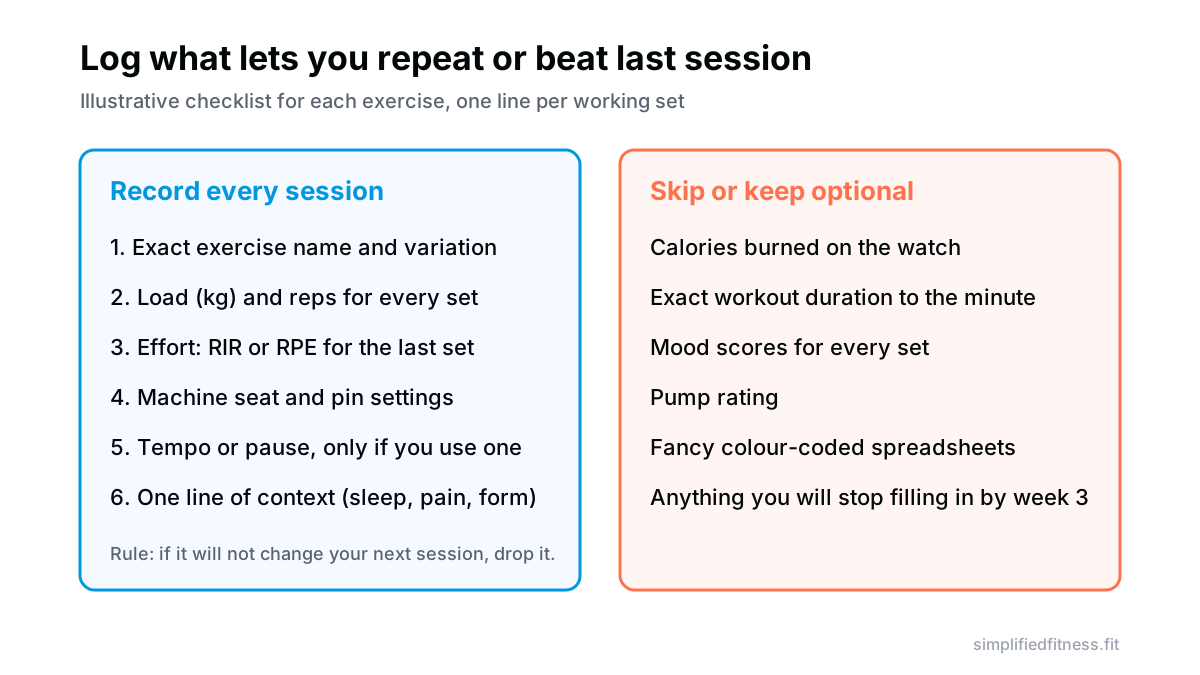
- Exact exercise name and variation. “Incline dumbbell press, 30 degrees” beats “chest press”. A barbell bench and a machine press are different lifts with different numbers.
- Load and reps for every working set. “24 kg x 10, 9, 8” is far more useful than “3 x 10 at 24”.
- Effort, as RIR or RPE. Reps in reserve (how many more clean reps you had) tells you whether 24 kg x 8 was easy or a near-max. Our reps in reserve and RPE guide explains the scale, and the RIR/RPE calculator helps you convert it into loads.
- Machine seat and pin settings. More on this below.
- Tempo or pauses, but only if you use them. A 2-second lowering or a 1-second pause in the stretch changes how hard the same weight feels.
- One line of context. Slept 5 hours, left shoulder tight, new gym. That line explains the odd session when you review it.
That is the full list. A review of monitoring methods in resistance training notes that volume load and the perceived intensity of individual sets give useful information about the actual training stimulus (Scott et al., 2016). The same review points out that intensity is often described only as a percentage of 1RM, which ignores rest periods, rep speed and how many reps were actually done. Recording the actual sets and effort avoids that blind spot.
Why exact seat and pin settings matter
This is the detail that separates a useful log from a decorative one. On machines, seat height, back pad position and pin placement change the range of motion and where the resistance feels heaviest. If you write “leg curl, 45 kg” and next month the seat is one notch different, you are comparing two different exercises without knowing it.
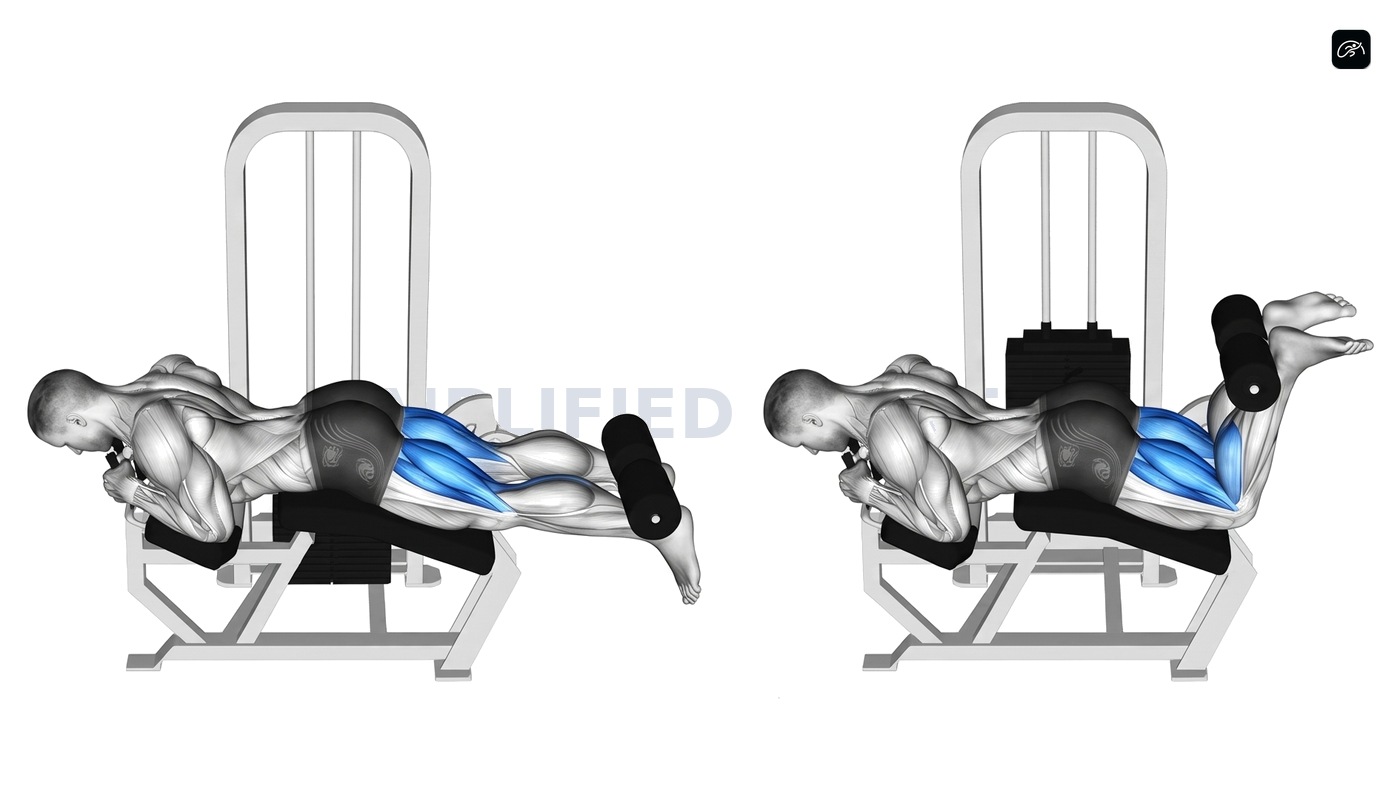
Write the setting once (“seat 4, pad 3”) and only update it when you change it. If you train in a shared Indian gym where every machine is a slightly different brand, add the gym or machine name too. A 40 kg stack on one brand is not a 40 kg stack on another.
What should you ignore?
Tracking more is not the same as tracking better. Skip these unless you have a specific reason:
- Calories burned on a watch. Estimates are rough and will not change your next set.
- Exact session length. Note it only if sessions are drifting long.
- Warm-up sets. They are not driving progress and they clutter the page.
- A rating for every feeling. One note per session is plenty.
- A perfect spreadsheet. Beautiful logs that you abandon in week three are worse than a messy notebook you keep for a year.
The test is simple. Will this change what I do next session? If not, drop it.
How to log so you can beat last time
A log only drives progress when it sets the target for the next session. Here is the loop.
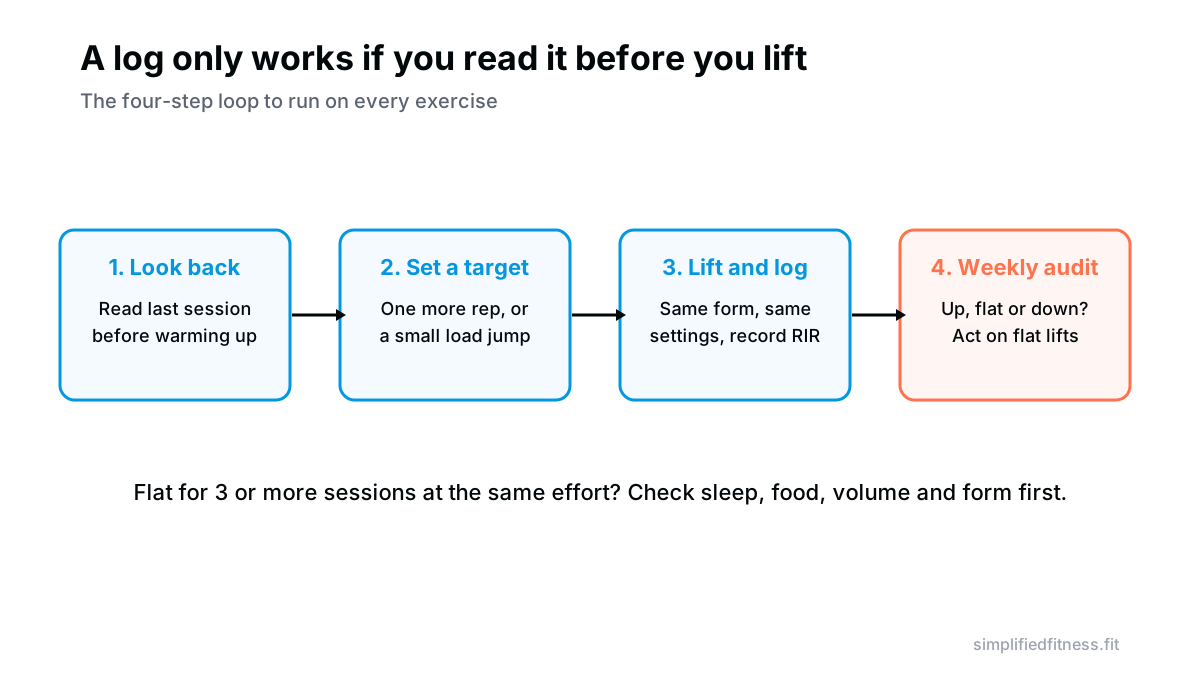
Step 1: look back. Before your first working set, read what you did last time on that exact exercise.
Step 2: set a target. One more rep at the same weight, or a slightly higher weight at the bottom of your rep range. If you work with a rep range, the logic is covered in our double progression guide. If you are stuck because plates jump too far, see microloading with fractional plates.
Step 3: lift and log. Write the set straight after you finish it, not at the end of the session. By then you will have forgotten the third set.
Step 4: audit weekly. Once a week, mark each lift as up, flat or down.
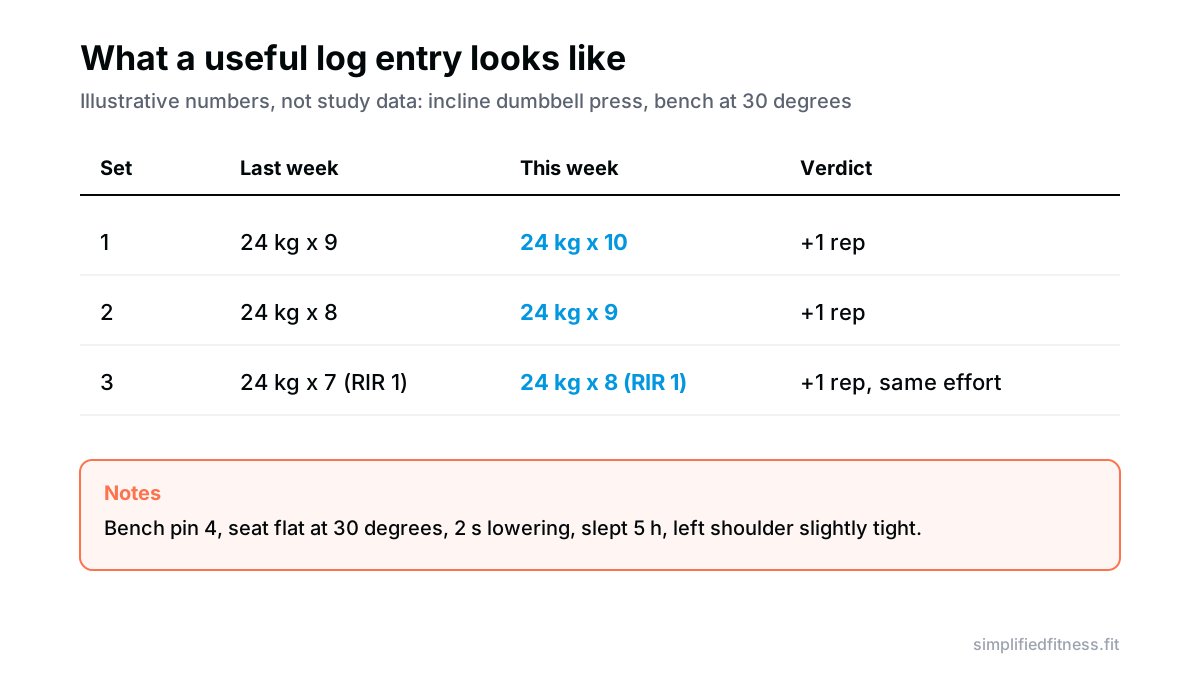
The numbers in Figure 3 are illustrative, not study data. They show the format: same exercise, same setup, one extra rep per set at the same effort.
Do you have to train to failure for the log to work?
No. The log needs an honest effort number, not a grinder every set. A 2023 meta-analysis of 15 studies found no evidence that training to momentary muscular failure was better than non-failure for hypertrophy (effect size 0.12, 95% CI -0.13 to 0.37) (Refalo et al., 2023). Some of the studies were short and varied in how they defined failure, so this is a reasonable guide, not a final word.
So the useful question is “how close did I go?” rather than “did I fail?”. That is what RIR records. How accurate is it? In a study of 24 resistance-trained men and women, predictions of 1 and 3 RIR on the bench press at 75% of 1RM were off by roughly 0.65 reps on average, with a slight tendency to underpredict (Refalo et al., 2024). That was one exercise, one load and a lab setting, so do not assume the same precision on every lift.
Another study followed 9 trained men over 6 weeks of bench press and found that RIR accuracy did not significantly improve over time (Remmert et al., 2023). The sample was small. A review of strength-training monitoring methods makes a related point: subjective tools such as RPE and RIR help account for day-to-day changes in readiness that fixed percentages of 1RM miss (Suchomel et al., 2021). The practical takeaway: your RIR number is a decent estimate, not a measurement. Log it anyway, and keep the same scale each time so the numbers stay comparable. For definitions of failure and form standards, our piece on technical vs mechanical failure is the companion read.
Which rep range should I log against?
Whatever your program says. You do not need to chase a special “hypertrophy zone” to make the log worthwhile. A review of the repetition continuum argues that muscular adaptations can be obtained across a wide range of loading zones (Schoenfeld et al., 2021). Choose a range you can perform with good form and keep it steady for several weeks, so your comparisons mean something.
If you want a broader tracking measure than per-exercise numbers, weekly hard sets per muscle group is easier to count than tonnage. We cover that trade-off in quantifying training volume: hard sets vs tonnage.
How do you audit week-over-week progression?
Do it in five minutes on the same day each week.
- List your main lifts.
- Compare this week’s top set with last week’s at a similar effort.
- Mark it up (more reps or more load), flat, or down.
- Look at your context notes for the flat and down lifts.
- Pick one thing to change, not five.
One flat week means nothing. Sleep, a stressful week at work, a hot gym in an Indian summer and a missed meal can all cost you a rep. Three or more flat sessions at the same effort is the signal to look closer. Check in this order: sleep, food and protein intake, total weekly sets, then exercise technique and setup consistency. Our systematic plateau flowchart walks through what to do next.
A related caution: do not read one great session as a new baseline. A single heavy day can be a good night’s sleep, not a trend. Judge progress as a trend over a few weeks, not as individual sessions.
Notebook or app: which is better?
Neither wins on science. No study shows that one format builds more muscle. A notebook is fast and never needs charging; an app shows last session automatically and draws trends for you. The best tool is the one you finish after every set, for months. Our beginner logbook guide compares the two formats in more detail.
Whichever you pick, keep the previous session visible next to the new one, and turn off any app features you do not use. The quickest way to quit tracking is to make logging feel like a second job.
Common workout tracking mistakes
Almost all of these break the link between the record and the next session.
- Logging but never reading. The data exists but never sets a target.
- Changing exercises constantly. If you swap the lift every two weeks you have nothing to compare. See why exercise rotation does not need to be constant.
- Skipping effort. Without RIR or RPE, you cannot tell a good set from a grinding one.
- Skipping settings. A new seat position looks like a new strength level.
- Rounding everything. “About 20 kg” erases the one-rep progress you are trying to see.
- Logging at the end of the session. You will misremember sets.
- Tracking too much. Eight variables per set means you stop by week three.
- Judging single sessions. Focus on 3 to 6 week trends.
- Letting the log shame you. A lower number is data, not a verdict. If tracking makes you anxious or obsessive, loosen it.
A simple template to copy
For each exercise, write one line:
Incline DB press (bench 30 degrees, pin 4): 24 x 10, 9, 8 | RIR 1 on last set | slept 5 h
Then write next to it: Target next time: 24 x 10, 10, 9. If you want a ready-made program to log against, our free push, pull, legs plan gives you a structure for it.
Everything beyond that is optional. Start there, keep it for eight weeks, and only add a column if you can name the decision it will help you make.
When to see a doctor
A logbook can show a pattern: strength dropping for weeks, unusual fatigue, or pain that appears on the same lift each time. If you notice sharp or persistent pain, numbness, or a sustained drop in performance with unexplained tiredness, do not try to train through it. See a doctor or physiotherapist. A training log is not a diagnostic tool.
The bottom line
A logbook helps you do one thing well: apply progressive overload on purpose. Record the exact exercise, load, reps, effort and machine settings, add one context note, and read it before you lift. Aim to beat last time by a rep or a small load jump, audit once a week, and look for trends over several weeks.
Choose the format you will actually use. Keep the template short. And if the numbers stall, check sleep, food, volume and form before you change the whole program.
Frequently Asked Questions
How do I start tracking my workouts?
Pick one place, a notebook or an app, and write the exercise, load, reps and effort for every working set. Without a record you are comparing today to a vague memory, which is how progress stalls unnoticed. Start with your next session and copy last week's numbers as your target.
What should I write in a gym notebook?
Write the exact exercise name, load in kg, reps per set, how close the last set was to failure (RIR or RPE), and machine settings such as seat height or pin position. Those are the variables that let you recreate the same conditions next time. Add a one-line note about sleep, pain or form so odd sessions make sense later.
Is a workout log really necessary to build muscle?
It is not strictly required, but it makes progressive overload far easier to apply on purpose. A large meta-regression of exercise and diet interventions found self-monitoring to be one of the most useful techniques, though lifting logbooks have not been tested directly. If you cannot remember last week's weights, a log removes the guesswork.
Should I use an app or a paper notebook?
Either works, because the benefit comes from recording and reviewing, not from the format. Apps auto-fill last session and chart trends, while notebooks are faster in a crowded gym and never run out of battery. Choose the one you can complete in under 20 seconds per set.
Do I need to track RIR or RPE?
It helps, because the same weight and reps can be easy one week and a grind the next. Trained lifters are reasonably accurate at judging RIR on the bench press, usually within about one rep, though accuracy varies by exercise. Log a rough number for your last set and treat it as an estimate, not an exact measurement.
Why log machine seat and pin settings?
A different seat height or pin position changes the lever arm, range of motion and sometimes how heavy the stack feels. If you do not record it, a lighter-feeling day may just be a different setup. Write the number once in your notes and update it only when you change it.
How often should I review my training log?
Glance at last session before every lift, and do a short audit once a week. Mark each exercise as up, flat or down compared with the previous week. A weekly rhythm is frequent enough to catch stalls and slow enough to avoid reacting to normal day-to-day noise.
What are the most common workout tracking mistakes?
The big ones are logging without ever reading the log, changing exercises too often to compare, skipping effort and settings, and tracking too many things so you quit. These mistakes break the link between the record and the next session. Fix them by keeping a short template and always setting a target before you start.
How do I know from my log that I am progressing?
Look at the same exercise at a similar effort level across 3 to 6 weeks. More reps at the same weight, or the same reps at a higher weight, both count as progress. A single heavy day proves little, so judge the trend, not one session.
What if my numbers go down some weeks?
Small dips are normal and usually reflect sleep, stress, food or a different setup. Training volume and effort are also easy to mismatch, so check your notes before assuming something is wrong. If numbers fall for several sessions in a row, review sleep, calories and total weekly sets, and speak to a doctor if you have pain or unusual fatigue.
Should I track warm-up sets?
Usually not. Warm-ups do not drive progress and logging them adds clutter that makes you quit sooner. Record your working sets, and only note a warm-up if it reveals an issue such as a sore joint.
Can I track my workouts if I train at a crowded Indian gym with few machines?
Yes, and it matters even more when equipment is shared or the stack numbers differ from gym to gym. Write which gym or machine you used, and note when you substitute, for example dumbbells for a cable. That keeps your comparisons honest when you have to improvise.
Do I need to track nutrition and bodyweight in the same log?
It is optional, but a weekly average bodyweight next to your lifts helps you interpret changes in strength. Keep it to one number per week so the log stays quick. If tracking food feels stressful or triggers unhealthy habits, skip it and talk to a professional.
Sources & References
Every claim above is checked against peer-reviewed research (PubMed, U.S. National Library of Medicine) or guidance from established health bodies. How we fact-check.
- Michie S, et al. Effective techniques in healthy eating and physical activity interventions: a meta-regression. Health Psychol. 2009. PMID: 19916637
- Refalo MC, et al. Accuracy of Intraset Repetitions-in-Reserve Predictions During the Bench Press Exercise in Resistance-Trained Male and Female Subjects. J Strength Cond Res. 2024. PMID: 37967832
- Remmert JF, et al. Changes in Intraset Repetitions in Reserve Prediction Accuracy During Six Weeks of Bench Press Training in Trained Men. Percept Mot Skills. 2023. PMID: 37436724
- Refalo MC, et al. Influence of Resistance Training Proximity-to-Failure on Skeletal Muscle Hypertrophy: A Systematic Review with Meta-analysis. Sports Med. 2023. PMID: 36334240
- Schoenfeld BJ, et al. Loading Recommendations for Muscle Strength, Hypertrophy, and Local Endurance: A Re-Examination of the Repetition Continuum. Sports (Basel). 2021. PMID: 33671664
- Scott BR, et al. Training Monitoring for Resistance Exercise: Theory and Applications. Sports Med. 2016. PMID: 26780346
- Suchomel TJ, et al. Training for Muscular Strength: Methods for Monitoring and Adjusting Training Intensity. Sports Med. 2021. PMID: 34101157

Umair Hazrami · Founder & Head Coach, Simplified Fitness
Umair Hazrami founded Simplified Fitness and the Simplified Lifter channel to cut through fitness noise. With 4+ years of consistent training and 10+ coaching clients, he writes every guide from the peer-reviewed research and links the sources so you can check them. Our editorial standards.
Educational content only, not medical advice. If you have a medical condition, are pregnant, or take medication, talk to a qualified doctor before changing your diet, supplements or training. Full disclaimer.
Keep reading
Programming
The 5 Modalities of Progressive Overload: A Checklist for When Weight Won't Go Up
5 ways to progressive overload: load, reps, range of motion, tempo and rest density. A practical checklist for compounds and isolations, with the research.
7 min read
Programming
Autoregulated Progressive Overload (APRE): How Much Weight to Add Next Week
Autoregulated progressive overload (APRE) uses your last-set reps to set next week's weight. Get simple jump rules, a worked example and the evidence.
9 min read

Programming
Deload Science: What a Deload Week Really Does to Fatigue, Muscle and Strength
Deload science explained: the fitness-fatigue model, what trials show for muscle size and strength, and what happens in a deload week. Studies linked.
8 min read

Programming
How to Do a Deload Week: Volume Cut vs Intensity Cut vs Time Off
How to do a deload week workout: compare cutting sets by half, lowering weight by 20%, or taking time off, with a step-by-step template and the research.
9 min read