Signs You Need a Deload Week: A Four-Point Checklist for Tired Lifters
Signs you need a deload week: falling reps, broken sleep, nagging joint aches and gym dread. Use this four-point checklist to decide when to back off.

TL;DR. The short answer
- The clearest signs you need a deload week are reps or load dropping for two sessions in a row at the same effort, plus disrupted sleep, lingering joint aches and a new dread of training.
- One bad session means little. Two or more flags that persist for one to two weeks is a stronger case for a reactive deload.
- In a sleep restriction trial in trained women, bar speed, perceived effort and stress markers worsened much more than total volume did, so check effort, not only numbers on the bar.
- The ECSS and ACSM overtraining consensus says no current marker is reliable enough for general use, so use a pattern of signs and rule out illness, under-eating and low iron.
- Sharp or worsening pain, swelling, night pain or persistent low mood are not deload problems. See a doctor or physiotherapist.
Part of our complete guide: Progressive Overload Methods, Deloads and Plateaus: The Long-Term Progression Guide
Table of contents
The signs you need a deload week are a pattern, not a single bad session: reps or load falling for two sessions in a row at the same effort, sleep that has gone wrong, joint aches that do not settle, and a new dread of walking into the gym. Two or more of those lasting a week or two is a good reason to back off. One flat Tuesday is not.
This is the reactive side of deloading, the “something is off right now” call. For the full picture of how deloads sit inside a training plan, start with our guide to progressive overload, deloads and plateaus. If you would rather schedule rest before fatigue builds, see proactive vs reactive deloads.
What does a lifter who needs a deload look like?
You are still training. You still show up. But the weights that moved fine three weeks ago now feel heavy, warm-ups drag, and you finish sessions flatter than you started. Sound familiar?
In sports science, that state has a name. A short-term performance drop that reverses with rest, and often leads to improvement afterwards, is called functional overreaching. If the balance between training and recovery keeps being ignored, it can slide into nonfunctional overreaching, and eventually overtraining syndrome. The European College of Sport Science and ACSM consensus statement describes this spectrum, and admits that separating nonfunctional overreaching from overtraining syndrome is very difficult and depends on clinical outcome and exclusion of other causes (Meeusen et al., 2013).
It also says that none of the markers currently used (hormones, performance tests, psychological tests, biochemical and immune markers) meet all the criteria for general use. Translation: there is no blood test or app score that tells you to deload. You need a pattern. If you want the deeper distinction, we cover it in overtraining syndrome vs nonfunctional overreaching.
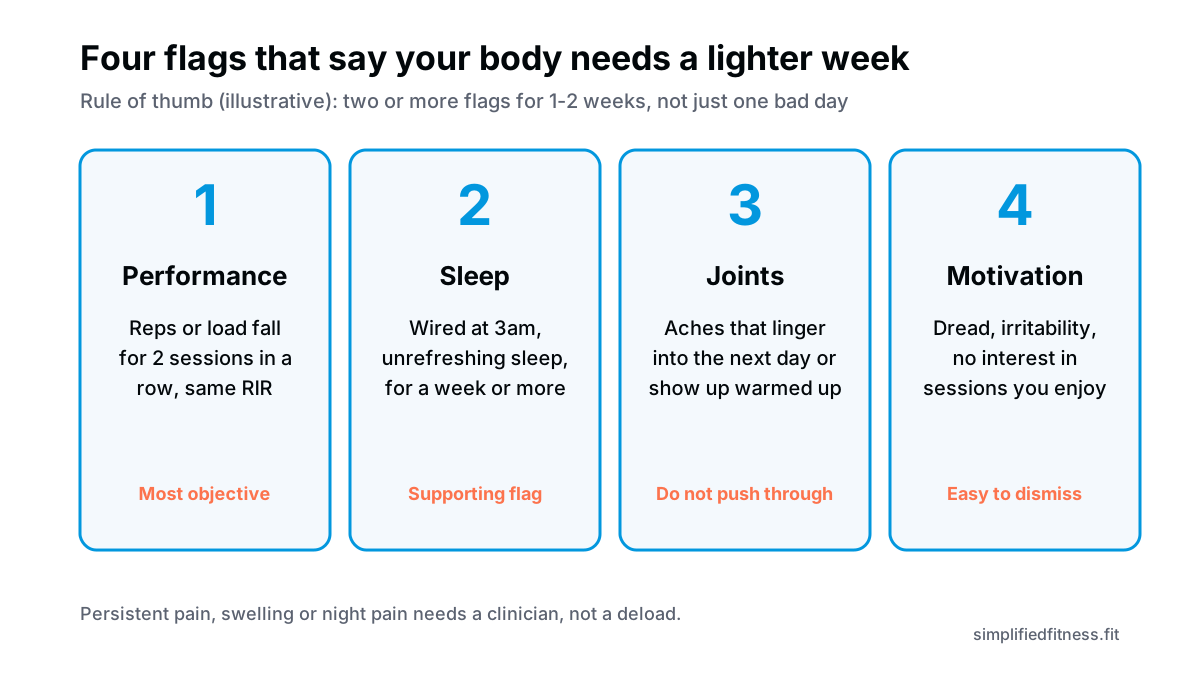
Flag 1: Are your reps or loads falling for two sessions in a row?
This is the most useful flag because it is the most objective. Your log does not care about your mood.
What counts: the same exercise, the same target effort (say, 1-2 reps in reserve), and fewer reps or less load than last time, in two consecutive sessions. A single drop is noise. Two in a row, with normal food and sleep, starts to look like fatigue.
Two traps to avoid:
- Comparing across different effort. If you stopped at 4 reps in reserve last week and 0 this week, a rep drop means nothing.
- Judging by one lift. If squats, rows and presses are all sliding, that is a stronger signal than one stubborn exercise.
Effort tracking matters here. A systematic review of 14 studies and 356 participants found that autoregulating training with repetitions in reserve or RPE ratings, as well as velocity targets, was associated with strength gains (Larsen et al., 2021). The review is about using these tools to adjust training, not about diagnosing fatigue, but it supports why logging effort alongside load is worth the 10 seconds. Our RIR and RPE calculator helps if you are unsure how to rate a set, and our guide to what to track in a training logbook covers the rest.
Flag 2: Is your sleep falling apart?
Waking at 3am feeling wired, lying awake after a late session, or sleeping nine hours and still feeling flat. Sleep disruption is often reported alongside heavy training and life stress, though the research linking training load directly to sleep problems in recreational lifters is limited, so treat it as a flag, not proof.
What the research does show is the reverse: what poor sleep does to lifting.
- A 2018 systematic review of 17 studies (rated moderate or weak quality) found that a single night of total sleep deprivation had little effect on strength, but consecutive nights of sleep restriction could reduce force output in multi-joint lifts, though not single-joint ones (Knowles et al., 2018).
- A 2022 meta-analysis of 69 publications found sleep loss (6 hours or less) was linked to an average 7.56% drop in exercise performance, with consistent effects after deprivation and late-restriction patterns, and morning exercise largely unaffected (Craven et al., 2022). The studies varied a lot (I2 of 98%), and the participants were mostly male, so treat the number as a rough direction.
- In a 2022 crossover trial, ten resistance-trained females did nine nights of 5-hour sleep and nine nights of 7+ hours. Total volume load dropped by less than 1%, but lower body bar speed slowed by up to 15%, velocity loss within sets was up to 7% greater, salivary cortisol rose 42%, training distress rose 84% and session perceived exertion rose 11% (Knowles et al., 2022).
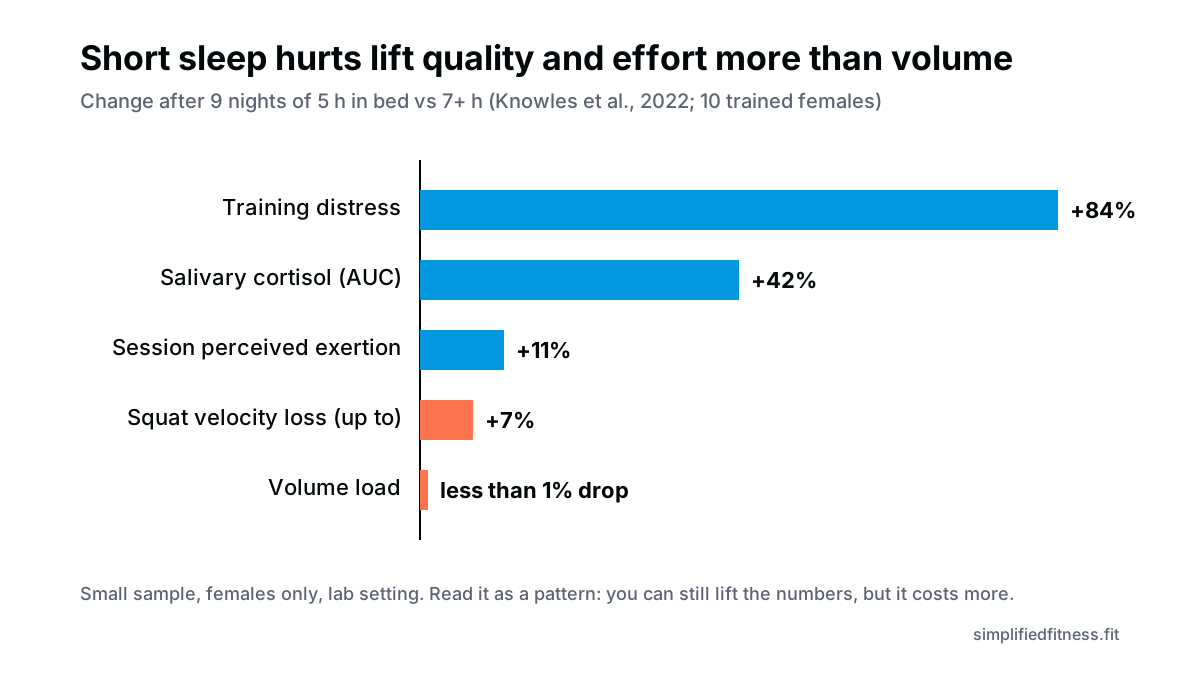
The practical read: sleep trouble can make the same workout feel harder before your totals fall. If you cannot fix sleep quickly (exams, a new baby, night shifts), a lighter week removes one stressor while you sort it out. If sleep stays broken for weeks, or you snore heavily and feel exhausted by day, talk to your doctor. For fixes, see our sleep hygiene checklist for lifters.
Flag 3: Are your joints and tendons nagging you?
Muscle soreness fades in a couple of days. Joint and tendon aches feel different: a dull knee after squats, elbows that complain on rows, a shoulder that is stiff in the morning.
Tendon research gives a useful frame. A review by Cook and Purdam proposes a continuum of load-related tendon pathology, from a reactive state to degeneration, and says presentation varies a lot in pain, irritability and function (Cook and Purdam, 2009). It is a model for clinicians, not a lifter’s test, so do not self-diagnose from it. What it supports is the idea that load matters and that the response to load differs person to person.
A practical way to sort aches:
| Pattern | Reasonable response |
|---|---|
| Mild, familiar, gone within a day | Keep training; trim sets or swap an exercise if it recurs |
| Lingering into the next day, or present when warm | Deload now: lighter loads, fewer sets, easier exercise variations |
| Sharp, worsening, swollen, night pain, numbness | Stop loading it and see a doctor or physiotherapist |
Flag 4: Has the gym turned into something you dread?
You used to look forward to leg day. Now you refresh your phone for ten extra minutes before leaving. You are irritable, or training feels like admin.
This flag is real but the weakest alone. Motivation drops with work stress, boredom, poor food and a bad month for reasons that have nothing to do with training. The consensus statement lists psychological markers among those used to detect overtraining, but it also says none are reliable on their own (Meeusen et al., 2013).
Where it earns weight is in combination. Dread plus falling reps plus bad sleep? That is a story. Dread alone? Maybe change your exercises or train with a friend first. And if low mood, loss of interest in everything, or hopelessness lasts more than a couple of weeks, that is a conversation for your doctor, not your program.
How many flags mean I should deload now?
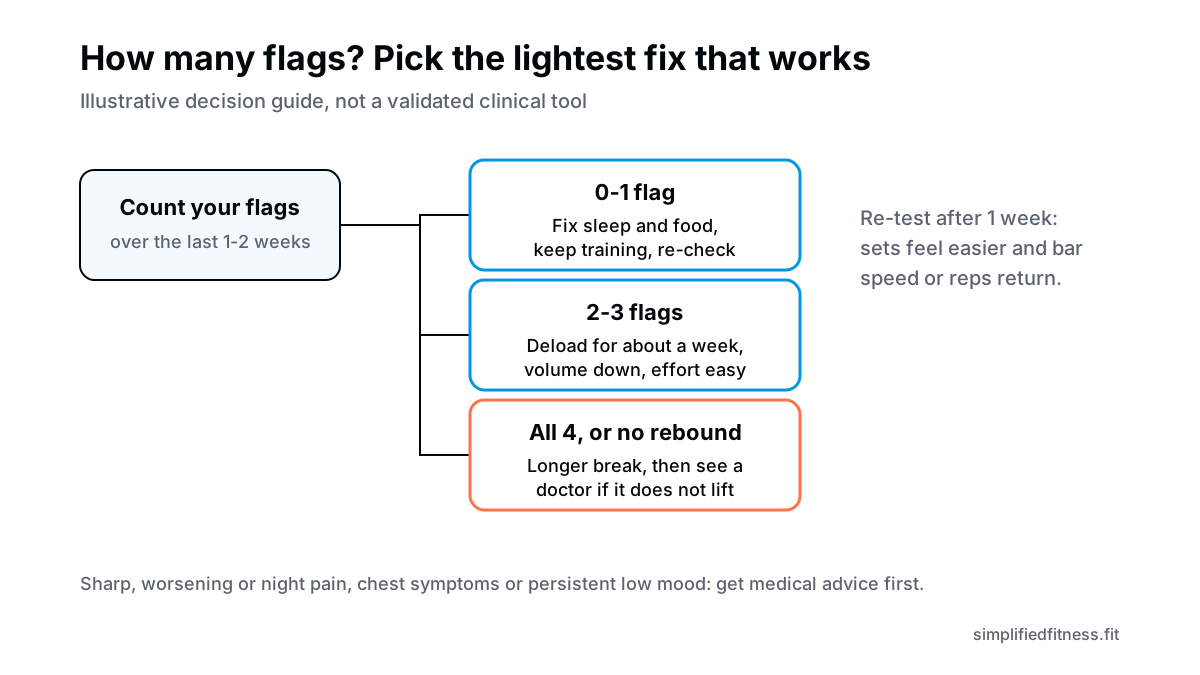
There is no validated threshold. Here is a sensible rule of thumb, based on the logic above and not on a trial:
- 0-1 flag: keep training. Check sleep, protein and calories.
- 2-3 flags for one to two weeks: run a reactive deload.
- All four, or no rebound after a week off: take longer, look at non-training causes, and see a doctor if fatigue or low mood persists.
What to rule out before you blame your program
The consensus statement says that understanding overtraining syndrome involves excluding other causes, including illness and infection, dietary calorie restriction, insufficient carbohydrate or protein intake, iron deficiency, magnesium deficiency and allergies (Meeusen et al., 2013).
That matters for lifters on a cut, and for vegetarian lifters in India who may be eating less protein and iron than they think. Dal and curd for lunch, a roti-sabzi dinner and not much else adds up to less protein than most lifters assume. If you are cutting hard, fatigued and flat, check your food before you check your split. Our macro calculator gives a quick sanity check. Persistent tiredness, pale skin or breathlessness deserve a doctor visit and blood tests, not guesswork.
What a reactive deload actually looks like
Keep it boring and short. Cut sets by roughly a third to a half, keep the same exercises, stop every set well short of failure, and aim to leave the gym feeling fresher than you arrived. The research on exactly how best to do this is thin, and approaches vary, so see our breakdown of volume vs intensity deloads and the how-to-deload walkthrough. For the underlying mechanism, read deload science.
Then retest. After a week, the same loads should feel easier, sleep should steady and aches should ease. If everything is back to normal, go back to progressing. If your numbers stay stuck even when you feel fine, you probably have a programming problem, and our lifting plateau flowchart is the better tool.
Frequently Asked Questions
What are the signs you need a deload week?
The main signs are reps or load falling for two consecutive sessions at the same effort, broken or unrefreshing sleep, joint or tendon aches that do not settle between sessions, and a new dread of training. No single sign is proof on its own. Look for two or more that last a week or two, then pull volume back.
How do I know when to deload at the gym?
Check your log first: if your top sets have dropped for two sessions despite eating and sleeping normally, that is your trigger. A consensus statement on overtraining notes that no single marker is reliable, so combine performance, sleep, aches and mood. If two or more are off, take a lighter week.
Can poor sleep be a sign I need to deload?
Yes, it can be one signal, especially if it arrives together with falling performance. In a trial of resistance-trained females, nine nights of sleep restriction raised perceived effort and stress markers and slowed bar speed. Fix the sleep basics first, and deload if the other flags are also present.
Why do I wake up at 3am after hard training weeks?
Hard training, high stress, late caffeine and poor recovery can all fragment sleep, and the cause is rarely one thing. The evidence on training load and sleep is limited, so treat it as a flag rather than a diagnosis. If it persists beyond a couple of weeks or comes with daytime exhaustion, talk to your doctor.
Should I train through joint aches or deload?
Mild, familiar achiness that settles within a day can often be managed by trimming volume or swapping an exercise. Aches that linger, worsen or show up even when warmed up are a reason to lighten load now. Sharp pain, swelling or pain at night needs a clinician, not a deload.
Is feeling unmotivated to train a sign of overtraining?
It can be one sign, but it is a weak one alone. Motivation also drops with stress, boredom, poor sleep and low mood, so it needs context. If dread appears together with falling performance and bad sleep, a deload is reasonable. If low mood persists for weeks, speak to your doctor.
How many bad workouts mean I need a deload?
One or two flat sessions are normal noise. A useful rule of thumb is two consecutive sessions where reps or load fall at the same effort, with at least one other flag. That points to accumulated fatigue rather than a bad day, and a lighter week is a low-cost test.
What is the difference between overreaching and overtraining?
Functional overreaching is a short-term performance dip that reverses with rest and often leads to improvement afterward. Nonfunctional overreaching and overtraining syndrome involve longer-lasting maladaptation, and the ECSS and ACSM statement says telling them apart is difficult. For most gym lifters the more likely issue is plain accumulated fatigue, which a week of reduced training often helps.
Is it normal for strength to drop during a hard training block?
A small temporary dip at the end of a heavy block is common and fits the idea of functional overreaching. A steady slide over several sessions, especially with poor sleep, is not something to grind through. Deload, then retest.
What should I do in a reactive deload week?
Cut your sets by roughly a third to a half, keep the same exercises, and stop every set well short of failure. Keep moving the same weight or slightly less so the pattern stays familiar. Details of different deload styles are in the linked methods article.
How do I know the deload worked?
After a week, the same loads should feel easier, your sleep should be steadier, and aches should have eased. If you return and the same weights still feel awful, look beyond training: calories, protein, iron, illness, stress and sleep. If nothing improves in a couple of weeks, see a doctor.
Can undereating cause the same symptoms as needing a deload?
Yes. The overtraining consensus statement lists caloric restriction, low carbohydrate or protein intake and iron deficiency among the factors to exclude before blaming training. Fatigue, poor performance and mood changes overlap heavily. Check your intake and ask a doctor about blood tests if tiredness is persistent.
Should I deload if I feel fine but my numbers are stuck?
Not necessarily. A plateau with good sleep, good mood and no aches is more often a programming or progression issue than a fatigue issue. Review your rep targets, effort and recovery before taking time off, and use the plateau flowchart if it persists.
Sources & References
Every claim above is checked against peer-reviewed research (PubMed, U.S. National Library of Medicine) or guidance from established health bodies. How we fact-check.
- Meeusen R, et al. Prevention, diagnosis, and treatment of the overtraining syndrome: joint consensus statement of the European College of Sport Science and the American College of Sports Medicine. Med Sci Sports Exerc. 2013. PMID: 23247672
- Knowles OE, et al. Inadequate sleep and muscle strength: Implications for resistance training. J Sci Med Sport. 2018. PMID: 29422383
- Knowles OE, et al. Sustained Sleep Restriction Reduces Resistance Exercise Quality and Quantity in Females. Med Sci Sports Exerc. 2022. PMID: 36136596
- Craven J, et al. Effects of Acute Sleep Loss on Physical Performance: A Systematic and Meta-Analytical Review. Sports Med. 2022. PMID: 35708888
- Larsen S, et al. Effects of subjective and objective autoregulation methods for intensity and volume on enhancing maximal strength during resistance-training interventions: a systematic review. PeerJ. 2021. PMID: 33520457
- Cook JL, et al. Is tendon pathology a continuum? A pathology model to explain the clinical presentation of load-induced tendinopathy. Br J Sports Med. 2009. PMID: 18812414

Umair Hazrami · Founder & Head Coach, Simplified Fitness
Umair Hazrami founded Simplified Fitness and the Simplified Lifter channel to cut through fitness noise. With 4+ years of consistent training and 10+ coaching clients, he writes every guide from the peer-reviewed research and links the sources so you can check them. Our editorial standards.
Educational content only, not medical advice. If you have a medical condition, are pregnant, or take medication, talk to a qualified doctor before changing your diet, supplements or training. Full disclaimer.
Keep reading

Programming
The 5 Modalities of Progressive Overload: A Checklist for When Weight Won't Go Up
5 ways to progressive overload: load, reps, range of motion, tempo and rest density. A practical checklist for compounds and isolations, with the research.
7 min read
Programming
Autoregulated Progressive Overload (APRE): How Much Weight to Add Next Week
Autoregulated progressive overload (APRE) uses your last-set reps to set next week's weight. Get simple jump rules, a worked example and the evidence.
9 min read

Programming
Deload Science: What a Deload Week Really Does to Fatigue, Muscle and Strength
Deload science explained: the fitness-fatigue model, what trials show for muscle size and strength, and what happens in a deload week. Studies linked.
8 min read

Programming
How to Do a Deload Week: Volume Cut vs Intensity Cut vs Time Off
How to do a deload week workout: compare cutting sets by half, lowering weight by 20%, or taking time off, with a step-by-step template and the research.
9 min read