Hypertrophy Resensitization: Do Low-Volume Maintenance Blocks Really Reboot Muscle Growth?
Hypertrophy resensitization explained: what the evidence says about low-volume maintenance blocks, how to run a 2-4 week block, and when it is not the fix.
TL;DR. The short answer
- Hypertrophy resensitization is the idea that a short, easy training phase makes muscle respond better to hard training afterwards. It is a coaching theory with limited direct human evidence, not an established mechanism.
- In the one trial that tested it in trained people, a full 1-week break did not improve lower body muscle growth and led to smaller lower body strength gains than training straight through (Coleman et al., 2024).
- A low-volume block, roughly 4-6 hard sets per muscle per week at 2-3 reps in reserve, is a reasonable coaching alternative to stopping entirely, though no trial has tested it for resensitization. Maintenance research suggests muscle can be kept with far less volume if loads stay heavy enough.
- Run it for 2-4 weeks at maintenance calories, then raise volume gradually. Fix sleep, food and stress first, because those cause most 'stale' feelings.
- Persistent fatigue, low mood, poor sleep or pain that lasts beyond a few weeks is a reason to see a doctor, not a reason to tweak your program.
Part of our complete guide: Progressive Overload Methods, Deloads and Plateaus: The Long-Term Progression Guide
Table of contents
Hypertrophy resensitization is the idea that a short, easy training phase makes your muscles respond better when hard training resumes. The honest answer is that it might help some tired lifters, but the “reboot” biology behind it is mostly a theory, and the best human trial on the question was not flattering.
That does not make the low-volume block useless. It makes it a fatigue-management tool, not a magic switch. This guide covers what the research does and does not show, how to run a 2-4 week block, and when it is the wrong move. It sits inside our wider guide to progressive overload, deloads and plateaus.
What is hypertrophy resensitization, really?
The popular explanation goes like this. Train hard for six months and your connective tissue gets beaten up, you carry low-grade inflammation, and your muscle’s growth machinery (including ribosome production, the cell’s protein factories) stops responding as well. A few easy weeks supposedly clear all that, and growth restarts.
Here is the problem. Each link in that chain is plausible, but we could not find a human study that shows all of them happening in trained lifters. Let’s look at what we do have.
- Volume and ribosomes are linked. In 34 untrained people doing one-leg-versus-the-other training for 12 weeks, moderate volume produced more muscle growth than low volume, alongside more ribosome-related signaling (Hammarström et al., 2020). That supports “volume matters”, not “volume desensitizes”.
- No obvious blunting after 8 weeks. In 14 young men, the acute growth-signalling response to a workout (including a marker of ribosome production) was similar before and after 8 weeks of training (Figueiredo et al., 2015). That is short-term and in healthy young men, so it cannot speak to six years of lifting.
- Chronic overload can cause trouble. A scoping review found that chronic high-volume or high-intensity training can lead to non-functional overreaching, where performance stalls for weeks, though the review found minimal evidence of true overtraining syndrome in lifters (Bell et al., 2020).
So the fair summary: fatigue and stalled performance are real. A distinct “desensitized anabolic receptor state” that a block repairs is not demonstrated. If you want the full picture of the broader reset idea, see our companion piece on volume resensitization and deloads.
Does taking time off actually boost muscle growth?
This is the most direct test we found. In 2024, researchers split 39 resistance-trained men and women into two groups for a 9-week high-volume program. One group took a full week off at the midpoint. The other trained straight through (Coleman et al., 2024).
The authors started from the resensitization idea. The result:
- No appreciable difference in lower body muscle size, local endurance or power.
- The continuous group improved lower body strength more.
- The continuous group also scored slightly better on a readiness-to-train questionnaire.
Their conclusion was that a 1-week deload mid-program appeared to hurt strength and had no effect on hypertrophy. Caveats matter here: the participants were young, the program was only 9 weeks, upper body training was unsupervised, and one week of complete rest is not the same as a few weeks of lighter training. It shows that a total break is not an automatic upgrade. It does not prove that a lifter with real accumulated fatigue gains nothing from backing off.
A second study asked whether the type of break matters. Thirty trained men finished 6 weeks of rising volume (up to 32 sets of 10 per exercise per week), then either trained at roughly 15% of that final week’s volume or stopped completely for a week. The muscle biopsy markers were largely similar, with only marginal differences (Vann et al., 2021).
Why a low-volume block makes more sense than stopping completely
No trial has compared a multi-week light block with multi-week rest for resensitization, so this is reasoning from indirect evidence. If the point is to feel better and train well afterwards, a light block has two practical advantages over zero training.
You keep your muscle. A review on the minimal dose needed to preserve fitness concluded that strength and muscle size, at least in younger people, can be maintained for up to 32 weeks with as little as one strength session a week and one set per exercise, as long as the relative load stays high. Older adults may need up to 2 sessions and 2-3 sets per exercise (Spiering et al., 2021). The authors point to intensity as the key variable. Note that this is a narrative review, not a head-to-head trial of resensitization.
You keep the habit. Skills, gym routine and motivation do not switch off. For a lot of people, three weeks of nothing becomes six.
And volume is not the enemy in general. A meta-analysis of 15 studies found a graded dose-response, with more weekly sets linked to more muscle growth on average (Schoenfeld et al., 2017). That is why the block is temporary. You are not trying to live at 5 sets a week; you are trying to get your recovery back so you can do 12-16 again productively.
How to run a 2-4 week low-volume maintenance block
This is a coaching template built on the findings above, not a protocol tested in a trial. The ranges are adjustable.
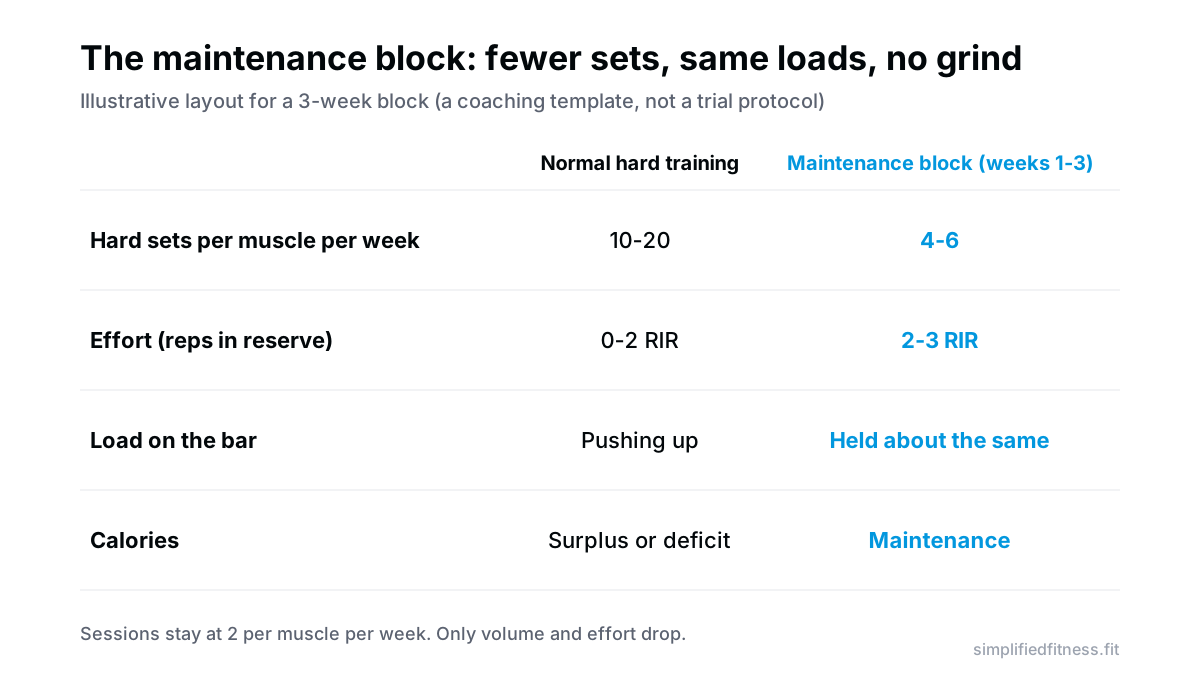
- Volume: 4-6 hard sets per muscle per week. Use our training volume calculator to count your normal week first, then roughly halve or better. Keep two sessions per muscle if you can; two shorter exposures often feel better than one long one.
- Effort: 2-3 reps in reserve. Stop well short of failure. If you are unsure how to judge it, our RIR and RPE calculator helps you pick loads.
- Loads: stay close to normal. Cut sets, not weight. If your usual working set is 8 reps at 100 kg with 1 rep left in the tank, 100 kg for 6-7 clean reps puts you at roughly 2-3 reps in reserve.
- Calories: maintenance. Use the calorie calculator for a starting estimate and hold protein at your normal target. Cutting hard during a block stacks two stressors; bulking hard turns it into a fat-gain phase.
- Duration: 2-4 weeks. Pick the end date on day one.
- Everything else: keep your exercise selection, sleep as much as you can, and use the spare time for walks and mobility rather than a second job.
Expect the first week to feel almost too easy. That is the point, not a sign you are doing it wrong.
Rebuilding after the block
The re-entry is where most people waste the break.
- Start near the lower end of your old volume, not at the top. For example, if you ran 18 sets a week before, begin around 8-10.
- Add roughly 1-2 sets per muscle per week while effort moves from 2-3 reps in reserve back towards 0-2.
- Expect the first week to feel strong and fresh. Do not read that as proof of a “reboot”; fresh legs feel strong.
- Write down your sets, loads and reps. If nothing improves after several weeks of proper effort, the block was not your problem. Our mesocycle architecture guide shows how to build the climb back up.
When a maintenance block is the wrong answer
Most “stale” feelings are not an anabolic problem at all. Check these first.
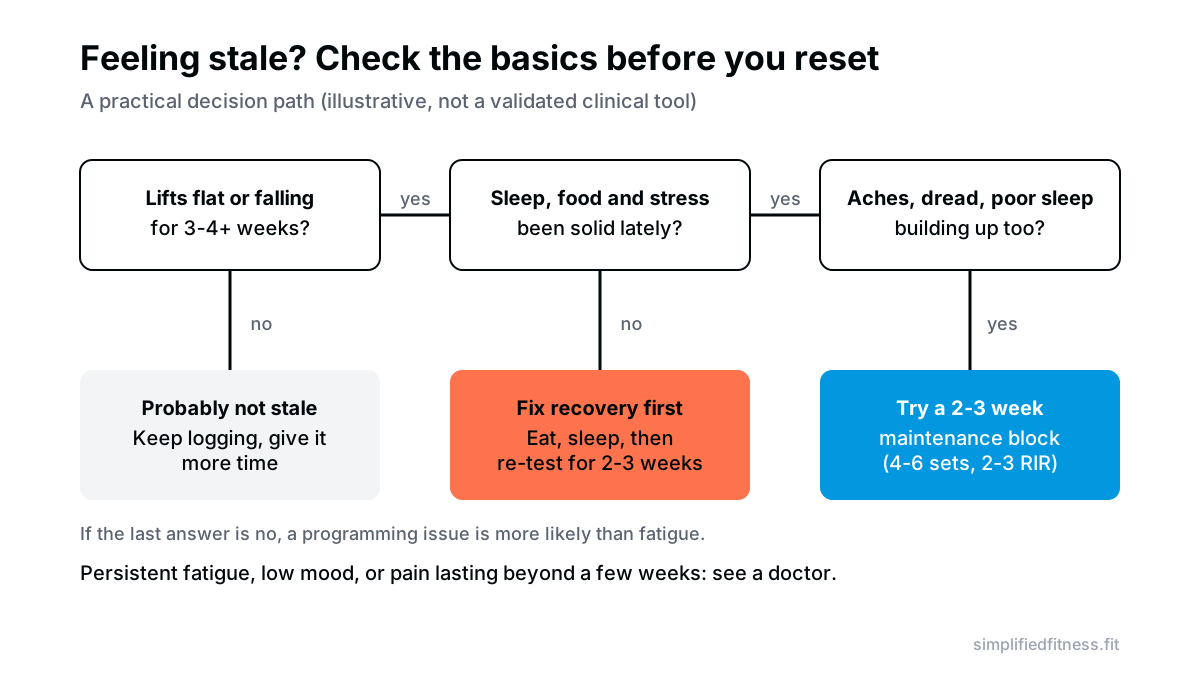
- You are under-eating or under-sleeping. A reset will not outrun a 6-hour sleep habit or a long-running calorie deficit.
- Your program is the issue. If you have run the same 12 exercises, same rep ranges and no progression scheme for months, you have a programming plateau. See our plateau troubleshooting guide.
- You need a short deload, not a block. If it is just been one hard mesocycle, a 5-7 day deload is probably enough. Compare options in deloading methods, and check the signs you need a deload.
- It may be more than fatigue. Weeks of unusual exhaustion, mood changes, disturbed sleep, loss of appetite, or pain that does not settle are not a programming issue. See a doctor. The line between normal fatigue and something clinical is covered in our piece on overreaching versus overtraining syndrome.
Who should and should not bother
A block is worth considering if you have trained hard and continuously for 4-6 months or more, your lifts have been flat or falling, and you also have the soft signals: nagging aches, dread of sessions, flat mood in the gym.
Skip it if you are a beginner, if you have just come back from time off, or if your recovery habits are shaky. Fix those first.
The bottom line
Hypertrophy resensitization is a useful story with thinner evidence than the internet suggests. The best trial in trained people found no growth advantage from a full week off. What the broader research does support is that muscle can be held with a fraction of normal volume if the loads stay honest, and that chronic high effort can sometimes pile up into stalled performance.
So treat a 2-4 week low-volume block as a planned way to recover and keep the habit alive, not a way to reboot biology. Run it with 4-6 sets per muscle, 2-3 reps in reserve and maintenance calories, then rebuild gradually.
Frequently Asked Questions
What is hypertrophy resensitization?
It is the idea that after months of hard training, a short low-volume phase restores your muscles' response to a growth stimulus. The theory is popular with coaches, but direct human evidence is limited. Treat it as a reasonable way to manage fatigue rather than a proven biological reset.
Does taking a break from lifting make muscle grow faster afterwards?
Not reliably. In a 2024 randomized trial in resistance-trained adults, a 1-week full break during a 9-week program did not improve lower body hypertrophy and led to smaller strength gains than continuous training. A lighter phase might still help if you are genuinely run down, but that has not been tested directly.
How long should a maintenance block last?
Two to four weeks is a common coaching range, not a trial-tested number. If one easy week clears the fatigue, you only needed a deload. Much longer than four weeks starts to eat into productive training time. Set an end date before you start so it does not drift.
How many sets per muscle should I do in a maintenance block?
About 4-6 hard sets per muscle per week at 2-3 reps in reserve is a workable target. Maintenance reviews suggest muscle size can be held for months with as little as 1 set per exercise and one session per week in younger people, provided loads stay challenging. Use our training volume calculator to count your weekly sets.
Should I eat at maintenance calories during the block?
Maintenance calories are a sensible default because they keep recovery supported without adding fat or stacking a diet on top of a reset. This is coaching practice rather than something a trial has tested for resensitization. Estimate your number with the calorie calculator and keep protein high.
Will I lose muscle during a low-volume block?
Unlikely over 2-4 weeks if you keep training with heavy-enough loads. A review of minimal training doses concluded that relative load (how heavy the weight is) matters most for holding onto muscle, and volume can drop a lot. Keep your usual exercises and loads, and cut sets rather than weight.
Is a maintenance block the same as a deload?
They overlap, but a deload is usually about a week and aimed at clearing short-term fatigue, while a maintenance block runs longer and also gives joints, motivation and appetite a rest. A survey of 246 competitive strength and physique athletes found deloads averaged about 6 days, every 5-6 weeks. Think of the maintenance block as the longer, planned cousin used once or twice a year.
How do I know if I actually need one?
Look for lifts flat or falling for several weeks despite decent sleep and food, plus signs like nagging aches, dread of sessions or poor sleep. If sleep and nutrition are the real problem, fix those first because a reset will not outrun them. Our deload indicators checklist walks through the warning signs.
Is it better to stop training completely or train lightly?
Neither option has clear evidence on its side. A 2021 study of trained men found that 1 week of active recovery (about 15% of the final week's volume) and 1 week of complete rest produced largely similar muscle responses, so the choice can come down to preference. If you find it hard to stay away from the gym, a light block keeps the habit alive.
Can beginners use a resensitization phase?
Beginners rarely need one. They progress quickly on modest volume and usually have not accumulated enough fatigue to need a reset. If a beginner feels flat, sleep, calories and plain consistency are far more likely culprits.
Does too much volume blunt muscle growth?
Not on average. A 2017 meta-analysis found more weekly sets were associated with greater muscle gain, so volume is not the enemy. Individual tolerance differs, though, and a scoping review found chronic high-volume or high-intensity training can tip some lifters into non-functional overreaching. The problem is volume you cannot recover from.
What do I do after the maintenance block ends?
Restart near your old volume's lower end, not your peak, and add sets over several weeks. Raise effort back towards 0-2 reps in reserve as you rebuild. If you jump straight to peak volume you risk piling the fatigue straight back on.
Sources & References
Every claim above is checked against peer-reviewed research (PubMed, U.S. National Library of Medicine) or guidance from established health bodies. How we fact-check.
- Coleman M, et al. Gaining more from doing less? The effects of a one-week deload period during supervised resistance training on muscular adaptations. PeerJ. 2024. PMID: 38274324
- Vann CG, et al. Molecular differences in skeletal muscle after 1 week of active vs. passive recovery from high-volume resistance training. J Strength Cond Res. 2021. PMID: 34138821
- Rogerson D, et al. Deloading practices in strength and physique sports: a cross-sectional survey. Sports Med Open. 2024. PMID: 38499934
- Spiering BA, et al. Maintaining physical performance: the minimal dose of exercise needed to preserve endurance and strength over time. J Strength Cond Res. 2021. PMID: 33629972
- Hammarstrom D, et al. Benefits of higher resistance-training volume are related to ribosome biogenesis. J Physiol. 2020. PMID: 31813190
- Figueiredo VC, et al. Ribosome biogenesis adaptation in resistance training-induced human skeletal muscle hypertrophy. Am J Physiol Endocrinol Metab. 2015. PMID: 25968575
- Bell L, et al. Overreaching and overtraining in strength sports and resistance training: a scoping review. J Sports Sci. 2020. PMID: 32602418
- Schoenfeld BJ, et al. Dose-response relationship between weekly resistance training volume and increases in muscle mass: a systematic review and meta-analysis. J Sports Sci. 2017. PMID: 27433992

Umair Hazrami · Founder & Head Coach, Simplified Fitness
Umair Hazrami founded Simplified Fitness and the Simplified Lifter channel to cut through fitness noise. With 4+ years of consistent training and 10+ coaching clients, he writes every guide from the peer-reviewed research and links the sources so you can check them. Our editorial standards.
Educational content only, not medical advice. If you have a medical condition, are pregnant, or take medication, talk to a qualified doctor before changing your diet, supplements or training. Full disclaimer.
Keep reading

Programming
The 5 Modalities of Progressive Overload: A Checklist for When Weight Won't Go Up
5 ways to progressive overload: load, reps, range of motion, tempo and rest density. A practical checklist for compounds and isolations, with the research.
7 min read
Programming
Autoregulated Progressive Overload (APRE): How Much Weight to Add Next Week
Autoregulated progressive overload (APRE) uses your last-set reps to set next week's weight. Get simple jump rules, a worked example and the evidence.
9 min read

Programming
Deload Science: What a Deload Week Really Does to Fatigue, Muscle and Strength
Deload science explained: the fitness-fatigue model, what trials show for muscle size and strength, and what happens in a deload week. Studies linked.
8 min read

Programming
How to Do a Deload Week: Volume Cut vs Intensity Cut vs Time Off
How to do a deload week workout: compare cutting sets by half, lowering weight by 20%, or taking time off, with a step-by-step template and the research.
9 min read