From Novice Linear Progression to Intermediate Periodization: What to Do When 5x5 Stalls
Transitioning from beginner to intermediate lifting? Learn how to spot a real stall, then move to double progression, weekly waves and an upper/lower split.
TL;DR. The short answer
- Linear progression has run its course when you fail the same weight for about three sessions, even after fixing sleep, food and a small deload. One bad week is not a stall.
- A 2022 meta-analysis found periodized programs beat non-periodized ones for 1RM strength (effect size 0.31) but not for muscle size, when total volume was matched.
- Undulating models looked better than linear ones for strength in trained lifters (effect size 0.61, borderline), with no difference in untrained people or for hypertrophy.
- The simplest next step is double progression: work inside a rep range and add weight only after you hit the top of it on every set.
- Most intermediate lifters do well training each muscle about twice a week, which fits a 4-day upper/lower split.
Part of our complete guide: Progressive Overload Methods, Deloads and Plateaus: The Long-Term Progression Guide
Table of contents
Transitioning from beginner to intermediate lifting is mostly one change: you stop adding weight every session and start earning progress over a week or a month instead. You are ready when you have failed the same load for about three sessions, after fixing sleep, food and a short deload. Then you move to double progression, a simple weekly wave or a short mesocycle, usually inside a 4-day split.
This guide sits under our main resource on progressive overload, deloads and plateaus. Here we focus on the bridge: how to tell a real stall from a rough patch, what to run next, and how to avoid the classic mistake of overcomplicating things.
When does linear progression stop working?
Linear progression means the bar gets heavier every workout, for example +2.5 kg on the squat each session. It works brilliantly for a while because you are new, your technique is improving, and a session of squats is a big enough stimulus that you recover in time for the next one.
Then the arithmetic catches up. A lifter squatting 60 kg can add 2.5 kg and barely notice. A lifter squatting 110 kg adding the same amount every 48 hours is asking for a faster rate of adaptation than the body usually supplies.
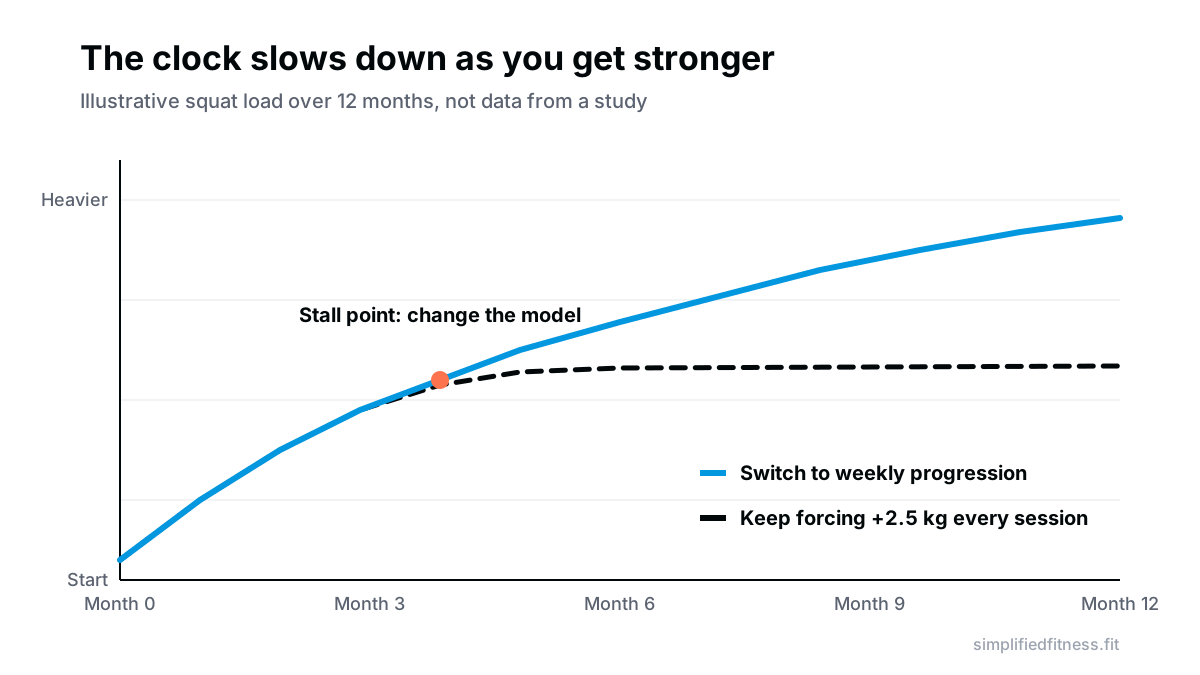
Plenty of things look like the end of linear progression and are not. A bad night, a skipped lunch, a hot gym in June, a week of exam stress. These cost you a session or two, not your whole program.
How do you know it is a real stall, not a bad week?
Run these checks in order. Most people stop at step two.
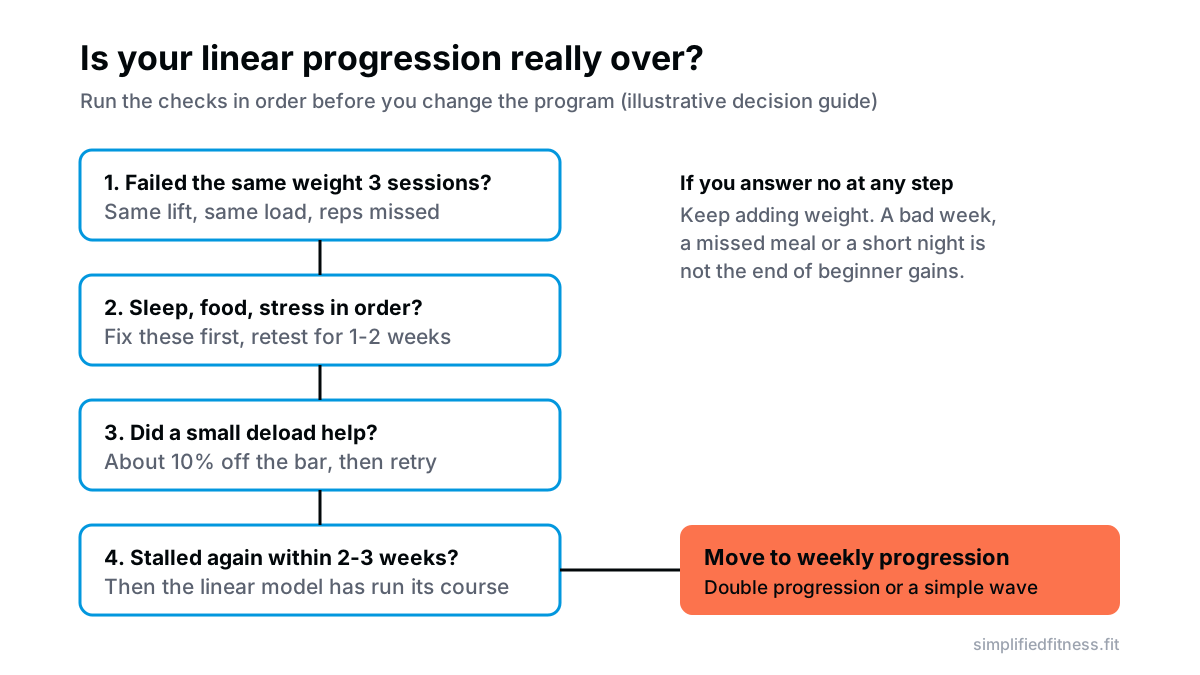
- Same weight, same lift, three misses. Not a single bad set. Three sessions where you cannot complete the planned reps at that load.
- Check the basics. Are you eating enough (on a dal-roti-rice budget it is easy to undereat protein and total calories without realising), sleeping around seven hours, and keeping your form consistent? Our protein calculator gives you a starting daily target.
- Take a small deload. Drop the weight by roughly 10%, keep the reps clean for a week or two, then climb back.
- See what happens next. If you pass the old weight and keep going, you were just tired. If you stall again within two to three weeks, the model is finished.
What changes between novice and intermediate training?
Not as much as program marketing suggests. You still lift hard, still track numbers, and still aim to beat your past self. What changes is the timescale.
- Novice: progress shows up session to session.
- Intermediate: progress shows up week to week or across a four to eight week block.
- Advanced: progress shows up over months, and often needs planned peaks.
Your rep ranges also get more flexible. The old idea that 1-5 reps build strength, 6-12 reps build size and 15+ builds endurance, called the repetition continuum, has been questioned. A 2021 review argued that muscle growth can be obtained across a wide spectrum of loads, with heavier loading mattering most for maximal strength (Schoenfeld et al., 2021). That gives you room to vary reps without feeling you are doing something wrong.
What does the research say about periodization?
Periodization is planned variation in volume and intensity over time. People often talk about it as if it were mandatory, so it helps to see what the data supports.
A 2022 systematic review and meta-analysis pooled 35 studies in which total volume was matched between groups. Periodized training beat non-periodized training for 1RM strength (effect size 0.31, 95% CI 0.04 to 0.57), but muscle size did not differ (effect size 0.13, 95% CI -0.10 to 0.36) (Moesgaard et al., 2022). In the same paper, undulating models beat linear ones for strength overall (effect size 0.31), and the gap was larger in trained participants (0.61, with a confidence interval that touched zero) than in untrained ones (0.06). Hypertrophy again showed no difference.
Now the conflicting piece. An earlier 2015 meta-analysis of 17 studies and 510 participants found no difference between linear and undulating programs for upper or lower body strength (Harries et al., 2015). The authors flagged short study length and participants’ training history as confounders, and suggested novelty or variety could help drive further strength gains.
Why might they differ? The 2022 analysis split people by training status, and the benefit of undulation showed up in the trained group. The 2015 one lumped many populations together, including beginners who respond to nearly anything. Both are short-term studies, so neither tells you what happens over five years.
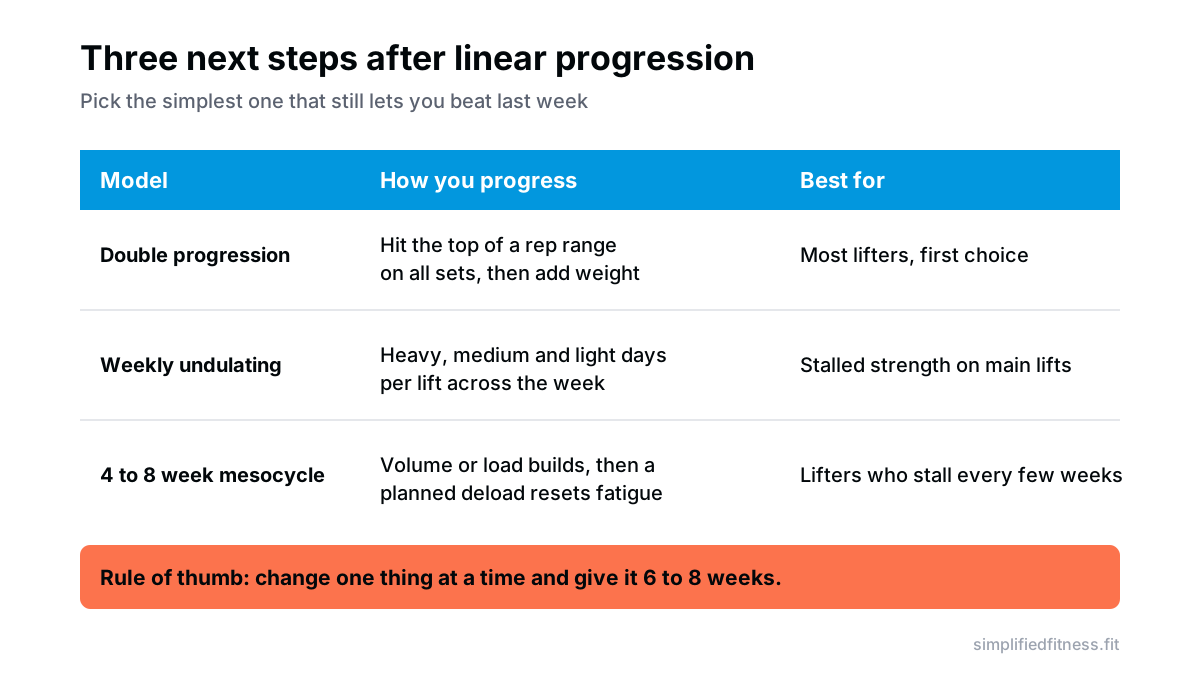
What should I run after 5x5? Three simple options
Option 1: Double progression
Pick a rep range, like 6-10 for squats or 8-12 for rows. Stay at one load until you hit the top of the range on every set, then add the smallest jump and start at the bottom again. Our full guide to the double progression model walks through the details.
In the gym it looks like this: 60 kg for 3 sets, with 8, 7, 6 reps this week, then 8, 8, 7 next week, then eventually 10, 10, 10 and it is time to go up. Slow, but it is progress you can see.
Not every jump has to be 2.5 kg. If your gym has smaller plates, or you use fractional plates, a 1 kg jump is perfectly valid on upper-body lifts.
Option 2: Weekly undulation
You rotate heavy, medium and light days for the same lift across the week. For example, a squat session at 5 reps, another at 8, and a lighter one at 12. The heavy day builds strength, the lighter days keep volume and technique practice high without grinding. Our guide to rep-range periodization compares daily undulating with block approaches in depth.
Option 3: A short mesocycle
A mesocycle is a block of roughly four to eight weeks with a clear goal and a built-in easier week at the end. You might start at 10 hard sets per muscle per week and add one set every week or two, then deload. We cover the planning in mesocycle architecture.
Do I need to change my split too?
Often, yes, because the program should fit how much recovery you now need. If you have been doing three full-body sessions a week, the natural next step is a 4-day upper/lower split.
The reasoning is training frequency. A 2016 meta-analysis of volume-equated studies found higher training frequency gave a larger hypertrophy effect size than lower frequency (0.49 versus 0.30), and the authors concluded that twice a week beats once a week, and whether three times is better than two is still unknown (Schoenfeld et al., 2016). Upper/lower hits every major muscle twice with room to recover. Our 4-day upper/lower guide covers the sessions in detail, and you can compare options in full body vs upper/lower vs PPL.
If you prefer a push/pull/legs layout, our free push day, pull day and leg day plans are a ready starting point.
How much volume should an intermediate do?
More than a beginner needs, but not endless. A 2017 meta-regression of 15 studies found a graded dose-response: each extra weekly set was associated with about a 0.37% larger gain in muscle size, and the higher-volume groups gained roughly 3.9% more than the lower-volume ones (Schoenfeld et al., 2017). That was a meta-regression of studies with mixed populations, so it shows a trend rather than a guarantee for you.
Meanwhile, a 2023 network meta-analysis found that all resistance training prescriptions improved strength and hypertrophy compared with no training. Higher loads (above about 80% of 1RM) gave the best strength gains, while all prescriptions promoted similar hypertrophy and the top-ranked ones for size included multiple sets (Currier et al., 2023).
Practical translation: add sets slowly, one at a time, and stop when recovery or joints complain. Our weekly set volume guide goes deeper, and the training volume calculator helps you count.
Managing fatigue as the weights get heavy
Fatigue is why intermediates need structure. A beginner can recover from nearly anything. You now cannot.
- Use RIR. Stop most sets with 1-3 reps in reserve instead of grinding. Our RIR and RPE calculator helps you gauge it.
- Plan an easier week. Deloads are a tool, not a punishment. See signs you need a deload.
- Protect sleep and food. In hot weather, drink enough and do not skip meals because it is too hot to cook.
- Rotate accessories, not the core lifts. Keep squat, bench, row and press stable so you can see progress.
A simple six-week intermediate template
Here is a generic structure, not a prescription for everyone.
- Weeks 1-2: Upper/lower, 3 sets per exercise, 2 reps in reserve. Use double progression on every lift.
- Weeks 3-4: Add one set to your two or three weakest muscle groups. Keep the reps in reserve at 1-2.
- Week 5: Hold volume, push for the top of rep ranges.
- Week 6: Drop volume by about a third and keep the weights moderate.
Then repeat, starting slightly heavier than before. Write everything down. If you do not have a log yet, start one today, because intermediate progress is hard to see without it.
When to see a doctor
A stall is a training problem. Pain is a different problem. See a doctor or physiotherapist if you have sharp or worsening joint pain, numbness or tingling, swelling, or discomfort that lasts more than a couple of weeks. Chest pain, dizziness or fainting during training also needs medical attention promptly. Do not try to push through these with a new program.
The bottom line
Do not graduate early. If you are still adding weight most sessions, stay put. When you truly stall, rule out sleep and food, deload once, then move to double progression, add a four to eight week structure if needed, and consider a 4-day upper/lower split. Evidence on periodization is modest and short-term, so choose the simplest plan you will actually follow, and let your logbook, not trends, tell you whether it works.
Frequently Asked Questions
How do I know when linear progression has stopped working?
You have likely outgrown it when you miss the same weight for around three sessions in a row, after sleep, calories and a short deload are sorted out. Progress slows because each jump is a smaller share of a bigger lift and heavier sessions take more out of you, so adding weight every workout stops matching what your body can adapt to. If you are still adding weight most weeks, keep going and do not change anything yet.
What do I do when my 5x5 stalls?
First rule out the boring causes: under-eating, short sleep and poor form. Then take a deload of roughly 10% off the bar, rebuild for two or three weeks, and see whether it stalls again. If it does, move to a weekly progression such as double progression, which asks for small improvements over a week instead of every session.
What is double progression?
Double progression means you choose a rep range, such as 6-10, and add reps first, then weight. You stay at one load until you hit the top of the range on every set, then you raise the weight by the smallest jump and start at the bottom again. It works because it turns a stalled 2.5 kg jump into a series of winnable steps.
What is periodization in simple words?
Periodization is planned variation in volume, load or reps across weeks and months instead of doing the same thing forever. A meta-analysis of 35 studies found it modestly improves 1RM strength compared with non-periodized training when volume is matched. In practice it can be as simple as heavy, medium and light days or a four-week build followed by an easier week.
Is linear or undulating periodization better?
The evidence is mixed. A 2015 meta-analysis of 17 studies found no difference in strength between linear and undulating models, while a 2022 meta-analysis found undulating better for strength, mainly in trained participants, with no difference for muscle size. For most lifters the better program is the one you can follow consistently.
Do I need a periodized program to build muscle?
Probably not. In the 2022 meta-analysis, hypertrophy did not differ between periodized and non-periodized training or between linear and undulating models when volume was equal. Total hard sets, effort and consistency matter more for size, so use periodization mainly to keep strength moving and fatigue manageable.
Should I switch to an upper/lower or push/pull/legs split?
A 4-day upper/lower split is a sensible first step because it hits each muscle twice a week. A 2016 meta-analysis found training a muscle twice weekly gave better hypertrophy than once weekly when volume was equated. Pick the split that fits your actual week, since a plan you can attend beats a perfect one you skip.
How long should an intermediate mesocycle be?
Many coaches use blocks of about 4-8 weeks, followed by an easier week, though research does not fix one ideal length. The block gives you a clear window to push volume or load and then reset. Start with six weeks, write down the plan, and adjust after you see how your lifts and joints respond.
Can I stay on a beginner program longer if it still works?
Yes, and you should. There is no prize for graduating early, and if you are still progressing on a simple routine, that is the right program. Change only when progress stalls for reasons you have checked.
How often should I deload as an intermediate?
Evidence on exact deload timing is limited, so treat any schedule as a starting point. A common approach is an easier week every 4-8 weeks, or sooner if performance drops and you feel run down for more than a week. See our guide on signs you need a deload for a checklist.
Is it normal for progress to slow down after the first year?
Yes. Strength and muscle gains usually come fastest early on and slow as you get closer to your personal ceiling. This is a normal pattern, not a sign you are doing something wrong, and it is why intermediates measure progress in months rather than weeks.
Should intermediate lifters train to failure?
Not on every set. Training near failure is useful, but constant grinding adds fatigue that slows the next session, especially on heavy compound lifts. Leave 1-3 reps in reserve on most work and save true failure for the last set of safer isolation exercises.
What should I do if I feel pain, not just a stall?
Sharp, worsening or lingering joint pain is different from a plateau, and extra weight will not fix it. Reduce the load on that lift, and see a doctor or physiotherapist if the pain persists beyond a week or two, wakes you at night, or comes with numbness or swelling.
Sources & References
Every claim above is checked against peer-reviewed research (PubMed, U.S. National Library of Medicine) or guidance from established health bodies. How we fact-check.
- Moesgaard L, et al. Effects of periodization on strength and muscle hypertrophy in volume-equated resistance training programs: a systematic review and meta-analysis. Sports Med. 2022. PMID: 35044672
- Harries SK, et al. Systematic review and meta-analysis of linear and undulating periodized resistance training programs on muscular strength. J Strength Cond Res. 2015. PMID: 25268290
- Schoenfeld BJ, et al. Loading recommendations for muscle strength, hypertrophy, and local endurance: a re-examination of the repetition continuum. Sports (Basel). 2021. PMID: 33671664
- Schoenfeld BJ, et al. Dose-response relationship between weekly resistance training volume and increases in muscle mass: a systematic review and meta-analysis. J Sports Sci. 2017. PMID: 27433992
- Schoenfeld BJ, et al. Effects of resistance training frequency on measures of muscle hypertrophy: a systematic review and meta-analysis. Sports Med. 2016. PMID: 27102172
- Currier BS, et al. Resistance training prescription for muscle strength and hypertrophy in healthy adults: a systematic review and Bayesian network meta-analysis. Br J Sports Med. 2023. PMID: 37414459

Umair Hazrami · Founder & Head Coach, Simplified Fitness
Umair Hazrami founded Simplified Fitness and the Simplified Lifter channel to cut through fitness noise. With 4+ years of consistent training and 10+ coaching clients, he writes every guide from the peer-reviewed research and links the sources so you can check them. Our editorial standards.
Educational content only, not medical advice. If you have a medical condition, are pregnant, or take medication, talk to a qualified doctor before changing your diet, supplements or training. Full disclaimer.
Keep reading
Programming
The 5 Modalities of Progressive Overload: A Checklist for When Weight Won't Go Up
5 ways to progressive overload: load, reps, range of motion, tempo and rest density. A practical checklist for compounds and isolations, with the research.
7 min read
Programming
Autoregulated Progressive Overload (APRE): How Much Weight to Add Next Week
Autoregulated progressive overload (APRE) uses your last-set reps to set next week's weight. Get simple jump rules, a worked example and the evidence.
9 min read

Programming
Deload Science: What a Deload Week Really Does to Fatigue, Muscle and Strength
Deload science explained: the fitness-fatigue model, what trials show for muscle size and strength, and what happens in a deload week. Studies linked.
8 min read

Programming
How to Do a Deload Week: Volume Cut vs Intensity Cut vs Time Off
How to do a deload week workout: compare cutting sets by half, lowering weight by 20%, or taking time off, with a step-by-step template and the research.
9 min read