The Double Progression Model: Mastering Rep Ranges (e.g., 8-12 Reps) for Consistent Growth
The double progression model explained: pick a rep range like 8-12, hold the weight, hit the top on every set, then add load. Rules, examples and mistakes.
TL;DR. The short answer
- Double progression means you pick a rep range (say 8-12), keep the weight fixed until every working set reaches the top of the range, then add weight and start again near the bottom.
- It works because muscle growth has been seen across a wide range of loads, so adding reps at a fixed weight is a legitimate form of progressive overload, not a lesser one.
- In a 10-week trial of untrained adults, adding load and adding reps produced similar gains in leg strength and muscle size. Trained lifters need more research.
- Stop most sets about 1-3 reps before failure and judge reps by a fixed standard, otherwise the numbers in your log mean nothing.
- Use the smallest weight jump your gym allows. If your next jump is too big, move to a higher rep range or slow the tempo to make the same weight harder.
Part of our complete guide: Progressive Overload Methods, Deloads and Plateaus: The Long-Term Progression Guide
Table of contents
If you want a simple answer to “how do I make my lifts go up without guessing?”, the double progression model is it. You pick a rep range, say 8-12. You stay at one weight until every working set reaches 12 reps. Then you add weight, your reps fall back to around 8-10, and you climb again.
That is the whole system, and it sits inside the bigger picture of progressive overload, deloads and plateaus. This article covers the rules, the numbers, and the mistakes that quietly break it.
How does the double progression model work?
You progress two variables in a fixed order.
- Reps first. At a constant weight, try to add a rep to at least one set each session.
- Load second. When all working sets reach the top of the range, add weight.
- Reset. Reps drop back to the lower part of the range and the loop restarts.
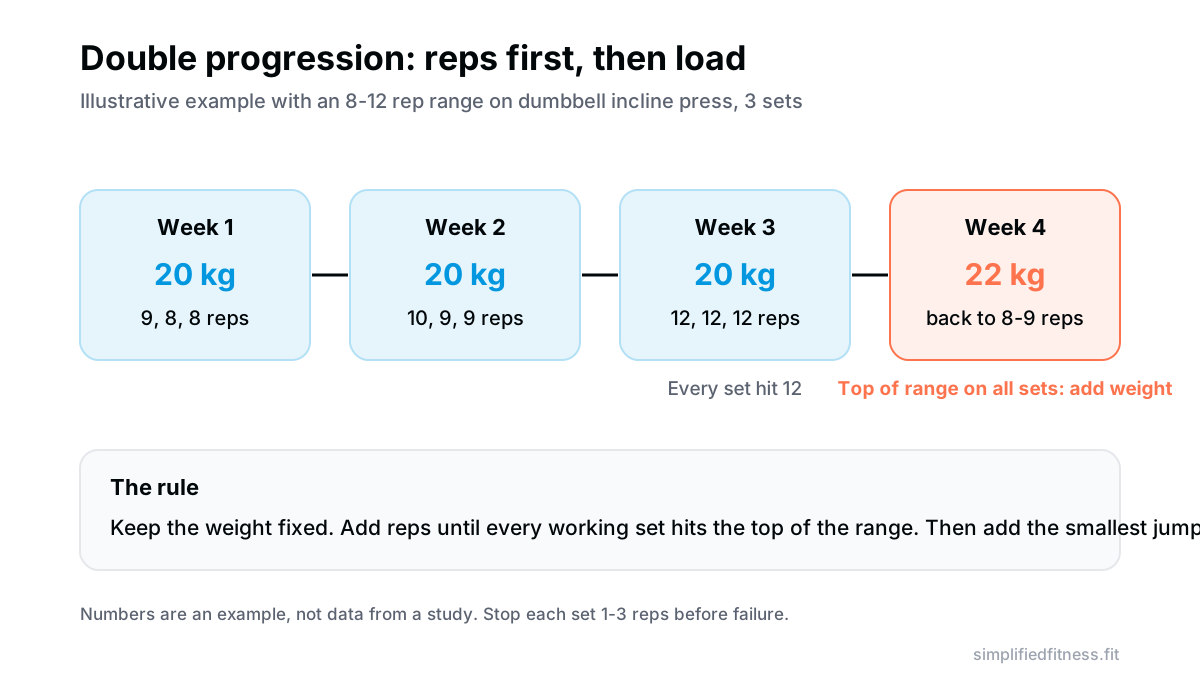
Say you do dumbbell incline press for 3 sets of 8-12. Session one is 20 kg for 9, 8, 8. The next time you get 10, 9, 9. A couple of weeks later it is 12, 12, 12. Now 22 kg goes on and you land at 9, 8, 8 again. Your target for any given session is never unclear.
That is why I like it for hypertrophy. The gym is noisy, you are tired, and “just lift heavier” is not a plan. Double progression gives you a rule you can follow on autopilot.
Does adding reps count as progressive overload?
Yes. Many lifters think overload only means a heavier bar. The research does not support that narrow view.
The older “repetition continuum” idea said heavy loads build strength, moderate loads build muscle and light loads build endurance. A 2021 review re-examined it and concluded that current evidence fails to support some of its assumptions, proposing instead that muscular adaptations can be obtained, and in some cases optimized, across a wide spectrum of loading zones (Schoenfeld et al., 2021). Strength may be the exception: in a meta-analysis of randomized trials, heavier loads (65% of 1RM and up) showed a trend toward bigger strength gains than loads of 60% or less, though the difference was not statistically significant (Schoenfeld et al., 2016). The same analysis found a similar non-significant trend for hypertrophy, so heavier training may have a small edge, but light loads still worked.
What does that mean for your 8-12 range? A wide band of loads can grow muscle, so rep progression at a fixed weight is a legitimate way to raise the demand on the muscle. See our guide to the 5-to-30 rep spectrum for hypertrophy for how far that logic stretches.
Is progressing reps as good as progressing load?
Two direct comparisons are worth knowing.
Trained lifters, 8 weeks. Plotkin and colleagues assigned 43 people with at least a year of lower-body training to either add load within a fixed rep range or add reps at a fixed load. Rectus femoris growth modestly favored the reps group and strength slightly favored the load group, with differences of questionable practical significance. The authors concluded that both strategies appear viable (Plotkin et al., 2022).
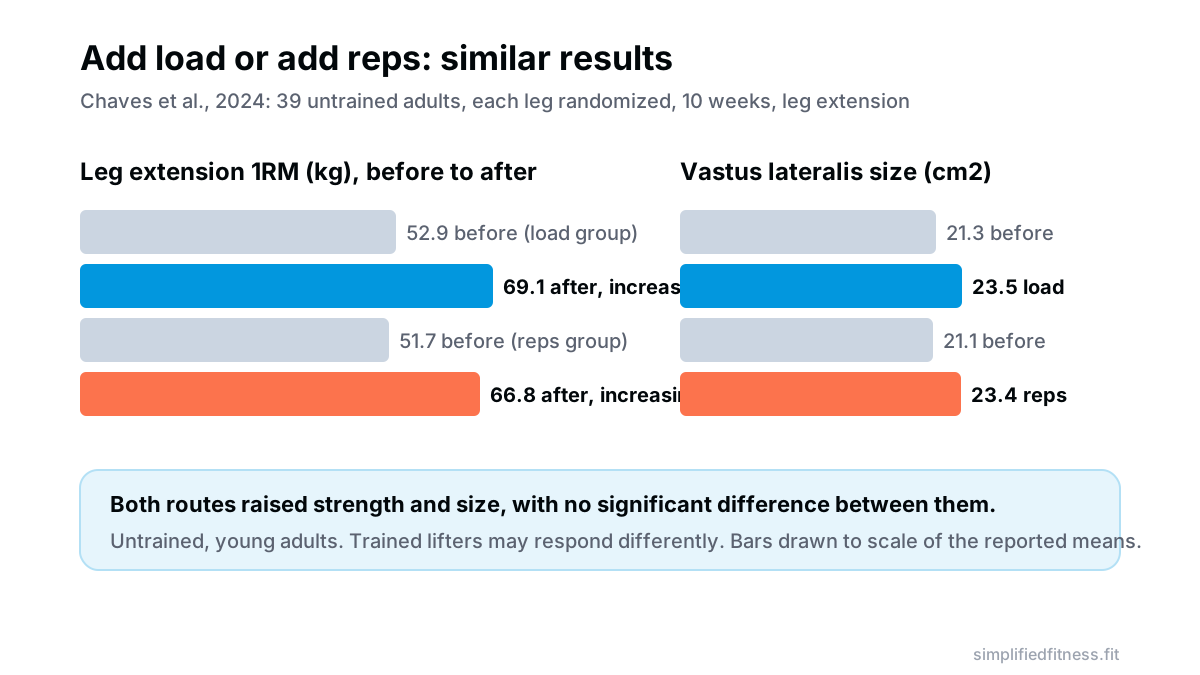
Untrained adults, 10 weeks. Chaves and colleagues randomized each leg of 39 untrained young people to progress load or reps. Both increased leg extension 1RM and vastus lateralis size, with no difference between them (Chaves et al., 2024).
How do I choose my rep range?
Pick a range about 4-6 reps wide for most lifts, and up to about 8 for light isolation work where each jump is proportionally large. Narrower ranges (such as 6-8) make you add weight very often. Very wide ranges (such as 5-20) can leave you stuck at one weight for ages.
| Exercise type | Practical range | Why |
|---|---|---|
| Heavy compounds (squat, bench, rows) | 5-8 or 6-10 | Fewer reps help keep technique tight when fatigue builds |
| Machines, dumbbell presses, pulldowns | 8-12 | Easy to load in small steps |
| Isolation (curls, lateral raises, leg extensions) | 10-15 or 12-20 | Light weights, jumps are proportionally large |
| Calves, rear delts | 12-20 | Loads are light, so higher reps are usually comfortable |
These ranges are coaching conventions, not rules written in a study. Given the evidence above, the best range is one you can train hard in, record accurately and repeat without joint complaints. If you run a dynamic variant that adjusts per set, see dynamic double progression.
How close to failure should the sets be?
Your reps are only comparable week to week if the effort is comparable. If you stop at 4 reps from failure one day and 0 the next, “10 reps” means two different things.
A meta-analysis of 15 studies found a trivial advantage for training to any definition of set failure versus non-failure (effect size 0.19), and no advantage for going to true momentary failure compared with stopping short (Refalo et al., 2023). In a 5-week trial in previously trained adults, those training to 0-1 reps in reserve and those staying at 4-6 reps in reserve showed no significant difference in strength or muscle cross-sectional area, though the near-failure group showed different motor unit firing adaptations (Ruple et al., 2023). That trial was small (19 people) and only 5 weeks long.
A practical rule: finish most sets with about 1-3 reps left, and save the last set of an isolation exercise for the hardest effort. Not sure what 2 reps in reserve feels like? Our RIR and RPE guide and the free RIR / RPE load calculator can help.
When should I add weight?
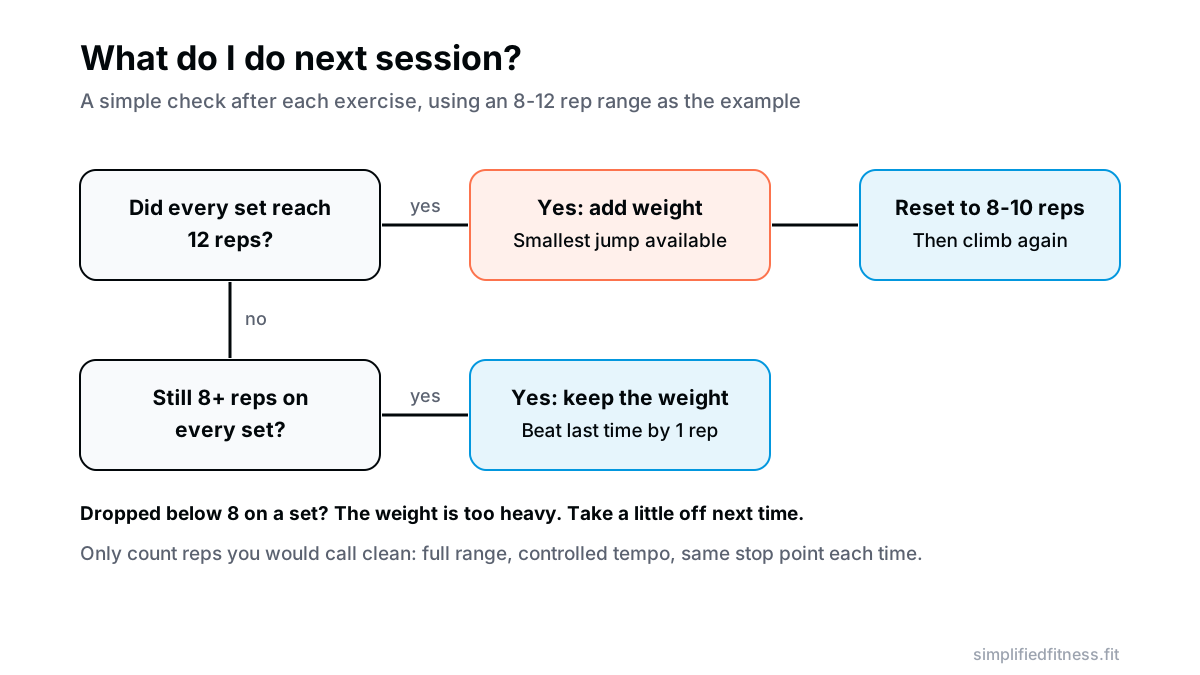
The standard rule is: all working sets at the top of the range. Not the best set. All of them.
A few refinements I find useful.
- Clean reps only. Full range of motion, no bouncing, same pause or tempo each time. Reps that do not count should not be written down.
- Premature jumps. Adding weight after one great set just means your next session starts below the bottom of the range. Stay patient.
- Two sessions at the top is a fair standard for lifts where form is shaky or the muscle is small and fatigues unevenly.
- Dropped below the bottom? The weight is too heavy. Take a little off and re-climb.
How big should the weight jump be?
As small as practical. A rough guide: aim for a jump that costs you about 2-4 reps, not 6 or more.
Many commercial gyms have dumbbells that go up in 2 kg or 2.5 kg steps, which is a huge percentage jump on a 8 kg lateral raise. Options:
- Widen the range (12-20 instead of 8-12) so the jump fits.
- Slow the lowering phase or add a short pause at the stretch to make the same weight harder.
- Use cables or machines with pin selectors and add a small plate if available.
- Use a barbell with fractional plates if you have them. Our plate calculator helps you load them.
For more on tiny steps, read about microloading and fractional plates.
How do I track double progression?
Without a log the model collapses. You are making decisions based on what you did last time, and memory is a bad record keeper.
Write down, for every working set:
- Exercise and equipment (machine brands differ)
- Weight
- Reps per set
- How hard it felt (RIR guess or just “easy, medium, hard”)
Before you start, glance at last session and decide on one goal: “Beat 10 on the first set” or “Add 2 kg if I get 12 on every set”. See our guide to what to record in a training logbook. A notes app works fine. Tools will not make you stronger, the habit will.
How many sets and how often?
Double progression tells you what to do inside a set. It does not tell you how many sets to do. For volume, a meta-regression of 15 studies found a graded dose-response, with more weekly sets per muscle associated with greater muscle gains (Schoenfeld et al., 2017). Our weekly set volume guide covers this properly. One caution: more sets only helps if you can recover from them, and the dose-response in that analysis does not mean “as many as possible”.
Our free /plans pages already use rep ranges that fit this approach, such as the push day.
What if I get stuck?
Stalls happen. Before changing the program, check the boring things.
- Sleep and food. Short sleep and a big calorie deficit make top-end reps harder. Eating enough protein (dal, paneer, curd, eggs, soya chunks, chicken, whatever fits your diet) helps recovery.
- Heat and hydration. In a hot Indian summer, gym performance can dip. Drink water and consider training in the cooler part of the day.
- Effort consistency. Are you stopping 5 reps short one week and 1 rep short the next?
- Form drift. If your range of motion shrinks to get reps, the number is fake.
- Fatigue. If several lifts stall together, a short deload is worth considering. See signs you need a deload.
If a stall is persistent, the triple progression approach adds sets as a third lever.
Who is double progression best for?
It suits intermediate lifters chasing muscle, and anyone who has run out of easy weekly jumps. True beginners can often add weight session to session at first, so a simpler approach may do. Advanced lifters may need finer control, such as per-set adjustments or cycling volume. For pure maximal strength, heavier and lower-rep work with an explicit load plan may suit better.
Pain is a separate matter. Sharp or worsening joint pain, numbness or chest symptoms during a lift are reasons to stop and see a doctor or physiotherapist, not to push on for the next rep target.
Quick-start checklist
- Choose a range 4-6 reps wide (up to about 8 for light isolations).
- Start at a weight you can do for the bottom of the range with 1-3 reps in reserve.
- Log every set.
- Add reps at the same weight.
- Add weight only when every set hits the top.
- Use the smallest jump you can find.
That is all there is. Run it for 8-12 weeks, then review your logs. The numbers will tell you what is working.
Frequently Asked Questions
What is the double progression model?
Double progression is a way of progressing in two steps: first reps, then weight. You choose a rep range such as 8-12, stay at one weight until all your sets reach the top rep, then increase the load and drop back toward the bottom of the range. It removes guesswork because the log tells you exactly when to add weight.
How does double progression work with 8-12 reps?
You start at a weight where you can do about 8 reps with 1-3 reps left in the tank, and add a rep or two each session. Once every set hits 12, you add the smallest weight jump available and your reps fall back to roughly 8-10. The cycle repeats, so you always have a clear target for the next session.
When should I increase the weight in double progression?
Increase it only when all your working sets reach the top of the rep range with clean form. One good set is not enough because the last set is usually where fatigue shows up. Some lifters wait for two sessions at the top before jumping, which is a reasonable option for very small muscles or shaky technique.
How many reps should I drop when I add weight?
As a rough coaching guide, expect to lose about 2-4 reps, depending on how big the jump is. A 2.5 kg increase on a lateral raise costs far more reps than 2.5 kg on a leg press. If you drop below the bottom of your range, the jump was too big, so use a smaller increase next time.
Is double progression good for beginners?
It is fine for beginners, but they can often add weight almost every session at first, so a simple linear approach may be enough early on. Double progression becomes more useful once weight jumps stop coming weekly. It is especially handy for isolation exercises where smaller loads make big jumps unrealistic.
Is double progression better than linear progression?
Neither is better in every case, they suit different stages. Linear progression adds weight every session and works while you are new and recovering quickly. Double progression is slower and more forgiving, which is why many intermediates use it for hypertrophy. Start with linear if it still works, and switch when you stall.
What rep range should I use for double progression?
A range with a spread of about 4-5 reps, such as 6-10, 8-12 or 10-15, is a practical choice for most lifts. Research suggests muscle growth can happen across a wide spectrum of loads, so the best range is the one you can train hard in without joint pain. Use heavier ranges for big compounds and higher ranges for isolation work.
What if I cannot reach the top of the rep range?
Keep the weight and aim to beat your last session by one rep on any set. If you have been stuck for three or four sessions, check sleep, food, and whether you are stopping too far from failure. A short deload or a slightly lower weight can also reset things.
Should I train to failure with double progression?
Not on every set. A 2023 meta-analysis found no evidence that going to momentary failure beats stopping short of it for hypertrophy. Leaving about 1-3 reps in reserve on most sets keeps your log honest and lets you recover, with the last set of an isolation exercise as the common place to push harder.
Can I use double progression for every exercise?
Yes, but with some tuning. Use a lower, heavier range on compounds like squats and a higher range on isolation moves like curls or lateral raises. For bodyweight moves, you progress reps until you can add load with a belt or backpack.
How do I use double progression with dumbbells that jump 2 or 2.5 kg?
Big dumbbell jumps can wipe out several reps at once. Widen the range for those lifts (for example 10-15), use a slower tempo or a pause to make the same weight harder, or add small magnetic or fractional plates if your gym has them. The aim is a jump that costs you 2-4 reps, not 6.
How do I track double progression?
Write down the exercise, weight, reps on every set, and how close to failure each set felt. Check last session before you start, then set one target: beat one set by one rep, or add weight if every set hit the top. A notes app or paper log works as well as any app.
How long does a double progression cycle take?
It varies with the exercise, your experience, and the size of the weight jump. No study sets a normal cycle length, but in practice a handful of sessions per cycle is common for intermediates, and it gets slower as you get more advanced. If you are adding weight every single session, your range may be too low or the starting weight too light.
Does adding reps build as much muscle as adding weight?
Available evidence suggests it can. In a trial of 43 resistance-trained people, increasing reps at a fixed load and increasing load at a fixed rep range gave similar muscle growth and strength over 8 weeks. The study was short and focused on lower body, so it supports the approach without proving it is best for everyone.
Sources & References
Every claim above is checked against peer-reviewed research (PubMed, U.S. National Library of Medicine) or guidance from established health bodies. How we fact-check.
- Schoenfeld BJ, et al. Loading Recommendations for Muscle Strength, Hypertrophy, and Local Endurance: A Re-Examination of the Repetition Continuum. Sports (Basel). 2021. PMID: 33671664
- Schoenfeld BJ, et al. Muscular adaptations in low- versus high-load resistance training: A meta-analysis. Eur J Sport Sci. 2016. PMID: 25530577
- Plotkin D, et al. Progressive overload without progressing load? The effects of load or repetition progression on muscular adaptations. PeerJ. 2022. PMID: 36199287
- Chaves TS, et al. Effects of Resistance Training Overload Progression Protocols on Strength and Muscle Mass. Int J Sports Med. 2024. PMID: 38286426
- Refalo MC, et al. Influence of Resistance Training Proximity-to-Failure on Skeletal Muscle Hypertrophy: A Systematic Review with Meta-analysis. Sports Med. 2023. PMID: 36334240
- Ruple BA, et al. The effects of resistance training to near failure on strength, hypertrophy, and motor unit adaptations in previously trained adults. Physiol Rep. 2023. PMID: 37144554
- Schoenfeld BJ, et al. Dose-response relationship between weekly resistance training volume and increases in muscle mass: A systematic review and meta-analysis. J Sports Sci. 2017. PMID: 27433992

Umair Hazrami · Founder & Head Coach, Simplified Fitness
Umair Hazrami founded Simplified Fitness and the Simplified Lifter channel to cut through fitness noise. With 4+ years of consistent training and 10+ coaching clients, he writes every guide from the peer-reviewed research and links the sources so you can check them. Our editorial standards.
Educational content only, not medical advice. If you have a medical condition, are pregnant, or take medication, talk to a qualified doctor before changing your diet, supplements or training. Full disclaimer.
Keep reading
Programming
The 5 Modalities of Progressive Overload: A Checklist for When Weight Won't Go Up
5 ways to progressive overload: load, reps, range of motion, tempo and rest density. A practical checklist for compounds and isolations, with the research.
7 min read
Programming
Autoregulated Progressive Overload (APRE): How Much Weight to Add Next Week
Autoregulated progressive overload (APRE) uses your last-set reps to set next week's weight. Get simple jump rules, a worked example and the evidence.
9 min read

Programming
Deload Science: What a Deload Week Really Does to Fatigue, Muscle and Strength
Deload science explained: the fitness-fatigue model, what trials show for muscle size and strength, and what happens in a deload week. Studies linked.
8 min read

Programming
How to Do a Deload Week: Volume Cut vs Intensity Cut vs Time Off
How to do a deload week workout: compare cutting sets by half, lowering weight by 20%, or taking time off, with a step-by-step template and the research.
9 min read