How to Do a Deload Week: Volume Cut vs Intensity Cut vs Time Off
How to do a deload week workout: compare cutting sets by half, lowering weight by 20%, or taking time off, with a step-by-step template and the research.

TL;DR. The short answer
- The most common deload among competitive strength and physique athletes cuts volume (fewer sets and reps) and lowers effort, while keeping the same exercises and training days. A typical deload lasted about 6 days.
- A practical default is to keep your usual load, cut sets by roughly half, and stop 3-4 reps short of failure. No trial has compared the three deload styles head to head, so this is coaching practice, not a proven winner.
- A full week off did not reduce muscle growth in one trial of resistance-trained people, but lower body strength gains were smaller than with continuous training.
- Pick time off when the problem is mental burnout, illness or travel. Pick lighter loads when joints or tendons are cranky and you still want to train.
- Pain that is sharp, worsening or lasting more than a couple of weeks needs a doctor or physio, not a deload.
Part of our complete guide: Progressive Overload Methods, Deloads and Plateaus: The Long-Term Progression Guide
Table of contents
If you are wondering how to do a deload week workout, here is the short answer: keep your usual exercises and training days, cut your sets by roughly half, keep the weight close to normal, and stop every set with 3-4 reps in the tank. That is a volume-reduction deload, and it mirrors what most competitive lifters report doing.
The other two options are lowering the weight by about 20% while keeping the sets, or taking the week off entirely. All three can work. They solve different problems. This guide shows you the exact template for each and when to pick which. For the bigger picture on overload, deloads and plateaus, see our complete guide to progressive overload, deloads and plateaus.
One honest caveat first. Nobody has run a trial that pits these three deload styles against each other in trained lifters. What we have is surveys of how people deload, a few trials on one-week breaks, and research on what happens when you cut training back. The advice below is built from those pieces, and I will flag where it is coaching judgement rather than proof.
What does a deload week actually look like in practice?
A deload is a planned, short stretch of easier training. Not a skipped week of guilt.
A 2024 survey of 246 competitive strength and physique athletes (about 8 years of training experience on average) found that every one of them deloaded. The typical deload lasted 6.4 days and came roughly every 5.6 weeks (Rogerson et al., 2024). They reported cutting both reps per set and sets per week, lowering the load, and raising reps in reserve. Training frequency stayed the same and most kept the same exercises.
So the common pattern is “same gym days, same lifts, less work, less effort.” Not “disappear for a week.”
A separate survey of 204 strength and conditioning coaches, mostly working with elite or world-class athletes, found most reduced volume during planned deload periods, with 0-25% being the most common cut (De Marco et al., 2024). Elite athletes often deload around competition, not just fatigue, so treat their numbers as a reference point, not a template.
Method 1: Volume reduction (the practical default)
This is the one I would start with. Keep the load roughly where it is. Cut the sets. Stop well short of failure.
The template:
- Keep your normal split and training days.
- Keep the same exercises, so the movement patterns stay sharp.
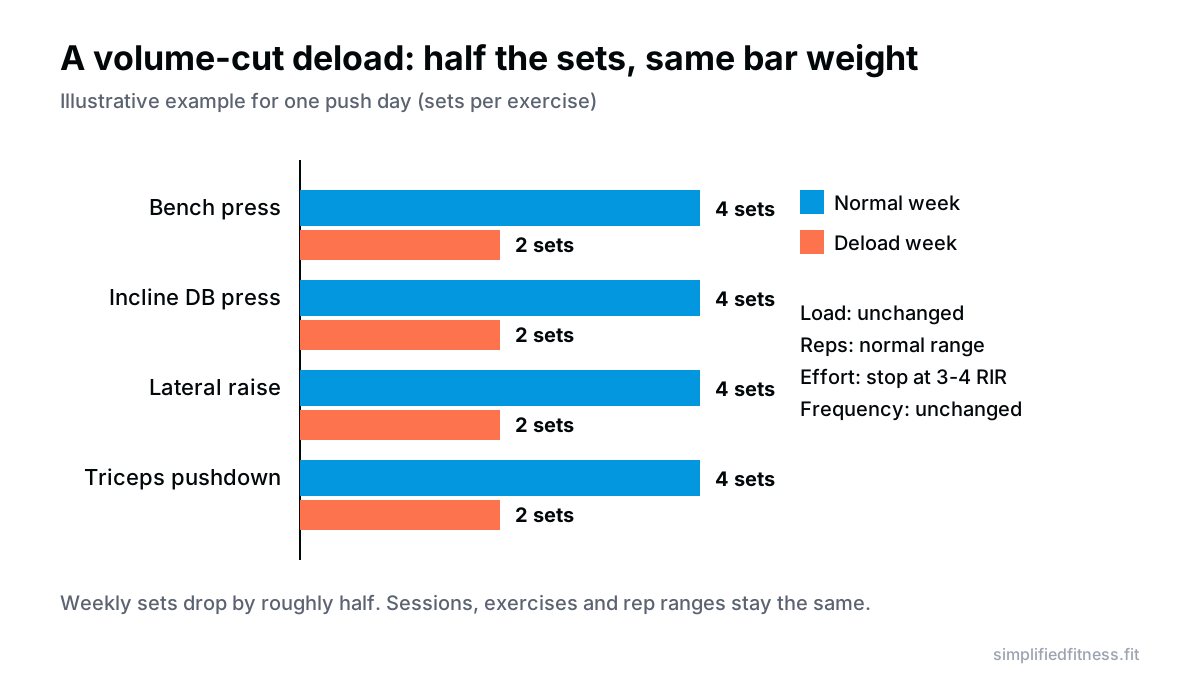
- Cut working sets by about 50%. If you normally do 4 sets, do 2.
- Use your normal working weights, or a small drop if they feel heavy.
- End every set with 3-4 reps in reserve (RIR). It should feel easy.
- Skip drop sets, partials, myo-reps and any other fatigue-adding extras.
Why does this tend to work well? Two reasons, and the second is partly inference.
First, fatigue comes mostly from the work you do, so doing less clears it. Second, you keep touching the same movements at familiar loads, which seems like a sensible way to avoid feeling rusty. Cessation research supports the general idea: a meta-analysis found that stopping training altogether lowers strength, with larger declines the longer the break, and bigger effects in older and inactive people than in recreational athletes (Bosquet et al., 2013). Reducing rather than stopping appears to avoid most of that downside, as the next trial suggests.
There is also evidence that you do not need much work to hold your ground. In one trial of 33 untrained men who first trained for 8 weeks, those who then cut their volume-load by about 50-57% (training once or twice a week) maintained their strength and quadriceps size over the next 8 weeks. The group that stopped completely lost about 22.6% of their half-squat 1RM and 5.4% of quadriceps cross-sectional area (Tavares et al., 2017). Those were untrained men over 8 weeks, not trained lifters over 1 week, so treat it as support for the principle, not a precise prescription.
A 2026 trial in untrained young men found something similar: cutting sets and frequency during weeks 4 and 8 of an 8-week program did not hinder muscle growth or strength endurance compared with training continuously (Pancar et al., 2026).
What about my “stop at 3-4 RIR” advice? Proximity to failure matters for growth. A meta-regression found muscle hypertrophy tended to improve as sets ended closer to failure, while strength gains were similar across a wide range of RIR (the authors call the analysis exploratory) (Robinson et al., 2024). Across one week that trade is fine, because the point is to dump fatigue. Do not stay at 3-4 RIR for months. Our guide to loads, rep ranges, RIR and rest covers how to dial effort back up.
Method 2: Intensity reduction (lighter weight, same sets)
Here you keep sets and reps, and drop the load by around 20%.
The template:
- Keep your normal sets and reps.
- Cut the weight by about 20%.
- Move the bar with intent, but finish every set feeling you could do a lot more.
- Keep the same exercises and days.
When does this beat a volume cut? Mainly when something is sore. Tendons and joints often grumble under heavy loads, and a lighter bar lets you keep the session structure without leaning on the cranky tissue. Elbow tendons on pressing days, a niggly knee on squats. If it is pain-free at lighter loads, that is the version for you.
The tradeoff is that you do not get as much of a break from total work. Sets and reps stay the same, so some fatigue sticks around, and a very light bar can feel pointless. I will be straight about evidence here: I cannot point to a trial that isolates a 20% load cut as a deload. It is a widely used coaching approach, and the coach survey above found roughly half of coaches also lowered intensity during taper, tournament and travel periods, usually by 0-25% (De Marco et al., 2024).
Method 3: A full week off the gym
Zero lifting. Walk, sleep, eat properly, maybe a casual swim.
This is the best fit when the problem is not your muscles. Mentally fried after exams or work deadlines? Fighting off a fever? Travelling for a wedding with no gym within an hour? Take the week. Seven days of rest is very unlikely to cost you muscle you can see.
The best direct evidence comes from a 2024 randomized trial. Thirty-nine resistance-trained young adults followed a 9-week high-volume program. One group took a full week off at the midpoint, the other trained continuously. Muscle size, local endurance and power did not differ between groups, but the continuous group improved lower body isometric and dynamic strength more, and reported slightly better readiness to train (Coleman et al., 2024).
So the week off did not cost them muscle, but it did cost some strength. Notice that this was a lower body outcome in a short trial, and the upper body was unsupervised, so it does not settle things for every lifter. If you are a strength-focused lifter chasing a 1RM, that detail matters more than if you are a general hypertrophy lifter.
Does it matter how you rest? A small trial of 30 trained men compared one week of “active” recovery (about 15% of the previous training volume) with one week of no training after a 6-week high-volume block. The two approaches produced only marginal molecular differences in muscle tissue, and the authors described the overall responses as largely similar (Vann et al., 2021). In plain terms, a tiny bit of training or none at all looked pretty similar. That is good news: you can pick whichever helps you stay sane.
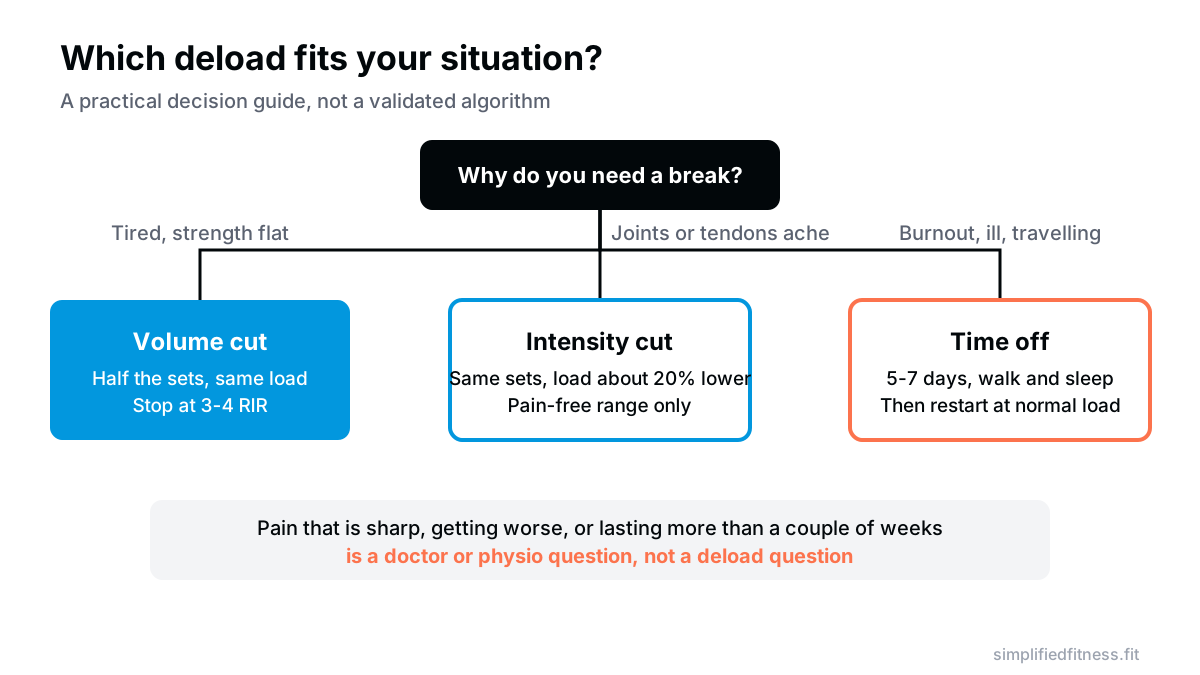
Which deload should you pick?
Use the problem, not the trend, to decide.
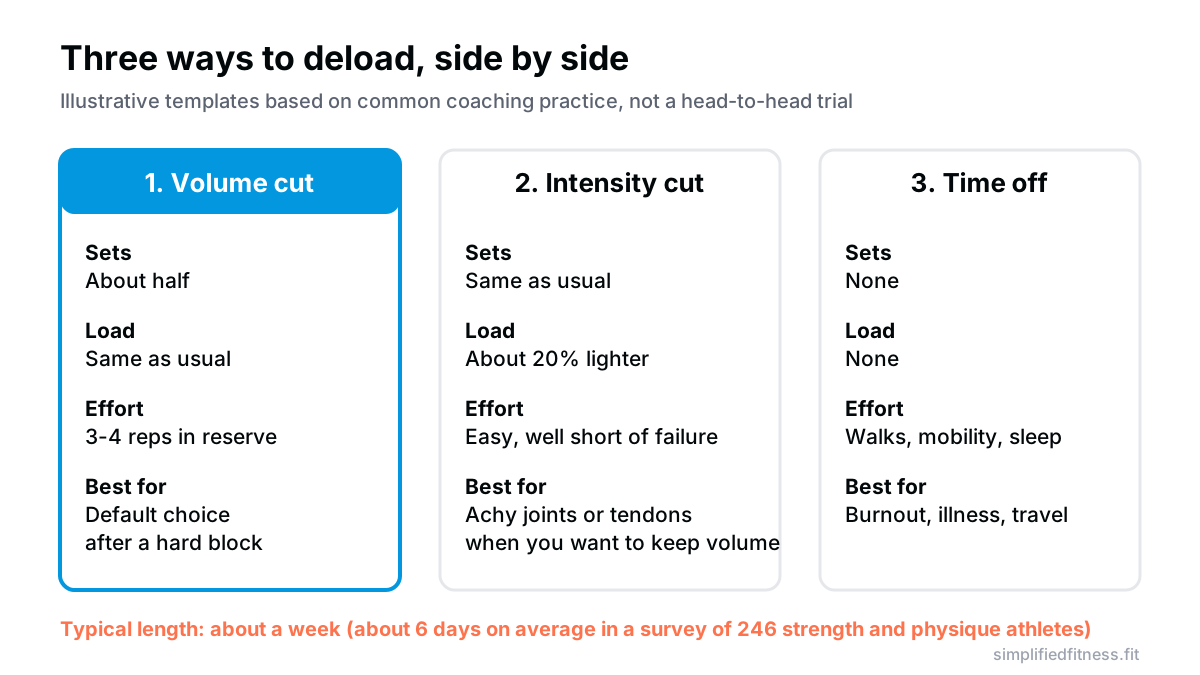
| Volume cut | Intensity cut | Full week off | |
|---|---|---|---|
| What changes | Sets down about 50%, load and frequency kept | Load down about 20%, sets kept | Everything stops |
| Effort | 3-4 RIR | Easy, well short of failure | Walks and light movement |
| Best when | Fatigue is piled up, strength has stalled | Joints or tendons are cranky | Burnout, illness, travel |
| Main risk | Doing too many “easy” sets | Total work stays high | Feeling rusty, smaller strength gains in one trial |
| Evidence | Common practice, supported by reduced-volume maintenance trials | Common practice, no isolating trial | One RCT, no muscle loss, smaller strength gain |
One more point on “which is best”. You will see claims online that volume reduction preserves strength best and cuts fatigue by some exact percentage. I have not found a study that supports a number like that, so I will not hand you one. What the evidence does support is that keeping some training in the mix is reasonable, and that a week of rest is also reasonable.
A simple 7-day deload template (push/pull/legs example)
Here is what the training days of a volume-cut week look like on a push/pull/legs split. Adjust for your own program.
- Push day: bench press 2 sets, incline dumbbell press 2 sets, lateral raise 2 sets, pushdown 2 sets. Normal weights, 3-4 reps left.
- Pull day: lat pulldown 2 sets, row 2 sets, rear delt fly 2 sets, curl 2 sets.
- Leg day: squat 2 sets, leg curl 2 sets, calf raise 2 sets. Keep depth and technique clean.
- Daily: a walk, 7-9 hours in bed, and normal protein.
You can check how much work that is against your usual week using our training volume calculator, and set the right weights for 3-4 RIR with the RIR and RPE calculator.
What to do around the deload
Food and sleep still matter. You do not need to slash calories on a deload, and for most people there is no reason to. Keep protein at your normal level (dal, paneer, eggs, curd, soya chunks or chicken, whatever you already eat) and do not try to “eat clean” as a punishment for resting.
In hot weather or a hectic work week, a lighter training week is also a good time to get your sleep schedule back in order. Sleep is the cheapest recovery tool you have.
If you are unsure when to deload, read our checklist of deload warning signs. To understand why recovery gets stuck in the first place, see the science of deloads and fatigue. And if you are choosing between planning deloads ahead and waiting for symptoms, we compare them in proactive vs reactive deloads. Longer low-volume phases are covered in maintenance volume for busy lifters, and if you want to see how a deload sits inside a training block, start with mesocycle architecture.
When a deload is not the answer
A deload fixes general training fatigue. It does not fix an injury.
See a doctor or physio if you have sharp or worsening pain, numbness or tingling, swelling, or pain that has lasted more than a couple of weeks. The same goes for exhaustion that does not improve with rest, disrupted sleep, mood changes or unexplained drops in performance that stretch over weeks. Those can have medical causes, and I cannot diagnose them from an article.
The bottom line
Start with a volume cut: half the sets, familiar weights, 3-4 reps in reserve, about a week. Use lighter loads if joints are complaining, and take the week off when your head or health needs it. Then return to normal and keep logging your lifts.
Not sure what a normal week should look like? Browse our free push day, pull day and leg day plans, and drop your sets by half when it is deload time.
Frequently Asked Questions
How do you do a deload week workout?
Keep your usual exercises and training days, cut your working sets by about half, keep the weight close to normal, and stop each set with 3-4 reps left. This follows what most competitive strength and physique athletes report doing, which is reducing sets and reps while keeping frequency the same. Run it for about a week, then return to normal training.
What is the best deload method for muscle growth?
There is no trial proving one method is best, so the honest answer is that a volume cut is the most widely used and easiest to defend. Cutting sets while keeping the bar weight familiar lowers fatigue and keeps the movement patterns and load tolerance you built. Start there, and switch to another method only if your situation (pain, burnout, travel) calls for it.
Should I lower the weight or the sets during a deload?
For most people, lower the sets first and keep the weight near normal. Surveys of strength coaches and athletes show volume is the variable most often reduced. In the coach survey, load was lowered less consistently (by about half of coaches). If joints or tendons are the problem, cutting load by around 20% while keeping sets is a reasonable alternative.
Is it OK to take a full week off the gym?
Yes, for most healthy lifters a week off is fine. In a 9-week trial of 39 resistance-trained people, a full week off at the midpoint did not change muscle size but led to smaller lower body strength gains than training continuously. Choose it when you are mentally fried, ill or travelling, and expect to feel a little rusty in your first session back.
How long should a deload last?
About a week is standard. A survey of 246 competitive strength and physique athletes found the typical deload lasted 6.4 days. If you still feel flat after one week, check sleep, food and life stress before extending it.
How often should I deload?
The same survey found athletes deloaded about every 5.6 weeks on average, give or take about 2 weeks, but that is a habit, not a rule. Athletes also reported deloading when performance stalled or soreness and joint aches piled up. Track your lifts so you can tell a real slump from a bad day.
Will I lose muscle during a deload week?
Unlikely. A meta-analysis found strength declines grow with the length of a break, and in a trial of resistance-trained people, one week off did not reduce muscle growth. A reduced-volume week is even less of a risk because you are still training.
Can I still do cardio during a deload week?
Yes, easy cardio like walking, cycling or a light swim is fine and often helps you feel better. Keep it low effort so it adds recovery rather than more fatigue. Hard intervals or long runs defeat the purpose.
What RIR should I use on a deload?
Aim for about 3-4 reps in reserve, which means every set ends well short of failure. A survey of strength and physique athletes found they raised their reps in reserve and lowered effort during deloads. Use our RIR calculator to pick loads that match that effort.
Do I need a deload if I am a beginner?
Usually not on a schedule. Beginners progress on modest volumes and recover quickly, so a planned deload is rarely needed unless you are sore, run down or ill. Take a lighter week when life or fatigue demands it, not because a calendar says so.
Should I deload on a cut or in a calorie deficit?
It can help, because recovery is often harder when you are eating less. Cutting sets while keeping the load familiar is a reasonable way to hold on to strength while fatigue clears, though no trial has tested deloads during a cut. If you feel flat for more than a week or two, talk to a coach or doctor about your intake and sleep.
What do I do if I feel weak after my deload?
A slightly rusty first session is normal, especially after a full week off. Start your first week back at your normal weights with a rep or two in reserve, and build back to your usual effort within a session or two. If strength is still down after two weeks, review sleep, protein and total workload.
When should I see a doctor instead of deloading?
See a doctor or physio if pain is sharp, getting worse, causes numbness, or lasts more than a couple of weeks. A deload helps with general training fatigue, not injuries. Persistent exhaustion, poor sleep, mood changes or unexplained performance drops over weeks also deserve a medical check.
Sources & References
Every claim above is checked against peer-reviewed research (PubMed, U.S. National Library of Medicine) or guidance from established health bodies. How we fact-check.
- Rogerson D, et al. Deloading Practices in Strength and Physique Sports: A Cross-sectional Survey. Sports Med Open. 2024. PMID: 38499934
- De Marco K, et al. Resistance Training Prescription During Planned Deloading Periods: A Survey of Strength and Conditioning Coaches Across Varying Sporting Codes. J Strength Cond Res. 2024. PMID: 39446750
- Coleman M, et al. Gaining more from doing less? The effects of a one-week deload period during supervised resistance training on muscular adaptations. PeerJ. 2024. PMID: 38274324
- Pancar Z, et al. Effects of deload periods in resistance training on muscle hypertrophy and strength endurance in untrained young men using a randomized within subject design. Sci Rep. 2026. PMID: 41730991
- Vann CG, et al. Molecular Differences in Skeletal Muscle After 1 Week of Active vs. Passive Recovery From High-Volume Resistance Training. J Strength Cond Res. 2021. PMID: 34138821
- Tavares LD, et al. Effects of different strength training frequencies during reduced training period on strength and muscle cross-sectional area. Eur J Sport Sci. 2017. PMID: 28316261
- Bosquet L, et al. Effect of training cessation on muscular performance: a meta-analysis. Scand J Med Sci Sports. 2013. PMID: 23347054
- Robinson ZP, et al. Exploring the Dose-Response Relationship Between Estimated Resistance Training Proximity to Failure, Strength Gain, and Muscle Hypertrophy: A Series of Meta-Regressions. Sports Med. 2024. PMID: 38970765

Umair Hazrami · Founder & Head Coach, Simplified Fitness
Umair Hazrami founded Simplified Fitness and the Simplified Lifter channel to cut through fitness noise. With 4+ years of consistent training and 10+ coaching clients, he writes every guide from the peer-reviewed research and links the sources so you can check them. Our editorial standards.
Educational content only, not medical advice. If you have a medical condition, are pregnant, or take medication, talk to a qualified doctor before changing your diet, supplements or training. Full disclaimer.
Keep reading

Programming
The 5 Modalities of Progressive Overload: A Checklist for When Weight Won't Go Up
5 ways to progressive overload: load, reps, range of motion, tempo and rest density. A practical checklist for compounds and isolations, with the research.
7 min read
Programming
Autoregulated Progressive Overload (APRE): How Much Weight to Add Next Week
Autoregulated progressive overload (APRE) uses your last-set reps to set next week's weight. Get simple jump rules, a worked example and the evidence.
9 min read

Programming
Deload Science: What a Deload Week Really Does to Fatigue, Muscle and Strength
Deload science explained: the fitness-fatigue model, what trials show for muscle size and strength, and what happens in a deload week. Studies linked.
8 min read
Programming
The Double Progression Model: Mastering Rep Ranges (e.g., 8-12 Reps) for Consistent Growth
The double progression model explained: pick a rep range like 8-12, hold the weight, hit the top on every set, then add load. Rules, examples and mistakes.
9 min read