Barbell Plate Calculator: Exactly Which Plates Go on Each Side
Type the weight you want on the bar, pick your bar and the plates your gym actually has, and get the plates for each side, heaviest first. No more mental maths between sets.
Your results
Estimates for healthy adults, for education only. Not a medical assessment. Built and reviewed by Umair Hazrami.
How this calculator works
There is no clever formula here, just arithmetic you would do on a whiteboard.
- Load per side = (target weight − bar weight) ÷ 2.
- Starting with the heaviest plate in your chosen set, add that plate as many times as it fits, then move to the next size down. Repeat until nothing fits.
- Anything left over is doubled (it is missing from both sides) and shown as the amount you are short. “Total loaded” is your target minus that shortfall.
The three plate sets are:
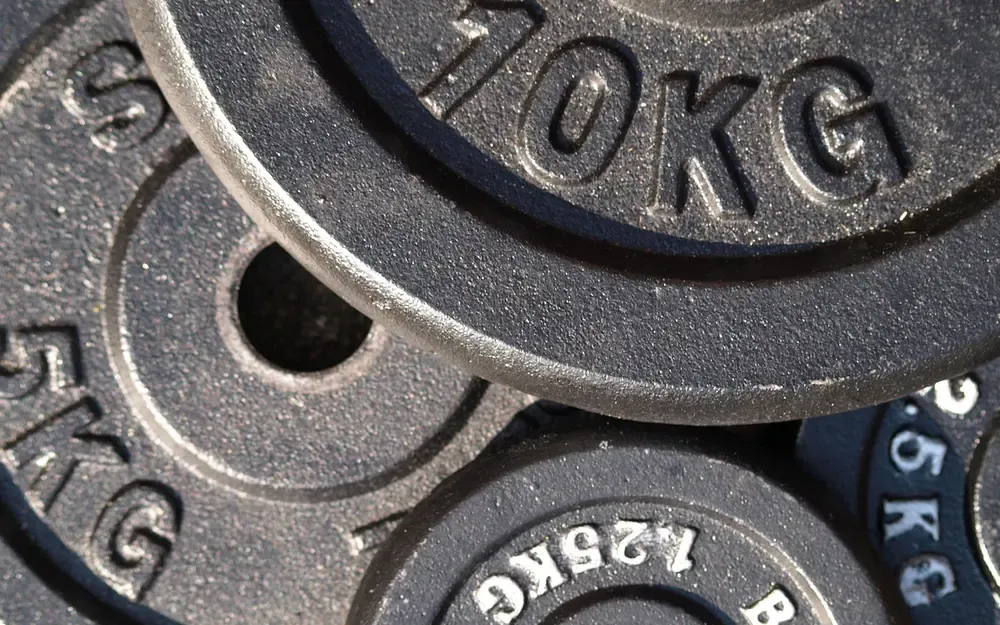
- Full: 25, 20, 15, 10, 5, 2.5 and 1.25 kg
- Gym (no 25s): 20, 15, 10, 5, 2.5 and 1.25 kg
- Home: 10, 5, 2.5 and 1.25 kg
It assumes you have as many pairs of each plate as you need. Working heaviest-first also gives you the fewest plates to slide on, which matters when you are loading the same bar between every set.
Using the result
Take 142.5 kg on a 20 kg bar with the full set. That is 61.25 kg per side: 25 + 25 + 10 + 1.25. Without 25s it becomes 20 + 20 + 20 + 1.25. Same weight, more plates.
Where this earns its keep is on warm-up sets and odd numbers from a program. If your 1RM calculator or RIR/RPE load calculator spits out something like 87.3 kg, round it to the nearest 2.5 kg first. The calculator will tell you if a number can’t be built, but rounding up front saves a trip back to the rack.
Small plates also set how fast you can progress. The ACSM position stand recommends adding roughly 2-10% once you can do one or two reps more than your target (ACSM, 2009). For an overhead press around 40 kg, even a 2.5 kg jump is over 6%. If that jump stalls you, adding reps at the same load is a reasonable alternative: in an 8-week trial in trained lifters, progressing reps and progressing load produced broadly similar lower body muscle and strength gains (Plotkin et al., 2022). That was one short study, so treat it as “both work” rather than proof either is better. The progressive overload guide covers both approaches.
Limitations
- Plates are not always what they say. Cheaper cast-iron plates, common in many local gyms in India, can be off by a noticeable margin. If exact numbers matter (meet prep, testing a max), weigh your plates once.
- Collars are ignored. Add their weight yourself if they are heavy.
- Kilograms only. Mixed kg and lb racks need a manual conversion.
- It doesn’t know your stock. If your gym only has one pair of 20s, the suggested load may not be possible. Swap in smaller plates that add up to the same per-side number.
For picking rep ranges and effort around that number, see the load, rep range and RIR guide. If you are new to barbell work, a structured routine like our free training plans gives you weights to aim for instead of guessing.
Frequently Asked Questions
How do I work out which plates to put on a barbell?
Subtract the bar weight from your target and halve it: that is the load for each side. Then add the heaviest plate that still fits, and repeat until nothing fits. For 100 kg on a 20 kg bar that is 40 kg per side, which this calculator loads as 25 + 15 kg.
Does the calculator count collars or clips?
No. It assumes the collars weigh nothing, which is true for most spring clips but not for competition collars, which usually weigh 2.5 kg each. If your gym uses heavy collars, subtract their weight from your target before you enter it.
Why does it say I am short of my target?
With 1.25 kg as your smallest plate, the bar can only move in 2.5 kg steps, so a target like 101 kg can't be hit exactly. The calculator loads the closest weight below your target and tells you how many kilos are missing. Round your plan to a multiple of 2.5 kg, or buy fractional plates if you need smaller jumps.
How heavy is the bar at my gym?
A standard men's Olympic bar is 20 kg and a women's Olympic bar is 15 kg. Technique bars, EZ bars and fixed straight bars vary a lot, so the 10 kg and 7 kg options are only common values. If there is no marking, weigh the bar on a scale once and remember it.
Can I use this with pound plates?
Not directly: the calculator works in kilograms and uses kilogram plate sizes. If your gym has pound plates, convert your target to kg and treat the output as a rough guide, since 45 lb plates (about 20.4 kg) don't map neatly onto kg plates.
How much weight should I add when I progress?
The ACSM position stand suggests raising load by about 2-10% once you can beat your target reps by one or two. On a 60 kg bench that is roughly 1.25-6 kg, so the smallest jump your plates allow often decides the pace. When the jump is too big, add reps at the same weight first.
Sources & References
Every claim above is checked against peer-reviewed research (PubMed, U.S. National Library of Medicine) or guidance from established health bodies. How we fact-check.
- American College of Sports Medicine. American College of Sports Medicine position stand. Progression models in resistance training for healthy adults. Med Sci Sports Exerc. 2009. PMID: 19204579
- Plotkin D, et al. Progressive overload without progressing load? The effects of load or repetition progression on muscular adaptations. PeerJ. 2022. PMID: 36199287