Technical Failure vs Mechanical Failure: Standardizing Form Across Training Cycles
Technical failure vs mechanical failure explained: which reps count, why strict form keeps progressive overload honest, and a simple standard to log.
TL;DR. The short answer
- Technical failure is the first rep you cannot finish with your agreed form. Mechanical failure is the rep where the bar stops moving no matter what you do. Technical failure almost always comes first.
- A rep counts toward progressive overload only if it meets the same depth, tempo and body position you used last time. A rep that does not meet it is still work, but it is not comparable.
- Meta-analytic data show training to momentary failure has no clear hypertrophy advantage over stopping short of it, so ending a set at technical failure costs you little.
- Strict form is not magic for muscle size. One 8-week trial found cheat reps neither helped nor hindered arm growth, but cheating inflates the weight on the bar without a fair comparison.
- Write a one-line standard for each main lift, film a set from the side now and then, and only add load when the standard is met.
Part of our complete guide: Progressive Overload Methods, Deloads and Plateaus: The Long-Term Progression Guide
Table of contents
Technical failure vs mechanical failure is a simple split. Technical failure is the first rep you cannot finish with your agreed form. Mechanical failure is the rep where the bar stops moving no matter how hard you try. For tracking progress, end the set at technical failure, because that is the last rep you can fairly compare with next week.
This is the discipline that keeps progressive overload honest. If the weight went up but the depth, tempo or body position quietly changed, you did not progress. You changed the exercise.
What is technical failure vs mechanical failure?
Technical failure is the point where a rep can no longer be completed with the standard you set before the set. Your squat gets shallower, your back starts swinging on the curl, the bar bounces off your chest. The muscle could probably still move the weight. Your form just stopped being the same movement.
Mechanical failure is the end of the road. You are pushing and the bar is not moving, or it stalls and sinks. Some people call this momentary muscular failure.
Here is the order of events on a hard set:
- Reps 1-5 look identical.
- Rep 6 is slower, but the same.
- Rep 7 needs a little hip drive or a shorter range. Technical failure.
- Rep 8 is a grind with a lot of body English. Still not the same exercise.
- Rep 9 stalls. Mechanical failure.
Technical failure comes first on almost every lift. The gap between the two tends to be biggest on exercises that are easy to cheat (curls, lateral raises, rows), because momentum can keep a set alive long after the target muscle has stopped doing the work.
Does the rep count? A three-question test
“Did the rep count?” is the question behind most gym arguments. Here is a test you can run in about two seconds, and it works for any lift.
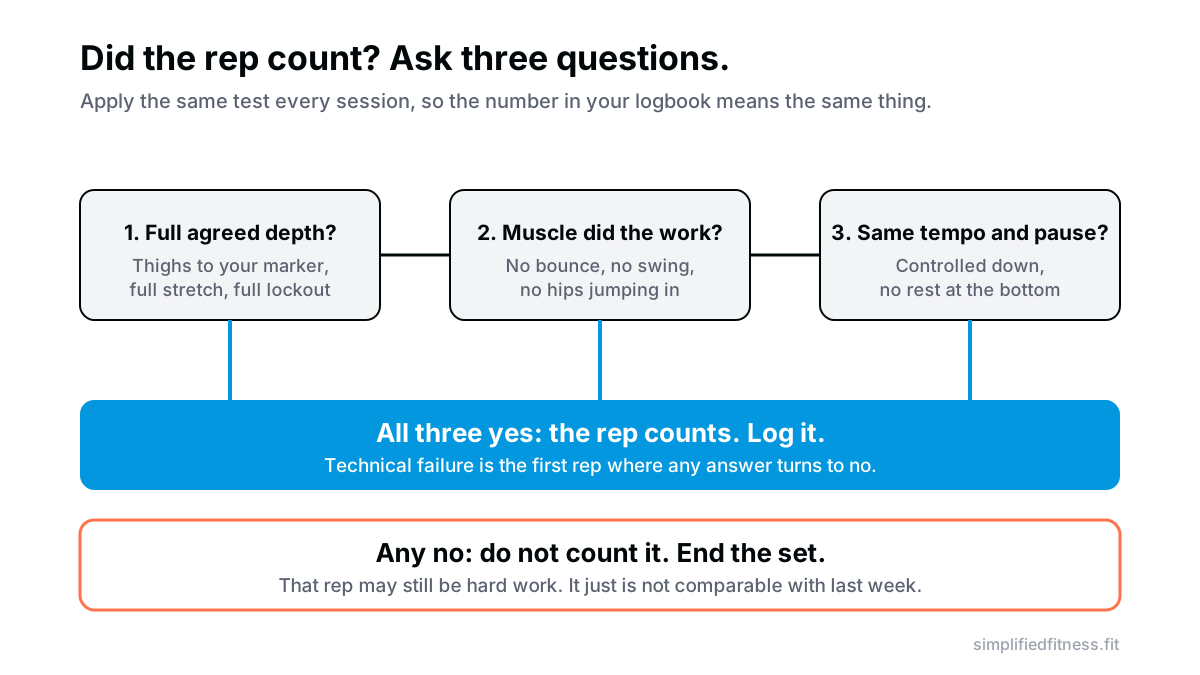
A rep that fails the test is not worthless. You still trained hard. It is just not comparable with the 8 clean reps you did last Monday, so it does not belong in the same column of your log.
If you want a place to log the clean reps and the extra ones separately, our guide to the training logbook and the variables worth tracking covers it.
How do lifters fake progressive overload?
Almost nobody sets out to cheat. It creeps in.
You add 2.5 kg to the bar. The set feels heavy, so the range shrinks by a couple of centimetres. Next week you add another 2.5 kg and the bounce gets a bit livelier. Six weeks later your logbook shows a big jump in load and your muscles are doing roughly the same job as before.
Common versions of the same trick:
- Squat depth drifting from below parallel to a quarter squat
- Bench press with a bounce off the chest and a bridged back
- Curls and rows with a swinging torso
- Lat pulldowns performed leaning way back
- Shorter pauses than last time, so elastic recoil does the work
Notice that every example above produces a bigger number in the log. That is the trap. The log rewards the cheating.

The squat is the classic example. “Depth” has to be a visible marker (hip crease below the top of the knee, or your glutes touching a box), not a feeling.
Does strict form actually matter for muscle growth?
Here the evidence is more interesting, and more honest, than the gym lore suggests.
An 8-week trial in 30 young adults used a within-person design: one arm trained biceps curls and triceps pushdowns with strict form, the other with externally supplied momentum, twice a week, 4 sets of 8-12 reps to momentary failure. Muscle thickness and arm circumference increased similarly in both arms. Volume load was markedly higher in the cheat condition (Augustin et al., 2025). The authors concluded the momentum neither helped nor hindered hypertrophy of the target muscles.
So the claim “cheating kills your gains” is not supported by that trial. It is a single study of upper-arm isolation exercises in young adults, so it tells us little about a heavy squat or deadlift.
Why standardize form, then? Three reasons that do not depend on that argument:
- Measurement. If the movement changes, you cannot tell whether you got stronger. The bigger volume load in the cheat arm shows how a log gets inflated without a matching change in growth.
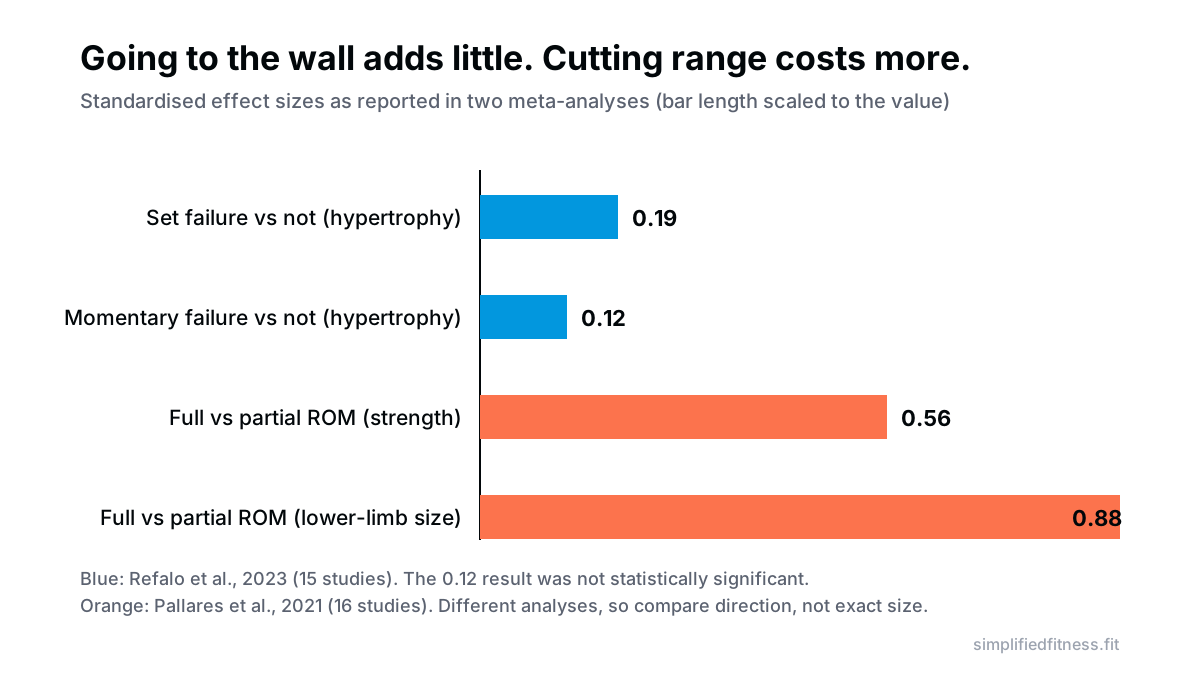
- Range of motion is not always neutral. A 2021 meta-analysis of 16 studies found full range of motion produced greater strength gains (ES 0.56) and lower-limb hypertrophy (ES 0.88) than partial range, with no significant difference for measures like muscle thickness (Pallares et al., 2021). A systematic review of 11 studies was more nuanced: partial reps at longer muscle lengths worked well for several muscles, and the authors suggested combining them with full range training (Kassiano et al., 2023). Different studies, different muscles, different answers. The safe reading is that range matters, and a range you keep changing makes the comparison impossible. We go deeper in our piece on full vs partial range of motion.
- Joint and tendon comfort. Coaches often argue that controlled reps protect connective tissue. Our brief search did not find a trial that tests this directly for technical failure, so treat it as coaching judgment rather than proven fact. If a ragged rep hurts a joint, that is reason enough to stop.
Do I need to hit mechanical failure to grow?
No. And that is good news for technical failure.
A systematic review and meta-analysis of 15 studies found a trivial advantage for training to set failure versus non-failure (ES 0.19), and no advantage for momentary muscular failure versus non-failure (ES 0.12, confidence interval crossing zero). The authors concluded there is no evidence that momentary failure is superior for hypertrophy (Refalo et al., 2023).
Two newer trials in resistance-trained people support the same direction, with a caveat:
- In a within-person trial, 18 trained lifters trained legs to failure on one side and to roughly 1-2 reps in reserve on the other for 8 weeks. Quadriceps thickness increased similarly, with the failure leg showing more velocity and rep loss across sets (Refalo et al., 2024).
- In a trial of 42 trained adults doing a single set per exercise, several hypertrophy measures tended to favour training to failure, although differences were generally modest, and strength and local endurance were similar (Hermann et al., 2025).
That is a case of conflicting findings in the details. One trial found equal growth, the other a modest lean toward failure in a single-set design. Differences in exercises, set numbers and measurement could explain it. The cautious takeaway: stopping a rep or two before the wall costs you little, and stopping at technical failure keeps your reps clean.
For how this plays out with different exercise types, see our training to failure vs RIR meta-analysis breakdown.
Can you judge technical failure by feel?
Mostly yes, with some practice.
In a study of 24 resistance-trained men and women doing bench press at 75% of 1RM, lifters predicted when they were 1 or 3 reps from failure with high accuracy (average absolute error around 0.65 reps), with a minor tendency to underpredict (Refalo et al., 2024). In the single-set trial above, participants were more accurate on the bench press than the squat and improved over the 8 weeks (Hermann et al., 2025).
Translation: your sense of “I have two left” is usable, especially on simple lifts, and it gets better with repetition. On squats and other complex lifts, leave a bigger margin. Our guide to RIR accuracy and the RIR and RPE scale guide go further, and the RIR and RPE calculator can help you estimate loads.
How do you standardize form across a training cycle?
The method is boring, which is why it works.
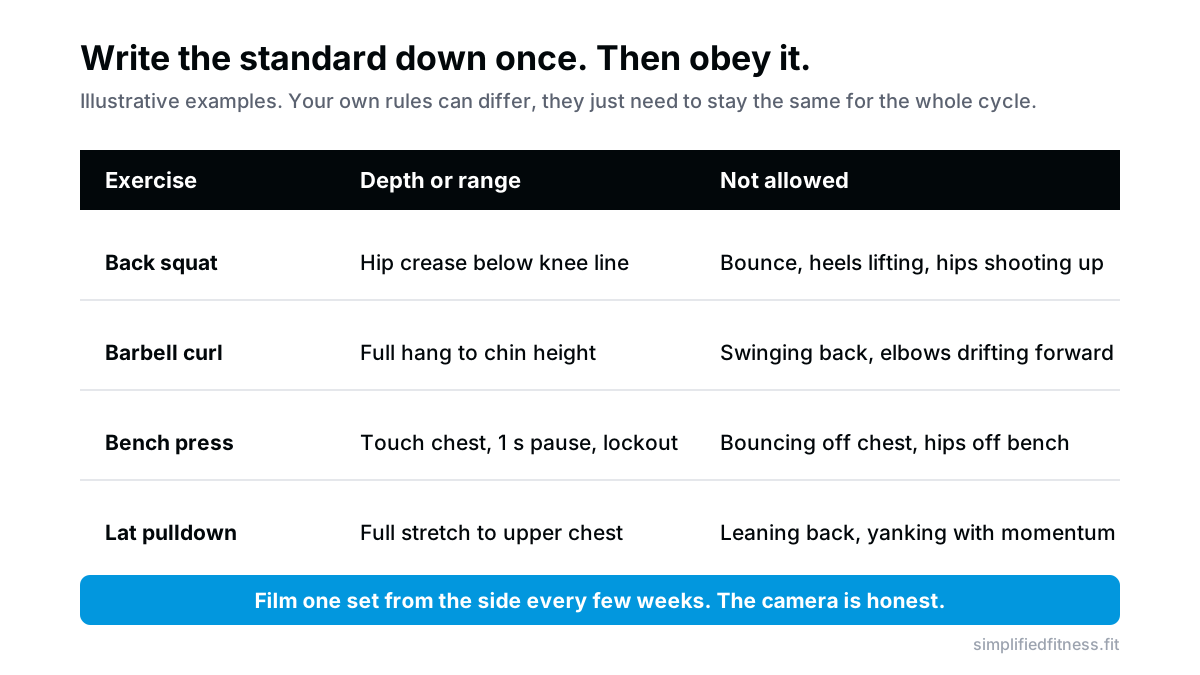
Step 1: Write the standard. Depth or range, pause (if any), tempo and body position. One line per main lift.
Step 2: Pick a marker you can see. A box for squat depth, a chest touch for bench, a full hang for pull-ups. Feelings drift. Markers do not.
Step 3: Stop at technical failure. The first rep that breaks the standard ends the set, even if you could squeeze out more.
Step 4: Log reps and quality. Record the load and the number of clean reps. If you want to log extra ugly reps, put them in a separate note.
Step 5: Film now and then. Side-on, same angle, first and last rep of the set. Your memory of your own form is the least reliable instrument in the gym.
Step 6: Change the standard only between cycles. If you decide to go deeper or add a pause, treat it as a new baseline and expect to drop the load.
How does this fit double progression?
Double progression says you add weight only after hitting the top of the rep range on all sets. That rule only works if the reps are the same reps. Hitting 12 reps with a bounce is not the same as hitting 12 with a pause.
If load jumps are your sticking point, microloading with fractional plates lets you add 1 kg or less instead of forcing a big jump that wrecks form. The plate calculator helps you set loads quickly.
If you are stuck for weeks despite strict standards, work through our plateau troubleshooting flowchart before changing anything else.
Is a cheat rep ever fine?
Yes, if you label it.
Some experienced lifters add a few momentum reps at the end of an isolation set on purpose, such as the last 1-2 reps of a curl. The 2025 arm trial suggests this is unlikely to harm growth in that context. The rule is that those reps go in a separate column. They never count toward the “did I beat last week” decision.
Keep cheat reps off heavy compound lifts such as squats, deadlifts and bench press unless you have a reason and a spotter. The risk is higher there, and the evidence is thinner.
What about hot gyms, long days and Indian lifting realities?
A few practical points for lifters in India.
- Heat and fatigue. In a hot, crowded gym with a fan-less corner rack, form breaks earlier. Do not treat that as failure of will. Stop at technical failure and rest a bit longer.
- Crowded floors. If you are bouncing reps because the rack is needed, take the fewer reps instead. A clean 6 beats a rushed 9.
- Vegetarian diets and recovery. None of this requires special foods. Eating enough protein from dal, paneer, curd and soya (or eggs, if you eat them) supports recovery, but it does not fix sloppy reps.
- Home training. Without a spotter, technical failure is also a safety rule. Stop a rep earlier and use pins or a bench you can slide out of.
When should you see a doctor?
Form discipline cannot diagnose anything. See a doctor or physiotherapist if you have sharp pain during a lift, pain that lasts more than a few days, swelling, numbness or tingling, or a joint that feels unstable. Do not train through those with “strict form” as a fix.
The simple version
Technical failure is your stop sign. Mechanical failure is a crash. Training to technical failure costs little for growth according to the best available meta-analysis, and it keeps your logbook honest. Write your standard, mark it with something visible, and only count reps that meet it. Progress that survives that test is real progress.
Frequently Asked Questions
What is the difference between technical failure and mechanical failure?
Technical failure is the point where you can no longer complete a rep with your predefined form, while mechanical failure is the point where the bar physically stops moving even though you are trying. Technical failure comes first because form degrades before force output hits zero. Decide your standard before the set so you can tell which one you actually reached.
Does a rep count if I used momentum?
For your logbook, no, because it is not the same task you performed last week. A 2025 trial found added momentum on curls and pushdowns neither helped nor hindered arm growth, but it did raise the volume load, which makes comparisons meaningless. Log only reps that meet your written standard and mark the rest as extra.
Should I train to technical failure or mechanical failure?
Technical failure is the safer and cleaner default for most lifts. A 2023 meta-analysis found no evidence that momentary failure beats stopping short of it for hypertrophy, so there is little to gain from grinding past good form. Stop the set when the next rep would break your standard.
What is a cheat rep?
A cheat rep uses momentum, body English or a shortened range to move a weight your target muscle cannot move cleanly. In the gym it looks like swinging your back on curls or bouncing the bar off your chest. It is a legitimate advanced technique only when you label it as such and do not count it as a normal rep.
Does form breakdown hurt muscle growth?
Evidence is limited and mixed. An 8-week trial in 30 young adults found similar arm growth with strict and cheated reps, while range-of-motion reviews suggest cutting range can reduce strength and some muscle gains. Treat form breakdown as a measurement problem first and a growth problem second.
How do I know if I hit technical failure?
You hit it when the next rep would need a bounce, a swing, a shortened range, or a body position change that your standard does not allow. Film a set from the side and compare the last rep with your first. If the last rep looks different, the set should have ended one rep earlier.
Is training to failure necessary for muscle growth?
No. A systematic review of 15 studies found no evidence that momentary failure is superior to non-failure training for hypertrophy. Stopping a rep or two short lets you keep more reps in later sets. Use the RIR scale to leave one or two reps in the tank on most sets.
Can I fake progressive overload with bad form?
Yes, and it is very common. Adding 5 kg while your squat gets 5 cm shallower means the muscle may be doing no more work than before. Compare reps at identical depth and tempo to see whether you actually progressed.
How accurate am I at judging how many reps I have left?
Resistance-trained lifters were fairly accurate at 1 and 3 reps in reserve on the bench press in one 2024 study, with a minor tendency to underpredict. Accuracy appeared better on the bench press than the squat in a later trial. Predict conservatively on complex lifts and let a filmed set check you.
Is partial range of motion bad?
Not always, but it is a different exercise from the full-range version. A 2021 meta-analysis found full range of motion better for strength and lower-limb hypertrophy, while a 2023 review found some partials at long muscle lengths can work well. Pick one range per cycle and do not swap it mid-block.
Should I standardize form for every exercise?
Do it for the lifts you track most closely, usually your main compounds and a few isolation movements. A standard is just depth, tempo, pause and body position written in one line. It takes a minute and makes every number in your log honest.
How often should I film my sets?
Every few weeks, and any time you hit a new weight on a main lift, is plenty. Film from the side at hip or chest height with the same camera angle each time. Compare your first and last rep of the set.
When should I see a doctor about pain from lifting?
See a doctor or physiotherapist if you have sharp pain, pain that lingers for days, swelling, numbness or pain that changes how you move. Form rules cannot diagnose these. Stop the exercise that causes it until you have been assessed.
Sources & References
Every claim above is checked against peer-reviewed research (PubMed, U.S. National Library of Medicine) or guidance from established health bodies. How we fact-check.
- Refalo MC, et al. Influence of Resistance Training Proximity-to-Failure on Skeletal Muscle Hypertrophy: A Systematic Review with Meta-analysis. Sports Med. 2023. PMID: 36334240
- Augustin F, et al. Do Cheaters Prosper? Effect of Externally Supplied Momentum During Resistance Training on Measures of Upper Body Muscle Hypertrophy. Int J Exerc Sci. 2025. PMID: 40191387
- Pallares JG, et al. Effects of range of motion on resistance training adaptations: A systematic review and meta-analysis. Scand J Med Sci Sports. 2021. PMID: 34170576
- Kassiano W, et al. Which ROMs Lead to Rome? A Systematic Review of the Effects of Range of Motion on Muscle Hypertrophy. J Strength Cond Res. 2023. PMID: 36662126
- Refalo MC, et al. Accuracy of Intraset Repetitions-in-Reserve Predictions During the Bench Press Exercise in Resistance-Trained Male and Female Subjects. J Strength Cond Res. 2024. PMID: 37967832
- Hermann T, et al. Without Fail: Muscular Adaptations in Single-Set Resistance Training Performed to Failure or with Repetitions-in-Reserve. Med Sci Sports Exerc. 2025. PMID: 40249908
- Refalo MC, et al. Similar muscle hypertrophy following eight weeks of resistance training to momentary muscular failure or with repetitions-in-reserve in resistance-trained individuals. J Sports Sci. 2024. PMID: 38393985

Umair Hazrami · Founder & Head Coach, Simplified Fitness
Umair Hazrami founded Simplified Fitness and the Simplified Lifter channel to cut through fitness noise. With 4+ years of consistent training and 10+ coaching clients, he writes every guide from the peer-reviewed research and links the sources so you can check them. Our editorial standards.
Educational content only, not medical advice. If you have a medical condition, are pregnant, or take medication, talk to a qualified doctor before changing your diet, supplements or training. Full disclaimer.
Keep reading
Programming
The 5 Modalities of Progressive Overload: A Checklist for When Weight Won't Go Up
5 ways to progressive overload: load, reps, range of motion, tempo and rest density. A practical checklist for compounds and isolations, with the research.
7 min read
Programming
Autoregulated Progressive Overload (APRE): How Much Weight to Add Next Week
Autoregulated progressive overload (APRE) uses your last-set reps to set next week's weight. Get simple jump rules, a worked example and the evidence.
9 min read

Programming
Deload Science: What a Deload Week Really Does to Fatigue, Muscle and Strength
Deload science explained: the fitness-fatigue model, what trials show for muscle size and strength, and what happens in a deload week. Studies linked.
8 min read

Programming
How to Do a Deload Week: Volume Cut vs Intensity Cut vs Time Off
How to do a deload week workout: compare cutting sets by half, lowering weight by 20%, or taking time off, with a step-by-step template and the research.
9 min read