Autoregulated Progressive Overload (APRE): How Much Weight to Add Next Week
Autoregulated progressive overload (APRE) uses your last-set reps to set next week's weight. Get simple jump rules, a worked example and the evidence.
TL;DR. The short answer
- Autoregulated progressive overload (APRE) means your reps on the final hard set decide next week's weight: more reps than planned, bigger jump; fewer, hold or drop.
- In a 6-week trial of 23 college football players, APRE improved bench and squat strength more than a fixed linear plan, but it was small and not randomized (Mann et al., 2010).
- A 2021 meta-analysis of 8 studies (166 athletes) found auto-regulation beat fixed loading for maximal strength, with APRE the strongest of the three methods tested.
- The exact kilogram jumps in this article are practical rules of thumb, not numbers from a trial. Treat them as a starting point and adjust to your own progress.
- Evidence is mostly from trained athletes on short programs. For muscle size specifically, the data are thin, so lean on consistency and good logging.
Part of our complete guide: Progressive Overload Methods, Deloads and Plateaus: The Long-Term Progression Guide
Table of contents
Autoregulated progressive overload means your performance decides your next weight. If you hit more reps than planned on your last hard set, the bar goes up by a bigger step. If you hit fewer, it stays put or drops a little.
That is the whole idea, and it fixes the thing most lifters get wrong: guessing. “Add 2.5 kg every week” works for a few weeks, then it either stalls you or crushes you. This guide gives you exact rules to replace the guessing. It sits inside our complete guide to progressive overload, deloads and plateaus, so start there if you want the big picture.
One honest note before we begin. The research behind APRE is real but small, and the kilogram jumps I give you later are practical rules of thumb, not numbers copied from a trial.
What is autoregulated progressive overload (APRE)?
APRE stands for Autoregulatory Progressive Resistance Exercise. As tested in a study of college football players, the idea is to let lifters progress at their own pace based on daily and weekly changes in performance, unlike traditional linear periodization, where intensity rises by a set amount every week (Mann et al., 2010).
Think about why that matters. You do not recover the same way every week. Exam stress, a bad night of sleep, a 40 degree afternoon in Delhi, a week of skipped meals: all of it changes what the bar feels like. A fixed plan ignores that. A rep-based rule does not.
It sits in a family of load adjustment methods that also includes RPE, reps in reserve and velocity tracking. A review in Sports Medicine describes APRE and the others as ways of addressing an athlete’s daily readiness, and notes that fixed percentage-of-1RM methods fail to account for day-to-day swings in performance (Suchomel et al., 2021).
Does APRE actually work? What the research shows
Short answer: it looks promising for strength in trained athletes, with caveats.
The original study. Mann and colleagues compared 23 Division I college football players (about 2.65 years of training experience) over 6 weeks of preseason training: 12 on APRE, 11 on linear periodization. APRE produced bigger gains in bench press 1RM, estimated squat 1RM and repeated reps at 225 lb (Mann et al., 2010). Note the design: the two groups trained in two separate years, so this is not a clean randomized trial.
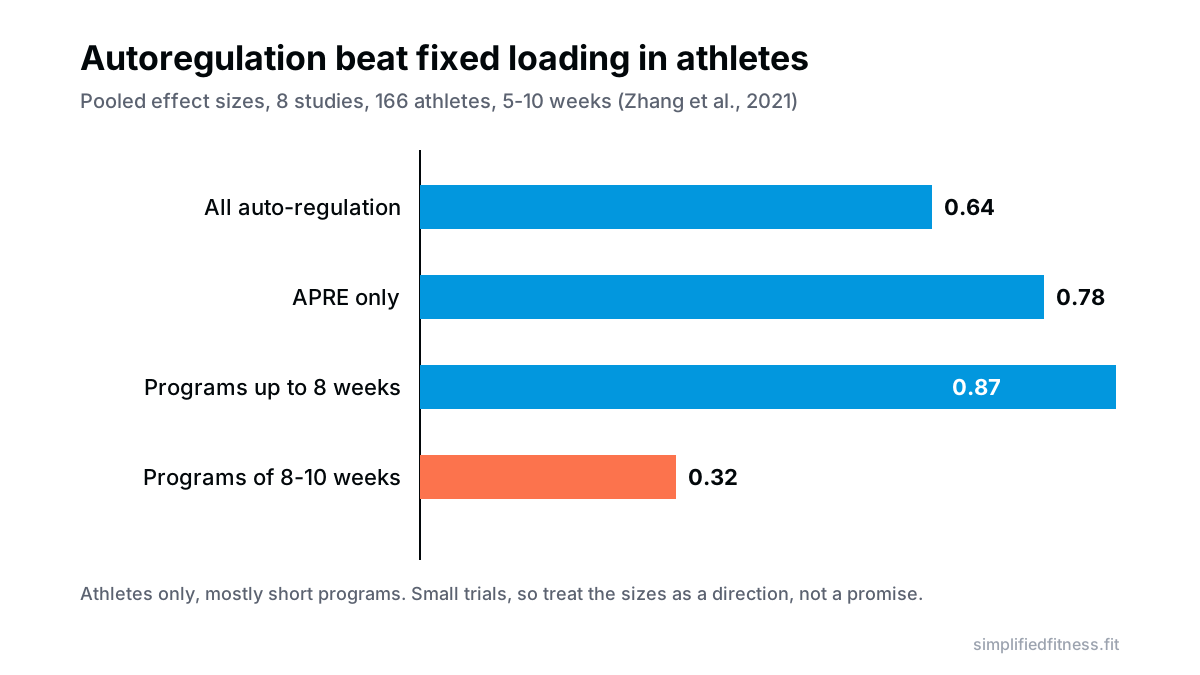
The pooled evidence. A 2021 meta-analysis pulled together 8 studies with 166 athletes (division 1 college players or athletes with at least a year of training), on programs of 5 to 10 weeks. Auto-regulation beat fixed loading for maximal strength (effect size 0.64), and APRE was the strongest of the three auto-regulation programs it compared, at 0.78 (Zhang et al., 2021). The benefit was larger in programs of 8 weeks or less (0.87) than in 8-10 week programs (0.32).
A newer ranking. A 2025 network meta-analysis ranked APRE first for improving both back squat and bench press 1RM, ahead of velocity-based training, RPE-based training and percentage-based training (Huang et al., 2025). But for the back squat, the authors report no moderate or large effect sizes between the interventions. A ranking is not the same as a big difference.
Even in direct comparisons between autoregulated methods, results are modest. A 4-week trial of 18 badminton athletes compared APRE with velocity-based training and found no significant differences between groups on jump measures, only a moderate effect size favouring APRE for the countermovement jump (Huang et al., 2023). Tiny sample, short window.
How much weight should I add next week? The rule table
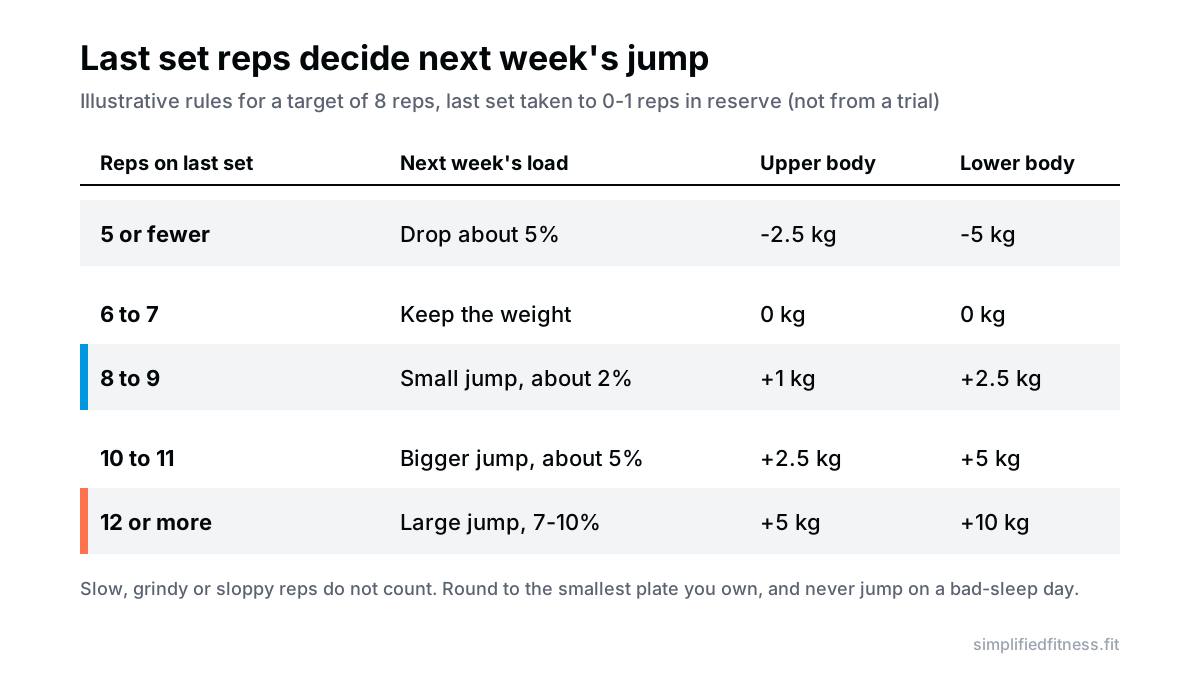
Here is the practical bit. These are the jump rules I would use as a starting point. To be clear, I built them to match the logic of APRE (more reps than planned means a bigger jump). They are not copied from a study, so adjust them if they feel too aggressive or too timid.
The setup. Pick a target rep number for your hardest set, say 8. Take the last working set to 0-1 reps in reserve, meaning you could have squeezed out maybe one more clean rep. Log the reps you hit.
Reading it in plain words:
- 5 or fewer reps: the weight was too heavy for today. Drop about 5%.
- 6 to 7 reps: you were close. Keep the weight and try for one more rep.
- 8 to 9 reps: you hit the target. Add a small jump, about 2%.
- 10 to 11 reps: the weight was lighter than you thought. About 5%.
- 12 or more: way too light. Jump 7-10%, but see the caution below.
Upper body lifts get smaller kilogram jumps than lower body lifts because the same plate is a much bigger percentage of a lateral raise than of a leg press. A 2.5 kg jump on a 120 kg squat is roughly 2%. On a 20 kg dumbbell shoulder press it is more than 10%.
A four-week example
Here is how it plays out on an incline dumbbell press with a target of 8 reps.
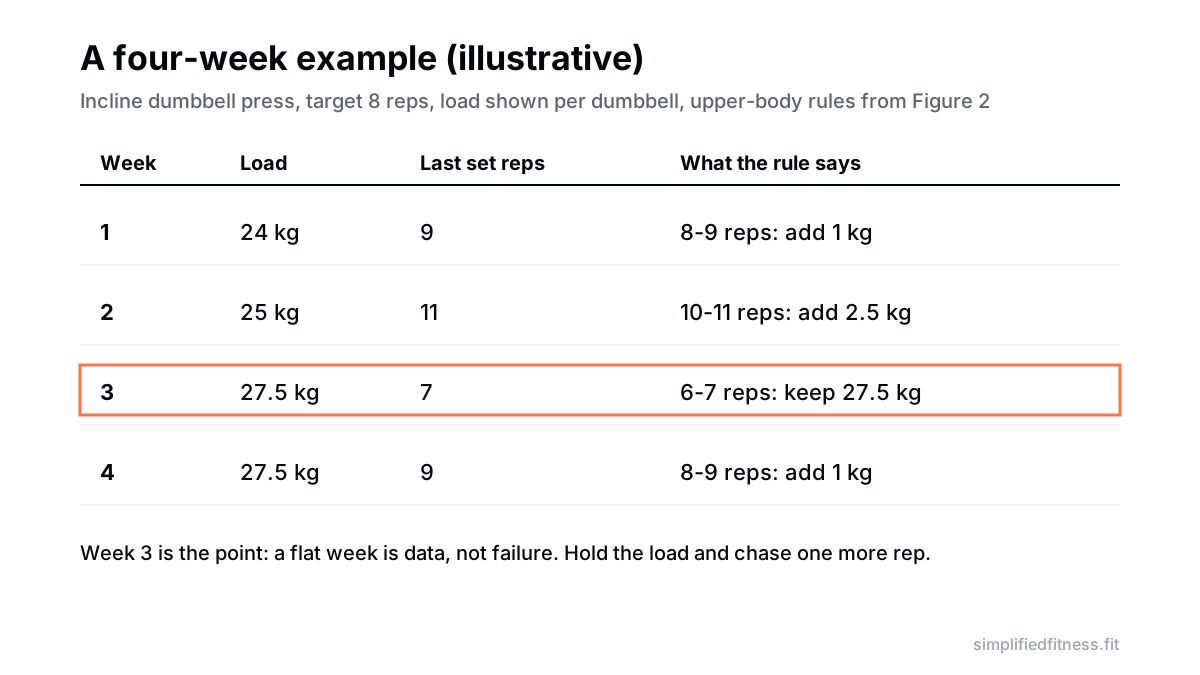
Week 3 is the one people panic about. You hit 7 reps at 27.5 kg, the rule says hold, and you hold. By week 4 you get 9 and move up. That is the system working, not stalling.
Do I have to train to failure for this to work?
No. And this is a common worry.
The rule table needs an honest read of how close to the limit you went, not a grinder every set. A systematic review and meta-analysis of 15 studies on proximity to failure found no evidence that training to momentary muscular failure is superior to non-failure training for muscle hypertrophy (Refalo et al., 2023). It also reported a trivial advantage when any definition of set failure was used, so effort matters a little, but you do not need to hit the wall every time.
Notice the limitation. That review is about muscle size, and the APRE trials are about strength. Different outcomes, different answers. For heavy compounds where failure is risky (squats, bench with no spotter), stop with a rep in the tank.
If you struggle to judge 0-1 reps in reserve, spend a few weeks calibrating first. Our RIR and RPE calculator helps you map how hard a set felt.
Does the rep range I choose matter?
Less than you would think. APRE was built around a specific rep number, but the wider evidence says you have flexibility. A 2021 review argued that muscular adaptations can be obtained, and in some cases optimized, across a wide spectrum of loading zones, challenging the old idea that only a narrow rep band builds muscle (Schoenfeld et al., 2021).
So pick a target you can keep up. Many lifters like 6-8 reps for a main compound and 10-12 for accessories. Choose one number per exercise, keep it for a block, and let the rule table do the rest.
Where APRE fits next to other progression models
You have options, and none is perfect:
| Method | How the next jump is decided | Good for |
|---|---|---|
| Linear loading | Fixed add every session or week | Beginners |
| Double progression | Hit top of rep range on all sets, then add weight | Isolation work, simplicity |
| APRE-style rules | Reps beyond target set the size of the jump | Main lifts, intermediates |
| RPE or RIR based | Effort rating guides load | Experienced lifters |
Suchomel and colleagues note that linear loading may suit novices but can limit variation if used exclusively for long periods (Suchomel et al., 2021). For the simpler rep-range method, see double progression. For adjusting how many sets you do rather than how heavy they are, read autoregulation of set volume.
Making small jumps without the gym’s plates
The biggest practical problem in an Indian commercial gym is that dumbbells jump from 10 kg to 12.5 kg to 15 kg, and the smallest plate on the stack might be 2.5 kg. A 1 kg jump rule is useless if you cannot load 1 kg.
Your workarounds, in order:
- Add reps instead. If you cannot load a small jump, take the extra rep and keep the weight.
- Carry fractional plates. A pair of 0.5 kg or 1.25 kg plates in your bag fixes most barbell and machine pin problems. See microloading with fractional plates.
- Use the plate maths. Work out exact bar loads with the plate calculator.
- Slow the tempo or add a pause as a stand-in progression for a week.
Logging: the part that makes it work
None of this works without a log. You need the exercise, the load, the reps on the last set, and a one-line note (slept badly, new gym, shoulder grumpy). Without that, you cannot apply the rule honestly. Our guide to what to track in a training logbook covers the minimum.
If you have no plan yet, our free push, pull and legs plan gives you a structure to apply these rules to.
When the system tells you to hold for weeks
Sometimes the rules keep saying “keep the weight.” That is information. Before changing the plan, check:
- sleep (a few nights of 5 hours shows up fast)
- protein and total calories, especially in a cut
- whether your reps are truly clean and your form is standardized
- total weekly volume and whether you are stacking too many hard sets
- life stress and heat
If the bar will not move for a month despite all this, work through our plateau troubleshooting flowchart before assuming you need a new program.
A simple way to start this week
- Choose 2-3 main lifts. Leave the rest on easy rep ranges.
- Set a target of 6-8 reps on your last working set.
- Take that set to 0-1 reps in reserve with clean form.
- Log the reps.
- Apply the table in Figure 2, scaled down if you prefer smaller jumps.
- Run it for 6-8 weeks, then look at your log, not your memory.
APRE gives you a rule where most programs give you a hunch. It will not turn a bad plan into a good one, and the research is too small to promise extra gains. But “add weight when the reps say so, hold when they do not” is a simple, defensible way to keep overload honest. For where it fits in a longer plan, return to our progressive overload guide.
Frequently Asked Questions
What is autoregulated progressive overload?
It is a way of adding weight where your own performance, usually the reps you hit on a hard final set, decides the next load rather than a fixed schedule. The idea is that strength and recovery vary week to week, so the plan bends with you. In practice you log your reps and apply a simple rule table before your next session.
What does APRE stand for?
APRE stands for Autoregulatory Progressive Resistance Exercise. It was studied in college athletes as a method where lifters progress at their own pace based on daily and weekly performance, instead of a set weekly increase. You can borrow the principle without copying a specific protocol.
How much weight should I add each week?
It depends on how many reps you hit above your target. A common sensible range is about 2% for a small rep surplus and 5-10% for a big one, rounded to the smallest plate you own. Hit your target on only part of the sets and stay put.
Is APRE better than linear progression?
In one 6-week study of 23 college football players, APRE improved bench press, estimated squat and repeated bench reps more than linear periodization. The groups were trained in separate years, so it is not a randomized comparison. It is promising for trained athletes, but not proof that it wins for everyone.
Does APRE work for building muscle?
The APRE research measures strength and performance, not muscle size, so we cannot say it builds more muscle. A load that keeps progressing with decent effort is the common thread behind hypertrophy, though. Use it as a way to keep overload honest, then judge progress by your logbook and mirror over months.
How many reps should I leave in reserve?
For the rule table in this article, finish the last set at 0-1 reps in reserve with clean form. A 2023 meta-analysis found no evidence that training to momentary failure beats stopping short for muscle growth. So you do not need ugly grinders to make the system work.
What if I hit fewer reps than my target?
Keep the weight the same next week, or drop about 5% if you missed by a lot. One low week is usually sleep, food, stress or heat, not a training failure. If you miss two weeks in a row, check your recovery before touching the bar.
Can beginners use APRE?
Yes, but beginners usually progress fast enough that simple linear loading or double progression works fine. A review of load adjustment methods suggests linear loading may suit novices, though it can limit variation over long periods. Start simple, and move to rep-based rules when the easy jumps dry up.
Do I need microplates for APRE?
For small jumps like 1 kg on a dumbbell press or lateral raise, yes, or you will be stuck choosing between no change and a jump that is too big. Fractional plates, 0.5 kg or 1.25 kg, solve this. Without them, add reps first and only add load when you clear the top of your range.
How is APRE different from double progression?
Double progression has you hit the top of a rep range on all sets, then add a fixed chunk of weight. APRE is more graded: how far past your target you went decides how big the next jump is. Both are rep-driven, so you can use one for isolation work and the other for main lifts.
Should I use APRE on every exercise?
Not necessarily. It suits your main compound lifts and a few key accessories where you can log reliably. Keep easy exercises like curls and lateral raises on a simple rep range so you are not doing maths between sets.
What if my weight stops going up for weeks?
That is a plateau, and the rule table will keep telling you to hold. Check sleep, protein, total weekly sets and whether your reps are really clean. Our plateau flowchart walks through the order to check things.
Is it safe to jump up 10% in one week?
A big jump is only suggested when you beat your target by a wide margin, which usually means the load was too light. Even so, dropping to 5% is a conservative choice if the lift is technical or the joint is touchy. If anything hurts in a sharp way, stop and see a doctor or physiotherapist.
Sources & References
Every claim above is checked against peer-reviewed research (PubMed, U.S. National Library of Medicine) or guidance from established health bodies. How we fact-check.
- Mann JB, et al. The effect of autoregulatory progressive resistance exercise vs. linear periodization on strength improvement in college athletes. J Strength Cond Res. 2010. PMID: 20543732
- Zhang X, et al. Auto-Regulation Method vs. Fixed-Loading Method in Maximum Strength Training for Athletes: A Systematic Review and Meta-Analysis. Front Physiol. 2021. PMID: 33776802
- Zijing Huang, et al. Autoregulated resistance training for maximal strength enhancement: A systematic review and network meta-analysis. J Exerc Sci Fit. 2025. PMID: 40791980
- Suchomel TJ, et al. Training for Muscular Strength: Methods for Monitoring and Adjusting Training Intensity. Sports Med. 2021. PMID: 34101157
- Refalo MC, et al. Influence of Resistance Training Proximity-to-Failure on Skeletal Muscle Hypertrophy: A Systematic Review with Meta-analysis. Sports Med. 2023. PMID: 36334240
- Schoenfeld BJ, et al. Loading Recommendations for Muscle Strength, Hypertrophy, and Local Endurance: A Re-Examination of the Repetition Continuum. Sports (Basel). 2021. PMID: 33671664
- Huang Z, et al. Comparing autoregulatory progressive resistance exercise and velocity-based resistance training on jump performance in college badminton athletes. PeerJ. 2023. PMID: 37576500

Umair Hazrami · Founder & Head Coach, Simplified Fitness
Umair Hazrami founded Simplified Fitness and the Simplified Lifter channel to cut through fitness noise. With 4+ years of consistent training and 10+ coaching clients, he writes every guide from the peer-reviewed research and links the sources so you can check them. Our editorial standards.
Educational content only, not medical advice. If you have a medical condition, are pregnant, or take medication, talk to a qualified doctor before changing your diet, supplements or training. Full disclaimer.
Keep reading
Programming
The 5 Modalities of Progressive Overload: A Checklist for When Weight Won't Go Up
5 ways to progressive overload: load, reps, range of motion, tempo and rest density. A practical checklist for compounds and isolations, with the research.
7 min read

Programming
Deload Science: What a Deload Week Really Does to Fatigue, Muscle and Strength
Deload science explained: the fitness-fatigue model, what trials show for muscle size and strength, and what happens in a deload week. Studies linked.
8 min read

Programming
How to Do a Deload Week: Volume Cut vs Intensity Cut vs Time Off
How to do a deload week workout: compare cutting sets by half, lowering weight by 20%, or taking time off, with a step-by-step template and the research.
9 min read
Programming
The Double Progression Model: Mastering Rep Ranges (e.g., 8-12 Reps) for Consistent Growth
The double progression model explained: pick a rep range like 8-12, hold the weight, hit the top on every set, then add load. Rules, examples and mistakes.
9 min read