Mesocycle Architecture: Structuring 4-8 Week Training Cycles for Natural Lifters
Mesocycle architecture explained: a week-by-week 7-week hypertrophy block with RIR targets, volume steps, a deload and how to start the next cycle.
TL;DR. The short answer
- A mesocycle is a 4-8 week training block with one job: start easy, add load, reps or sets on purpose, get close to failure at the end, then deload and start fresh.
- A workable 7-week template: week 1 at about 3 RIR, weeks 2-4 at about 2 RIR, week 5 at about 1 RIR, week 6 optionally at 0-1 RIR, week 7 as a deload. The RIR numbers are a coaching convention, not something trials have tested as a package.
- Keep the same exercises for the whole block so your logbook numbers are comparable. Rotate lifts between blocks, not inside them.
- Periodizing a block does not clearly beat non-periodized training for muscle size when volume is equal (meta-analysis of 35 studies), though it did favour 1RM strength. Structure is for managing fatigue and progress, not a growth hack.
- Deloads are a tool, not a rule. One trial in trained lifters found a full week off did not change muscle growth and slightly reduced strength gains, so take one when you need it.
Part of our complete guide: Progressive Overload Methods, Deloads and Plateaus: The Long-Term Progression Guide
Table of contents
Mesocycle architecture is the plan for a 4-8 week block of training: where you start, how hard sets get harder each week, and when you back off. A solid default for natural lifters is 7 weeks, easy start at about 3 reps in reserve (RIR), steady progress at 2 RIR, a peak near 1 RIR, then a deload. This article is the calendar view of the progressive overload, deloads and plateaus guide.
Most people train day by day. They show up, pick something, push until they are tired. It works for a while. Then it doesn’t, and nobody can say why, because nothing was planned and nothing was compared.
A block fixes that. You decide the rules before week 1, so week 5 means something.
What is a mesocycle?
A mesocycle is a chunk of training, typically 4-8 weeks, with one goal. Here the goal is muscle size. A microcycle is one week inside it. A macrocycle is the full year.
Here is the honest part. The research does not say a mesocycle makes muscle grow faster by itself. A meta-analysis of 35 volume-equated studies found periodized and non-periodized training gave similar hypertrophy, although periodized programs favoured 1RM strength, and the extra strength edge for undulating over linear models showed up in trained people only (Moesgaard et al., 2022).
So why bother? Because a block gives you three practical things: a reason to start easy, a way to add difficulty without guessing, and a built-in point to reassess. Growth still comes from enough hard sets, done consistently.
How do you structure a mesocycle for hypertrophy?
Here is the 7-week template. It is a coaching convention, not a protocol proven in a trial. The ingredients (more sets over time, effort near failure, a lighter week) each have some support, the exact package does not.
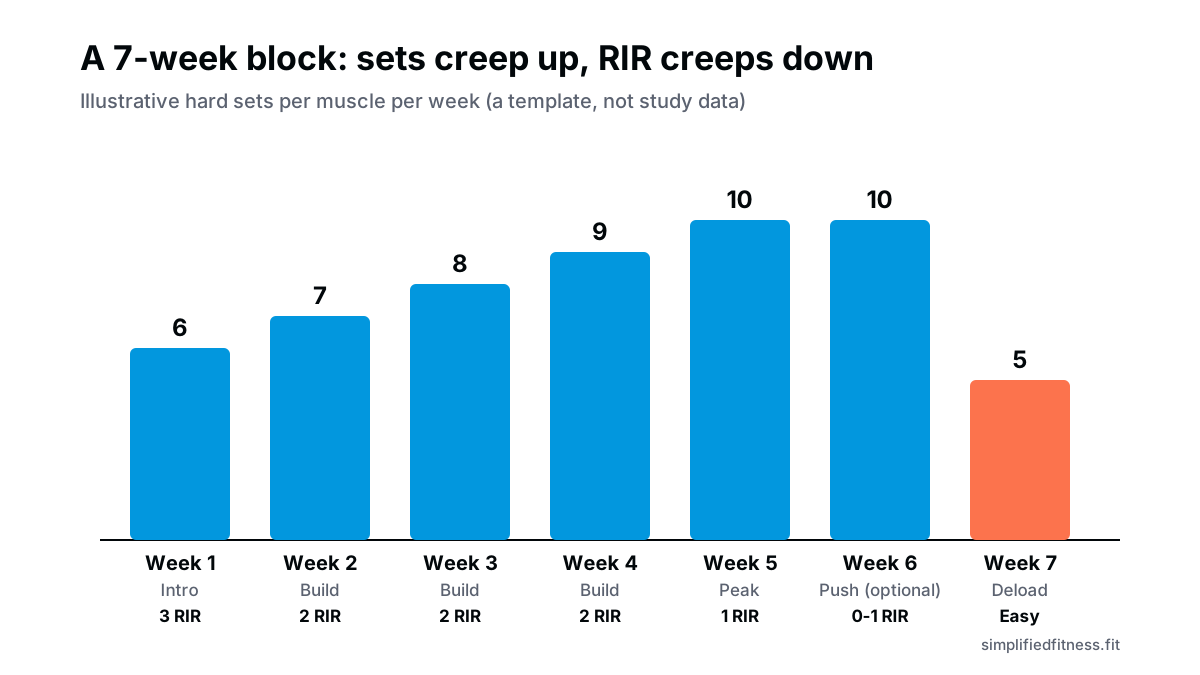
| Week | Role | Effort (RIR) | What changes |
|---|---|---|---|
| 1 | Intro | About 3 | Lowest sets. Find working loads, groove technique |
| 2-4 | Build | About 2 | Add load or reps each week, add a set in weeks 3-4 if recovery is good |
| 5 | Peak | About 1 | Highest quality, hardest weight you can control |
| 6 | Push (optional) | 0-1 | Hold sets steady, final set per exercise close to failure |
| 7 | Deload | 3+ | Cut sets roughly in half, keep loads moderate |
New to RIR? Our guide to reps in reserve and RPE explains how to judge it, and the RIR and RPE calculator converts between scales.
Week 1: start easier than your ego wants
Week 1 is the intro. Use about 3 RIR and the lowest volume of the block. In the gym this means leaving three clean reps in the tank on every set. It feels too easy. That is the point.
Why start there? You need room to climb. If week 1 already feels like week 5, there is nowhere to go but backwards. A mesocycle also needs a starting number, and a conservative set count (think of it as your minimum effective volume) gives you one. We cover how to choose it in mesocycle volume progression from MEV to MRV.
Weeks 2-4: the progressive overload stretch
This is the working core. Aim for about 2 RIR and add something small every week: 1-2 reps, a small jump in load, or one extra set. Pick one lever at a time. Adding weight, reps and sets all at once is how a good week turns into a bad one.
Use a rep range, say 8-12, and move up the load when you reach the top of it on all sets. Double progression gets its own treatment in the double progression model. A review of the repetition continuum argues that muscle can be built across a wide spectrum of loads when sets are hard enough, so the range you choose can follow your exercise and joints (Schoenfeld et al., 2021).
Week 5: the peak
Now get close, about 1 RIR. Weights are heavier than week 1, sets are at or near the block maximum, and every set should still look like a rep you would be proud of. Quality over theatre.
Can you actually judge 1 RIR? Not perfectly. In one study of trained lifters on the bench press, 1 RIR and 3 RIR calls were both off by well under a rep on average (Refalo et al., 2024), but that is one lift in experienced people. Our piece on how accurately lifters gauge RIR goes through it. Err toward stopping a rep early on the heavy compounds.
Week 6: the optional push
This is where the template gets controversial, and it should. Some coaches have the last working week at 0 RIR on the final set per exercise. The thinking: a short dose of extreme effort, then a deload to clear it.
The evidence does not demand it. A meta-analysis of 15 studies found no evidence that training to momentary muscular failure beats stopping short of it for muscle size (Refalo et al., 2023). The effect for “set failure” overall was trivial (effect size 0.19). The same authors point toward a non-linear relationship: more proximity to failure is not always more growth.
A scoping review also notes that short bursts of high-volume or high-intensity lifting can produce functional overreaching, while chronic stretches can tip into non-functional overreaching, and true overtraining syndrome was rarely documented in lifters (Bell et al., 2020). Translation: one hard week is fine for most people. Four is a gamble.
My take: if you are sleeping badly, in a calorie deficit, or on a stressful job stretch, skip week 6 and go straight to the deload. Use 0 RIR only on machines and cables where a missed rep is harmless.
Week 7: the deload
Cut sets by about half, keep loads reasonable, stay 3 or more reps from failure. Same exercises. Same days. Just less.
Is a deload essential? Honestly, the evidence is thin and mixed. In 39 trained lifters, a full week off at the midpoint of a 9-week program left muscle growth about the same but gave smaller lower-body strength gains than training straight through (Coleman et al., 2024). In 19 untrained men, cutting volume to a single 2-set session in weeks 4 and 8 produced similar growth and strength-endurance to training continuously (Pancar et al., 2026).
Why might they differ? Different populations, different durations, and a full break versus a reduced load. And neither trial deloaded in response to signs of high fatigue, which is the scenario where a deload is supposed to help. So the sensible read: a deload is unlikely to hurt growth, may cost a little strength if it is a complete stop, and is worth taking when you actually need it. To tell if you do, see signs you need a deload, and for what a deload does physiologically, deload science.
How does fatigue accumulate across a block?
Each week of hard training leaves a little residue. Sleep dips a bit, joints feel tight, bar speed drops. Fitness gains build too, but fatigue can build faster as sets and effort rise. That is why the template ramps gradually instead of starting at peak.
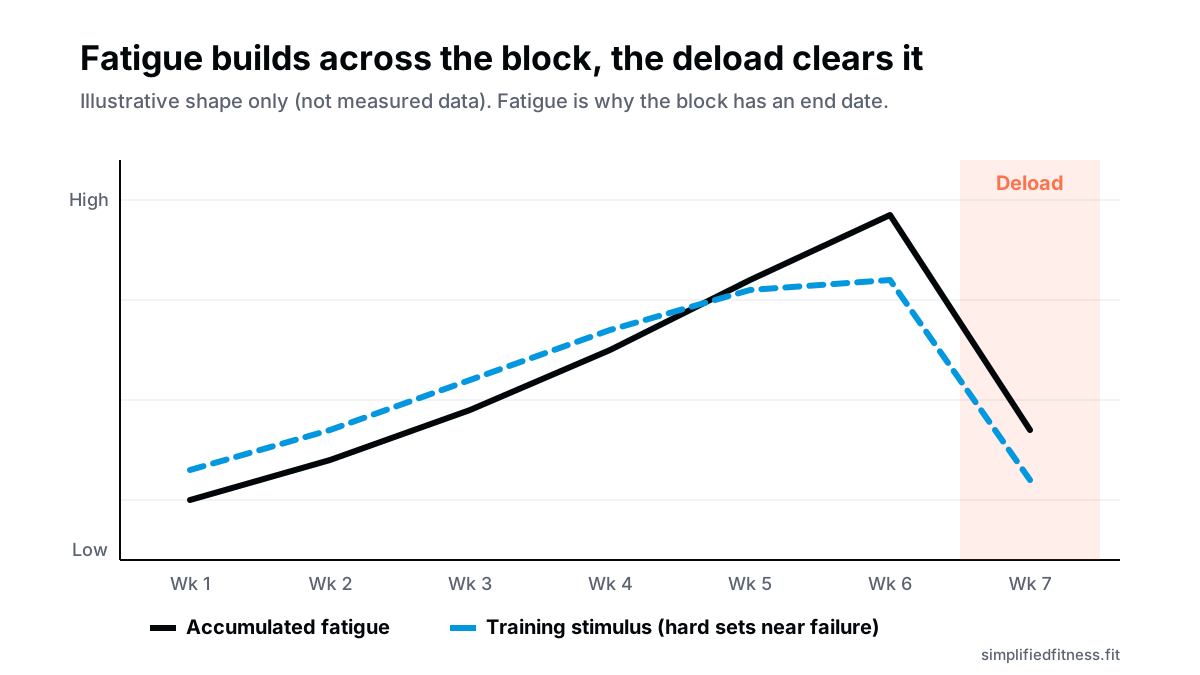
The practical rule is simple. If performance drops two sessions in a row on the same lift while sleep and mood slide, the block has served its purpose. Bring the deload forward. Ending a block at week 5 is not failure. It is the plan working.
Keep the exercises the same inside a block
Here is a rule that is easy to break. Do not rotate exercises inside a mesocycle.
If you swap the incline press for a different incline press in week 3, your week-2 numbers are meaningless. You cannot tell if you progressed. Using the same movements, the same rep range and the same technique standard lets your logbook do its job. Our training logbook guide lists what to record.
Rotate between blocks instead, and only when there is a reason: a cranky joint, a stalled lift, or plain boredom. We cover the logic in exercise rotation and the muscle confusion myth.
How do you transition between mesocycles?
Do not restart where you finished. Restart near the intro.
- Review the block. Which lifts moved? Which stalled? Which joint complained?
- Reset effort. Go back to about 3 RIR in week 1.
- Reset volume, slightly higher if it went well. If you hit week 5 recovered and strong, begin the next block one set above last block’s starting point. If you felt flattened, start at the same number or one lower.
- Update loads from the logbook, not from memory.
- Swap at most one or two exercises, only where you had a reason.
Some lifters take a 1-2 week gap of easy training between blocks. That is fine, and it roughly overlaps with a deload.
Making the block fit your life
A few Indian-context realities matter. Hot, humid summers make high-volume weeks harder; if you train in a non-air-conditioned gym in May, consider a shorter 5-week block or moving the deload earlier. A vegetarian diet is no obstacle to a block, but check protein with the protein calculator so recovery is not the weak link. Exam season or a work deadline? Hold the block at the build stage and skip the peak.
Count your weekly hard sets per muscle with the training volume calculator, and the broader weekly dose rules sit in volume landmarks (MV, MEV, MAV, MRV).
When to see a doctor
Normal block fatigue passes with rest. Persistent chest pain, fainting, unusual shortness of breath, a joint that is swollen or locked, numbness, or weeks of poor sleep with low mood are not “push through” signals. See a doctor or physiotherapist.
The bottom line
A mesocycle is a calendar for effort. Start easy at about 3 RIR, add one lever at a time through the middle weeks, peak near 1 RIR, optionally push once, then deload and reset. Keep the lifts fixed inside the block and rotate between blocks.
The research says volume matters and that periodizing mainly helps strength, not size, so do not expect a block to do magic. Expect it to keep you organised, progressing and a little less beat up.
Frequently Asked Questions
What is a mesocycle in weight training?
A mesocycle is a block of training, usually 4-8 weeks long, built around one goal such as hypertrophy. It sits between the single session and the full year of training. Pick a goal, plan how hard sets and effort will progress week to week, and write the plan down before week 1.
How long should a hypertrophy mesocycle be?
Most lifters do well with 4-8 weeks, and 6-7 weeks including the deload is a practical default. No trial has identified a single ideal length, so this is a coaching convention. Shorter blocks suit beginners or people with unpredictable schedules, longer blocks suit lifters who progress slowly.
How do you structure a mesocycle for muscle growth?
Start at a manageable volume with about 3 reps in reserve (RIR), then add weight, reps or a set each week while effort rises toward 1 RIR. Weekly hard sets are the main lever for growth, and a meta-analysis found more sets generally gave more size [(Schoenfeld et al., 2017)](https://pubmed.ncbi.nlm.nih.gov/27433992/). End the block with a lighter week and keep the exercise list unchanged.
What is the difference between a mesocycle, a microcycle and a macrocycle?
A microcycle is usually one training week, a mesocycle is a block of several weeks, and a macrocycle is the whole season or year. Think of them as week, block and year. Plan the block first and the year will mostly take care of itself.
Should I train to failure in the last weeks of a mesocycle?
Not necessarily. A meta-analysis found no evidence that training to momentary muscular failure beats stopping short of it for hypertrophy [(Refalo et al., 2023)](https://pubmed.ncbi.nlm.nih.gov/36334240/). If you want 0 RIR, use it on the last set of safe, stable exercises like machines and cables, not on heavy barbell squats.
Do I have to deload at the end of every mesocycle?
No. Deloading is a tool to manage fatigue, and the evidence does not show it is mandatory. A 2024 trial in trained lifters found a one-week break did not change muscle growth and slightly lowered lower-body strength gains. If you feel fresh at week 7, a lighter week is optional; if lifts are stalling and joints ache, take it.
Should I change exercises every mesocycle?
Keep them the same within a block and consider rotating between blocks. Using the same lifts lets you compare logbook numbers fairly, and it gives you time to improve technique. If an exercise bothers a joint or you are bored, swap it at the block boundary.
How do I start the next mesocycle?
Restart near the intro volume and effort, not where the last block ended. Use your final-week numbers to set new loads, and trim a set if you finished the block feeling beaten up. Starting the new block at your old peak volume is how people burn out by week 4.
Does periodization actually build more muscle?
Not clearly. A meta-analysis of 35 volume-equated studies found periodized and non-periodized training produced similar muscle growth, though periodized training favoured 1RM strength [(Moesgaard et al., 2022)](https://pubmed.ncbi.nlm.nih.gov/35044672/). Treat a mesocycle as an organizing tool, and expect most of the growth to come from enough hard sets done consistently.
How many sets per muscle should I do in a mesocycle?
There is no single right number. The template in this article climbs from 6 to 10 hard sets per muscle per week as an example; many lifters recover from more, and our volume articles cover how to find your range. A 2026 meta-regression found more volume gave more growth, with diminishing returns [(Pelland et al., 2026)](https://pubmed.ncbi.nlm.nih.gov/41343037/). Use our training volume calculator to count your weekly sets.
Can beginners use mesocycles?
Yes, but a beginner can usually just add weight or reps every session for a while. Formal blocks matter more once linear progress slows. A simple 4-week block with a lighter fifth week is plenty at the start.
What if I miss a week or fall ill mid-mesocycle?
Restart the week you missed rather than skipping ahead. Illness and travel are normal, and the plan should bend to them. If you were off for a week or more, drop loads by one notch and resume at an easier RIR.
Is the 0 RIR overreaching week safe?
Short periods of high-volume or high-intensity training can cause functional overreaching, but long runs of it may tip into non-functional overreaching, according to a scoping review [(Bell et al., 2020)](https://pubmed.ncbi.nlm.nih.gov/32602418/). That review found little evidence of true overtraining syndrome in lifters. Keep the push week to one week, and stop it early if sleep, mood and performance all slide together.
Sources & References
Every claim above is checked against peer-reviewed research (PubMed, U.S. National Library of Medicine) or guidance from established health bodies. How we fact-check.
- Schoenfeld BJ, et al. Dose-response relationship between weekly resistance training volume and increases in muscle mass: A systematic review and meta-analysis. J Sports Sci. 2017. PMID: 27433992
- Pelland JC, et al. The Resistance Training Dose Response: Meta-Regressions Exploring the Effects of Weekly Volume and Frequency on Muscle Hypertrophy and Strength Gains. Sports Med. 2026. PMID: 41343037
- Moesgaard L, et al. Effects of Periodization on Strength and Muscle Hypertrophy in Volume-Equated Resistance Training Programs: A Systematic Review and Meta-analysis. Sports Med. 2022. PMID: 35044672
- Refalo MC, et al. Influence of Resistance Training Proximity-to-Failure on Skeletal Muscle Hypertrophy: A Systematic Review with Meta-analysis. Sports Med. 2023. PMID: 36334240
- Coleman M, et al. Gaining more from doing less? The effects of a one-week deload period during supervised resistance training on muscular adaptations. PeerJ. 2024. PMID: 38274324
- Pancar Z, et al. Effects of deload periods in resistance training on muscle hypertrophy and strength endurance in untrained young men using a randomized within subject design. Sci Rep. 2026. PMID: 41730991
- Bell L, et al. Overreaching and overtraining in strength sports and resistance training: A scoping review. J Sports Sci. 2020. PMID: 32602418
- Refalo MC, et al. Accuracy of Intraset Repetitions-in-Reserve Predictions During the Bench Press Exercise in Resistance-Trained Male and Female Subjects. J Strength Cond Res. 2024. PMID: 37967832
- Schoenfeld BJ, et al. Loading Recommendations for Muscle Strength, Hypertrophy, and Local Endurance: A Re-Examination of the Repetition Continuum. Sports (Basel). 2021. PMID: 33671664

Umair Hazrami · Founder & Head Coach, Simplified Fitness
Umair Hazrami founded Simplified Fitness and the Simplified Lifter channel to cut through fitness noise. With 4+ years of consistent training and 10+ coaching clients, he writes every guide from the peer-reviewed research and links the sources so you can check them. Our editorial standards.
Educational content only, not medical advice. If you have a medical condition, are pregnant, or take medication, talk to a qualified doctor before changing your diet, supplements or training. Full disclaimer.
Keep reading

Programming
The 5 Modalities of Progressive Overload: A Checklist for When Weight Won't Go Up
5 ways to progressive overload: load, reps, range of motion, tempo and rest density. A practical checklist for compounds and isolations, with the research.
7 min read
Programming
Autoregulated Progressive Overload (APRE): How Much Weight to Add Next Week
Autoregulated progressive overload (APRE) uses your last-set reps to set next week's weight. Get simple jump rules, a worked example and the evidence.
9 min read

Programming
Deload Science: What a Deload Week Really Does to Fatigue, Muscle and Strength
Deload science explained: the fitness-fatigue model, what trials show for muscle size and strength, and what happens in a deload week. Studies linked.
8 min read

Programming
How to Do a Deload Week: Volume Cut vs Intensity Cut vs Time Off
How to do a deload week workout: compare cutting sets by half, lowering weight by 20%, or taking time off, with a step-by-step template and the research.
9 min read