Strength Gains vs Muscle Growth: Why Your Lifts Go Up but Your Muscles Look the Same
Strength gains vs muscle growth: why your bench can jump 10 kg while your chest looks unchanged, what the research says about nerves and size, and what to do.

TL;DR. The short answer
- Early strength gains come partly from your nervous system and technique getting better at the lift, while visible muscle size changes more slowly and is harder to see in a mirror.
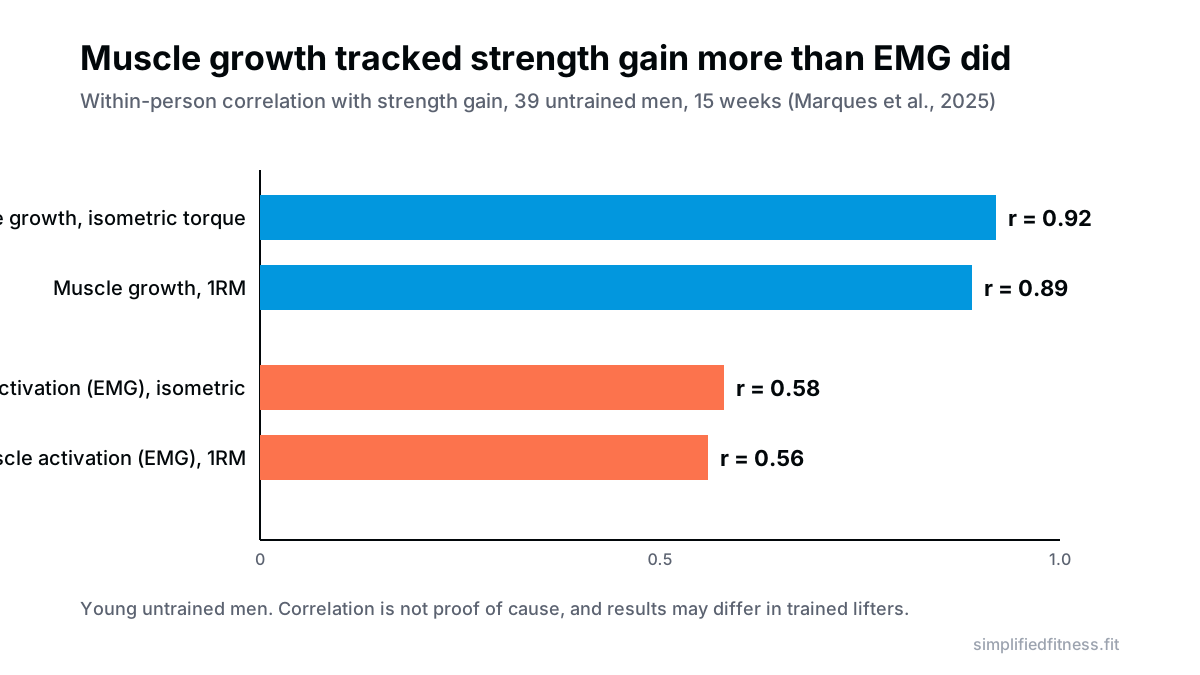
- Over months and years, muscle size is a major driver of strength. In a 2025 study of 39 untrained men, muscle growth tracked strength gain far more closely than changes in muscle activation did.
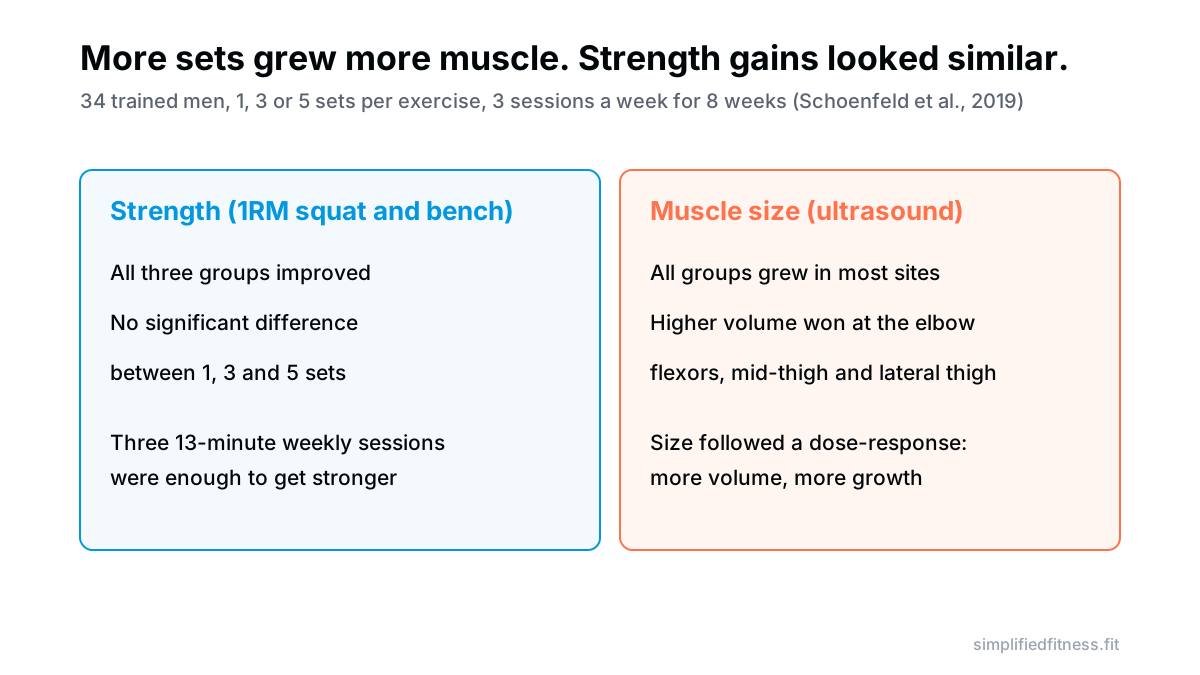
- Strength and size are not the same goal. In a trained-men trial, 1, 3 and 5 sets per exercise produced similar strength gains, but higher volumes grew more muscle.
- If you want visible size, train each muscle with enough hard sets, keep eating enough protein and calories, and give it months, not weeks.
- Strength that rises with no change in size at all is normal early on. Sudden weakness, pain or unexplained muscle loss is a reason to see a doctor.
Part of our complete guide: Progressive Overload Methods, Deloads and Plateaus: The Long-Term Progression Guide
Table of contents
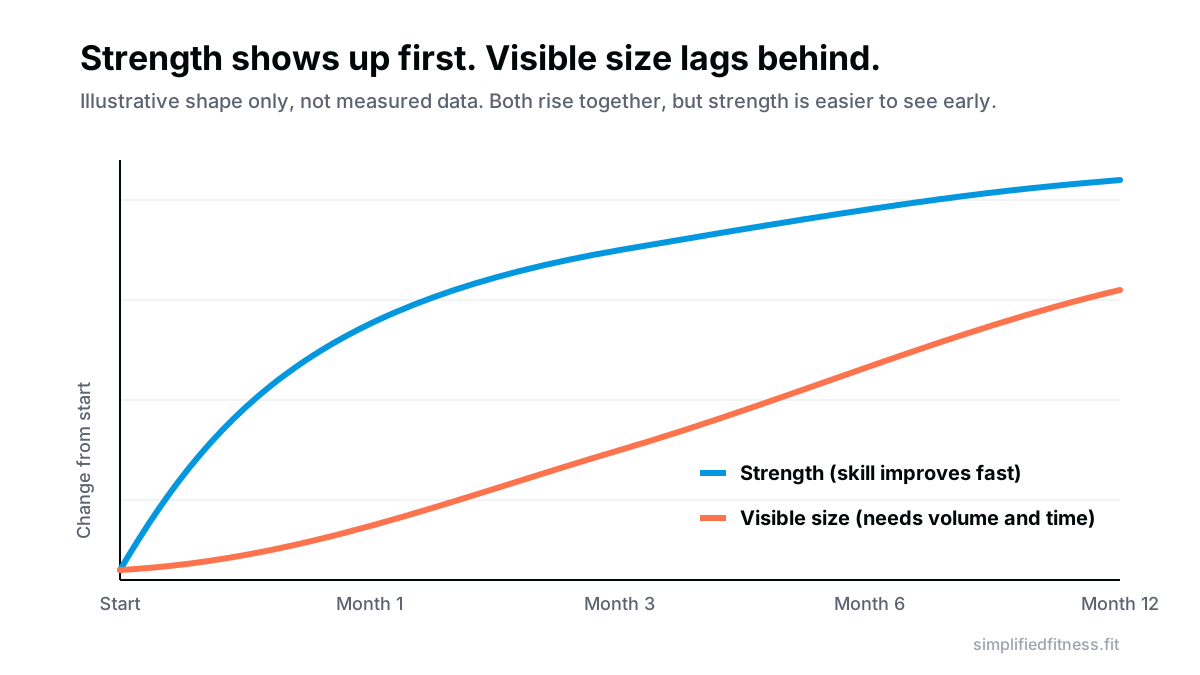
Your bench went up 10 kg and your chest looks exactly the same. That is normal, and it does not mean nothing is happening. Strength gains vs muscle growth run on different clocks: early strength is partly your nervous system and technique improving, while visible size needs more volume, food and time.
This article is part of our complete guide to progressive overload, deloads and plateaus. Here we stay on one question: why strength and size drift apart early, and why they eventually move together.
Why am I getting stronger but not bigger?
Three things are usually going on at once.
1. You are getting better at the lift. A bench press or squat is a skill. Your bar path gets cleaner, your setup gets tighter, and your brain learns to recruit the right muscles in the right order. Sale’s classic review describes how strength training can allow a lifter to activate prime movers more fully and coordinate all the relevant muscles better, producing more net force in the intended direction (Sale, 1988). Same muscle, better driver.
2. Muscle is growing, but slowly. In an 8-week study of young and older women, thigh muscle thickness exceeded measurement error after about 2-3 weeks of training, so growth starts early (Loenneke et al., 2017). A few millimetres of thickness is real, but you will not see it from the front mirror.
3. Your eyes are a bad measuring tool. Lighting, pump, hydration and bodyweight changes all swamp small shifts in size. The barbell does not lie. The mirror often does.
If you want the deeper neural story on its own, our guide to neural adaptations vs muscle growth in early training covers it.
Is it all “just neural”? What the research says
Here is where gym folklore gets ahead of the evidence. The old story was that the first weeks of strength are almost entirely neural and muscle growth only “kicks in” later. The newer picture is more mixed.
Sale’s 1988 review was careful: both neural and muscular changes matter, and their relative roles differ in short and long term training (Sale, 1988). Loenneke’s data above shows muscle starts growing within weeks, not months.
Then there is a methodological wrinkle. A 2021 study compared long-term trained men with untrained men and found that higher electromyography (EMG) amplitude in the trained group might be confounded by differences in muscle size, rather than being a clean measure of central neural drive. The authors suggest this points to limited agonist neural adaptation after long-term training (Škarabot et al., 2021). In plain words: older EMG evidence for big “neural gains” may have been overstated because muscle size was muddying the signal.
The honest takeaway is a middle path. Nerves and technique matter early, muscle size starts changing early too, and the longer you train, the more size does the heavy lifting.
Does muscle size actually drive strength?
Mostly, yes, once you look at it properly.
For years, studies comparing average strength change with average size change found weak links, which fed the idea that size and strength were barely related. The better question is within each person: when your muscle grows more, does your strength rise more?
A 2025 study followed 39 previously untrained young men through 15 weeks of lower body training, measuring quadriceps muscle volume and strength before and after. Muscle growth had very strong within-person correlations with strength gain (r = 0.92 for isometric torque, r = 0.89 for 1RM). Changes in muscle activation, measured by EMG, were moderately correlated (r = 0.58 and 0.56). In the statistical model, muscle growth contributed more than five times as much as activation to strength gain (Marques et al., 2025).
An earlier study found the same direction in the arm. In 33 untrained men after 12 weeks of elbow flexor training, percentage gains in muscle volume correlated with gains in isometric and 1RM strength (r = 0.527 and 0.482), while EMG changes did not correlate with strength changes (Erskine et al., 2014).
This is also why muscle size likely sets much of the long-term ceiling. Technique can only be polished so far, and beyond that, more force mostly has to come from more muscle. We dig into this in muscle cross-sectional area and the strength ceiling.
Strength training vs size training: where the paths split
If size and strength are linked, why does the gym treat them as different goals? Because of what each needs most.
In a trial of 34 resistance-trained men, groups did 1, 3 or 5 sets per exercise, three days a week for 8 weeks. Strength and endurance improved in all groups with no significant differences between them. Muscle size, measured by ultrasound, increased in most sites in all groups, but higher volumes won at the elbow flexors, mid-thigh and lateral thigh (Schoenfeld et al., 2019).
A 2017 meta-analysis of 15 studies supports the size side: each additional weekly set was associated with an increase in effect size of 0.023, about a 0.37% bigger gain in muscle size, with higher volumes producing greater hypertrophy (Schoenfeld et al., 2017).
So the practical split looks like this.
| Goal | What matters most | What can be enough |
|---|---|---|
| Strength | Practice the lifts, progressive load, good technique | Fewer sets can work for a while |
| Muscle size | Enough hard sets per muscle per week, near failure, time | Higher volumes tend to grow more |
| Both | Progressive overload with decent weekly volume | Most lifters want this |
The volume trial was short (8 weeks) and in trained men only, so treat the exact numbers as a guide, not a rule. Use our training volume calculator to see where your weekly sets actually sit, and our training volume and frequency guide for how to adjust.
Do I need to train in a “hypertrophy rep range”?
Not strictly. The traditional repetition continuum says heavy loads build strength, moderate loads build size, and light loads build endurance. A 2021 review argues the evidence does not support some of that theory’s assumptions, and proposes that adaptations can be obtained, and sometimes optimized, across a wide spectrum of loads (Schoenfeld et al., 2021).
Note the scope: that review is a narrative re-examination, not a single trial. Take it as “rep range is flexible”, not “anything goes”.
Practically, a mix is sensible. Heavier sets on the big lifts build the skill and the numbers. Moderate and higher-rep sets on machines, dumbbells and cables often feel better on joints. Our high-load vs low-load hypertrophy guide goes further.
Why does the pump not count, and what does?
A great pump can make a muscle look big for an hour. It is mostly temporary fluid, not new tissue. If you chase it, you can feel like you are growing while the tape measure says otherwise. See pump vs true hypertrophy.
Signals that do count over time:
- Your lifts trend up at similar rep counts
- Tape measurements creep up over 6-12 weeks
- Photos in the same lighting look different after a month or two
- Bodyweight rises slowly if you are eating in a surplus
Any one of these can mislead. Together they paint a decent picture.
What to do when strength is up and size is flat
The most common mistake here is assuming more weight on the bar is the same as more muscle. It can be, but only if the muscle is actually doing the work. If you are grinding out a bench with shoulders rolling and elbows flared, you are practising a lift, not training a chest.
A simple checklist:
- Count hard sets. Aim for roughly 10 hard sets per muscle per week as a starting point, and add sets slowly if progress stalls.
- Train close to failure. Use our RIR and RPE calculator to find 1-3 reps from failure.
- Use a stretch. Choose exercises that load the muscle through a full range, such as flys, incline presses, and deep leg presses.
- Progress the right way. Add reps first, then weight, as covered in our progressive overload guide.
- Eat for growth. Hit your protein target and do not run a deficit if size is the priority.
- Wait. Give it 8-12 weeks before judging.
Food matters more than most people think
If strength rises while size does not, check your intake. Strength can improve on modest calories because skill gains need no extra tissue. Building tissue does. Indian vegetarian lifters often under-eat protein. Dal, paneer, curd, soya chunks and milk can all contribute, and roti or rice supplies energy to train hard. Our protein calculator gives a daily target, and the diet plan page shows how to spread it across meals.
When strength changes are a medical question
Normal plateaus are not an emergency. But see a doctor if you experience sudden unexplained weakness, visible muscle wasting, numbness, severe or persistent pain, or very dark urine after training. These are outside what any program can fix. This article is general education, not a diagnosis.
The bottom line
Strength gains vs muscle growth is not a contradiction. Early on, technique and nervous system efficiency lift your numbers faster than your muscles visibly change. Over months, muscle growth becomes a major driver of how strong you can get, and growth responds to enough weekly volume, effort and food.
So keep lifting, keep progressing, count your sets, and give your chest time to catch up with your bench. Want a structure to follow? Start with our free push day plan and judge progress over a couple of months, not a couple of weeks. For the bigger picture, see our muscle hypertrophy guide for natural lifters.
Frequently Asked Questions
Why am I getting stronger but not bigger?
Strength usually moves faster than visible size because part of early strength is skill: better coordination, better bar path and more effective use of the muscle you already have. Muscle growth does happen alongside it, but it is slower and hard to spot by eye. Track measurements or photos every 4-6 weeks rather than judging by the mirror each week.
Can you get stronger without gaining muscle?
Yes, to a point. Studies of nervous system adaptation show that practice and better muscle activation can raise strength in the short term without much change in size. Over longer periods, though, most strength gain in trained muscle goes hand in hand with growth, so the ceiling is limited.
How long does it take to see muscle growth after starting to lift?
Measurable growth can start within a few weeks. One 8-week study in young and older women found thigh muscle thickness exceeded measurement error after about 2-3 weeks of training. Seeing it clearly in the mirror usually takes longer, often a few months, and depends on your starting point, food and sleep.
Is strength training or hypertrophy training better for getting bigger?
For size, the key variable is enough hard sets near failure, not a special rep range. A 2021 review argues that muscle can grow across a wide spectrum of loads, including heavy and moderate ones. Pick loads you can progress on, and train close enough to failure that the sets are truly challenging.
Do I need to train in the 8-12 rep range to build muscle?
Not exclusively. A 2021 review of the repetition continuum found the evidence does not support strict rep zones for hypertrophy, and that growth can be achieved across a wide range of loads. Heavy, moderate and lighter sets taken close to failure can all build muscle, so choose ranges that suit the exercise and your joints.
Why did my bench press go up but my chest looks the same?
Bench press is a skill, and your technique, tension and coordination can improve quickly, which raises the number without much visible change. Triceps and front delts also share the load. Add enough chest volume, use some controlled isolation work such as flys, and judge progress over 8-12 weeks.
How many sets do I need to grow a muscle?
More sets per week tends to mean more growth, within limits. A 2017 meta-analysis found a graded dose-response, with each extra weekly set linked to about a 0.37% bigger gain in muscle size. Start around 10 hard sets per muscle per week, then add sets only if progress stalls and you are recovering well.
Does muscle size limit how strong I can get?
In general, bigger muscles can produce more force, and the two are strongly linked over months and years of training. A 2025 study found muscle growth was very strongly correlated with strength gain after 15 weeks of lower body training. Skill, tendon and body mechanics also matter, so size is a major factor and not the only one.
Should I just lift heavier to grow?
Heavier loads help, but heavy weight alone is not what drives size. You still need enough weekly volume and sets that end close to failure. Add weight when you hit the top of your target reps with good form, and do not sacrifice technique to move more kilos.
Can I build muscle on a vegetarian Indian diet?
Yes. Dal, paneer, curd, soya chunks, milk, eggs (if you eat them) and roti or rice can supply enough protein and calories if you plan portions. Spread protein across meals and use our protein calculator for a daily target. Eating too little is one of the most common reasons size lags behind strength.
How do I know if I am actually gaining muscle?
Look at several signals together: strength trending up over weeks, tape measurements of the arm, thigh or chest, progress photos in the same light, and body weight trending up slowly if you are eating in a surplus. No single signal is perfect. Re-check every 4-6 weeks, not every day.
When should I see a doctor about strength changes?
See a doctor if you lose strength suddenly, notice unexplained muscle wasting, have persistent pain, numbness, or dark urine after training. These are not normal training plateaus. A clinician can check for causes that no program change will fix.
Sources & References
Every claim above is checked against peer-reviewed research (PubMed, U.S. National Library of Medicine) or guidance from established health bodies. How we fact-check.
- Marques EA, et al. Muscle Growth Is Very Strongly Correlated with Strength Gains after Lower Body Resistance Training: New Insight from Within-Participant Associations. Med Sci Sports Exerc. 2025. PMID: 40680785
- Erskine RM, et al. The contribution of muscle hypertrophy to strength changes following resistance training. Eur J Appl Physiol. 2014. PMID: 24610245
- Sale DG. Neural adaptation to resistance training. Med Sci Sports Exerc. 1988. PMID: 3057313
- Škarabot J, et al. Neural adaptations to long-term resistance training: evidence for the confounding effect of muscle size on the interpretation of surface electromyography. J Appl Physiol. 2021. PMID: 34166110
- Loenneke JP, et al. Time-course of muscle growth, and its relationship with muscle strength in both young and older women. Geriatr Gerontol Int. 2017. PMID: 28276188
- Schoenfeld BJ, et al. Resistance Training Volume Enhances Muscle Hypertrophy but Not Strength in Trained Men. Med Sci Sports Exerc. 2019. PMID: 30153194
- Schoenfeld BJ, et al. Dose-response relationship between weekly resistance training volume and increases in muscle mass: A systematic review and meta-analysis. J Sports Sci. 2017. PMID: 27433992
- Schoenfeld BJ, et al. Loading Recommendations for Muscle Strength, Hypertrophy, and Local Endurance: A Re-Examination of the Repetition Continuum. Sports (Basel). 2021. PMID: 33671664

Umair Hazrami · Founder & Head Coach, Simplified Fitness
Umair Hazrami founded Simplified Fitness and the Simplified Lifter channel to cut through fitness noise. With 4+ years of consistent training and 10+ coaching clients, he writes every guide from the peer-reviewed research and links the sources so you can check them. Our editorial standards.
Educational content only, not medical advice. If you have a medical condition, are pregnant, or take medication, talk to a qualified doctor before changing your diet, supplements or training. Full disclaimer.
Keep reading
Programming
The 5 Modalities of Progressive Overload: A Checklist for When Weight Won't Go Up
5 ways to progressive overload: load, reps, range of motion, tempo and rest density. A practical checklist for compounds and isolations, with the research.
7 min read
Programming
Autoregulated Progressive Overload (APRE): How Much Weight to Add Next Week
Autoregulated progressive overload (APRE) uses your last-set reps to set next week's weight. Get simple jump rules, a worked example and the evidence.
9 min read

Programming
Deload Science: What a Deload Week Really Does to Fatigue, Muscle and Strength
Deload science explained: the fitness-fatigue model, what trials show for muscle size and strength, and what happens in a deload week. Studies linked.
8 min read

Programming
How to Do a Deload Week: Volume Cut vs Intensity Cut vs Time Off
How to do a deload week workout: compare cutting sets by half, lowering weight by 20%, or taking time off, with a step-by-step template and the research.
9 min read