2-Day per Week Lifting Programs: Minimum Effective Dose for Busy Professionals
Can a 2 day a week workout routine hypertrophy goals support? Yes. Get a ready two-day full-body plan, the research behind it and how to run it in 60 minutes.

TL;DR. The short answer
- Two well-built full-body sessions a week can maintain the muscle you have and still build more, as long as each muscle gets enough hard sets and you train close to failure.
- Research on matched weekly volume finds that spreading sets over fewer days does not meaningfully change muscle growth, so training frequency is a scheduling choice, not a growth switch.
- Aim for roughly 3-5 hard sets per muscle per session (about 6-10 per week), leaving 1-3 reps in reserve on most sets and pushing the last set of each exercise closer to failure.
- Maintaining muscle takes far less than building it: in younger adults, as little as one weekly session with one set per exercise has held muscle size, provided the load stays heavy.
- Choose compound lifts you can progress for months, keep the sessions near 60 minutes, and if you are over 60 or have a health condition, check with your doctor first.
Part of our complete guide: Best Workout Split for Muscle Growth: PPL vs Upper/Lower vs Full Body, What the Research Says
Table of contents
Yes, a 2 day a week workout routine for hypertrophy works, as long as the two sessions are full-body, hard and progressive. Research on matched weekly volume finds that training frequency matters far less than total hard sets and effort, so two focused hours a week can keep your muscle and still build more.
This guide is for the doctor, the founder, the consultant or the parent who really has two slots a week and nothing more. It sits inside our wider workout splits and session architecture guide, and it gives you a ready program, not just theory.
Can you really build muscle lifting twice a week?
Mostly, yes. But two caveats first.
The best evidence comes from studies that matched total weekly sets across different frequencies. A 2019 meta-analysis of 25 studies found no significant difference between higher and lower frequency when volume was equated, including in resistance-trained people (Schoenfeld et al., 2019). The authors concluded that, for a given volume, you can pick a weekly frequency based on preference.
A small randomized trial points the same way. Trained participants did 9 weeks of whole-body training either twice or four times a week with equal volume, and muscle growth and strength gains did not differ between groups (Hamarsland et al., 2021). It was only 21 people over 9 weeks, so treat it as supportive, not final.
Now the caveat. An earlier meta-analysis of 10 studies found that training a muscle twice a week beat once a week on a volume-equated basis (Schoenfeld et al., 2016). The newer 2019 analysis pooled more studies and found no meaningful frequency effect when volume was equated, so the older finding has not held up strongly. Training every muscle twice covers you under either reading, which is why this plan does it.
For the full frequency debate, see 1x vs 2x vs 3x training frequency at equated volume. If your only free days are Saturday and Sunday back to back, the weekend warrior split handles that case with an upper/lower layout instead.
How much training is the minimum effective dose?
There are two different questions here. Maintaining is one. Building is another.
Maintaining. A 2021 narrative review concluded that younger adults can hold strength and muscle size for up to 32 weeks with as little as one session a week and one set per exercise, provided the relative load stays heavy (Spiering et al., 2021). For older adults, maintaining muscle may take up to 2 sessions and 2-3 sets per exercise. The review’s takeaway was that intensity seems to be the key variable. It is a narrative review, not a trial, so treat these numbers as a floor to test rather than a guarantee.
Building. For growth, volume matters more. A meta-regression of 15 studies found a graded dose-response: each extra weekly set was linked to about 0.37% more muscle gain (Schoenfeld et al., 2017). A review on time-efficient training suggested a minimum of about 4 weekly sets per muscle group, and said weekly volume is more important than frequency (Iversen et al., 2021).
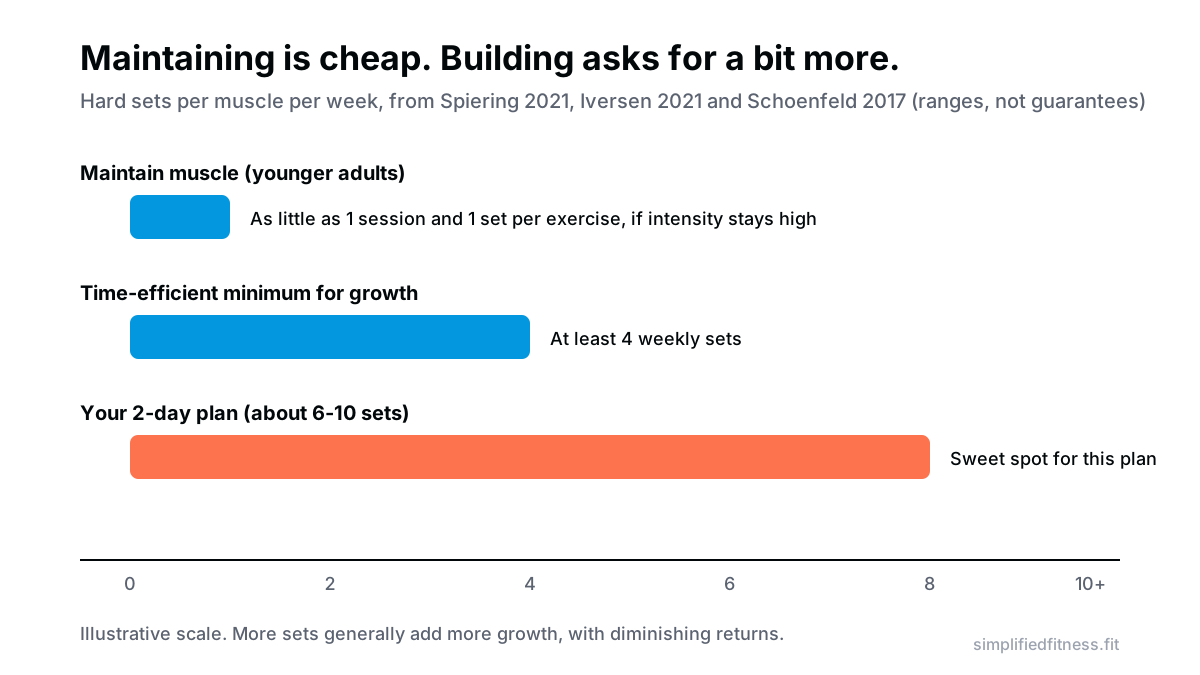
So where does the 3-5 sets per session come from? Two sessions of 3-5 sets gives about 6-10 weekly sets per muscle. That sits above the roughly 4-set minimum and well inside what a 60-minute session can handle. It is a practical estimate, not a magic number, and compound lifts also give indirect work to other muscles (a bench press trains triceps, for example).
If you want to count your own sets, the training volume calculator helps. For what happens when you drop even lower, read our piece on maintenance volume for busy lifters.
The 2-day program: Day A and Day B
Run these on non-consecutive days, such as Wednesday and Sunday. Each session is full-body, about 60 minutes, and about 15-18 hard sets.
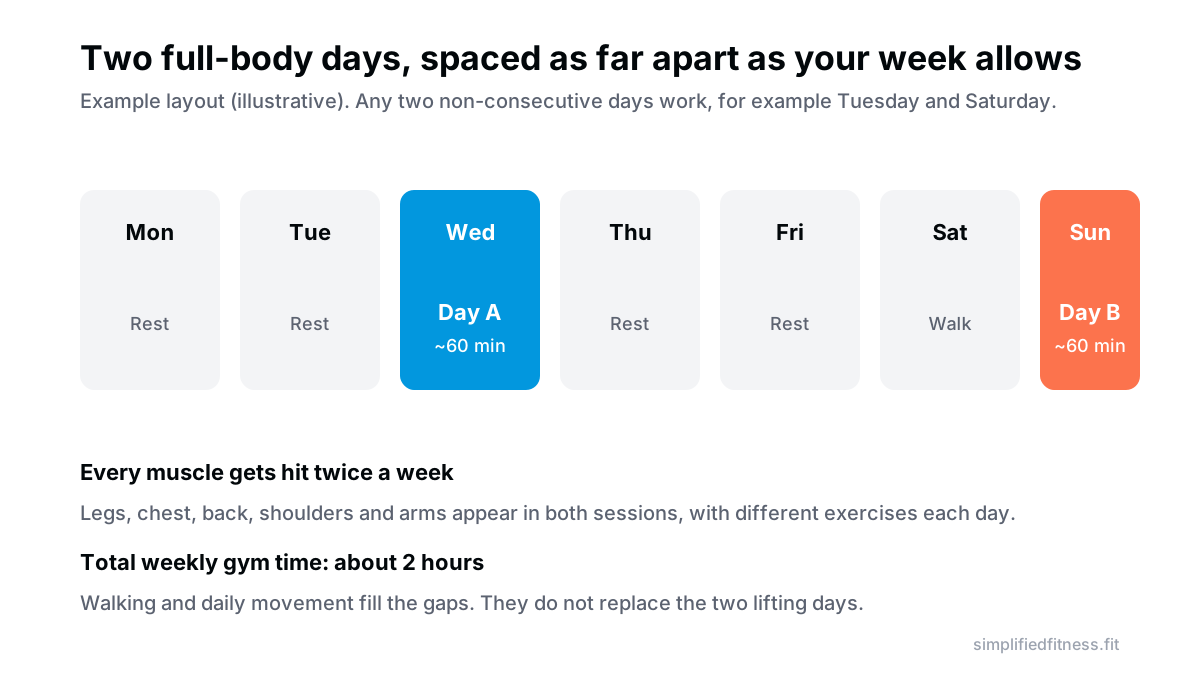
Day A
| Exercise | Sets | Reps | Rest |
|---|---|---|---|
| Barbell back squat or leg press | 3-4 | 6-10 | 2-3 min |
| Incline dumbbell press | 3 | 8-12 | 2 min |
| Wide-grip lat pulldown | 3 | 8-12 | 2 min |
| Stiff-leg deadlift or hip thrust | 2-3 | 8-12 | 2 min |
| Dumbbell lateral raise | 2-3 | 12-20 | 60-90 sec |
| Tricep pushdown | 2 | 10-15 | 60-90 sec |
Day B
| Exercise | Sets | Reps | Rest |
|---|---|---|---|
| Leg press or hack squat | 3 | 8-12 | 2-3 min |
| Dumbbell shoulder press | 3 | 8-12 | 2 min |
| Close-grip seated row | 3 | 8-12 | 2 min |
| Seated leg curl | 3 | 10-15 | 90 sec |
| Pec dec fly or cable fly | 2 | 12-15 | 60-90 sec |
| Preacher curl or hammer curl | 2 | 10-15 | 60-90 sec |
| Standing calf raise | 2 | 10-15 | 60 sec |
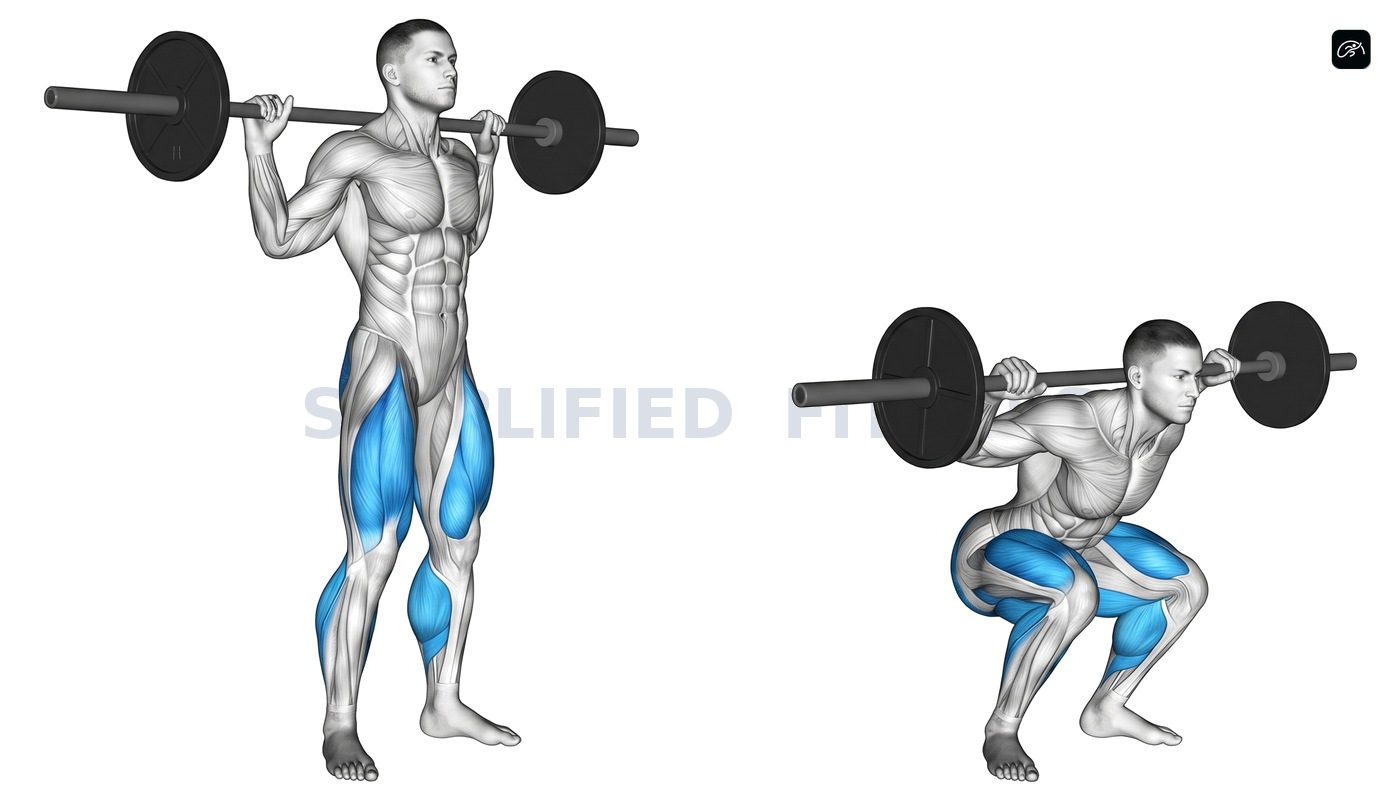
Why these choices? The Iversen review recommends at least one leg pressing movement, one upper-body pull and one upper-body push, using multi-joint exercises with full range of motion. That is exactly the backbone here. The review says machines, free weights or a mix can all work, so use whatever you can progress safely.
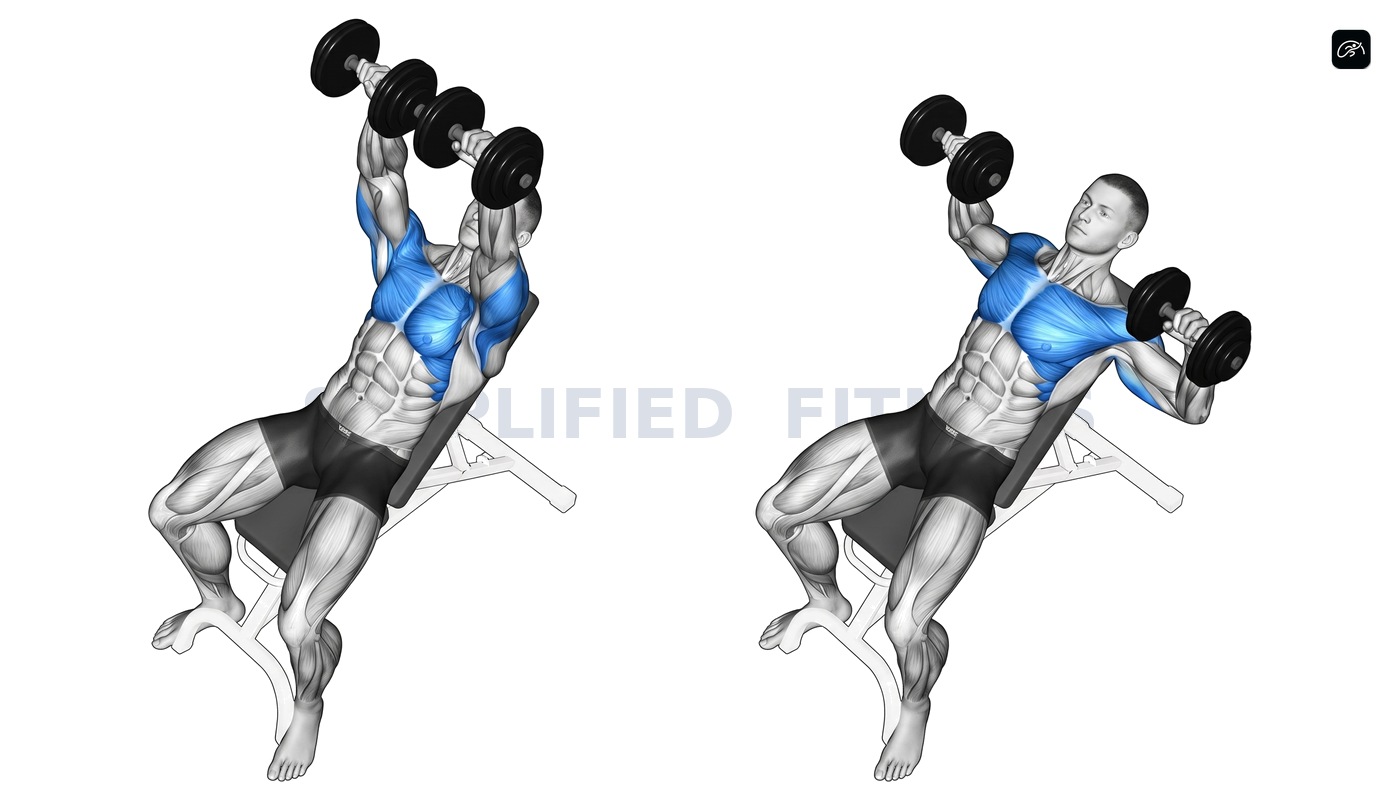
Load range is flexible. The same review suggests working in the 6-15 repetition range for time-efficient training. You can find your own starting weights with a rep-in-reserve approach, which we explain in reps in reserve (RIR) and RPE.
How hard should the sets feel?
On two days, there is no room for sets that feel like warm-ups. This is the one place where effort has to pay for the missing frequency.
Here is the research, with the conflict laid out. A 2023 meta-analysis of 15 studies found no evidence that training to momentary failure beats stopping short of failure for muscle growth, and suggested a non-linear relationship (Refalo et al., 2023). A 2024 meta-regression pointed a different way: muscle size gains increased as sets ended closer to failure, while strength was similar across a wide range of reps in reserve (Robinson et al., 2024). That second analysis relied on estimated RIR from study descriptions, called itself exploratory, and had modest model fit.
Why the difference? One looked at failure versus non-failure categories. The other treated proximity to failure as a continuous scale and estimated reps in reserve from descriptions. The practical middle is sensible: most sets should end with roughly 1-3 reps left in the tank, and the last set of each exercise can go closer to failure when it is safe. For heavy squats and presses, stop a rep short of true failure unless a spotter or safety arms are available.
Compare with our deeper look at training to failure versus RIR, and use the free RIR and RPE calculator if you want a sanity check.
How to fit a 60-minute session into a busy day
Most busy professionals do not fail on knowledge. They fail on logistics.
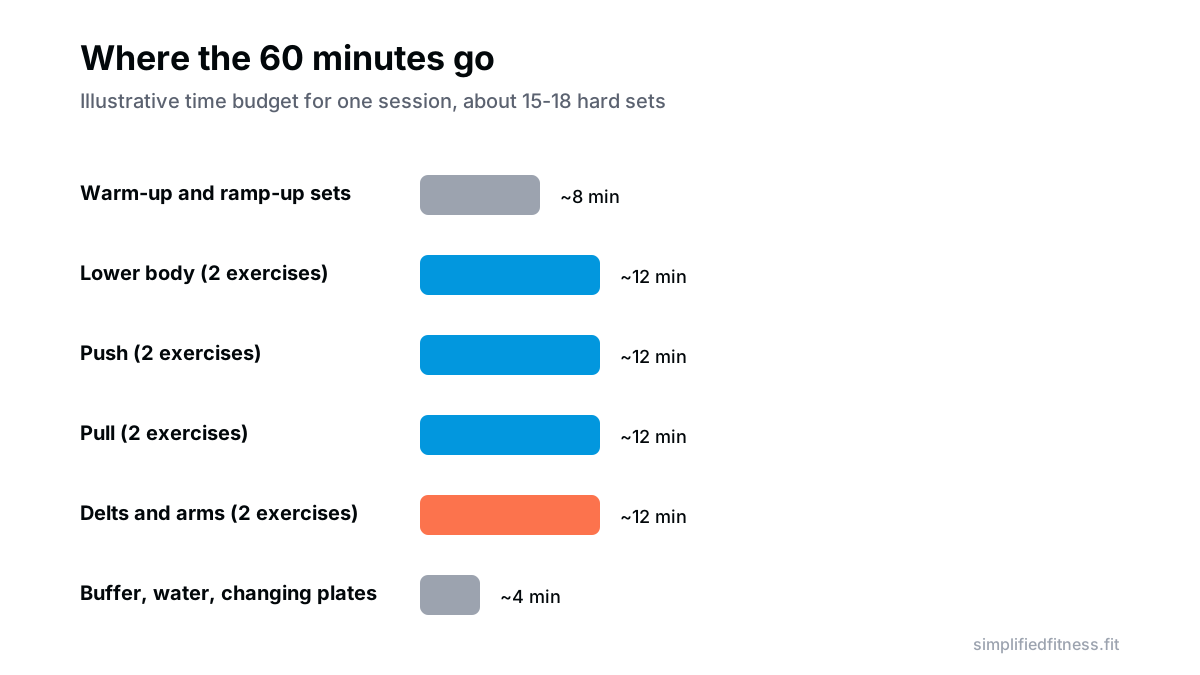
Practical ways to keep it under the hour:
- Warm up with your first exercise. Do 2-3 ramp-up sets of the squat or leg press, not 15 minutes of stretching. Iversen and colleagues also advise limiting the warm-up to exercise-specific sets.
- Pair non-competing exercises. Do a lat pulldown between sets of lateral raises, for example. Our guide to antagonist supersets and time efficiency explains how.
- Keep isolation rest short. 60-90 seconds is enough for lateral raises and curls. Hold the long rests for squats and presses.
- Plan the session the night before. Write the weights from last time into your phone and walk in knowing the first set.
If sixty minutes is still too much on some days, a 30-minute express workout is a better fallback than skipping the session entirely.
How to progress when you only train twice a week
With only 2 exposures a week, each session has to give you a clear target. A simple rule works well.
Pick a rep range, say 8-12. When you hit 12 clean reps on all sets of an exercise, add the smallest weight jump the next session. If you cannot hit 8, stay at the same load and aim for more reps. That is it.
Log your loads. Muscle grows slowly, and a notebook will show progress your mirror cannot. Aim for small improvements in either reps or load every 1-2 weeks on your main lifts, and expect slower progress as you get more experienced. When progress stalls on several lifts for 3-4 weeks and you are sleeping well and eating enough, add one set to the stalled muscles before you add a day.
Because the weekly volume is moderate, many people can run this plan for long stretches without a planned deload. If your joints hurt or performance drops for two sessions in a row, take an easy week with about half the sets.
Eating and recovering around a two-day plan
A two-day plan does not change what your body needs to build tissue. It only changes how often you are in the gym.
Protein, total calories and sleep decide whether those hard sets turn into muscle. For protein targets, use the protein calculator. In an Indian vegetarian context, that usually means dal, paneer, curd, soya chunks and eggs if you eat them, spread across meals. Our diet plan page has a ready structure.
Sleep matters more than most supplements. If you are working long hours, protect your sleep before you add training days.
When two days is not enough
Two days is a strong minimum, not a ceiling. Consider adding a third day if:
- you have trained consistently for several months and progress has stalled despite good effort, food and sleep,
- you want to add specialization, such as extra shoulder or arm work, without making sessions longer than an hour,
- sessions are running over 75 minutes to fit all the sets in.
The move from here is simple: split Day C out of your longest session, as covered in our 3-day full-body hypertrophy plan. If your schedule is erratic because of shifts or travel, see workout splits for high-stress careers and shift work.
Who should get medical advice first
Heavy lifting is safe for most healthy adults, but not everyone. See a doctor before starting if you have heart or blood pressure problems, chest pain with exertion, a recent surgery, uncontrolled diabetes, joint injuries or are pregnant. The same applies if you are older and have not trained before. Start lighter, learn technique, and build up. This article is education, not medical advice.
The two-day plan in one paragraph
Pick two non-consecutive days. Do a full-body session of 6-7 exercises on each, aiming for roughly 3-5 hard sets per muscle per session. Stay within 1-3 reps of failure on most sets. Add weight or reps whenever you hit the top of your range. Eat enough protein, sleep, and keep both sessions. Repeat for a few months, then review.
Frequently Asked Questions
Can you build muscle lifting only 2 days a week?
Yes, most people can build muscle on two days a week if the weekly sets and effort are adequate. Meta-analyses find that training frequency does not significantly change hypertrophy when weekly volume is equal. Pick two full-body sessions, train hard, and add weight or reps over time.
How many sets per muscle do I need on a 2 day split?
A practical range is about 3-5 hard sets per muscle per session, which gives roughly 6-10 per week. A review of time-efficient training suggests a minimum of about 4 weekly sets per muscle, and a meta-regression found more sets tended to give more growth. Start near the lower end if recovery is poor and add a set only when progress stalls.
Is a 2 day full body split better than upper lower?
For two days, full body is usually the better fit because it trains every muscle twice. An upper lower split on two days would hit each muscle only once a week, and an older meta-analysis suggested twice weekly beat once weekly. If you can add days later, an upper lower layout becomes sensible.
Should I train to failure on a 2 day program?
Go close to failure rather than always to it. A meta-analysis found no evidence that failure beats stopping short for muscle growth, though a separate exploratory analysis suggested growth improves as sets end closer to failure. Leave about 1-2 reps in reserve on most sets and push the final set of each exercise harder.
Can I just train on Saturday and Sunday?
You can, and many people do. Back to back days give you less recovery between sessions but five full days of rest afterwards. Frequency research suggests total weekly volume matters more than how sessions are arranged, though back to back spacing itself has not been studied much. If you feel sore or flat on Sunday, move the first session to Thursday or Friday so there is at least one rest day between.
How long should each session last?
About 60 minutes is realistic for 15-18 hard sets plus a short warm-up, if you keep rest honest. Longer sessions tend to become sets you are too tired to do well. Keep rest between heavy compounds to around 2-3 minutes and pair non-competing exercises when you are short on time.
Will I lose muscle if I only train twice a week?
Unlikely, if your effort and loads stay high. A narrative review found that younger adults maintained muscle size for up to 32 weeks with as little as one session a week and one set per exercise, as long as relative load was kept. Older adults may need up to 2 sessions and 2-3 sets per exercise.
What are the best exercises for a 2 day workout routine?
Choose multi-joint lifts that load several muscles at once, such as a squat or leg press, a press, a row or pulldown, and a hip hinge. A time-efficiency review recommends at least one leg pressing movement such as a squat, one upper-body pull and one upper-body push. Add small isolation work for shoulders and arms only after the big movements are covered.
How much protein do I need on a 2 day plan?
Protein needs depend on your body weight, age and goals, not on how many days you lift. The research here did not test protein, so use our protein calculator for a starting number. Spread it over meals such as dal, paneer, curd, eggs or soya and adjust if your weight or recovery changes.
Is 2 days a week enough to get stronger?
Yes, particularly if you are newer to lifting or returning after a break. A 9-week trial in trained participants found similar strength gains from two or four weekly sessions when total volume was matched. Progress will slow with experience, so track your lifts and expect to add sets later.
What if I miss one of my two sessions?
One missed session is not a disaster, and a single full-body workout can still maintain muscle in the short term. Do the missed session within a day or two if possible, or just run the next day as normal and do not double up. If you miss both in one week, restart the following week without trying to make it up.
Can older adults use a 2 day program?
Often yes, and two days is a common recommendation for older people. Research suggests maintaining muscle in older adults may take up to 2 weekly sessions and 2-3 sets per exercise. If you are over 60, have heart disease, joint pain or take medicines that affect blood pressure, see your doctor before starting heavy lifting.
Should I do cardio on the other days?
Walking and light activity on non-lifting days are good for general health and do not undermine a lifting plan. Hard cardio that leaves you drained can eat into recovery for the next lifting day. Keep it easy on the day before a session and keep both lifting days non-negotiable.
Sources & References
Every claim above is checked against peer-reviewed research (PubMed, U.S. National Library of Medicine) or guidance from established health bodies. How we fact-check.
- Spiering BA, et al. Maintaining Physical Performance: The Minimal Dose of Exercise Needed to Preserve Endurance and Strength Over Time. J Strength Cond Res. 2021. PMID: 33629972
- Iversen VM, et al. No Time to Lift? Designing Time-Efficient Training Programs for Strength and Hypertrophy: A Narrative Review. Sports Med. 2021. PMID: 34125411
- Schoenfeld BJ, et al. How many times per week should a muscle be trained to maximize muscle hypertrophy? A systematic review and meta-analysis of studies examining the effects of resistance training frequency. J Sports Sci. 2019. PMID: 30558493
- Schoenfeld BJ, et al. Effects of Resistance Training Frequency on Measures of Muscle Hypertrophy: A Systematic Review and Meta-Analysis. Sports Med. 2016. PMID: 27102172
- Schoenfeld BJ, et al. Dose-response relationship between weekly resistance training volume and increases in muscle mass: A systematic review and meta-analysis. J Sports Sci. 2017. PMID: 27433992
- Hamarsland H, et al. Equal-Volume Strength Training With Different Training Frequencies Induces Similar Muscle Hypertrophy and Strength Improvement in Trained Participants. Front Physiol. 2021. PMID: 35069251
- Refalo MC, et al. Influence of Resistance Training Proximity-to-Failure on Skeletal Muscle Hypertrophy: A Systematic Review with Meta-analysis. Sports Med. 2023. PMID: 36334240
- Robinson ZP, et al. Exploring the Dose-Response Relationship Between Estimated Resistance Training Proximity to Failure, Strength Gain, and Muscle Hypertrophy: A Series of Meta-Regressions. Sports Med. 2024. PMID: 38970765

Umair Hazrami · Founder & Head Coach, Simplified Fitness
Umair Hazrami founded Simplified Fitness and the Simplified Lifter channel to cut through fitness noise. With 4+ years of consistent training and 10+ coaching clients, he writes every guide from the peer-reviewed research and links the sources so you can check them. Our editorial standards.
Educational content only, not medical advice. If you have a medical condition, are pregnant, or take medication, talk to a qualified doctor before changing your diet, supplements or training. Full disclaimer.
Keep reading
Programming
30-Minute High-Density Hypertrophy Sessions: Micro-Workouts for Time-Constrained Lifters
Can a 30 minute workout for muscle growth work? See how paired sets, Myo-reps and machine setups fit 16 hard sets into half an hour, plus a 4-day plan.
10 min read

Programming
The 7-Minute Dynamic Warm-Up: A Fast Routine to Prep Joints Before Lifting
A dynamic warm up for lifting takes about 7 minutes, not 25. See the 2-3-2 routine, what the research says about stretching and foam rolling, and what to skip.
9 min read
Programming
Antagonist Paired Sets: Cut Workout Time by About 40% Without Losing Reps
Antagonist paired sets supersets time saving explained: pairing push and pull cuts a session by roughly 40% keeping reps. Pairings and rest times included.
8 min read
Programming
The Arnold Split (Chest/Back, Shoulders/Arms, Legs): Does It Work for Natural Lifters?
Does the Arnold split workout routine work for natural lifters? See how chest/back supersets, arm days and weekly volume play out, with a 3, 5 and 6 day setup.
10 min read