Triple Progression and Volume Progression: What to Do When Load and Reps Stall
Triple progression lifting explained: when weight and reps stall, add a set, then reload. Steps, a 6-week example, set caps and when to deload.

TL;DR. The short answer
- Triple progression means you progress reps first, then sets, then load. When reps and weight both stall, adding one working set gives you a new way to do more total work.
- Research links more weekly sets to more muscle growth, but with diminishing returns, so extra sets only help while you can still recover from them.
- Cap your set additions. One systematic review of trained young men suggested 12-20 weekly sets per muscle as a general range, which makes a reasonable ceiling for many lifters. At your cap, reset rather than keep adding.
- When you reach your cap, drop back to fewer sets, add the smallest possible load jump, and rebuild reps. That converts the volume you tolerated into a higher baseline.
- Stalled for 4+ weeks with poor sleep, joint pain or falling performance across lifts? Fix recovery or deload first, and see a doctor for pain that does not settle.
Part of our complete guide: Progressive Overload Methods, Deloads and Plateaus: The Long-Term Progression Guide
Table of contents
Triple progression lifting is a simple order of operations for a stalled lift: add reps first, then add a working set, and only then add weight. When you cannot add load and you cannot add reps, an extra set is the next legal move, because it raises the total work your muscle has to handle.
This is a troubleshooting tool inside the bigger system covered in our progressive overload, deloads and plateaus guide. Here we focus on one situation: you have lifted the same weight for the same reps for about four weeks, and nothing is moving.
One honest note up front. “Triple progression” is a coaching framework, not a protocol that has been tested head to head in trials. What is well supported is the idea underneath it: more hard sets are linked to more muscle growth, up to a point. We will keep those two things separate.
What is triple progression?
You may already know double progression: pick a rep range such as 8-12, add reps at one weight until every set hits 12, then add load and start again at 8. It works beautifully until it does not.
The stall usually looks like this. You hit 3 x 10 on the lat pulldown last month. Today it is 3 x 10 again. Your rep range ceiling feels far away and the next plate jump feels too big. Double progression has run out of road.
Triple progression adds a middle rung:
- Reps: climb toward the top of your rep range across all sets.
- Sets: once reps top out or stall, add one working set at the same load and rebuild reps.
- Load: once sets hit your cap, drop back and add the smallest load jump.
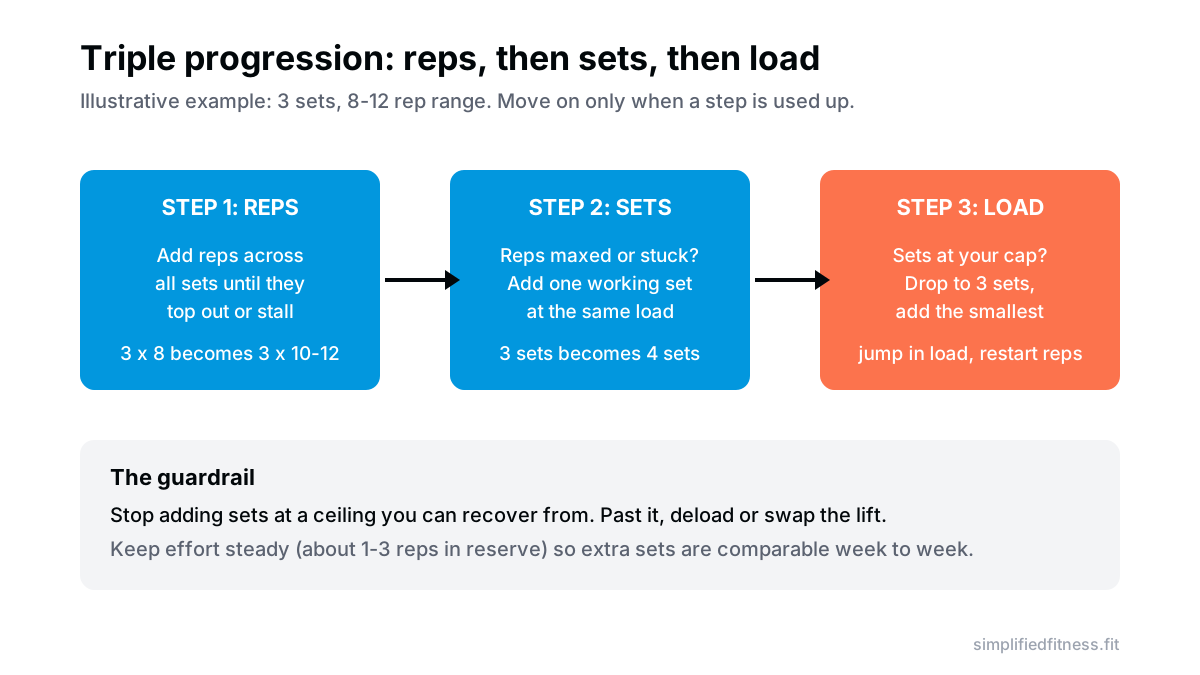
Plain version: you are not forcing a breakthrough. You are giving yourself a third dial to turn.
Why does adding sets count as progressive overload?
Overload does not have to mean a heavier bar. It means asking the muscle for more than last time. Volume is one of the clearest ways to do that, and the research on it is fairly consistent.
A meta-regression of 15 studies found that each additional weekly set was associated with a 0.37% greater gain in muscle size, and that higher-volume groups gained about 3.9% more than lower-volume groups (Schoenfeld et al., 2017). The authors described a graded dose-response relationship.
A much larger analysis in 2026, covering 67 studies and 2,058 participants (about 79% male, average age around 25), agreed that muscle size and strength both increase with weekly volume. It also found diminishing returns, and those were considerably more pronounced for strength than for hypertrophy (Pelland et al., 2026).
There is another angle. Total volume load (sets x reps x weight) is what you are really building when you run double progression. In an exploratory analysis of 24 untrained men, a rep-zone approach produced faster volume load progression and greater cross-sectional area gains than a fixed percentage of 1RM, with no difference in strength (Nobrega et al., 2023). That is untrained men and secondary data, so hold it loosely. The point is only that how you progress volume can matter.
What to do when double progression stalls
Before you add anything, check the boring stuff. Most stalls are not programming problems.
- Did you sleep at least 7 hours on most nights?
- Are you eating roughly at maintenance or above, with decent protein (dal, paneer, curd, eggs, soya chunks all count)?
- Is your technique and range of motion the same as three weeks ago? Reps that get shorter and quicker are not progress.
- Did you log last session’s numbers, or are you guessing? A simple training logbook makes stalls obvious instead of vague.
If all of that is fine, run this sequence.
Step 1. Confirm the stall. Three to four sessions on the same lift with no extra reps and no extra load.
Step 2. Pick one exercise per lagging muscle. Not all of them.
Step 3. Add one working set at the same weight. Aim for roughly 1-3 reps in reserve on most sets, so the extra set is a clean, repeatable stimulus and not a grind.
Step 4. Rebuild reps. Your first session with the new set will probably show fewer reps per set. That is normal. Climb again.
Step 5. Decide at your cap. If you reach the ceiling you set for that muscle, move to the load step below.
A six-week example
Here is how it can play out on a stalled lat pulldown. These numbers are an invented teaching example, not trial data.
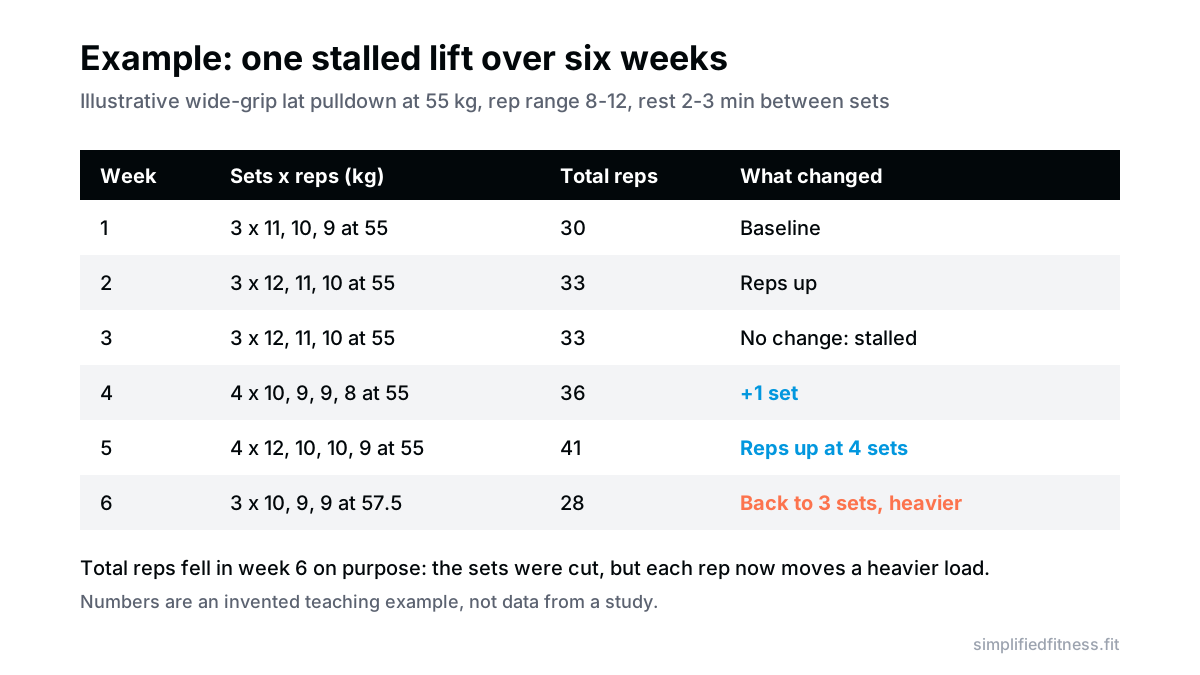
Weeks 1-2 are ordinary double progression: reps creep from 30 to 33 total. Week 3 repeats week 2 exactly, so the lift has stalled. (In a real log you would want to see that repeat for three or four sessions before acting; the example compresses it.) In week 4 the lifter adds a fourth set, reps dip per set, then climb again to 41 total reps by week 5. In week 6, sets drop back to three, load goes up by 2.5 kg, and reps restart near the bottom of the range.
Notice what changed. Total reps in week 6 are lower than week 5, yet every rep now moves 57.5 kg instead of 55 kg. That is the conversion step, and it is the whole point.
How many sets should you add, and where do you stop?
One set at a time. One muscle at a time. That is the cautious default.
As for where to stop, the evidence does not hand us a single number. A systematic review of trained young men (6 studies in the quantitative analysis) suggested that 12-20 weekly sets per muscle group may be a good general range. Moderate (12-20) and high (over 20) volumes did not differ for the quadriceps or biceps, but higher volume appeared better for the triceps (Baz-Valle et al., 2022). Small number of studies, young trained men, so apply it with some caution.
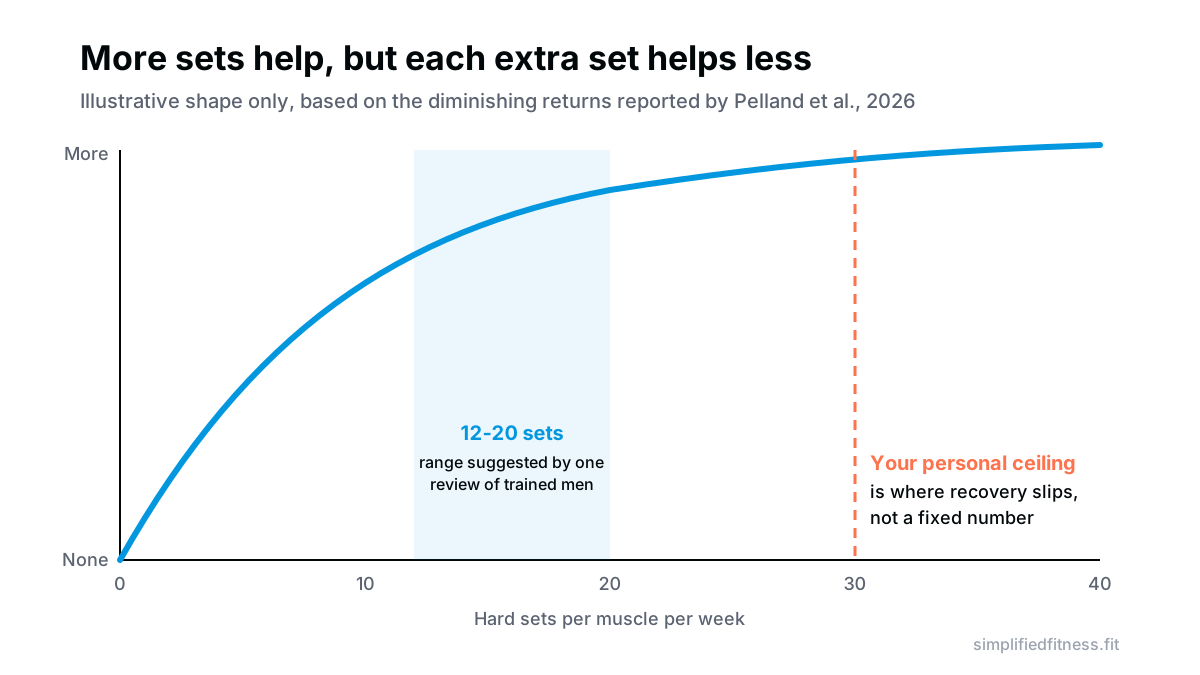
Your personal ceiling is usually where one or more of these show up:
- Reps at a given load start dropping week to week instead of rising
- Sleep gets worse or resting heart rate feels off
- Joints or tendons start to nag
- Motivation tanks, and sessions feel like a chore
If you want a rough count of what you already do, our training volume calculator adds up weekly sets per muscle. For a longer view of how volume climbs and resets across a block, see volume progression from MEV to MRV.
Does a big jump in volume backfire?
Lifters love to ask this, usually before doubling their sets on Monday.
A 2026 trial gave 25 resistance-trained men and women a within-person comparison for 8 weeks: one leg got a +20% weekly volume increase, the other a +120% increase over habitual training. Both legs grew, the large jump did not reduce growth, and the molecular markers measured were largely similar between legs (Camargo et al., 2026). But the large jump did not clearly improve growth either.
So the result says a big step may not wreck adaptation over 8 weeks in trained people. It does not say it is wise, comfortable or sustainable for months, and it was about leg training only. For a plateau, a small step is easier to manage and easier to read.
How to turn extra volume into a new baseline
This is the part most lifters skip, and it is where the payoff lives. Piling on sets forever is not progression, it is just more tiring training.
When you hit your cap:
- Hold the higher volume until reps at your current load are clearly ahead of where the stall began.
- Drop back to your normal number of sets, or one fewer if you feel flat.
- Increase load by the smallest jump you can. If gym plates are too coarse, see our guide to microloading with fractional plates. The ACSM position stand suggests a 2-10% load increase when you can complete one to two reps over the target (ACSM, 2009), though for upper body isolation lifts a smaller jump often makes more sense.
- Restart reps near the bottom of your range.
Where does deloading fit?
After a set-adding phase, a lower-volume week helps fatigue clear so you can see your real strength. Many coaches plan one every 4-8 weeks, though trial evidence for a specific schedule is limited, so go by performance and how you feel. Our guide to deloading methods compares cutting sets with cutting load.
If you stall across several lifts at once, add sets nowhere. That pattern points to sleep, food, stress or accumulated fatigue, and our plateau troubleshooting flowchart walks through it step by step.
Does effort matter when you add sets?
Yes. Extra sets only help if they are hard enough to count. A 2024 series of meta-regressions found that hypertrophy tended to improve as sets were taken closer to failure, while strength gains were similar across a wide range of reps in reserve. The authors warned that the RIR values were estimated from study descriptions and the analysis was exploratory (Robinson et al., 2024).
Practically, that supports finishing most working sets within about 1-3 reps of failure, not stopping at 5 reps short, and not grinding every set to the wall. A RIR/RPE calculator can help you choose loads that land there.
When to see a doctor
Muscle soreness and tiredness are expected when you add volume. Sharp or worsening joint pain, pain that wakes you at night, swelling, numbness or tingling, or an unusual drop in energy that lasts for weeks should be checked by a doctor or physiotherapist. A plateau is not worth training through an injury.
If you want a plan that applies this to your own lifts and schedule, our free push, pull and leg day templates are a simple place to start.
Frequently Asked Questions
What is triple progression in lifting?
Triple progression is a progression order where you add reps first, then sets, then load. It extends double progression (reps, then weight) with a middle step for when neither moves. It is a coaching framework rather than a named, trial-tested protocol, so treat it as a structured way to apply overload.
What do I do when double progression stalls?
Add one working set at the same weight and rebuild your reps. Weekly set volume is linked to muscle growth in meta-analyses, so this gives you a fresh overload target when reps and load will not move. Log it, and only keep adding sets while performance stays steady or improves.
How many sets should I add per week?
One set per muscle group per week is a sensible step, and often one extra set on one exercise is enough. Small steps let you see what actually caused a change. If you jump several sets at once, you cannot tell whether the extra work helped or hurt.
Is adding sets better than adding weight?
Neither is better in general. Meta-analyses link more sets to more hypertrophy, while load is what you track for strength. Use sets when load and reps are stuck, and use load when you are within range and recovering well.
How many sets per muscle per week is too many?
There is no single number, because recovery differs between people. A systematic review of trained young men suggested 12-20 weekly sets per muscle may be a good range, with no clear difference between 12-20 and over 20 for the quads and biceps. If performance drops, sleep suffers or joints ache, you are probably past your ceiling.
Can a big jump in volume hurt muscle growth?
In one 2026 trial of trained people, a +120% jump in weekly leg volume did not reduce growth compared with a +20% jump, though it also did not improve it. It was only 8 weeks in 25 people, so it does not prove large jumps are wise. Smaller steps are the safer default.
How do I turn extra volume into a stronger baseline?
Hold the higher volume until reps at your current load are clearly ahead, then cut sets back and add the smallest load jump. Your muscles have adapted to more work, so the heavier load usually feels manageable for fewer sets. Rebuild reps from the bottom of the range.
Do I need a deload when I add sets?
Often, yes, at the end of a set-adding phase. A planned week with lower volume lets fatigue clear so your true strength shows. Our deload guides cover how to do it.
Should I train to failure when adding sets?
Mostly no. A meta-regression found hypertrophy tends to improve as sets end closer to failure, but the estimates of reps in reserve were uncertain. Leaving 1-3 reps in the tank on most sets keeps extra sets repeatable.
How long should I stall before changing the plan?
Around three to four sessions on the same lift with no extra reps and no extra load is a fair signal. Check sleep, food and technique first. Then make one change, such as adding a set, and give it two to three weeks.
Does triple progression work for beginners?
Beginners rarely need it, because load and reps usually keep rising on their own. Simple double progression is enough early on. Keep triple progression for when you have been stuck for several weeks.
Can I use volume progression on every exercise?
No, pick one or two exercises per muscle. Adding a set to everything raises total fatigue quickly and makes it hard to tell what worked. Add sets where the muscle is lagging.
What if adding a set makes my joints hurt?
Back off, because pain is a signal to reduce load or volume, not push through. Swap to a more joint-friendly variation if needed. If pain persists for more than a couple of weeks, is sharp, or comes with swelling or numbness, see a doctor or physiotherapist.
Sources & References
Every claim above is checked against peer-reviewed research (PubMed, U.S. National Library of Medicine) or guidance from established health bodies. How we fact-check.
- Schoenfeld BJ, et al. Dose-response relationship between weekly resistance training volume and increases in muscle mass: A systematic review and meta-analysis. J Sports Sci. 2017. PMID: 27433992
- Baz-Valle E, et al. A Systematic Review of The Effects of Different Resistance Training Volumes on Muscle Hypertrophy. J Hum Kinet. 2022. PMID: 35291645
- Pelland JC, et al. The Resistance Training Dose Response: Meta-Regressions Exploring the Effects of Weekly Volume and Frequency on Muscle Hypertrophy and Strength Gains. Sports Med. 2026. PMID: 41343037
- Camargo JBB, et al. Large increases in resistance training volume do not impair muscle hypertrophy or anabolic-catabolic molecular signaling in trained individuals. J Appl Physiol. 2026. PMID: 42461790
- American College of Sports Medicine. American College of Sports Medicine position stand. Progression models in resistance training for healthy adults. Med Sci Sports Exerc. 2009. PMID: 19204579
- Robinson ZP, et al. Exploring the Dose-Response Relationship Between Estimated Resistance Training Proximity to Failure, Strength Gain, and Muscle Hypertrophy: A Series of Meta-Regressions. Sports Med. 2024. PMID: 38970765
- Nobrega SR, et al. Muscle Hypertrophy Is Affected by Volume Load Progression Models. J Strength Cond Res. 2023. PMID: 36515591

Umair Hazrami · Founder & Head Coach, Simplified Fitness
Umair Hazrami founded Simplified Fitness and the Simplified Lifter channel to cut through fitness noise. With 4+ years of consistent training and 10+ coaching clients, he writes every guide from the peer-reviewed research and links the sources so you can check them. Our editorial standards.
Educational content only, not medical advice. If you have a medical condition, are pregnant, or take medication, talk to a qualified doctor before changing your diet, supplements or training. Full disclaimer.
Keep reading

Programming
The 5 Modalities of Progressive Overload: A Checklist for When Weight Won't Go Up
5 ways to progressive overload: load, reps, range of motion, tempo and rest density. A practical checklist for compounds and isolations, with the research.
7 min read
Programming
Autoregulated Progressive Overload (APRE): How Much Weight to Add Next Week
Autoregulated progressive overload (APRE) uses your last-set reps to set next week's weight. Get simple jump rules, a worked example and the evidence.
9 min read

Programming
Deload Science: What a Deload Week Really Does to Fatigue, Muscle and Strength
Deload science explained: the fitness-fatigue model, what trials show for muscle size and strength, and what happens in a deload week. Studies linked.
8 min read

Programming
How to Do a Deload Week: Volume Cut vs Intensity Cut vs Time Off
How to do a deload week workout: compare cutting sets by half, lowering weight by 20%, or taking time off, with a step-by-step template and the research.
9 min read