The 5 Modalities of Progressive Overload: A Checklist for When Weight Won't Go Up
5 ways to progressive overload: load, reps, range of motion, tempo and rest density. A practical checklist for compounds and isolations, with the research.
TL;DR. The short answer
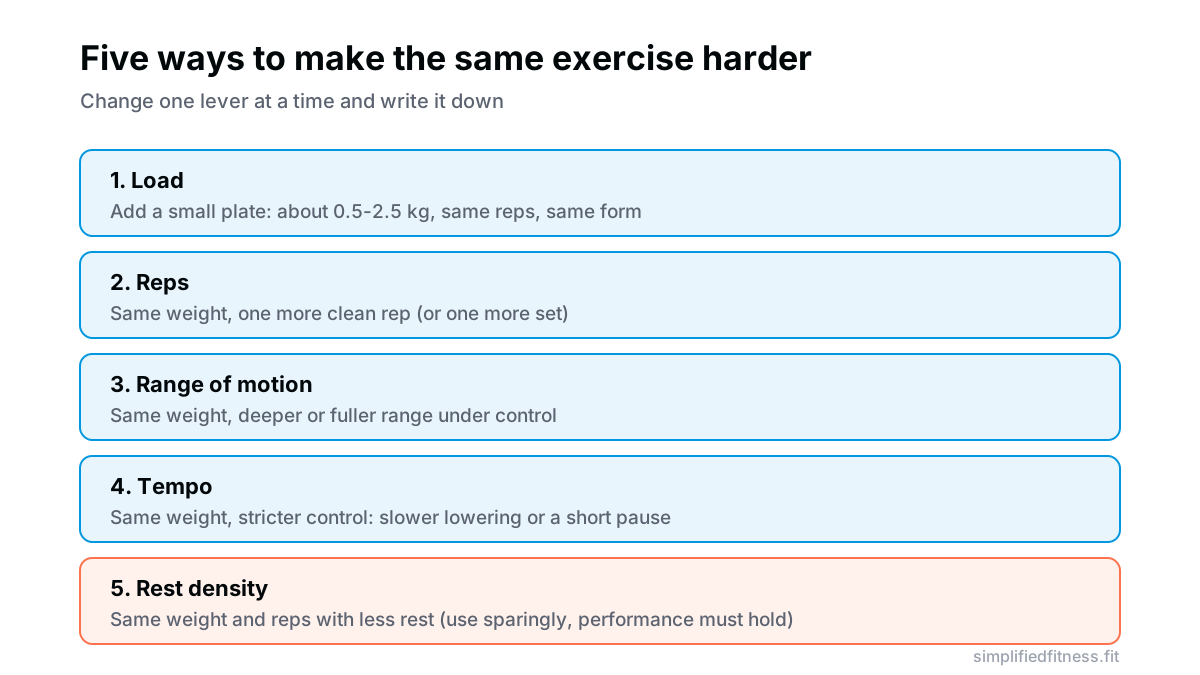
- There are five practical ways to progressive overload an exercise: more load, more reps at the same load, a fuller range of motion, stricter tempo, and shorter rest at the same performance.
- Adding load and adding reps are the main levers. Range of motion, tempo and rest density are useful when small weight jumps are not available or you keep stalling.
- Change one lever at a time and log it. If two things change together, you cannot tell which one worked.
- Research suggests muscle growth is similar across a wide range of loads and rep durations, so a rep or a cleaner range counts as real progress, not a consolation prize.
- Cutting rest only counts as progress if reps and form stay the same. Longer rests (above about 60 seconds) look slightly better or equal for hypertrophy in current evidence.
Part of our complete guide: Progressive Overload Methods, Deloads and Plateaus: The Long-Term Progression Guide
Table of contents
The five ways to progressive overload are more load, more reps at the same load, a fuller range of motion, stricter tempo, and shorter rest at the same performance. Load and reps do most of the work. The other three are your backup plan when the bar will not go up.
Most lifters think progressive overload means “add weight every week.” That works until it does not. This checklist gives you five levers to pull, so a stalled lift becomes a puzzle instead of a dead end. (For the bigger picture, including deloads and plateaus, see our complete guide to progressive overload, deloads and plateaus.)
What counts as progressive overload?
Progressive overload means asking the muscle to do a little more than it did before, with the same quality of movement. If you want the principle itself and why it is wider than “add iron,” read the progressive overload principle beyond adding weight.
The key phrase is “same quality.” Ten reps with a shorter range is not more than eight full-range reps. Heavier weight with a bouncing, half-speed squat is not progress either. Overload only counts when the exercise looks the same and the demand goes up.
One more point on evidence. A 2021 review argues that muscle adaptations can be obtained across a wide spectrum of loading zones, not just one “hypertrophy range” (Schoenfeld et al., 2021). That is the scientific reason the levers below are interchangeable in many cases. It is a review and a proposed framework, not a final verdict, so treat it as a useful guide.
Modality 1: Increase the load
This is the classic. Same exercise, same reps, a heavier weight.
The trick is making the jump small. On a barbell compound, 1-2.5 kg is a sensible step. On a lateral raise or a curl, 0.5-1 kg can be a big percentage jump, which is why small plates matter. Our guide to microloading and fractional plates covers that in detail.
Heavier loads do matter for one thing in particular. A 2017 meta-analysis of 21 studies found that gains in 1RM strength were greater with high-load training, while muscle growth was similar between low- and high-load programs (Schoenfeld et al., 2017). The included trials took sets to failure, so the result may not hold for sets stopped far from it.
Modality 2: Increase the reps
Same weight, one more clean rep. Or one more set once reps are consistent.
Rep progression is the friendliest lever for isolation work, and it is also where most people win when weights are limited (a gym with 2 kg dumbbell jumps, or home dumbbells). If you want a formal system for this, our article on the double progression model walks through rep ranges step by step.
The 2017 meta-analysis above is why reps are a legitimate way to progress for size: hypertrophy was similar across low and high loads when sets were taken to failure. That compared different loads rather than rep progression itself, but it shows that a lighter weight for more reps can still grow muscle. If you are unsure how close to failure you are, the free RIR and RPE load calculator helps you estimate it.
Modality 3: Increase the range of motion
Same weight, a longer, more complete rep. Think of a deeper squat, a fuller stretch at the bottom of a dumbbell press, or a longer path on a row.
The evidence is mixed by body region. A 2021 meta-analysis of 16 studies found full range of motion produced greater strength gains (ES = 0.56) and lower-limb hypertrophy (ES = 0.88) than partial range, with no clear difference for muscle thickness, pennation angle or fascicle length overall (Pallares et al., 2021). An earlier systematic review of six studies reached a similar conclusion for the lower body, but called the upper-body evidence limited and conflicting (Schoenfeld and Grgic, 2020).
So a fuller range is a reasonable lever, especially for legs. The caveat is that most of this work is in healthy, mostly young men, so results may differ in other groups. For a deeper dive, see full versus partial range of motion for hypertrophy.
Here is the rule I would follow: increase depth only as far as you can control the weight, and treat the new depth as the new baseline. If your form falls apart at the bottom, you did not progress. You just changed the exercise.
Modality 4: Improve the tempo
Same weight, same reps, stricter control. In practice that means a 2-3 second lowering phase and a brief pause in the stretched position, instead of dropping the bar and bouncing out.
Be realistic about what tempo does. A 2015 meta-analysis of eight studies found hypertrophy was similar with repetition durations from 0.5 to 8 seconds, and suggested very slow reps (over 10 seconds per rep) were inferior, with the caveat that few controlled studies exist (Schoenfeld et al., 2015). A 2025 meta-analysis of nine studies (166 participants) on eccentric duration found uncertain effects on hypertrophy and strength overall, though longer eccentrics looked similar or better for strength in trained participants (Amdi and King, 2025).
Put together: tempo is not a magic growth switch, but standardising it makes your log honest. If your reps get cleaner and more controlled, the same weight is harder to move well. That is a fair kind of overload. Read more in our tempo and repetition duration breakdown.
Modality 5: Increase density (shorter rest)
Same weight, same reps, less rest. Density means more quality work per minute.
This one is easy to misuse. Cutting rest only counts as progress if your reps hold. If a 90-second rest drops your reps from 10 to 7, you did not increase density. You traded quality for time.
The research leans the other way for pure muscle growth. In a trial of 21 resistance-trained men, a 3-minute rest group gained more squat and bench strength than a 1-minute group over 8 weeks, and had greater anterior thigh muscle thickness (Schoenfeld et al., 2016). A 2024 Bayesian meta-analysis of nine studies suggested a small hypertrophic benefit to rests longer than 60 seconds, with no appreciable difference beyond about 90 seconds (Singer et al., 2024). Heterogeneity was substantial, so treat the numbers as soft.
Practical takeaway: keep rest long on heavy compounds, and use shorter rest as a late lever on lighter isolation work when you are short on time. Our guide on rest intervals for hypertrophy goes deeper.
Which lever for compounds, which for isolations?
Not every lever fits every exercise. Big barbell lifts have bigger fatigue costs and bigger weight jumps. Isolations have the opposite problem: small muscles, small plates.
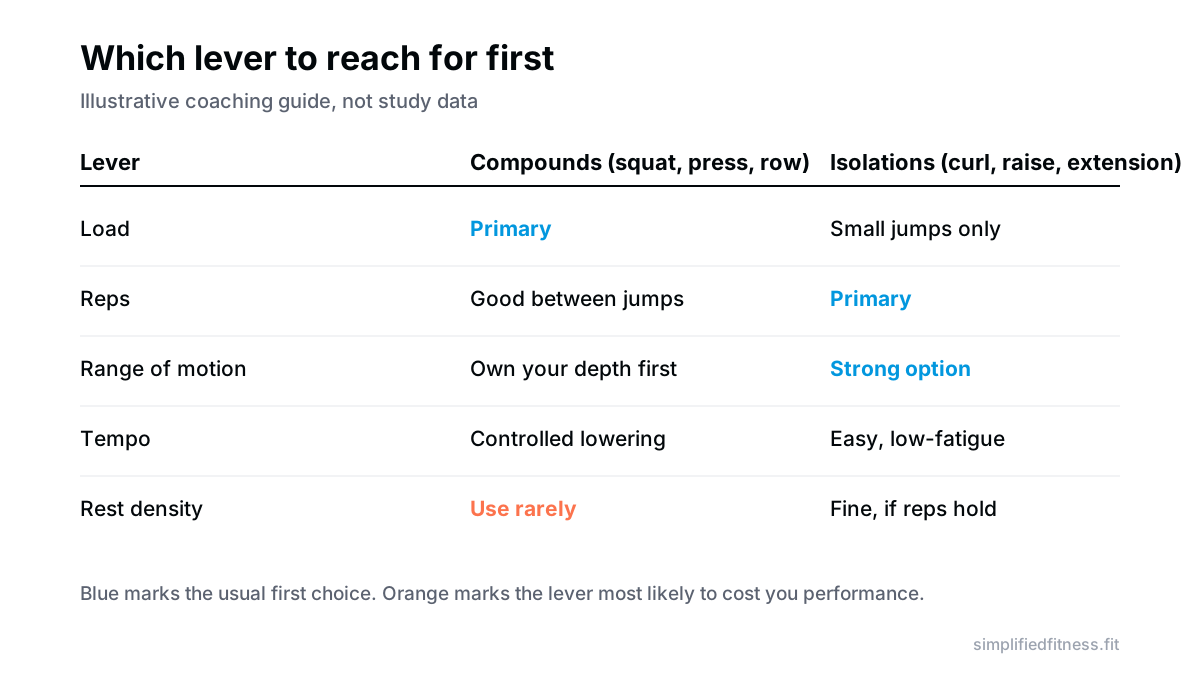
| Lever | Best on compounds | Best on isolations |
|---|---|---|
| Load | Primary, small jumps (1-2.5 kg) | Often too big a jump; use microplates |
| Reps | Good between load jumps | Primary lever |
| Range of motion | Own your depth first | Strong, low-fatigue option |
| Tempo | Controlled lowering | Easy to standardise |
| Rest density | Use rarely | Fine if reps hold |
This table is a coaching guide, not study data. Individual lifters respond differently, and the research above is mostly in healthy adults, so adjust to how you actually recover.
What to do when you stall
Walk down the list in order. It is simple, and it keeps you from changing five things at once.
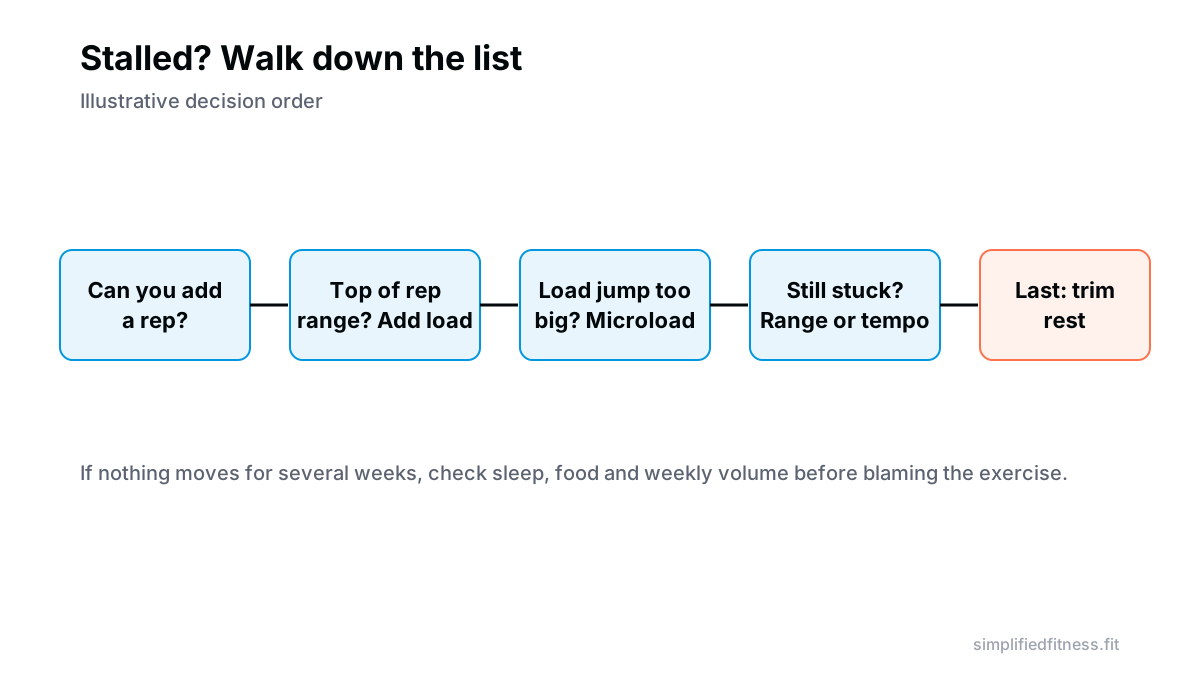
- Can you add a rep to any set? Do that first.
- At the top of your rep range on all sets? Add a small amount of load.
- Is the smallest jump you have still too big? Use fractional plates or switch to reps.
- Still stuck? Tighten range of motion or tempo, and keep it consistent.
- Last resort: shorten rest slightly, and only if reps hold.
A written log is what makes any of this work. If you are not tracking, start with the training logbook guide. A free push-pull-legs template like our push day plan is a good place to start writing numbers down.
If nothing moves across several weeks and many lifts, look at sleep, protein and calories before tweaking the program. And if a stall comes with persistent pain, unusual fatigue or strength that is dropping fast, see a doctor or physiotherapist instead of pushing through.
Common mistakes with the five levers
- Changing two levers at once, then not knowing which one worked.
- Counting a shorter range or a faster, sloppy rep as “more.”
- Chasing short rest on heavy squats and deadlifts.
- Forcing 2.5 kg jumps on lateral raises and curls.
- Not logging, so every session feels like a restart.
The bottom line
The five ways to progressive overload give you a menu. Load and reps carry most of the weight. Range of motion, tempo and rest density help when small jumps are not available or you keep stalling. Pick one lever, keep everything else the same, and write it down. That alone puts you ahead of most people in the gym.
Frequently Asked Questions
What are the 5 ways to progressive overload?
The five levers are load, reps, range of motion, tempo and rest density. Each one makes the same exercise a bit harder without changing the movement itself. Pick one per exercise, log it, and move to the next lever only when the current one stops working.
How can I progressive overload without heavier weights?
Add reps at the same load, deepen your range of motion under control, slow the lowering phase or shorten rest while holding performance. These all raise the demand on the muscle even if the plate stays the same. This is especially useful at home or in a gym with big dumbbell jumps.
Do lighter weights for more reps build as much muscle as heavy weights?
For hypertrophy, mostly yes. A 2017 meta-analysis of 21 studies found muscle growth was similar between low-load and high-load training when sets were taken to failure, while 1RM strength favoured heavier loads. So if your goal is size, adding a rep is a legitimate step, but if you want a bigger 1RM you still need to lift heavy at times.
How much weight should I add each session?
On compound lifts, jumps of roughly 1-2.5 kg are common, and on small isolations even 0.5 kg can be a lot. Smaller jumps are easier to repeat for the full rep target. If your gym lacks small plates, switch to the rep, range or tempo lever instead of forcing a big jump.
Does a deeper range of motion count as progressive overload?
Yes, if the weight and reps stay the same and the extra depth is controlled. Full range of motion appears to help lower-body hypertrophy compared with partial range, while upper-body evidence is limited and mixed. Increase depth gradually and stop where you can control the weight.
Does slowing down my reps build more muscle?
Not necessarily. A 2015 meta-analysis found similar hypertrophy with repetition durations from 0.5 to 8 seconds, and very slow reps (over 10 seconds) looked inferior, though the data was limited. Use a controlled 2-3 second lowering and a brief pause for consistency, not extreme slowness.
Is shorter rest between sets a good way to progress?
Only if your reps and form hold. A 2016 trial in trained men found 3-minute rests produced more strength and quadriceps growth than 1-minute rests over 8 weeks. Treat shorter rest as a late-stage lever for isolations and keep rest long enough on heavy compounds.
Which type of progressive overload is best for beginners?
Adding reps and then small amounts of load is the simplest route. Beginners improve technique quickly, so a cleaner, deeper rep also counts. Keep a log so you know exactly what changed each week.
How do I know I am overloading, not just doing more?
Overload means the same exercise, done with good form, produces a higher demand than last time. More reps with a shorter range, or a heavier weight with sloppy form, is not overload. Compare the same range, tempo and rest each session in your log.
Can I use more than one overload method at the same time?
You can, but it muddies the signal. If you add weight and cut rest in the same week and the reps drop, you do not know which change caused it. Change one lever at a time, then combine them once you know how you respond.
What should I do if none of the five methods work?
Check the basics before changing the exercise: sleep, protein, total calories and weekly sets. If progress has stopped for several weeks across many lifts, a lighter week may help. See a doctor if you also have persistent pain, unusual fatigue or unexplained strength loss.
Should I use the same overload method for squats and curls?
Not usually. Compounds have bigger weight jumps and more fatigue, so load and reps carry most of the progress. Isolations suit rep progression and range of motion because small plates are often not available.
Sources & References
Every claim above is checked against peer-reviewed research (PubMed, U.S. National Library of Medicine) or guidance from established health bodies. How we fact-check.
- Schoenfeld BJ, et al. Loading Recommendations for Muscle Strength, Hypertrophy, and Local Endurance: A Re-Examination of the Repetition Continuum. Sports (Basel). 2021. PMID: 33671664
- Schoenfeld BJ, et al. Strength and Hypertrophy Adaptations Between Low- vs. High-Load Resistance Training: A Systematic Review and Meta-analysis. J Strength Cond Res. 2017. PMID: 28834797
- Pallares JG, et al. Effects of range of motion on resistance training adaptations: A systematic review and meta-analysis. Scand J Med Sci Sports. 2021. PMID: 34170576
- Schoenfeld BJ, et al. Effects of range of motion on muscle development during resistance training interventions: A systematic review. SAGE Open Med. 2020. PMID: 32030125
- Schoenfeld BJ, et al. Effect of repetition duration during resistance training on muscle hypertrophy: a systematic review and meta-analysis. Sports Med. 2015. PMID: 25601394
- Amdi CH, et al. The effect of eccentric phase duration on maximal strength, muscle hypertrophy and countermovement jump height: A systematic review and meta-analysis. J Sports Sci. 2025. PMID: 40692176
- Schoenfeld BJ, et al. Longer Interset Rest Periods Enhance Muscle Strength and Hypertrophy in Resistance-Trained Men. J Strength Cond Res. 2016. PMID: 26605807
- Singer A, et al. Give it a rest: a systematic review with Bayesian meta-analysis on the effect of inter-set rest interval duration on muscle hypertrophy. Front Sports Act Living. 2024. PMID: 39205815

Umair Hazrami · Founder & Head Coach, Simplified Fitness
Umair Hazrami founded Simplified Fitness and the Simplified Lifter channel to cut through fitness noise. With 4+ years of consistent training and 10+ coaching clients, he writes every guide from the peer-reviewed research and links the sources so you can check them. Our editorial standards.
Educational content only, not medical advice. If you have a medical condition, are pregnant, or take medication, talk to a qualified doctor before changing your diet, supplements or training. Full disclaimer.
Keep reading
Programming
Autoregulated Progressive Overload (APRE): How Much Weight to Add Next Week
Autoregulated progressive overload (APRE) uses your last-set reps to set next week's weight. Get simple jump rules, a worked example and the evidence.
9 min read

Programming
Deload Science: What a Deload Week Really Does to Fatigue, Muscle and Strength
Deload science explained: the fitness-fatigue model, what trials show for muscle size and strength, and what happens in a deload week. Studies linked.
8 min read

Programming
How to Do a Deload Week: Volume Cut vs Intensity Cut vs Time Off
How to do a deload week workout: compare cutting sets by half, lowering weight by 20%, or taking time off, with a step-by-step template and the research.
9 min read
Programming
The Double Progression Model: Mastering Rep Ranges (e.g., 8-12 Reps) for Consistent Growth
The double progression model explained: pick a rep range like 8-12, hold the weight, hit the top on every set, then add load. Rules, examples and mistakes.
9 min read